In black and white
I wish to discuss the way to distinguish the sex of two of our commonest black and white birds and the distinction is conveyed by the arrangement of the black and the white.
Magpie-Lark
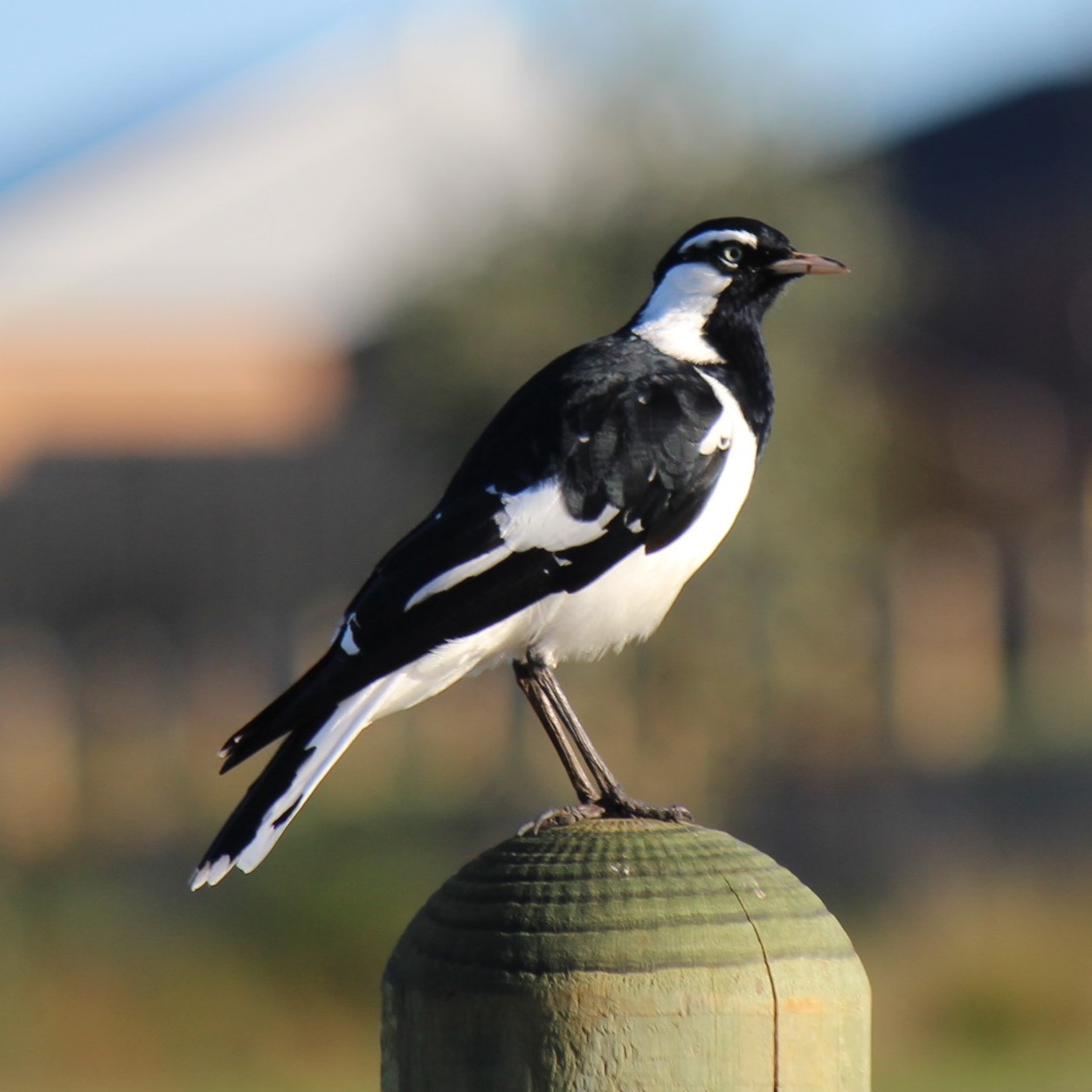
Magpie-larks Grallina cyanoleuca, are common enough, often found stalking the verges in pairs making a sweet duet of calls. It is quite easy to pick the male from the female: the male has a black beard and strong white eyebrow. The female has a white face and throat. Males are bolder and for this reason, most of the photos I have of this bird are of the male. I have had to ask for help for a photo of a female.

Australian Magpie (Cracticus tibicens)
It is also more likely that magpie photographs will be of the male with its clear white back – whether the white is confined to the neck nape (as in the Black-backed form) or travels intact down to between the wings (the White-backed form). The rule of thumb is that the White-backed in Victoria is found south of the Dividing range and the Black-backed is found north of it. In Yea we can get both types, but black-backed is more common. See Ron’s post Evolution for more discussion on the different races.
In all the races of magpie, the female has the same pattern of white but her white is mottled, flecked with grey, less distinct.


In the Western race of the magpie found in Perth, the female’s mottled back takes a special form – it looks like a spray of diamonds on a black background.
‘

Learning the different details of our common birds helps us rediscover their beauty and wonder. Differentiating the sexes isn’t always quite so black and white.




 Focus On Fauna