Which came first…
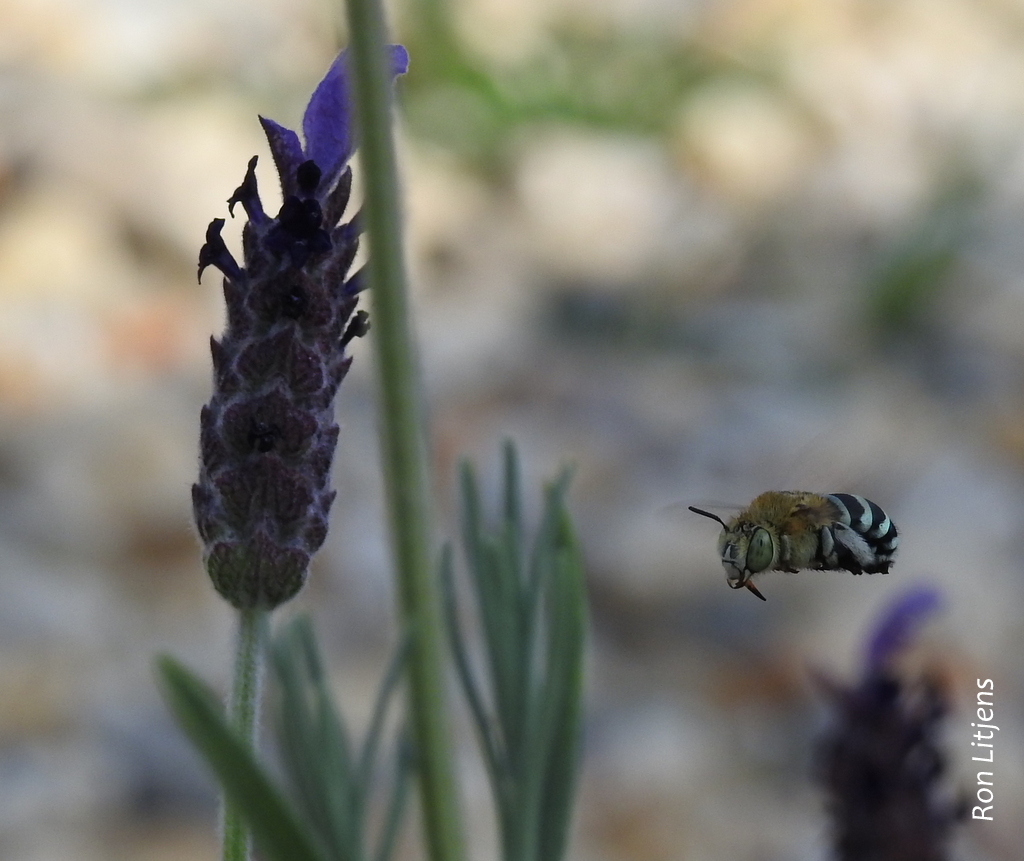
Flowering plants first occurred in the fossil record about 100 million years ago, at the same time that bees appeared. Theory says that the two co-evolved i.e. bees responding to changes in the flowers and vice versa. Today flowers come in all different shapes ranging from flat daisy-like flowers to tubular-like flowers of heath and correa. It is not surprising therefore that the insects that visit them have different adaptions to access the nectar and pollen.
One of the physical characteristics that distinguish bees from each other for example is the length of their tongues. Long-tongued bees have mouth parts designed for sipping, like through a straw. These bees are good at extracting nectar from deep throated flowers such as lavender and salvia. The Blue-banded Bee (Amegilla sp.), pictured above with its tongue protruding is a long-tongued Australian native bee. Short-tongued bees have mouth parts adapted more for lapping from flowers such as eucalypts that have a shallow nectar bowl.

Like bees, some flies are also good pollinators of plants and consume nectar from a range of flowers. They also have mouth parts adapted for different shaped flowers. Under the category of blowflies is a genus of fly called Stomorhina (from the Greek stoma meaning mouth and rhino meaning nose). They are commonly called Snout Flies or Nose Flies (pictured above) because of their long probosces.
These flies (pictured above) are often found feeding on the nectar of flowers and are effective pollinators. Due to the length of their probosces, they can access the pollen in tubular flowers that normal flies cannot -probably an evolutionary tactic as well.
It raises the age-old evolutionary question – Which came first – the flowering plant or the pollinator?




 Focus On Fauna