It’s in the name
A lot of fauna derive their common names from either the location where they are found or their appearance, or both, for example the Crimson Rosella, Blue-banded Bee, Eastern Yellow Robin. A few however are named after what they do. This is very useful when trying to look for them in the bush. With Spring almost upon us some of these ‘doing’ named critters are acting true to type.
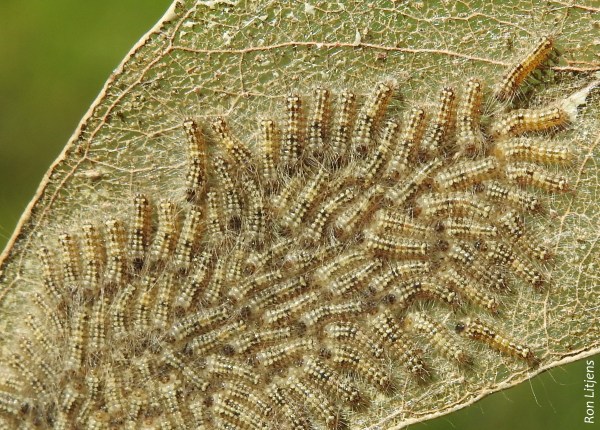 One of the most delicate artefacts one can find when walking through the bush is a perfect skeleton of a gum leaf with all the veins intact. It should be no surprise given the theme of this blog that one of the architects of this is the caterpillar of the Gum-leaf Skeletoniser Moth (Uraba lugens). The adult moth lays between 100 and 200 eggs, twice a year. The resulting caterpillars (see picture above) eat only the surface layer of a leaf on both sides before moving on to the next leaf, leaving the gum-leaf veins.
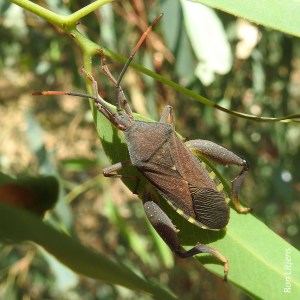 Another critter with a name suggesting its habit is the Eucalyptus Tip-wilter Bug (Amorbus sp.). These insects are Hemipteran i.e. equipped with sucking mouthparts for extracting sap. In Spring gum trees start to develop new shoots. Both the adults and instars of the Tip-wilter Bug attack these shoots extracting the sap and causing the new growth to shrivel and die.
I suggest we start renaming some of our local fauna. How about a ‘Destroying the windscreen rubber of your car’ Cockatoo and ‘Poo all over the patio’ Swallow.
Black cockatoo query
Recently the question was asked if the Strath Creek/Flowerdale area had ever been part of the home range of black cockatoos other than the Yellow-tailed Black Cockatoo Calyptorhynchus funereus.
A long term resident of the district recalls seeing what he assumed were the Red-tailed Black Cockatoo Calyptorhynchus magnificus over 50 years ago.
There are two types of black cockatoos in Victoria that have red markings on their tails the Red-tailed Black Cockatoo and the Glossy Black Cockatoo Calyptorhynchus lathami.

Glossy Black Cockatoo
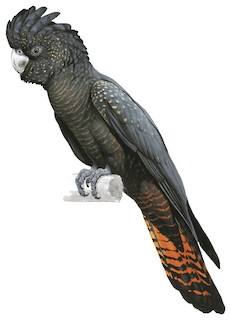
Red-tailed Black Cockatoo
Historically both species were more widespread in Victoria than they are now but these days both birds have a very reduced home range (See map below). However Strath Creek/Flowerdale would have always been outside the normal range of both species.
C. lathami are now usually only found in far East Gippsland and C. magnificus is restricted to the western part of Victoria.
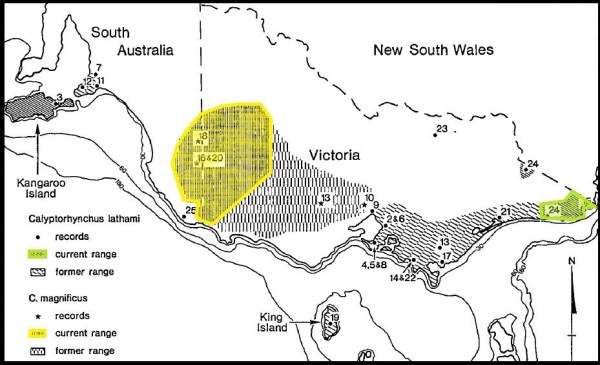
Occasionally C. lathami will still appear more westerly. This year for instance there have been sightings of them at Mt Macedon and even close to Melbourne in the SE suburbs around Dandenong and Frankston. Their recent movements are probably due to the fires that occured over large areas of East Gippsland. Other observations in recent years have also occurred in the Strathbogie Ranges.
In past decades it may not have been that unusual to occasionally see either of the species in the Strath Creek/Flowerdale district if their main feed plants were present.
A major part of the C. lathami’s and C. magnificus’ diet is the seed of sheoaks (Allocasuarina species) and the loss of these plants in the landscape is almost certainly the cause of the decline of both species in Victoria. Over the last few years UGLN have been including the drooping and black she-oak in many of our landcare plantings in an effort to increase the distribution of the plants and the wildlife that feed on the plants.
There are still a few remnant she-oaks in the district but logging, clearing for agriculture and browsing by stock, rabbits and feral deer have severely affected their ability to regenerate and these plants are now quite rare in much of the upper goulburn region.
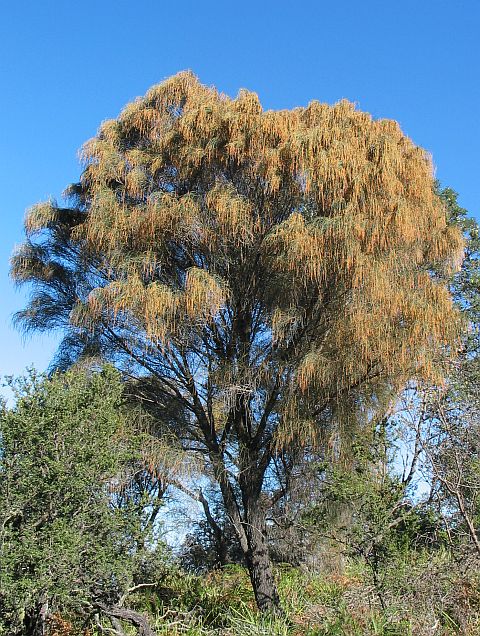
Drooping Sheoak Allocasuarina verticillata
If anyone has any old or new observations from the area about either of these two magnificent birds or sheoaks i’d be very interested to hear about them.
Email Chris Cobern: ugln.projects@ugln.net
The more things change…
Events of the past week sent me up the hill to the bush block to find some peace and quiet to ponder and try and make sense of it all. I had not been up there for a while. The need for reliable phone coverage and internet to sort out the current administrivia of my life had kept me in town for too long.
 Even before I got out of the car I was greeted by an old friend. This male Superb Fairywren (Malurus cyaneus), pictured left, immediately appeared and took up the battle where he had left off months ago (it may not be the same one), attacking the old nemesis – his reflection in the car windscreen and rear view mirrors. The bird finally flew away when I realise that waiting in the car for the assault to finish might have me waiting a long time. So I got out.
In nest box at the side of the house I was greeted for the tenth consecutive year by an Australian Owlet-Nightjar (Aegotheles cristatus), pictured below. It was obviously still confused as it had again taken up residence in the ‘rosella’ nest-box. Meanwhile not 20m away were two ‘Owlet-nightjar’ nest-boxes that have sat vacant now for 11 years.

 And in the bush the ‘acacia cycle’ was in full swing. There are eight acacia species on the property which flower in a specific sequence every year. The Cootamundra and Snake Wattle blooms were slowly fading, the Golden Wattle was in full flower and I know from past history which wattles will flower next and in what order. At ground level the appearance of Early Nancys signal the imminent arrival of the lilies. They are not called ‘early’ for nothing.
It seems that irrespective of how transient human affairs may seem to be, the predictable and reliable cycles of Mother Nature continue on. And there is a strange comfort in that.
Vale Macwake
Those who are regular readers of this blog will recognise the work of Macwake otherwise known as David Wakefield and Laurie Macmillan. Dave, Laurie and Bertram Lobert with the support of the Upper Goulburn Landcare Network set up the Focus on Fauna project in response to the 2009 Black Saturday bushfires. As well as active field-work Dave penned (and Laurie edited) the original Focus on Fauna blogs. Sadly David Wakefield and Laurie Macmillan passed away this week.
Much will be said in other forums about the impact they have had on the community at large and the legacy they have left.

Coonans Reserve working bee, December, 2018
From a personal perspective, I first met Dave and Laurie at a Strath Creek Landcare Group function just after I had moved into the district a week prior to Black Saturday. I immediately saw in Dave a kindred spirit. He was a gentle man with a love of the environment and a vast understanding of the natural world and the interaction of things in it. We ‘clicked’ immediately. Over the years Dave has been a mentor to me generously sharing this knowledge. In 2012 he invited me to contribute to the Focus on Fauna blog and together, until recently, the two of us maintained the punishing effort of publishing two blogs a week (one each) on all manner of fauna in our valley…nearly 700 in total. We also talked about the Focus project at venues across the state and it was Dave who first encouraged me to deliver talks on the animals that we had found, a creative outlet I have enjoyed ever since.
Focus on Fauna will continue true to the vision of David, Laurie and Bertram. The hole left by David and Laurie however is immense. I had so much more to learn from them but am grateful for what they shared.
Chapeau my friends. It has been an honour.
ronlit (aka Ron Litjens)
Nature or nurture?
The last blog introduced Nellie and Griff, two young ‘Attenboroughs’ who at our Landcare planting last week spent more time lying prostrate on the ground examining what lived at that level than they did walking around. It raises a very David Attenborough-type question ‘How did they become so interested in this stuff? Is it some inherent quality or did they learn it from the home environment? Nature or nurture?’ It prompted me to find a set of photographs which their mother, Cat, our Landcare facilitator gave me late last year for use in a blog (see below).
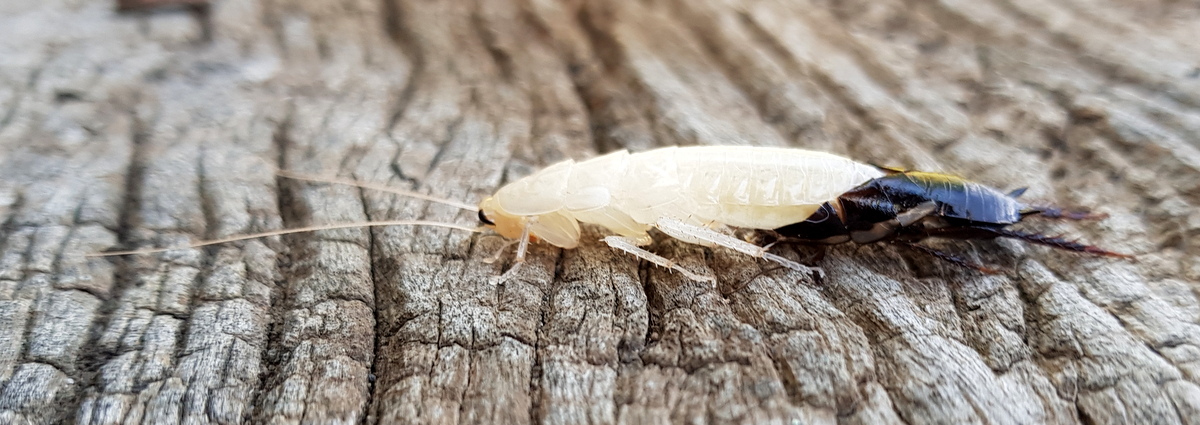
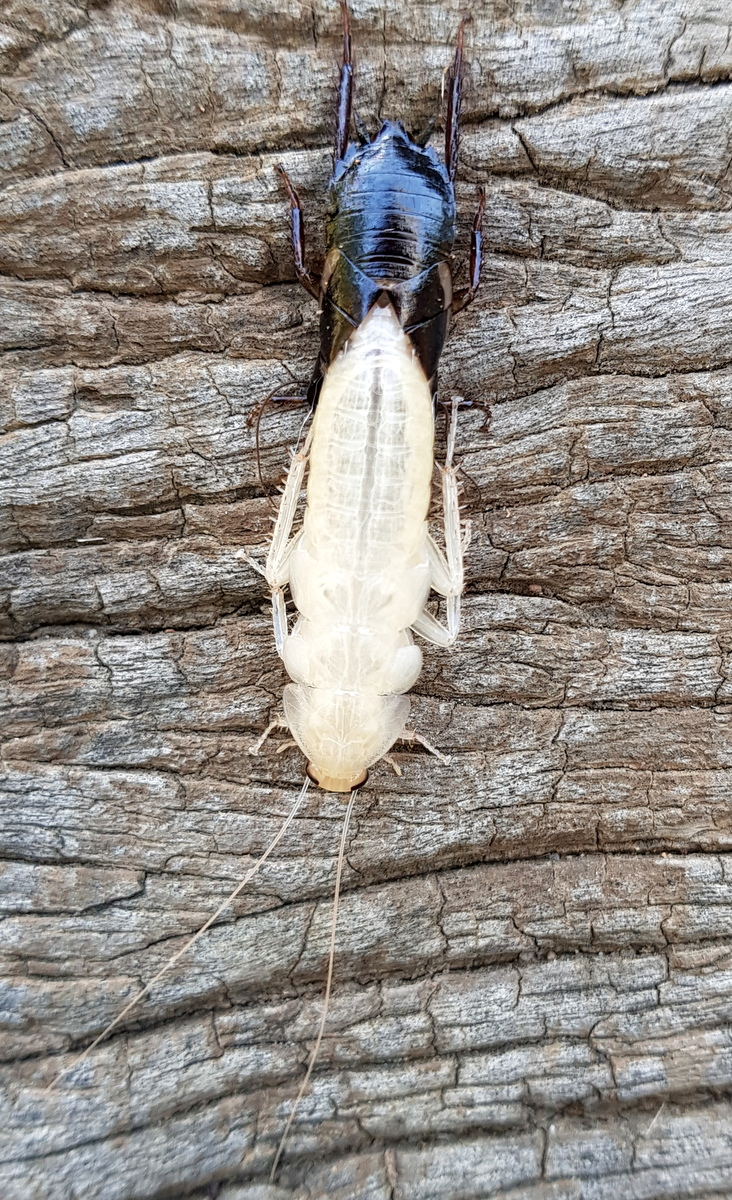 Most will associate the insect life-cycle as comprising four distinct stages – egg, larvae, pupa and adult e.g. butterflies. However many insects such as cicadas and dragonflies develop through three phases – the egg, nymph and then the adult. The nymph looks almost identical to the adult (but has no wings) and as it grows it goes through several moults where it casts off the old, small skin (exoskeleton) and develops a new larger one. This process of moulting is known as ecdysis. In the final moult the adult emerges complete with wings.
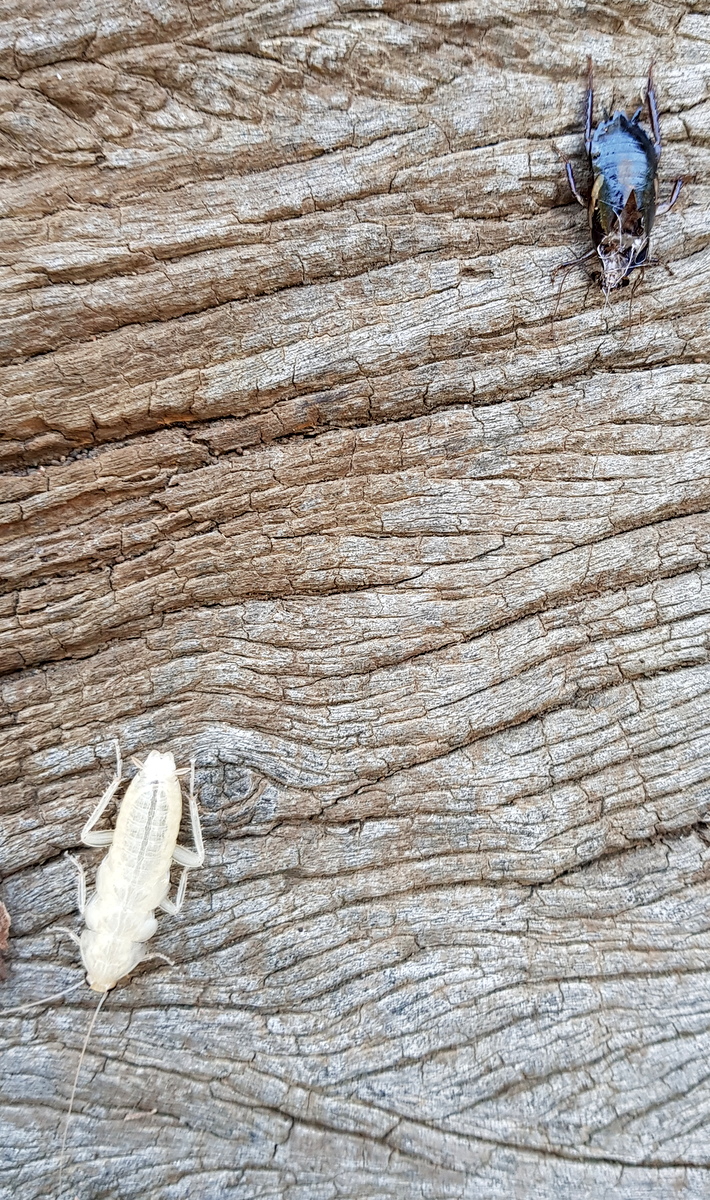 Cockroaches also develop by this pathway. Cat photographed a cockroach moulting in her wood shed. The emerging insect can be seen backing out of its old skin that is left containing all the features of the recently departed insect including the antennae. The new exoskeleton is initially soft but hardens when exposed to air. From the photo it is hard to tell if the emerged cockroach is the adult or one of the instars (a term used to describe a nymph during the lifecycle e.g. 1st instar, 2nd instar, etc).
And I suspect the answer to the title question is both.
Young Attenboroughs at large
Last weekend the Yea River Landcare group had its first official ‘Not National Tree Day’ planting event, held coincidentally on the day National Tree Day was supposed to be held. In line with the restrictions the planting was broken up into an AM group and a PM group, social distancing was maintained and some people wore masks (not mandatory at the time). Not the social occasion we have been used to in the past! Part of our group were two youngsters Griff and Nellie who initially were deployed transporting tree guards, stakes and plants to the required locations, but when that was done swiftly started searching the bush to see what they could find… Attenboroughs of the future.
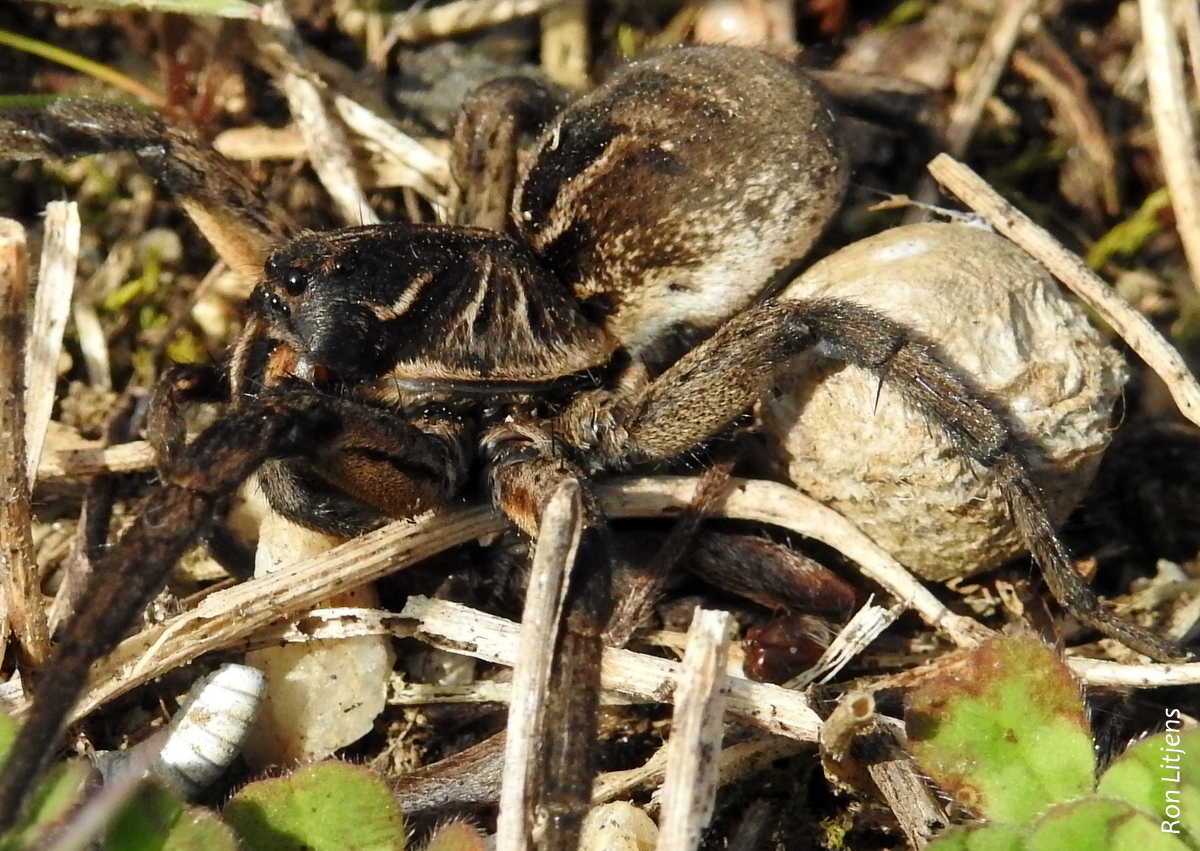
Their discovery of the day would have to be a Wolf Spider (pictured above) which had obviously been displaced by the planting activity and was trying to carry its egg sac to a safer place. Spiders lay their eggs in a woven sac of silk. For many spiders the sac is fixed either within the web or on vegetation, for example under bark. Wolf Spiders do not build webs. They are ambush hunters and can also chase and catch prey. Wolf Spiders are unique in that they carry their egg sac with them. The sac is attached by a line of silk (see photo) to the spinnerets on the abdomen. When walking the spider has to raise its abdomen so that the sac does not drag on the ground. After hatching, the young spiders spend several weeks clinging to the adult spider’s back…I should get the Young Attenboroughs to find that for me.
 The bush exploration also turned up a collection of grubs and other interesting things such as the sucked out shell of a much smaller Wolf Spider. Oh to have young eyesight again!
Garden perils
We are lucky enough to be living in Strath Creek during this pandemic so that when there is a break in the weather we can get outside to do some much-needed weeding in the garden. In the warmer months we keep a watchful eye out for wildlife, but in winter we tend not to be as aware, so that when one of the intrepid weeders took the next step to the left, it was a bit of surprise to see what was nearly underfoot – an Eastern (or Common) Brown Snake (Pseudonaja textilis), pictured below.
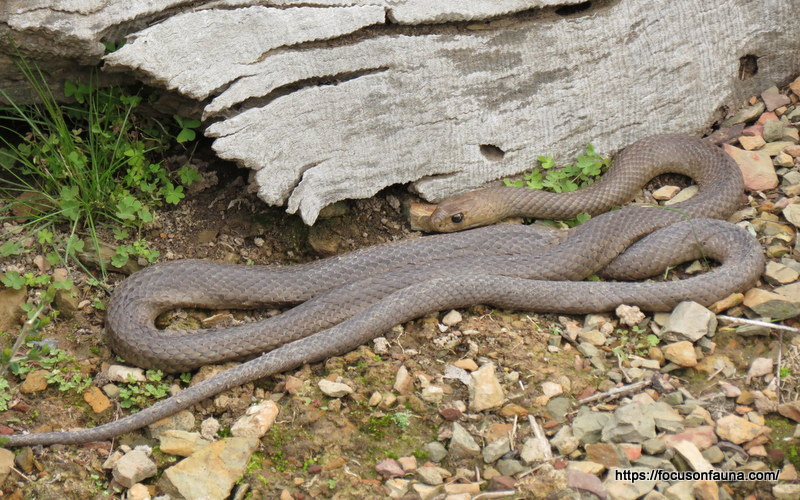
We took our camera out a day or so later to see if the snake was there again, and fortunately it was. By our reckoning it was probably about 1.4m long, although quite skinny. Usually you only see a brown snake as it heads away from you at lightning speed, but this one was much more relaxed, or sluggish, the temperature being a cool 14°C. Waiting conveniently until we had taken our photos, it slid ever so gently under the log where it seems to be living.
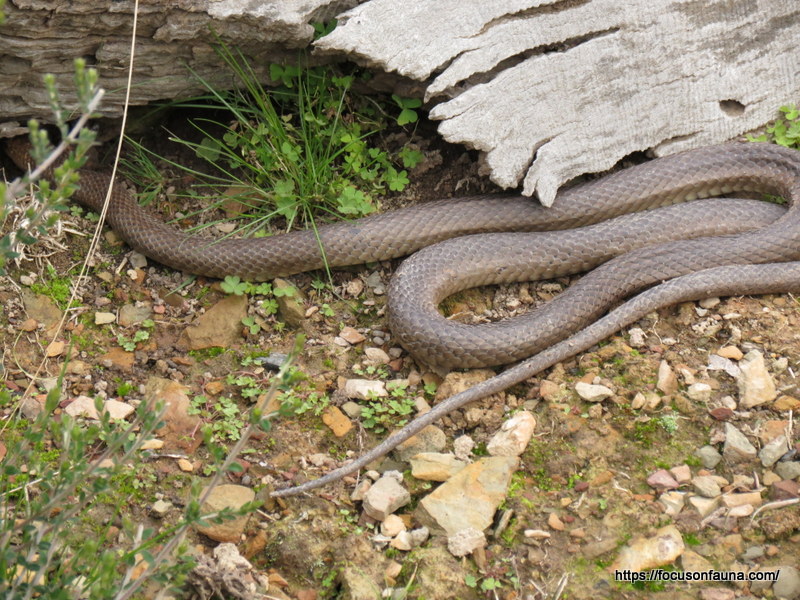
Going …

… gone
Some years ago we also saw an Eastern Brown out sunning itself at 9am on a frosty winter morning! So just be aware, COVID-19 may not be the only thing to avoid this winter, although we are actually quite accustomed to sharing our garden with the local snakes.
World Wide Web II
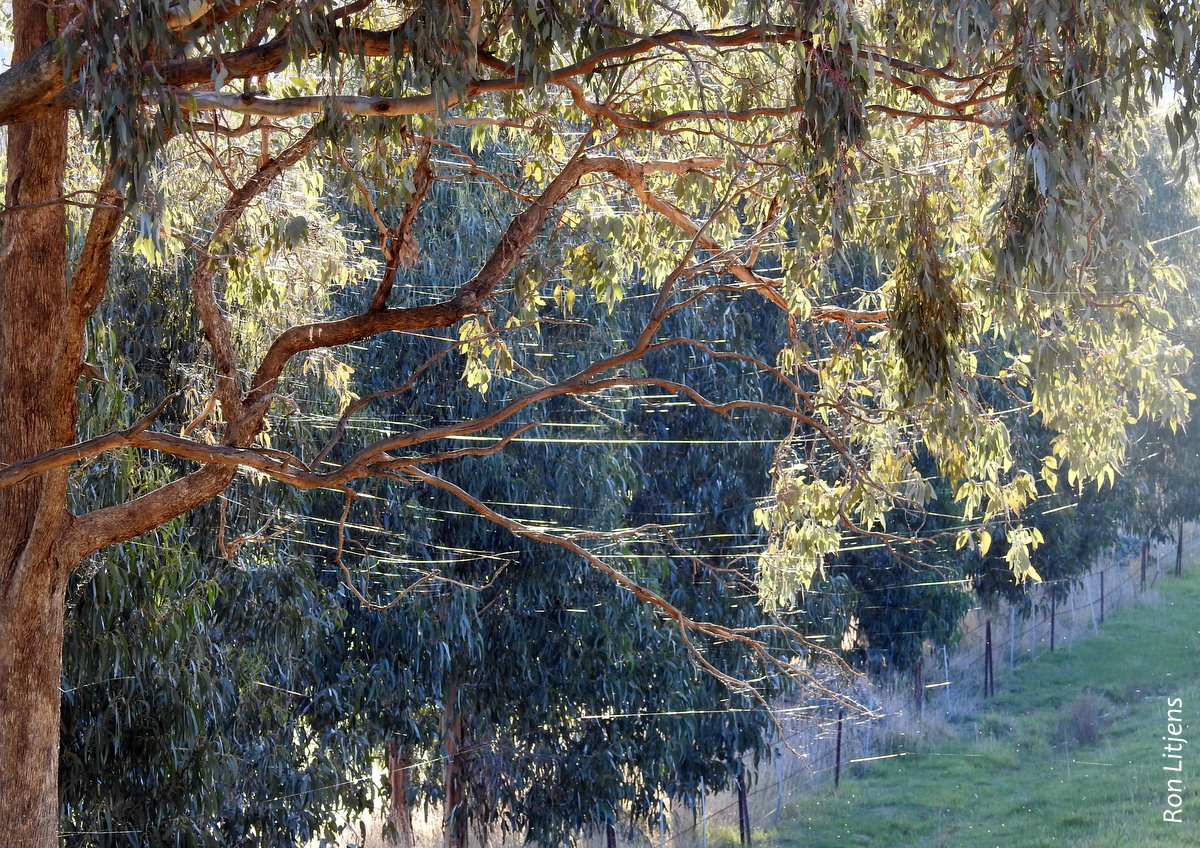 This is probably the first blog since we started in 2011 that has not featured a photo of a critter. But you can certainly see where they have been. If you have been cycling or walking recently you would have felt it. Or if you have been driving when the sun is just at the right (correct) angle you maybe would have seen it – silk streamers festooned on everything. Not just one or two but thousands, dare I say millions of them (pictured left). One of the sources of this phenomenon is spiders. A previous blog (Keeping the wolves from your door) featured Wolf Spiders and mentioned that the young spiderlings disperse by releasing a strand of silk into the breeze and ‘ballooning’ away. Now is that time.
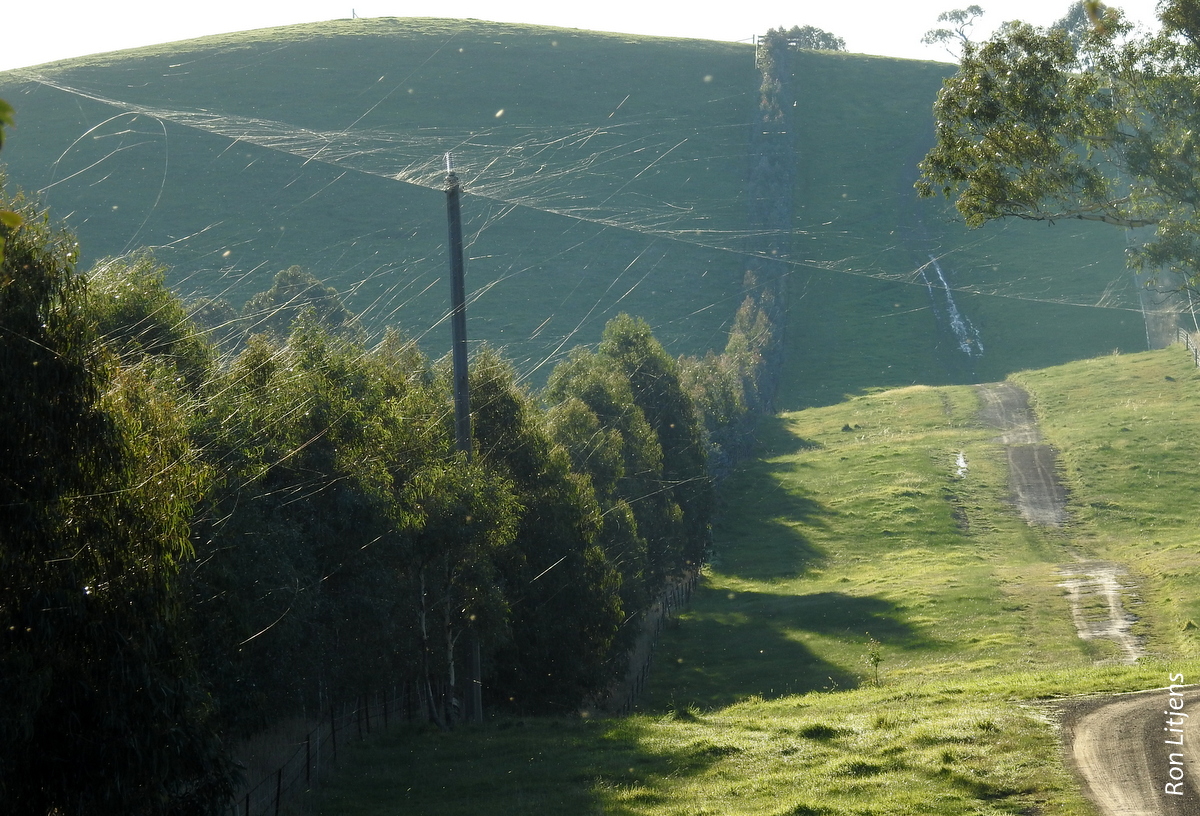
Recent studies have shown that simply releasing a silk strand into the breeze does not provide the required lift to float the spider away. Spiders use the earth’s electric field to get the required lift. When released the silk strand picks up a negative charge, the same as the surface on which the spider is sitting. This creates a repulsive force. In addition the air is positively charged. Spiders can detect these electric fields using sensitive hairs on their bodies and the electrical repulsive and attractive forces assist them to get airborne on their silk streamer. It is an effective way to disperse. Spiders have been found many kilometres in the air, and thousands of kilometres out to sea.
In these times of restricted air travel and climate change denial, the invertebrate world seems little fazed and is travelling using renewable energy.
Rose Hillers
 Crimson Rosellas are a dime a dozen at our place – permanent residents that have been recorded, usually in quite large numbers, for every month of the twenty years that we have been keeping records. Not so their close cousins Eastern Rosellas, which although fairly common usually make only a fleeting appearance and are much more wary. So it has been pleasing that recently a group of four Easterns has been regularly spotted here on our COVID-19 lock-down walks.

The Eastern Rosella is the “original” rosella, whose name has an interesting back story. They were a common sight to the early colonists (or invaders, depending on your viewpoint) around Rose Hill (now Parramatta) west of Sydney. So they became known as Rose Hill Parrots, shortened to Rose Hillers and subsequently Roselle and eventually Rosella, by which sole name it was known for some years – the Crimson Rosella in those days being known as Crimson Parrot among several other early names. [Ref. Ian Fraser and Jeannie Gray, Australian Bird Names (2013)]
Other early names for the Eastern Rosella included Rosehill Parrakeet, Common Rosella, Rosy, Red-headed or White-cheeked Rosella and Nonpareil Parrot, aptly describing as “unequalled” the bird’s amazingly coloured plumage.

Due to their continual wariness, the few photos we managed to take have been front-on and fail to show the wonderful contrasting patterns on the back of the bird, which can be seen on the photo at right taken by David Francis, NatureShare.
Every toadstool’s a stage
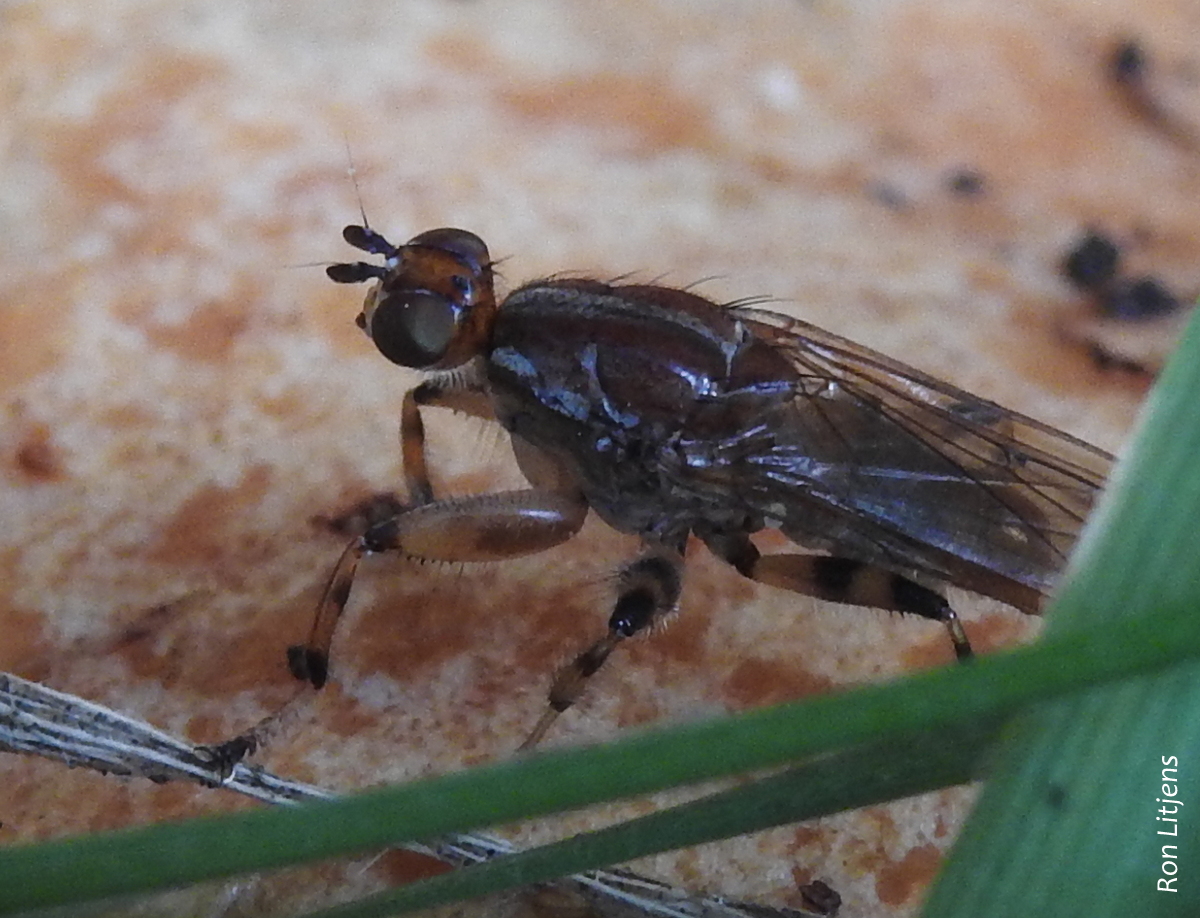 For Fungus Flies (Tapeigaster sp.), pictured left, all of life’s dramas are carried out on the surface of a mushroom. The mushroom represents a combat zone, boudoir and nursery. The wet start to autumn means there are mushrooms a-plenty and hence heaps of drama for the flies. Australia has dozens of native Fungus Fly species and several introduced ones. They all live in the cool temperature south east of the continent.
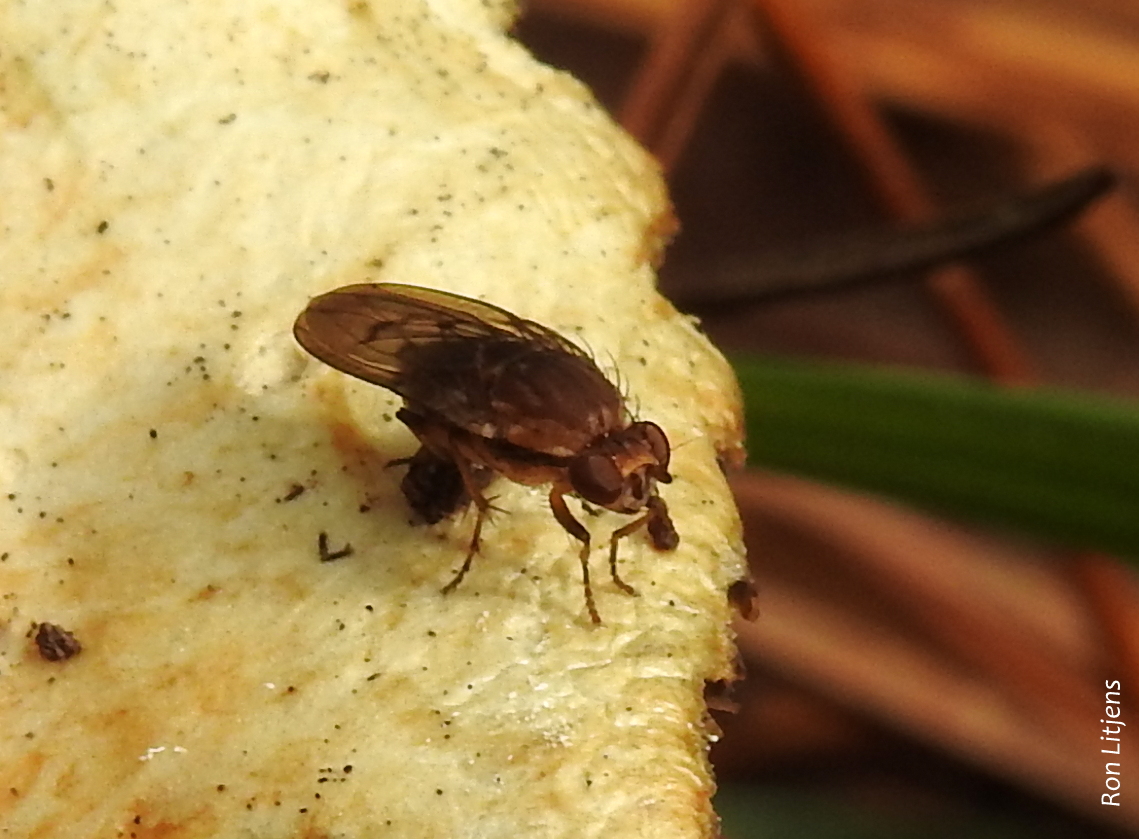 For the males in Fungus Fly world the chances of mating depend on the attractiveness of the mushroom you ‘own’. A male fly will patrol the perimeter of its mushroom to ward off any male intruders. Ownership disputes are settled by a boxing match. Each male will raise its front pair of legs and ‘box’ the other until one of the combatants gives up and flies away.
If the male is successful in attracting a female mating occurs on the mushroom and soon after the female fly lays eggs (pictured above right) in the mushroom. The resulting larvae rapidly consume the mushroom leaving it as a heap of ooze in a matter of days.
There is a twist to the tale however. Like all flies, after mating the male and female fly off leaving the young to fend for themselves. This leaves the maggots vulnerable to predation if they venture too close to the surface of the mushroom. Pictured below is an ant carrying off a Fungus Fly maggot for dinner, either for itself or its young.
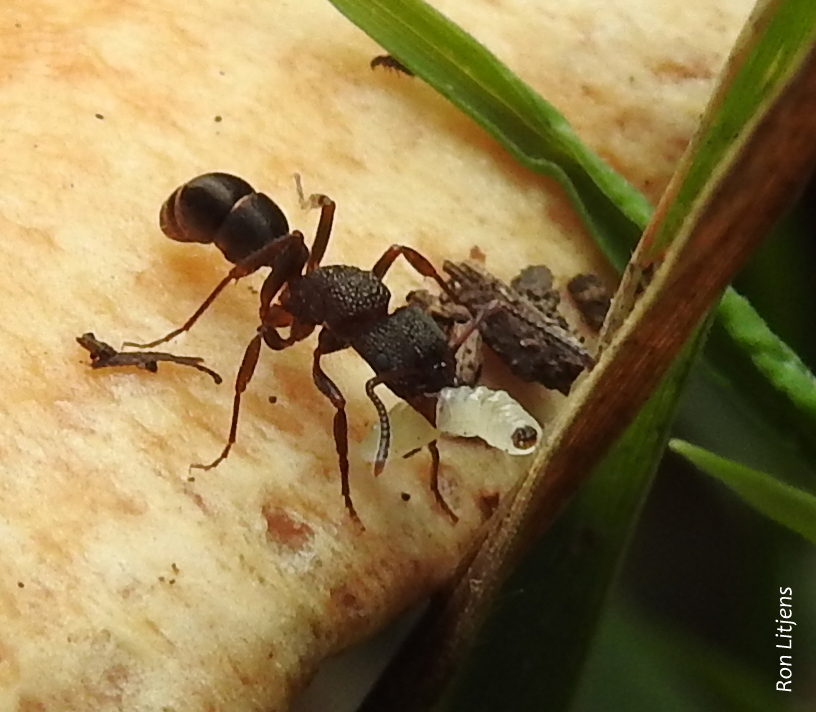
It’s life and death drama on the mushroom stage.




 Focus On Fauna