World-wide web
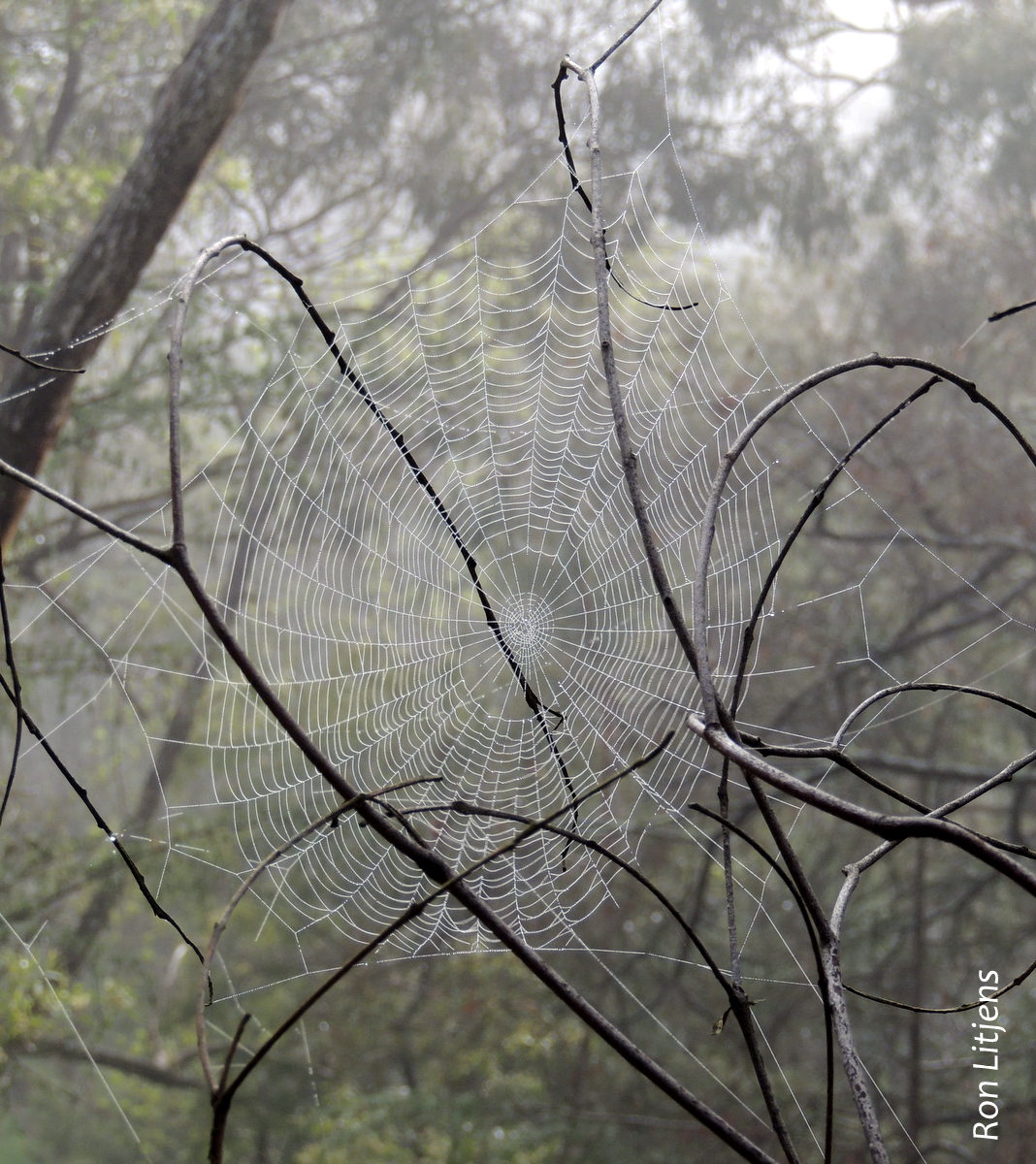 For most people the stereotypical spider web is the flat wheel-like structure seen suspended between bushes or on fences (pictured left). These are constructed by a group of spiders known as Orb-weavers, in English the word ‘orb’ infers ‘roundness’. These spiders are found all over the world. As with any large group of fauna there are no strict rules – not all orb-weavers build orb-shaped webs and there are some spiders that are not orb-weavers that do build orb webs (it’s not the web that defines the spider!).
The orb-weaver builds the web by floating silk in the wind from one point to another. From the middle of that strand it repeats the process. These strands radiating from the centre are not sticky and the spider uses these to navigate around the completed web. Once the radial structure is completed the spider walks around the web laying concentric circles of ‘sticky’ silk with which it catches prey. Many such spiders are nocturnal. During the day orb-weavers will sit camouflaged in the vegetation (see photo below). At dusk they will consume or dismantle the existing web and build a new one for the night.

Slender Leaf-shaped Orb-weaver (Araneus talipedatus)
 Like all spiders orb-weavers have eights eyes distributed as two rows of four, one row above the other. For orb-weavers the middle two eyes of both rows form a tight square configuration with the outer eyes being spaced further apart.
Orb-weavers exhibit a large variety of shapes, sizes and colours. In suburb gardens, Golden Orb-weavers (Nephila sp.), pictured right, are commonly seen orb-weavers. Those who go bushwalking during summer will be familiar with the webs of Spiny Orb-weavers such as the Australian Christmas Jewel Spider (Austracantha minax), below, which appear to cover every bush.
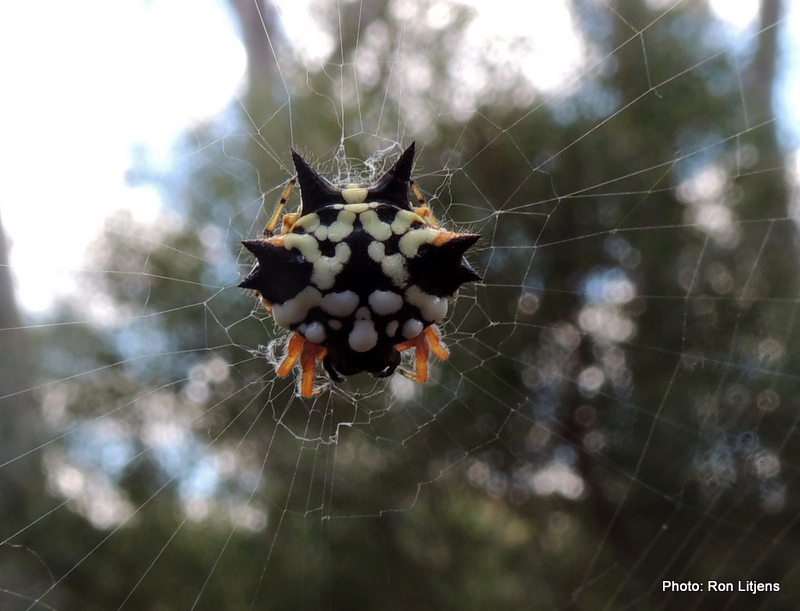 Orb-weaver webs are usually vertical and the spider sits with its head facing down. The male is much smaller than the female and mating is initiated by the male tapping the web to signify its presence – the arachnid form of Tinder!
The Robin Routine
 Some fauna like humans are creatures of habit. On my daily cycling trips I know what birds will be in what areas because in the right season they come back to the same spot. At the moment the robins are coming down from the highlands to winter in the district. It is a sure sign, if my fingers numbed with cold didn’t remind me, that winter is approaching. And every year they sit on the same stretches of fence line and ignore others.
First back, that is now, are the Flame Robins (Petroica phoenicea), pictured left. The scientific name comes from the Greek petros meaning rock, oikos meaning dwelling place and phoenicius meaning scarlet i.e. scarlet rock-dweller – a nod to the habitat where the type specimen for robins comes from, Norfolk Island.
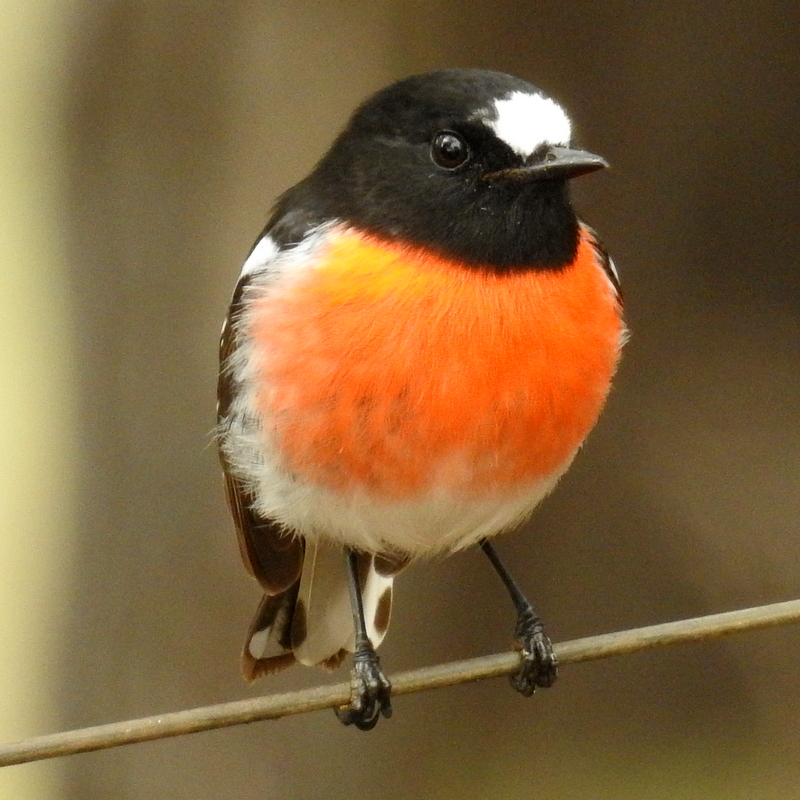 Robins usually roam the landscape as part of a mixed flock of birds. Later on in the season they will be joined by Scarlet Robins (Petroica boodang) forming a colourful and noisy group. At first glance the two species look identical but the Scarlet Robin is black (as opposed to grey), has a black throat and a large white flash on the forehead (pictured right).
At the moment the Flame Robins are mixing with Yellow-rumped Thornbills (Acanthiza chrysorrhoa) and European Goldfinches (Carduelis carduelis), pictured below. The latter, introduced residents to Australia, are found widely throughout Europe and Asia. I have not seen Goldfinches in these areas before.
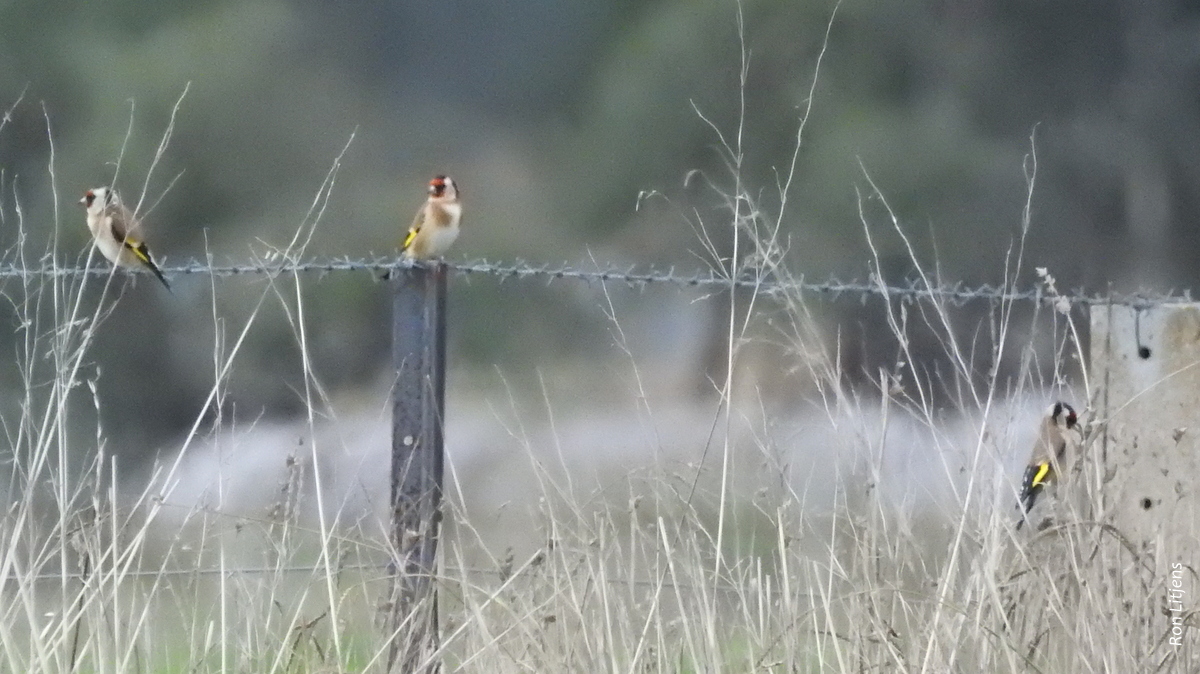
The bush is getting cosmopolitan (or over-run).
I got lucky
Autumn is the time of year when for butterflies the result of all that frantic summer mating becomes obvious. There is now an army of caterpillars marching across the landscape devouring vegetation. It is a relatively easy thing to identify a butterfly. Their colours and shapes are very obvious, the number of species in any district is limited and there are a number of excellent resources for identifying them. The chance of identifying a caterpillar however is more fraught.
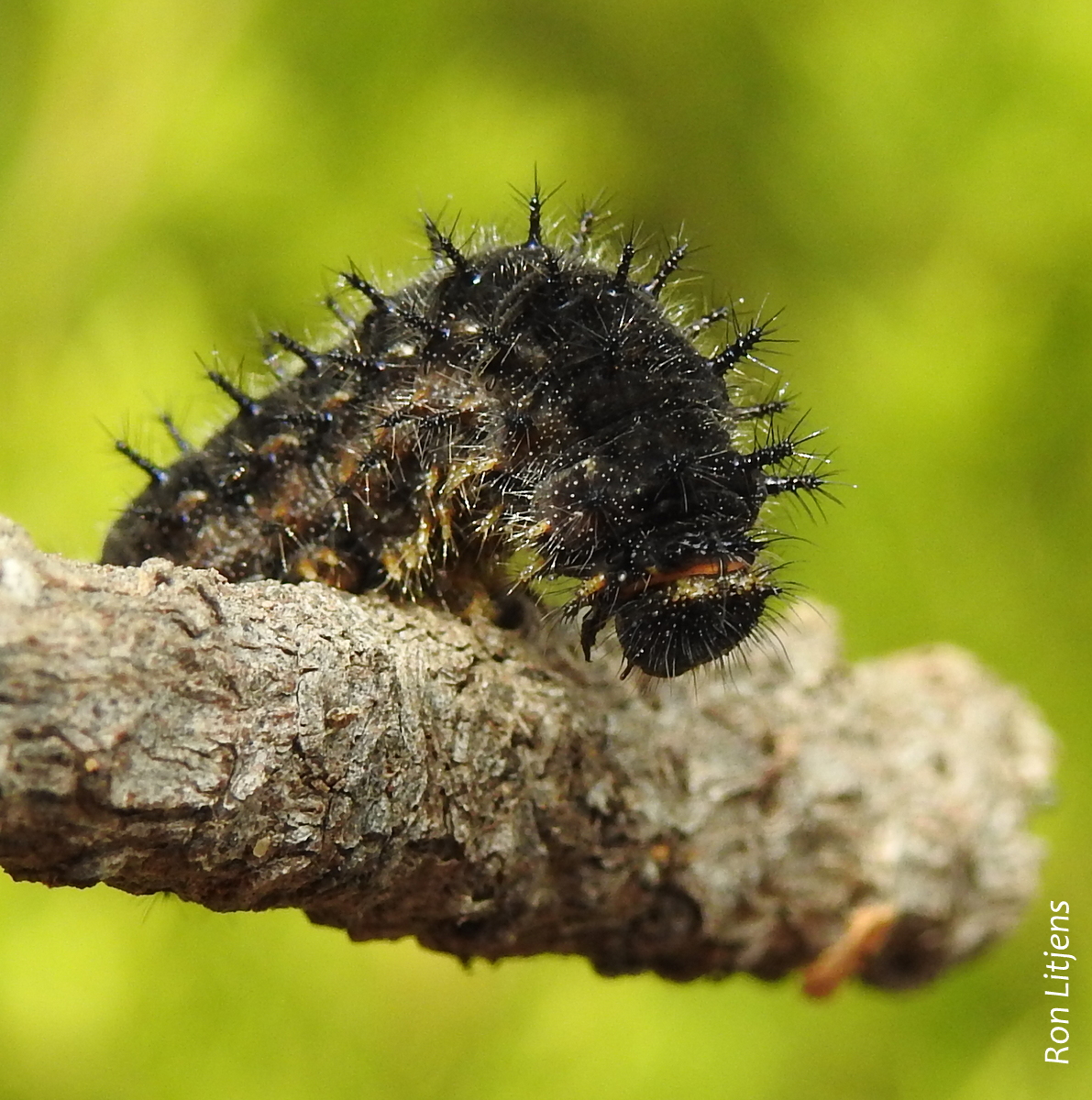
Yesterday I noticed an unknown caterpillar walking along a branch (pictured above). The difficulty in identifying it was that not only could it be the larva of a butterfly, it could also be the larva of a moth or not be a lepidopteran larva at all. So where do you start. For me, given it was a rainy Saturday morning I decided to go to one my favourite websites for butterflies and moths (http://lepidoptera.butterflyhouse.com.au) and simply scroll through the caterpillar pictures (not a very scientific approach I know).
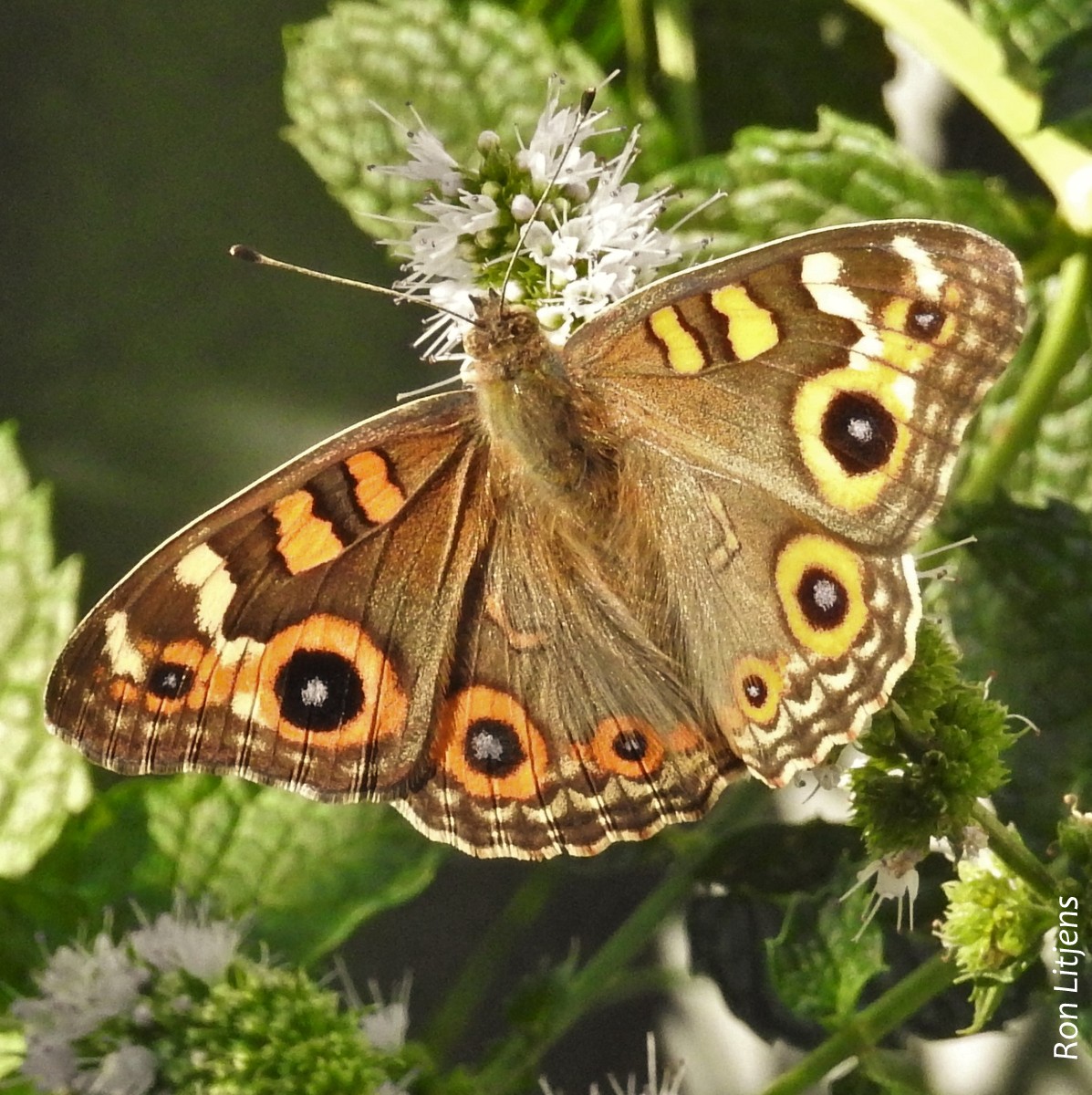 After several hours of fascinating photos I was about to give up and there it was – a Meadow Argus caterpillar (Junonia villida), a local species. The Meadow Argus is a butterfy of Australia and the South Pacific islands. Generally orange/brown in colour the wings have blue ‘eye spots’ used to frighten predators away. On the underside of the forewings there are also eye-spots used for the same purpose when the wings are in a vertical position.
As far as caterpillar id goes, I got lucky!
Keeping the wolves from your door
The current global situation has meant that I have much more time to cruise around photographing critters, and even more time to lie in wait for them. During a recent burst of gardening I found a hole in the ground and decided to wait and see what if anything appeared out of it (any excuse to laze away the day). Once the sun hit the entrance it wasn’t long before the resident appeared, a Wolf Spider. It took a further week of watching before I could get a shot of the whole spider outside of its burrow (see below) – stay-at-home protocols obviously also apply to spiders.

Wolf Spiders are one of the larger spiders in the district. They can be identified by their characteristic eye configuration (see previous blog) consisting of a bottom row of four small eyes with a top row of two large eyes facing forward and two smaller eyes facing backward. As previously mentioned they are ambush hunters rapidly chasing down prey along the ground from the burrows and cracks in the ground in which they live. And they are common. A walk at night in the bush with a torch will reveal a myriad of points of light reflected from the back of their eyes. Even divided by eight, it represents a lot of spiders.

A refugee from our recent burn-off
For those arachnophobes among us it may be hard to prevent these spiders getting close. The female spider carries the egg sac, and later the spiderlings, around on her abdomen. When the spiderlings are ready they send up strands of silk and disperse on the wind, often traveling large distances. A frightening thought? Think of them as an army of pest exterminators.
There she is at last
 Q: What do you call a Feather-horned Beetle without the feathery antennae?
A: Female
It has been a good season for Feather-horned Beetles (Rhipicera sp.). The males (pictured left) with their impressive antennae have been flying for nearly two months (not continuously!) using these antennae to detect females. Last month a blog about these amazing looking creatures finished with the line ‘My challenge this year is to take a picture of the female beetle’ as I had never seen one. The female beetles have more rod-like antennae.
 As the mating season draws to a close and the male beetles have all but gone I guess it is now safe for the female beetles to show themselves (pictured right) in public without being harassed because there are a few making an appearance.
Challenge complete.
Two metres up and feedin’ fine
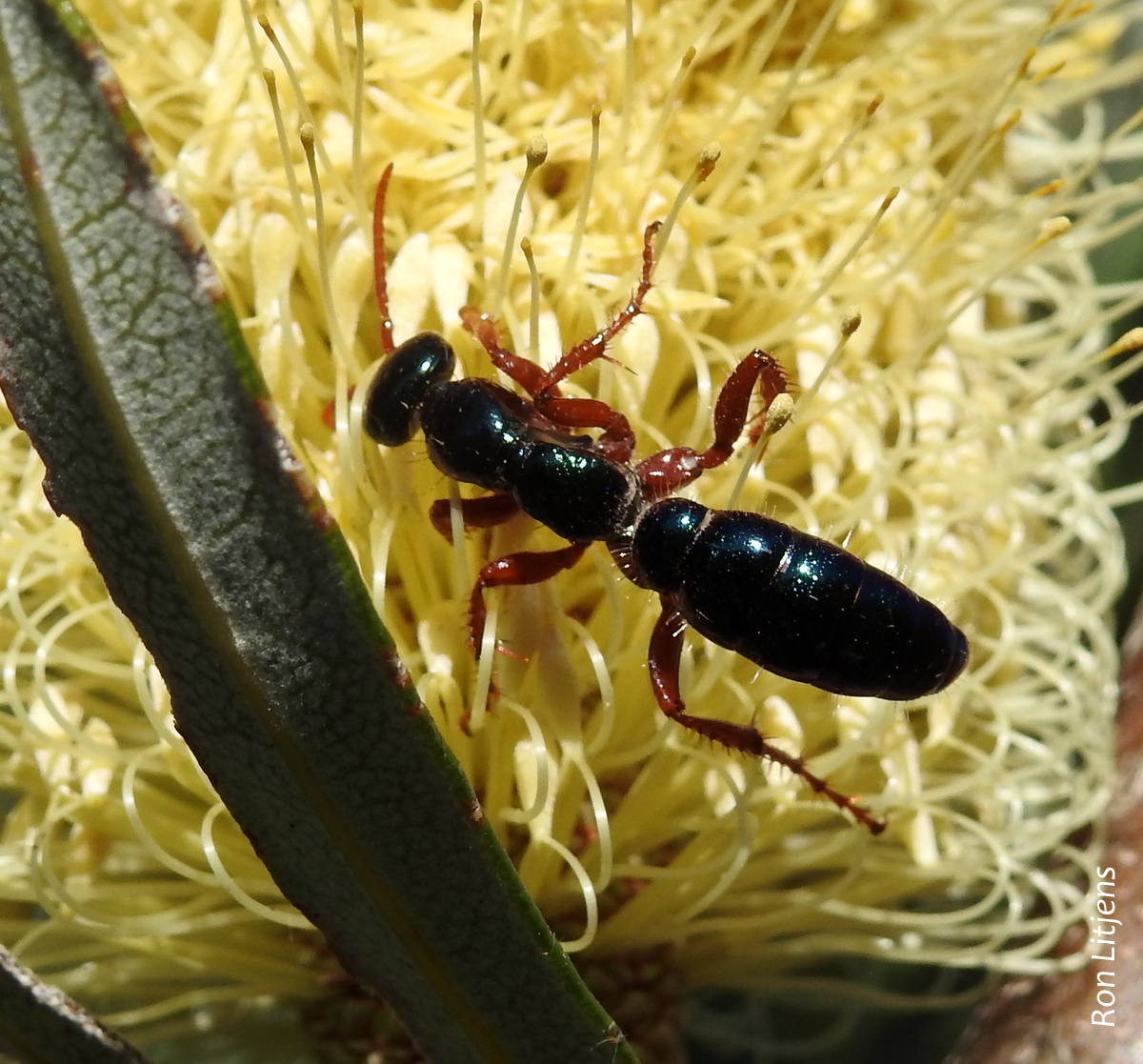 Last month a blog featured an insect known as a Blue Ant (Diamma bicolor). It is a species of Flower Wasp so called because like most female flower wasps it is wingless and it is metallic blue in colour i.e. it looks like a blue ant. Flower Wasps are known for their sexual dimorphism. The male is generally much larger than the female. The male is also winged. Adult wasps are nectar feeders. To feed, the female mates with the male wasp who flies off and carries the female into the higher reaches of a plant where it can feed and mate at the same time. In the case of the Blue Ant the female is much larger than the male and the recent blog questioned how the female wasp gets up to the flowers given the male wasp physically is not big enough to fly her to a food source.
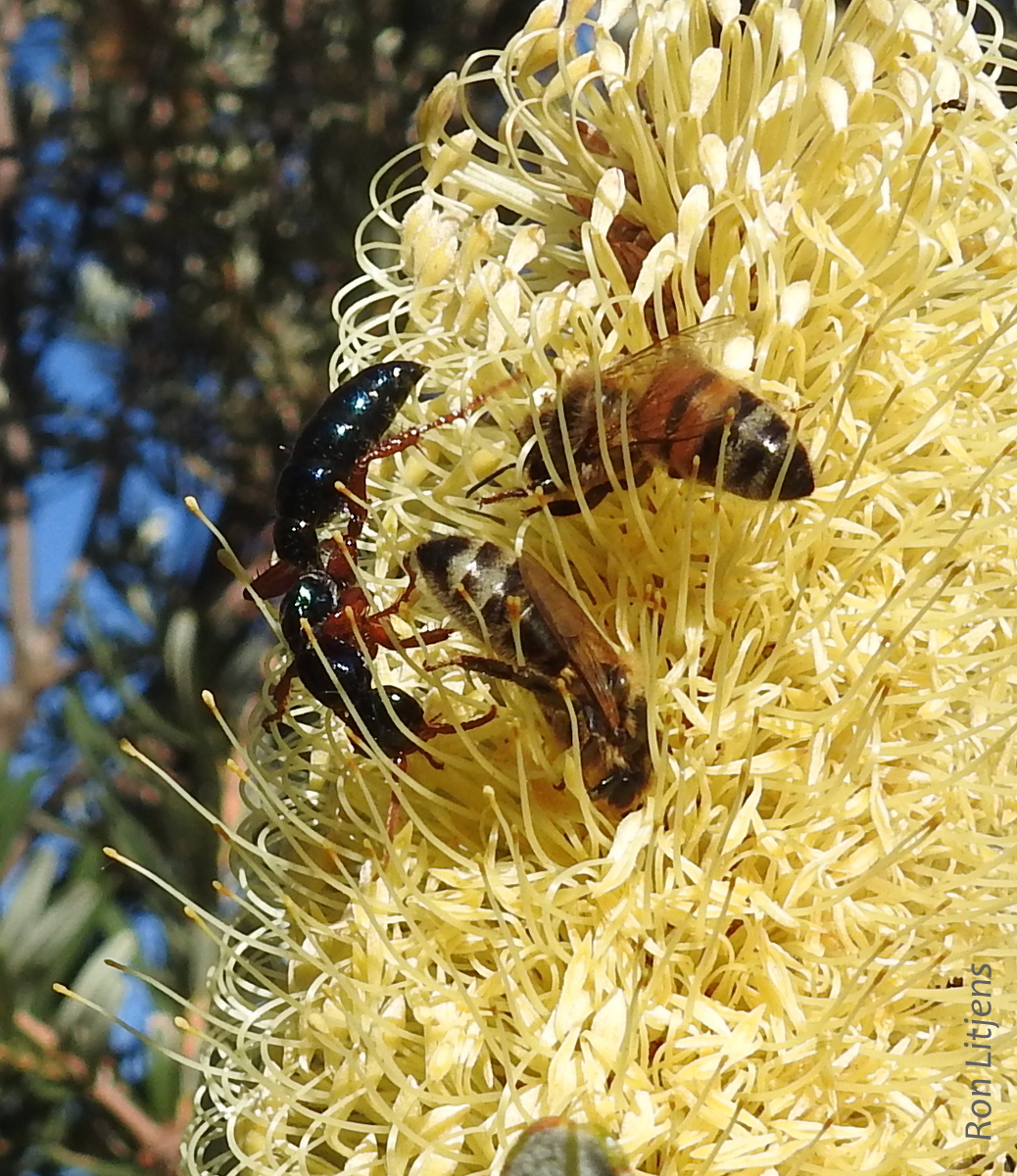 During a bird survey of a neighbour’s property I came across a Silver Banksia (Banksia marginata) in bloom. The flowers were swarming with pollinators. Lo and behold frantically dipping into the Banksia flowers with all the other bees, flies and beetles was a female Blue Ant (pictured). Although I did not see how it got there I assume it climbed the tree. The flowers were at least 2 m above the ground.
When last seen the Blue Ant had tangled with a Honey Bee and both had plummeted earthwards. I guess it has to climb back up.
Meet Mama
 By far one of the most interesting insects in the Australian bush is the psyllid. A psyllid, also known as a Jumping Plant Louse, is a hemipteran, a sap sucking insect. This blog is littered with tales about psyllids but they have been exclusively about the nymphs. It’s time to meet the parents.
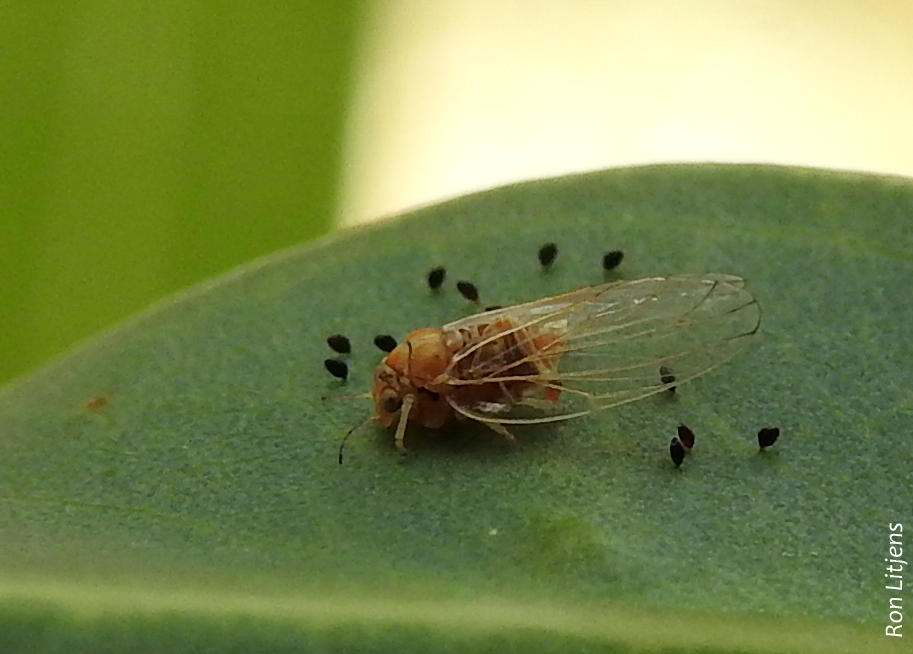
Adult psyllids (pictured above left) look like small cicadas and are about 3 mm long. They are winged but are poor fliers relying on the wind to transport them from plant to plant. After mating the female psyllid lays orange to brown coloured eggs on stalks, usually on the underside of leaves (pictured below). Most psyllid species are host specific, feeding on a small number of related plants. Plants such as eucalypts each have their own group of psyllid species. A psyllid may lay up to six generations of eggs in a year depending on the species.
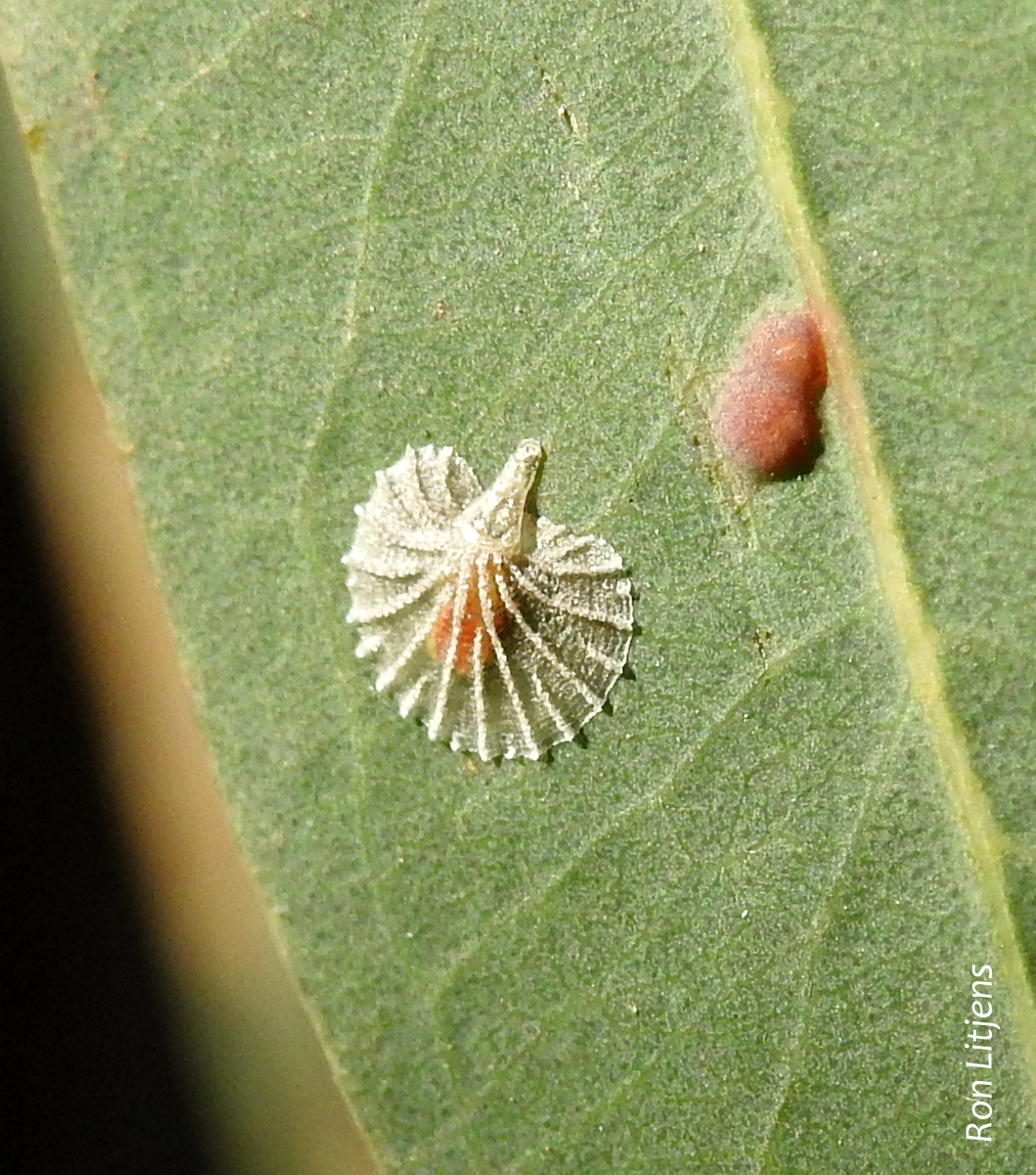 When the eggs hatch the emergent nymphs construct a protective structure made of honeydew and wax under which they live. This structure known as a lerp protects the nymph from predators and dehydration. Pictured left is a Lace lerp (Cardiaspina sp.) with the psyllid nymph underneath. Lerps can take many forms – conical pyramid, fairy floss, clam shell, etc. depending on the species of psyllid. The lerp in turn is a food source for birds such as pardalotes and bell miners and is an indigenous source of sugar. The nymph progresses through five stages before emerging as an adult.
 The nymph feeding causes local discoloration of the leaf where the sap has been sucked (pictured right). Though not fatal to the leaf or the plant an explosion in a psyllid population can cause widespread ‘browning’ of trees and stunting of growth. In natural environments psyllid populations are kept in control by predators and the availability of food.
Nice parents, destructive kids.
Magnificent moth
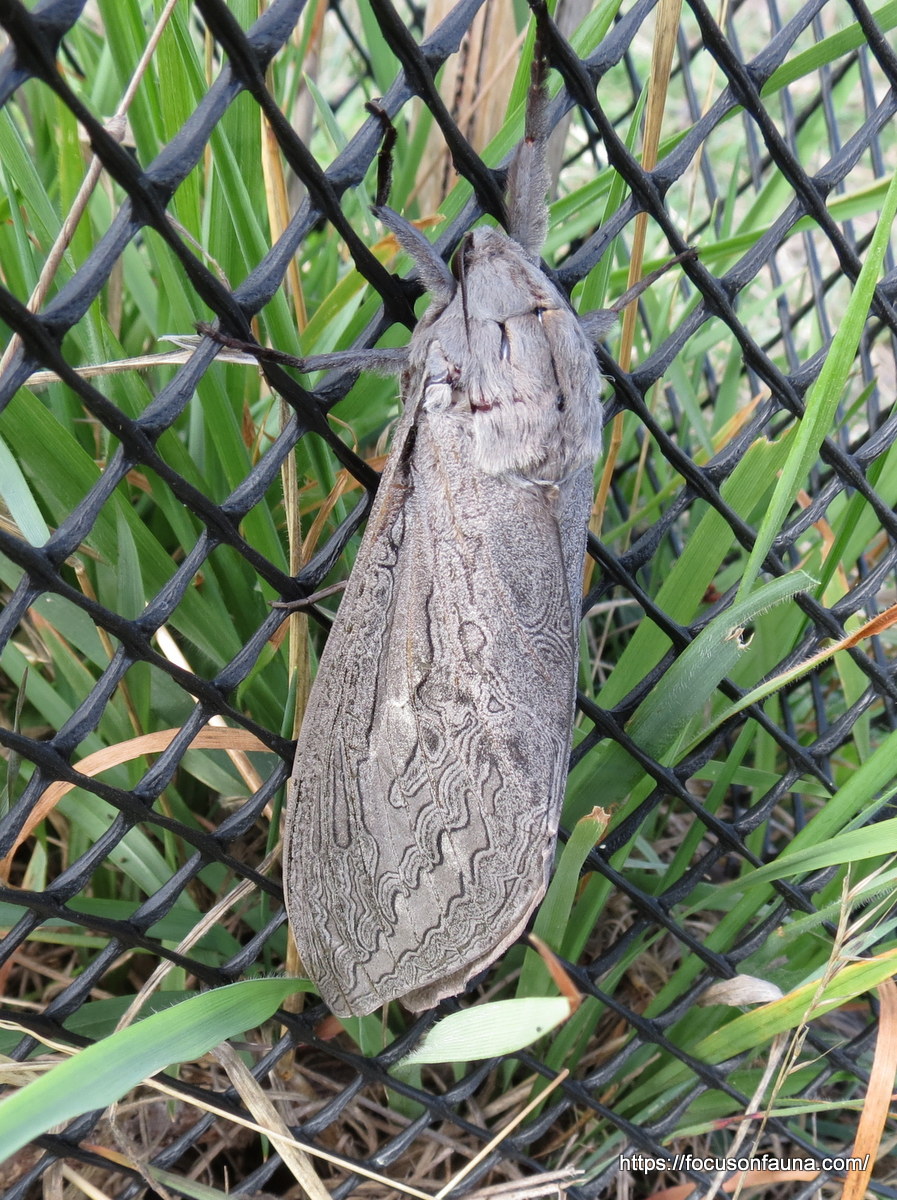 While checking for deer damage to our revegetation plantings, we came across this large and strikingly patterned moth clinging to a tree guard. Our moth guru Peter Marriott, author/joint author of the wonderful series of books Moths of Victoria, kindly identified it as a female Magnificent Ghost Moth, Abantiades magnificus.
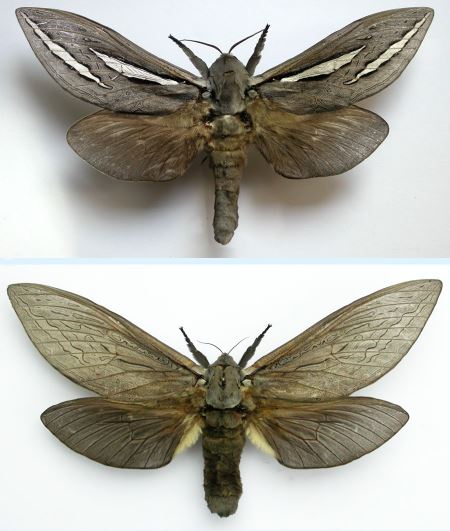
The Ghost Moth family, Hepialidae, includes some of the largest moths in Victoria, with females of one genus reaching up to 25 cm wingspan – the moth pictured at left would be about 16 cm across and the male a bit smaller at about 12 cm. The Ghost Moths are also known as Swift Moths or Rain Moths, as they often emerge from their pupal stage in the ground after rain. The larvae are commonly called Bardi grubs.
The Magnificent Ghost Moth pictured at right shows the male above and the female below. These images were reproduced with permission from Moths of Victoria (Part 6 Ghost Moth – Hepialidae and Allies) by Axel Kallies with Peter Marriott and Marilyn Hewish, published by the Entomological Society of Victoria 2015.
This was apparently the first sighting of this species in our area and the distribution map has now been altered slightly to include Strath Creek.
Sleek snake
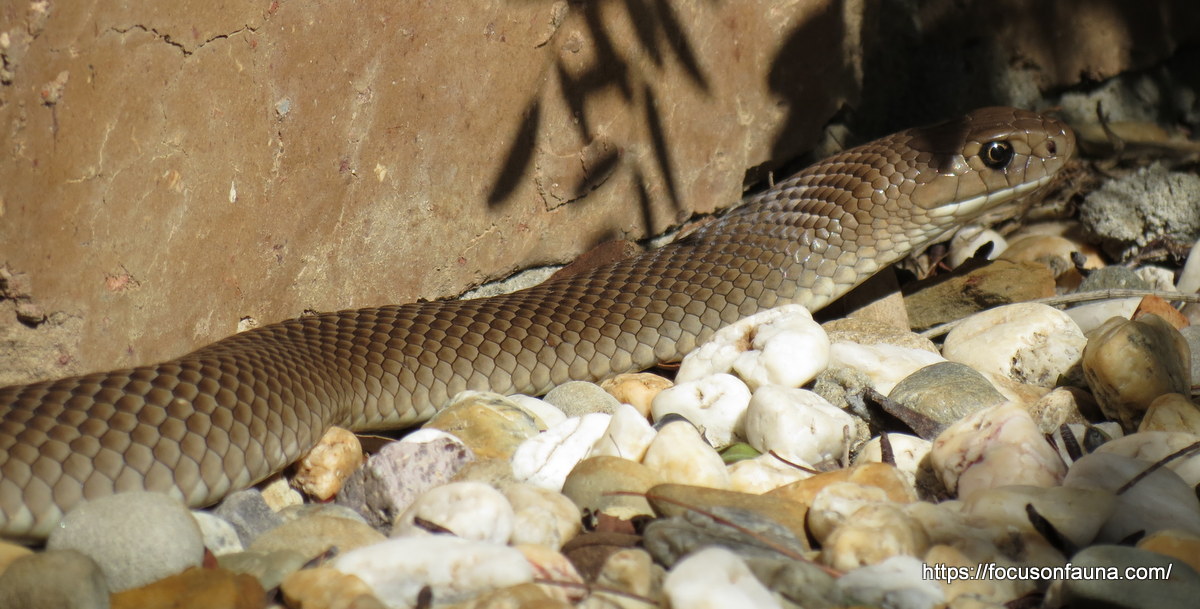
The sleek snake pictured here was sunning itself beside our chimney the other day. It’s an Eastern Brown Snake, Pseudonaja textilis, but from the photo you could perhaps be excused, from a quick glance, for thinking it was another snake occurring naturally in Victoria: the White-lipped Snake, Drysdalia coronoides. That is until you knew the length of the snake, which was at least 1.5 metres, about 3 times the maximum length of the White-lipped.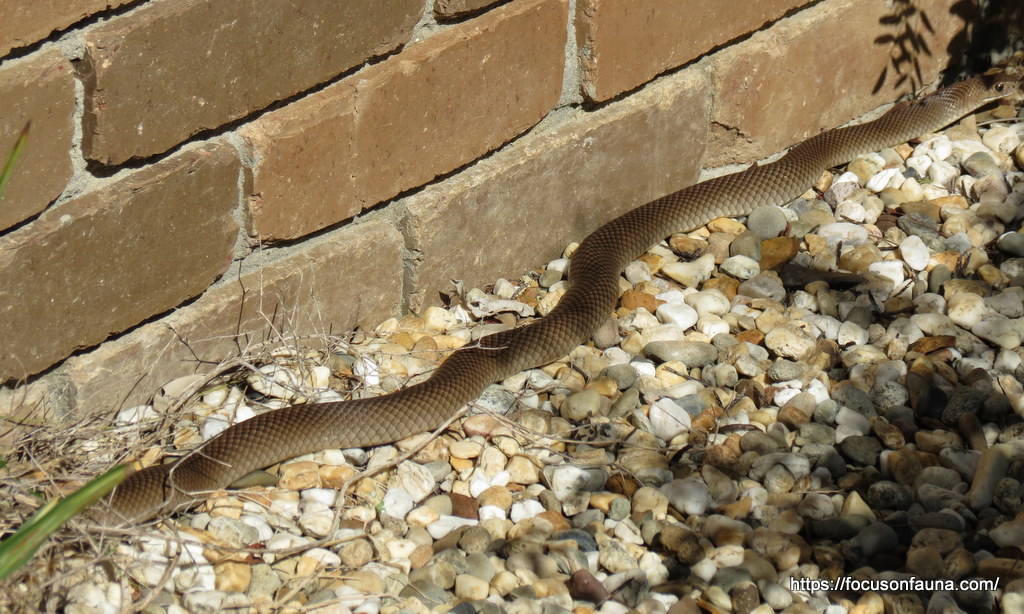
And while you might tread rather casually around a White-lipped Snake which, although venomous, is not considered dangerous, you certainly would be a lot more circumspect around this Eastern Brown, which is not only dangerously venomous but lightning fast and quick to retaliate when provoked.
The lesson being, don’t provoke any snakes – just appreciate their sleek beauty from a safe distance (and be thankful for a camera’s zoom lens)!
Friendly falcon
We have been enjoying watching our resident Brown Falcon, Falco berigora, hunting at the back of our property where it remains quite unperturbed even under close observation.
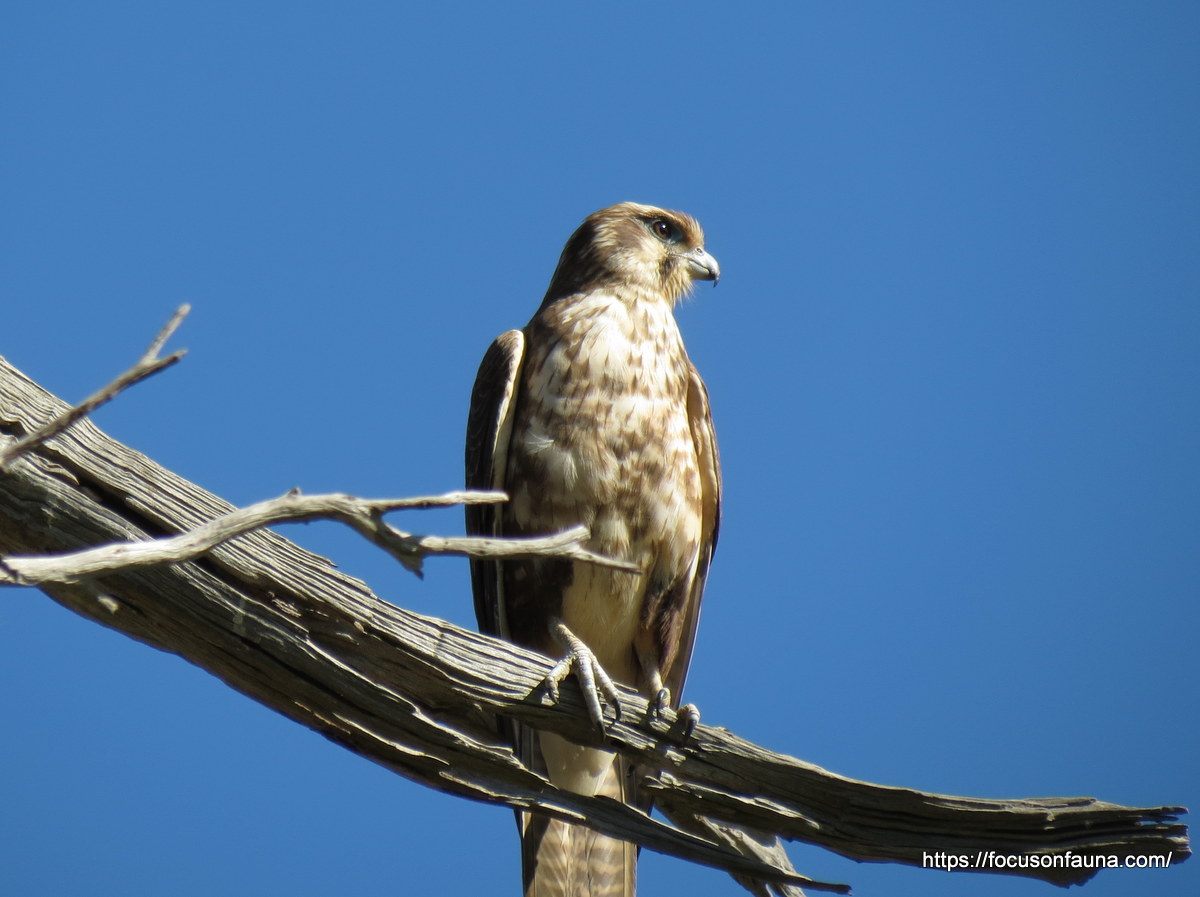
The Brown Falcon is not a typical falcon in its methods of flying and feeding. Its flight is rather slow and heavy and it is often seen perched in the open on a fence post or dead tree branch. It is capable of hovering, somewhat clumsily, but its most common hunting method is to scan the ground from its perch and glide down quietly onto its prey, which it grabs in its talons. We have also watched one running and hopping around comically on the ground, chasing grasshoppers. Unlike some other falcons, it is less likely to pursue birds in the air, although it is certainly capable of it.
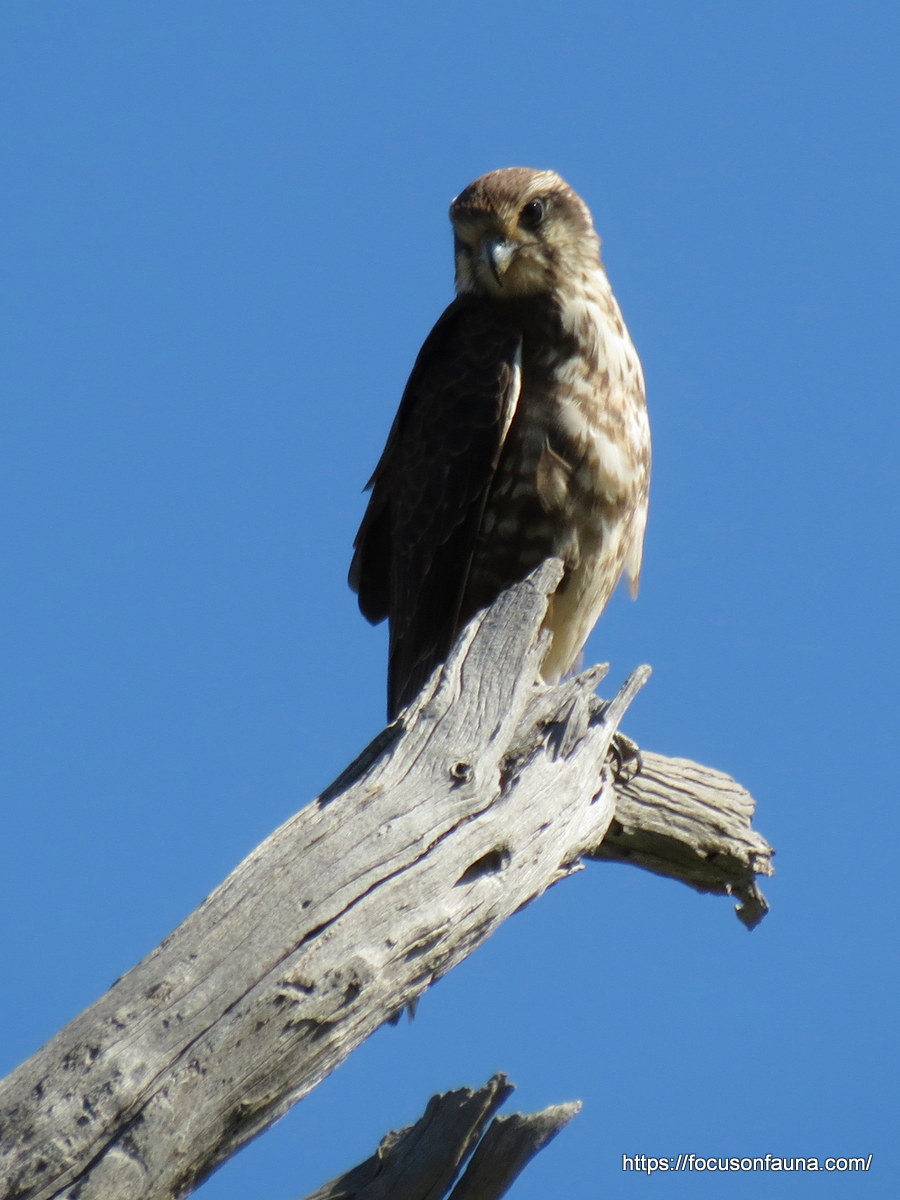
One of the most common and widespread of Australia’s raptors, the Brown Falcon is not always immediately identifiable due to its highly variable plumage, from a uniform dusky dark brown through mostly rufous, to brown above with whitish underparts, like the one pictured. The consistent giveaway for identifying this species is the facial markings, with a dark “tear drop” stripe below its eye and another dark patch on its pale cheek. It also helps to know that this is one of the noisiest raptors, with a characteristic cackling call in flight.

Not only is our falcon entertaining and quite tame, it is also performing a service by keeping some pests in check, hopefully including the occasional small rabbit!



 Focus On Fauna