Here comes another sucker
Insects of the order Hemiptera, those that have sucking mouthparts, feature regularly in Focus on Fauna. These include cicadas, tree-hoppers, psyllids and scale. Well here’s another one.
Pictured below are the nymphs of a planthopper, so called because their defensive reaction is to jump free of danger. Adult planthoppers look like triangular spikes, often green in colour, on the stems of vegetation. In reality planthoppers are camouflaged by the shape and colour and move slowly to avoid detection.
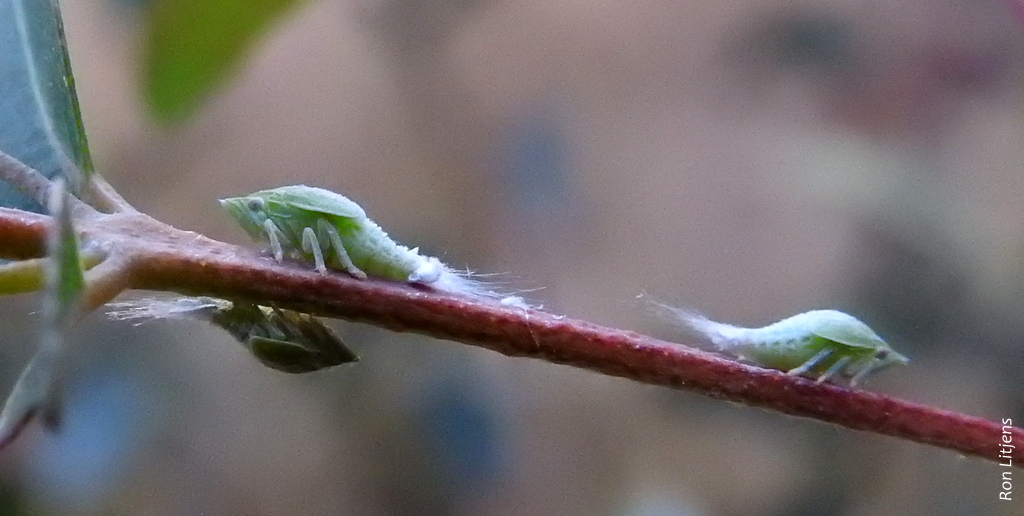
Like all hemipterans the nymphs progress through several moulting stages until they finally become adult. Planthopper nymphs extrude a wax from the abdomen (picture) that aids in concealing them from parasites or predators as the wax filaments can be spread out like a type of umbrella. It is also thought that because the nymphs do not have wings the filaments spread widely can act as a type of parachute if falling.
I had half a mind to call this blog Farting Fibre-optics.
… a snake’s belly
 A grisly and sad sight confronted local farmer Terry while out on his tractor on the Broadford-Flowerdale Road. A Red-bellied Black Snake (Pseudechis porphyriacus) had been run over by a vehicle and the impact had dislodged its stomach content – an Eastern Brown Snake (Pseudonaja textilis). The brown snake was about 3/4 the length of the very fat black which was estimated at just under 1.5 metres long.
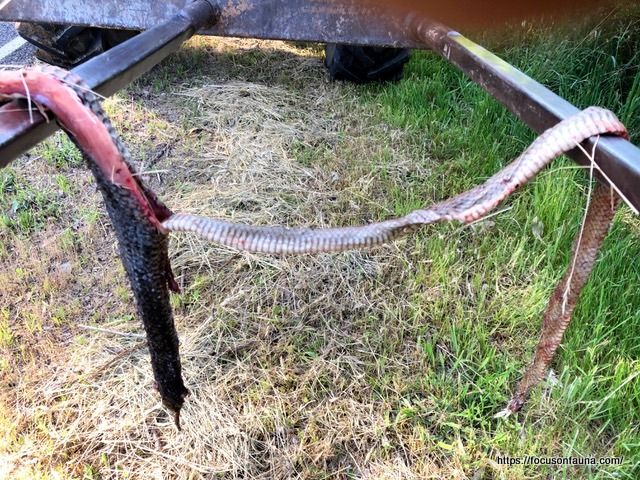
According to the Australian Museum, many Australian snakes eat other snakes as a normal part of their diet. The technical term for this is ophiophagy. True cannibalism – that is the eating of the same species – has also been observed in a number of snakes, including the two involved here. Many years ago we came across an Eastern Brown Snake with the tail end (1/2 a metre or so) of another of the same species trailing from its mouth. The half-coiled predator snake was shaking its head from side to side in an attempt to finish swallowing its victim.
The reverse of Terry’s encounter was experienced by Kay at Strath Creek back in 2014 when she watched, and recorded on video, an Eastern Brown Snake consuming a Red-bellied Black Snake. The dramatic video can be seen on a previous Focus on Fauna post Snake v snake.
There is still much to learn about snake diets, and chance observations like Terry’s, despite an unfortunate outcome, help to fill in the knowledge gaps. Citizen science at work!
It’s raining…beetles
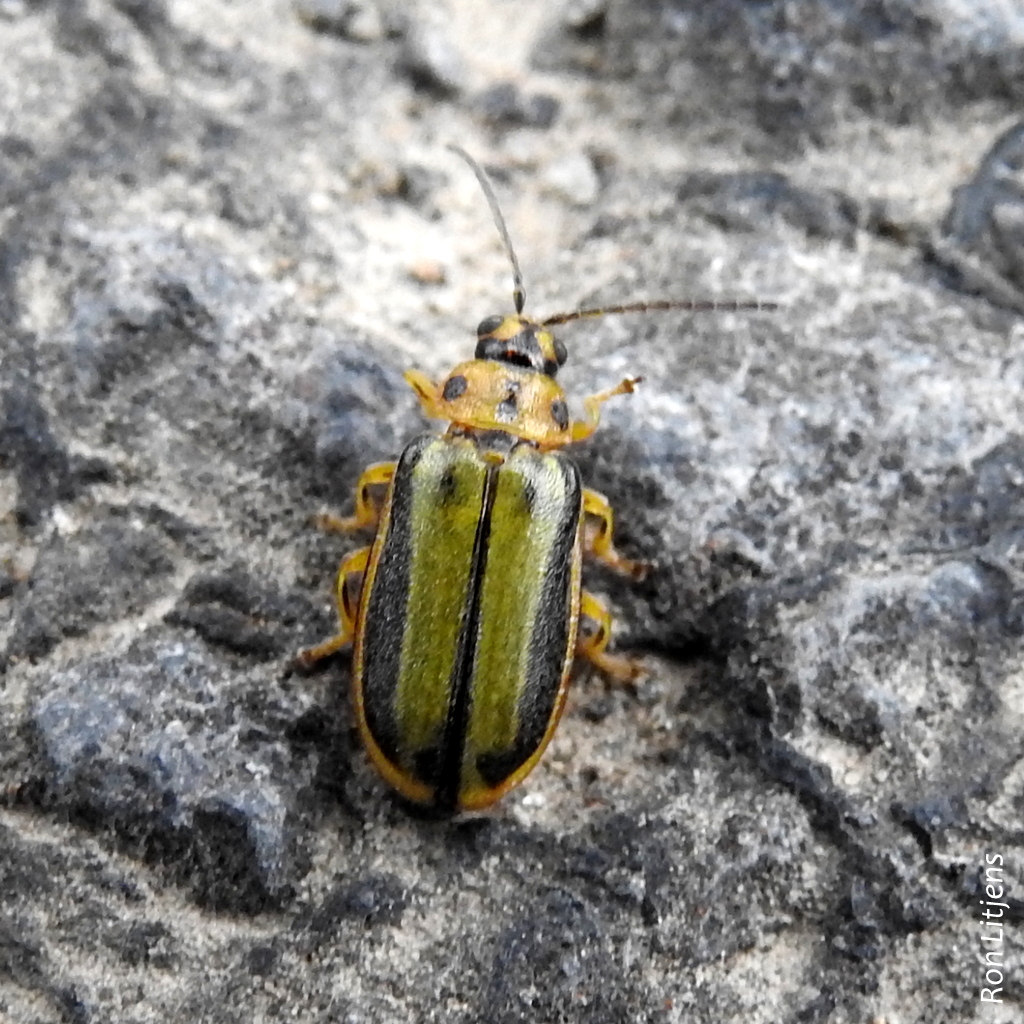 During a recent bout of windy weather I was out walking Mac (the Border Collie) when a violent gust of wind caused a lot of debris to rain down from a tree I was walking under. The tree was an Elm of some sort and the debris was hundreds of beetles, Elm Leaf Beetles (Xanthogaleruca luteola), pictured left.
Originally from Europe these beetles were accidentally introduced to Australia. The adults and their larvae (pictured below) can cause serious damage to Elm trees by skeletonising old and emerging leaves. The result is rarely the death of the tree but the tree can be severely weakened and made vulnerable to diseases such as Dutch Elm disease.
 As with many insect pests introduced into Australia, for example the European Wasp, in their native habitats cold winter temperatures kill off many of the insects thereby controlling the populations. However this does not happen in the milder Australian winters so the number of insects grows unchecked.
Unsurprisingly these beetles are of the same leaf-eating beetle family (Chrysomelidae) as the Eucalyptus Leaf Beetle in the previous blog.
It always amazes me how family members can look so different.
Excuse me. I thought you were a Ladybird
A combination of warming weather and fresh young eucalyptus leaves means the Eucalyptus Leaf Beetles (Chrysomelidae family) are not far away. These often highly coloured beetles are sometimes called Tortoise Beetles and are often mistaken for Ladybird Beetles because of their shape (pictured below). For those whose livelihood is growing plantation eucalypts the Tortoise Beetle is a pest as both the larvae and the adults eat foliage over a long period in the year.
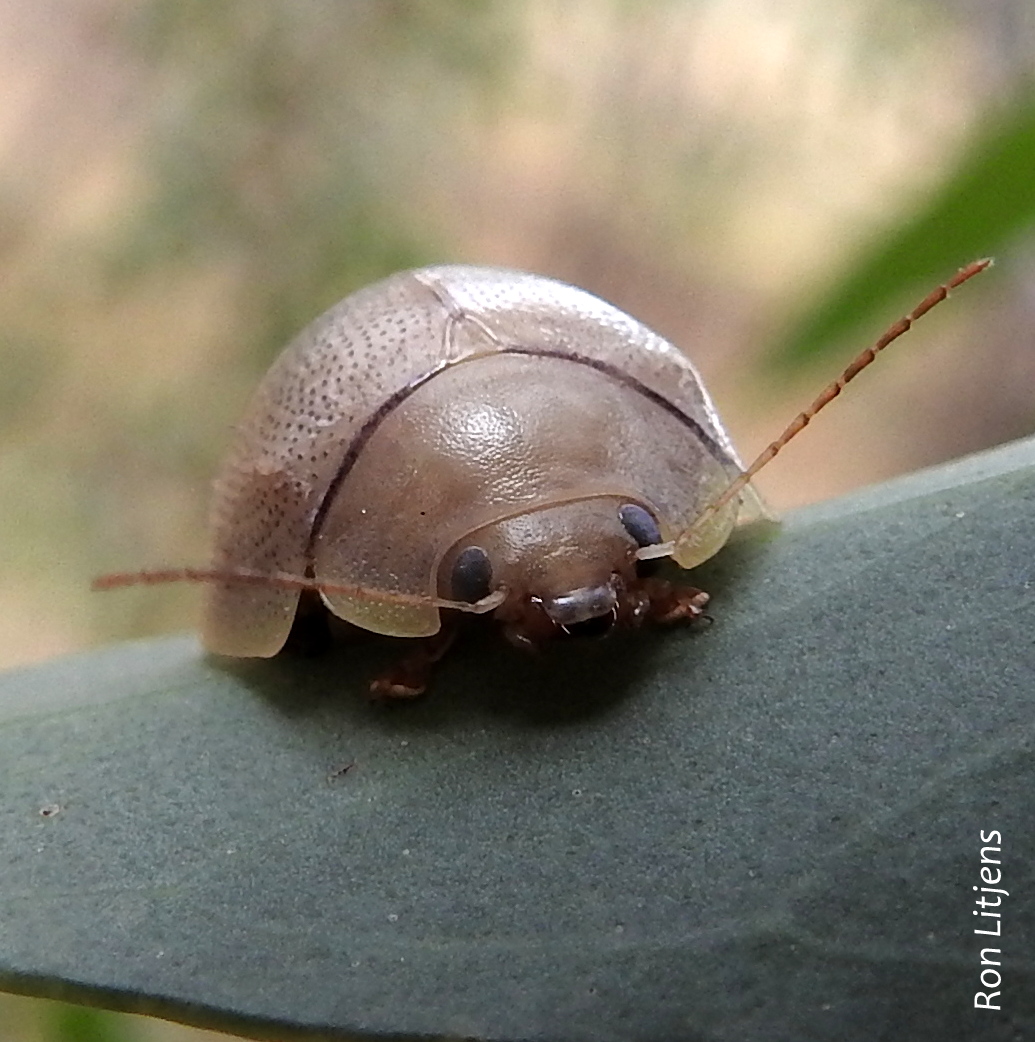
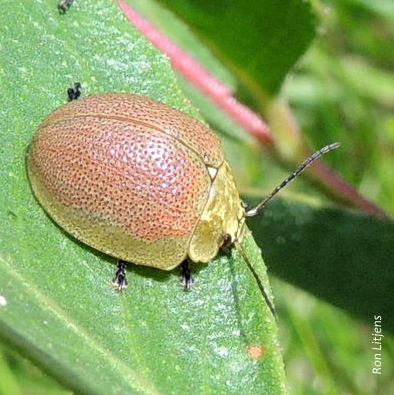 The adults over-winter under bark or mulch and come out in late spring/early summer to mate. Eggs are laid on the young eucalypt leaves and the hatched larvae as a group consume the entire leaf before moving on to the next. Disturbing them produces a reaction similar to that of spitfires, the abdomen gets raised and a mixture of hydrogen cyanide and eucalyptus oil is emitted (pictured below left). Two generations of beetles can be produced each season.
 The larvae prefer young leaves whilst the adults eat older leaves, leaving the characteristic half-moon shapes on the leaf margins.
 Eucalyptus Leaf Beetles are small (larger than a Ladybird) and very common. You will inevitably find them if you look carefully at your gum trees this summer. They will be either eating or mating or in some cases the female will eat whilst the male mates (pictured right).
What a way to spend the summer.
Not following the rules
Everyone knows that spring is Magpie season. This is shorthand for watch out for them swooping as they defend their territory from anyone who passes through whether it be by walking, cycling or any other form of locomotion. As a cyclist myself I have several defence mechanisms. The first is the cable-ties sticking vertically out of the bike helmet. This does little to deter the attacking bird but does extend the safety buffer around your head so that you don’t lose a chunk of ear. I have also had success with gluing a pair of eyes (the facsimile thereof) on my helmet. Australian Magpies (Gymnorhina tibicen) tend not to swoop when being watched.
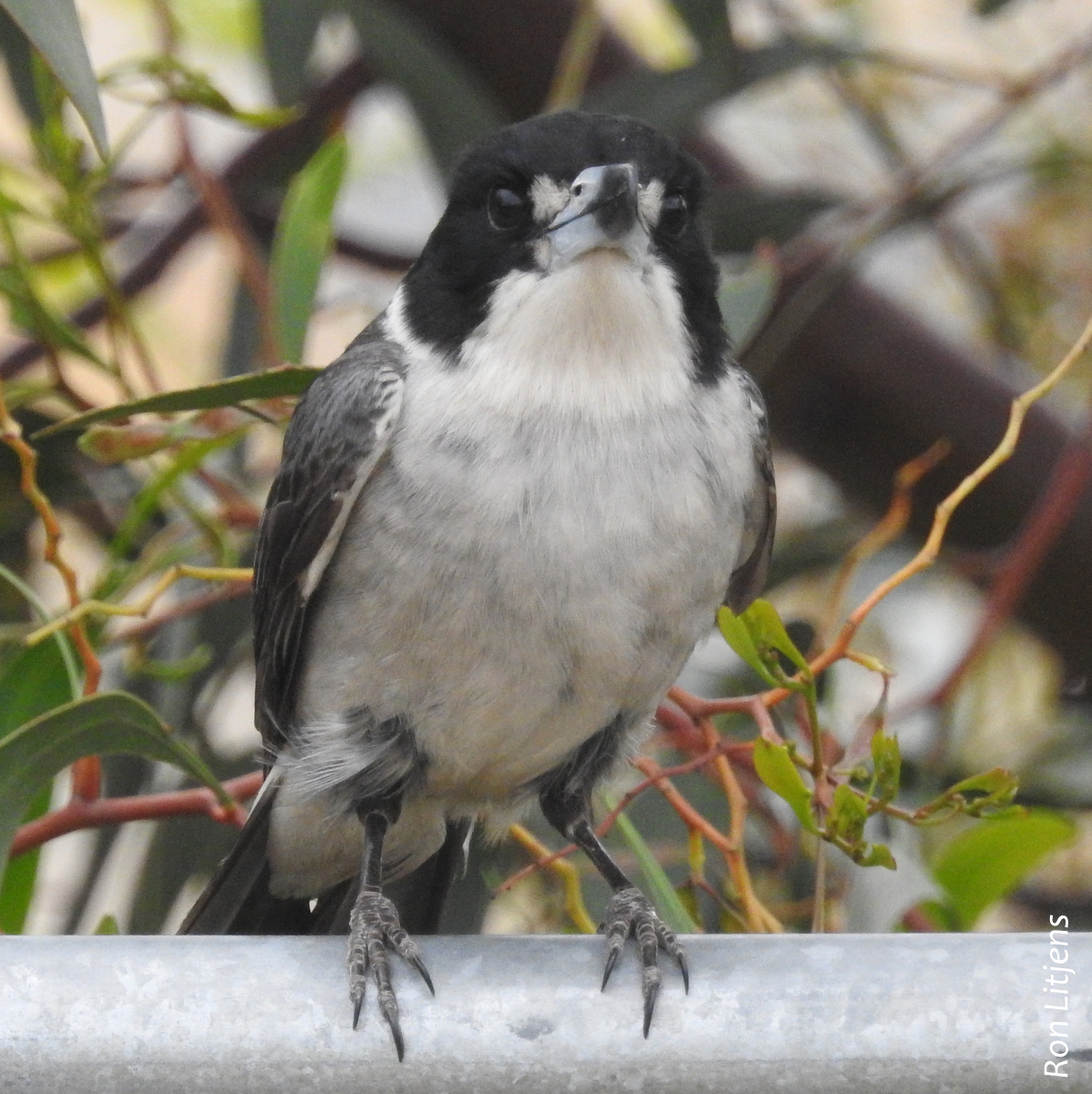
Yesterday however I was swooped by a Grey Butcherbird (Cracticus torquatus), pictured above. Grey Butcherbirds are of the same family as Magpies, Currawongs and Woodswallows. They are smaller than Magpies but occupy the same ecological niche. They feed on small vertebrates including other birds (and cyclists!)
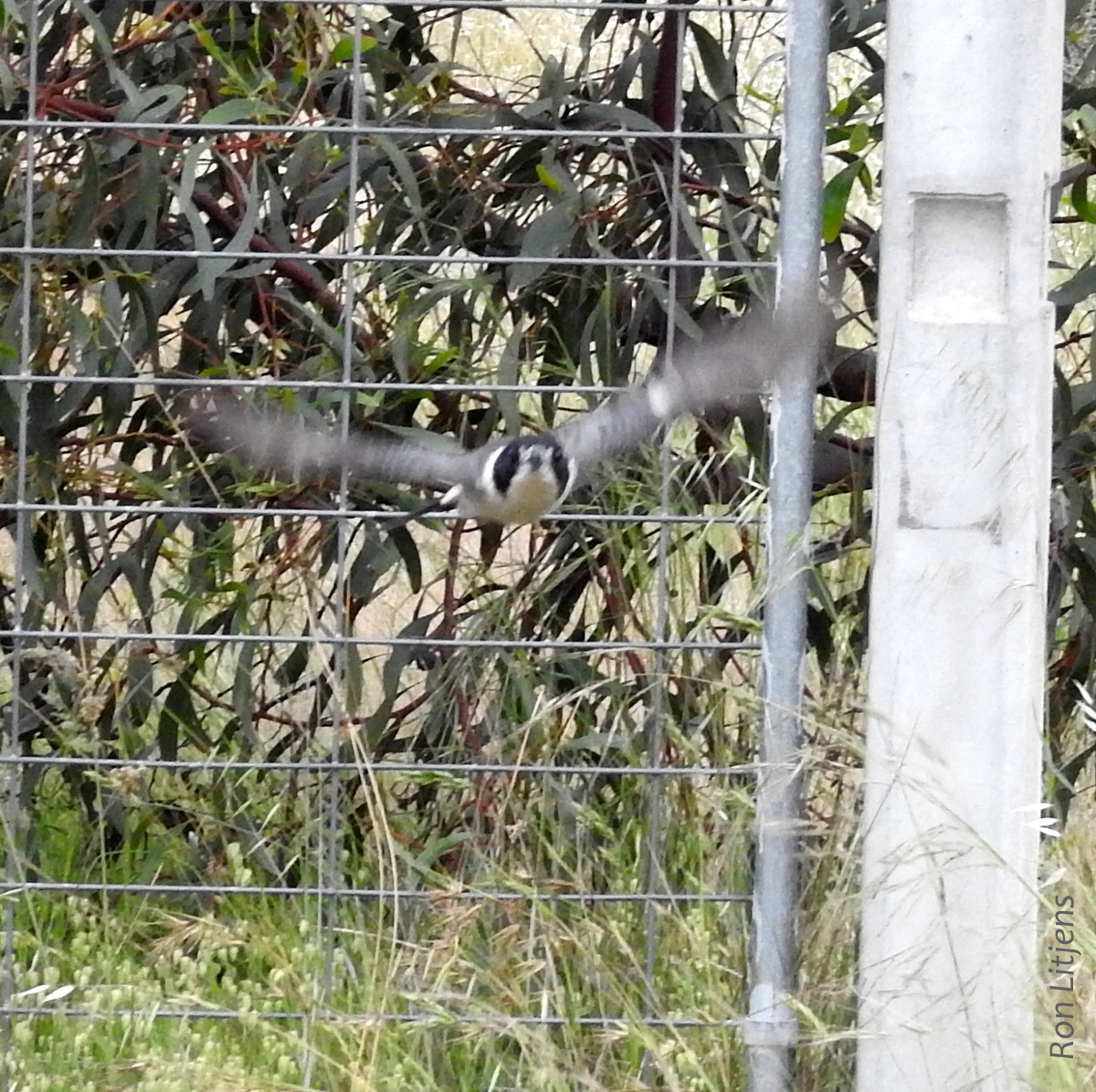
The difference seems to be that Grey Butcherbirds don’t seem to care whether you are watching them or not when they swoop. I dismounted my bicycle and had many opportunities to try and photograph the incoming missile (right). It did not seem daunted at all by the fact I was facing it.
It obviously hasn’t read the rule book.
Neither cuckoo nor shrike

Black-faced Cuckoo-shrike

Change-over time at nest duties
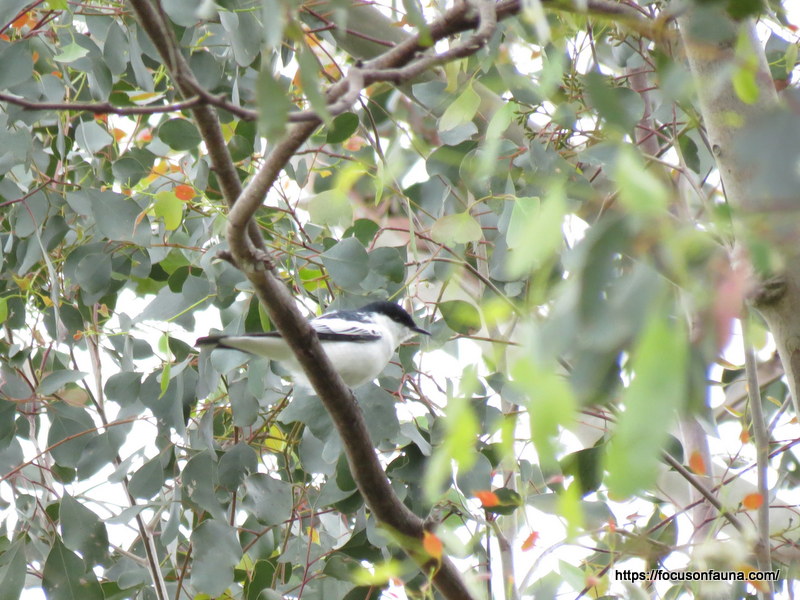
White-winged Triller male
Another migratory bird in the cuckoo-shrike family (Campephagidae – meaning caterpillar-eater) is the White-winged Triller (pictured below) which is turning up in numbers in our district and, unusually, around southern Victoria, including Melbourne suburbs. The abundance of White-winged Trillers is known to fluctuate widely, and the last time we had a big influx of trillers was in 2013, when they could be heard in spring all around the Flowerdale/Strath Creek area.
Like all the cuckoo-shrike family, these two birds are unrelated to either cuckoos or shrikes. The origin of the name remains a mystery, though unconvincing explanations have been proposed about cuckoo-like plumage and flight, and shrike-like bill. As Fraser and Gray say in their book Australian Bird Names “… it is another awful combination of names of birds of entirely different orders…”.
To hear local recordings of the cuckoo-shrike and triller calls/song, click on the audio below.
Black-faced Cuckoo-shrike:
White-winged Triller:
Room with a view
 As a very amateur birdo I find that my preconceived ideas about birds and how they live are continually being challenged and corrected, none more so than my recent discovery. I find wetlands and dams to be infinitely fascinating places – the intersection between the terrestrial and the aquatic life. At the right time of the year contemplation at the side of a dam will reveal a multitude of birdlife nesting in the reeds and sedges. And so I thought that all aquatic birds e.g. ducks, herons, etc. did the same.
 Last week I spied a nest made of sticks and twigs high up in a River Red Gum (above left). It was to my great surprise that a photograph of the nest revealed two White-faced Heron (Egretta novaehollandiae) chicks peering out over the edge (above). My Pizzey and Knight bird app tells me the nest should be ‘in a leafy branch 5 – 12 m high, sometimes far from water’. Check.
 Coincidentally, now that I know where to look, I spied an Pacific Black Duck (Anas superciliosa), left, nesting in the top of an old stag and an Australian Wood Duck (Chenonetta jubata) nesting in a tree hollow (pictured below).

A quick check of other ducks, egrets and spoonbills on the app shows they invariably nest in hollows or nests high in trees either close to or away from water – obviously the inner-city high-rise apartment dwellers of the aquatic bird world. Be careful what you assume.
Herbie rides again
For those of my generation the term Love Bug conjures up images of a self-directed Volkswagon Beetle called Herbie with the racing number of 53. The Love Bug movie spawned a succession of sequels featuring the said car. At the moment there is another Love Bug on the scene. Flies of the genus Plecia pictured below are starting to swarm.

 In late spring and early summer the males hatch and await the arrival of the females. Mating takes place as soon as the females have hatched and lasts up to three days after which time the female lays eggs and dies. The term love bug or honeymoon bug comes from the fact that for the majority of their lives these flies can be seen flying around attached tail to tail mating.
The eggs are laid in decaying vegetable matter, the substrate on which the larvae feed. The adults are nectar feeders (pictured right).
In the United States swarms are known to create significant traffic hazards by coating car windscreens and blocking radiator grilles…probably more of a traffic hazard than even Herbie.
A hard head?

Hardhead female with grebe

Hardhead female with black duck
The Hardhead is the only Australian representative of the true diving ducks or pochards. It’s an efficient swimmer and swift flyer, but a clumsy walker. It likes deep water, usually keeping well away from shore. Being a diver, it can reach food inaccessible to other ducks – its diet can include aquatic insects, crustaceans and submerged vegetation.
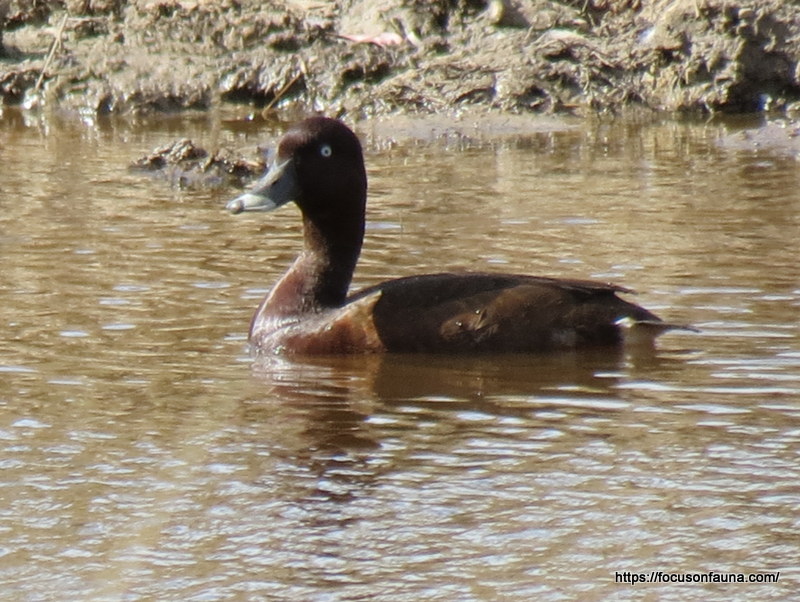
Hardhead male
The male Hardhead has a conspicuous white eye (see photo below), which gave rise to its previous name, White-eyed Duck. The “Hardhead” monicker was apparently given to it by shooters who considered it hard to kill due to its dense plumage and reputed stamina (from Australian Bird Names, Fraser & Gray).
It is still a permitted game species in the annual Victorian duck season, despite its conservation status in Victoria being listed as “Vulnerable”, meaning it is considered to be facing a high risk of extinction in the wild.
As they say, go figure!
Just like the Serengeti
At our house we run a 2-bay (single turn) hot composting system to convert garden waste and food scraps into soil. When one bay is full the contents are transferred into the second bay (that’s the single turn bit) and then the original bay is filled again. Last weekend was the day of the transfer and in doing so we unearthed a range of fauna that had called the compost heap home for the past year or so.
 One of the most distinctive was a Slater-eating Spider (Dysdera crocata), pictured left, identifiable by its red cephalothorax and cream coloured abdomen. For its size this spider has very large fangs. This allows it to feed on most underground invertebrates including slaters, beetles, crickets and even centipedes. They are night-time hunters and spend most of the day in a silk ‘room’ which they construct in an underground crevice in leaf litter or under rocks or wood.
 If you get close enough you’ll notice the spider has 3 pairs of eyes set close together. But don’t get too close – a bite will cause minor inflammation but can result in headaches and nausea. The other name for this spider is the European Garden Spider, indicative of its Mediterranean origin. Due to its aversion to ants, its distribution in Australia is limited to the south east of the continent.
As an aside, when I was a kid seeing African scenes of lions and their prey – zebra, antelopes, etc, living in very close proximity, seemingly ignoring each other, I wondered how could that be? The picture above right shows something similar, Slater-eating Spiders and slaters roaming about together. Just like the Serengeti but in microcosm.




 Focus On Fauna