Leaf-eaters
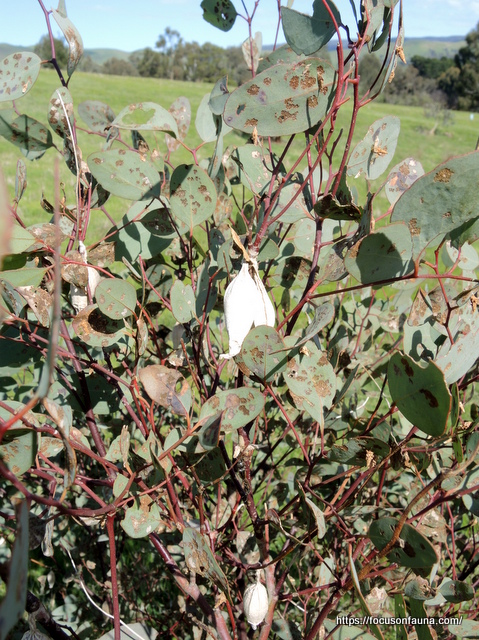
Young Yellow Box tree
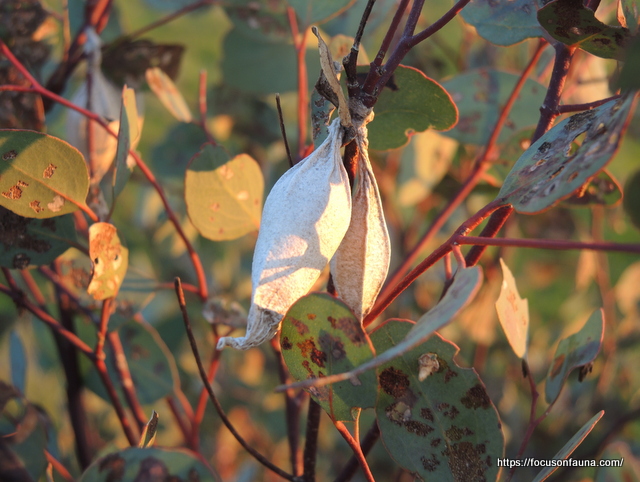
Actually most of the sacs seemed to be old and inactive – one we dissected had only a dry pupa case inside, the moth having flown the coop. On closer inspection of the leaves, we noticed there were numerous much smaller cases (less than 1cm long), and these contained tiny dark larvae actively chewing and moving around, which were clearly responsible for much of the leaf damage.
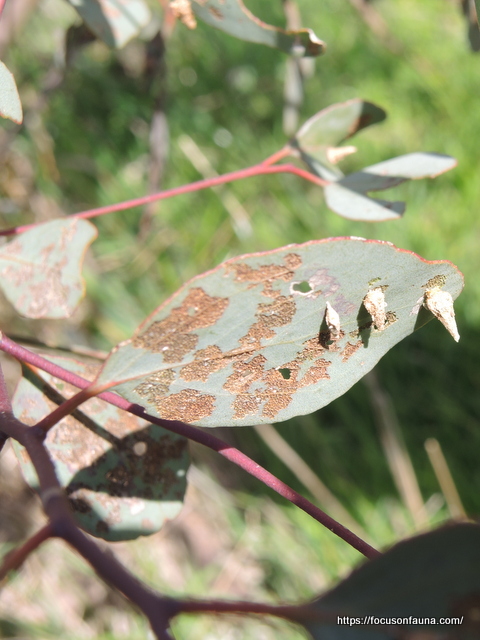
The wingless female Ribbed Case Moths remain in the case for life, and lay their eggs in there. Hatched male larvae (caterpillars) leave the case and feed on the surface of eucalyptus leaves. They construct silken cases which they enlarge as they grow. Eventually they pupate and leave the case as a small hairy moth with transparent wings, as can be seen on the BowerBird website.
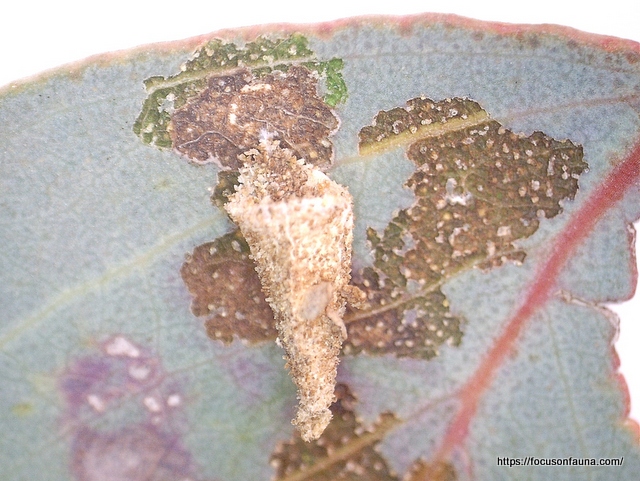
Larval case
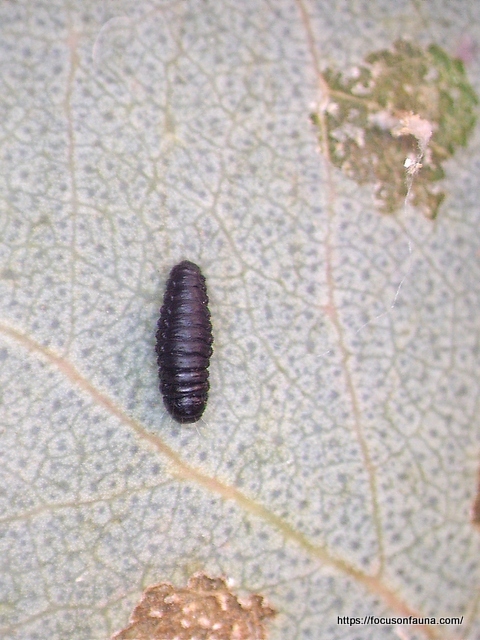
Ribbed Case Moth caterpillar
The cases are built of tough silk and are incredibly strong. Unlike those of many other members of the Psychidae (case moth) family, they are not reinforced/decorated with leaves or sticks, apart from a few bits and pieces when small.
This young Yellow Box will no doubt survive and soon put on a new flush of growth, unlike some of the deer-damaged plants, unfortunately!
Fauna beware
Day of the Triffids by John Wyndam was one of the first books I ever borrowed from a library, and it probably had a lot to do with my following science as a career. The story describes a world where humankind, blinded after watching a spectacular meteorite shower, is at the mercy of carnivorous plants (called Triffids) which roam the country-side killing all and sundry. Even to this day, whenever I observe a shooting star I do it with one eye closed … just in case.
Some triffid-like carnivorous plants showing signs of life at the moment are plants of the genus Droseraceae (from the Greek word drosos meaning dewdrops), the Sundew plants. Though not as sexy as the well-known Flytraps, which catch their prey by snapping shut their leaves, the way in which sundews capture their food is equally interesting.

Sugar Ant trapped in Scented Sundew leaves
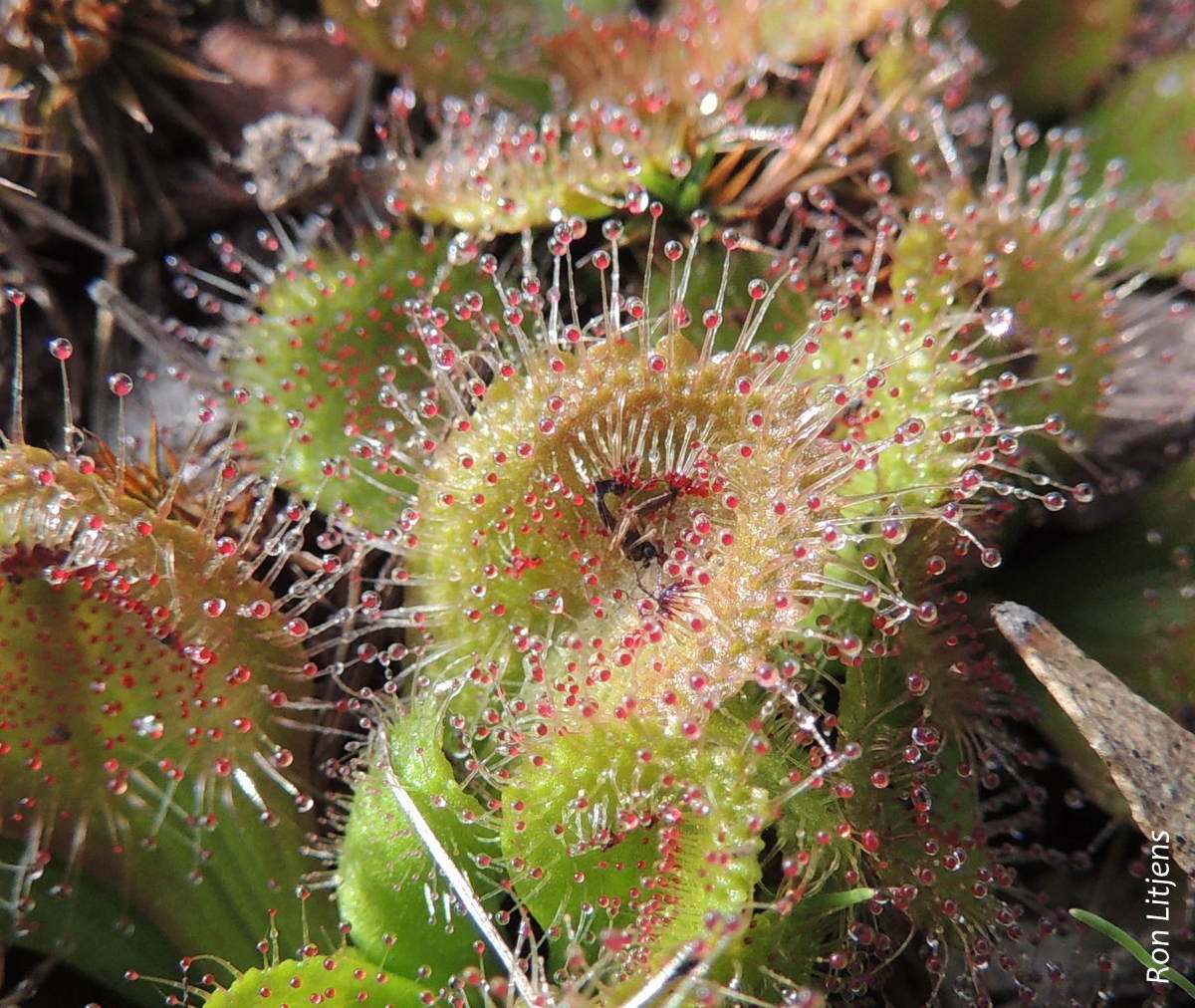 Each leaf of the sundew sprouts a number of tentacles that exude sweet liquid, which attracts insects (see photo above). When the insects touch this sticky liquid they become trapped and eventually die either of exhaustion in trying to escape, or asphyxiation as the sticky goo covers them. Enzymes are then released to dissolve the insects and the plant absorbs the nutrients. The picture (right) shows a mosquito trapped in the sticky tentacles. The black debris seen on the leaves are the remains of digested insects.

Scented Sundew
The commonest species of sundews in our area are the Scented Sundew (Drosera aberrans) and the Tall Sundew (Drosera peltata). In Scented Sundews, which are flowering now (pictured left), the leaves lie along the ground. In Tall Sundews these leaves are on stems (pictured below), making them look much more sinister and triffid-like. It has pale pink flowers in early summer.
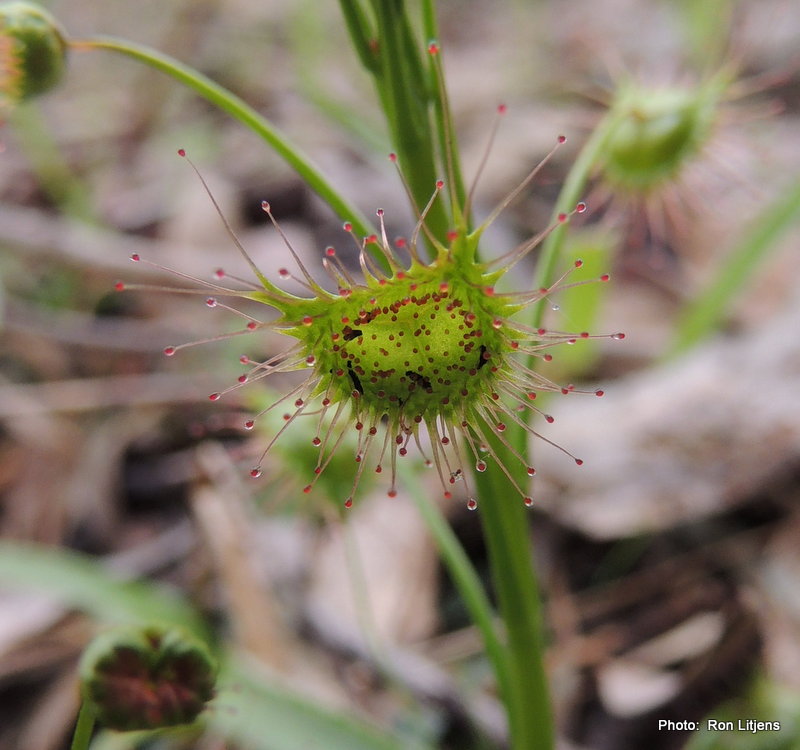
Tall Sundew
These sundews won’t dissolve your leg, should you stand on one, unless you’re a mosquito. The Tall Sundews stand about 50 mm high so kangaroos and possums are safe from entrapment. But knowing evolution, it’s just a matter of time.
A New Holland, almost!
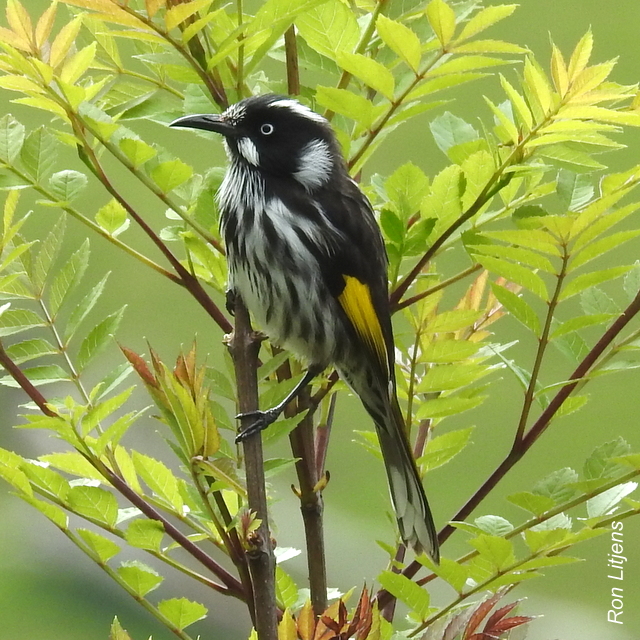 The flowering of plants in late winter and early spring marks the beginning of the nectar wars when honeyeaters spend the day frantically defending their food sources. In our district a black and white bird with a yellow wing patch flashing through the foliage (and sometimes that’s all you see) usually means the New Holland Honeyeaters (Phylidonyris novaehollandiae) are back in town (pictured left).
 Maree from Junction Hill, who recently provided photos for the blog on the Mantis Parasitic Wasp she observed outside her kitchen window, noticed a ‘yellow-flashed’ honeyeater in her loquat tree recently. It looked like a New Holland Honeyeater…but not quite. After spending hours trying to get a clear photograph of the bird, the pictures (right and below), showed it to be a Crescent Honeyeater (Phylidonyris pyrrhopterus), not seen by Macwake, our resident ‘birdo’, in the King Parrot Valley since 2008.
 Crescent Honeyeaters inhabit dense eucalypt forests and woodlands in coastal southeast Australia, breeding in the high country in summer and moving to lower altitudes in autumn and winter. They feed primarily on nectar but also consume fruit and invertebrates such as scale insects.
Pairs of birds form long term socially monogamous relationships. Even though territories are defended by the males the species is sexually promiscuous with females often wandering into other territories to mate.
For Marie this was a ‘lifer’, first ever observation of this species. I’m heading up to Marie’s this weekend. I want a lifer too.
Tina’s Hoax?
Tina is the local creative artist, flower arranger extraordinaire and style icon for vintage clothes. She works in the local garden supplies centre and as such frequently comes across weird and wonderful fauna amongst the pots and plants. The latest is this beauty (pictured below). On first appearances it looks like a candy-cane coloured slug. It is in fact a flatworm, a Howitt’s Flatworm (Artioposthia howitti) to be exact.

Flatworms are one of the most primitive lifeforms. They have no body cavity and hence lack organs for breathing and circulation. Oxygen instead enters the body by diffusion. This limits the size that flatworms can attain and creates a body shape with a large surface area i.e. flat. They are also the ultimate regenerator. Cutting a piece off will result in a new flatworm.
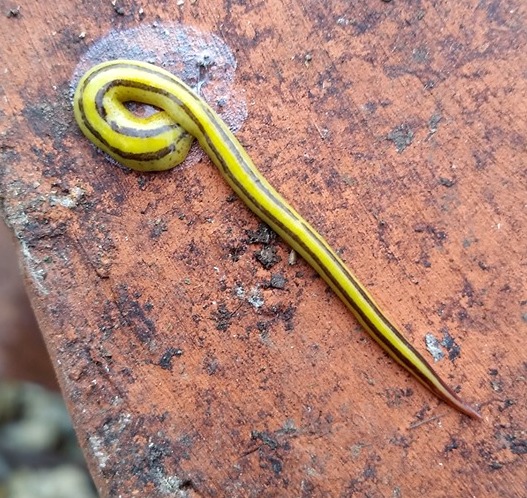
Superficially they look a bit like leeches but do not loop up when moving. Like slugs and snails flatworms move on a slime track. They are predators. Some trap small invertebrates in their slime trail. The insides of the victim are then sucked out. As they also have no anus waste products and undigested food are expelled through the mouth (talk about ‘potty mouth’!)
It’s all very interesting but beware. Knowing Tina’s sense of the mischievous and her artistic talent it would not surprise me if a search of the garden centre turned up some very thin brushes, pots of yellow and brown paint and a very annoyed ordinary garden slug (painted).
Dam platypus
 We’re quite used to seeing platypus in the King Parrot Creek and there have been sightings from there in recent months, even when the creek was reduced to barely connected pools. This included a platypus at Flowerdale which unfortunately had fishing line tightly wound around its body.
But we were a little surprised to get an email from Peter and Terry saying there was a Platypus, Ornithorhynchus anatinus, in their large farm dam (see photo at left), which in fact is more of an ornamental lake in the sizeable garden area surrounding their Strath Creek house.
We were less surprised after reading the following sentence in Mammals of Victoria, edited by Peter Menkhorst: “Wandering individuals, probably mainly dispersing immature animals, are occasionally found crossing dry land up to 2 km from the nearest water body … or in apparently sub-optimal habitats such as irrigation channels and farm dams.” Farm dams for livestock are often less than ideal habitat for platypus because of their depth and bare shallow-sloping hard-packed banks unsuitable for constructing burrows for nesting and shelter. Fenced-off dams with vegetated banks, like the one shown here, encourage the invertebrates that platypus feed on and are generally more suitable habitat.
Whether the platypus came up from the nearby Strath Creek or Wild Dog Creek after they began flowing again following recent rain, or came down from another dam on the property is open to speculation, but it is certainly a long way from any permanently flowing waterway.
One good piece of news regarding platypus is that new rules in Victoria banning the recreational use of opera house traps (and other enclosed yabby trap designs) in all waters came into effect from 1st July this year following a campaign by the Australian Platypus Conservancy. So there should hopefully be no more reports of platypus drowning in these lethal traps.
Spewin’
 This organism is not quite fauna and not quite flora nor fungi. On the side of the driveway I found something on the ground that looked like it had been left by a wallaby after a big night out (see picture left). Appropriately named it is a Dog Vomit Slime Mould (Fuligo sp.). The name is bad enough but not all slime moulds look that revolting (see picture below).
.
.

Trichia sp.
Slime moulds do not neatly fit into either the fauna, flora nor fungi categories and they have characteristics of all three. In normal situations slime moulds exist as single-celled organisms that are unable to be seen with the naked eye. They feed on microorganisms in dead plant material and fungi.
 In times of stress however, if the food supply is scarce or if the temperature is unsuitable, slime mould organisms cluster together to form a larger, visible ‘blob’. The blob can be metres in size. The mass can move towards light or hunt for food as a single unit. Slime moulds reproduce by producing spores. When mature, the spores are dispersed and new ‘amoebae’ are formed.
During our recent fungi workshop white slime moulds were seen growing from the dead trunks of Tasmanian Blue Gums (pictured right).
I have a great idea to use these to produce a B-grade horror movie. It will obviously have to be done in Technicolor (Yawn.)
Nice necktie
One of the most common nocturnal animals in the district is the Common Brushtail Possum (Trichosurus vulpecula). They are usually seen crouched on a branch high up in a tree. If you do get a chance to see their undersides they have a marking on the chest that looks like a neck-tie (see picture below).

Scent is used by many animals for a variety of purposes – marking territory, defining social organisation, attracting mates, etc. and the Common Brushtail Possum is no exception. The Brushie has two areas on its body that have specialised scent producing glands. One is near the cloaca (rear opening) and the other is the sternum (breastbone).
As possums mature they develop an area of reddish-brown hair on the chest up to 10cm long and 3cm wide. This area has a high density of scent producing glands. The density of glands is influenced by a number of factors such as gender, age of the animal and season.
Both male and female possums scent mark trees, rocks, etc. by rubbing them with their chests (chesting). This leaves an orange to brown stain on the object and also on their fur. It is still unclear as to the purpose of these markings. Koalas are also known to exhibit this behaviour.
So I now know what I thought was a neck-tie is not. It makes scents.
They’ll soon be wearing sunnies at night
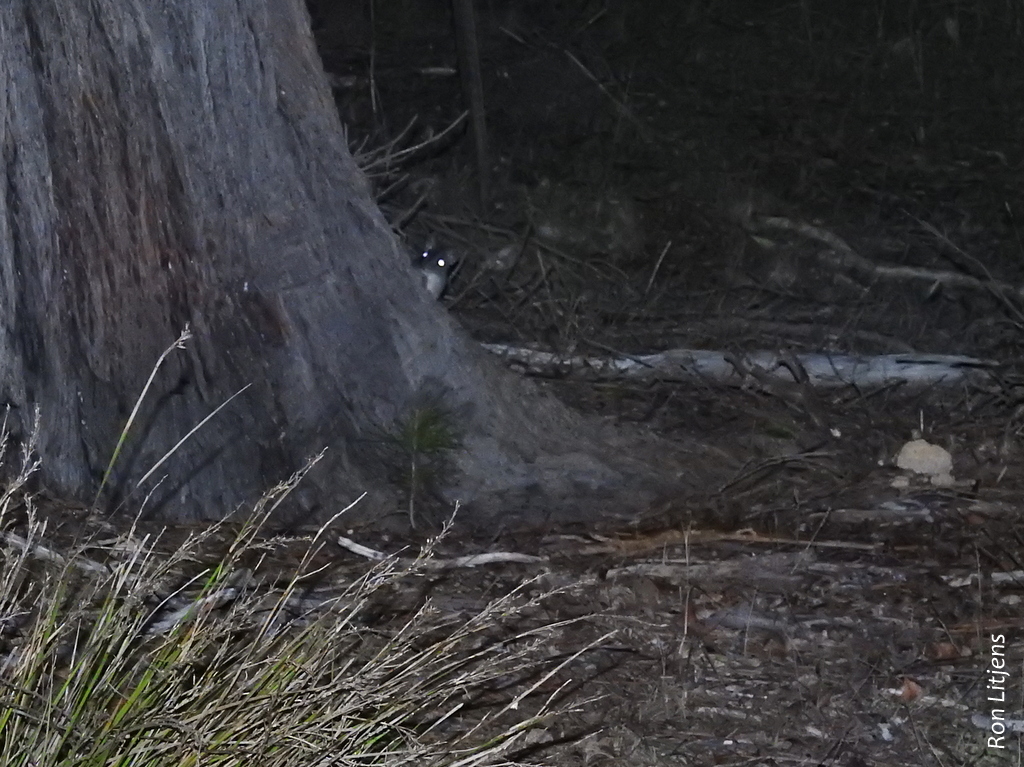 A recent blog discussed using eye-shine to find fauna (spider, frogs, mammals) at night. I have started carrying a head-torch and a camera when taking Mac the Border Collie out for his nightly walk. Recently two pinpoints of light at the base of a large Red Stringybark in the road reserve (see photo left) alerted me to the presence of a critter. It was not perturbed by our presence maybe because we were hidden by the bright light, and continued to go about its business.
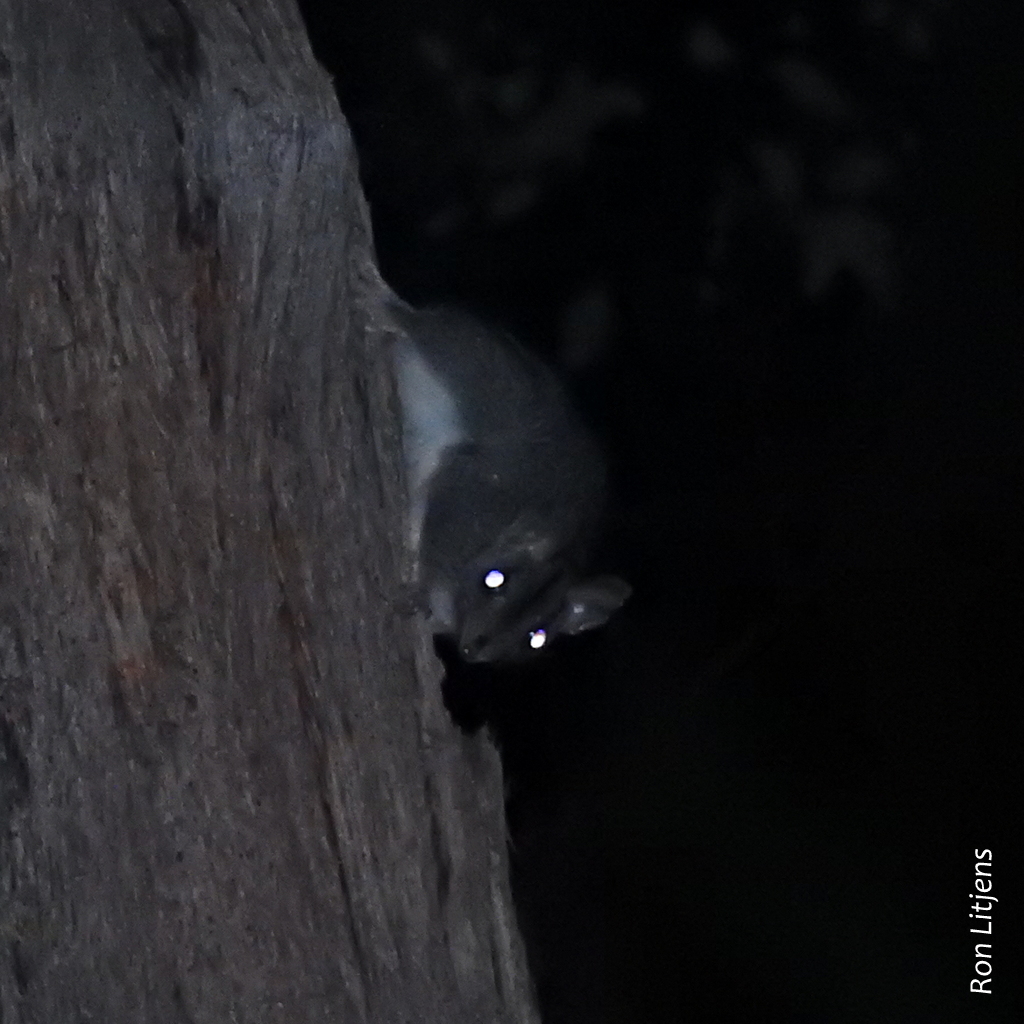
It soon revealed itself to be a Brush-tailed Phascogale (Phascogale tapoatafa tapoatafa) or Tuan, a shy and not often seen small, arboreal marsupial. As the name suggests it is characterised by a large tuft of hair on the end of its tail (see photo below).
Phascogales feed on invertebrates (insects, spiders, centipedes, etc) which they find by foraging around fallen logs and leaf litter. The home range of the male animal is about 100 hectares so even if they are in your area the chances of you seeing them are slight.
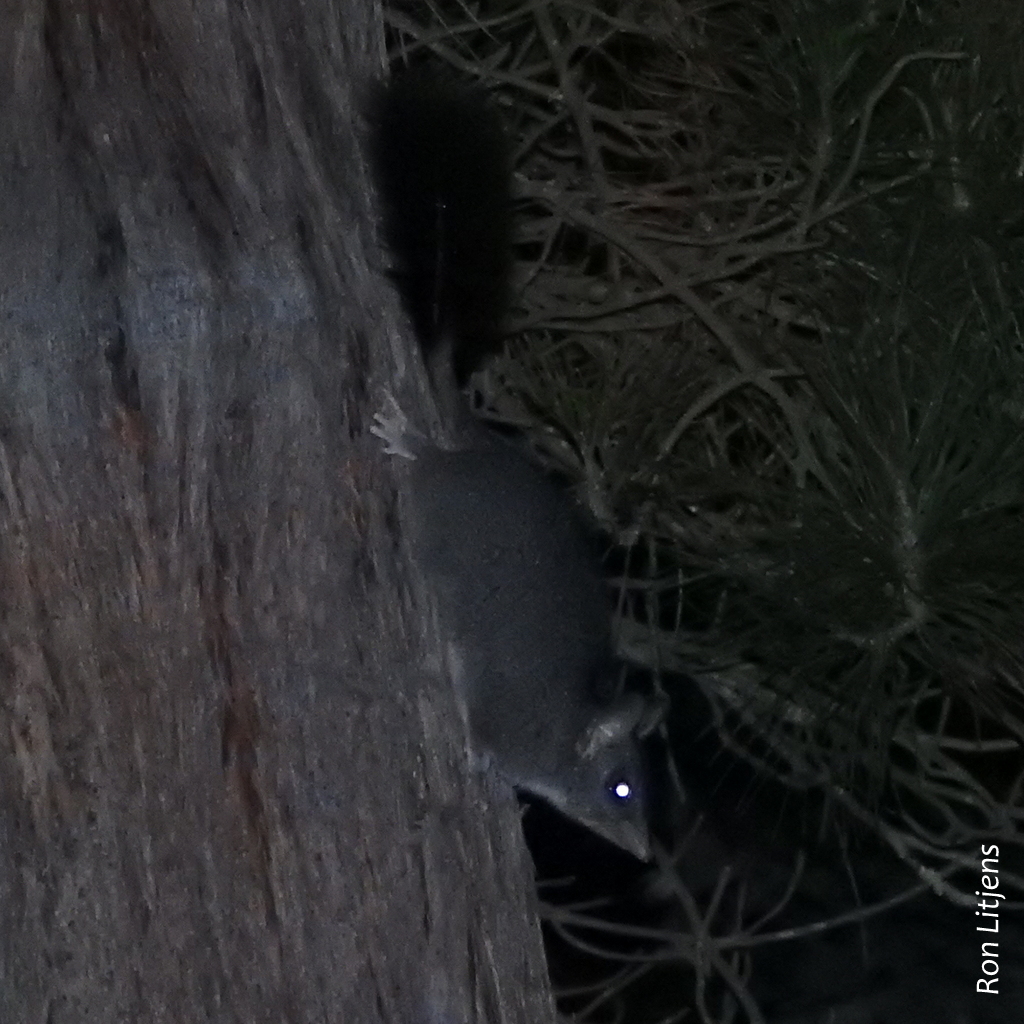
Phascogales are currently listed as Threatened under the Flora and Fauna Guarantee Act (1988). This is mainly due to the loss of hollow bearing trees and widespread clearing of its preferred habitat (open dry sclerophyll forest) for agriculture. This affects both the number of nesting sites and its food supply. Happily the phascogale nest-box set up on our property is currently occupied.
Our night-time walks will continue. I am sure it won’t be long before the native fauna, in an attempt to avoid detection will close their eyes as Mac and I wander past … or in the very least start wearing sunnies.
Spotlight at your peril
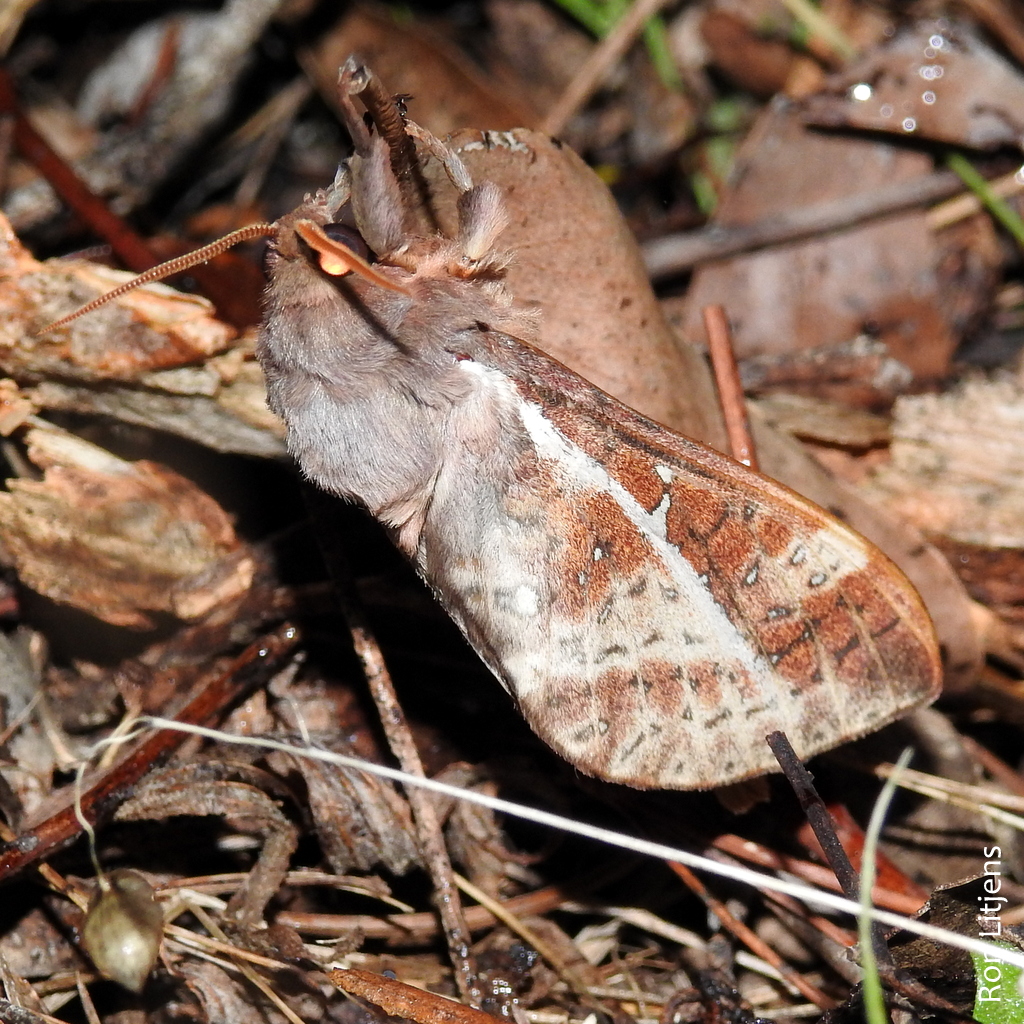
Variable Oxycanus Moth (Oxycanus dirempta)
.
.
.
.
.
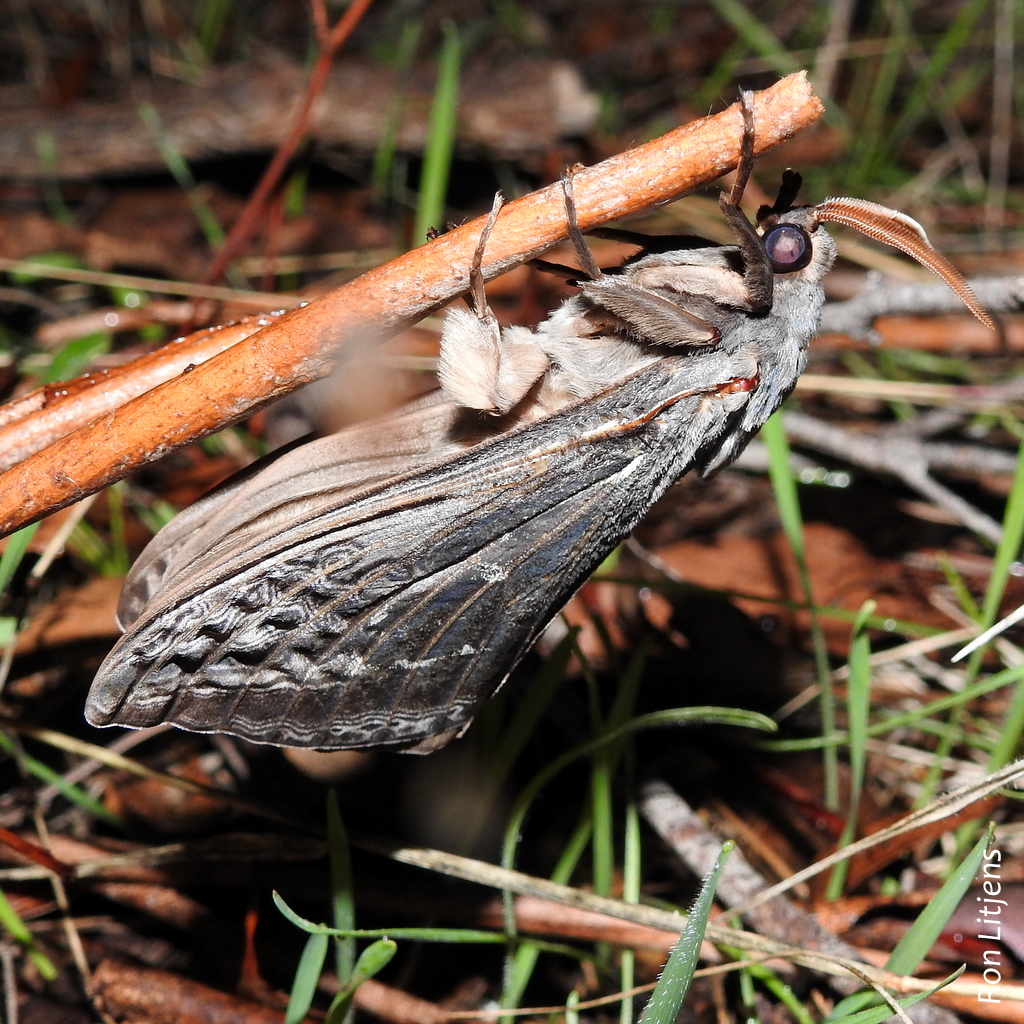
Abantiades sp.
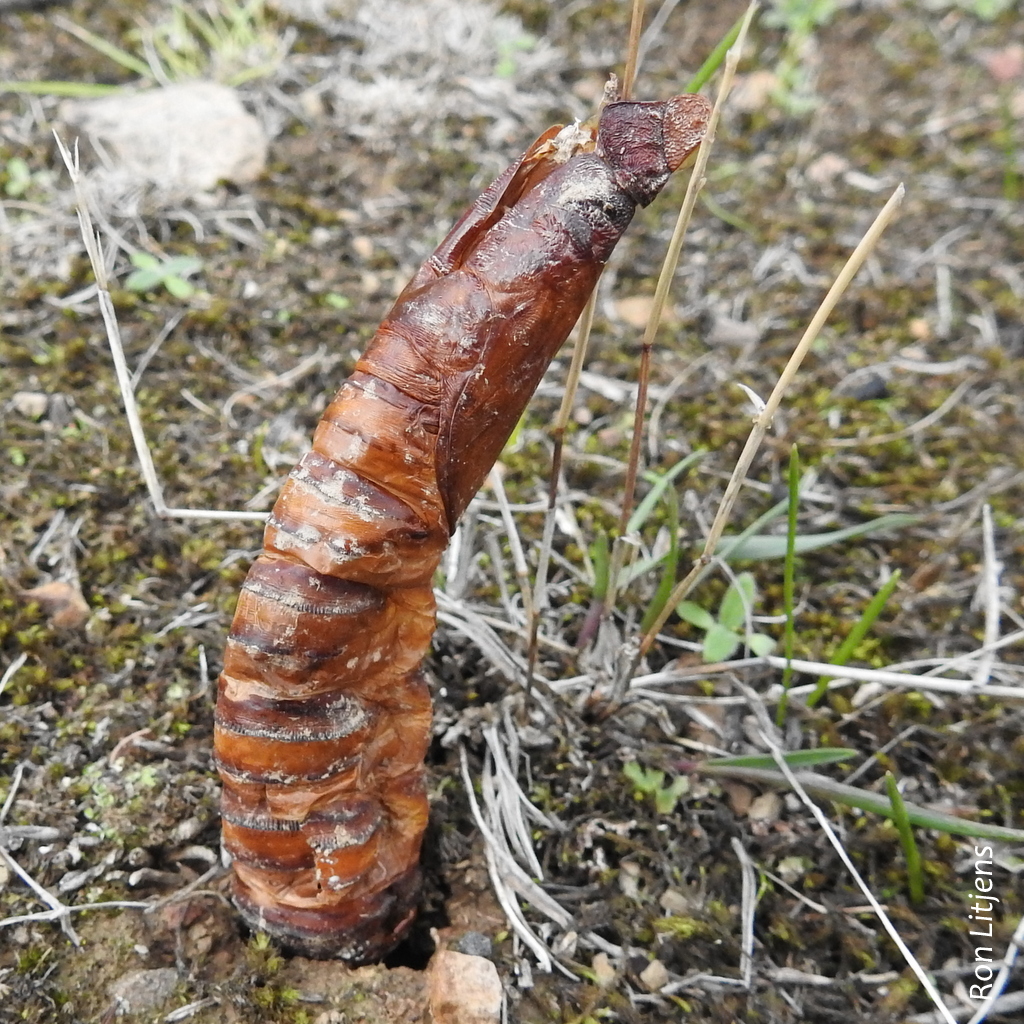 The male moth is smaller than the female. After mating the female moth spreads eggs over a wide area by distributing them whilst in flight. The resultant larvae build burrows in the ground which they line with silk. They then feed on leaf litter or tree roots. The moths pupate in their burrow and when ready the pupa wriggles to the surface and the adult emerges. The empty pupa skin is often found lying on the ground or still poking out of the burrow (see picture right).
At the moment there are several species flying about. For those of you who do not heed the warning, a word of advice. Whilst spotlighting keep your mouth closed. One of the moths tastes kind of bitter. I think it’s the brown one!
Whistling wings
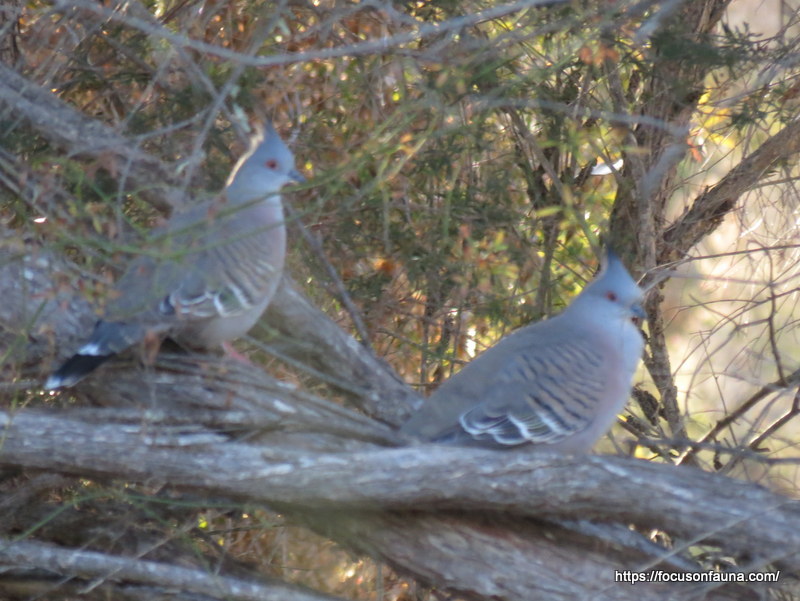
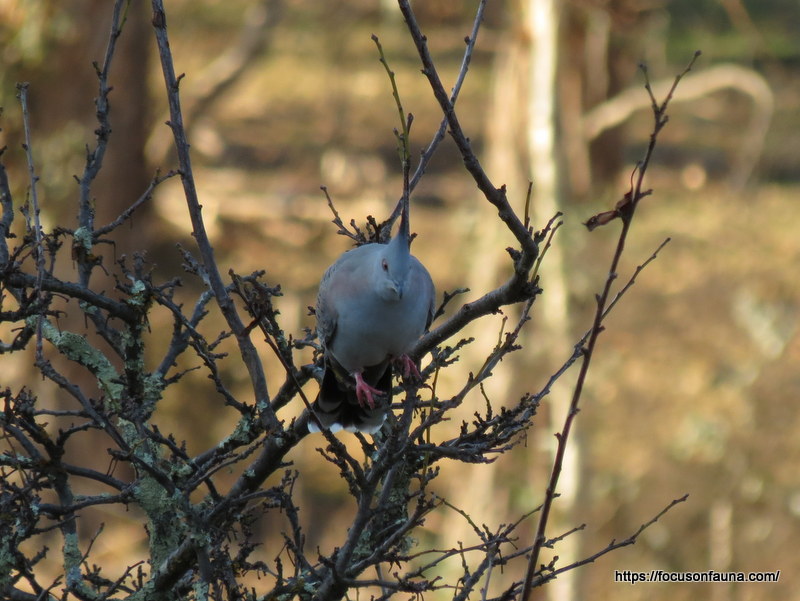 Crested Pigeons are not a particularly uncommon sight in our district, especially where grain is being fed to livestock, but it was a rare occurrence to have about ten of them visit our garden the other day. The rushed “insurance shot” of them at left is a bit out of focus and the next shot of one of them (below, right) is directly front on, which doesn’t do justice to the brilliant patterns and iridescent bronze colouring of their wings.
So for a better view we’ve included (below) a photo of a “crestie” taken at Maryborough some years ago.
They soon departed with their characteristic clatter of whistling wing-beats which can be heard in the audio below, together with their “whoop” call. The loud wing noise is apparently created by the particular alignment of a single flight feather.
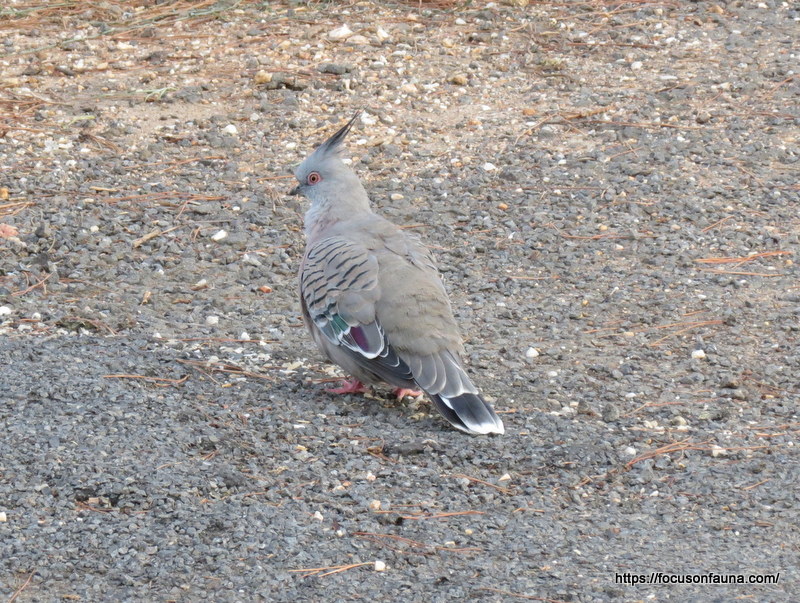
The scientific name of the Crested Pigeon (Ocyphaps lophotes) means, unsurprisingly, “crested swift pigeon” and they are indeed very fast flyers. They typically intersperse their rapid wing-beats in flight with periods of gliding, which is very graceful to watch.
Crested Pigeons were originally confined to dry lightly-timbered parts of inland Australia, but have been able to greatly expand their range with the widespread clearing of native vegetation for crops and grazing. Their distribution now covers most of Australia, only excluding the far north and eastern Victoria.
We’re more than happy to have them join our local bronzewings. They are always easy to identify with their distinctive crests (more like a spike really), and of course their whistling wings.




 Focus On Fauna