Welcome to the Country, Goldfinch
Once a creature has been introduced and settled in to a new environment, there must come a time when they are regarded as part of the local ecology. I heard a scientist say that even Cane Toads have caused no harm to native frogs – and the predators that die eating the poisonous critters soon learn to avoid them or at least avoid the poisonous bits. This is an introduction to my opinion that I don’t mind the European Goldfinch (Carduelis carduelis). A cheerful whistle, bright colours and causing no obvious harm, these English songsters are a happy find when I’m out in nature.


The name finch is given to birds that have a heavy triangular beak and eat seeds. Worldwide the group is complex and vast with many birds granted the name and many other finches being called something else. These finch-type birds are usually very social (congregating in flocks except for the breeding period), colourful and cheerful. Australian finches (Estrildidae – a different family) are represented only by the Red-browed firetail in central Victoria, while the introduced ‘finches’ include the House Sparrow, the Greenfinch and the Goldfinch.
A farmer once told me how he shot 7 sparrows with one shotgun cartridge – he put out some wheat and had the gun poking through a hole in the shearing shed at the line of House Sparrows that came to eat it. I have other friends that call all introduced birds ‘weeds’. I certainly feel little love for the Common Miner or the Starling but there comes a point where the creatures and plants naturalised in an environment have to be accepted and respected, albeit controlled if they are causing damage.
We all live on the one small planet and while every arrival and introduction causes some disruption and anxiety in a place, these changes cannot be reversed easily. Attempts to control horses, deer, feral cats, fire-ants, black berries, rats, wheel cactus or serrated tussock are undoubtedly important but costly and difficult. However, some introductions seem to cause little harm and perhaps we then need to trust in nature’s capacity to adapt and accommodate. I regard the Goldfinch as a pleasant newcomer not a weed.
Fairy Martin
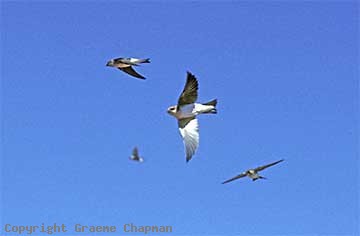
Every time I see a flock of Welcome Swallows skimming over a lagoon hunting for insects, I check to see if there is a Fairy Martin flying with them. Fairy martins (Petrochelidon ariel) differ from swallows in having a square tail (not the long swallow-tail of the swallow) and having a white patch on their rump. I saw one today in a flock of swallows. It’s always a thrill. When they perch together it is easy to tell the difference. The smaller Fairy Martin has a red head compared with the black head of the Swallow.

Fairy Martins are summer visitors to Victoria where they build incredible mud bottle nests under a bridge or culvert or verandah in colonies. They may also be seen hawking for insects over water or at the end of the season, flocking together to prepare for migrating North. I once saw a flock of 66 on a fence in Limestone Road.

We more commonly get the Tree Martin (Petrochelidon nigricans) which also migrates down in warmer months but it nests in holes in trees, and has a dark grey head. I used to see them every Spring seeking nest holes on Constitution Hill in Yea
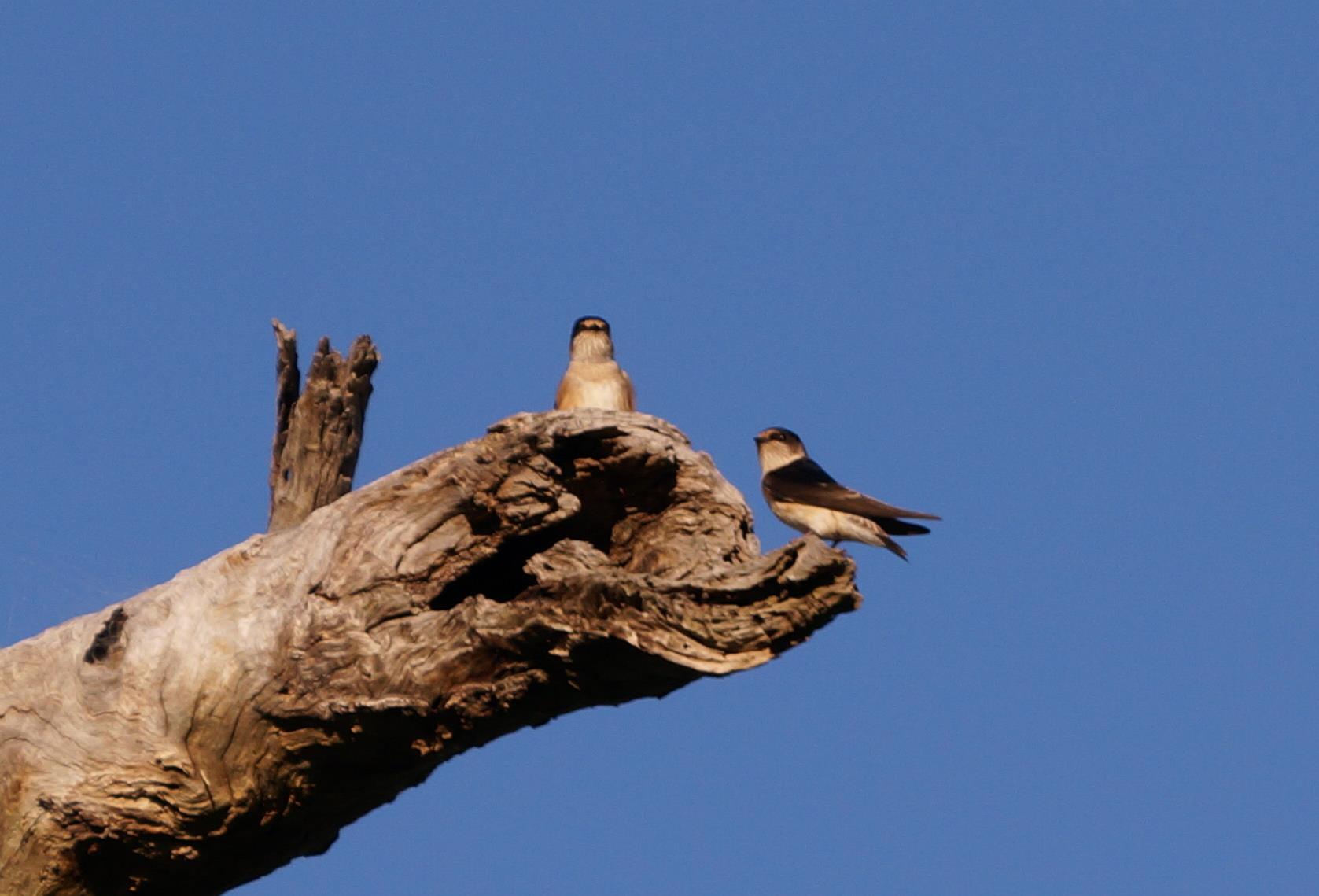
The martins are clearly in the swallow family but that square tail and white rump are very distinctive. (Tree martins also have the white rump but it is more ‘muddy’/greyish.)
The Fairy Martin is a particularly nimble, delicate, pretty, acrobatic, airborne sprite usually found near water. When I feel like a lumbering earthbound lump, the thought of the Fairy Martin makes my spirit soar.
The reed section
Now that Spring has arrived, today I encountered my first Australian Reed Warbler (Acrocephalus australis). If they are found in Victoria in Winter, they’re hard to find. I have always assumed they are Spring migrants but it is possible some individuals lurk silent and hidden in the off-season. They turn up at the same patch of reeds each season and call loudly, only occasionally rising to the top of the reeds.

The Reed Warbler’s loud ‘chuck chuck chuck krutchy-krutchy’ call is the sound of Summer for me and it carries loudly from every decent patch of Phragmites reeds. In this video, it is hard to see the bird (right on top of the reeds) but it is a typical environment and you can hear that call.
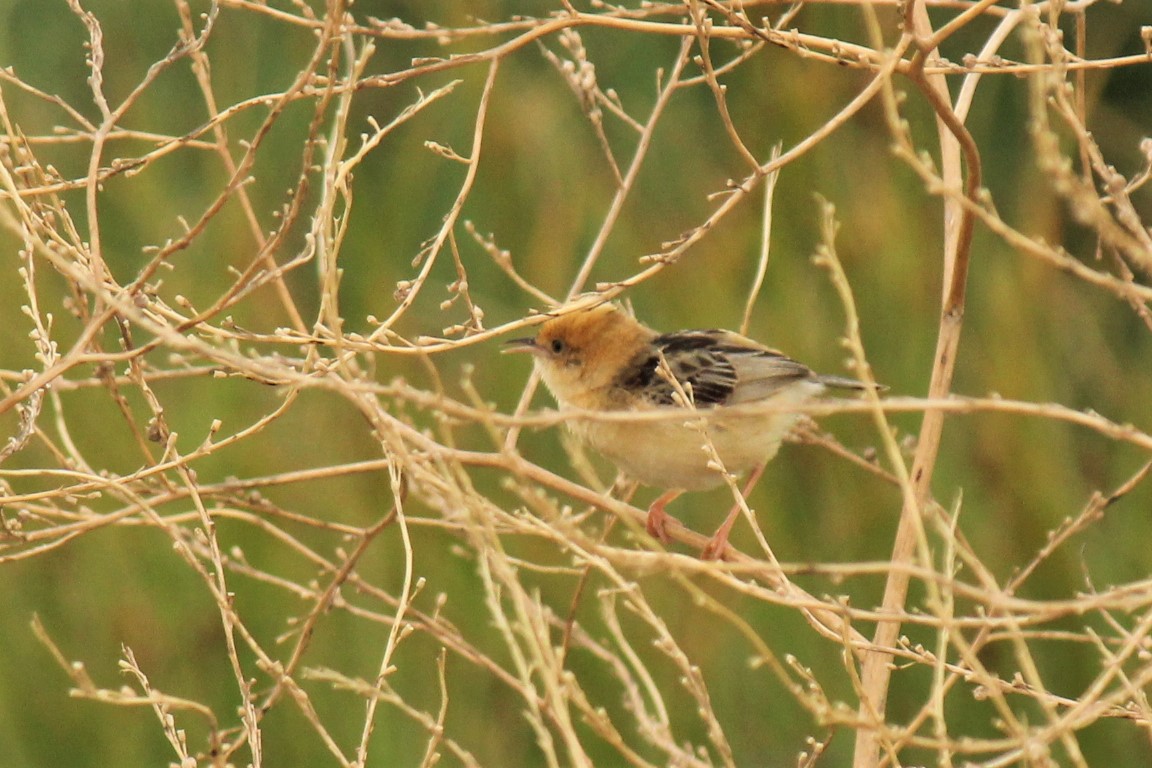
Another reed bird is the Golden-headed Cisticola (Cisticola exilis). (It is pronounced ‘sis-TICKle-er’). I usually detect their presence by their little buzzing call which may be heard in reed beds near water, or sometimes in long grass – even Phalaris – well away from it. I have sometimes been able to make a kissing noise with my lips and they will rise to the top of the grass or reeds to see who is calling. In non-breeding season, cisticolas have a black-streaked head and are a very handsome little bird. In breeding season, their head turns a rich gold colour from whence their name derives.


If beautiful birds like these are to become more widespread in any district, the habitat must be regenerated. They like beds of reeds, swamps, rank grasses and sedges, marshy places. They don’t need many trees. If we can (re-)generate acres of such places, we may even get other denizens of reedbeds: the booming bittern, the incredibly rare Painted Snipe, button-quail, waders, chats and fieldwrens, not to mention more variety of turtles, frogs and insects. This would enrich our local environment and help to secure their fragile hold on existence.
The Duettists
I have been able to identify three species of birds that sing duets for various reasons, and they are each fairly common.
Eastern Whipbird
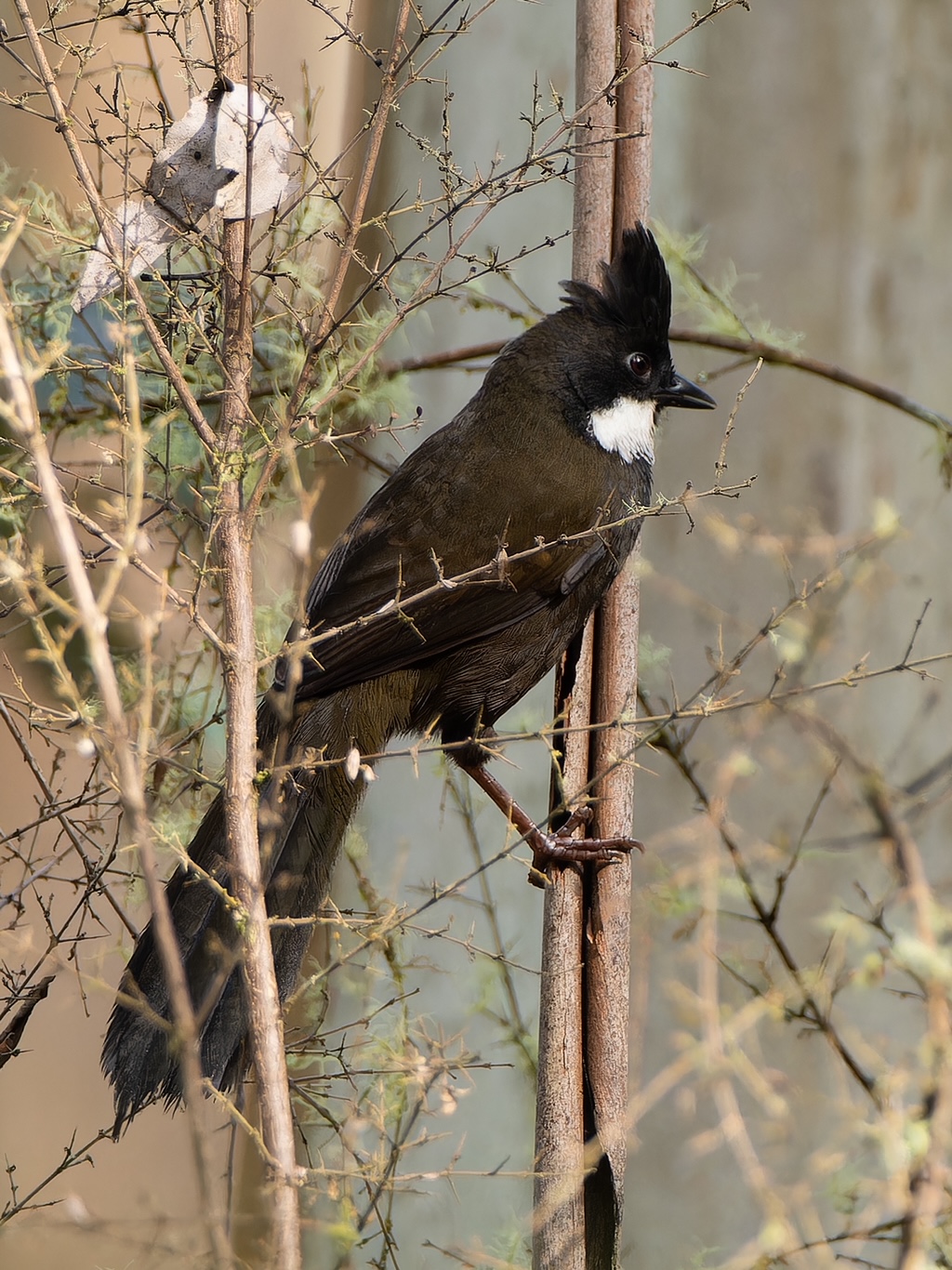
First, there is the Eastern Whipbird (Psophodes olivacaeus) . As they skulk around in thick growth on the ground floor of forests they seem to use the duet as a way of keeping in touch. One will call with the famous whip-crack call and it is immediately answered with a two note ‘psiew-psiew’. The books say with confidence that the male cracks the whip and the female submissively responds, but since it is impossible to tell male from female by appearance, I wonder if anyone has seriously studied if the calls are so gendered? Maybe it’s any two whipbirds foraging in the forest? Maybe the female calls first? Anyway, that it is a duet is undoubted. In David Wakefield’s recording here, there are some calls unanswered and some with the classic duet, and at the end there are some other strange churring calls that Whipbirds make.
Magpie-larks
Another famous duettist is the Magpie-Lark (Grallina cyanoleuca). They often duet as they strut around on roadsides and prepare their mud nests. You can hear in David Wakefield’s recording, there are two singers at least:
“Research on Australian magpie-larks has documented clear boundaries between duet dialects, with pairs at the edges of dialect zones sometimes producing hybrid duet forms that incorporate elements from both traditions. When birds disperse across dialect boundaries and form pairs with mates from different acoustic traditions, they must negotiate a common duetting pattern, often adopting elements from both partners’ backgrounds.”
From International Bird-life
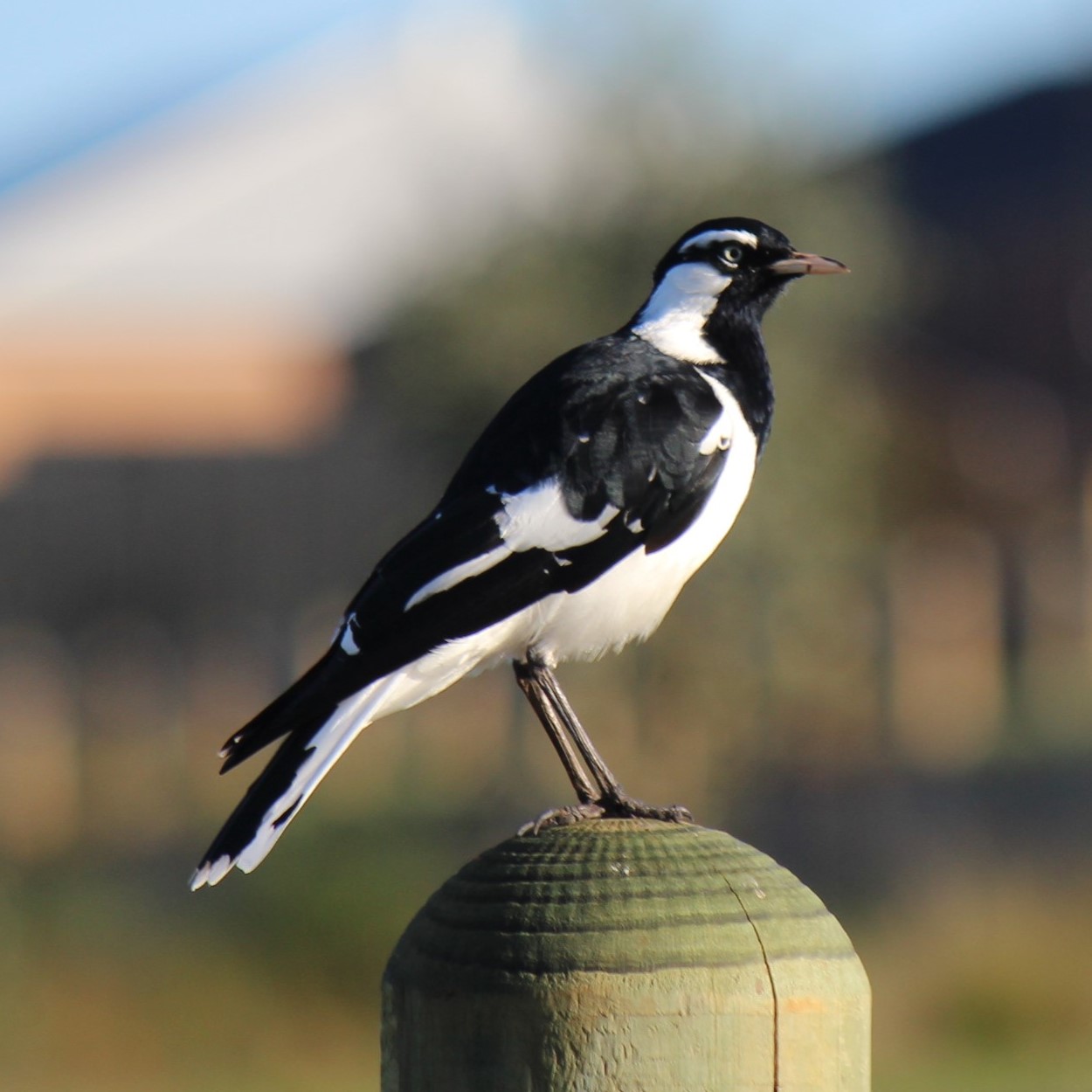

Grey Butcherbird
I was unaware that the glorious, rollicking call of the Grey Butcherbird (Cracticus torquatus) is actually often a duet. According to Birdlife Australia,
“Some Grey Butcherbirds, for example, sing a melodious tune that sounds very much like “whistle while you work”. This is answered by a second bird with “tool-to-tool”, all of the same note, to which the first bird responds with a lilting “tool-till-tooool”, and then the second bird repeats “tool-to-tool”. It all flows so easily that it sounds like a single call. Magic!”
I’m not sure that I can work out the alleged phrases the Birdlife quotation above detects, but in this David Wakefield recording from 2017 careful listening definitely discerns at least two birds overlapping.
Various reasons have been proposed for duetting: establishing territories, maintaining pair bonds, signalling partnerships to rivals. The precision of the duets is sometimes astoundingly precise. I have sung harmony in duets with other singers and it reminds me that in nature, as with humans, the most beautiful achievements arise when individuals work together in perfect synchrony.
Hare Style
You will never feel the same about the Hare (Lepus europaeus) if you read the book Raising Hare by Chloe Dalton. The author, who is a political adviser in the UK happened to find a leveret (baby hare from the French for ‘little hare’, lievre) a few days old which she took home and raised. Her account of the extraordinary relationship she develops with it while preparing to return it to the wild is awe-inspiring.

I only have one photo of a hare but it is enough to see some of its features: its eyes are on the side of its narrow head and each one can see 180 degrees, so that even though this hare has its back to me, it can see me. How the brain handles eyes that are not always looking at the same thing, I cannot imagine.
The ears are very long, which is one way to quickly distinguish it from its cousin the rabbit, and it keeps its longish tail pointing down not up like the cottontail of a rabbit. Its feet are very long and its speed is incredible – up to 50 kmh – while its capacity to leap and turn and dodge is unmatched.
Pliny in the 77AD book Natural History said the hare is designed to be the prey of every creature. There is far more written about how to cook a hare than how to raise one. Perhaps that is because they have never been domesticated, unlike rabbits. They were introduced by Europeans to Australia for the purpose of hunting and coursing (a once-popular but now banned sport involving dogs chasing hares).
Hares are a pest to revegetation projects, nibbling off tree seedlings and gnawing the bark of saplings, and for this reason are often shot – I have done it myself. They are a pest to agriculture also. However, they have never become a plague of rabbit or cane-toad proportions and are restricted to South-eastern states.
Hares make a nest in grass called a ‘form’ to which they return every night. Their instinct when threatened is to freeze and trust their remarkable camouflage, meaning they often get killed by agricultural machinery. Rabbits give birth underground to blind, hairless, helpless kittens. The leveret is ready to run from the moment of birth. Mother hare places it in a nest where it waits motionless for her regular return to feed it milk. After 8 weeks, it is weaned and on its own.
If you get a chance to get up close to a hare, they are exceptionally beautiful with their many different colours, their furry feet and ears, and enormous eyes. I recommend Chloe Dalton’s book; a deep look at any part of nature increases one’s awe and reverence for all of it.
Live and let die
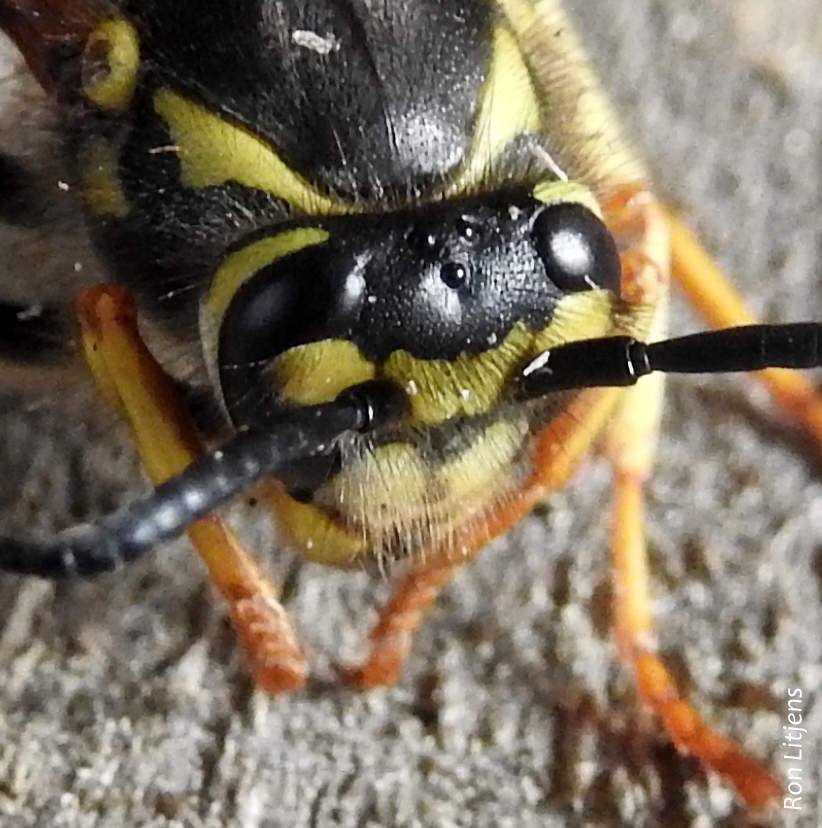
My house is a no-kill zone for fauna…and they know it. As much as I try to prevent them from entering, I share the space with the odd gecko or two, spiders of all kinds, flies, even mosquitoes. They are free to exist on a live and let live basis. However….
It has been a cold winter and the stockpile of wood stacked up against the outside wall is ever decreasing. I have discovered that a range of fauna inhabit this temporary haven – cockroaches, silverfish, beetles and unfortunately many queen European Wasps (Vespula germanica), pictured.
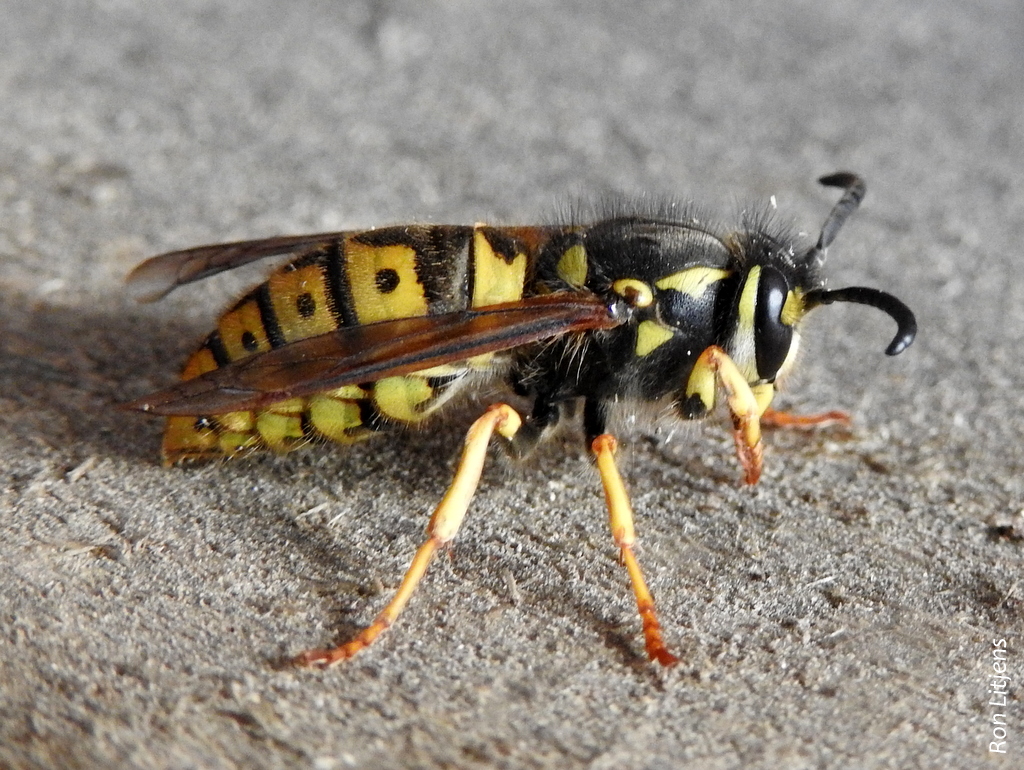
European Wasps (Vespula germanica) are a highly invasive wasp species known to drive native insect species out of an area and create havoc with outdoor human activities over the summer period. In their native Europe and the Middle East populations of European Wasps are controlled by the climate with very cold weather killing many nests. However in the more temperate Australia, nests survive the winter and continue to grow. Many of the new queens find places to hibernate over the winter i.e. my woodpile, only to become active when the weather warms up. A single queen can lay up to 10,000 eggs in a season and this has forced an amendment to my live and let live policy.
For European Wasp it is live and let die.
Swamp birds 2: Dusky Moorhen
Like the coot and the swamphen, the Dusky Moorhen (Gallinula tenebrosa) is a common bird found on water, in the reeds or browsing on grass around the edge of water. These are the Gallinules, which is Latin for ‘little hen”. They all are black with various other shades of blue or brown and have a showy frontal-shield and beak of bright colours – the coot has white, the Purple Swamphen and Dusky Moorhen both have bright red . Because the latter two are both red-beaked it is easy to confuse them. The Purple Swamphen (Porphyria melanotus) is a bigger bird with a definite blue wash on the neck and breast. It is bolder, and the head is quite a different, more bulky shape. The smaller, more timid moorhen has a yellow tip on the red beak. Here’s a comparison in photos:


Another curious character trait of Dusky Moorhens is the way they flash white patches on their tail as they walk or swim. Swamphens have a single white patch and they don’t flash it like moorhens do.
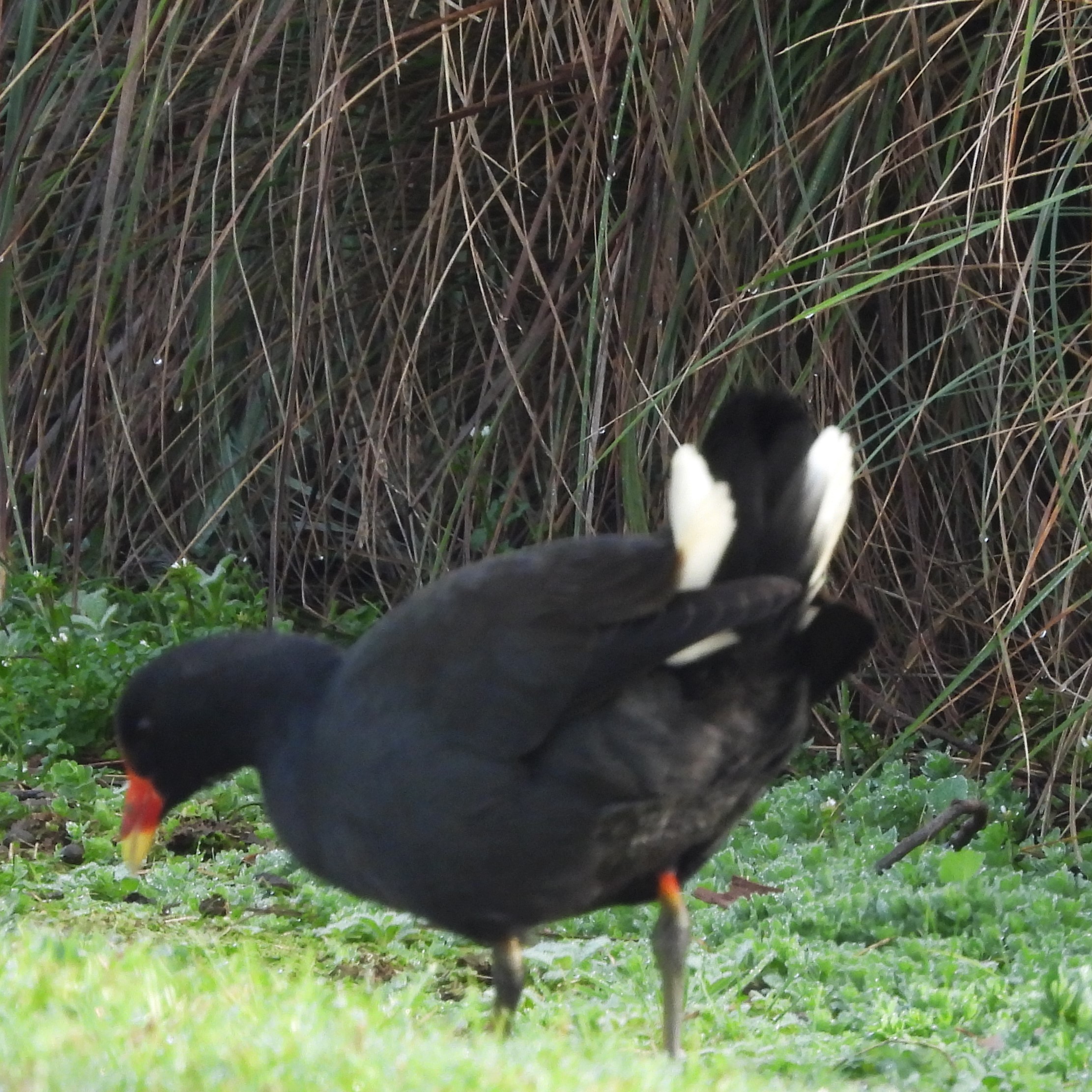

In the latter photo showing a swamphen and moorhen together, I point out that the swamphen is bigger; the moorhen is running away as I approach while the swamphen is boldly unconcerned, and one can make out the blue is more prominent on the swamphen.
A few years ago, when volunteers had constructed a nice pile of sticks in the lagoon at Yea Wetlands, a pair of moorhens built a nest right on top. The big floods have washed the sticks away now but when the lagoon is dry, rebuilding it for habitat would be a good idea.
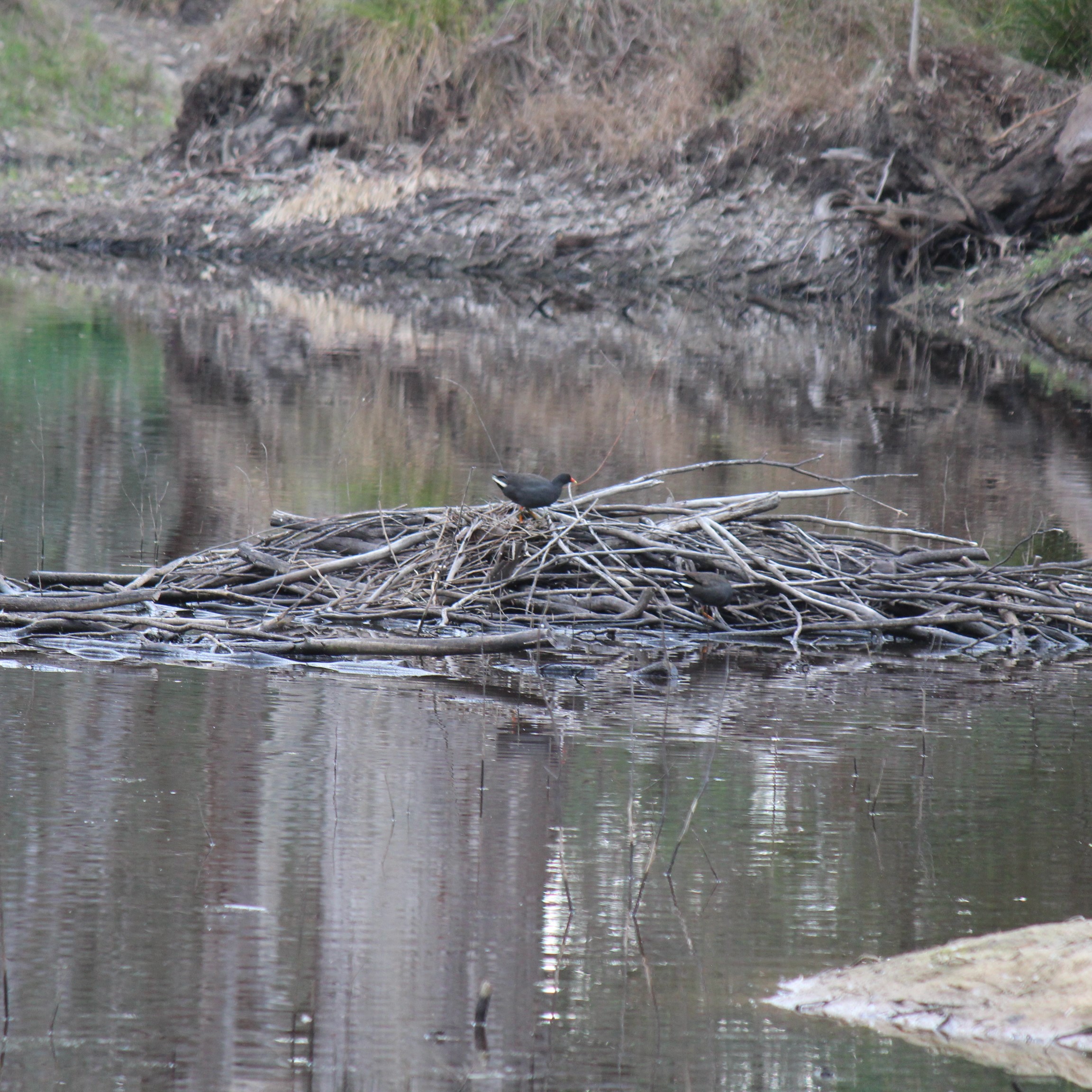
So that’s cleared that up, then? Little hens with red beaks are not all the same. And I hope you can tell the difference.
Swamp birds 1: Coot
There is a set of birds found around reedbeds, dams and lakes about the size of a domestic hen with distinctive colours on the frontal-shield above the beak. They are often called the gallinules, and they are so widespread they can appear a little pedestrian. The most common is undoubtedly the Swamphen a large blue-purple bird with a red beak and frontal-shield whose Latin name catches its purple front and black rear: Porphyrio melanotus. All gallinules forage on aquatic vegetation, or adjoining reeds and grass, looking for worms, molluscs and succulent vegetation. The other common gallinules are the Dusky Moorhen (Gallinula tenebrosa) and the Eurasian Coot (Fulica atra). Keen observers will note that the moorhen is more likely in small wetlands and swamps while the coot prefers larger stretches of water (every town’s sewerage pond is sure to have a flock).
The Eurasian Coot has a distinctive white frontal-shield. It takes to flight with a pattering run across the water. It is often seen bottom up as it searches for food under the water.
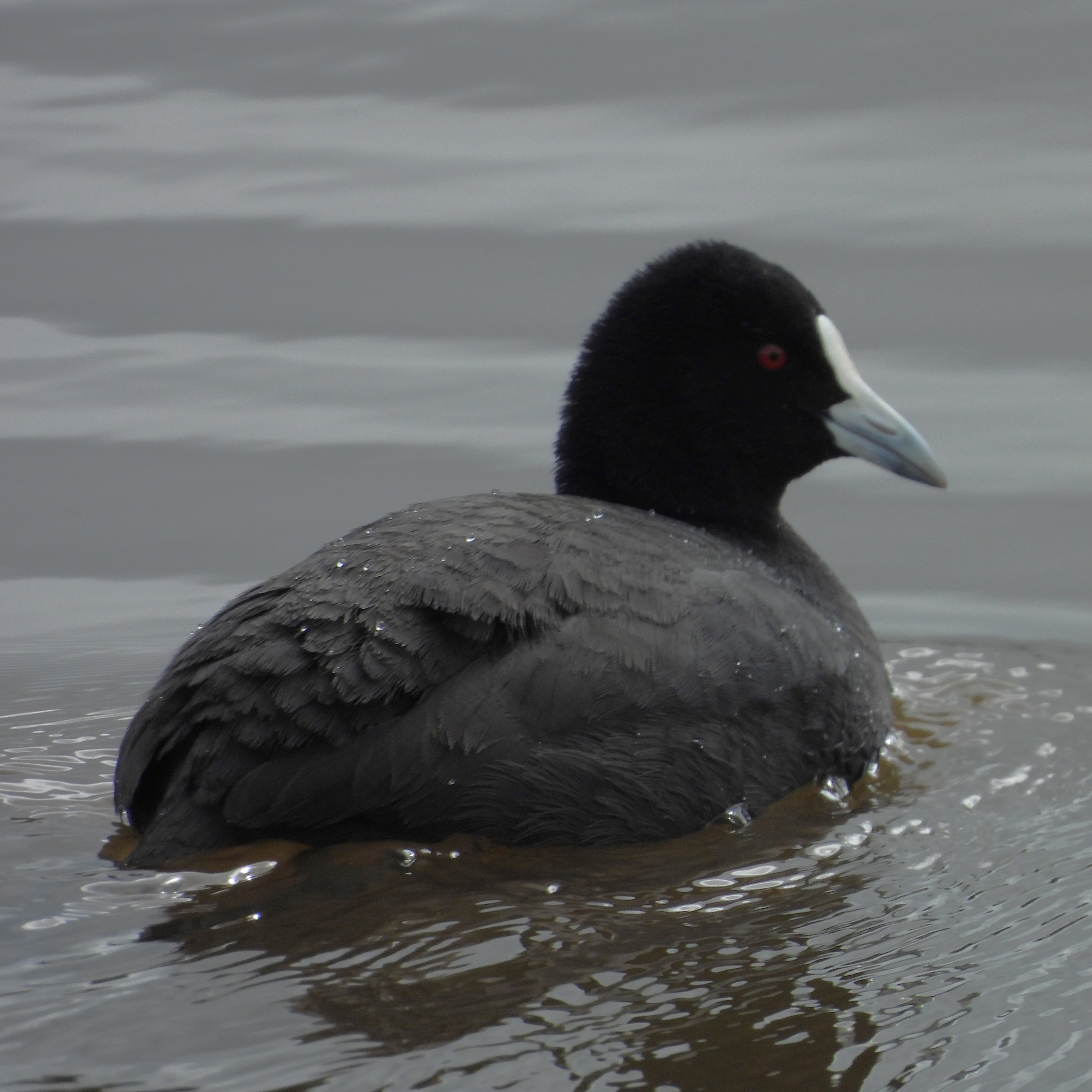
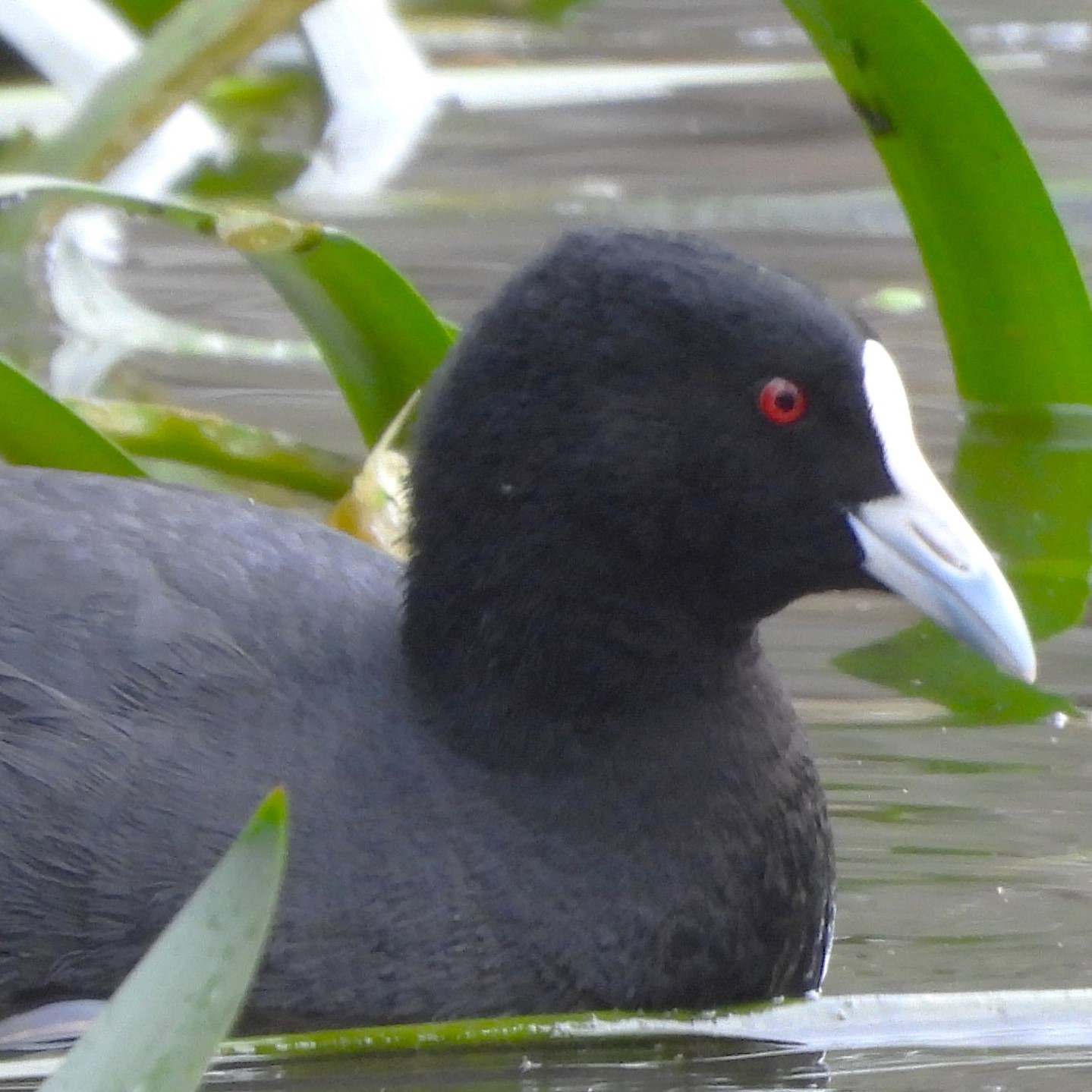
Their nest usually built on the water concealed among the reeds, may contain as may as fourteen eggs though usually 6-9. The chicks have reddish heads. For the first year the young birds are plain black without the white frontal-shield.

Eurasian coots, as the name suggests are found throughout Europe and Asia and recently arrived in New Zealand. The white frontal-shield may be the reason why the phrase arose ‘bald as a coot’. The Oxford dictionary says this phrase arose in the 1400s. but I haven’t heard it much lately though complete bald heads seem to be more fashionable than male-pattern baldness. We need to revive the phrase, bald as a coot!
A different squadron
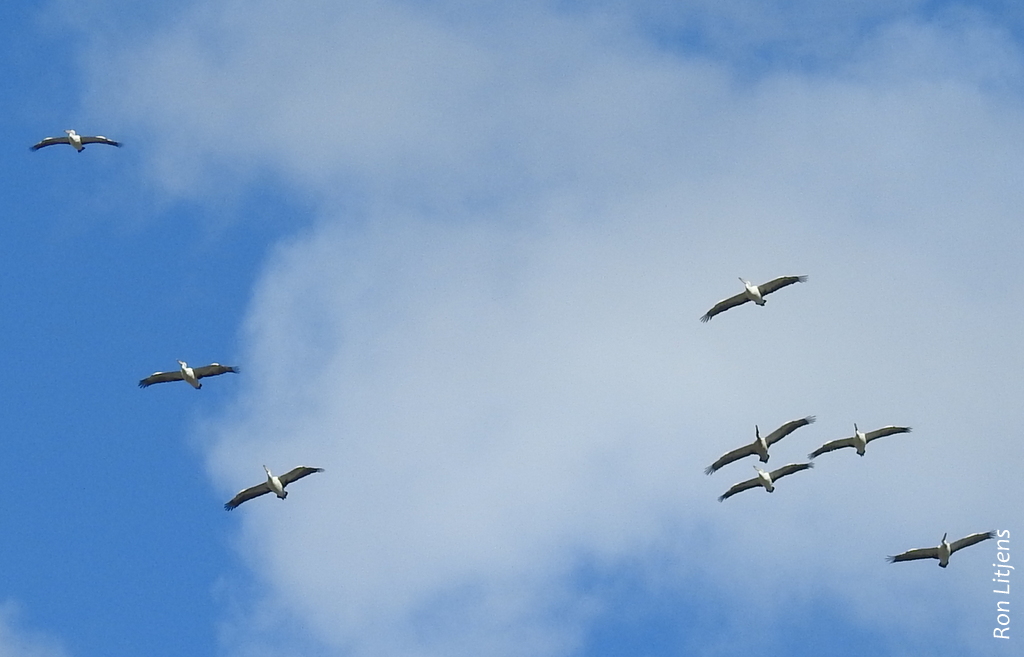
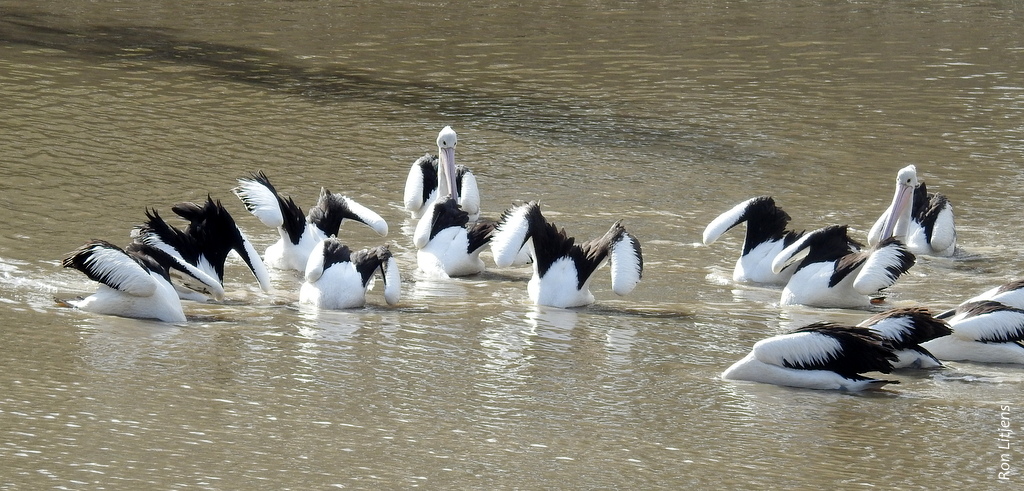
The sight of a ‘squadron’ of Yellow-tailed Black Cockatoos overhead is a sight to behold but recently large flocks of Australian Pelicans (Pelecanus conspicillatus) have proved to be equally impressive if not as noisy and at a higher altitute, pictured left. Pelicans are one of Australia’s heaviest flying birds. They can be found Australia wide around large bodies of water – salt, brackish or fresh.
Pelicans move across the landscape following their food source. Australian Pelicans are primarily fish eaters although they have been known to eat birds as well – ibis, ducks, etc.

The uncommon sight of large flocks of pelicans in our district recently may been due to the drought in other parts of the country. They usually settle on large bodies of water but have been noticed swimming (pictured above) and feeding (pictured below) on some of our local farm dams.
I wonder what the fish think.
The Mutants of Flowerdale
Almost ten years ago this blog featured a leucistic magpie (click HERE). Leucism, derived from the Latin word leuco meaning white, is a genetic mutation resulting in the partial loss of pigmentation in an animal. In the case of birds it means the excessive white colouration of the feathers.

Last week whilst driving through Flowerdale I noticed (with my aged eyesight) on the hill in the distance a solitary bird that looked like an Australian Ibis (Threskiornis moluccus) – but with short legs. Telephoto pictures revealed it to be another leucistic Australian Magpie (Gymnorhina tibicen), pictured left, with more white feathers than normal. Interestingly it was photographed in the same field as the bird in the previous blog eight years ago. This bird and the one in the previous blog look very similar and given magpies can live to 30 years old in the wild it could be the same bird. If it is, this bird has been living in the same location for a long time, something that I had never considered before.

In a neighbouring paddock was another leucistic magpie, pictured right. This bird had an almost exclusively white back and white pants (all the recognised magpie forms have black ‘pants’). Maybe the mutation is being propagated through the offspring. In smaller birds this propagation is not likely to persist as white birds tend to stand out more and therefore are more easily targeted by predators. Magpies however are probably big enough to look after themselves.
Regularly patterned magpies like the Black-backed Magpie below did not seems to be fazed by its differently patterned companion. We can all learn something from that!





 Focus On Fauna