The Flame of Life
In July, a couple of years ago, I was in Yea’s old Cemetery. In this sombre place of weathered stone and wrought iron, hard soil and lichen, the cemetery’s oldest headstones are in poor condition, contributing to the awareness of the brevity of life and the inevitability of death and decay.
In the brooding heaviness of a grey day in this place, a party of flame robins (Petroica phoenicia) was on the move. Perhaps half a dozen birds, of which 4 at least were males.
The contrast was heart-changing. The mood lifted, the beauty shone, it was like poetry.


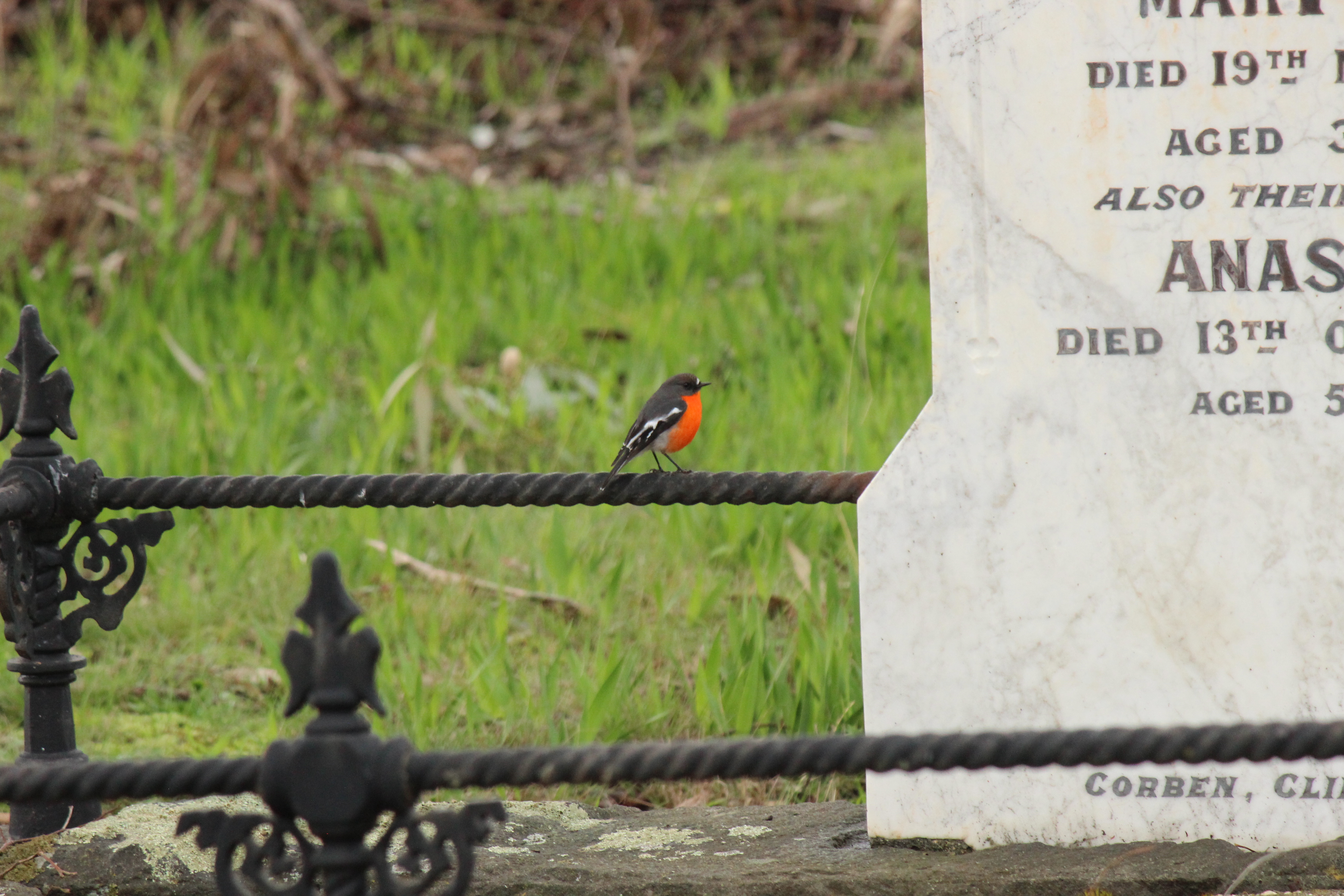
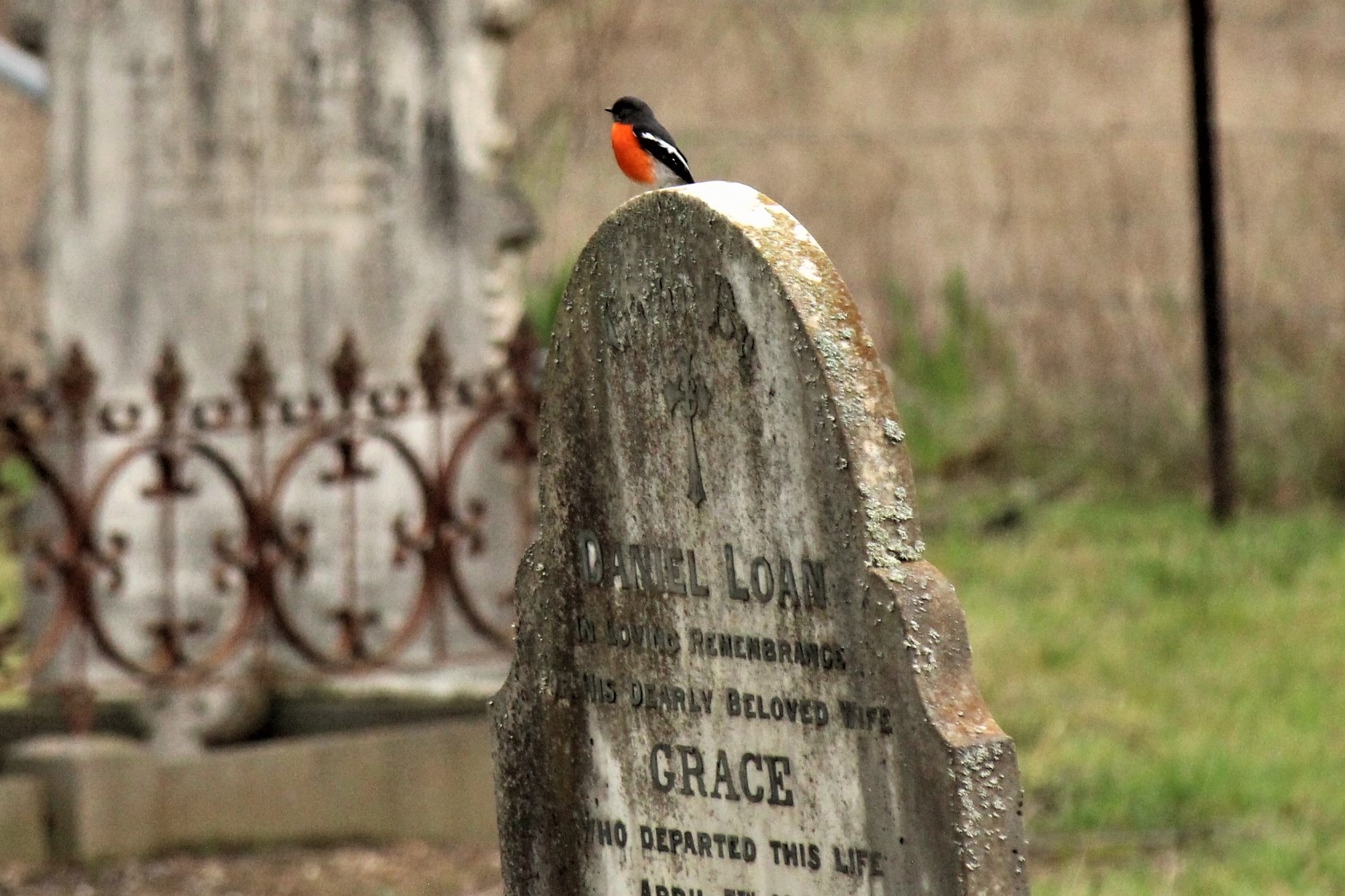
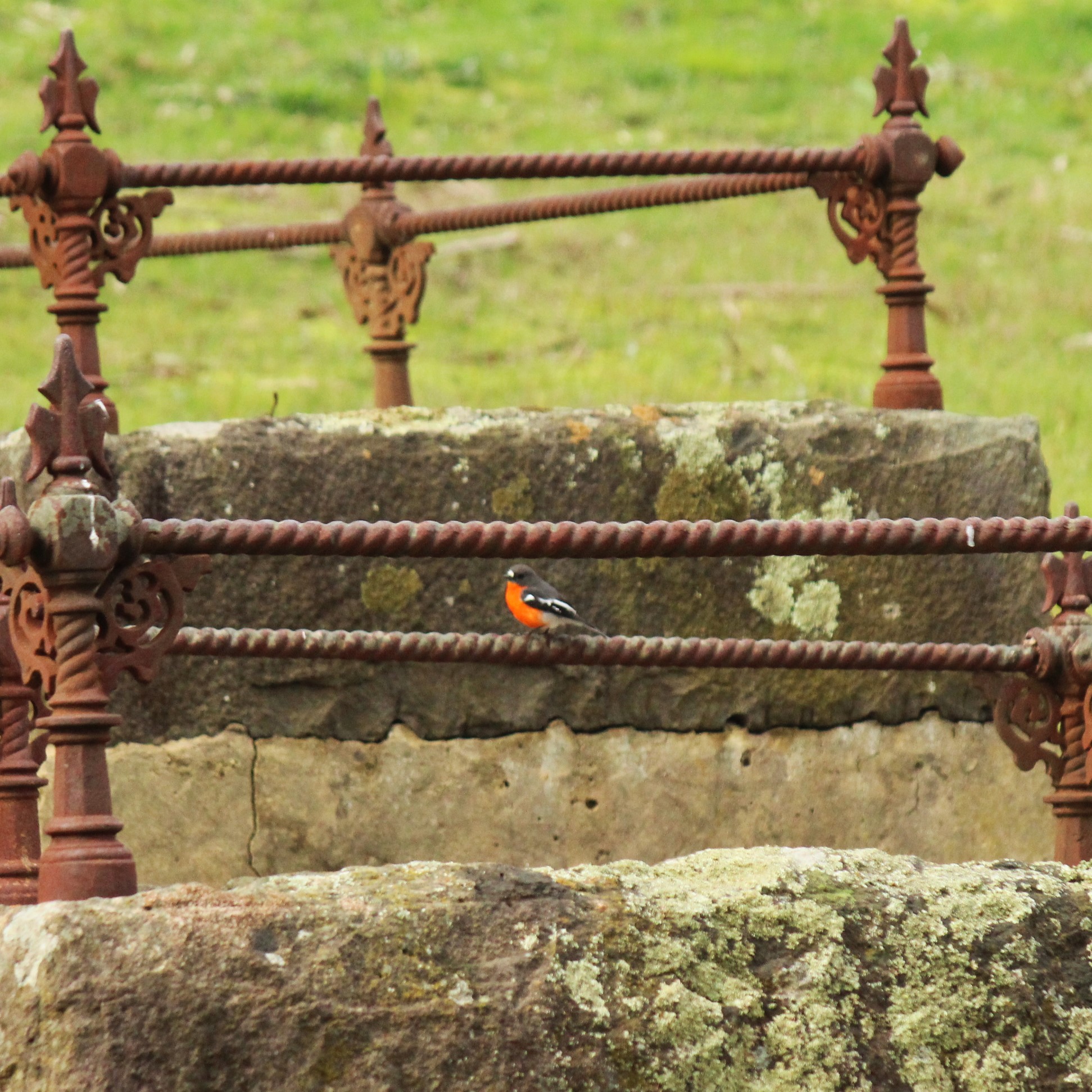

To invert the solemn words from the Funeral liturgy, In the midst of death, we find the flame of life.
Handy camping tool – or not?
On our last camping trip the sandy tent area we pulled up at was pitted with unusual crescent shaped holes in the ground – cause UNKNOWN.

Included in our camping kit for the first time was a new gadget, a ‘black light’ (ultraviolet) torch. Why? Because some minerals such as calcite and hyalite (a form of opal) fluoresce under ultraviolet light. And what better way to entertain yourself after the sun goes down than doing a bit of UV fossicking.
Walking around in the dark with the new gizmo we found no fluorescent rocks but noticed that in those crescent shaped holes were creatures that did fluoresce. But they quickly ducked back into their holes before we could make out what they were.
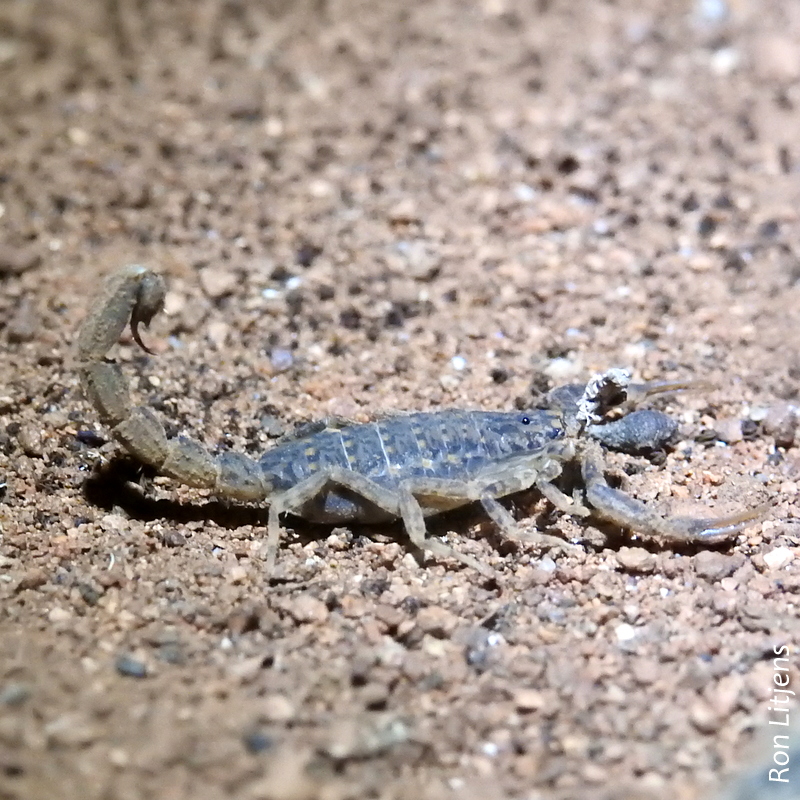
We eventually found a creature out in the open glowing bright blue in the UV light (pictured above). We did not really have to use our white-light torch (pictured right) to identify it as a scorpion.
Scorpions are arachnids (just like spiders). They have eight legs, two large pincers and a tail equip with a sting. No one understands what chemical in the scorpion exoskeleton causes it to fluoresce under UV light. Nor do they understand the reason why scorpions fluoresce at all.
Suffices to say that the UV torch will remain in our camping kit so we can hunt down fluorescent minerals and invertebrates. That is, if we really want to know.
Chicken, duck or goose
One of the best ways to view Australian raptors is simply by driving your car through the countryside. They are invariably hovering stationary above a field, perched on fence posts and powerlines keeping an eye out for unwary prey, or they are on the side of the road feasting on the roadkill.
Unfortunately the latter is why many raptors are killed, also being hit by cars. This is particularly true for Wedge-tailed Eagles that cannot get out of the way quick enough as a car approaches.
I recently encountered a Whistling Kite (Haliastur sphenurus), pictured left in the middle of the road feasting on what I assumed was a dead native animal. Upon stopping the Kite flew into a nearby tree. The carrion turned out to be an extremely large form of poultry, pictured below.


Whistling Kites are found in Australia, New Guinea and New Caledonia. They feed on a large range of animals, birds and insects. In summer they hunt live prey but as the weather cools down and there is less food around their diet turns to carrion. People more expert at poultry than I identified the dead bird as a rooster. In this case the carrion was as large as the kite itself. I can only assume that the dead rooster was dropped on the road by a fox.
The dead bird was removed from the road and thrown into a nearby field to avoid a further accident.
One dead bird is enough.
East versus west
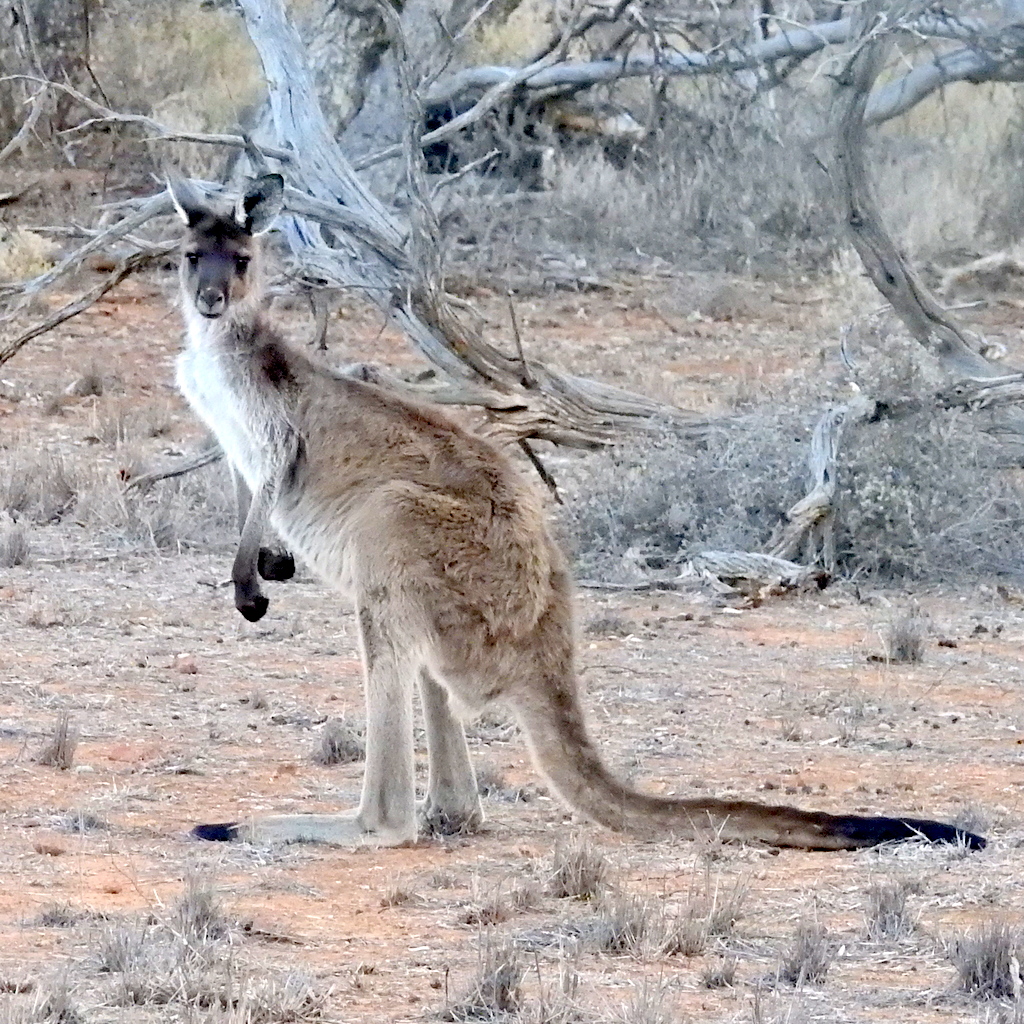
Macropus, coming from the Ancient Greek meaning long foot, is a genus of kangaroo of which only 2 of 15 known species still exist. Commonly they are known as grey kangaroos and the existing species are the Western Grey Kangaroo (Macropus fuliginosus), pictured left and the Eastern Grey Kangaroo (Macropus giganteus), pictured below. Until recently the Red Kangaroo was considered a sub-genus but has been determined to be sufficiently different to be its own group.
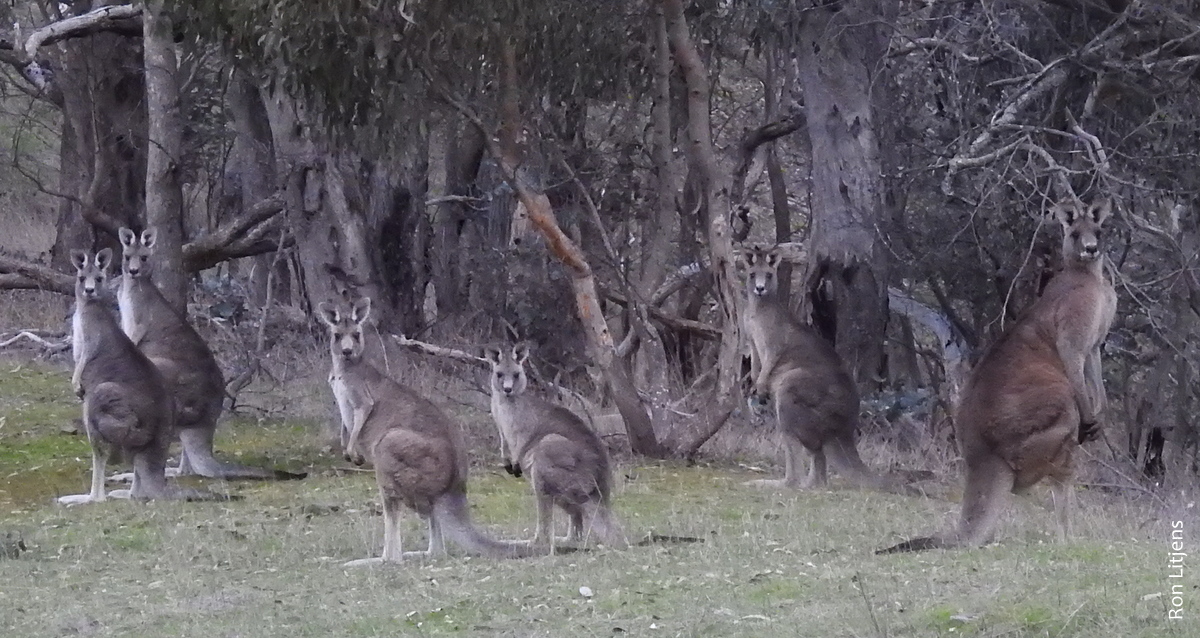
As the name suggests the two species have different ranges. The distribution for the Eastern Grey almost follows the north-south Queensland, NSW, Victoria border and all territory east. The range of the Western Grey extends across southern Australia but stops around the Victorian border and extends north into NSW. So there is overlap in southern NSW.
When photographed together it is relatively easy to tell the two species apart. The Western Grey is browner and smaller with a darker face. But if you a travelling in the Riverina and you see a roo the definitive test is that the Eastern Greys have fur over all their ears whereas the Western Greys only have fur at the base of the ears.
The challenge is to get close enough to tell (without running the animal over!)
Jacky Winter and the Flying Ants
This sounds like a title for a children’s adventure book. It’s really just an observation on some interesting behaviour. The Jacky Winter (Microeca fascinans) is not common around the Strath Creek – Yea district, but is occasionally observed. It is a bird of farmland, woodland, dry scrub. They have no distinguishing marks except the tail has white feathers down each side (which I could not get the bird to flaunt in these photos). In Spring their call goes ‘peter-peter-peter-peter’.
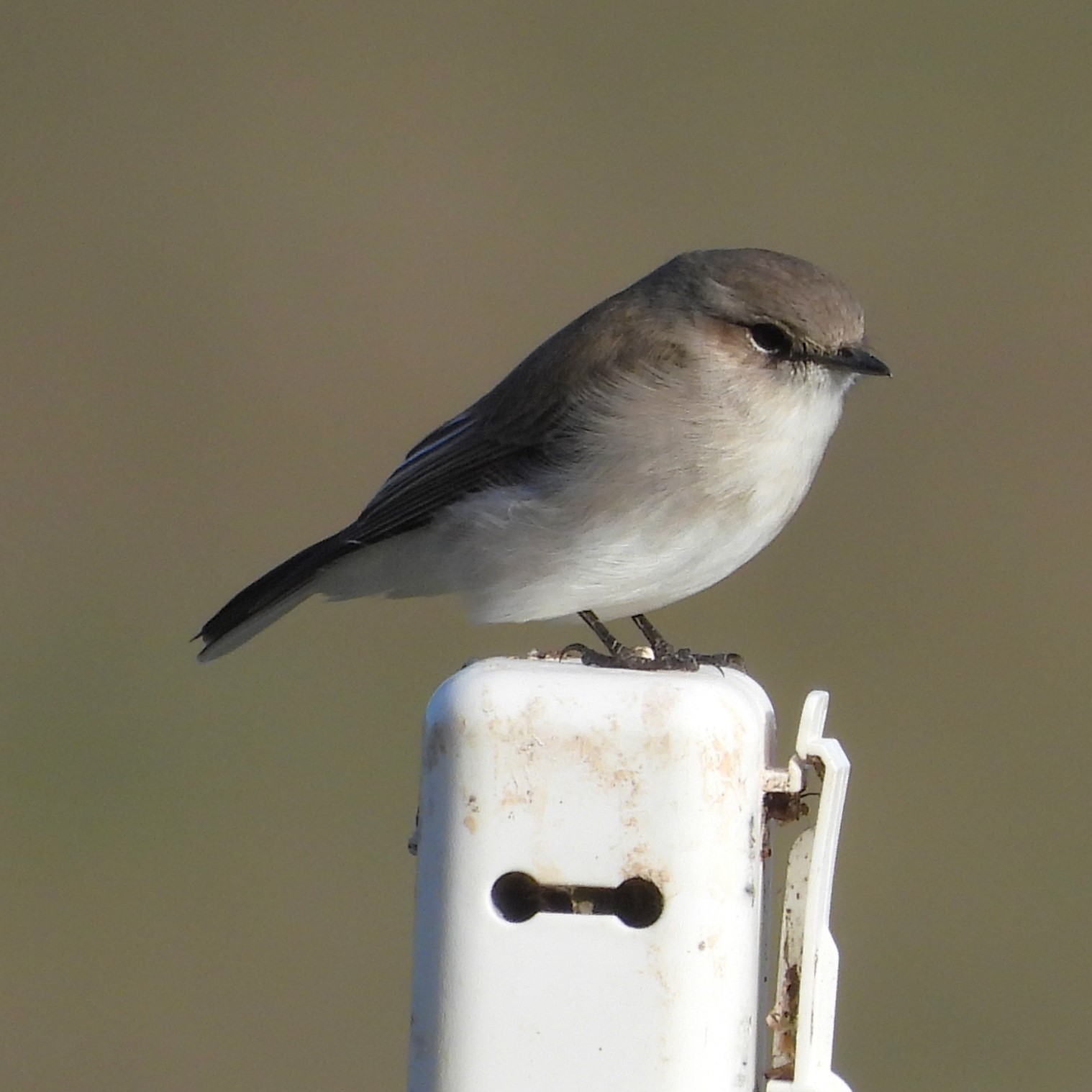
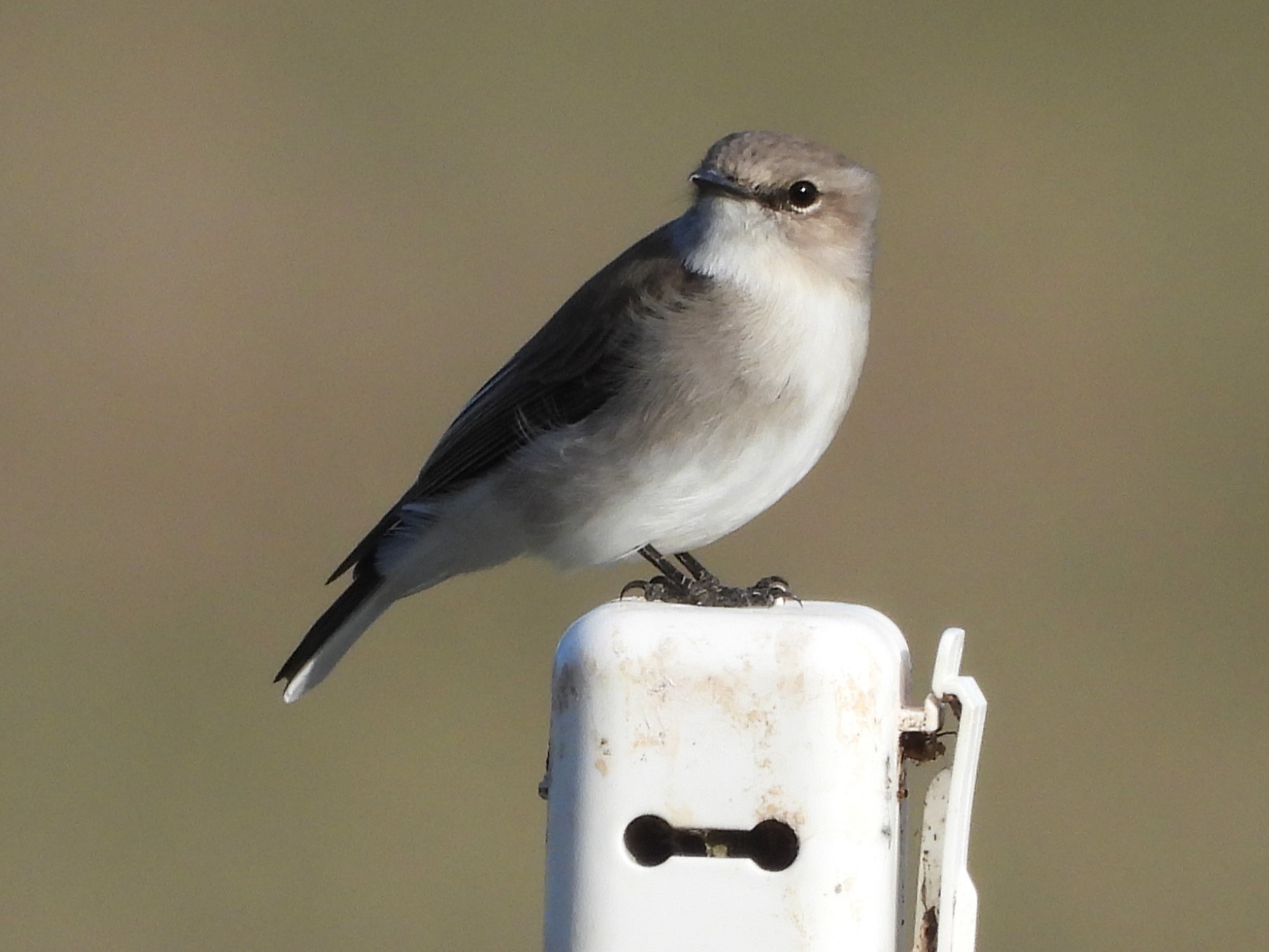
I saw 4 of these birds engaging in typical behaviour recently. They were all sitting on fenceposts and sallying out to catch flying insects then returning to their posts. What was the occasion? It is flying ant time! The air had many flying ants and these insectivorous little robins were loving it.

Once a year at the end of summer, ants and termites produce swarms of winged females and males known as alates, called queens and drones respectively. They come pouring out of the nest and hit the air in a nuptial flight. While in the air, a queen and a drone will clasp each other, and fall to the ground to start a new colony. In termites, this is done by biting off each other’s wings, whereas ant alates keep their wings (but the drones die when their work is done). There are thousands of species of ants and I do not know which species these black ants are. Different species time their flight according to warmth, humidity, day-length; some are spectacular, all are wonderful.
As well as reproducing the colony – only one couple needs to be successful for that!- this proliferation of flying protein is a bumper provision for the ecosystem, feeding all manner of spiders, birds, reptiles, bats, predatory insects.
Sometimes the overproduction of seeds or eggs or alates in nature seems so generous and helpful to other species, it makes one question the view which sees nature as highly competitive and only concerned with survival of the fittest. There is a strong sense of cooperation and mutual care sometimes.
Humans, take note!
In black and white
I wish to discuss the way to distinguish the sex of two of our commonest black and white birds and the distinction is conveyed by the arrangement of the black and the white.
Magpie-Lark
Magpie-larks Grallina cyanoleuca, are common enough, often found stalking the verges in pairs making a sweet duet of calls. It is quite easy to pick the male from the female: the male has a black beard and strong white eyebrow. The female has a white face and throat. Males are bolder and for this reason, most of the photos I have of this bird are of the male. I have had to ask for help for a photo of a female.
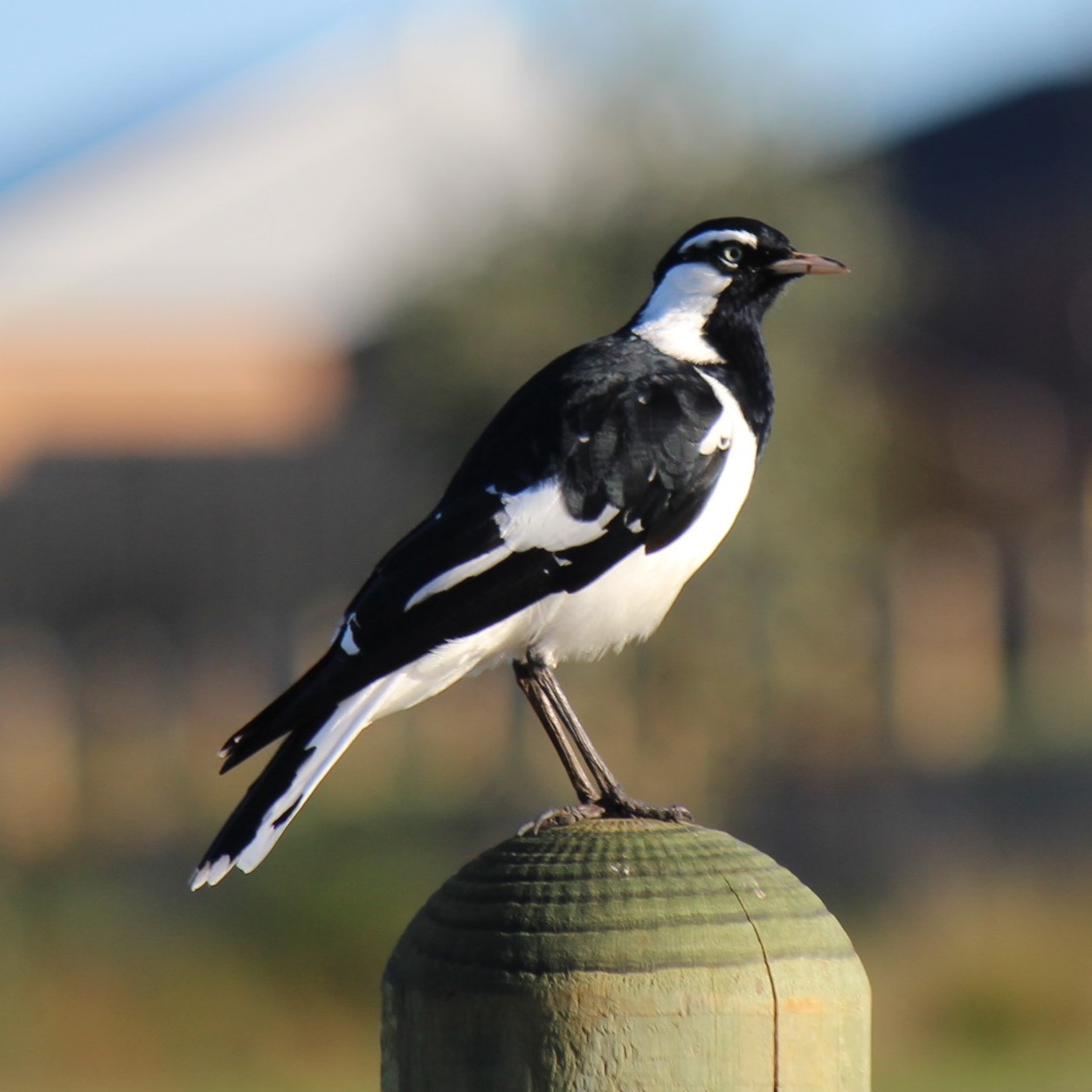

Australian Magpie (Cracticus tibicens)
It is also more likely that magpie photographs will be of the male with its clear white back – whether the white is confined to the neck nape (as in the Black-backed form) or travels intact down to between the wings (the White-backed form). The rule of thumb is that the White-backed in Victoria is found south of the Dividing range and the Black-backed is found north of it. In Yea we can get both types, but black-backed is more common. See Ron’s post Evolution for more discussion on the different races.
In all the races of magpie, the female has the same pattern of white but her white is mottled, flecked with grey, less distinct.


In the Western race of the magpie found in Perth, the female’s mottled back takes a special form – it looks like a spray of diamonds on a black background.
‘

Learning the different details of our common birds helps us rediscover their beauty and wonder. Differentiating the sexes isn’t always quite so black and white.
Are you over the Rainbow?
Each October, thousands of Australians participate in Birdlife Australia‘s Great Aussie Birdcount, and each year since it began in 2014, the most commonly reported bird is the Rainbow Lorikeet. Trichoglossus moluccanus is a stunningly beautiful parrot, loud, bold, and easily tamed to come for regular feeding by homeowners. Colourful, small flocks of them streak across the sky in every town, park and woodland.

When I was a child in Melbourne last century, rainbow lorikeets were not ever seen. When I lived on the Murray River in the 1990s, they were rarely seen but gradually increased in appearances. When I came to Yea in 2012, rainbow lorikeets were infrequent visitors. As of 2025, they are common in all those places. This shows that they are native birds who have thrived with the changes we have brought to the environment with our farming and urban landscapes – as have Noisy Miners and Magpies.
This colourful species was not present in Western Australia until they turned up in Perth a couple of decades ago; now their population is over 40,000 and reports that they are out-competing local species for nesting hollows are raising concern. They have recently arrived in Tasmania, and New Zealand has a program to prevent their multiplication there. They have also increased their range along the Eastern seaboard of Australia well beyond their original confines. Some have also established in Hong Kong.
They have some endearing qualities: they are monogamous, pairing for life mostly it seems, they are friendly and very photogenic. Both sexes look alike and they adapt well to aviaries – if you can put up with the screeching. But balancing those endearments, they display some negative qualities – raiding fruit trees, expelling nestlings of other birds so they can take the hollows, and dominating the limited food resources of the bush. The WA Department of Agriculture estimates $3 million damage annually to fruit crops by rainbow lorikeets.
They are adapted to eat nectar, pollen and fruits with a specialised ‘brush tongue’ that scoops out the nectar from within flowers. Trichoglossus means ‘hairy tongue’. (Eeww!)
So what’s the verdict? Pest or prize? Beautiful or bad boy? Are you over the rainbow? For all the problems they cause, it is hard to resist such very pretty faces. I’m grateful to live with them.
Bird Hunters Part 2: the Pouncers
The big beak on a butcherbird ends with a wicked spike – which is useful for the act of butchering. Today’s bird hunters are those with small feet and big beaks: butcherbirds and currawongs. They are pouncing opportunists who will take anything – rodent, insect, bird, nestling – and they must be doing pretty well because they are common, increasing throughout the country.


It is completely horrible when these birds rob nests. On this site, there are many sad tales of nests full of hungry young nestlings that suddenly go missing, and sometimes the culprit is identified as a currawong or butcherbird (eg here). Especially vulnerable are Grey Fantails and Willie Wagtails.
Currawongs (Streptera) come in two varieties in our district – the Pied (S. graculina), common around towns and the Grey (S. versicolor), a bird of forests and hills. The Pieds used to come to town for the Winter and spend the summer in alpine areas, but since the 1980s, observers have noticed that they now are present all-year round (though numbers are a bit smaller in the warmer months). Some people think this is responsible for a decline in small songbirds in cities and towns, as they are so effective at finding nests and robbing them.
The Grey Butcherbird (Cracticus torquata) gets its name from the alleged habit of this family of birds of hanging larger prey on spikes or in forks of branches to eat at leisure. I have never witnessed this and it certainly seems to be more common in American species of Shrike (which are the same family). I asked around and one friend supplied the following photo of a butcherbird with a forlorn young Rufous Fantail strung up.

While butcherbirds and currawongs are the foremost predators of nests, there are plenty of others who will have a go – kookaburras, ravens, magpies and some raptors. A rare raptor, the Square-tailed kite (Lophoictinia isura), makes a living by soaring low over treetops and dropping suddenly on to prey, especially nestlings of bigger birds. I have only seen one once in the district.
Butcherbirds and currawongs will take small birds other than nestlings when they can. They sit and watch for a vulnerable moment, drop on the victim and grasp its neck with the powerful beak.
This post is more about the horrors of nature than its delights, though all, of course, a necessary part of the circle of life. The moral might be: beware of predators with big beaks and small feet, and there seem to be a few around the world at the moment.
Red-footed Booby
This is a most astonishing find. On the Hubbard’s farm Three Sisters a Wedge-tailed Eagle dropped a strange prey. Upon investigation a large seabird was found with a wingspan over a metre wide and a long tube-nose typical of ocean-dwelling birds. It proved to be a Red-footed Booby (Sula sula).


Boobies are similar to gannets, they fly acrobatically and dive from on high plunging into the water to catch fish. They nest on offshore islands, this species on Christmas Island among other places, often building nests in trees.
The discovery of a Red-footed Booby in Strath Creek is unexpected (of course) and actually quite sad. The species was thought only to live in tropical areas but increasingly it has been found moving further south with records increasing in NSW. This will be linked to warming sea-surface temperatures associated with the strengthening of the East Australian Current under climate change. Some oceanic birds, especially younger birds – this bird is in immature plumage – get lost and driven by storms inland where they perish. The only other records in Victoria of this species are on a beach in East Gippsland (2013) and on a basketball court in Essendon (2019). Some wit said, they must be booby-traps.
Normally birds like this are encountered on “pelagic trips”. This is when a group of birders go far out on a boat, scatter some fish oil and berley and take photos of everything that flies past. This is the only way to observe albatross, storm-petrels, prions, fulmars, shearwaters and boobies. They feed on the wing and are able to drink seawater, excreting the salt out through specialised nostrils on their beak. Collectively they are called ‘tube-noses’.
There are other species of Booby, the Brown, the Masked. In Hawaii, there is a blue-footed booby, but this one is definitely not that. It has red feet.

Finding a seabird like this on a farm 70 kilometres inland is an astonishing discovery, and it may be part of a bigger story – changing waters, changing bird movements, adaptation and adjustment and the ones that get lost along the way.
[Thanks to the experts on the Facebook page Australian Bird ID for help with this identification.]
Additional Note: The Red-footed Booby was placed in the freezer and has now been delivered to the Melbourne Museum (on 21st Feb 2025) who will examine it and archive it.
Quit while you’re a head
The presence of Common Garden Skinks (Lampropholis guichenoti) in the garden (pictured below) is the sign of a healthy ecosystem. As is the appearance of butterflies. And whilst the presence of both may bring a thrill to the heart you know that Mother Nature can be cruel.

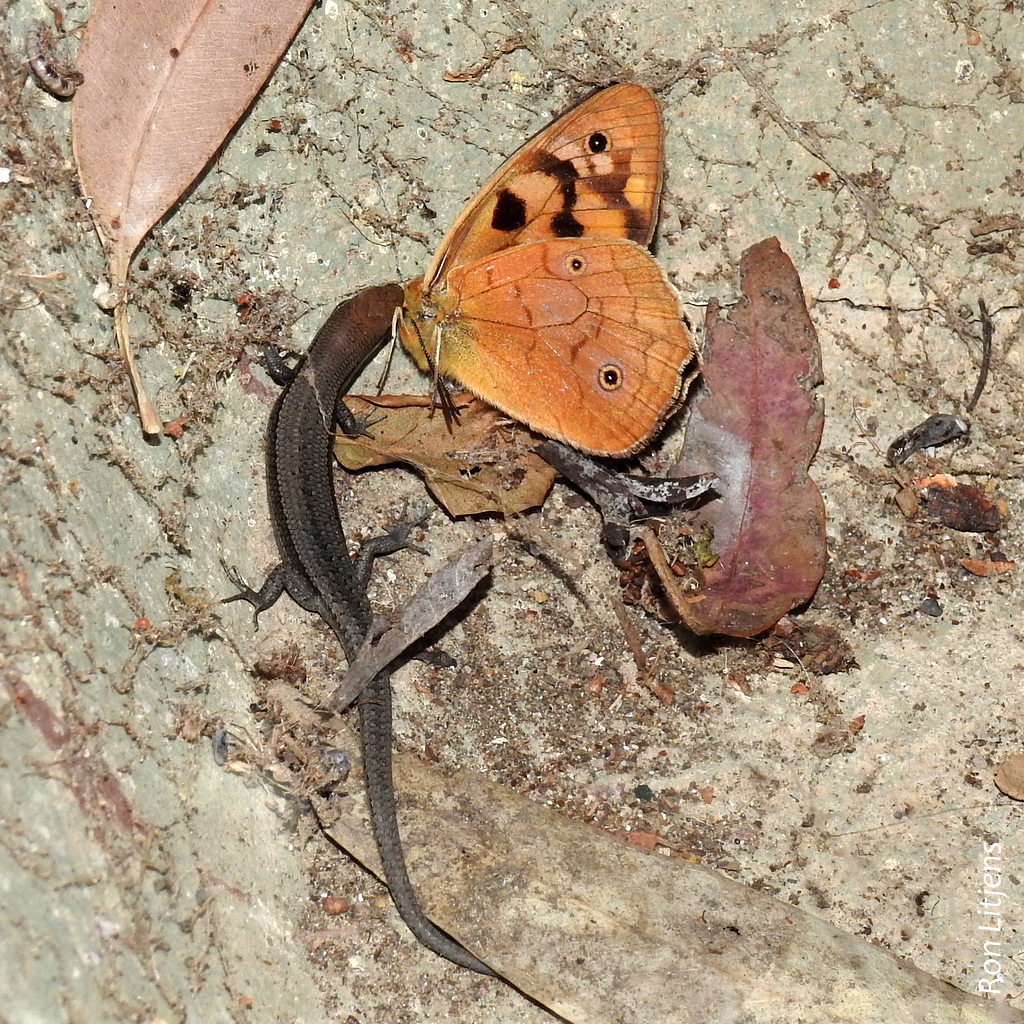
I hadn’t really thought about it but lizards are carnivores, in particular insectivores. They will eat caterpillars, grasshoppers, flies and cockroaches as well as other invertebrates such as worms, slaters and spiders. This was forcefully brought home when I witnessed a mighty struggle between a skink and a Shouldered Brown (Heteronympha penelope) butterfly (pictured left). The spectacle lasted over a minute but in the end the skink managed to bite off the head of the butterfly. Lizard 1, Butterfly 0. Unfortunately my attempt to photograph the scene disturbed the lizard and it disappeared into the garden leaving what I thought was a headless butterfly corpse.

The next day the headless butterfly body was still alive walking and flapping around (pictured right). For many creatures the respiratory system is controlled by the brain and the head contains the respiratory opening. Removing the head results in rapid suffocation. However this is not true for insects. They breathe through holes on the side of their bodies, called spiracles. Respiration and other functions are controlled by brain cells (ganglia) distributed throughout the body. So for a short period of time the butterfly can continue to function.
What about the butterfly? Well, it won’t suffocate but it will probably die of starvation – its mouth was in its head!




 Focus On Fauna