It’s a strange old world
 Spring and summer are the mating times for many Lepidoptera – butterflies and moths. Their spiralling and sometimes frenzied courtship flights are precursors to eggs being laid on the favourite food plants of the future caterpillar. Currently in egg-laying mode is the Australian Grapevine Moth (Phalaenoides glycinae), pictured left.
The Grapevine Moth is a mainly black and cream day-flying moth endemic to south-eastern Australia. The adult moths have handsome bright orange tufts of hair on their legs and abdomen (below right). The caterpillars feed on native plants such as Hibbertias and Paperbark Mistletoe.
 When grapevines were introduced to Australia it was found that the Grapevine Moths were partial to this plant — hence their name. They lay eggs on the underside of new vine leaves and the caterpillars feed on these and the developing fruit. The picture below left shows a moth in the process of laying an egg (click photo to enlarge).
And so it is that the native Australian Grapevine Moth is now regarded as a pest in its own land (and other countries) for feeding on an introduced plant. To make things even more strange, one of the methods of trying to control this moth and other insect pests was the  introduction in 1862 of the Indian Myna (Acridotheres tristis) — a strategy that did little to control the Grapevine Moth and created an even bigger nuisance, the bird itself.
It’s a strange old world we live in.
.
.
.
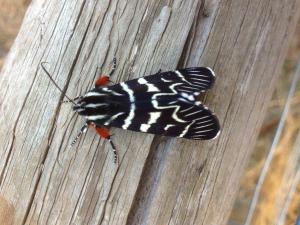 P.S. Coincidentally, Dave Hubbard just sent in this photo (below) of the same insect. They are obviously making an impression at the moment.
A host of herons

White-faced Heron on a Flowerdale roadside
Often solitary, the heron is reported to form companies in autumn, but autumn is still away off, and 14 seems quite a large flock – maybe something to do with El Niňo weather patterns perhaps?


The White-faced Heron has also been known as Blue Crane, a misnomer since the cranes (Brolga and Sarus Crane) belong to a separate family, despite their superficial similarity. It is found throughout Australia as well as Indonesia, PNG, New Zealand and nearby Pacific islands.
Janet sent us the central photo above which shows one surprise sighting in her daughter’s backyard pond in suburban Montrose! Click for a closer look.
White-faced Heron calls:
Aliens IV: Infestation
Those who are fans of sci-fi will know that when aliens invade earth they multiply in egg-shaped sacs hidden somewhere safe like in an underground cave or cellar. Those sacs may or may not contain a human host on which the developing alien might feed.

The photo above taken recently could be of a terror (the new collective noun for aliens) of extraterrestrials or it could simply be a group of Hemipterans (true bugs) hatching on a Poa sp. seed head. Hemiptera is an order of insects that includes cicadas, leafhoppers and aphids, which are distinguished by common sucking mouthparts. All insects in this order either suck on the sap of plants (below right) or on other insects (below left).

Gumtree Bug instar sucking sap
Hemipterans do not undergo a complete metamorphosis, changing from a caterpillar to an adult, as moths and butterflies do. Instead they are born looking similar to the adult and progress to that state through a series of ‘moultings’. This is known as hemimetabolism or partial metamorphosis.
Pictured (top) is a species of Stink Bug. The newly hatched young (known as instars) look very similar to the adult but lack the wings. There are five stages of ‘moulting’ before the adult emerges. The 1st instars do not move far from the egg shells. Their food source is the bacteria left on the egg shell by the female adult when the eggs were laid. After the first moulting, the young (2nd instar) will wander off to look for food.

Assassin Bug sucking on a beetle
Both the instars and adult stink bugs (more politely known as Shield Bugs) will excrete a foul-smelling liquid when disturbed. This liquid deters predators such as wasps which paralyse the bug and use it as a host for its larvae.
I reckon this has the makings of an Alien movie blockbuster. I just need to work out who plays Ripley.
Kingfishers calling
 We have had a Sacred Kingfisher calling for many weeks now in the corner of a paddock where two very large old trees (a Candlebark and a Yellow Box) grow just 5 metres apart next to a windbreak planting of younger trees and shrubs. It occasionally comes down to some Swamp Gums beside a large dam.
Recently the kingfisher had some competition and there were three birds calling for much of the morning, generally separated by a distance of 200-300 metres. The “kek-kek-kek-kek” call we were hearing from the three birds is mainly given by the male during courtship or to advertise its territory. Our resident kingfisher still seems to be solitary so, while he successfully saw off the competition, he is yet to attract a mate.
-
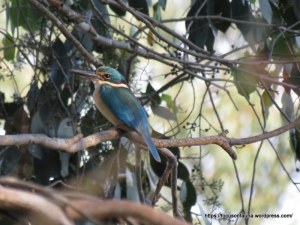
- Our regular bird in a Swamp Gum
-
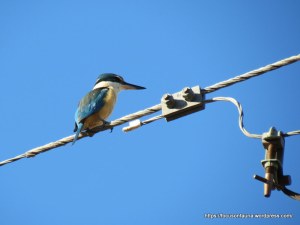
- An interloper
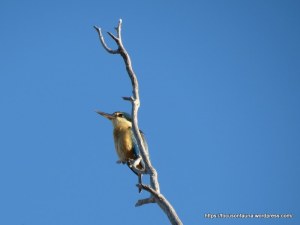
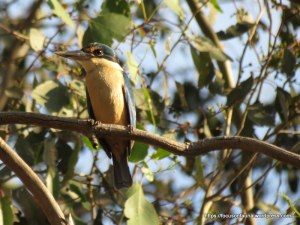
 Despite its name, the Sacred Kingfisher rarely eats fish. Its prey is varied but usually includes small reptiles, crustaceans and insects, and it can often be found in woodland some distance from water. It is however regularly sighted in the Yea Wetlands and there is a good chance to see one on World Wetlands Day, Tuesday 2nd February, when a guided “Walk with the Birds” will be held in the wetlands. Click on the flyer at right for full details.
The Sacred Kingfishers calls can be heard in a previous post, Colourful kingfishers.
Freaking Phasmids, Batman
While cycling along a dirt road during the holidays we had to take evasive action to avoid running over what appeared to be a large green praying mantis crossing our path. Even though a post concerning a similar incident was published earlier last year, we decided to stop and get a photo, only to discover not a mantis but a stick insect – a Violet-winged Stick Insect (Didymuria violescens). I have seen fewer than half a dozen stick insects in my life, the last one more than four decades ago. So this was a rare treat.
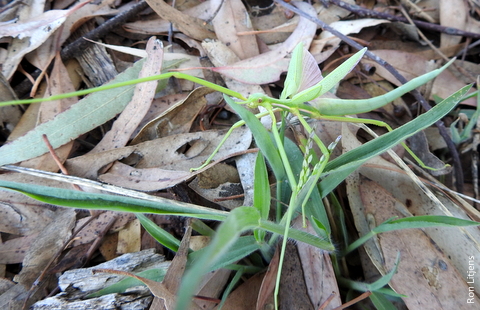
Stick insects come from the order known as Phasmids, from the Greek word phasma meaning phantom. This refers to their ability, because of their colour and shape, to blend into the background and not be seen. They have several other defensive weapons including spurs, chemical sprays and brightly coloured wings which they use to startle predators.
 Stick insects are nocturnal, making them even harder to find. They feed on leaves and other vegetation – the Violet-winged Stick Insect eats mainly eucalyptus leaves. The female can produce viable eggs without mating and all such offspring will be identical females.
This specimen seemed in a hurry to get somewhere, flashing its pink underwings to warn us off. It finally found the one tuft of green grass in the brown landscape where it hung on and froze (another defensive behaviour), blending in beautifully … and its sitting so still is a photographer’s dream.
Grand design
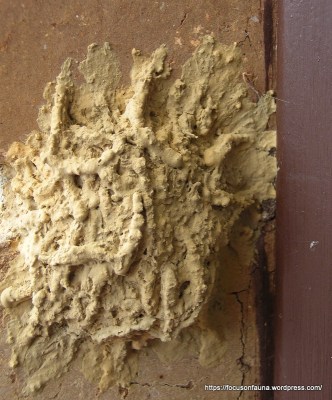
Common Mud-dauber’s nest

Shaunna and Chris’s nests
Shaunna and Chris from Strath Creek sent us a photo of a “waspy-thingy” and several nests on a steel locker in their car-port. As it happened we were already following the progress of a similar mud-dauber wasp as it constructed a nest on the brick wall of our house.
The Common Mud-dauber nest consists of a number of parallel tubular cells constructed of mud by the female who emits a high-pitched buzz as she builds. On completion of each open-ended cell, the mud-dauber lays an egg, then goes in search of a spider, which it paralyses with its sting, carries to the nest and forces into the open cell to provide food for its larva when it hatches. The cell is then sealed and eventually the whole nest is padded out and smoothed over with mud, and finally an array of randomly oriented ridges as decoration/disguise/reinforcement (who knows ?) completes the structure (see picture above).
To make life more difficult for the mud-dauber, there is often the threat of a Cuckoo Wasp (Stilbum cyanurum) female laying its eggs in the mud-dauber’s nest while it is away collecting spiders. The cuckoo wasp larva feeds on the mud-dauber’s larva and/or on its spider food supply.
The pictures below include the gradual construction of the mud-dauber’s nest.


Some fascinating details about the mud-dauber can be found on the WA Museum’s website, including a comparison with one of the similar looking potter wasps of the genus Delta, which is actually in an entirely different family (Vespidae) compared to the mud-dauber which belongs to the family Sphecidae. Potter wasps build a different shaped mud nest and stock it with caterpillars rather than spiders. The Orange Potter Wasp was featured in a previous FoF post.
Mr (or Ms) Prickles takes a bath
 Sitting by the dam is the place to be in summer, as the wildlife go there to cool off as much as we do. The best time is just as the sun is setting (probably when the sun is rising too but I give that a miss). The dragonflies are still out, the birds come down for their evening splash and sometimes, if you’re really quiet, a rakali might put in an appearance.
This week I was surprised by the appearance of Mr (or Ms) Prickles, one of our resident echidnas, ‘beetling along’ over the hill. It headed straight for the dam and didn’t stop until it was half submerged and taking a long drink (pictured left). I imagine it’s pretty dusty and thirsty work licking up ants all day.
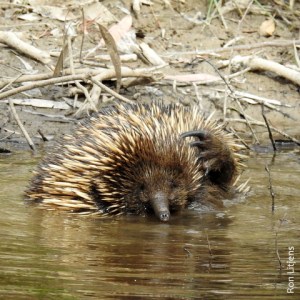
After the cooling drink, the echidna obviously decided to extend its bathing regime and forged deeper into the dam where it spent a good ten minutes wallowing and scratching itself. We all know echidnas spend most of their time looking for their primary food source, ants and termites. They do this by breaking open logs, unearthing rocks or digging holes in the ground  with their large claws. It is rare that you get to a good look at those claws because echidnas avoid threats like humans by digging themselves into the earth when approached. During the bathing session, however, the claws were on display (pictured right) as the echidna scratched in between the spikes. Washing done, it spent another ten minutes simply lolling about cooling off.
The cost of a half-hour session at the Ronlit Baths and Day Spa – nothing.
The look of bliss on the echidna’s face (pictured left) – priceless.
A jumble of gliders
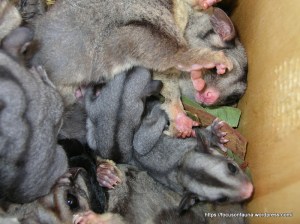 These nest-box photos were actually taken a few weeks ago but seem to have been put in a fogotten folder. They are, however, worth sharing as they show an uncountable jumble of Sugar Gliders (Petaurus breviceps) including several youngsters.
It’s also interesting that this particular nest-box had been home to Brush-tailed Phascogales for some time. When last checked some months ago the box was found to be full up to the lid with shredded bark and phascogale scats, but appeared to have been abandoned. The Sugar Gliders have either removed or compressed some of the bark and scats and added their preferred bedding of eucalypt leaves.
There is no semblance of order in the gliders’ house – they just all tumble in on top of one another in a higgledy-piggledy fashion. Must be snug in winter, but uncomfortably hot at this time of year!
Click on each photo to see in more detail.
What’s the buzz?
The Wild Pollinator Count last month taught me that there are many things, not only bees, that pollinate our flowers. And if you are thinking bees, the range of native bees is large.


Recently I have noticed native Blue-banded Bees (Amegilla cingulate), pictured above, in our garden. About the size of a European Honey Bee it has blue bands on the abdomen – five if it’s a male, four if it’s a female. They are solitary bees that do not build a hive. Instead the female bee constructs a tunnel in the ground where it lays an egg and then looks after the hatched larva by feeding it nectar. The male sleeps outside, locking its jaws on a grass stem or stick then just hanging there (pictured below).
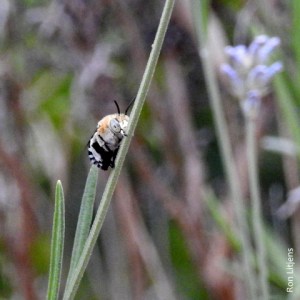
Blue-banded Bees are ‘buzz pollinators’ – dislodging hard-to-get pollen by rapidly vibrating the flowers with either their wings or head. They are particularly attracted to blue and purple flowers and in our garden are found around the lavender and pelargoniums.
Trying to get a photograph of these bees is difficult. They flit about very quickly. They also seem to be more aware of intruders than the honey bee and if you get too close they will stop their feeding, fly over towards you and look you up and down. Most disconcerting.
But if you sit there long enough …
Bronze beauty !
 Usually at this time of year it’s a Stubble Quail that causes the heart to beat faster when it is inadvertently flushed from long grass with a clatter of wings. But the quail are absent this season, and lately it’s the Common Bronzewing that produces the same effect when it suddenly flies off a few metres away in the back of our property near Strath Creek. Often all you see is a fairly dull-plumaged plump bird rapidly flying off low to the ground, and disappearing into shrubbery or low branches of a tree.
While driving along Upper King Parrot Creek Road the other day, we spotted a bronzewing sitting in the middle of the road – which is actually not an uncommon occurrence near Carver Creek. The bird eventually flew off and perched in a roadside tree, so as usual it was screech to a halt and out with the camera to try to get a shot. Fortunately the light was just right to capture the bronzed green iridescence of its wing that gives the bird its common name, but which doesn’t always show up in photos. Bronzewing indeed!




 Focus On Fauna