A nesting story
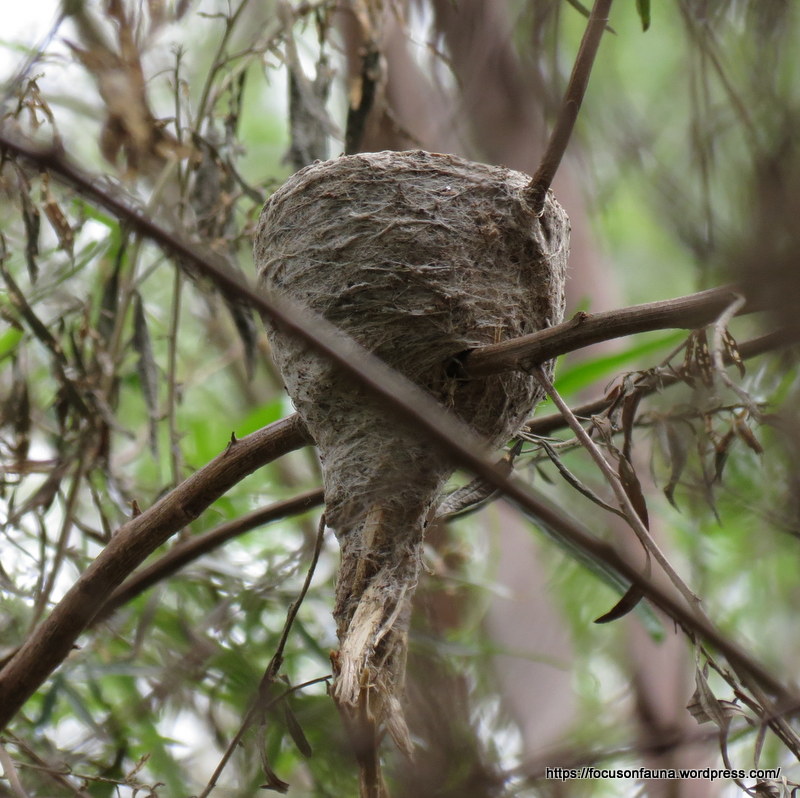 After spotting this intricately constructed Grey Fantail’s nest in Coonans Reserve, Flowerdale recently, we were reminded to finally get round to editing the many video clips of a pair of Grey Fantails that nested in the back of our shed last January (see previous post A Grey Fan-tale).
We managed to record the full story, from nest construction right through to the successful fledging of two young chicks, which we thought was well worth sharing. Three clips can be seen on YouTube as follows:
Nest building
Feeding
Leaving the nest


A Real Life Nursery Rhyme
Everyone knows the story of Humpty Dumpty – an ovoid-shaped character that one moment was sitting on a wall and the next was not. A real-life enactment of that happened at our house recently. WARNING, there is no happy ending.
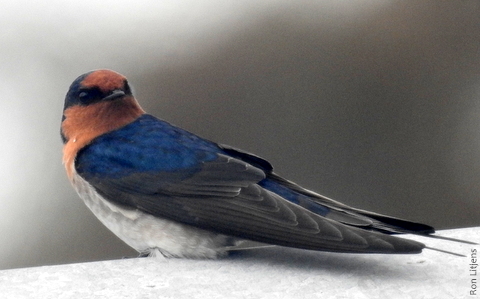 For more than a month Welcome Swallows (Hirundo neoxena), pictured left, have been building a nest under our deck. Hirundo is Latin for swallow and neoxena comes from the Greek words neos meaning new and xenos meaning visitor. Those who have encountered these birds before will know that welcome is a relative term. The construction and subsequent occupation of the nest usually results in an enormous splatter of faeces on the ground below the nest. But for the sake of being able to watch ‘close-up’ the development of young swallows in the nest it was worth the mess. The nest was built on a horizontal PVC pipe. Looking down through the deck we counted four eggs and the parents were ever attentive on the nest.
 On Saturday night a very large storm swept up the valley and on Sunday morning the nest was no more. Strewn on the ground were pieces of mud and unfortunately, broken eggs. It did provide a good opportunity to study how the nest was constructed. We all know that the swallow nest is built of mud. It is sometimes mixed with grass and carried by the beak-full to the construction site. (I sometimes think that wasps are smarter carrying their mud balls in their legs). What I didn’t realise was that the nests are lined with twigs, feathers and fur. Beautiful, if it stays attached to the wall.
.
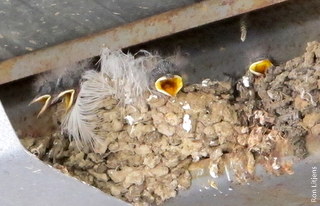 The two parents returned to the failed nesting site for weeks after the incident. But at another nest site (pictured left) we may get a ‘Happy ever after‘ ending.
Bum steer


The birds in question are the Golden Whistler and Crested Shrike-tit, and as you can see from the photos below, although they both have yellow, black and white colouring and are similar in size, they are distinctly different in patterning, bill-shape and body stance. They also differ in habits and call – click on the audio bars below to hear local examples of the calls.


What’s in a name?
Readers of this blog will have noted that every animal is described by its common name (in Bold text) followed by its scientific or binomial name (in italics and brackets).
I’m nothing to crow about
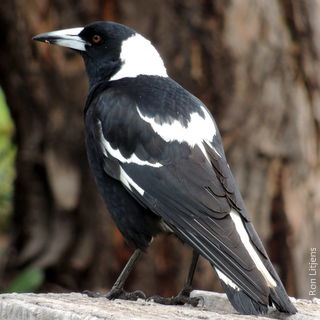
The common name is what most people use to describe an animal, such as magpie or water-rat. The trouble with using the common name is that in different locations that name could mean different things. For example the Australian Magpie was called that because it looked like a bird in England called the Magpie. The European Magpie however is of the crow family – an entirely different beastie. Stranger still, the same animal could have different names depending on location, for example, the Magpie Lark (Grallina cyanoleuca) in Victoria (pictured below) is called a Mudlark in WA and a Pee-Wee in NSW.

Identity crisis? Which state am I in.
Every plant, animal, fungus, etc. on earth has one and only one binomial name – making identification of everything very exact. The binomial name has a two-word format – Genus species, where the Genus is a noun and starts with a capital letter and the species is an adjective and has no capital. Both words have to be either Latin or the latinised form of another language, usually Ancient Greek.
The Australian Magpie has the binomial name Cracticus tibicen. Cracticus is from the Greek word kraktikos meaning a flute-player and tibicen is from the Greek word meaning noisy – a very apt description of this bird’s loud and melodious call.
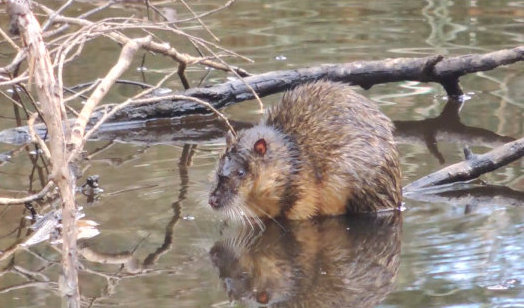 Water-rat is a common name used to describe a whole lot of rodents around the world. The binomial name for the Australian Water-rat or Rakali is Hydromys chrysogaster. It is derived from four Greek words – hudro meaning water, mys meaning mouse, khr so meaning gold (as in colour) and gaster meaning belly – the literal translation is Golden-bellied water-mouse.
So remember when you are travelling around the world (or even interstate) the common name could mean different things. To be specific you’ll need to use the binomial name. It also helps if you speak a Mediterranean language at home.
Make every bird count!
 As part of National Bird Week 2015, which runs from 19th to 25th October, BirdLife Australia is conducting its second annual AUSSIE BACKYARD BIRD COUNT.
You can get involved as a citizen scientist, even if you’re a relative novice. All you need is 20 minutes and keen eyesight (or binoculars) in your ‘backyard’ of choice, which may be your actual backyard, a local park or reserve, or your favourite patch of bush.
Simply record the birds you know and look up those you don’t on the new Aussie Bird Count app or through the website. There you can find statistics and information on how many people are taking part near you and the number of birds and species counted in your local area, and the whole of Australia!
If you’re in the Flowerdale-Strath Creek area, you can come along to an introductory walk and talk about the count on Saturday 17th October starting at 10am in Coonans Reserve, Upper King Parrot Creek Road, Flowerdale. Sue McNair, Environment Officer with Murrindindi Shire Council, will have all the information to get you started on the count. Download the flyer for the event here: Make every bird count. Sue is hoping for a good response so the bird data can be used in the Shire’s environmental planning processes.
So, join in the count wherever you are – not only will you get to know your feathered neighbours, but you’ll be contributing to a vital pool of information from across the nation that will help determine how Australian birds are faring.
Last year 800,000 birds were counted – this year let’s make it one million!
Buried treasure
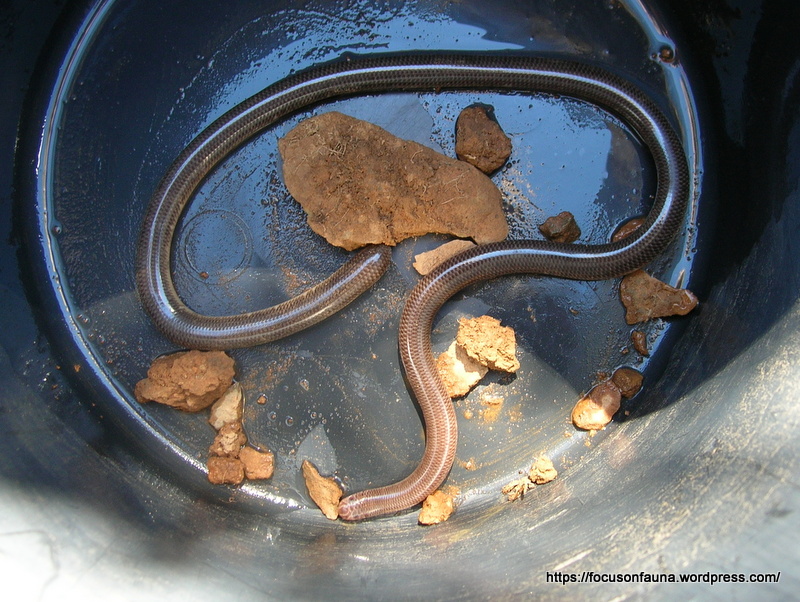 While shifting some rocky soil to renovate a frog pond, we exposed what looked like a very large shiny worm. It was in fact a blind snake, Ramphotyphlops sp.
Blind snakes are non-venomous and rarely encountered as they spend most of their time burrowing in search of ants and termites. Not needing to see far, their eyes are greatly reduced and appear as dark spots covered with a transparent scale.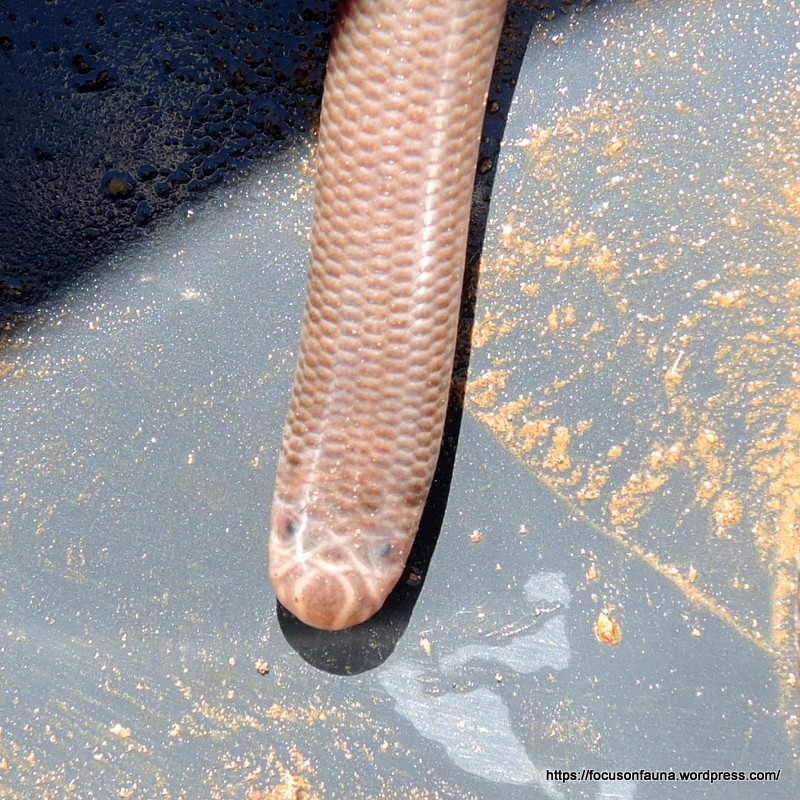
When trying to identify this particular snake we were surprised to find 42 species listed in our field guide for Australia, although only 4 have been reliably recorded in Victoria. From the descriptions and distribution maps, we think this is a Blackish (or Gray’s) Blind Snake (Ramphotyphlops nigrescens), probably a juvenile judging by its pinkish-brown colour, compared with the dark adult.
A positive identification would require counting the number of rows of mid-body scales and close examination of the head scales. However, not being experienced in handling snakes, and not wishing to stress the animal, we quickly returned it to the soil pile where it rapidly disappeared into a near-invisible crevice, to devour more termites we hope.
Arm the battlements—the walls have been breached

Mister
For more than a decade now we have smugly sat on the side of our hill watching the ferals invade the lowlands. Not the animals such as foxes, rabbits and cats. They seem to be everywhere and unstoppable. But the exotic birds. Down in the nearest township sparrows and the like mix it with the native birds. We have watched with dismay the advancing tide of Indian Mynas along our local roads from the direction of the big cities but somehow felt safe in the thought that the birds would stick to the open pasture lands. There has not been a sign of them in our woodland hilltop stronghold.
Then last week jumping out of the understorey next to the house was a feral of a totally unexpected type, a Blackbird. The walls have been breached; all is lost.

Ms
The Common Blackbird has the scientific name Turdus merula (somehow it seems appropriate!) – turdus being Latin for Thrush and merula Latin for blackbird. The Blackbird is a native of Europe and Asia. It was introduced to Melbourne in the late 1850s by a bird dealer. Since then the population has spread through much of south-eastern Australia.
The Blackbird is considered a pest because it competes with native birds for nesting sites and food sources and is also thought to spread weeds such as blackberry by dispersing the seed. On the upside traditionally they have been caught and used as food. A lot has been said about Indian Myna traps, not a word about Blackbird traps. Time for a Google search.
Who knows? Pies could be a common staple in our house in the near future.
Prophet of evil ?
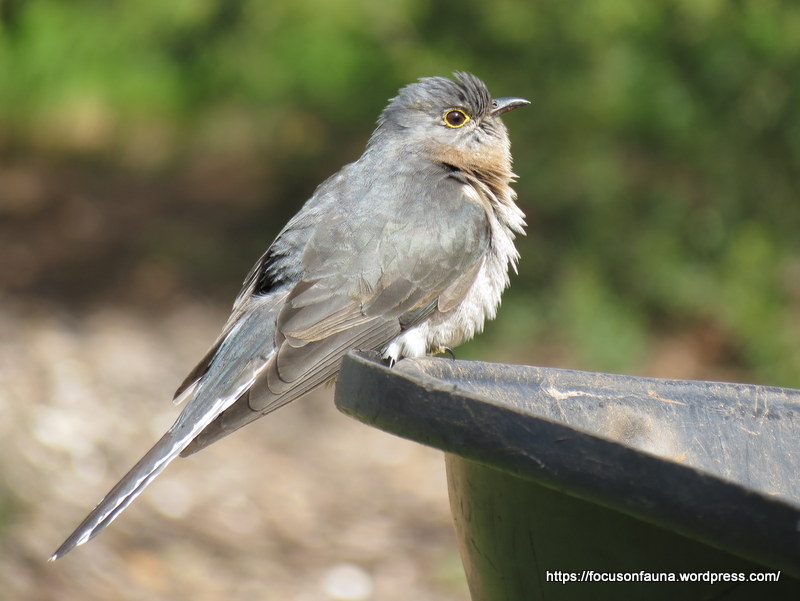 Early spring sees the return of some of the seasonal migratory birds after their winter sojourn in warmer climes further north. Examples are the Black-faced Cuckoo-shrike, Olive-backed Oriole, Rufous Whistler and, being breeding time, the various cuckoos. So far we have had Shining Bronze-Cuckoo and, prominent in our garden, the Fan-tailed Cuckoo pictured here.
Its distinctive features are the yellow eye-ring, barred tail, cinnamon colouring on its underparts and the male’s call, a mournful trill (click on the audio below).

What is not especially noticeable, despite its species name, is a fan-tail. Fraser and Gray in their fascinating book Australian Bird Names – a complete guide, suggest that this is because John Latham who first described the species in 1802, had never seen a live one!
The genus name Cacomantis meaning “prophet of evil” is however appropriate, that is if you happen to be a thornbill, scrubwren, fairy wren or any of the many other species of small birds parasitised by the Fan-tailed Cuckoo. What we find extraordinary is that although these birds clearly see the cuckoo as a threat – they emit frenzied alarm calls when it is around and even harass it – they readily feed the cuckoo chick which, to our eyes at least, bears no resemblance to their own offspring. The power of a bright gape and loud pleading squawks perhaps!

In the picture at left you can see a (blurred) Eastern Spinebill which was dive bombing and clacking at the cuckoo. You can also see the cinnamon breast of the cuckoo – we think this is a female – in the male the cinnamon extends right down the front.
Fan-tailed cuckoo calls:
Where’s the party?
 Carpentry is a lonely chore. I am currently renovating the external stairs at our place and as I don’t have a shed it’s happening under the cover of the deck. It is a cold and lonely job at this time of the year. Last weekend I was kept company by this critter which spent many hours simply walking around the stack of wood I was cutting.
Barely a centimetre long this beetle is a scarab beetle which belongs to a subfamily called Stag Beetles, so called because of the extended jaws resemble the antlers of a stag. The females are smaller in size with smaller jaws. The male stags use their jaws to fight other male stag beetles for food or mates. In this species (whatever it is) the  jaws are quite small. Some species have mandibles approaching the same length of the body in size. The fan-like antennae are composed of plates that can sense odours.
I managed to work the whole afternoon without squashing, nailing or painting the beetle as it kept up its forlorn wanderings – just a stag looking for a party.
Looping along
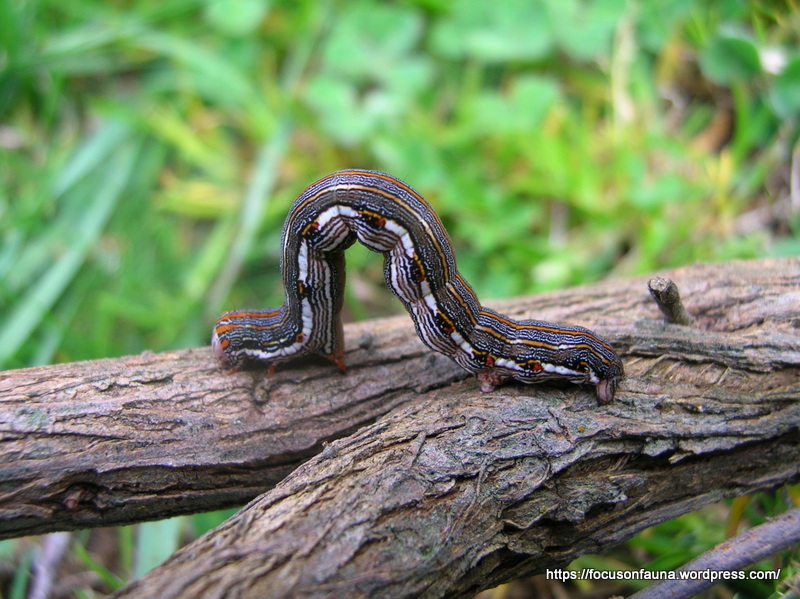 This multi-coloured and intricately-patterned caterpillar is one of a group known as loopers, so called because of their method of locomotion.
Being somewhat challenged in the leg department, a looper brings its hind clasping legs up to its front legs, forming a loop in its body, as pictured at left, then moves forward using its front legs.
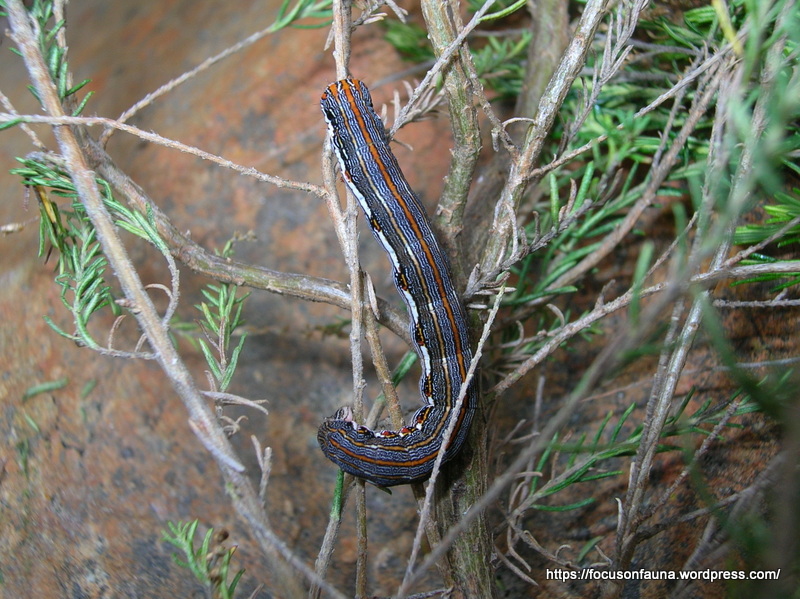
Looper caterpillars mostly belong in the moth family Geometridae, and the one pictured here is in the genus Chlenias. Unlike this colourful caterpillar, Chlenias spp moths are generally of delicate muted brown colouring.
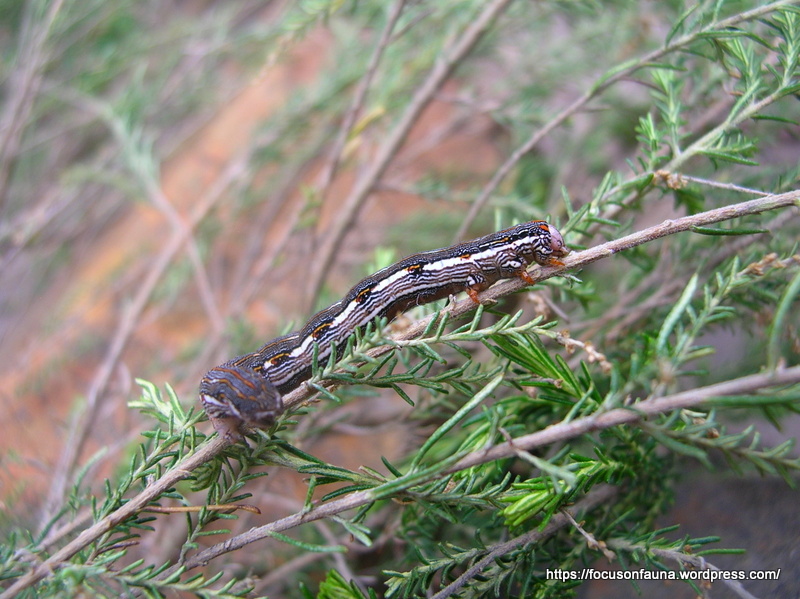
Our specimen was found on a stem of Drooping Cassinia (Cassinia arcuata). Some loopers are voracious feeders and known to cause severe defoliation of the host plant.
Thanks to Ken Walker and BowerBird for putting us on the right track for identification, so that we were able to find more detailed information, including a possible species identification, in Moths of Victoria – Part 5, where there is a photo of a very similar-looking caterpillar, also found on a Drooping Cassinia, and named as Chlenias zonaea.




 Focus On Fauna