Mea culpa!
One of the purposes of writing FoF blogs is to showcase the weird and wonderful world of fauna that exists in our valley. Taking the pictures is the easy bit. Identifying the critters is much harder (and for me, much more fun). I am not an entomologist, zoologist or any other -ologist. The veracity of the identifications should be considered taking into account those aforementioned qualifications, or lack thereof. Sometimes I later find I have identified a species incorrectly and rarely, even a genus. I do my best. Flicking through past blogs I discovered a bigger mistake than that. 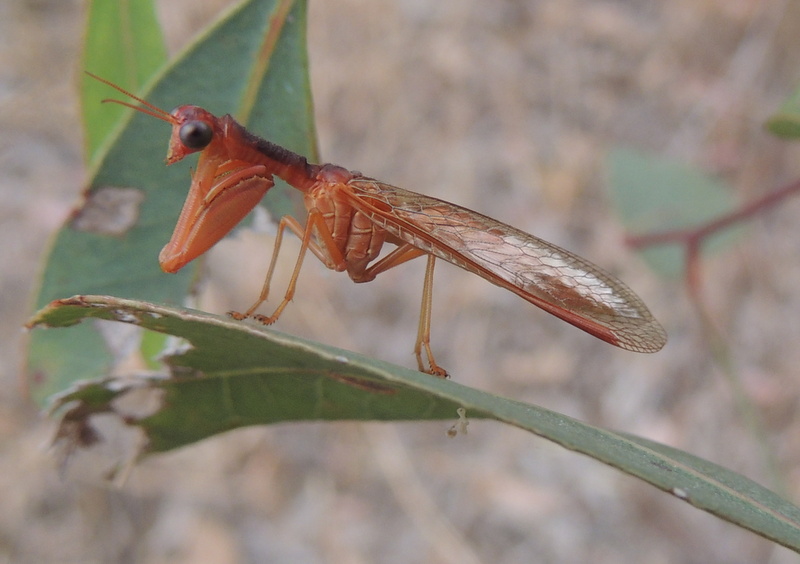 In a recent blog I identified the insect pictured left as a praying mantis, because of the barbed front legs and the way they were held. At least I got the insect bit right. It is in fact a Mantis Fly (Campion sp.). Curiously it is neither a mantis nor is it a fly. It is a type of lacewing, also known as a Mantid Lacewing. Obviously in the identification process I even got the insect family wrong. .
  The adult Mantis Fly is predatory, catching insects in the same way as a praying mantid does – with its barbed front legs. After mating the females lay thousands of eggs attached to tiny stalks. The larvae feast on spider eggs by getting into a spider egg sac and then sucking out the content of the eggs. They then pupate inside the egg sac. For those of you who saw the original blog and have been distressed about the initial identification, mea culpa. It won’t happen again.
Xmas in July
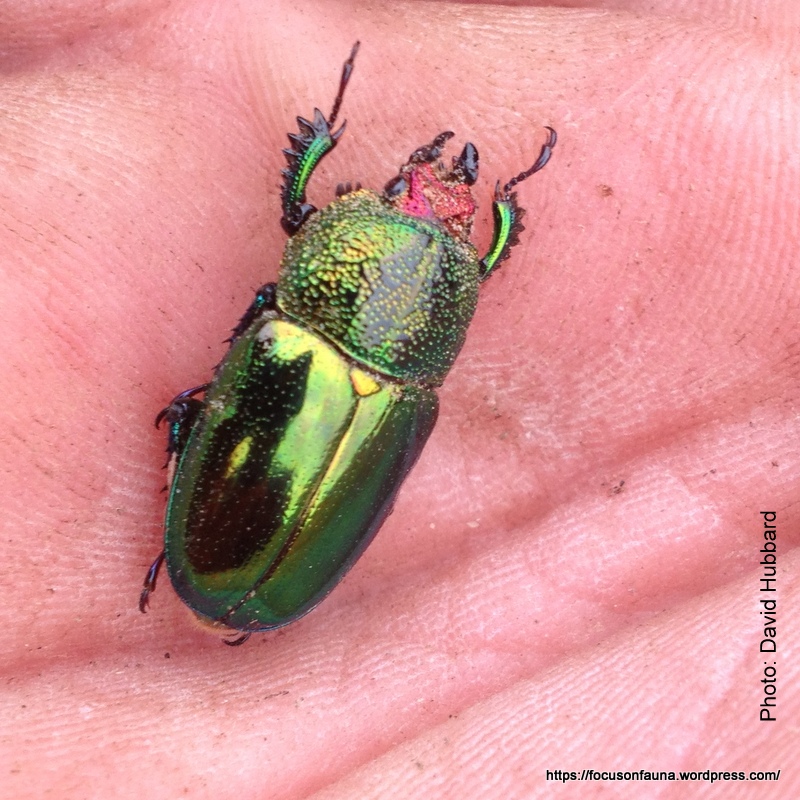 Be it spiders, flatworms or beetles, David H. from Flowerdale regularly comes up with some interesting photos for this blog. This gorgeous beetle is a good example. It’s a Christmas beetle, a common name associated with Australian native beetles in the genus Anoplognathus which has 35 species.
Named for its abundance around Christmas time, it seems to us unusual to find an adult beetle in July, at least in our neck of the woods – in northern parts of Australia they do become active earlier in the year than in Victoria. Here they normally live underground in larval form at this time of year, probably pupating near the surface by now, prior to emerging in Spring as adults. Perhaps recent rains after a dry spell triggered this one’s emergence – or is it a manifestation of climate change?
The larvae feed mainly on grass roots, whereas the adult beetles feed on eucalypt leaves and have been associated with severe localised defoliation of trees during population explosions in favourable years.
Tales from the woodpile #7
NOT FOR ARACHNOPHOBES
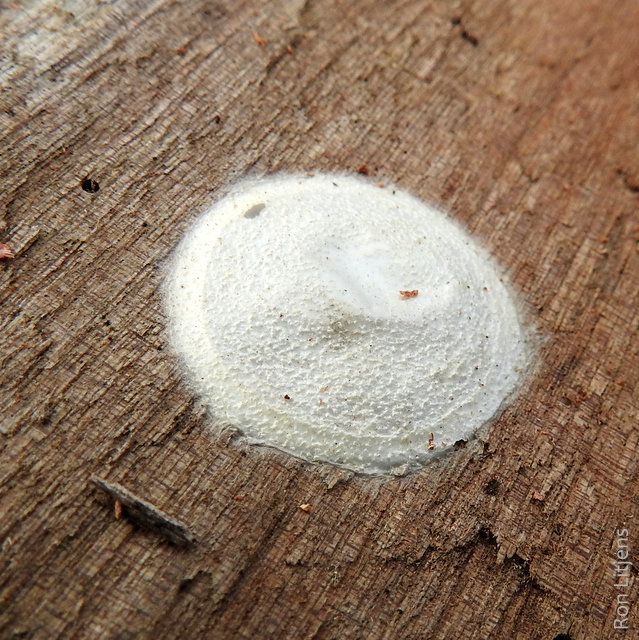 Cutting up wood last we week came across this white disc (see picture left) attached to the wood deep in one of the splits in the trunk. The owner of the disc soon revealed itself – a Social Huntsman (Delena cancerides) – which wasn’t acting too socially. After a few aggressive moves it settled down over its possession so I could easily observe it.
Spiders are different from insects in obvious ways. An insect has three body parts (head, thorax and abdomen), antennae, compound eyes and six legs. Spiders have only two body parts – a cephalothorax, from the Greek words cephalo meaning head and thorax meaning trunk or chest, and an abdomen. 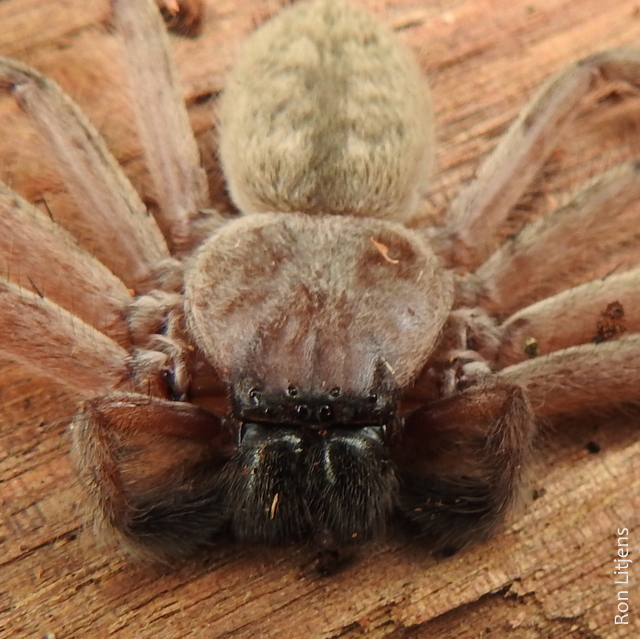 The cephalothorax has no antennae but has attached eight legs (see picture right). The knees of a huntsman instead of flexing vertically like most arthropods, flex forward. This allows the spider to be able to sidle into narrow spaces. The cephalothorax also houses eight simple eyes under which are two black chelicerae which contain the fangs. Huntsman poison is not regarded as fatal for humans.
Outside the chelicerae, looking like a pair of small legs are the palps (or pedipalps). Palps contain chemical detectors that function like smell or taste organs. In male Huntsmans the palp is also used for mating. In the final segment of the palp there is a structure that siphons up sperm packets from the male’s abdomen. The palps are then used to transfer the sperm packets to the female during mating. Once fertilised, the female produces a silk sac into which it lays up to 200 eggs, which is where this blog began (see picture above left).
This is not palp fiction. This is for real.
Who’s there ?
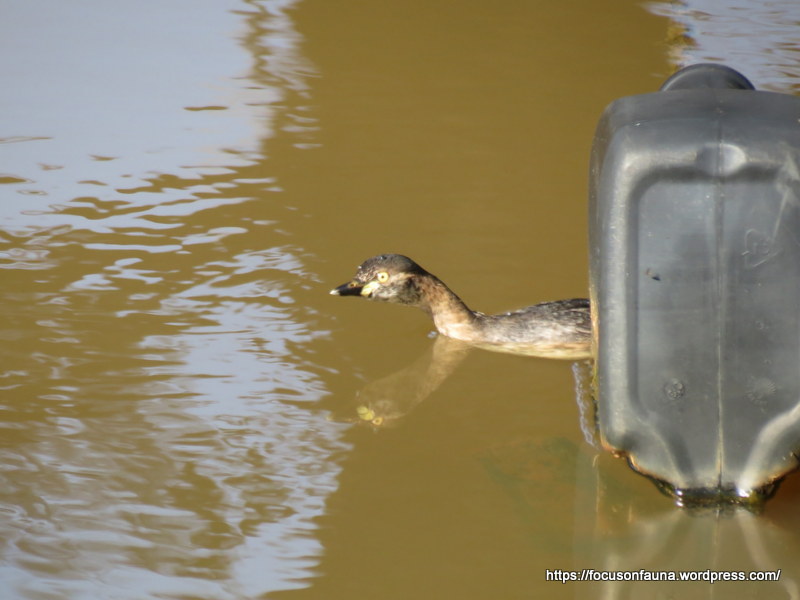 On regular trips past a small dam on our property we have been noticing concentric ripples and a fast-disappearing animal, usually near a plastic container serving as a trough intake float. Among possible candidates that came to mind were an Eastern Snake-necked Turtle and a Rakali (Water-rat), both of which have previously been seen at the dam. But our best bet was an Australasian Grebe, a common bird on farm dams, which is in fact what it turned out to be when we waited one day until it popped out from behind the float.
This grebe is already developing its breeding plumage which includes a yellow bare patch on the face, a black head and chestnut stripes on its neck and flank.
Click on any of the photos to enlarge, and click HERE to see previous posts on the Australasian Grebe.
At last!
After the bushfires of ’09, people very kindly donated several nest-boxes for various fauna that were displaced when the forest burned. We placed a rosella nest-box near the house so that we could watch it and as previously reported it has had almost constant use from possums and various bird species (but not rosellas!). We put up the remaining nest-boxes at various locations on the property.
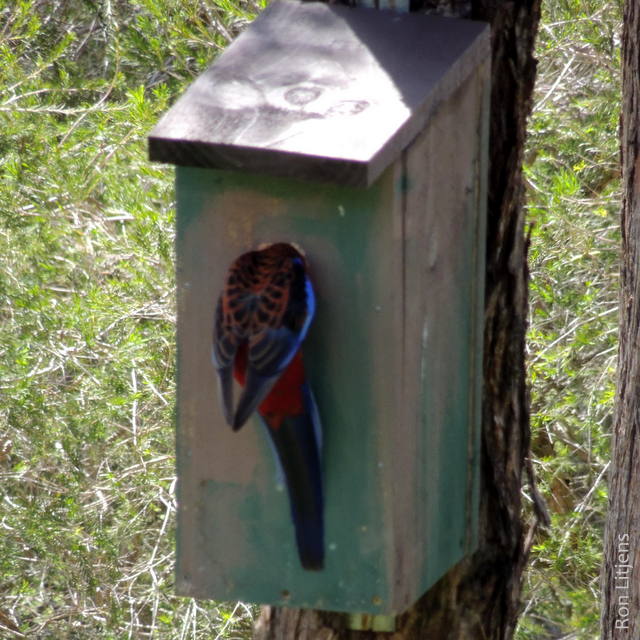
Anybody home?
The Sugar Glider nest-box has not been occupied but has received attention from curious Crimson Rosellas (pictured left). The hole is too small to allow them to enter the box, but over the last three summers the rosellas have been gnawing away at the entrance, slowly making it bigger. 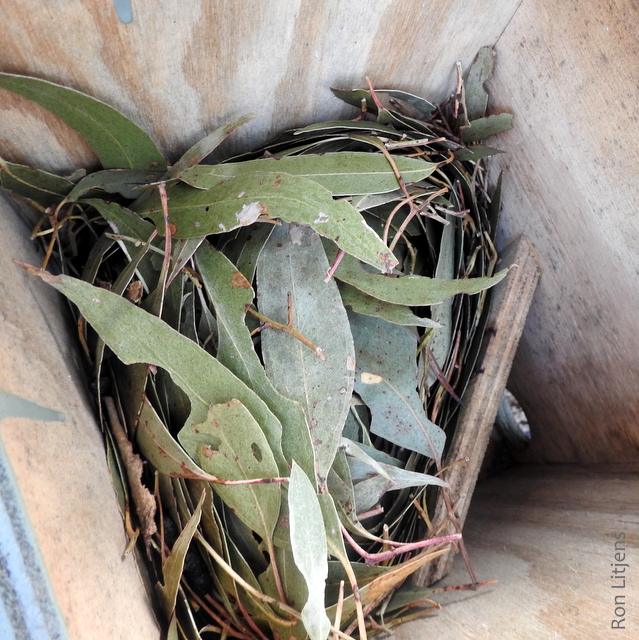 The Brush-tailed Phascogale nest-box is near the woodpile by the dam. This nest-box is characterised by a low entrance at the back of the box, with an internal baffle that the phascogale has to climb up to reach the inside chamber. For the last 5 years this
 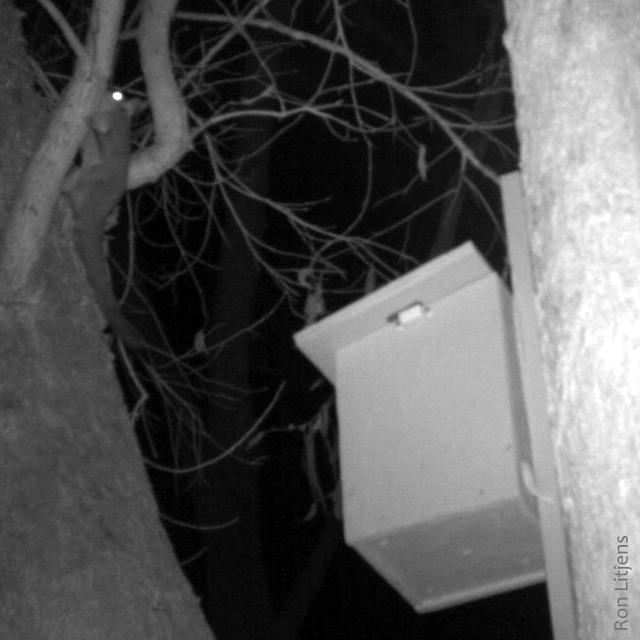 nest-box also has remained empty. But a quick inspection of the box last week showed evidence of recent activity, at last! – freshly rolled-up Long-leaved Box leaves (photo above). Rather than disturb the occupants we set up a motion-sensing camera on a nearby log to see who had taken up residence. The picture left shows a Sugar Glider just leaving the box. So now we have rosellas inspecting the sugar glider nest-box, sugar gliders in the phascogale nest-box and everything else (except rosellas) in the rosella nest-box. For all you nest-box builders out there, a label on the nest-box identifying what type of box would probably help potential residents identify their new homes correctly. Assuming they can read.
Who’s been nibbling my plants? cont.
At a couple of the UGLN Lorax Project sites we have had trouble with two large herbivores, deer and wallabies, browsing on the plants. To try and overcome this issue at certain sites this year we have started to use the large (900mm tall) mesh tree guards.

Kangaroo at a wire mesh tree guard.
Two types have been used, plastic mesh and wire mesh. Being mesh, the plants will still blow around in the wind and shouldn’t become spindly and weak.
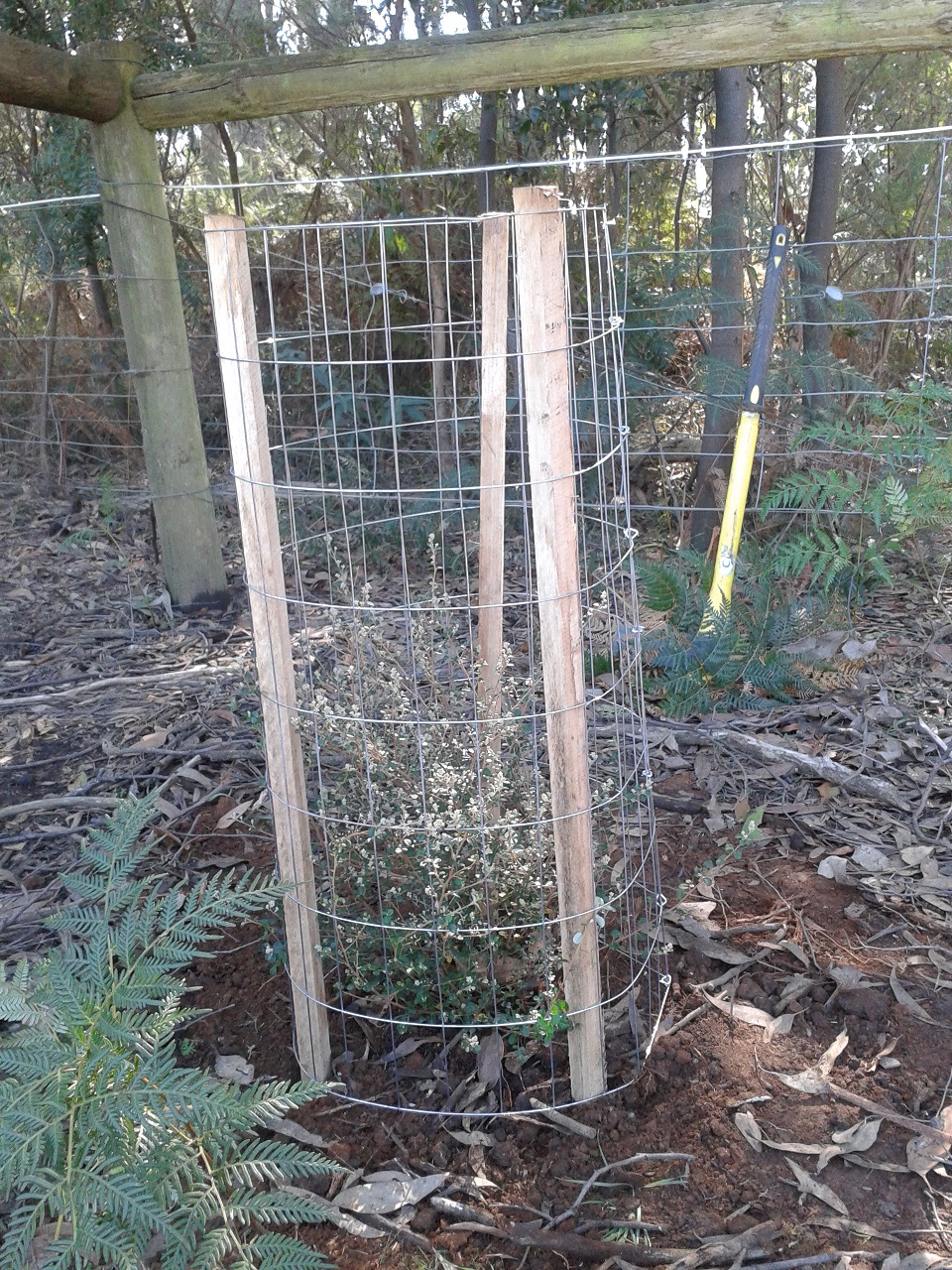
The rare Round-leaf Pomaderris protected by a tall guard.

Plastic mesh guard
The cost is around $4.30 to guard and stake each plant. This includes 3 x 1200mm stakes and 1 x 900mm mesh guard. Stakes can be purchased from GATE Enterprises in Seymour for 72c each. Plastic or wire mesh guards are from Arborgreen or Suregro at around $2.15 each.
Plant selection is also important, although usually by trial and error. Prickly species and others with a strong odour such as Eucalypts and Olearia’s are often not touched except maybe out of curiosity. I have found Gahnia and Carex species are also left alone.
These species could be planted with standard guards while plants like acacias, indigofera and she-oaks especially would benefit from the extra protection.
Chris Cobern. UGLN Landcare Co-ordinator.
Around the clock protection.
Who’s been nibbling my plants ?
 The Strath Creek Landcare Group, in partnership with the Goulburn Broken Catchment Management Authority, has been progressively fencing off and planting out sections of the King Parrot Creek in order to create a revegetated riparian strip protected from livestock. We have found that many of the plants have been continually nipped off when they emerge above their plastic guards, which are proving effective only against rabbits and hares.
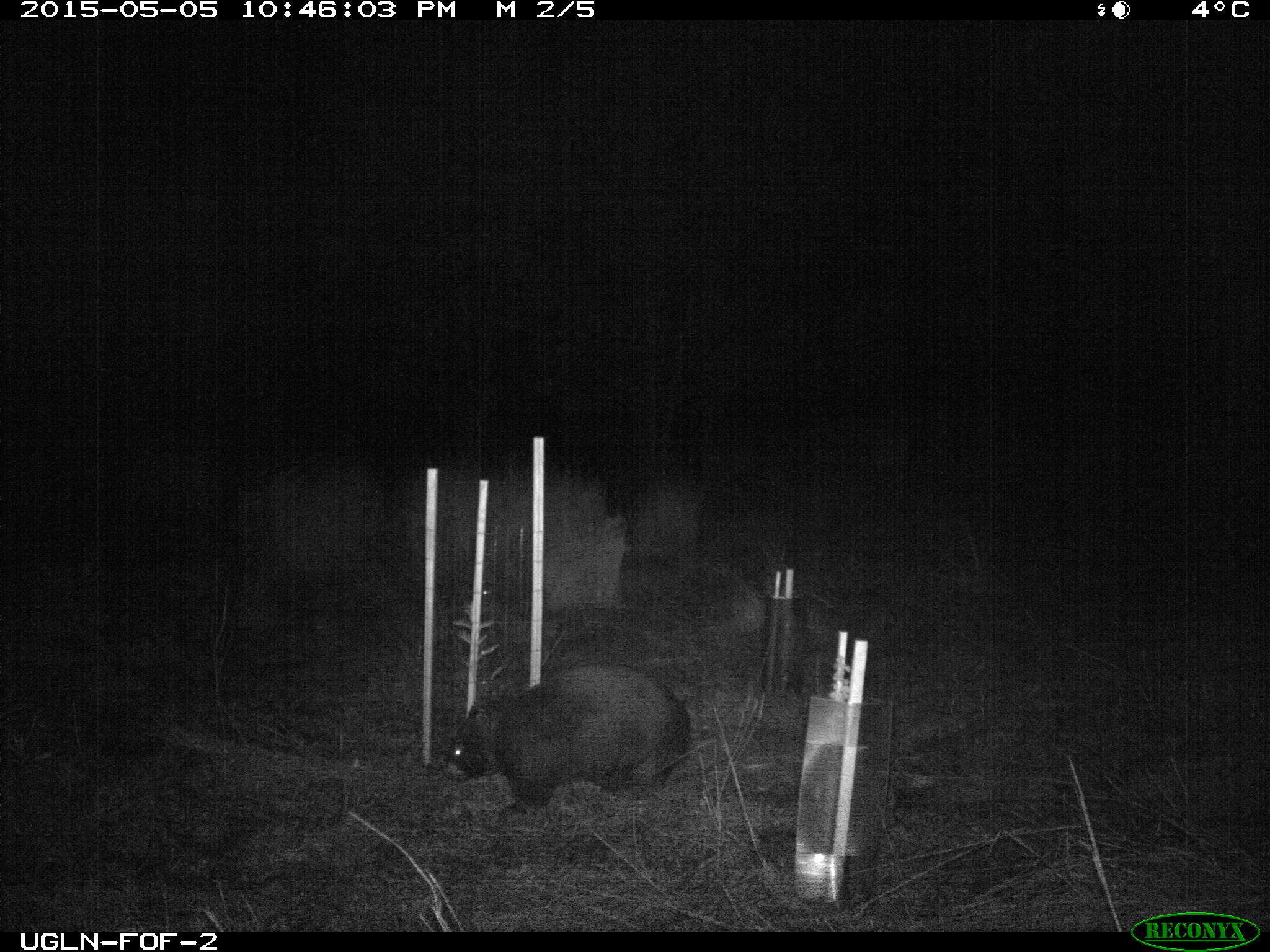
We had a couple of suspects in mind, but to collect hard evidence we set up a remote camera in one of the planting sites. Over a two-week period we recorded hundreds of images of Common Wombats, Eastern Grey Kangaroos and Red Foxes, all of which completely ignored the guards and plants. But a few shots caught at least one of the culprits in action – a Black Wallaby. The only real surprise was the lack of any deer among the pictures, as Sambar and Fallow Deer are known to be in the area, particularly in nearby Coonans Reserve.
The regular browsing of the plants presents quite a challenge. In an attempt to better protect the more vulnerable plants, some guards are being doubled up on longer stakes, and we also plan to trial taller guards on this year’s plantings. The disadvantage of these measures is that in some cases it can result in spindly weak plants when the guards are eventually removed.
Maybe all we can do is hope for good spring rains to produce a rapid flush of growth that the wallabies (and deer) can’t keep up with. Unfortunately an unlikely prospect in this El Nino year!


The differences are minor
Sometimes when passing by a window I look at my reflection and see my brother. You may think that it would not be unusual but in our family I have inherited the oval face and lanky build of my mother’s side of the family while my brother has the round face and more solid build of my father’s. Yet resemblances do exist: it’s in the genes.
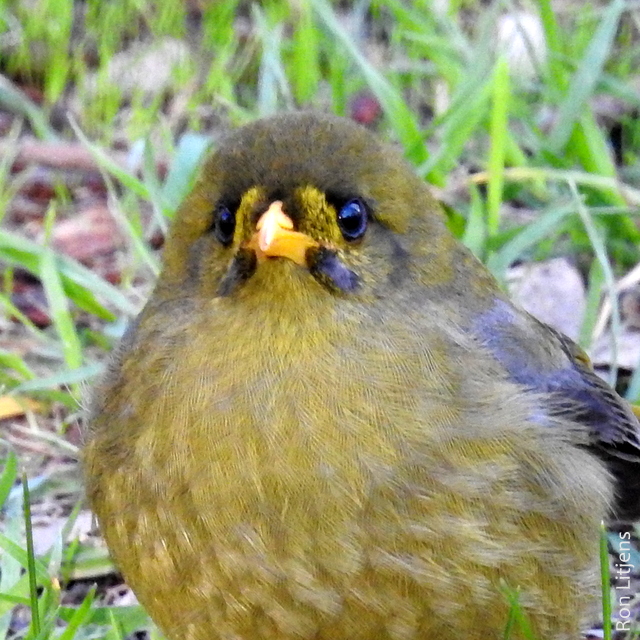
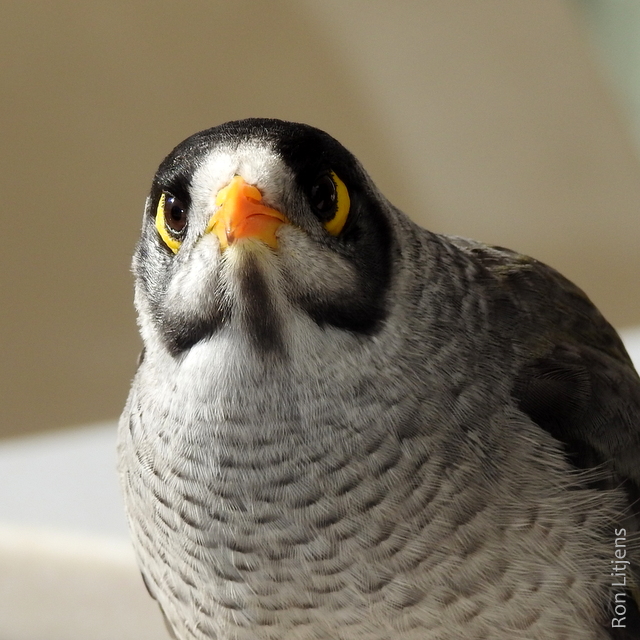
Similarly I have recently come across two types of Miner, which are of the same genus but different species: the Bell Miner and the Noisy Miner. Both are very aggressive honeyeaters that vigorously defend the territory containing their food source or nesting sites. You can find the Bell Miner locally around Cummins Lagoon in the Yea Wetlands. The Noisy Miner is more widespread in our valley.
Bell Miner
Noisy Miner
Both birds are of the genus Manorina from the Greek manos meaning open and rhinos meaning nostrils. It refers to the characteristic long, thin nostril slits on the beak. The species name for the Bell Miner, melanophrys, means black-browed (from the Greek, melanos for black and ophrus for eyebrow). The species name for the Noisy Miner, melanocephala, is ‘black-headed’ (from melanos and the Greek word for head, kephale).
On the surface these are really different birds. But if you look closely at these miners side-by-side there are resemblances – the similar beak shape, thin nostrils, even the intense stare they give you with those black eyes. You can’t hide the evidence of common genes. The differences are…minor.
Taking a cold bath
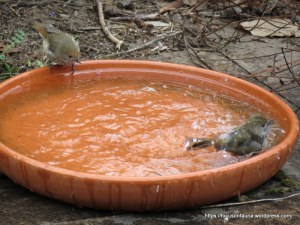
 What would tempt a tiny woodland bird into a bird-bath in mid-winter? This is the question we pondered as we watched these Brown Thornbills splashing about in one of our birds-baths with the air temperature at around 7°C. And it may have been the same pair we saw a few days earlier happily bathing in water where the ice-cap from a minus 3°C frost that morning had only just melted!
So, why do they do it? Parasite control, keeping their feathers in good shape or do they simply find it invigorating? It’s easy to understand them bathing to cool off in stifling summer heat, but with the water temperature not much above zero, and given their small body mass …?
Any comments welcome.


The fable of the wise man
There was once a boy who was raising two robin chicks. He went to the wise man and asked, “Wise man, I am raising two robin chicks. As they are getting older I would like to tell them apart.”
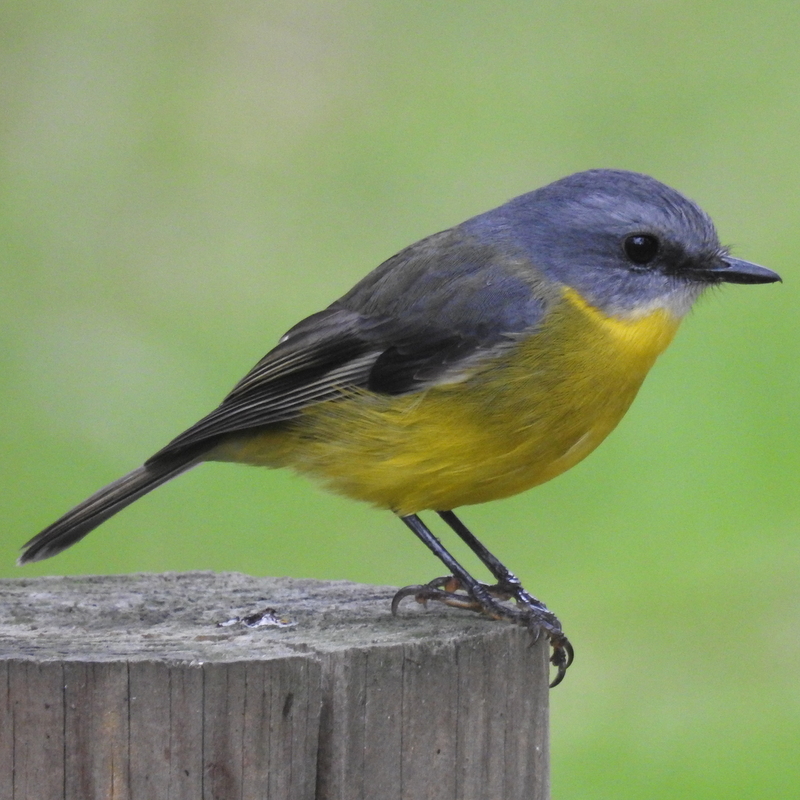 The wise man thought about this for a while, then smiled gently. “Young one”, he said, “The solution to your problem is easy. Buy a red and a yellow piece of wool. Tie the red wool around the leg of one chick and the yellow wool around the leg of the other. In that way you will always be able to tell them apart.”
 The boy smiled broadly. “Thank you wise old man”, he said. “I will tie the red wool around the leg of the Scarlet Robin and the yellow wool around the leg of the Eastern Yellow Robin.”
The moral of the story is – if it is winter, all the birds and animals are hiding out of the weather, and you can’t think of a blog to write but have a couple of good bird photos, just write-your-own fable. It will buy you an extra week.