Not so lady-like after all

An adult Transverse Ladybird Beetle (Coccinella transversalis)
Ladybird Beetles or Ladybirds are of the family Coccinellidae, from the Latin word coccineus meaning scarlet. The term Ladybird or Lady Beetle originates from British red, seven-spotted ladybird. The ‘Lady’ refers to The Virgin Mary, who is often depicted in early paintings wearing a red cloak, and the seven spots symbolise the seven joys and seven sorrows of Mary.
The common Ladybird image is of a cute, benign creature – pretty to look at (usually orange/red with black markings) and beneficial in the garden for reducing pests. This image is further promoted by cartoons of the insect world, such as Minuscule on ABC-TV, where ladybirds are the ‘good guys’ whose main sport is to vex the poor hapless spiders.
The truth is slightly different. Adult and larval ladybirds are voracious predators of aphids, scale insects, mites and if food is scarce, each other. A fully grown larva will consume several

Larval Common Spotted Ladybird (Harmonia conformis) eating a ladybird pupa
hundred aphids per week. A ladybird larva moves around using a combination of its six legs and the tip of the abdomen, which can attach itself to surfaces. During feeding, a larva may suspend itself by the abdomen, leaving the legs free to grasp prey.
The red colour serves as a warning for ladybird predators. As extra protection, when disturbed ladybirds may exude an off-smelling toxic liquid. Not so lady-like after all.
What next ?
 Not content with discovering Striped Legless Lizards and recording a snake-eating snake on their Strath Creek property (click HERE and HERE for the stories), Kay and Neil have found evidence of another threatened species, the Brush-tailed Phascogale (Phascogale tapoatafa). Unfortunately this time the discovery involved a dead animal.
Kay and Neil’s property includes one of the sites of the Strath Creek Biodiversity Project and, after conducting a bird survey on the site, we decided to check nest-boxes installed elsewhere on the property some time ago. One of the boxes showed clear signs of a phascogale’s presence: wool, bark and feathers as nesting material, and lots of smelly droppings (scats) – see photo at left. There was also a skull visible in one corner of the box which we decided to remove. This turned out to belong to a small phascogale with a lovely brush tail and very sharp teeth! – click on the photo for a clearer look.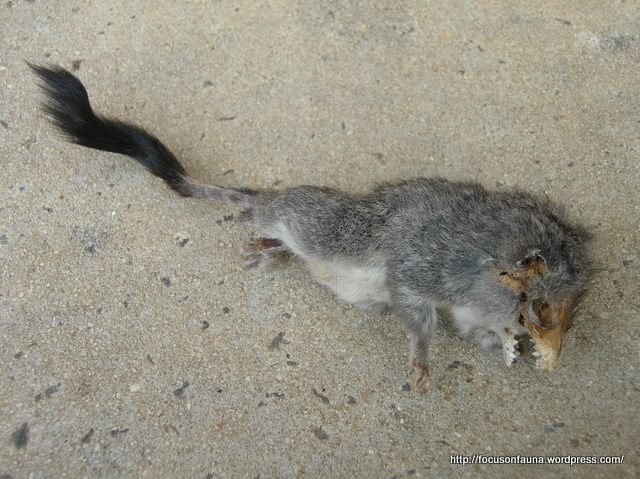
This was presumably a juvenile from last year’s breeding, born in July or early August, making it about 7 or 8 months old, depending on when it died. The box was checked with a special nest-box camera in late January and found to be empty, so this was not the breeding site. The cause of death of the young phascogale is unknown and it is also not clear whether or not the box is still being used.
The extensive revegetation undertaken on this property and a neighbouring property by the Biodiversity Project will significantly improve the habitat available for phascogales and there will hopefully be an expanded population in the future.
Why is my fish batter moving?
Saturday night is home-made fish and chips night at our place. I prepare the fish and my partner makes the baked potato chips with rosemary. For my part, the batter is prepared using stone-ground wholemeal flour and a secret mix of herbs and spices. Last Saturday the batter did not look right – it appeared to be moving.

Adult Confused Flour Beetle
Examination under a microscope showed the mixture to be chock-full of insects. I initially thought them to be weevils but a closer look revealed them to be adult and larval Confused Flour Beetles (Tribolium confusum), not as confused as me I can assure you. And they are tiny. In the pictures, the size of the larva and the adult beetle can be compared to the nearby stone-ground flour particles.
Worldwide, these beetles are a major agricultural pest and are highly resistant to pesticides and radiation. They cannot feed on whole grain but readily feast on grain dust, flour and broken grain. The ‘confused’ name

Larval Confused Flour Beetle
comes from the fact that they are often mistaken for other common flour beetles, particularly the Red Flour Beetle (Tribolium castaneum). They can be distinguished by the shape of their antennae.
As I have had this flour for a while, the question in my mind is ‘Why has this infestation happened now?’ Of course the other question, which doesn’t really bear thinking about, is ‘How long have I been cooking with beetles without even knowing!?’
Restless indeed
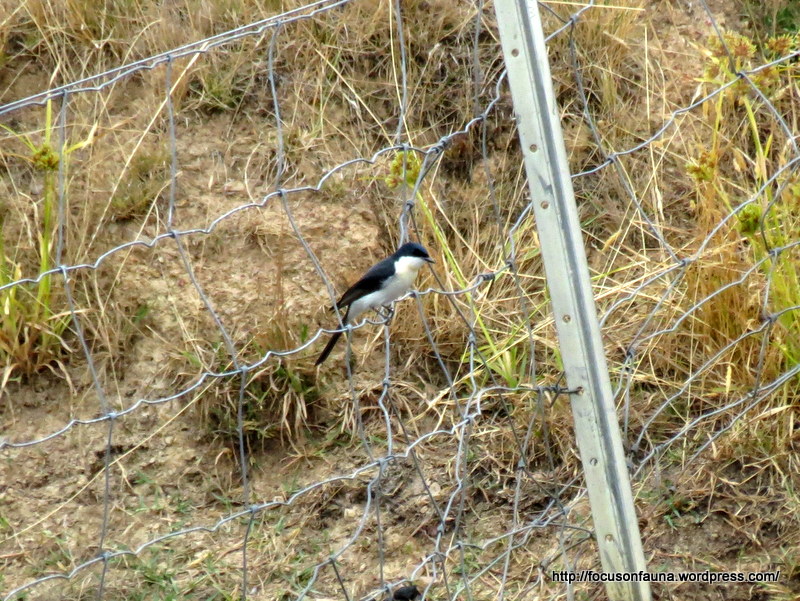 We went to check on a report of several Snake-necked Turtles sighted in a dam on a property at Strath Creek. We didn’t find the turtles, but did come across this Restless Flycatcher busily darting around and hovering over another dam in search of insects, and sweeping its tail back and forth upon landing. Its scientific name, Myiagra inquieta, reflects its common name – Myiagros was a lesser Greek god with the role of keeping flies away from ritual sacrifices to Zeus and Athena, and the Latin ‘inquietus’ means restless or disturbed.
The Restless Flycatcher’s white front extends right up to its bill, which distinguishes it from Willie Wagtail (who also has a white eyebrow) and the other local flycatchers, Leaden and Satin, whose white underparts extend only to the dark upper breast. It has a diverse range of calls, including a strange sustained chirring or rasping sound often described as like a scissors grinder, which is not all that helpful – when was the last time you heard a scissors grinder? Anyway, click on the audio bar below to hear for yourself some of the sounds recorded at Strath Creek.
What lurks below
I know the photograph below is blurred but I am continuing the great tradition of indistinct shots of aquatic beasts. Who ever saw a crystal clear image of the Loch Ness Monster?
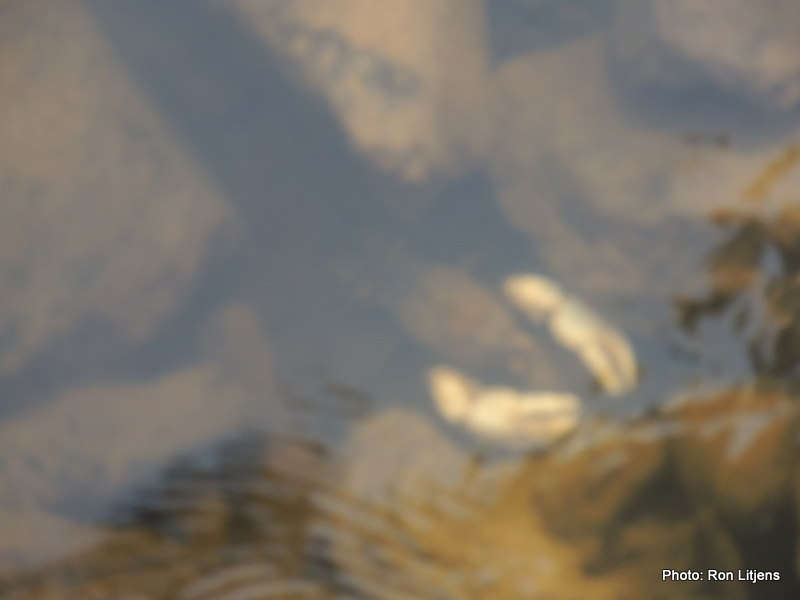 On my bicycle ride to the post office in Hazeldene I often stop on top of Coonans Bridge on the off-chance of glimpsing a platypus or a rakali. Sometimes I have been lucky. On this occasion I looked down and saw the two large white claws of a freshwater crayfish. As I saw it, it saw me and I had only one chance to take a photo. (Note to self—next time don’t leave the camera on manual focus!)
Given the white claws and where I saw it, my guess is that the creature in question is a freshwater crayfish of the species Euastacus, commonly known as the Spiny Crayfish because of the short spikes on the shell. The Spiny Crayfish is restricted to south-eastern mainland Australia and lives in permanent water sources at mid to high altitudes. The other common species of freshwater crayfish in our area is Cherax, commonly known as the yabby. It has a smooth shell and inhabits both permanent and ephemeral aquatic environments, including our dam. I only ever get to see yabbies (or bits of them) after a rakali (Hydomys chrysogaster) has had one for lunch (click HERE to view).
The freshwater crayfish has now joined the watch-list from Coonans Bridge. Next time I’ll make the picture even more out of focus and truly pass the creature off as Nessie.
It’s frog o’clock
Nature has a way of marking the passage of time. One look at the colour of the fields down in the valley will indicate what season it is. And looking at the phase of the moon will tell you about time’s progress through the lunar cycle. We have discovered another indicator on an even smaller timescale.
Must be lunch-time
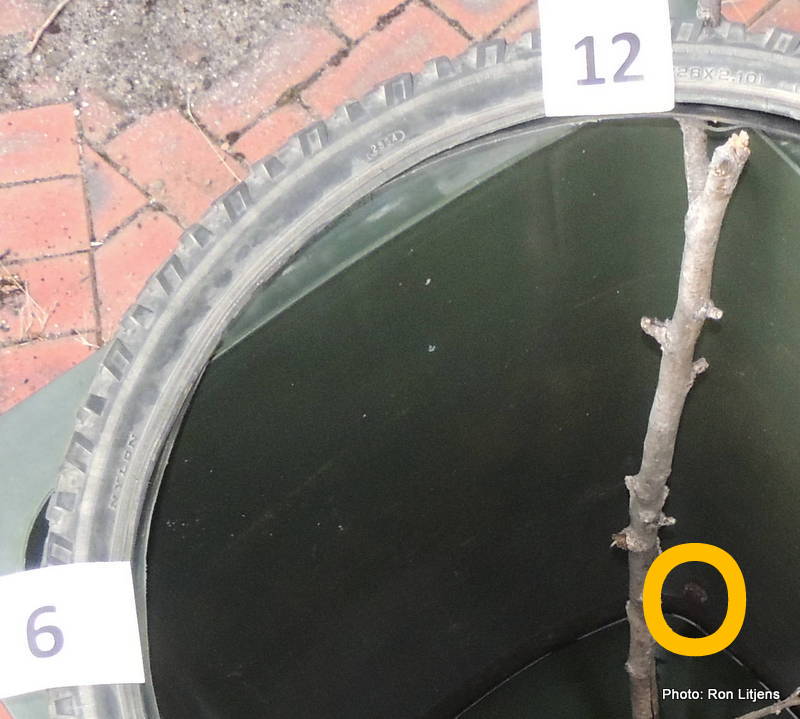
After the bushfires of ’09 and the dramatic failure of our new fire pump, we placed at the corners of our house wheelie bins of water and mops (it is amazing the extent of fire-fighting one can achieve with a wet mop and a bit of adrenalin!). The wheelie bins are positioned to catch the rain runoff from the roof that misses the guttering. During winter the bins slowly fill up so that when summer hits they are full of water. In summer, apart from the birdbath, the wheelie bin is the only water source for a considerable distance and inevitably attracts a resident frog.
During the day the frog (circled) clings to the side of the bin (see picture left) and as the sun changes its position in the sky, the frog 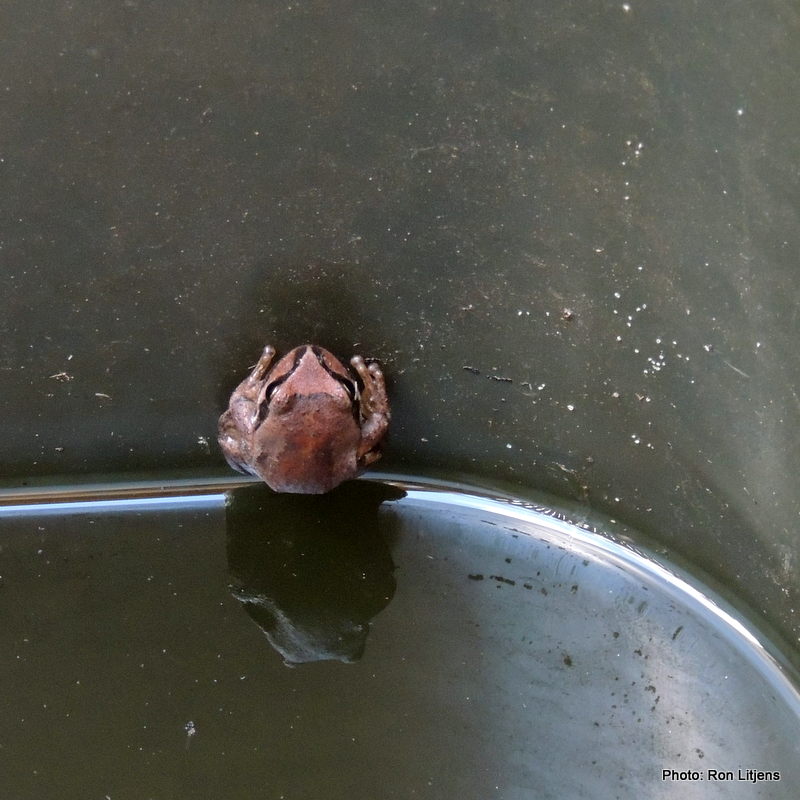 changes its position in the bin, staying just out of the direct sunlight. If you place a rough scale on this, in this case an old bicycle tyre with numbers on it, the position of the frog compared to the scale will give you a relatively accurate estimate of the time of day, sort of like a sundial. It works on sunny and overcast days.
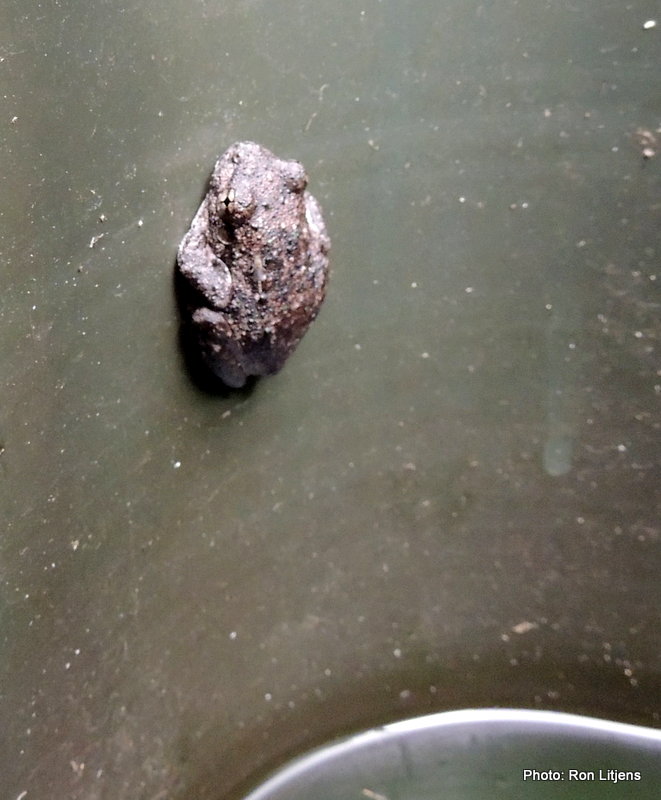 Last year the time keeper was a Plains Brown Tree Frog (Litoria paraewingii) I think, pictured above. This year a Peron’s Tree Frog (Litoria peronii) has taken up the duties. Peron’s Tree Frogs have cross-shaped pupils (see picture left).
It is not as accurate as a digital watch but it is an energy-efficient biological clock – and it isn’t ticking.
A flying visitor
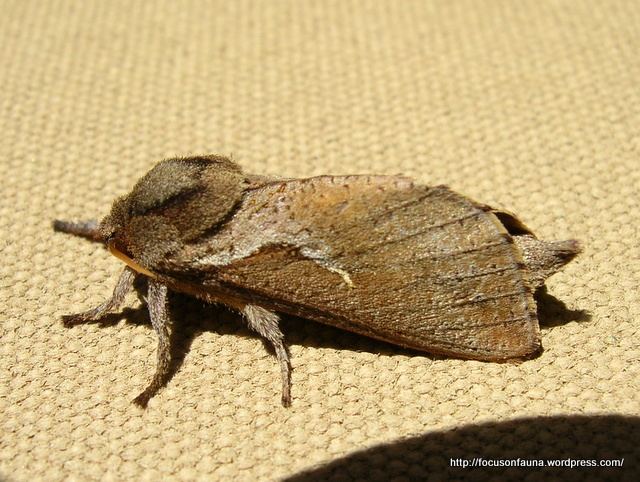
 This odd little creature caught our eye as it clung to a window awning. At first glance you might think it was one of the Three Blind Mice!
It is in fact a moth, Elhamma australasiae, of the family Hepialidae. This is a male – the female is larger and plainer. They may be seen as early as late January, but are most commonly seen from mid-February through to late-March.
Thanks to Peter Marriott for the ID.
To see a wonderful array of moths recorded recently in the Strathbogie Ranges, we suggest visiting the Boundary Hill Forest Blog.
Birds of a feather…
The interesting thing about watching a bird bath is not only the different species of birds that visit, but the way in which they do it. Some birds are solitary visitors such as the Sulphur-crested Cockatoo or the White-throated Treecreeper. Some visit with their partner (and offspring in the right season). The Scarlet Robin and Grey Currawong fall into this category. And then there is what we call at our place ‘the tribe’, a mixed group of wrens, robins, fantails and thornbills that roam the bush as a wandering flock.
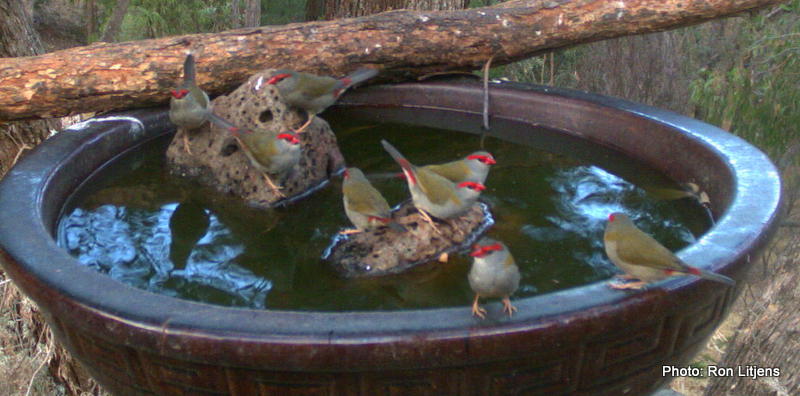 What are particularly interesting to watch are the species that travel in extended family groups. As with most families there are obvious dynamics at play and definite pecking orders. Recently we posted a blog about the White-winged Choughs (click HERE to view). Lately Red-browed Finches (Neochmia temporalis) (from the Greek neokhmos meaning new as in ‘new bird’ and the Latin word temporalis meaning to do with the temples – on the head) have been visiting en masse. Highly social, these finches are usually seen in parties of 10 to 20 birds in autumn and winter. They feed on grass seeds and insects and build domed nests in prickly shrubs.
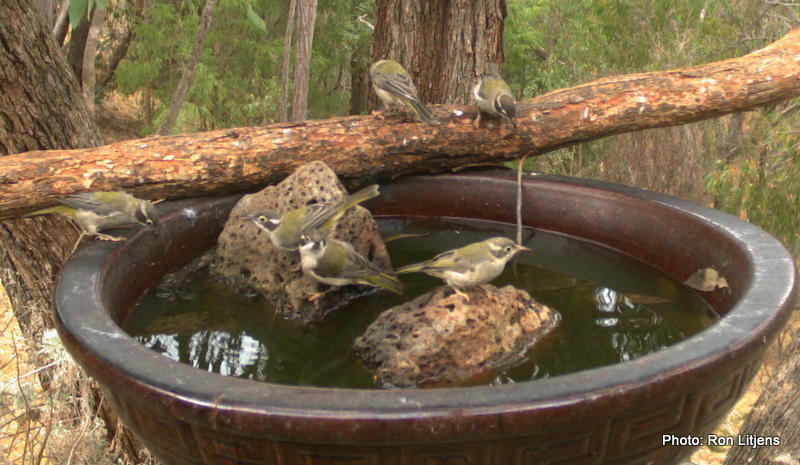 Another family of birds currently visiting are the bespectacled Brown-headed Honeyeaters (Melithreptus breirostris) (from the Greek word melithreptos meaning ‘honey-fed, and the Latin words brevis meaning short and rostrum meaning bill). These birds feed on insects and breed cooperatively. Groups of juveniles and adults will all help to incubate eggs and feed the young. Juveniles sport a blue eye-ring. As with humans the young are just tooo trendy.
Rich reserve

Silvereye
Wandering around the streamside reserve on the King Parrot Creek at Coonans Bridge, Flowerdale the other day, we came across the usual array of small birds – Red-browed Finches, Grey Fantails, Eastern Yellow Robins, thornbills, pardalotes and honeyeaters – flitting through the dense vegetation. But the most abundant bird at present seems to be the Silvereye, whose constant testy-sounding contact call dominates the small bird chorus – click on the audio arrow below to hear.
Each year at about this time, numbers of Silvereyes in Victoria are boosted by an exodus of birds from Tasmania moving north for winter. There are several subspecies of Silvereye – the birds of the Tasmanian subspecies can be distinguished by a rufous wash on their flanks.
The colouring of the Silvereye’s plumage is nuanced (click on the photo for a closer look), often blending with the foliage of shrubbery in which it forages, making it surprisingly hard to see, though its call is a give-away.
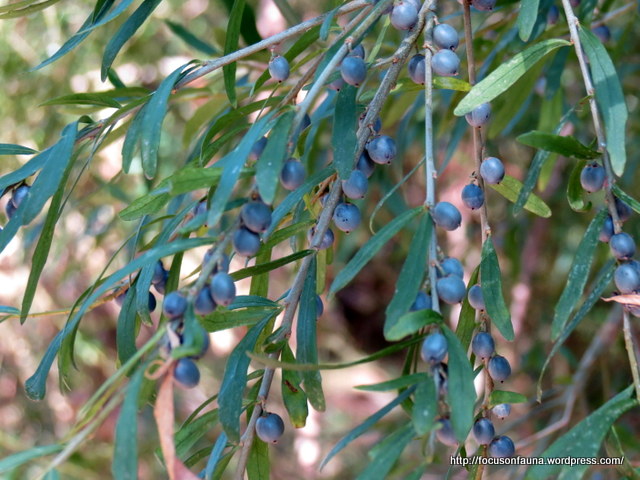
Tree Violet

Common Elder
There is no shortage of food for Silvereyes in the reserve. Apart from numerous insects, there are the berries from Tree Violet (Melicytus dentatus) and Prickly Currant Bush (Coprosma quadrifidus) as well as the increasingly prevalent introduced weed Common Elder (Sambucus nigra). Blackberries (Rubus spp.) are present, but in greatly reduced numbers due to ongoing control by Landcare members and the Goulburn Broken Catchment Management Authority.
Following the recent Platypus Watch organised by the Strath Creek Landcare Group and King Parrot Creek Environment Group (click HERE for a report on the event), some participants went on a spotlight walk through the reserve and were rewarded with a sighting of a Common Ringtail Possum, as well as close up views of birds roosting in the shrubbery, particularly Silvereyes, whose white eye-rings shone out as the birds froze in the spotlight.
A couple of days later, we returned to where the only platypus was seen and were able to get a clear photo and very brief video of this sleek animal.
Pardalotes love eating lerps
Most households have words or phrases that have special meanings to them. To outsiders these phrases have a different meaning or even appear nonsensical. One of our phrases is ‘Pardalotes love eating lerps’. We read this sentence on an information board while camping at Wyperfeld National Park in northern Victoria. As we lived in the city at the time, we had no idea what a pardalote was, let alone a lerp. In our house this term is used to describe anything said that is meaningless or unintelligible. It is often directed at the TV, especially at politicians.

Spotted Pardalote looking for a lerp
Now that we live in the bush, pardalotes and lerps are our neighbours. Pardalotes (Pardalotus sp.) (from the Greek pardalotus meaning spotted like a leopard) are brightly coloured birds closely related to scrubwrens and thornbills. They are common but not often seen birds that tunnel into the ground to build nests. The Spotted Pardalote (Pardalotus punctus) pictured left and the Striated Pardalote (Pardalotus striatus) are widespread through southeastern Australia.
Lerps on the other hand are the protective covers that the larvae of psyllid insects build to protect themselves from predators and
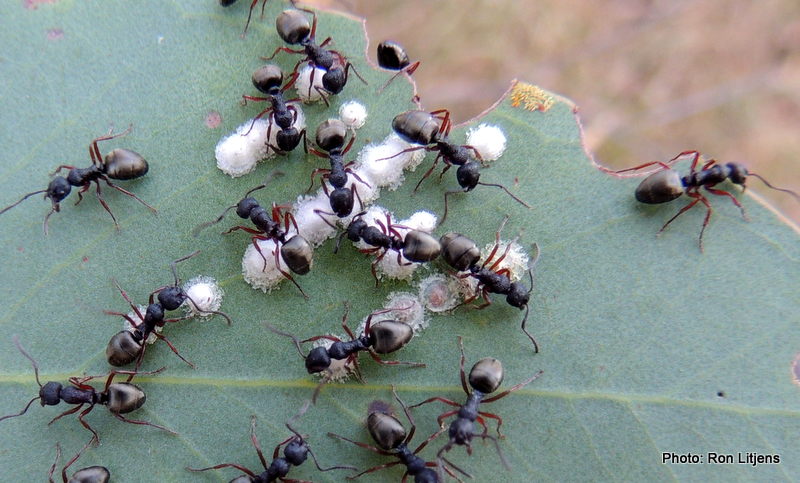
Ants tending Sugar Lerps (Glycaspis sp.)
parasites. The larvae exude honeydew which mixes with amino acids to form the crystallised honeydew lerp. As with the recently featured Gumtree Hoppers, which also exude liquid honeydew (click HERE to view), lerps are usually tended by ants (pictured right). In exchange for honeydew the ants offer protection against predators. Given the writing on the information board, I am guessing the ants aren’t very effective against predators such as pardalotes.
If this article makes no sense to you at all, you know what phrase to use. We will get the message.




 Focus On Fauna