Net results
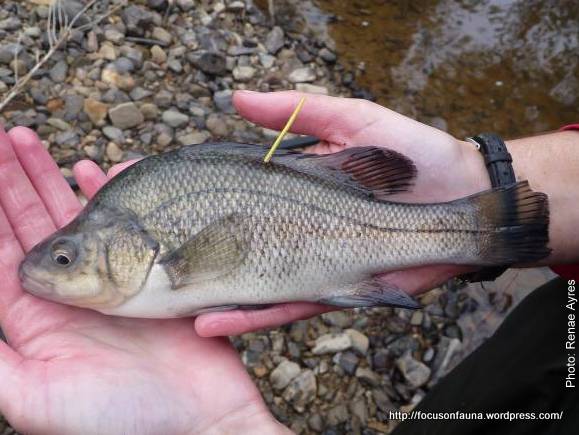
Macquarie Perch
We have just received a report on the annual Fish Survey in the King Parrot Creek from the team at the Arthur Rylah Institute (see a previous post Gone fishing ! for details of the survey). The Macquarie Perch are clearly holding their own and are present in significant numbers right along the creek, despite the presence of introduced trout. It is good to see a range of other native fish also being identified. The capture (and safe release) of five Platypus supports our opinion that there is now a healthy population of platypus in the creek (see Successful platypus and rakali survey). Another encouraging result was the absence of Carp.
King Parrot Creek – Fish Survey Results April 2013
| Common name |
Moores Rd |
Callandoon |
Burslems Bridge |
Richards Bridge |
Draytons Bridge |
Total |
| Macquarie perch |
3 |
10 |
19 |
18 |
12 |
62 |
| River blackfish |
2 |
16 |
8 |
1 |
27 |
|
| Two-spined blackfish |
13 |
13 |
||||
| Riffle galaxias |
6 |
6 |
||||
| Mountain galaxias |
2 |
2 |
4 |
|||
| Flat headed gudgeon |
1 |
1 |
||||
| Brown trout* |
31 |
3 |
2 |
20 |
17 |
73 |
| Rainbow trout* |
1 |
1 |
2 |
|||
| Redfin perch* |
1 |
1 |
||||
| Yabby |
2 |
1 |
12 |
9 |
24 |
|
| Freshwater crayfish |
7 |
3 |
1 |
12 |
23 |
|
| Platypus |
1 |
1 |
1 |
2 |
5 |
|
|
63 |
36 |
31 |
55 |
56 |
241 |
* Exotic
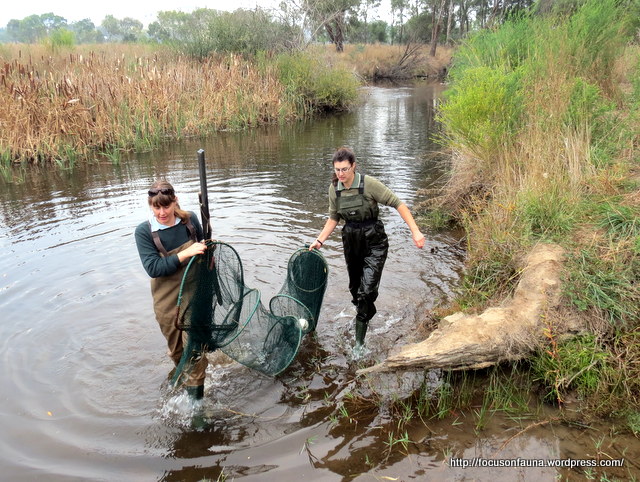
Incidentally, the two eminently competent female fish researchers undertaking the survey, Jo and Renae, have shown us a fascinating historical document – a 1933 letter from the Office of the Chief Inspector of Fisheries and Game:

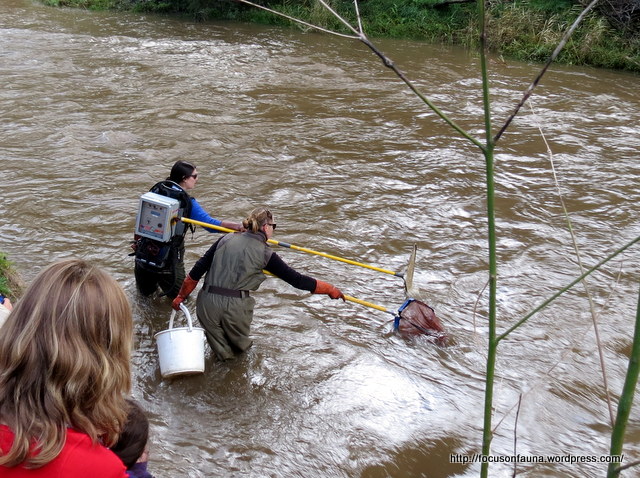
Having watched with admiration Jo, Renae and Fern deftly set up long Fyke nets or wield heavy electro-fishing equipment in a fast-flowing stream with slippery rocks and deep pools, we can only be amazed that the attitude in the letter ever prevailed, and thank goodness times have changed !!
Illegal?
A man’s occupation?
Flowerdale 1 Strath Creek 1
 The rivalry between Flowerdale and Strath Creek has just intensified. Fellow blogger and Flowerdale resident Ronlit reported a rare sighting of a Spotted Quail-thrush on his property in early June (see A flurry of wings resolved). Not to be out-done, Kevin and Noreen saw and photographed a Spotted Quail-thrush while fencing along the creek on their Strath Creek farm. They were both surprised and intrigued by this lovely and unusual bird which obligingly stayed put while they rushed to get a camera and a bird field guide to confirm its identification.
The Strath Creek bird is a male with a white throat patch on a black face compared to an orange throat patch on the female bird at Flowerdale. Ronlit quipped that his bird “… was probably out looking for a date.” Perhaps the two birds will meet up and we can look forward to a productive mid-valley rendezvous leading to a detente between the two districts.
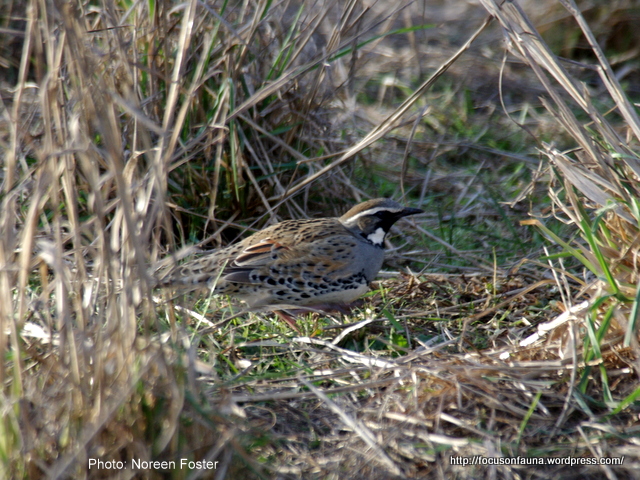
Male Spotted Quail-thrush
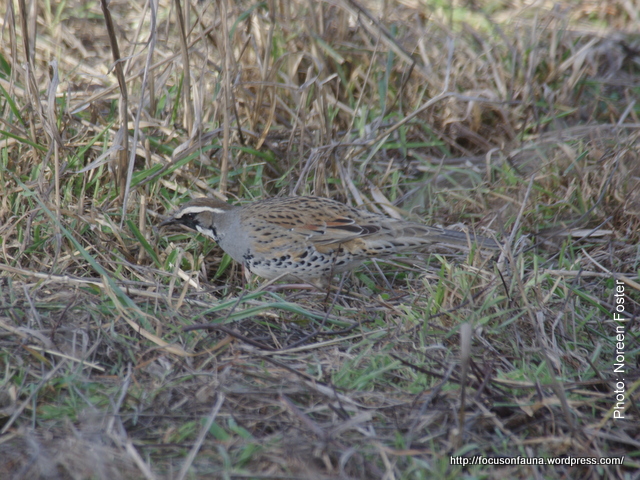
Well camouflaged
These sightings are significant as the Spotted Quail-thrush’s conservation status in Victoria is listed as “Near threatened”. In Kevin and Noreen’s case the sighting was particularly interesting as the bird’s usual habitat is upper slopes and ridges in drier forests, not creekside vegetation in low open farming land! The quail-thrush is reported to be shy and elusive and yet this bird quietly walked around in the grass in front of Kevin and Noreen, and Ronlit has seen his bird boldly walking past his kitchen window several times since his initial sighting.
[Since writing this, Steve Joblin, Project Officer for the Strath Creek Biodiversity Project, reports spotting (sic) another Spotted Quail-thrush on one of the project revegetation sites on “Three Sisters”, adjacent to the Mt Disappointment State Forest. This just happens to be on the dividing line between Flowerdale and Strath Creek, so the score remains even.]
Looking for a spring in autumn

A spring?
We moved to our property during the drought years. Living in the Spring Creek catchment I always wondered why it was so called. I had noticed that at the same elevation in each of our valleys there was an area of ‘greener’ vegetation. It hasn’t been until the last three years we have actually seen water welling up out of the ground. Now that we are deep into autumn, which usually brings rain, I am again looking for signs of the springs.
I recently noticed down the valley a bright patch of green standing out against the dried grass. The spring is back, I thought. Closer examination showed the green to be ‘pickings’ from an exotic Irish Strawberry (Arbutus unedo) a ‘nasty’ weed-of-a-tree, I’ve been told. And the culprits weren’t too difficult to spot against the green foliage… Crimson Rosellas (Platycercus elegans, from the Greek platukerkos, meaning broad-tailed and elegans meaning elegant, referring to the tail shape that is distinctive from other parrots). These birds, like most other parrots, must spend half their life shredding trees. Not only do they get food this way but they aid in propagating the tree by dropping the seed or flying off and distributing the seed in their droppings.
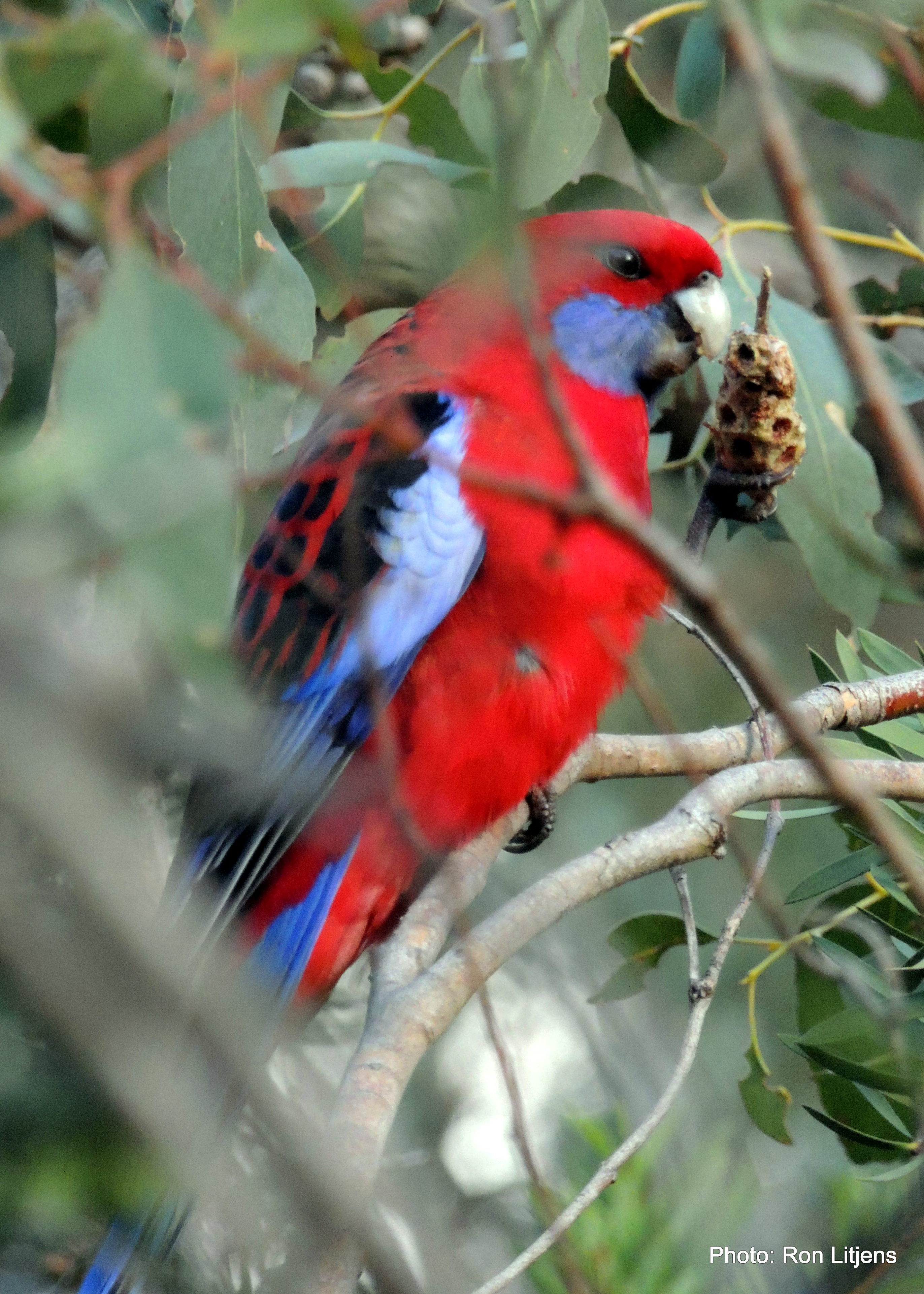 And to show that they get stuck into Aussie bush tucker as well, the photograph (left) shows a Crimson Rosella eating a Calllistemon seed pod ‘corn-cob’ style.
Not at all drab
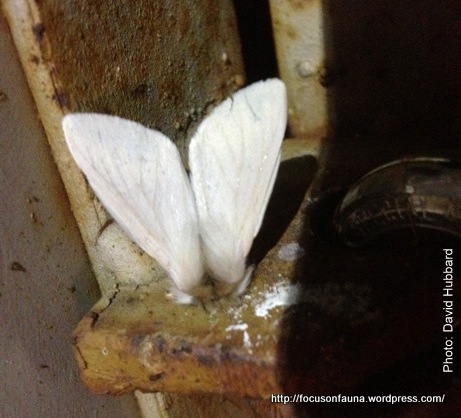
Sparshall’s Moth
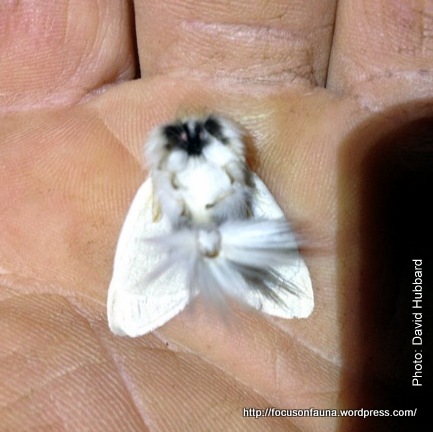
Moths are sometimes thought of as rather drab and uninteresting creatures, but many of our native moths are in fact very attractive. A good example is this moth photographed recently on Three Sisters at Flowerdale. It is a Sparshall’s Moth (Trichiocercus sparshalli), identified as a male by the long white tufts of hair on its abdomen (see photo below). It’s coming to the end of its flying time, which peaks in April/May and again October/November.
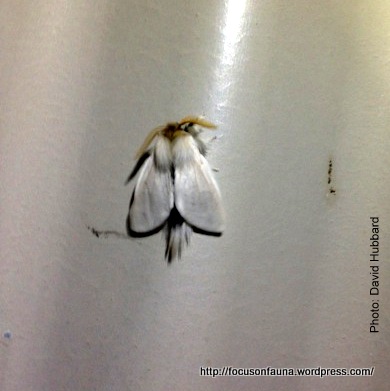

Sparshall’s Moth larvae
Photo courtesy of P. Carwardine and Peter Marriott
Corella torture?
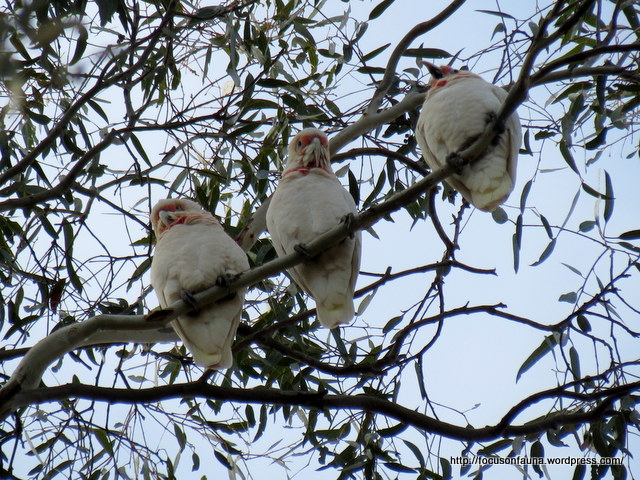
Long-billed Corellas
Driving along Upper King Parrot Creek Road the other day we came across the pair of Common Bronzewings that often sit on the road near Carver Creek – the Flowerdale-Strath Creek ‘border’. Our attempt to get a photo of them was in vain as they quickly fluttered off to an adjacent paddock out of sight. We then noticed a continuous strange wheezing noise from overhead that at times could possibly be mistaken for someone having their toenails ripped out – or possibly their throats cut (see photo). On investigation, it turned out to be a group of Long-billed Corellas (Cacatua tenuirostris) sitting on a branch high in a roadside eucalypt tree, together with a single Sulphur-crested Cockatoo.
Their constant noise (click on the audio bar arrowhead below to hear it) was still going on when we returned more than half an hour later, although the cockatoo had left (driven off by the noise?). We have watched Galahs making a similar call while engaging in mutual grooming, known as allopreening, a practice thought to promote bonding and reduce tensions in close-roosting birds. So perhaps this strange vocalisation is part of the corellas’ social bonding ritual – maybe these are recent fledgelings? We have heard Gang Gang Cockatoos and Yellow-tailed Black-Cockatoos also make regular wheezing calls when feeding, so it seems to be a feature of members of the Family Cacatuidae. Comments welcome.
Rakali River, anyone?
When I was a kid the family went for picnics in the bush at Diamond Creek. That’s when Diamond Creek truly was the bush. I spent many an hour wading through the water trying to find those elusive diamonds. It was only much later in life I was told Diamond Creek was named after a bull called Diamond that drowned in it.
 Until recently I had consigned the King Parrot Creek to the same category as Diamond Creek, great name, but not based on reality. I have lived in Flowerdale for nearly a decade and spent many hours on the banks of the creek. I regularly see platypus, rakali and any number of bird species but never a King Parrot (I can hear the Flowerdale residents gasping in amazement!). Grey Fantail Creek – sure, Platypus Creek – yep, Sacred Kingfisher Creek – maybe, but King Parrot Creek – no.
Trudie and Len recently invited me around to their property to look at the Tawny Frogmouths, which had returned to roost in their usual tree (click HERE to view blog). And there, sitting on a branch was an Australian King-Parrot (Alisterus scapularis). The male has a striking orange head and body with green wings while the female has a green head and wings and an  orange belly. They are truly worthy of having a creek named after them. Word of my heresy, however, has spread through the township. To all Flowerdalians, I do believe in K-P’s. Please stop sending photos.
This weekend, weather permitting, we’re going on a picnic … to Diamond Creek … to make our fortune in diamonds (no bull).
Sheer opportunism

Wombat-poo or Toad-stool?
A previous post (click HERE to view) mused about the athleticism needed by wombats, wallabies, etc. to construct the ‘plop-on-the-rock’ installations that exist across our landscape. Structures built on logs, rocks and grass are pretty impressive but for sheer opportunism nothing beats this effort photographed on the Three Sisters, Flowerdale – on top of a growing mushroom.
If opportunism was an Olympic event, this deserves a platinum medal.
A flurry of wings resolved
The vegetation on the eastern side of our property consists of open Box–Stringybark forest. The understorey consists mainly of grasses — natives with a few exotics. In summer the long grass hides a multitude of creatures, primarily Red-bellied Black Snakes, Brown Snakes and smallish birds that suddenly burst from the grass in a flurry of wings and disappear equally quickly back into the grass some distance away. We call these LQJ’s (little quail-ey jobs)—not to be confused with LBJ’s (little brown jobs), which are the unidentified birds that flit around the tops of trees. Trying to photograph the LQJ’s for identification purposes is almost impossible. They appear when you least expect them—sort of like the Highway Patrol, and then are gone.
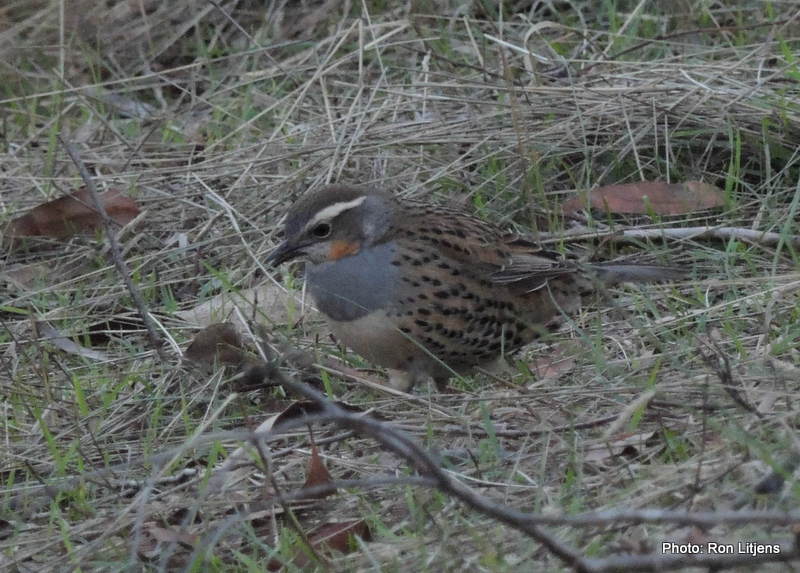 Because of the drought, the long grass is flat and there are not many places for the LQJ’s to hide at the moment. And so it was during my dusk stroll I saw an LQJ power-walking across my path. I managed to get a couple of photos that helped me identify it as a female Spotted Quail-thrush (Cinclosoma punctatum, from the Greek words kikhle meaning thrush, soma meaning body and the Latin word punctus meaning sting—hence spot).
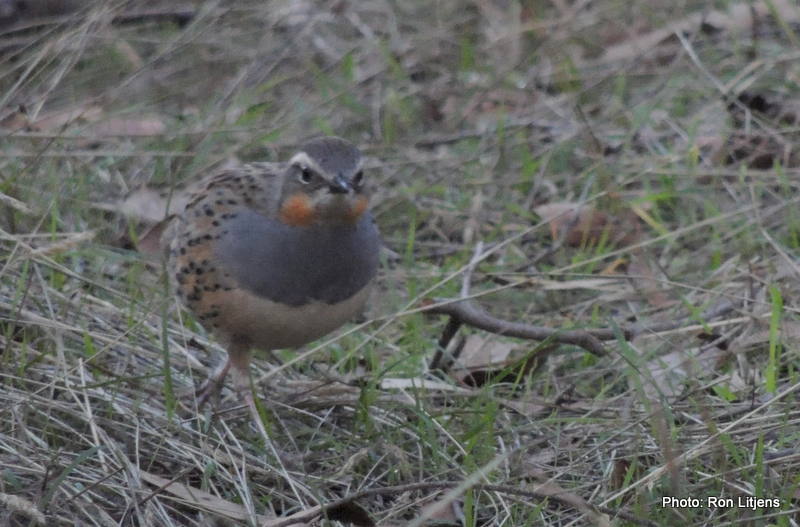
The Mrs. – note the orange cheeks
These birds build a loose nest of bark, leaves and twigs against rocks, stumps or native grass tussocks from June to November. This one was probably out looking for a date.
Now one species has moved from LQJ status to a big tick on the identified bird list. I wonder how many other LQJ’s are out there?
Colourful kingfishers
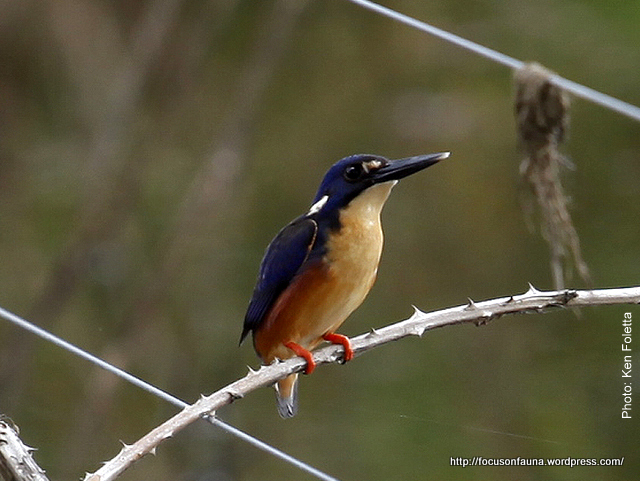
Azure Kingfisher
Last November we had a surprising appearance of an Azure Kingfisher in our garden near Strath Creek, but it was such a fleeting visit that we had no chance to get a photo. Fortunately, Ken from Alexandra, who provided the wonderful pictures of a Whistling Kite in the recent post, Kite flying, was either luckier or more patient, and managed to capture the image shown at left of this gorgeous little bird near the Goulburn River. If you ever get a glimpse of this bird in direct sunlight, as we did recently at Majors Creek near Mitchellstown, it is an absolute knock-out! The colours are extraordinarily vivid, and that’s coming from one of us who is supposed to be colour-challenged!
The Azure Kingfisher’s natural habitat is along well-vegetated waterways and it is occasionally spotted beside the King Parrot Creek. It is one of the birds that would definitely have benefited from revegetation works along the creek by Landcare and others.
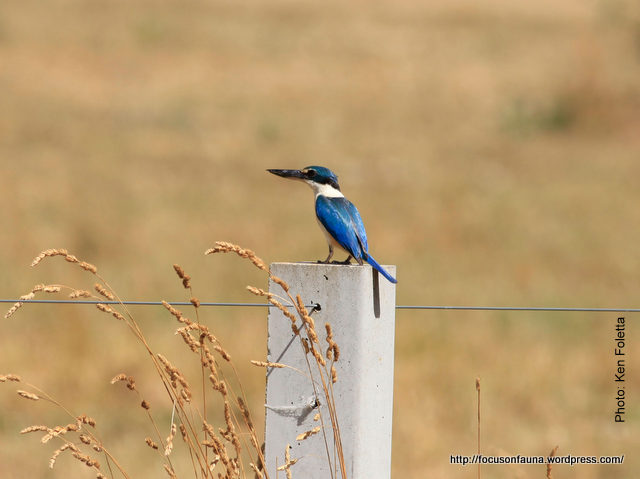
Sacred Kingfisher
Ken also sent in a picture of the slightly larger and more common Sacred Kingfisher (at right). It isn’t confined to waterways, and may be seen in open woodland where it feeds mainly on small reptiles and insects. Its plumage can be variable which may be confusing for identification. Its distinctive repetitious call is often the first indication of its presence. It also has other less easily identified calls, which can be heard by clicking on the audio bar arrowhead below.
A pleasant surprise

Superb Lyrebird
More than four years after the Black Saturday fires we thought we would set up remote cameras on a couple of the larger patches of bushland in private ownership. Paul’s 360ha bush property in the middle of Flowerdale was severely and totally burnt out in 2009, but the regeneration is quite impressive, especially in the moister gullies, with dense regrowth of a range of eucalypts, Silver Wattle, Blackwood, Hazel Pomaderris, Prickly Currant Bush, Victorian Christmas Bush and numerous other shrubs and ground flora.
Checking the cameras’ SD cards the other day, we scrolled through lots of shots of the expected wombats and wallabies, and, (ho-hum) the usual suspects among feral pests – foxes, Sambar, rabbits – and then a pleasant surprise … a Superb Lyrebird (Menura novaehollandiae) (pictured above).
Walking around the property, it is clear that many other bush birds are returning – and last year a Long-nosed Bandicoot was recorded on remote camera.
-
- Black Wallaby
-

- Sambar – a voracious browser of regenerating plants and spoiler of revegetation efforts
-

- Common Wombat
-

- Red Fox – a significant threat to recovering wildlife




 Focus On Fauna