Pied Currawong—a delicious pastry?

Pied Currawong (Strepera graculina) – Yum!
Have you ever wondered where the word ‘pied’ comes from? Is Pied Currawong a recipe used by the early settlers when food was short? The index of Pizzey and Knight’s Field Guide to the Birds of Australia lists eleven birds (Butcherbird, Cormorant, Little Cormorant, Currawong, Harrier, Heron, Honeyeater, Imperial-Pigeon, Monarch, Sitella and Stilt) with the pied descriptor. A veritable smorgasbord of tasty treats.
The term was originally coined by that famous cataloguer of Australian birds, John Gould. The English word ‘pie’ comes from the French word of the same spelling, which is the old name for the European Magpie (Pica pica). The European Magpie is a member of the crow family and is unrelated to the Australian Magpie. The French word is derived from the Latin word pica, which is the Latin name for the bird. So ‘pied’ literally means ‘like a European Magpie’—in other words, black and white.
The meaning of pied has changed with time. Modern dictionaries define pied as meaning ‘of two or more colours’. But in Gould’s 1848 book the term strictly meant black and white.
So for those thinking about supplementing your diets with some local pastries, think again.
The next generation
 In our last post we mentioned a poll held by BirdLife Australia to find Australia’s favourite bird. On reflection, we ended up voting for the Brown Thornbill – not the most colourful or striking of birds, but a small bird with a feisty personality and a wide range of calls and song. Also we thought it would probably be the underdog in the poll and would need support. The Brown Thornbill has been a constant companion around our property, being one of the few birds observed every single month since we started keeping records 15 years ago.
The little chap pictured here is a fledgling that became disoriented in a recent wind-storm, and after trying several times to fly through the glass door, took refuge under the verandah, which was a good place to be since it had started to hail!
Where is the SES when you need it?
 During my time in Flowerdale I have witnessed some pretty ferocious displays by Mother Nature including highly localised tornadoes sweeping up our valley. It was always of some comfort to know that in case we lost a roof or all our windows the SES was never too far away (well, in Kinglake anyway). Think of those without such a service. In the middle week of September there were a couple of days of heavy drumming rain. Most creatures took cover in holes and under logs. But the driving rains simply washed the top off our local termite mound.
Termites, sometimes incorrectly referred to as ‘white ants’, are social insects that live in large communities (called mounds if they are above  ground). The nests are built from a combination of soil, mud, chewed wood or cellulose, saliva and faeces. Termites are delicate insects that need to stay moist to survive. The temperature and humidity inside a mound, as well as the oxygen to carbon dioxide ratio, is controlled through a network of tunnels and galleries. Any breach of the outer walls disrupts these environmental conditions and prompts immediate action to repair the damage. In addition, exposure of the nest renders the termites susceptible to attacks from predators such as ants and birds.

Job done!
So it was that hundreds of termites (Nasutitermes sp.) were seen repairing the rain-damaged mound. In the picture above (click to enlarge) the workers have the pale heads and the soldiers have the dark-brown heads. By the next day the work was done, with not a tarpaulin or insurance assessor in sight.
When you’re on a good thing …
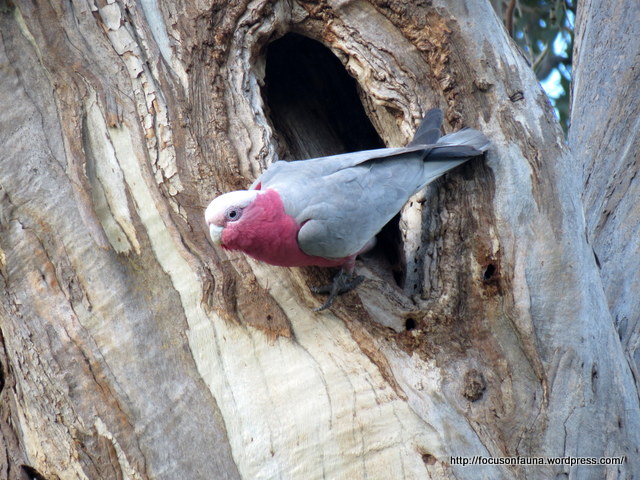
Galah 2013
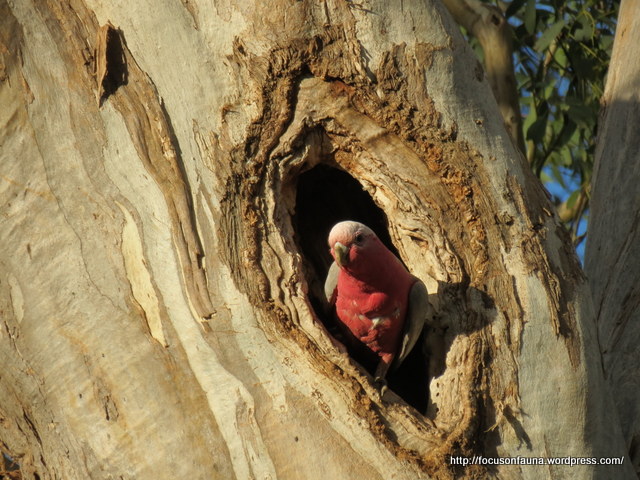
Galah 2012
The Galah is one of 52 birds chosen by BirdLife Australia for inclusion in a poll to decide Australia’s favourite bird, as part of this year’s Bird Week celebrations starting on 19th October. You can cast a vote for your favourite bird at http://www.australiasfavouritebird.org.au/. Some of the birds included in the list of candidates have been photographed locally and are shown below.
We find it hard to select one particular ‘favourite’ bird, but the gorgeous Galah would have to be well in the running.
Excuse me. I’ve got a frog in my throat
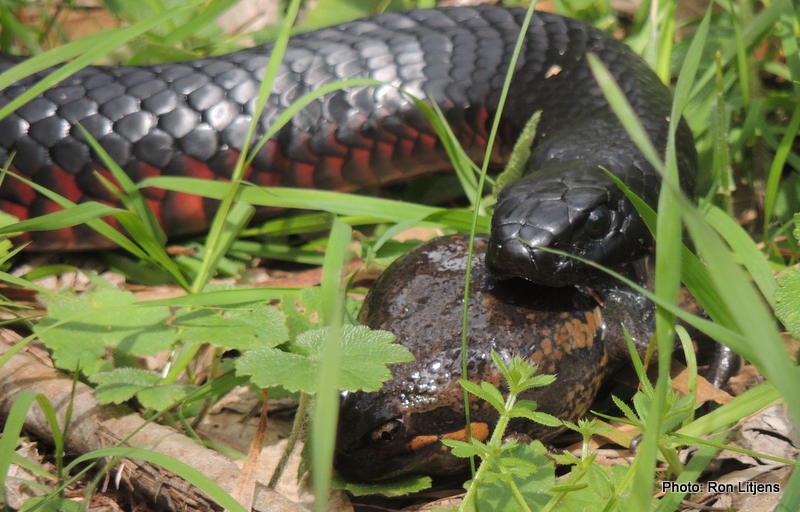 The reptiles have awoken from their winter torpor and are hungry. Walking next to the dam on the weekend we came across this Red-bellied Black Snake (Pseudechis porphyriacus) with a penchant for French food – frog legs, no less. Frogs are the main diet of these snakes. They also prey on other reptiles and small mammals. The snake wasn’t saying much — it’s rude to talk with your mouth full.

Finger lickin’ good (if I had any)
The Pobblebonk Frog (Limnodynastes dumerilii) wasn’t ‘bonking’ either. The neurotoxins in the snake venom are rarely life-threatening to humans but of course are deadly to frogs. We left the snake to enjoy its lunch in peace.
Another koala

Koala
A Koala (Phascolarctos cinereus) is an uncommon visitor to the Flowerdale-Strath Creek area, but we do get reports of sightings from time to time. This one was photographed by Don on Upper King Parrot Creek Road. It doesn’t show in the photo, but the koala had a blue ear-tag which we think means it was one of a group transferred from French Island and released into Mt. Disappointment State Forest in 2004 – click on From French Island to Flowerdale to see an earlier post about the translocation (and a really cute photo!).
We spotted another koala trotting along the Whittlesea-Yea Road on Junction Hill late afternoon a few weeks ago – a very dangerous spot for a koala! But with a guard rail and double lines there was no way of stopping to try and herd it into the roadside vegetation.
It is good to know there are some koalas around, as they would have had little hope of escaping the Black Saturday fires and those that survived would have struggled to avoid starvation before fresh growth was established on eucalypt trees.
The mystery of the hole in one
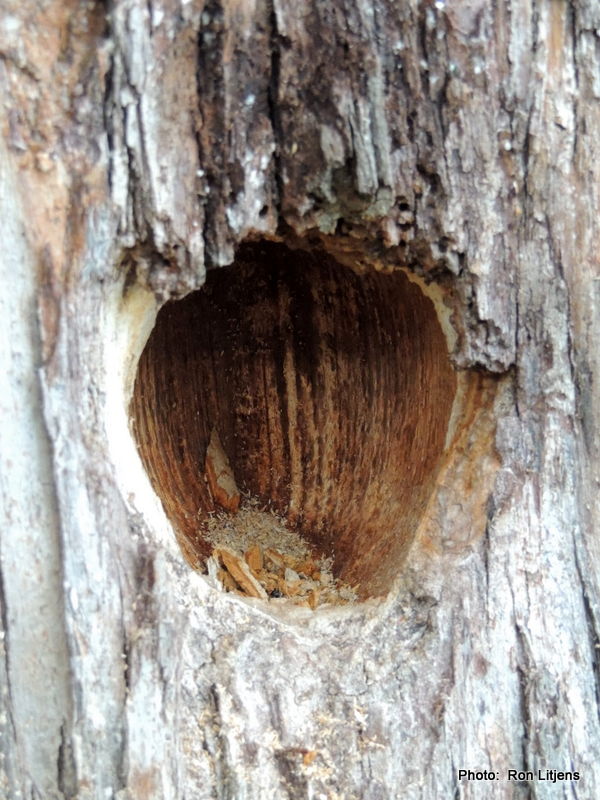 The white wood chips lying on the grass at the base of a coppiced Long-leaved Box (Eucalyptus goniocalyx) were a dead give-away that something was afoot. Inspection of the upper branches revealed nothing amiss. However, examining the three trunks I found a hole in one. The hole was about 1.5 metres off the ground, with a cavity about 12 cm deep and perfectly smooth inside. The wood chips looked to originate from something gnawing at the bark around the opening, presumably to make it bigger. As there was nothing to indicate who the mystery builder was, I mounted a remote camera on one of the other trunks.
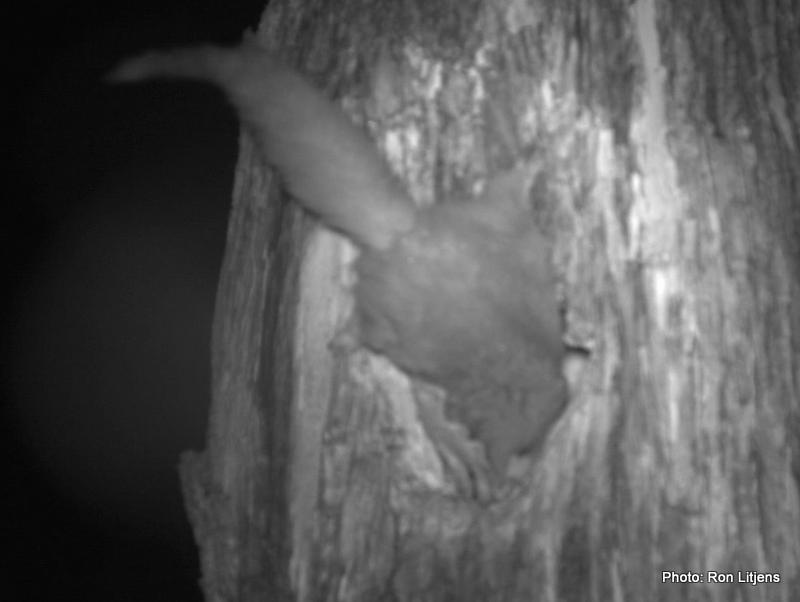
Doing some ceiling work
Over the course of a week several birds visited the cavity during the day either looking for food (White-throated Treecreeper, Cormbates leucophaea) or a place to stay (Crimson Rosella, Platycercus elegans). On the first few nights a Sugar Glider (Petaurus breviceps) appeared at the hole, looked at the camera and just as quickly disappeared. Now, however, it spends a lot of time working on the cavity oblivious to being photographed. Its ability to renovate while upside down, sideways or right side up is an ability wish I had. Occasionally the Sugar Glider tries the cavity on for size. From
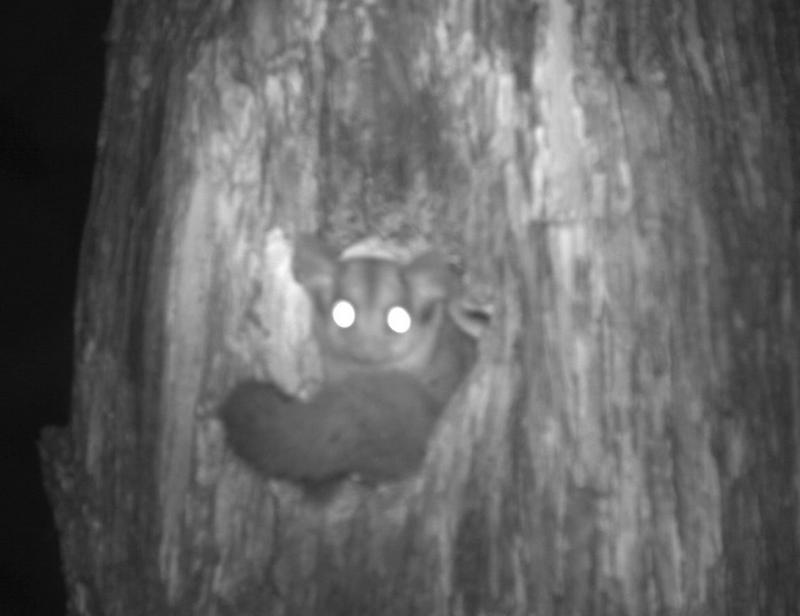
Still need that extension
the picture left, it still has some work to do. But as anyone who has renovated a house before will tell you, the job is never done.
Whistler’s return

Rufous Whistler
One of the delights of spring for us is the return of the Rufous Whistler (Pachycephala rufiventris) and, following the example of Ronlit, we should tell you that the scientific name means ‘rufous-bellied thick-head’, an unkind name for a beautiful bird, even though it does describe its rather large round head. Its ringing song heralds the breeding season.
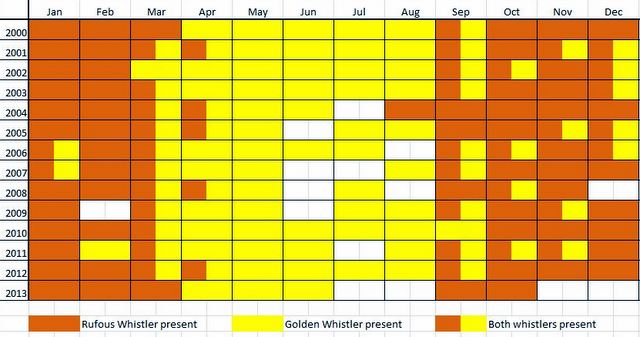
In south-east Australia Rufous Whistlers generally migrate north in autumn, although we have had a report of them over-wintering at Flowerdale. At our place they have never been recorded in the period May to July. This year the whistler was first heard here on 23rd September, but its return has varied from late August to early October in recent years. At present there are several of the whistlers chasing each other around the garden.
One of the advantages of keeping monthly bird records is that you can compare the presence of birds from year to year and the arrivals and departures of migratory birds. The chart below shows that for much of the year the Rufous Whistler tends not to co-exist here with the other local whistler – the Golden Whistler. Another interesting observation from the chart is that February 2009, when the Black Saturday fires occurred, was the only February when neither whistler was present.
The Rufous Whistler is common and widespread over much of mainland Australia, but absent from Tasmania. To hear some typical phrases from the Rufous Whistler’s song book, click on the audio bar below.
The soap opera continues
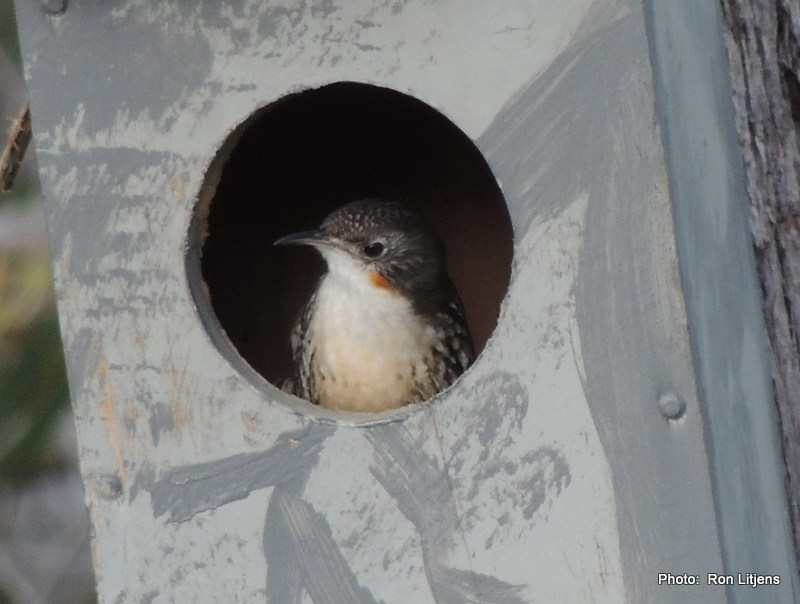
Female Treecreeper – note the ochre neck spot
With nesting season upon us we have been waiting to find out what the latest residents in our much-blogged about (click HERE to view) nest-box are. I am writing a soap opera about the comings and goings of both the furred and the feathered in this piece of real estate. It will be called The Box, in honour of the ground-breaking 1970s TV soap. Some of you will be old enough to remember it (I am) and were allowed to watch it (I wasn’t). This season a pair of White-throated Treecreepers (Cormobates leucophaea) has moved in. 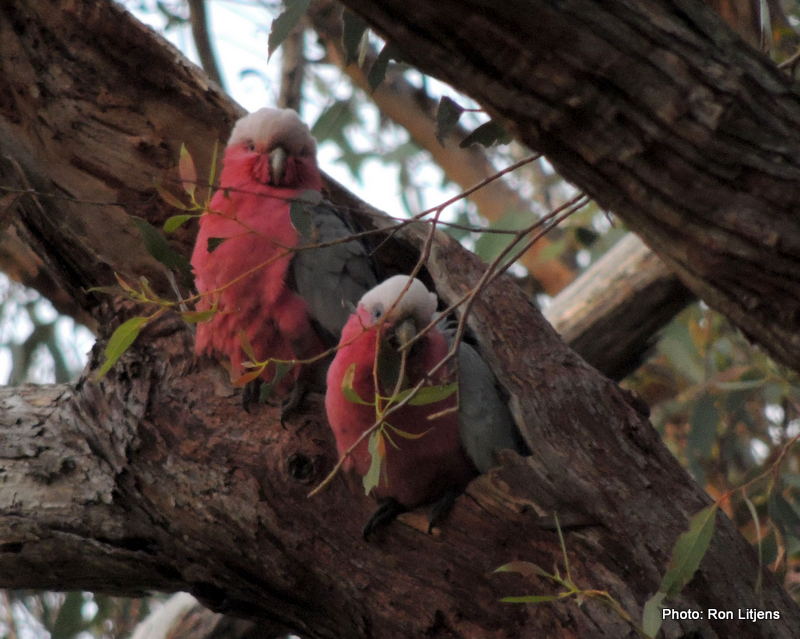 Normally they would nest in a hollow branch or cavity in a tree trunk. The birds had been casing the joint for several weeks but last weekend they spent the day removing rubbish from within the nest-box and replacing it with new bedding.
Not 20 metres away a pair of Galahs (Eolophus roseicapilla) has taken up residence in the hollow limb of an old Red Stringybark (Eucalyptus macrorhyncha). The racket coming from that direction over the past month attests to the fact that it was also hotly contested real estate.
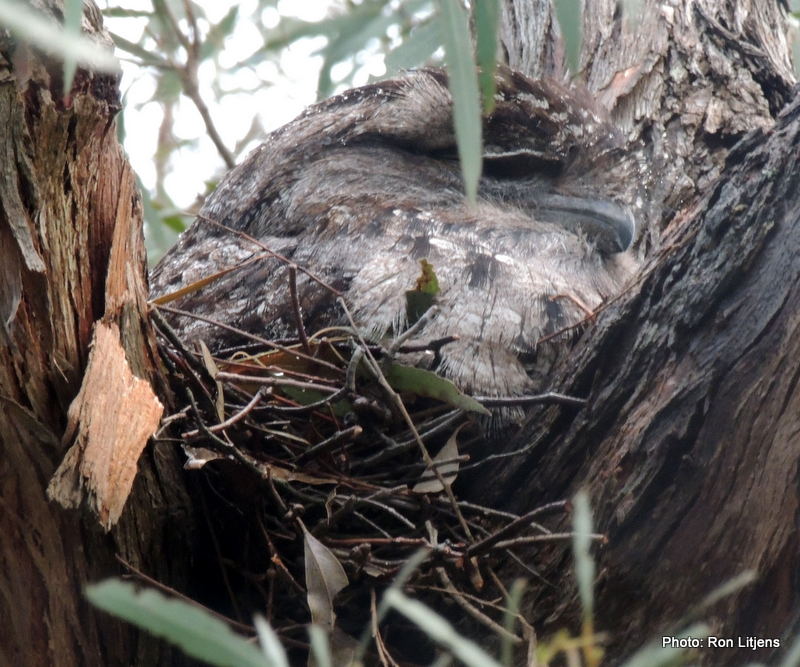
Tawny Frogmouth
While over at Len and Trude’s place, the recently sighted (click HERE to view post) Tawny Frogmouths (Podargus strigoides) have built their typical flimsy nest of twigs and leaves and have started sitting. I will watch this nest with interest because it doesn’t look like it could withstand a breath of wind.
Spring is here.
Growling frogs
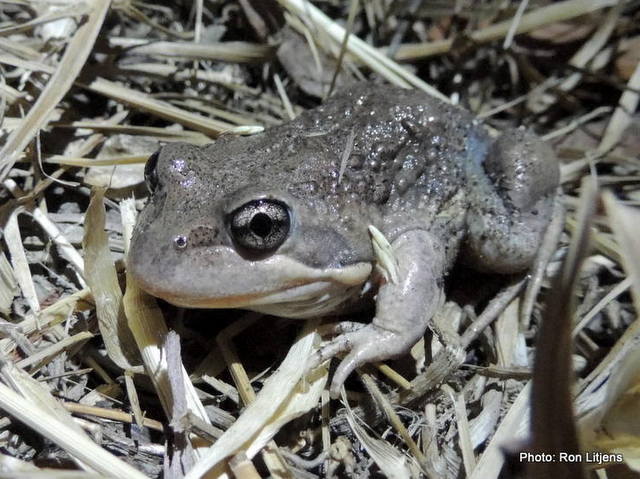 We have had a couple of reports of frogs heard growling recently. Much as we would like to put the reports down to the endangered Growling Grass Frog (Litoria raniformis), we suspect the culprit is the Pobblebonk, aka Eastern Banjo Frog (Limnodynastes dumerilii), as was the case with the soft growl we recorded at our own wetland area the other day – click on the audio bar below to hear the call.
The identification of this call was confirmed by Jo Wood at the Goulburn Broken Catchment Management Authority, who has also had several reports of growling Pobblebonks which can be heard below.
The actual call of the Growling Grass Frog is a much more robust growl which can be heard on the Frogs of Australia website by clicking HERE. A reminder that all the frogs of the Goulburn Broken Catchment can be heard by downloading free the CMA’s iSpy Frogs app from the iTunes store.
If you find the growls too much, try listening to this soothing recording of a range of the frogs calling at the moment.




 Focus On Fauna