A magpie by any other name

Black-backed
On a recent trip to Canberra I noticed many magpies patrolling public spaces (and stealing peoples’ lunches). They looked slightly different from the ones at home but I couldn’t work out why. When I came back I looked carefully at the magpies living in the hills around our place and there was a difference. In Canberra the magpies have a black head, a white back of the neck and an almost exclusively black back (see picture left). Even though I see magpies like these in Flowerdale, I predominantly see magpies that have a black head, but the white extends from the neck all the way down the back (see picture right).

White-backed
Apparently a magpie is not a magpie is not a magpie. The Australian Magpie (Cracticus tibicen) (from the Greek word kraktikos meaning noisy and the Latin word tibicen meaning flute-player) is a species with three different forms – the Black-backed (made up of three different races), the White-backed (three races) and the Western (two races) forms. Based on geographical location the Black-backed Magpie we see around here is most likely the race terrareginae and the White-backed Magpie is most likely the race tyrannica. As they can interbreed, the distinction between the races is not that clear. So when you next see a magpie, look out for what form it is.
The difference matters little to me. During the fast-approaching nesting season, black-backed and white-backed magpies alike will dive-bomb me as I ride my bicycle down Spring Valley Road on the way to the Post Office.
P.S. The first magpie swoop of the season was recorded at Moores Reserve at 1713 on 27th August 2013.
Birds calling
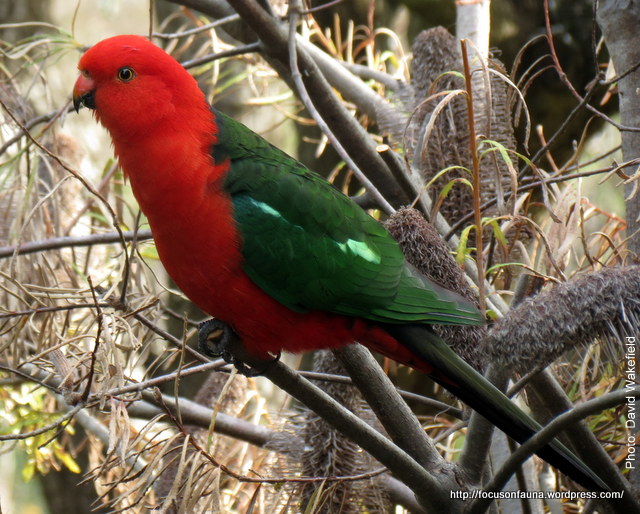
Australian King Parrot
The Strath Creek Landcare group has just released a CD for local distribution titled ‘Bird Calls of the lower King Parrot Valley‘. The CD is intended as a companion to a booklet about birds produced in 2007 and follows the same format as the booklet. Birds, probably more so than any other animals, produce an extraordinary array of sounds and, apart from appreciating their intrinsic beauty, learning the various calls is a valuable means of identifying individual species.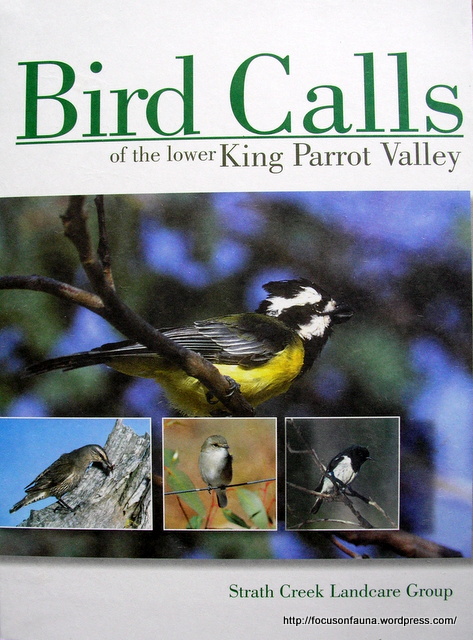
The CD should probably have been titled ‘Bird Vocalisations of …’ since purists distinguish between ‘calls’ and ‘songs’, the former usually being brief, acoustically simple sounds and the latter involving more complex series of varied notes with a recognisable pattern. But it can be a fine distinction and in any case ‘vocalisation’ seems clumsy for a title, so ‘calls’ it is.
Like humans, birds can have slight variations (dialects) between different regions, so we tried wherever possible to record the calls locally.
Birds are unique in possessing an organ called a syrinx. (Unlike us, their larynx serves only to stop food and water entering the windpipe and lungs.) The syrinx or voice-box is a structure at the base of the windpipe where it divides into two bronchial tubes. Rapid contraction of the bird’s lungs forces air through these tubes, and muscles and vibrating membranes within the syrinx create a musical sound. Each tube can be conrolled separately, allowing variations in the sound – one tube may be used mainly for breathing, or both may be used to produce different sounds that either combine or interact. Very rapid shallow breaths coordinated with the call notes allow some birds to sing for lengthy periods without a discernible break. Variations in the structure of the syrinx, as well as the length and diameter of the wind-pipe, account for the great diversity in bird calls/songs.
[For the technically-minded the calls were mostly recorded with a Zoom H4n recorder coupled to a Rode NTG-2 directional microphone.]
Copies of the CD are available free of charge at the Goulburn Broken Catchment Management Authority office in Yea. Click on the audio bars below for a couple of samples of the calls.
Tales from the woodpile #3
In the list of the ‘cellar-dwellers’ of public opinion would have to be spiders, used- car salesmen and politicians. In most cases these group reputations have resulted from the actions of a few. My uncle was a used-car salesman and he was one of the nicest, funniest people you could ever hope to meet. I have never met a ‘real’ politician but after watching ‘Kitchen Cabinet’ on ABC1 it appears that politicians are ordinary people who find it hard to cook a decent meal without the help of friends and family…just like me. And as for spiders, a previous post (click HERE to view, if you dare) showed them to be not the ugly, horrible hairy creatures people make out but rather, in close-up, cute, almost comical hairy creatures, what with their hairy lips and googly eyes.

Bark Cockroach
An addition to the ‘cellar-dweller’ list would have to be cockroaches. Their reputation for spreading dirt and disease has been unfairly garnered from the few imported species that have sneaked onto our shores. Australian bush cockroaches are nature’s garbage collectors and are themselves an important (and crunchy) food source for a lot of other Australian fauna.
Anyone who stacks wood in preparation for the following winter will know that after a period of time logs gradually split, the bark starts to come loose and eventually falls off. This process creates lots of nooks and crannies for insects to hide in and the cockroach is ideally suited to live in these spaces. During my recent visit to the woodpile I disturbed two species of cockroach. Pictured left is the Bark (or Flat or Trilobite) Cockroach (Laxta granicollis). They are communal insects that live in small colonies and communicate using smell. Pictured left is a female. The male is narrower and is winged. Their flat, almost two-dimensional bodies make them ideally suited to live in splitting logs.
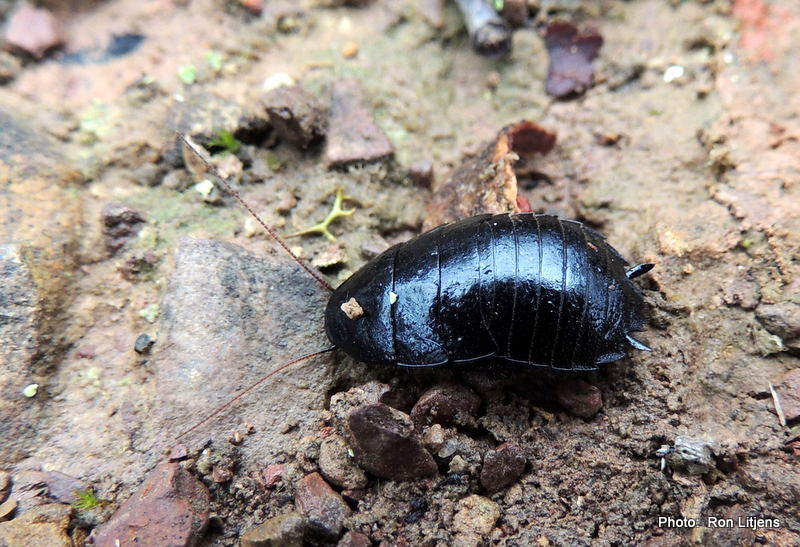
Black Woodland Cockroach
Slightly more robust in form is the Black Woodland Cockroach (Platyzosteria melanaria), pictured right. Their glossy black colour distinguishes them from the dark reddish-brown Oval Woodland Cockroach.
These woodpile residents are not as sexy as other woodpile co-habitants like the Brush-tailed Phascogale, for example, but none the less are just as valuable a contributor to the ecosystem. Don’t squash them.
Out for a duck
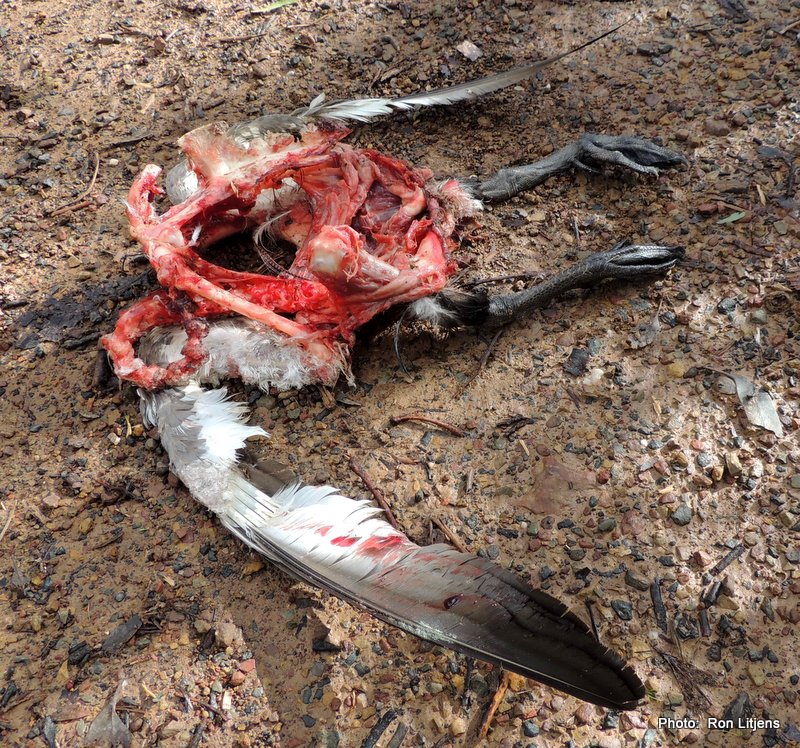 Our pleasant walk was disturbed by finding an eviscerated carcass of what looked to be duck lying in the middle of the driveway. The only recognisable parts were the webbed feet. Whatever animal did the deed did a very good job. The skeleton was mostly intact but there was scarcely any meat left on it. This suggested to us that this wasn’t a fox or feral cat kill.
The carcass was obviously fresh. We may have even disturbed what was feeding on it. So we set up a remote camera at the scene, in case something returned to finish the meal. We returned after a few hours and sure enough the 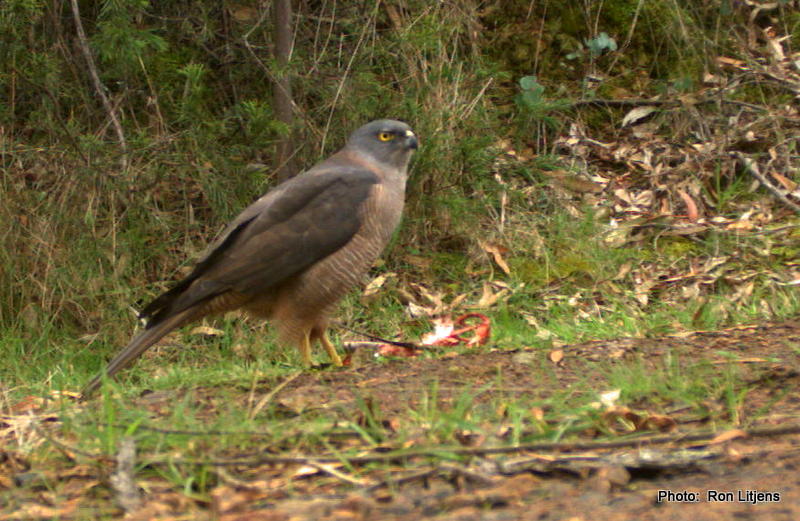 body had gone. The image captured on the camera was of a Brown Goshawk (Accipiter fasciatus). The scientific name comes from the Latin accipere meaning to seize or to capture and the Latin word fascia meaning banded, referring to the brown and white bars on the underbody. The Collared Sparrowhawk looks almost identical to the Brown Goshawk. The main difference is the latter is stockier and has a heavier brow.
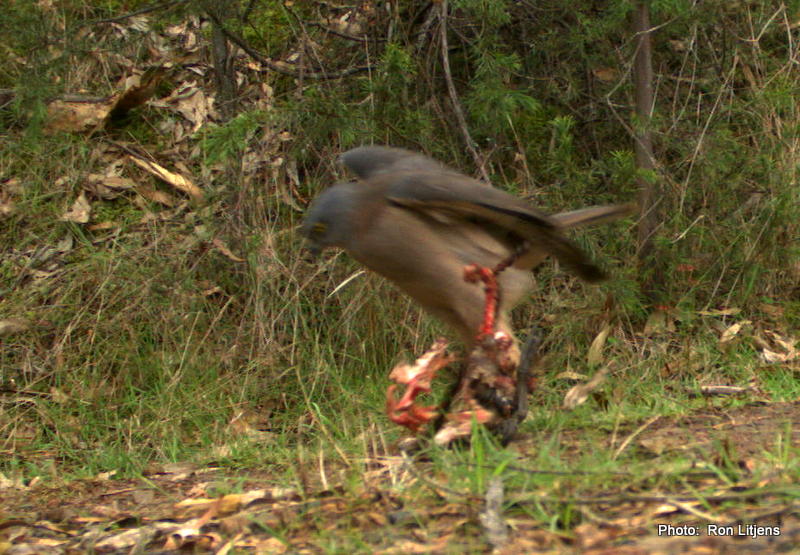
Goshawk version of a ‘heavy meal’.
It is hard to know if the bird pictured killed the prey or was just an opportunistic scavenger. Brown Goshawks normally hunt by diving on prey from low, concealed perches using speed and surprise as an advantage. Rabbits and mice make up most of the diet, which can also include birds up to the size of domestic chooks. Brown Goshawks will also feed on carrion. The kill is taken and eaten on a nearby perch. I presume that is where the Goshawk is taking its prize captured in the ‘action shot’ on our camera.
For such an effort it deserves raptorous applause.
Snakes and ladies

Red-bellied Black Snake
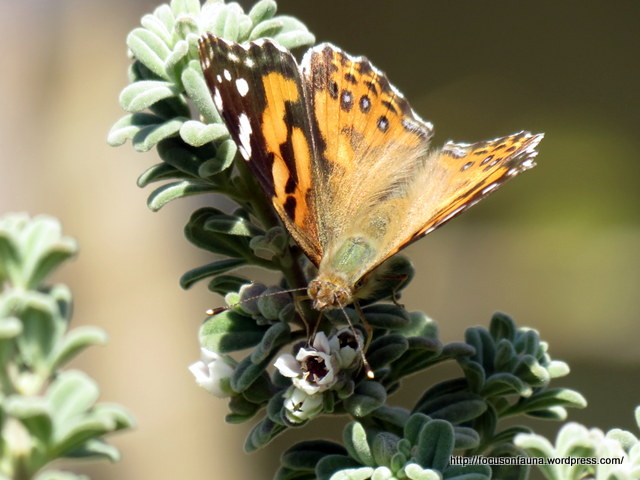
Australian Painted Lady
One of the first butterflies to appear in spring is the Australian Painted Lady (Vanessa kershawi) pictured at right, which has taken a particular fancy to a Downy Zieria bush (Zieria cytisoides). For another impressive image of the lady go to the Strathbogie Ranges – Natureview website.
Other butterflies seen around and included in the slide show below are the Yellow Admiral (Vanessa itea) and the Cabbage White (Pieris rapae). The Imperial Jezebel (Delias harpalyce) was flying too high to photograph satisfactorily.
Pigs might fly but sheep don’t
At the moment the Valley of a Thousand Hills looks wonderful. On the vivid green slopes, snowy-white sheep graze. Maybe those sheep are a little too white. As I move closer to get a better look, they take to the air. Well, pigs may fly but sheep certainly don’t.
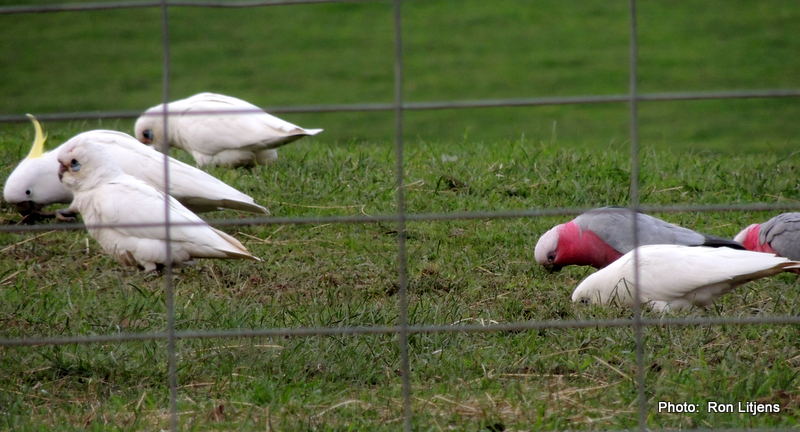
Birds of a feather…
At this time of the year flocks of cockatoos graze in the paddocks. Up on Junction Hill these flocks are comprised exclusively of Sulphur-crested Cockatoos (Cacatua galerita) but in the lower, more open parts of the King Parrot Valley, Galahs (Eolophus roseicapillus) and Little Corellas (Cacatua sanguinea) are also in the mix (pictured left).
.
 They are digging up Onion Grass or Guilford Grass (Romulea rosea var. australis), a herbaceous perennial weed originally from South Africa. In late winter the plant develops small bulbs called puddings (pictured right) that are sweet to eat and for these birds this is the food of choice before the acacia seeds ripen later in the year. The flowers, which come out in spring, are pink (pictured below).
It’s a surprise that these cockies can do such a fine community (weeding) service. I wonder if we could teach them to eat Cape Weed as well?
Finding phascogales
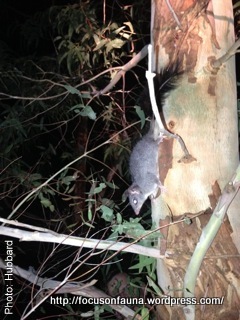
Brush-tailed Phascogale
A Focus on Fauna favourite, the Brush-tailed Phascogale (Phascogale tapoatafa), was photographed recently on “Three Sisters” on the Broadford-Flowerdale Road. Since the FoF project began in late 2010 there have now been at least four phascogale sightings at widely-spaced locations on this large grazing property adjoining the Mount Disappointment State Forest, which is encouraging since much of its habitat was severely burnt in 2009. Two of those sightings were reported in previous posts on this blog – click HERE and HERE to view.
According to the Victorian Biodiversity Atlas, the Brush-tailed Phascogale was found on “Three Sisters” in 1932 and 1933, but there were no subsequent records in the vicinity until Focus on Fauna entries in 2011. Although this phascogale is listed as a threatened species under the Fauna and Flora guarantee Act, we are finding it is a case of the more you look, the more you find, and a greater awareness in the community as well as remote surveillance (and mobile phone) cameras are making it easier to record sightings.
Brush-tailed Phascogales have an interesting, and somewhat precarious, life-cycle. Breeding is restricted to the cooler months, with frenzied mating in May and June, after which all males die of various stress-induced diseases, with only pregnant females surviving. They give birth from mid-June to early August, following about 30 days gestation. The photo above was taken on 11th August, so this would be a female, probably with several young attached to the teats in her pouch. Most females only produce one litter and survival beyond 3 years is rare.
Tales from the woodpile #2
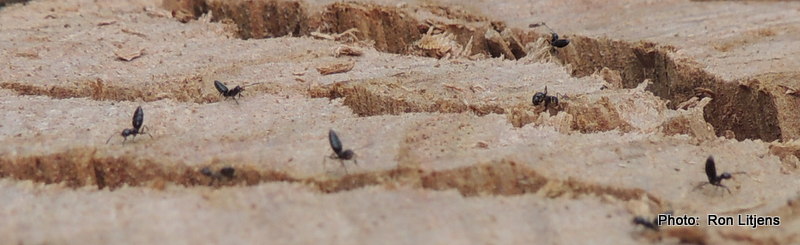
Annoy-ance
While splitting wood recently, the bark fell off a log revealing an colony of irate ants, which proceeded to scurry around with their abdomens in the air (pictured left, click image to enlarge it). They were threatening to spray formic acid (methanoic acid) as a defense mechanism. The word ‘formic’ comes from the Latin word for ant, formica.
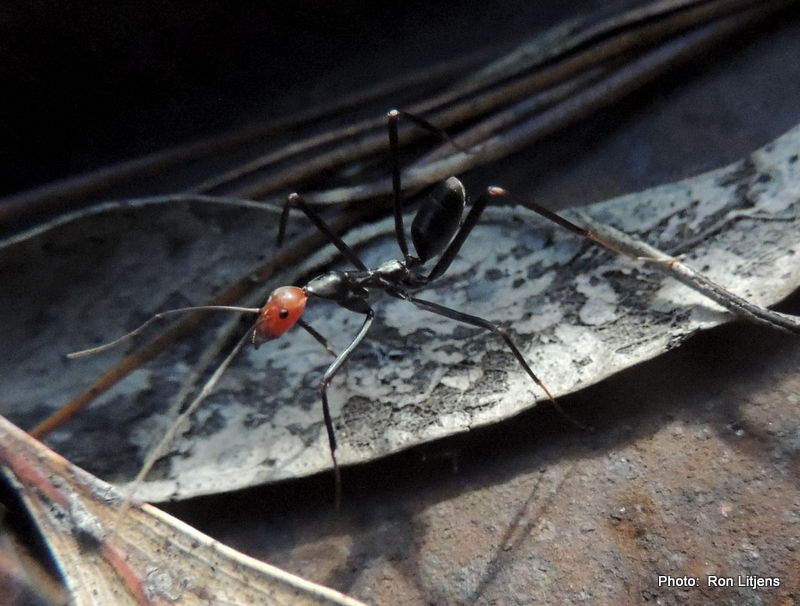
Defi-ance
Most ants use a mixture of formic acid and other chemicals to defend themselves. In some ants this is delivered as a painful sting. The Dolichoderinae family of ants lack a sting and therefore spray the chemicals by forcibly ejecting the formic acid from a poison gland in the tail. A Spider Ant (Leptomyrmex erythrocephalus) (from the Greek eruthros meaning red and kephale meaning head), pictured right, is shown with the abdomen raised in a defensive position. Another local ant from the same family (pictured below) is the Double-spined Dolly Ant (Dolichoderus doriae) (from the Spanish dorados for golden colour). It is named after the spines that protrude from the thorax. Annoying either of these ants will result in a defensive spray and the familiar ‘ant smell’.
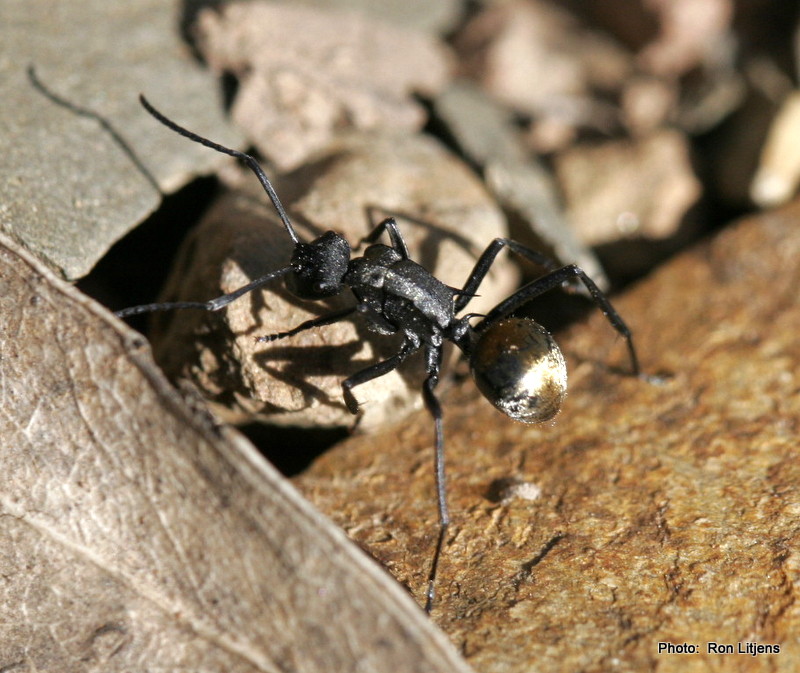
Protuber-ance
Other fauna use this ant behaviour to their advantage. Many birds, including some Australian birds such as the Regent Honeyeater, are known to perform ‘anting’ where they rub ants into their feathers. The ants get annoyed and spray formic acid, which acts as a combination insecticide, miticide, fungicide and bactericide. Some birds then eat the ant after all the formic acid has been eliminated.
In an amazing evolutionary step, creatures such as the Anteater (from the Americas) do not produce hydrochloric acid to promote digestion like most mammals. Instead they rely on the formic acid secreted by ants they eat to do the job. Hence the ants provide the acid to digest themselves.
And that is why you never see an echidna with a sore tummy. It’s full of ant-acid.
Small is beautiful
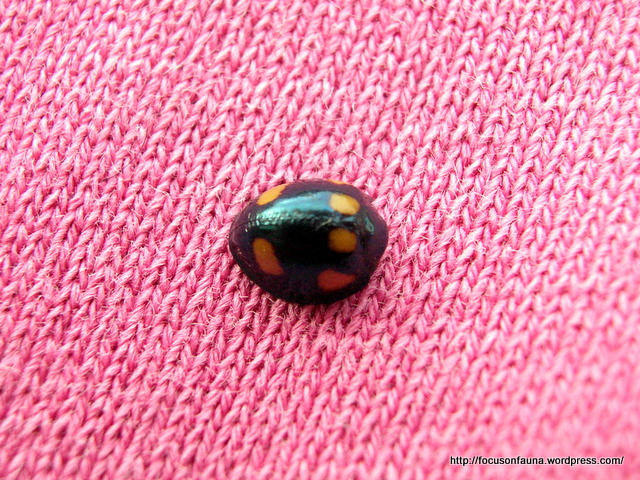 Just to show that size (or lack of it) is no barrier to qualifying for this blog, we’ve included this lovely little beetle that came in on the clean washing straight from the line. It’s an Orange-spotted Ladybird (Orcus australasiae) and the fine-knit windcheater background gives an idea of the size – approx. 5 mm long. This ladybird reverses the usual colour scheme of black spots on orange/red wing covers found on many species of the Family Coccinellidae, including the familiar Common Spotted Ladybird (Harmonia conformis).
Many ladybird beetles are not just pretty, but perform a useful role as predators on aphids, mealy bugs, mites and scale insects. So, despite their depiction in the ABC-TV’s Minuscule series as irritating little smarty-pants, they represent a valuable means of biological pest control.




 Focus On Fauna