Hooded Robin at Flowerdale
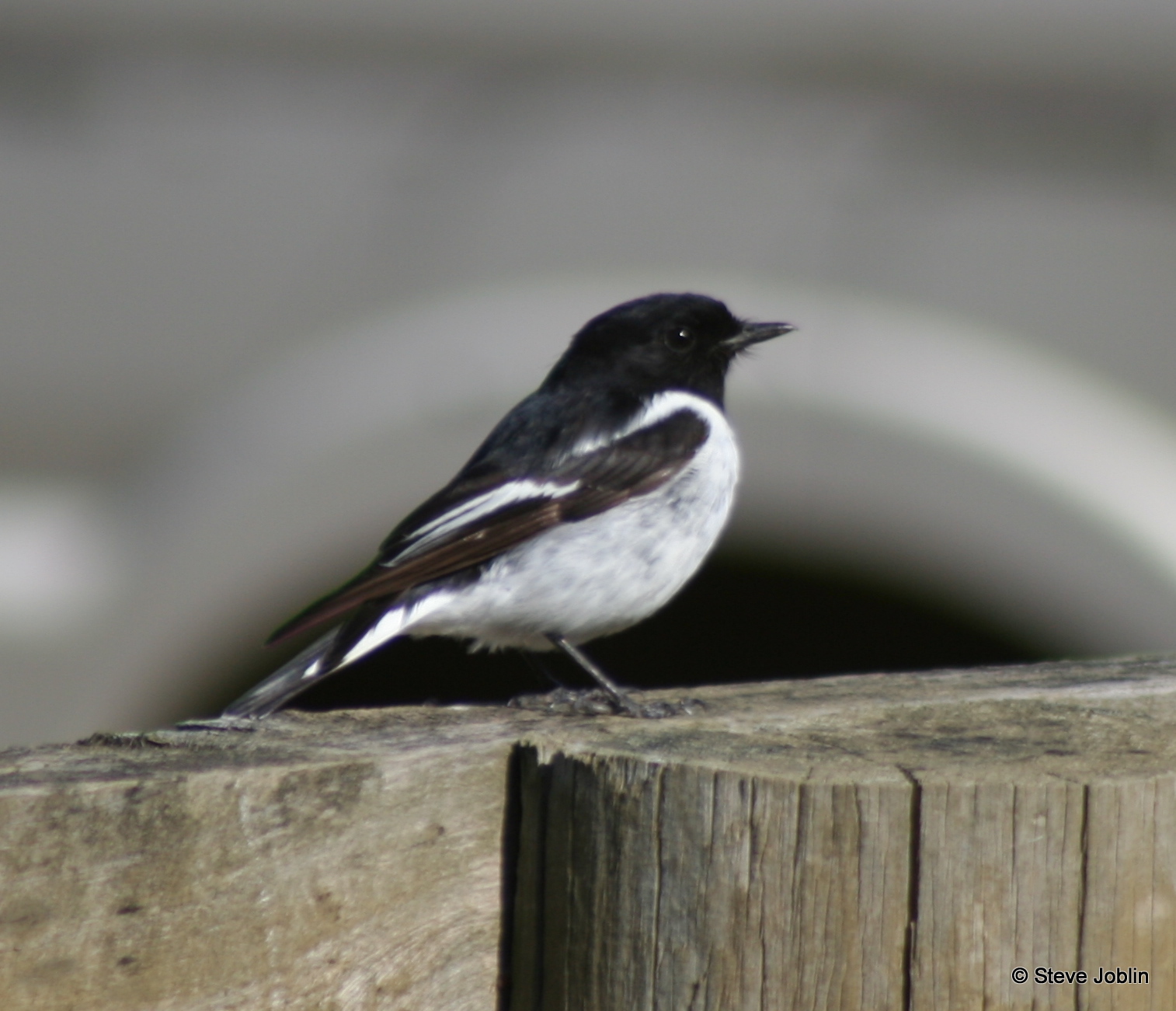
Hooded Robin - Photo: Steve Joblin
A recent rare sighting on a property in Spring Valley Road was a male Hooded Robin. This lovely bird prefers lightly timbered woodland with grassy clearings and fallen timber. Its conservation status in Victoria is “Near Threatened” and it is one of a number of temperate woodland species in serious decline due to habitat loss and fragmentation, as well predation by foxes, cats etc.
The Strath Creek Landcare group featured the Hooded Robin in its booklet Birds of the lower King Parrot Valley in the “Focal Species” section. It was hoped that these declining woodland birds could be encouraged back to the district by Landcare works such as protection of remnant habitat and revegetation. Such works have been carried out over several years on this Flowerdale farm. Fire swept through the property in February 2009, and it is good to know the Hooded Robin has now returned. There were three previous sightings of an immature bird in 2002, 2004 and 2007.
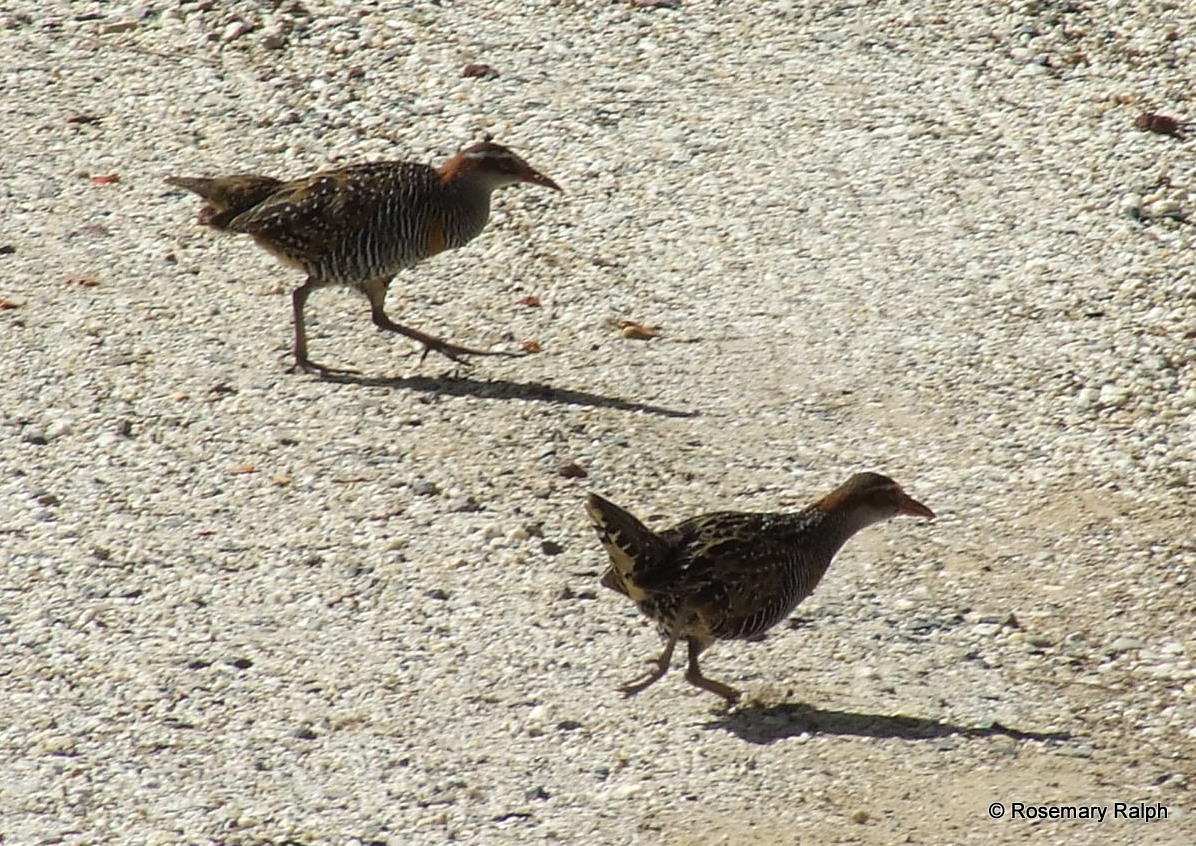
Buff-banded Rail - Photo: Rosemary Ralph
Another uncommon visitor to the district recently was the Buff-banded Rail. A pair of rails has been observed with a young one on a Strath Creek property. The rail’s preferred habitat is reeds and rushes bordering wetlands, and these birds are obviously attracted by the landholders’ large well-vegetated pond close to the house. A distinctive feature of the rail is that it flicks its tail constantly.
Click on each of the photos for a closer look.
Camera results
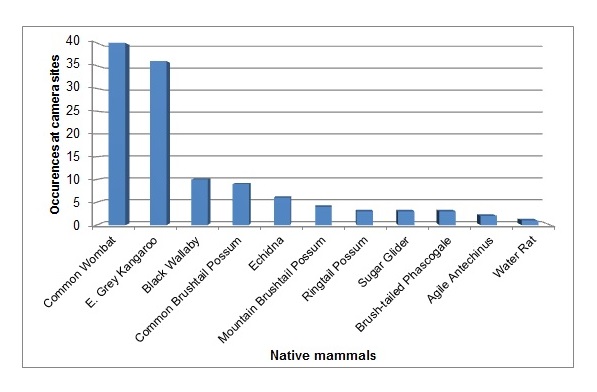
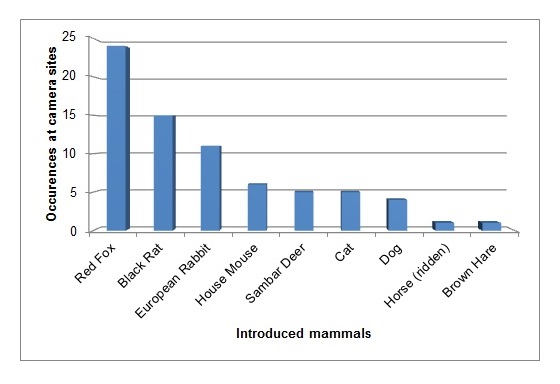
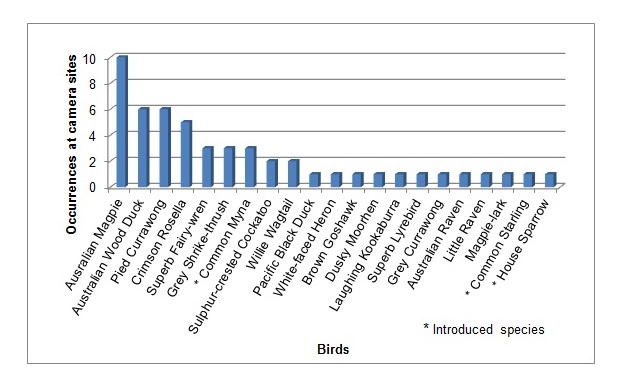
An analysis of our remote camera survey results over the period January to November shows that wombats and kangaroos were by far the most frequently recorded native animals. From almost 100 camera deployments (each for a period of one week) on 25 properties, we recorded 11 native mammal species, 9 introduced mammals, 21 bird species and one reptile (a Common Blue-tongue).
Foxes, rats and rabbits were the most common pest species. The Red Fox was recorded on 17 of the 25 properties surveyed. With the night-time infra-red shots it was not always easy to readily identify the Black Rat from the native Bush Rat and the House Mouse from a native antechinus.
The birds captured on camera were mostly common species, but the highlights were a Superb Lyrebird and a Brown Goshawk , both on the same property – click on the name to see a previous post on each of thes birds.
Busy beetles
 You may have noticed swarms of beetles flying around and aggregating on plants recently. These are the Plague Soldier Beetles (Chauliognathus lugubris). They can be found in forests, heaths and woodlands as well as gardens.
According to the Australian Museum: “The Plague Soldier Beetle infests blossoms of native trees, fruit trees, vegetable plants and other garden plants in such numbers that they can actually weigh down weaker plants. While this may be distressing to gardeners, the plants do not suffer much. This may be because the beetles are too interested in mating to bother eating the plants. Scientists found that in one such infestation 92% of the animals were copulating.”
The larvae live in the soil and feed on soft-bodied invertebrates.

Cuckoos calling
All four of the cuckoos that regularly visit the Flowerdale/Strath Creek area each year to breed have been in full voice in recent weeks. Click on the arrow on the sound icon to hear each of their calls, which were recorded locally.
Fan-tailed Cuckoo –
Pallid Cuckoo –
Horsfield’s Bronze-Cuckoo –
Shining Bronze-Cuckoo –
Another cuckoo, the Brush Cuckoo, would probably have been found in the wetter forests of the upper King Parrot Creek valley, and it would be interesting to know if it has returned since the 2009 fires.
Any sightings or calls heard?
Herons thriving
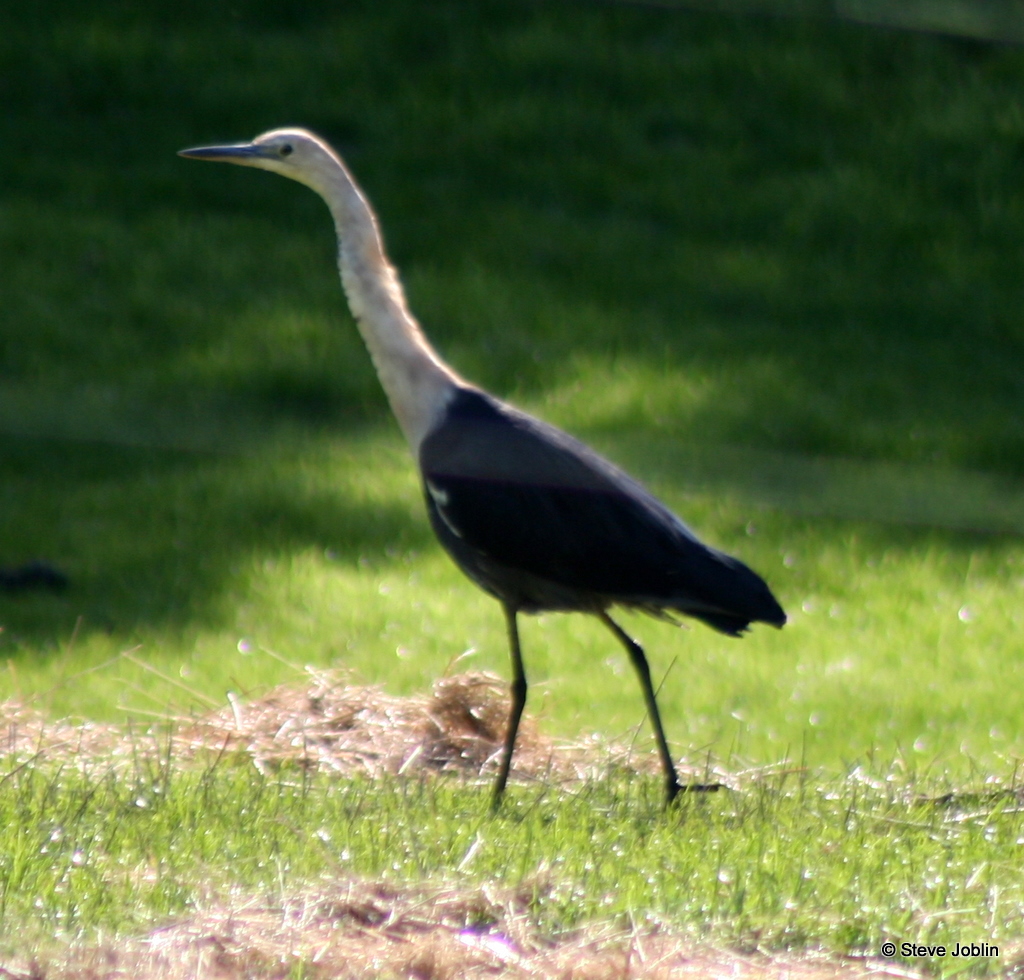
White-necked Heron at Flowerdale by Steve Joblin
The good rains over the past couple of years seem to have favoured the White-necked Heron, quite a common sight around the Flowerdale – Strath Creek area recently. They look very large and majestic in flight, with their deep slow wingbeats and conspicuous white ‘headlights’ showing on the leading edge of their wings. On the ground they are seen in wet paddocks, roadsides and around dams, often standing motionless for some time while hunting.
Sign up for ‘maccas’
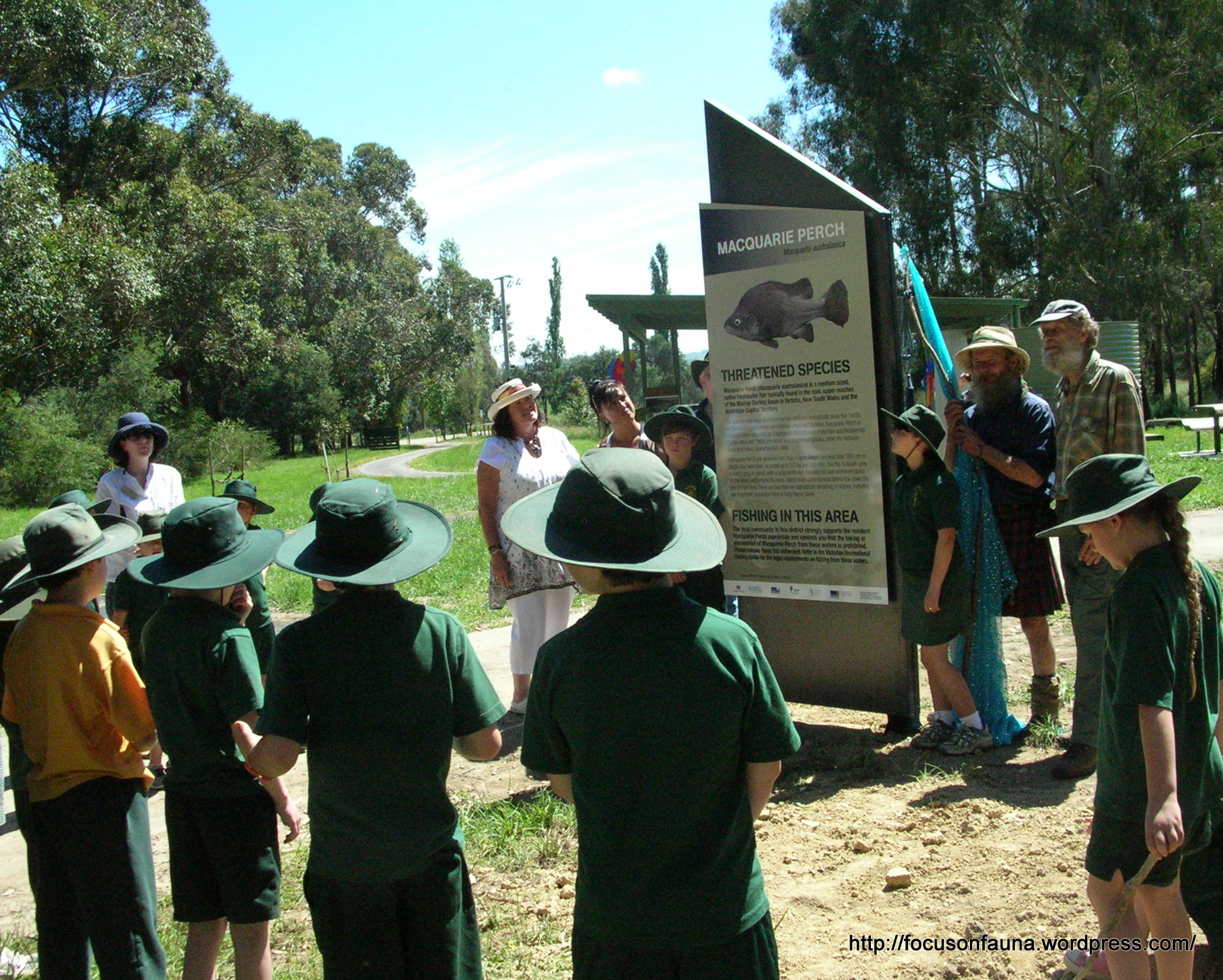

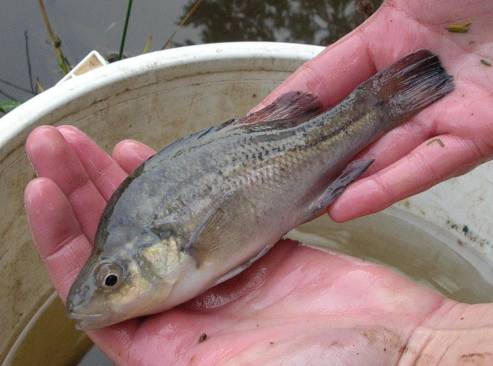
Impressive and informative new Macquarie Perch awareness signage was unveiled yesterday at the Moores Road Reserve, Flowerdale, as part of Native Fish Awareness Week. Gathered together for the ceremonial ‘lifting of the scales’ from the sign were the ‘macca mob’, comprising representatives from groups and agencies involved in the conservation of this threatened species:
Flowerdale Environment Work Engine, Flowerdale Primary School, Strath Creek Landcare Group (King Parrot Creek)
Hollands Creek Demonstration Reach Community Group
Strathbogie Ranges CMN (Hughes Creek)
Fisheries Victoria (DPI)
Arthur Rylah Institute (DSE)
Goulburn Broken CMA
The Taungurong (Daung Wurrung) people
Those present were provided with an update on monitoring and breeding programs, and discussed how best to coordinate recovery actions in the future. The school kids were involved in plenty of fishy activities.
The theme of Native Fish Awareness Week is “Habitat makes fish happen!” highlighting the importance of suitable stream habitat for the survival of native fish.
To read about recent surveying and research into spawning of Macquarie Perch in King Parrot Creek on the DSE website, click HERE. And for a summary of the post-fire recovery actions for the maccas in 2009, click HERE.
From French Island to Flowerdale
 In 2004, a number of tagged koalas from French Island were released by DSE officers in Mt.Disappointment State Forest. It was feared that the koalas may not have survived the Black Saturday fires, but several have since turned up in surrounding areas such as Broadford and Flowerdale.
A koala was found recently in Spring Valley Road near Coonans Bridge Reserve, Flowerdale, with a numbered blue tag in its right ear. This was reported to DSE and it was identified as a male from French Island that was released on Spur Road in October 2004. The large Manna Gums along King Parrot Creek would provide good habitat for the koala, but outside the forest it is unfortunately vulnerable to dogs, vehicles etc.
The koala pictured here was actually found along Upper King Parrot Creek Road, Strath Creek in 2007. The blue tag indicates it is also a French Island koala, which means that there was some dispersal from the forest even before the fires.
Goshawk on Junction Hill
 This Brown Goshawk was photographed by a remote camera installed on a densely vegetated property at Junction Hill, north of Flowerdale – the same location where a Superb Lyrebird was recorded in August (click HERE to see previous post).
The bird’s prominent brows and robust body and legs would seem to identify it as a goshawk, rather than the similar but finer-bodied Collared Sparrowhawk, which also has a significantly longer middle toe . The streaked head and upper breast, and broad ventral stripes would indicate this is an immature bird.
A Brown Goshawk (possibly the same bird?) was observed flying low over the property 3 days later, during a standard bird survey conducted when retrieving the camera.

A minor problem for a skink?
Possums and gliders

Sugar Glider
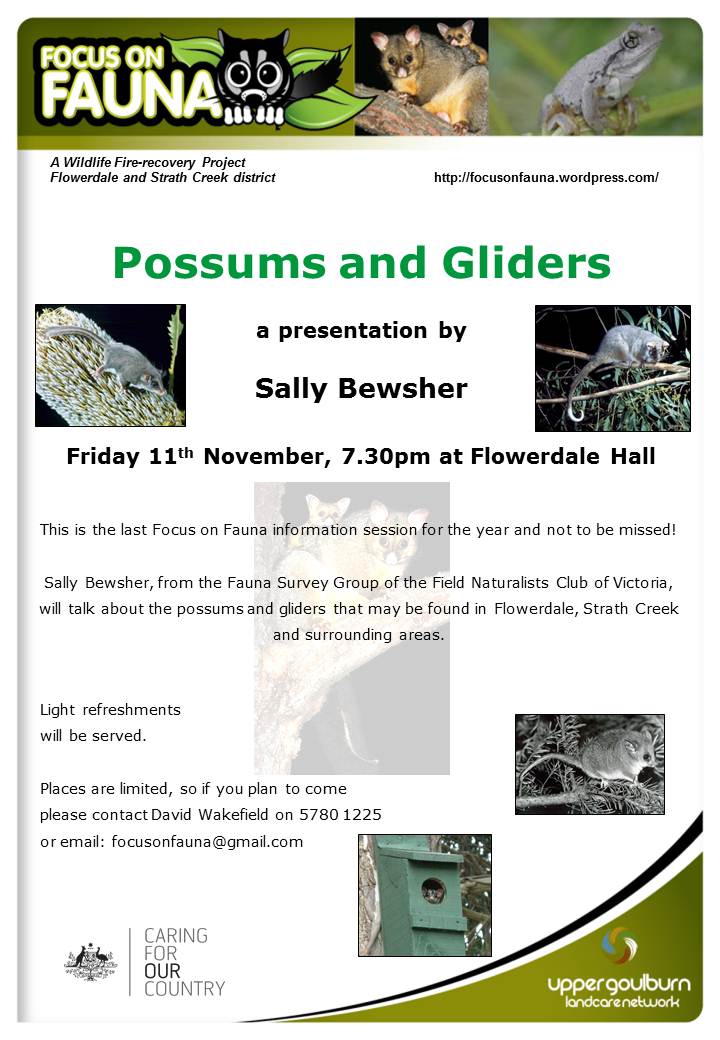
Another Focus on Fauna evening is coming up on 11th November at Flowerdale Hall. This will be the final presentation for the year, so be sure to put this date in your diary, and come along to find out more about those creatures that go bump in the night!
Click on the flier below for full details:




 Focus On Fauna