Hiding the Nest

Predators seem to destroy many nests and eat many baby birds. Kookaburras, currawongs, butcherbirds, ravens, even magpies find it hard to resist an easy meal of nestlings. I fear for small urban birds like Grey Fantails and Willie Wagtails as I have witnessed several times the tragedy of hours of work and care – constructing nests, sitting on eggs, feeding young – come to nothing when one of those bigger birds drops by for lunch.
Biologists call it an arms race – the prey bird has to find new ways to outwit or defeat the predator, and there are many intricate strategies, while the predator, in turn, learns new ways to hunt them. Should either prey or predator get too far ahead, the other will struggle to survive.
Some years ago on this blog, Macwake detailed the story of Dusky Woodswallows with a conspicuous nest in a Sheoak losing their brood to some unknown predator: Precarious Position. The story surprised me because I have observed that Woodswallows (genus Artamus) frequently nest cryptically behind a piece of lifted bark on the side of a tree. If they are so foolish as to nest in the open, expect the predators to win the arms race.
I once witnessed a season where a huge mixed flock of White-browed and Masked Woodswallows descended on a Red Gum forest – every spare piece of dislodged bark harboured a nest and the air was alive with busy adults zooming around, feeding the brood.
Here is a Dusky Woodswallow pair (A. cyanopterus) I observed recently with a more typical, cryptic nest site. I never actually could see the babies even though they were obviously being fed and it was only at shoulder-height. The nest is tucked in behind the bark.


My guess is they raised the young successfully.
How I spent my summer
To make sure that I get the most out of my summer holidays I usually set myself some goals, for example, read a novel a week. One of my goals this summer was to get a photograph clearly showing why the Spotted-eye Hoverfly (Eristalinus sp.) was thus called. It seemed like an easy task but these insects are very active fliers and very aware of anything new in their environment, like a photographer.
Hover flies are one of the major groups of pollinating insects, visiting a wide range of flowers, with the adults feeding exclusively on nectar and pollen. Some hoverflies only pollinate one flower species. Hoverflies of the genus Eristalinus are characterized by distinctive eye markings. Their larvae live in aquatic and semi-aquatic environments and have the ability to filter and purify water.
After five weeks of racing around a variety of white or pale-yellow flowered bushes I have ONE semi-decent photo (below).
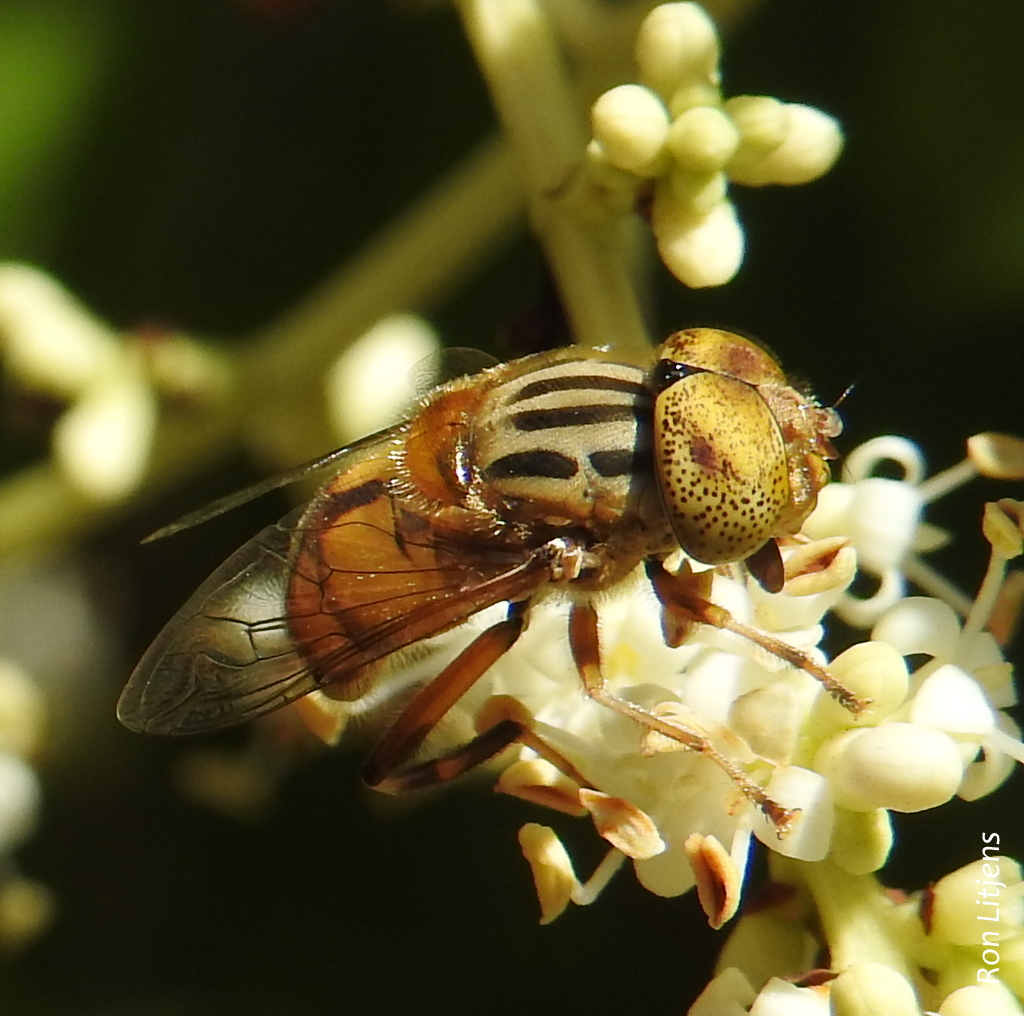
Job done. Now on to the next goal. Where am I going to find a female Feather-horned Beetle???
2022 Minimalist nest design award
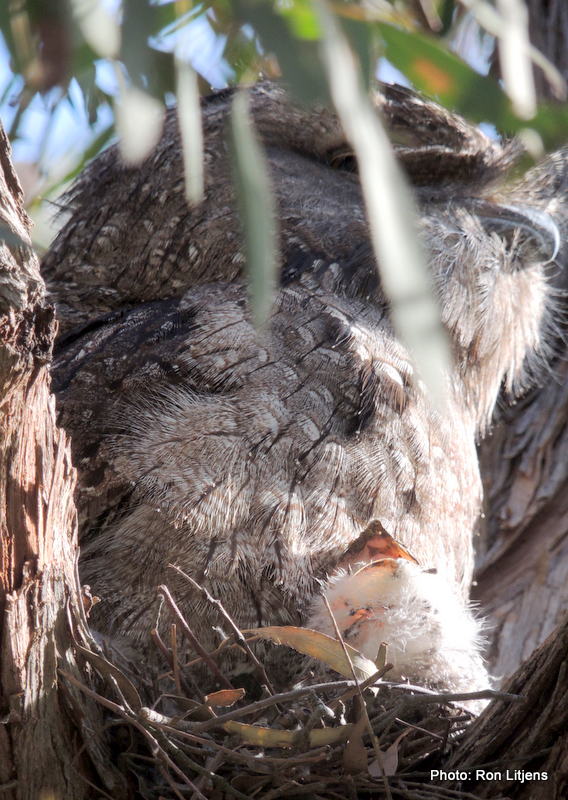
Finalist 1 – Tawny Towers (left)
Architect: Tawny Frogmouth (Podargus strigoides)
Location: Horizontal branch, Flowerdale
Materials: Twigs, loosely dropped into place, grass and leaf lining
Affordability: 3 stars – minimal use of materials, all recycled
Stability: 1 star – very flimsy, easily blown down in a storm
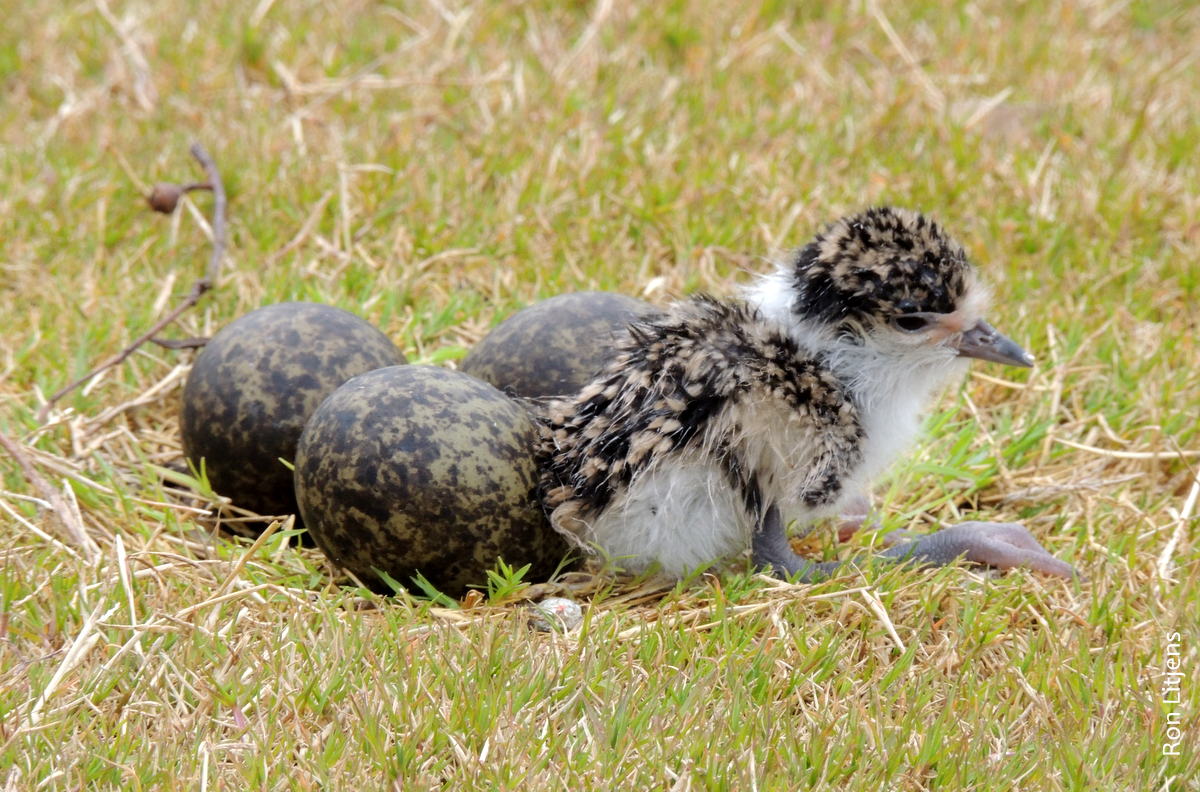
Finalist 2 – Plover Pad (below)
Architect: Masked Lapwing (Vanellus miles)
Location: Middle of the Flowerdale Recreation Reserve
Materials: A few sticks of grass laid out on the ground
Affordability: 4 stars – very minimal use of materials, all recycled
Stability: 3 stars – can’t fall down, minimally camouflaged, could be stepped on
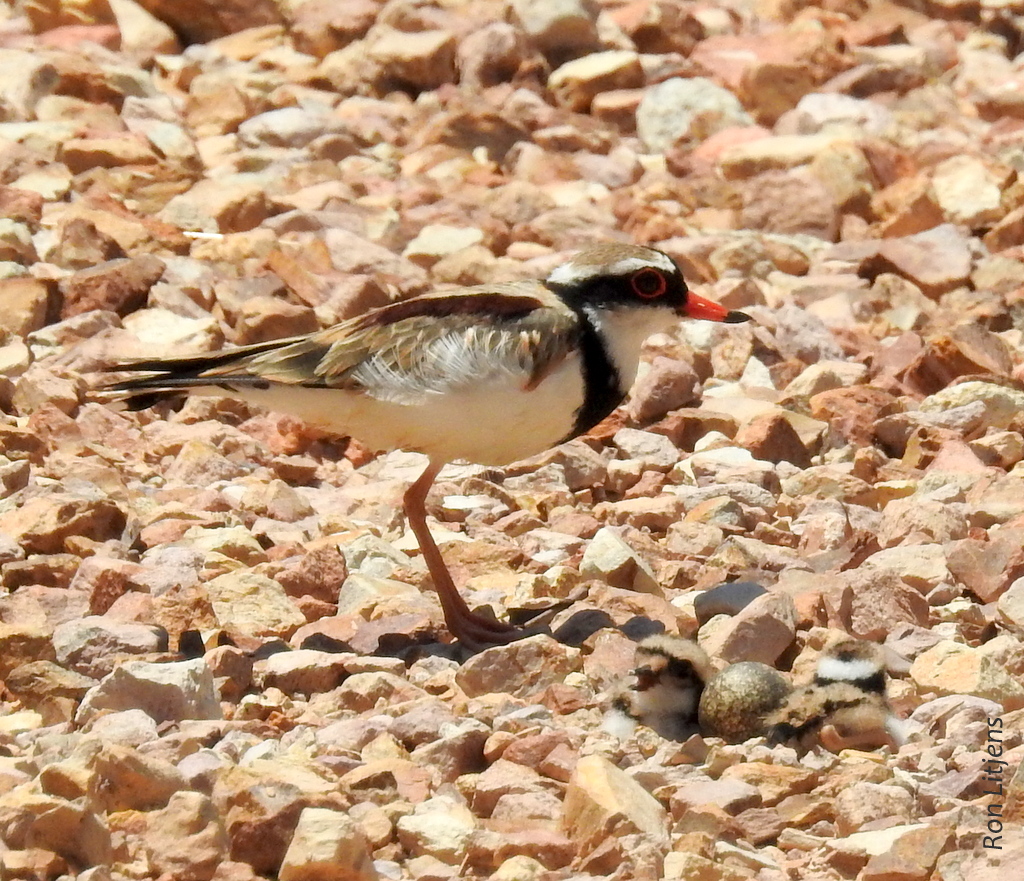
Finalist 3 – Dotterel’s Dive (above)
Architect: Black-fronted Dotterel (Elseyornis melanops)
Location: Middle of the amphitheatre, Euroa Arboretum
Materials: nothing, a depression in the rocks
Affordability: 5 stars – you get what you pay for!
Stability: 5 stars – built of stone, can’t fall down, highly camouflaged
And the winner is … the Black-fronted Dotterel. Congratulations. An honorable mention goes to the Bush-stone Curlew and the Plains Wanderer.
Go turtles!

The gum leaves in summer seem to be decorated with their own Xmas ornaments – a variety of lumps and bumps. These adornments are usually due to insects that lay their eggs either in or on the leaves, insects such as gall wasps, sawflies and eucalyptus bugs. One decoration that caught my eye this year appeared to be a type of ruff encircling a eucalypt stem (pictured left). The structure, presumably an egg case was hard to identify on the internet. As pointed out in an earlier blog it is hard enough to identify an adult insect from a photo, let alone its young or worse still its eggs – if indeed it was an insect that caused it.
In such a case the tried and true method of simply waiting and watching the object was called for although a more thorough search of the same tree revealed other egg clusters, some more advanced in the lifecycle. Luckily the waiting phase was minimized.
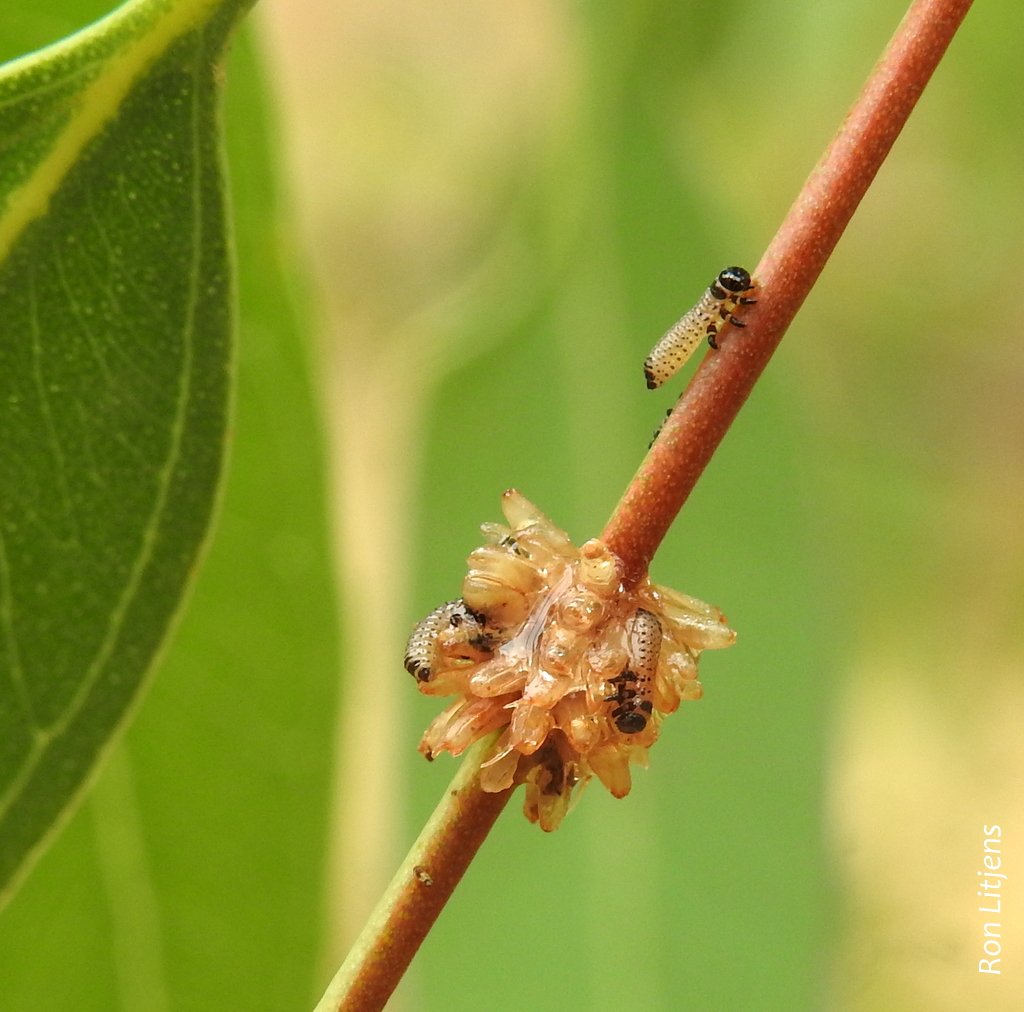
The photograph above shows that out of one such cluster small grubs emerged and then made their way along the stem to the nearest leaf where they joined their ‘hatching cohort’ devouring gum leaves. These are the larvae of Eucalyptus Leaf Beetles, beetles that sort of look like Ladybird Beetles but are bigger (click HERE for related blog).
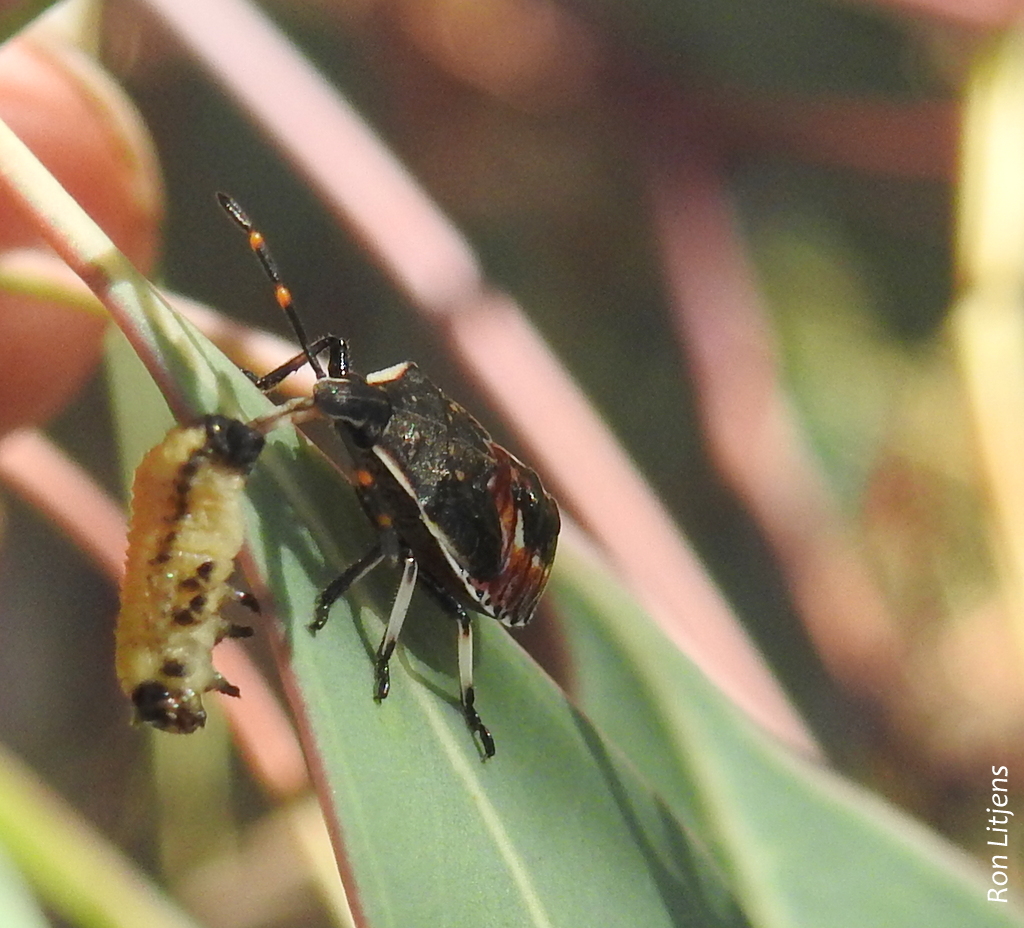
The life of the grub however is not easy. There are all sorts of perils along the way. Pictured right is a predatory Shield Bug nymph attacking a beetle grub. It stabs the grub with its rostrum through which it pumps in digestive juices and then sucks out the nutrients.
It was like watching one of those nature documentaries where young turtles hatch and try and make their way down the beach to the safety of the ocean before the seagulls eat them. I always root for the turtles. This grub didn’t make it.
Skewered!

This blog site has featured many articles about Hemipterans, an order of insects that includes cicadas, psyllids and various other types of ‘bugs’. Amongst other things these insects are characterised by having sucking mouthparts known as rostrums. The rostrum is capable of piercing and consists of two tubes. One facilitates the injection of saliva into a food source. The saliva contains enzymes that dissolve cellular material. The second tube allows the insect to suck out the pre-digested liquid.
Whereas psyllids, gum-leaf hoppers, spittlebugs and the like suck sap from plants there is a group of Hemipterans that are predatory and feed on other invertebrates. The Orange Assassin Bug (Gminatus australis) is one such creature. When ‘at rest’ the rostrum is tucked underneath the body (see picture above).
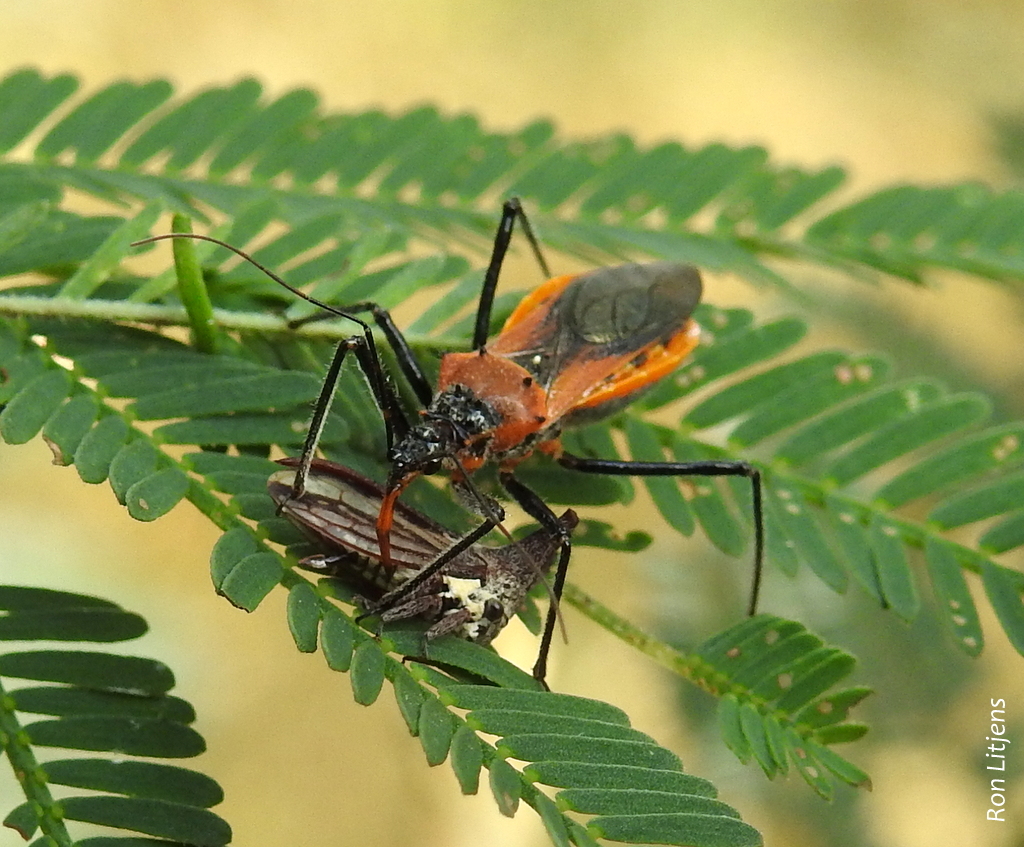
The Assassin Bug is an ambush predator that grabs passing prey with its front legs before stabbing it with its rostrum, injecting enzymes and sucking out the liquid food. The legs are haired to help grip the prey. The unlucky victim pictured above is a Horned Treehopper (Ceraon sp.).
Interestingly both predator and prey are Hemipterans. I guess ‘Who lives by the rostrum, dies by the rostrum’.
Hidden in plain sight
The fly family Syrphidae comprises insects commonly known as Hover Flies. Adult hover flies feed on nectar and pollen and are often found ‘hovering’ around flowers, hence the name. They are an important pollinating group of insects.
Hover flies are harmless to humans having no biting or stinging capability. This harmlessness makes them susceptible to predation. To mitigate this hover flies exhibit Batesian mimicry to different extents. Batesian mimicry is a form of biological resemblance whereby a harmless organism e.g. a hover fly, mimics an organism with warning capability i.e. sting or colouration, with the hope that it is mistaken for something dangerous and left alone. At the minimum this mimicry in hoverflies consists of black and yellow colouring so as to resemble bees. The previous insect blog described the mimicking characteristics of a harmless drone fly, a species of hover fly.

At the moment Sweet Bursaria (Bursaria spinosa) is flowering attracting many species of insects (and insect photographers!). Yesterday’s ‘find’ was a black and yellow wasp, pictured above. Trying to identify it proved more difficult than photographing it. After several hours of unsuccessful research I noticed the antennae of the insect were short and stubby, pictured below, much more fly-like than long, bent wasp antennae. Another hour of trawling the web revealed the creature to be a Wasp-mimic Hover Fly (Ceriana (Sphiximorpha) breviscapa). Unless you are close enough to note it only has one pair of wings and those antennae, it looks for all intents and purposes like a more dangerous Potter Wasp.

Batesian mimicry to the max!
Gosh – a super swooper!
It’s commonplace to get swooped by a magpie during the nesting season, but I was taken by surprise when I stepped into a clearing and got swooped by a large screaming dark bird of prey. It kept swooping low over my head and perching on various branches on either side. After a few good looks, I recognised it as a Brown Goshawk (Accipiter fasciatus) and the fact that it was so large meant that it was a female – the female is almost a third larger than the male in goshawks and sparrowhawks. It got harassed in turn by first one, then two, then three Leaden Flycatchers – a noteworthy bird to observe in itself.
I had seen this same bird perched and calling on a tree a month or so ago a short distance from this spot and then it flew off in this direction when irritated by some nervous Grey Fantails.
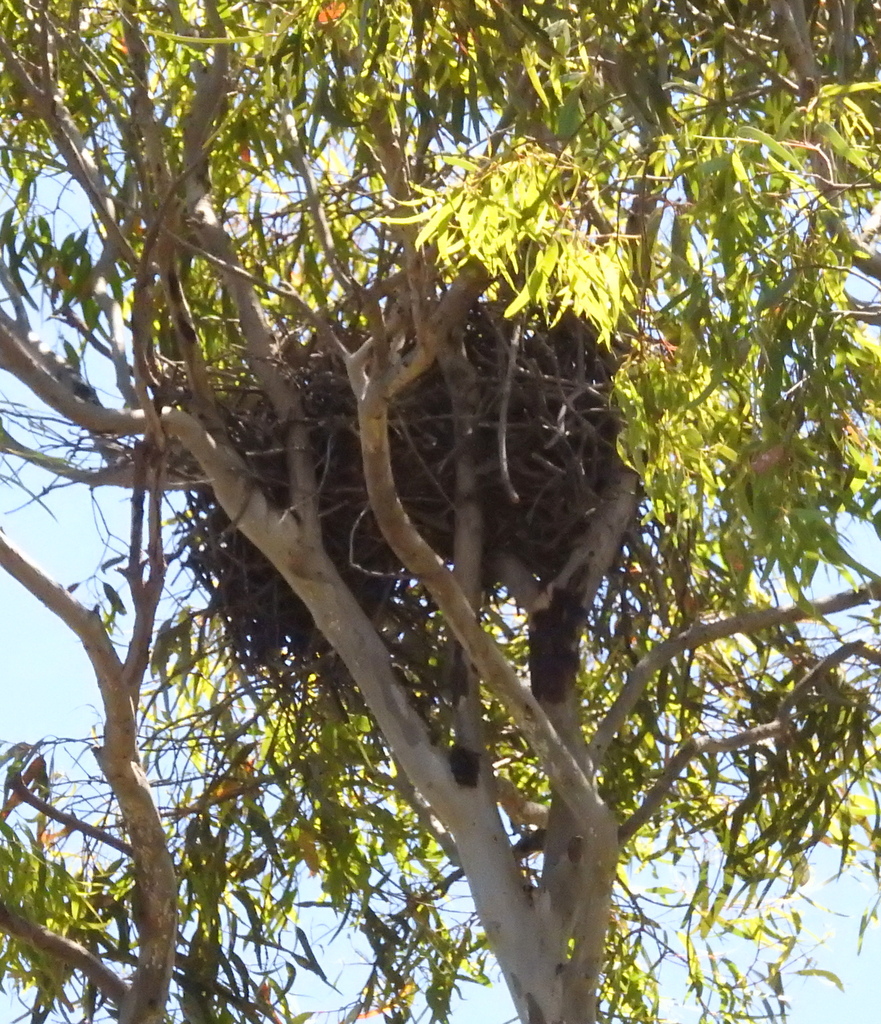
I asked the Victorian Birders facebook page if anyone had encountered swooping Goshawks before, and someone shared a story of one that drew blood from a passing jogger in Langwarrin defending its nest. I knew there must be a nest nearby.
On a subsequent day, Ron Litjens and I returned to the area and saw both male and female birds flying around and sure enough, we soon spotted the nest at the top of a tall Red Gum.
It is impossible to tell as yet how successful the nesting season has been, but we will keep monitoring from time to time and hope to see some chicks emerge before too long.
Goshawks are stealth hunters. They do not soar around on thermals and drop like kites or eagles. They sit quietly until they see a prey bird – honeyeater or blackbird, for example, then launch suddenly with powerful feet extended to grab the victim out of the tree they are in. I was once noticing a honeyeater feeding on blossom in a small bush on a street in a rural town, when a great whoosh passed my ear and a goshawk hit the bush like an explosion and flew off with the hapless honeyeater held at a cruel angle.
The power of this bird makes being swooped by it a good deal more terrifying than a pedestrian-buzzing magpie.

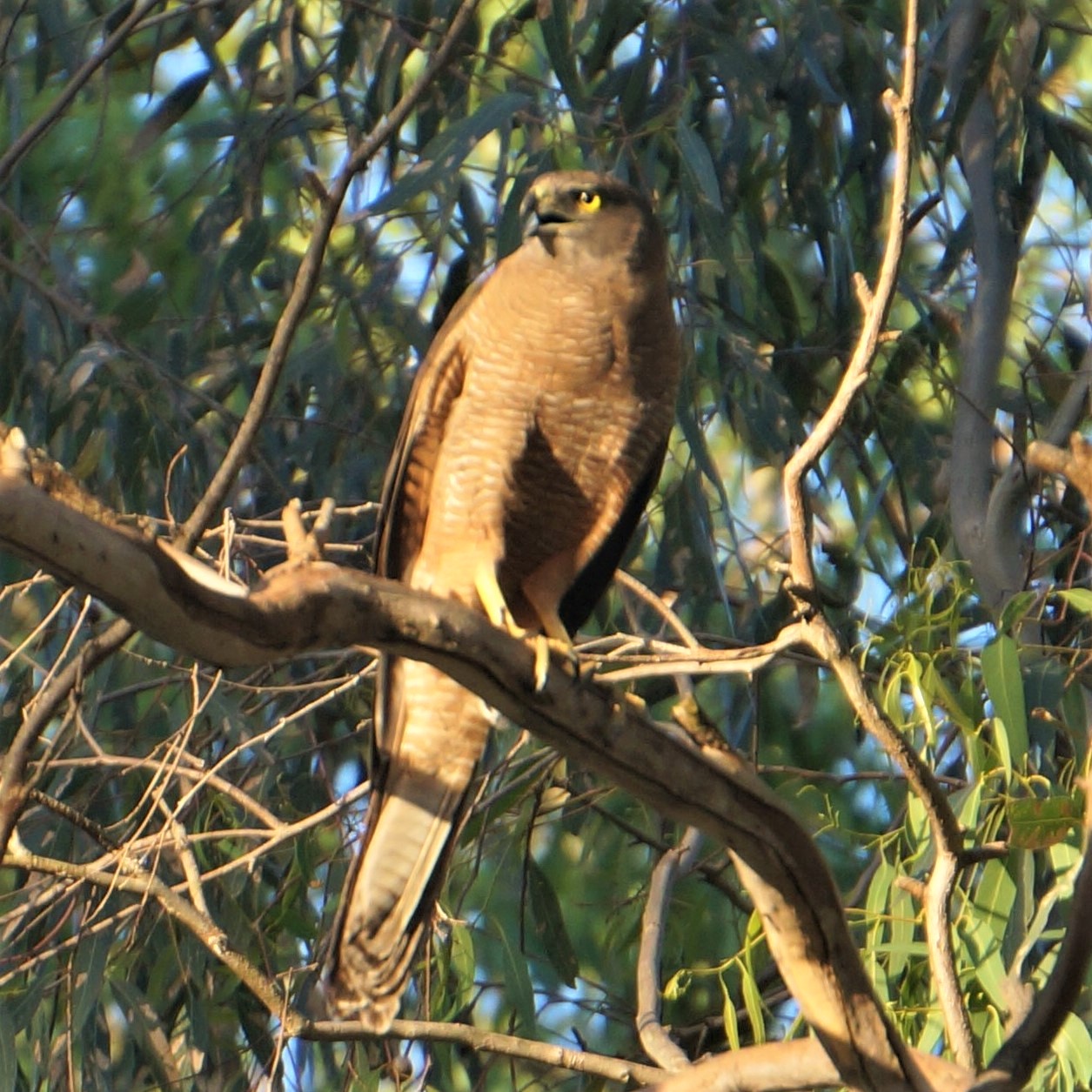
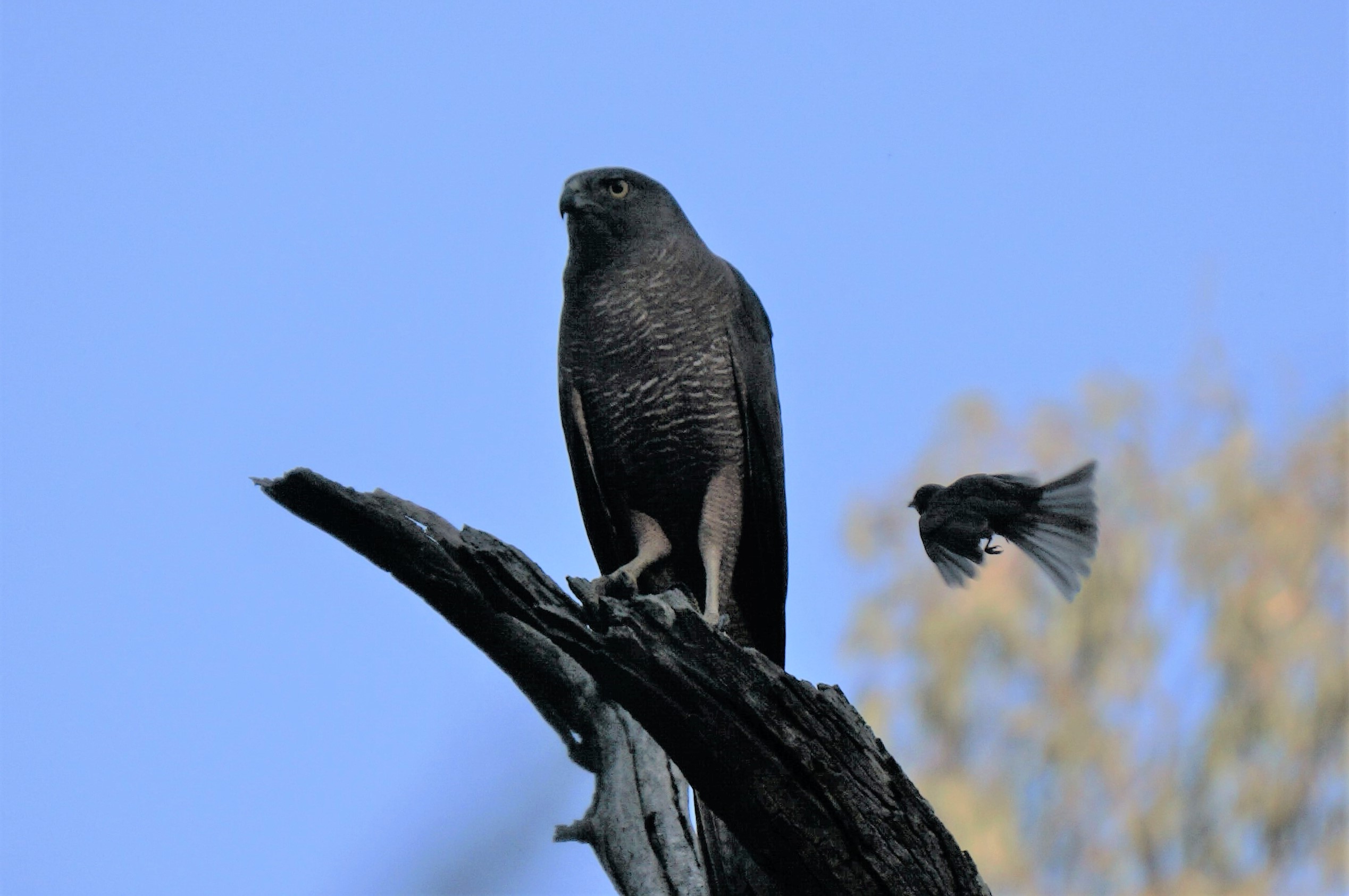
Two bees or not two bees
That is the question. And the answer is NOT two bees.
In the picture below there are two insects that superficially appear to be the same. The one on the left is a European Honeybee (Apis mellifera). The insect on the right is a Drone Fly (Eristalis sp.), seen in much greater detail in the photo at the bottom left. Both are active pollinators and when buzzing around a flower look much the same. The Drone Fly spends more time hovering when feeding on pollen whereas the Honey Bee has a more direct approach. The Drone Fly has short stubby antennae and only one pair of wings, the Honey Bee has bent antennae and two pairs of wings, not that either characteristic is obvious in the frenzy of feeding.
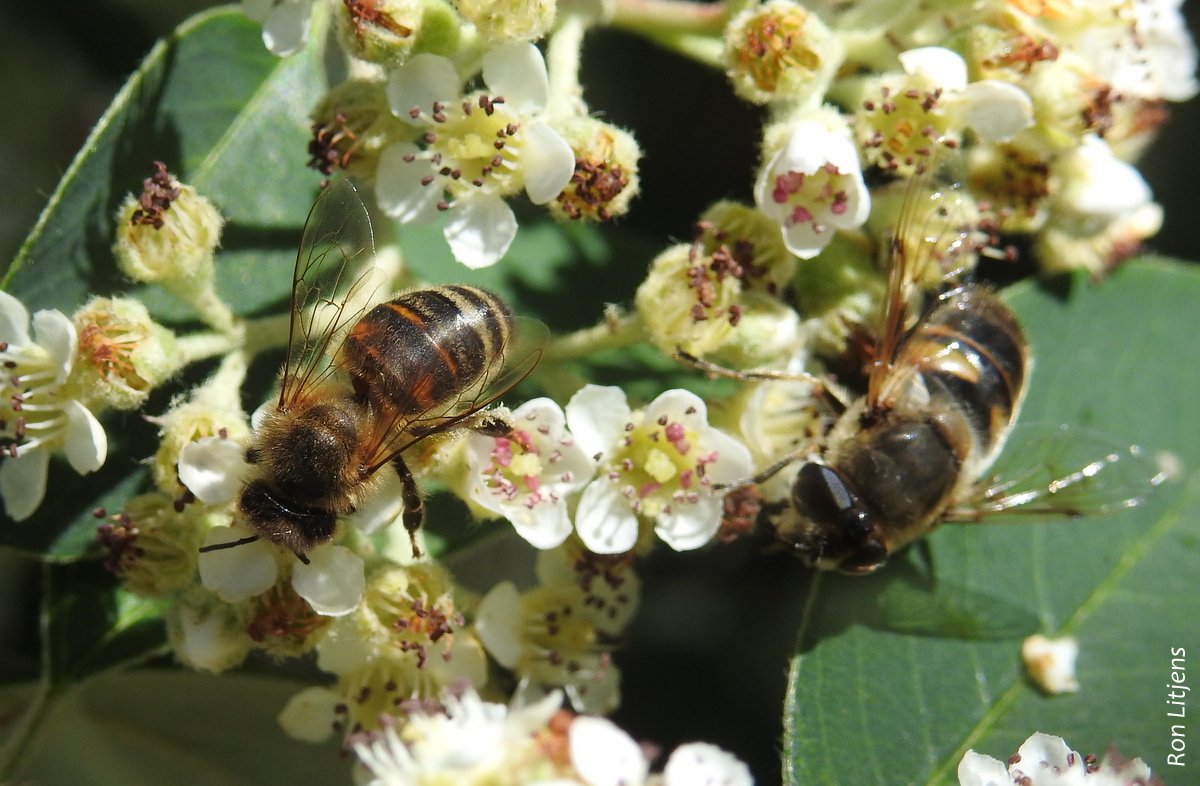

The similarity between the two insects is a classic case of Batesian mimicry where a creature that is harmless against a predator i.e. the Drone Fly takes on the visual characteristics of a creature that is harmful or dangerous to the same predator i.e. the Honey Bee. In this case the harmless Drone Fly has taken on the characteristics of the Honey Bee that has stinging capability. The Drone Fly is relying on the fact that its shared predator such as a Robber Fly can’t distinguish between the two and it will leave it alone fearing being stung. Drone Flies are not the only insect to demonstrate this type of antipredator adaption. Many species of moths and beetles also mimic the Honey Bee in appearance.
If I were to adopt Batesian mimicry I’d probably have to start taking steroids and speak with a guttural German accent.
The path to enlightenment is never smooth.
Several years ago the answer to the simple question about a discovery found in the vegie garden, ‘What eggs are these?’ resulted in much angst (click HERE). Using book and web resources to identify adult insects is hard enough. Identifying insects by their larvae is even harder and by their eggs, nigh on impossible unless you’re an expert. To answer the question the eggs were placed in a jar until they hatched. This resulted in the positive identification of the larvae but their subsequent release back into the garden was not a great success. They grew into bugs that decimated the tomato crop that year.

So when the same question was asked of a similar vegie patch discovery this year, caution was observed. The eggs in question, pictured left, were yellow and clustered on the underside of a vegetable leaf. The eggs were again placed in a jar and did not hatch until the leaf to which they were attached was a dried scrap.

The resultant larvae, pictured right, looked more like tiny iguanas than anything else but easily identifiable – ladybird beetle babies. Adult beetles and their larvae are highly beneficial in the vegie patch as they voracious consumers of aphids. No dramas in reintroducing these into the wild.
Occasionally the path to enlightenment is smooth.
The Greeblies are here
After three anxious weeks of watching them on the nest – a floating structure built way to close to the shore by my way of thinking and in the vicinity of a big ol’ Red-bellied Black (Snake), mum and dad Australasian Grebes (Tachybaptus novaehollandiae) hatched what can only be described a three cotton balls with paddles.

Although the three Greeblies (not the official term for a Grebe chicks!) are quite capable of swimming at birth when danger threatens they clamber aboard the back of one of the parents and hide under their wings (see picture above and below). If the parents are concerned then they do the usual grebe-thing of diving under the water only to reappear metres away. The young ones are taken along for the ride.
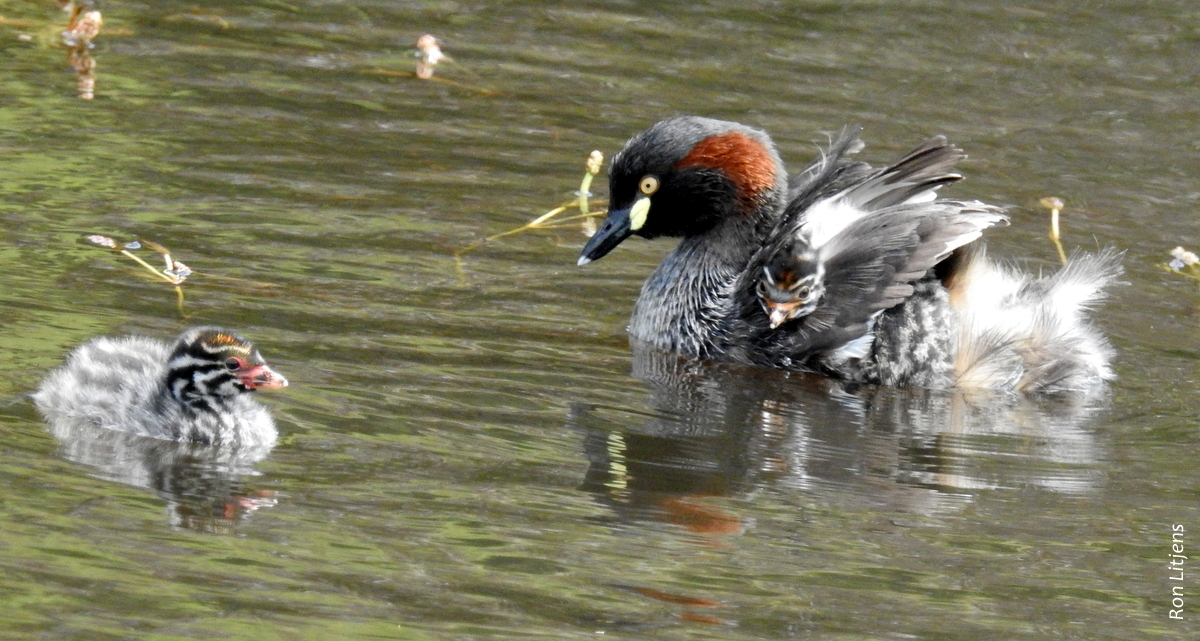
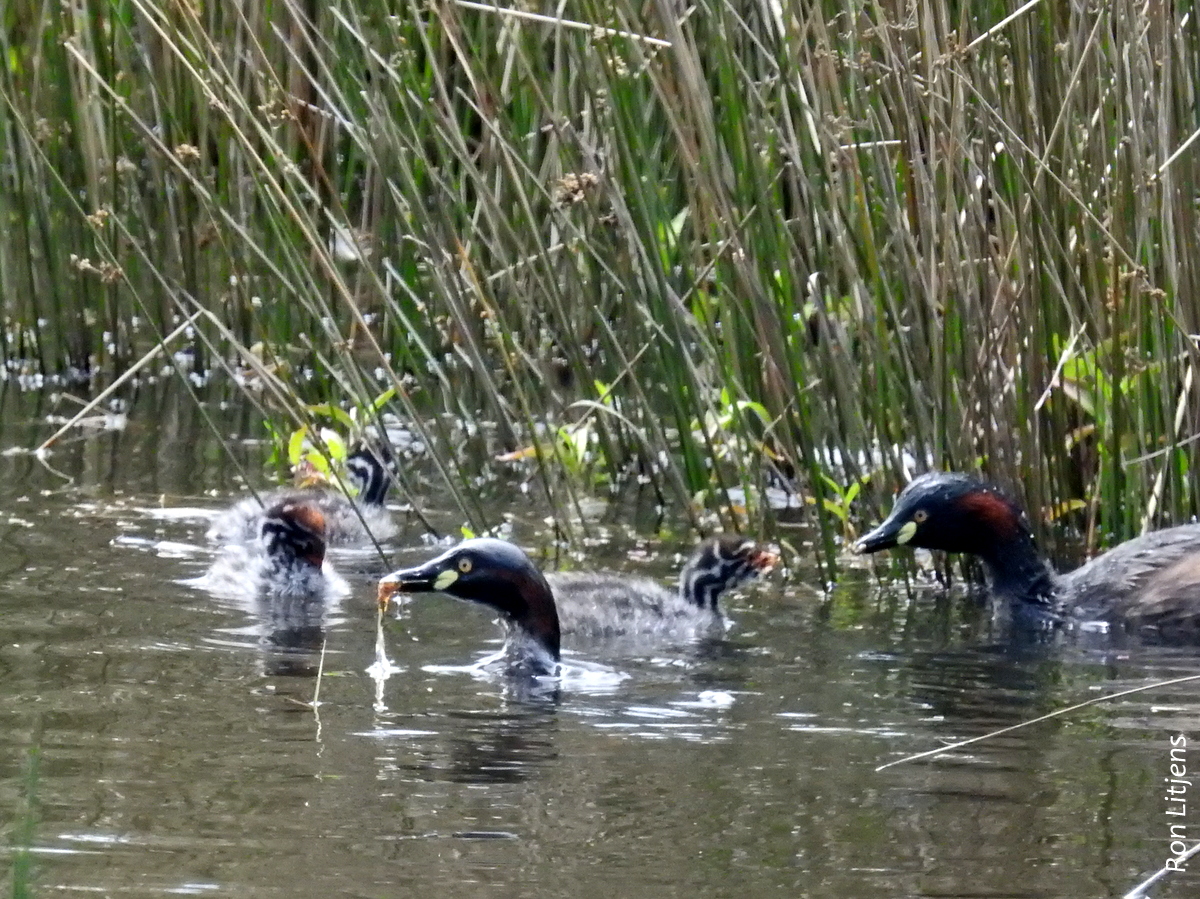
This form of chick transportation only takes place in the first few weeks after hatching. By then the greeblies are too big to fit on their parents’ backs and have themselves learned the art of diving when danger approaches. Daily life now appears to consist of the adults diving down and picking up food that is voraciously eaten by the chicks as soon as they surface.
After a couple of months the parents will leave the young to fend for themselves. In good seasons they may reuse the nest to lay a second clutch of eggs.
I don’t think I could stand the stress of waiting again.




 Focus On Fauna