Nature at the door
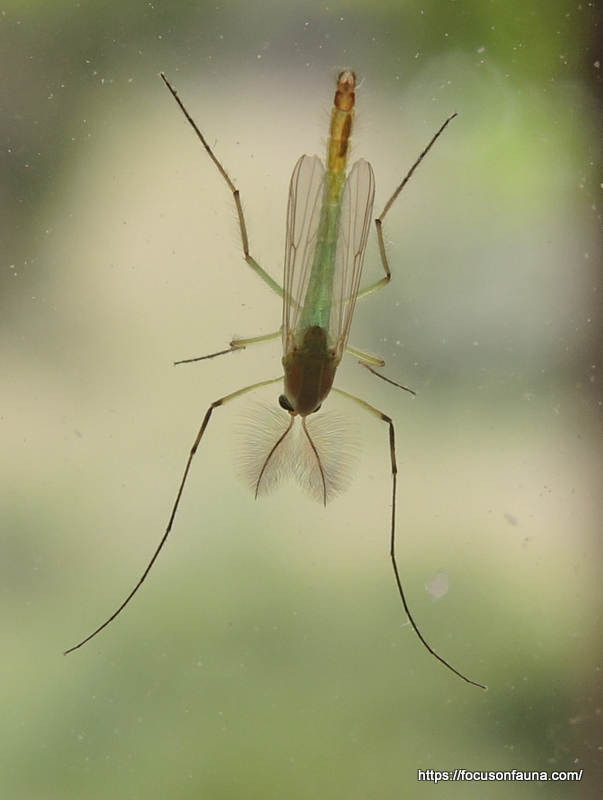 Our glass-panelled back door seems to have been a magnet for interesting insects just lately. The small fly pictured at left we thought at first was a mosquito, but Karen Retra from the Wild Pollinator Count suggested on the BowerBird website that it may in fact be a non-biting midge (family Chironomidae), and so far no one has disputed that.
If so, it is a nectar feeder and potential pollinator, although not all adult midges actually feed. But with those feathery antennae (which indicate a male) plus a hairy abdomen and rear legs, it is easy to see it being an efficient pollen collector. Click on the image for a closer look.

Then we noticed the small long-legged fly (family Dolichopodidae) pictured at right with green eyes, striped abdomen and patterned wings. Any further identification suggestions for this one would be welcomed.
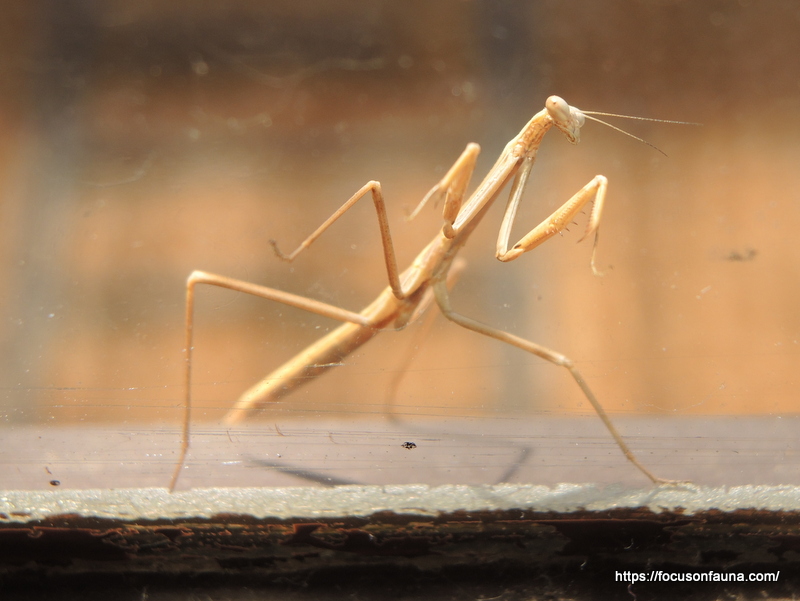
Another non-fly insect keen to have a peek through the door was this small frail mantis nymph at left, which was only about 4cm long.
We thought about cleaning the door for better photography, but then perhaps the dirty glass is what these insects find attractive?!
Pete Best – in our garden
Gardening is such a peaceful past-time. Sometimes the idyll is punctuated by the sighting of a snake or the unearthing of a Pobblebonk, or worse still, half a Pobblebonk, just to add that dash of excitement. My gardening experience was recently interrupted by an angry buzzing (click on the sound clip below. Ignore the cockatoos in the background).
Instantly a number of possibilities came to mind – none of them good. If the neighbours had been watching they would have seen me hurtle out of the garden and then from a safe vantage point survey the veggie plot for a considerable amount of time.
The result – nothing. The expected appearance of an angry something (bee?/wasp?/frog?/cicada?) failed to materialise and after a while the sound stopped only to kick off again as soon as gardening resumed. The culprit, a Rhinoceros Beetle (Dasygnathus trituberculatus), pictured below.
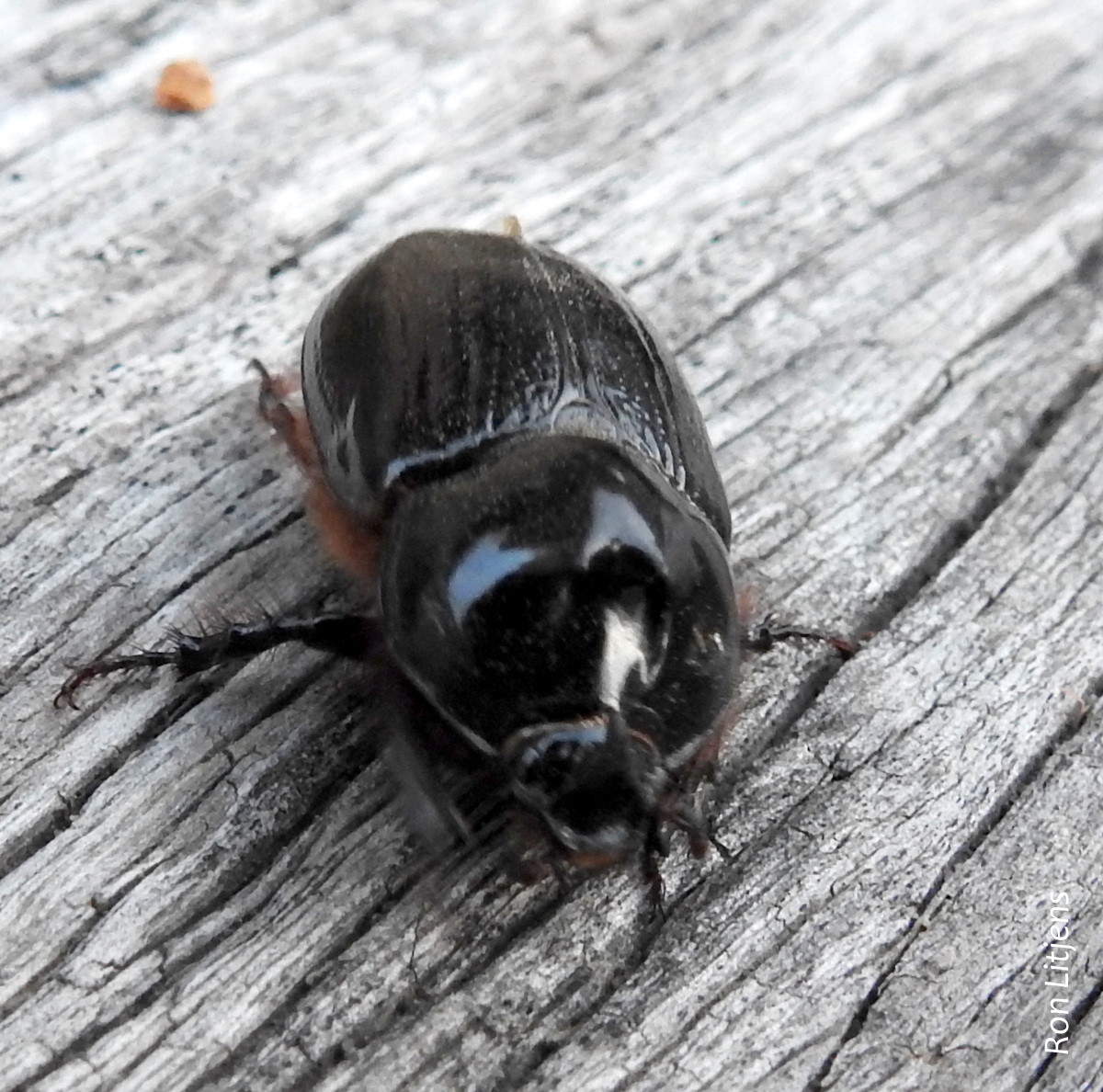
Rhinoceros beetles are Scarabs just like Christmas Beetles. They are active at night. The male beetle sports three horns, one on the ‘nose’ and two on the ‘forehead’. The former is used for digging in the soil and for fighting other males with during mating season. The larvae live in the soil and feed on plant roots.
I am not sure of the mechanism by which the sound was made. It was obvious on closer inspection that the abdomen was vibrating rapidly under the hard wing case. Maybe the sound was generated by friction or maybe by air. But the investigation went no further and it was released. Clearly a very annoyed beetle. Just like Pete Best (a bit of trivia for all you Beatles aficionados!)
Right at last
The science of nest-box construction is fascinating. The size and position of the entrance hole and the depth, length and width of the box all influence which fauna select what residence. After the 2009 fires I, like many landholders in the King Parrot Creek valley, was supplied with nest-boxes to install on my property to replace the natural hollows which had been destroyed by the bushfires. Over the years this blog has reported on the many tenancies these nest-boxes have had. Some nest-boxes have been popular, some have not.
 The rosella nest-box has had a revolving tenancy each year of White-throated Treecreepers, Australian Owlet-nightjars (ONJ) and both Ring-tailed and Brush-tailed Possums. Rosellas for the past seven years have been repeatedly trying to get into a Sugar Glider nest-box. The entrance hole is too small but that has not stopped them from spending many hours trying to gnaw a bigger one (see photo left).
The Brush-tailed Phascogale nest-box has been occupied occasionally by Sugar Gliders and the two ONJ nest-boxes have never been occupied. That could be more a statement of nest-box location than design. But never has a nest-box housed the animal or bird for which it was intended – until now.
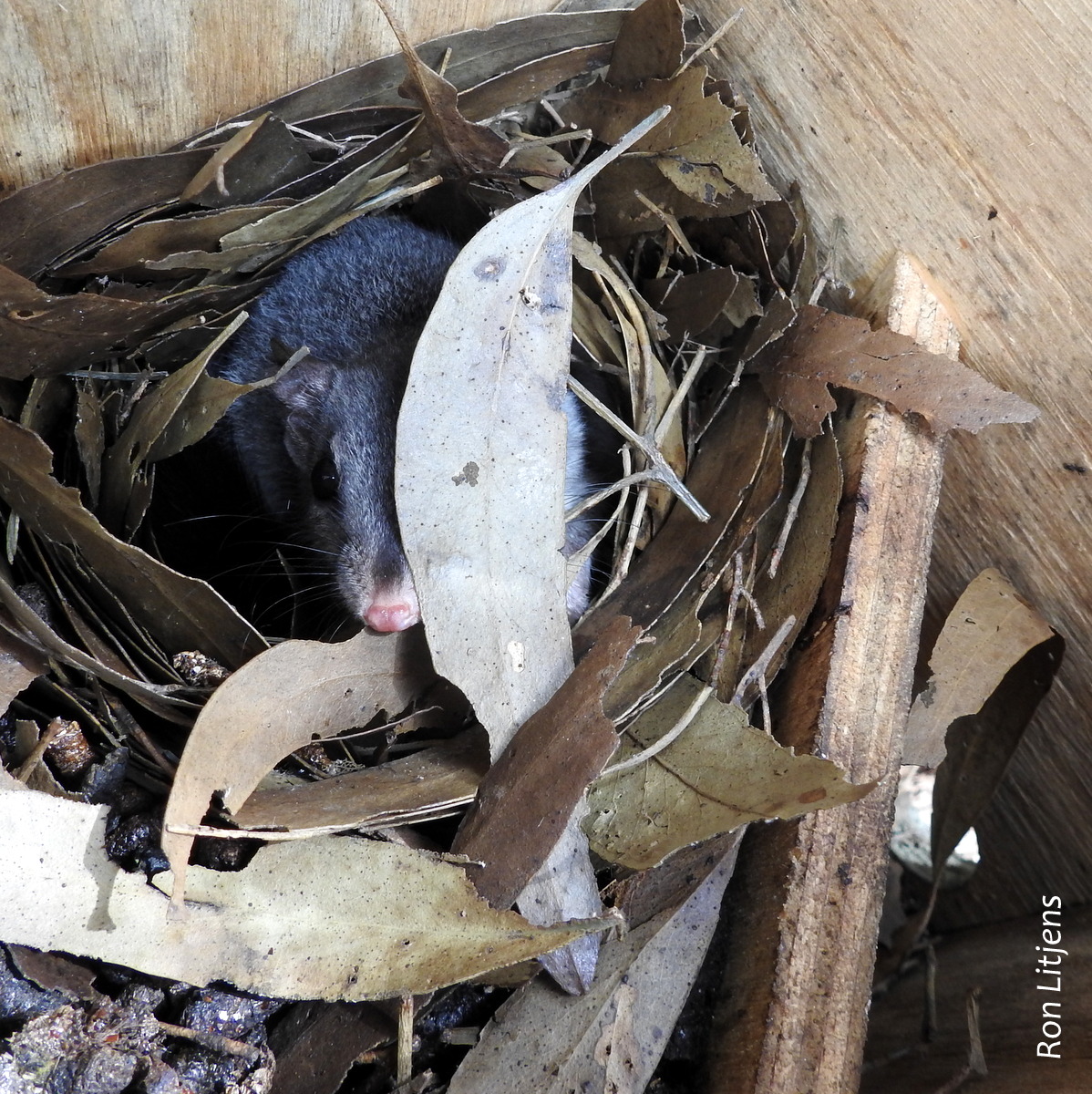 A check of the phascogale nest-box this week revealed, surprise, surprise a Brush-tailed Phascogale (Phascogale tapoatafa), pictured above. The animal was curled up in a cylinder of leaves. Macwake informs me that it was probably a recent arrival in the box as the nesting material and design is that of Sugar Gliders. Phascogales prefer nests of shredded bark and their own scats.
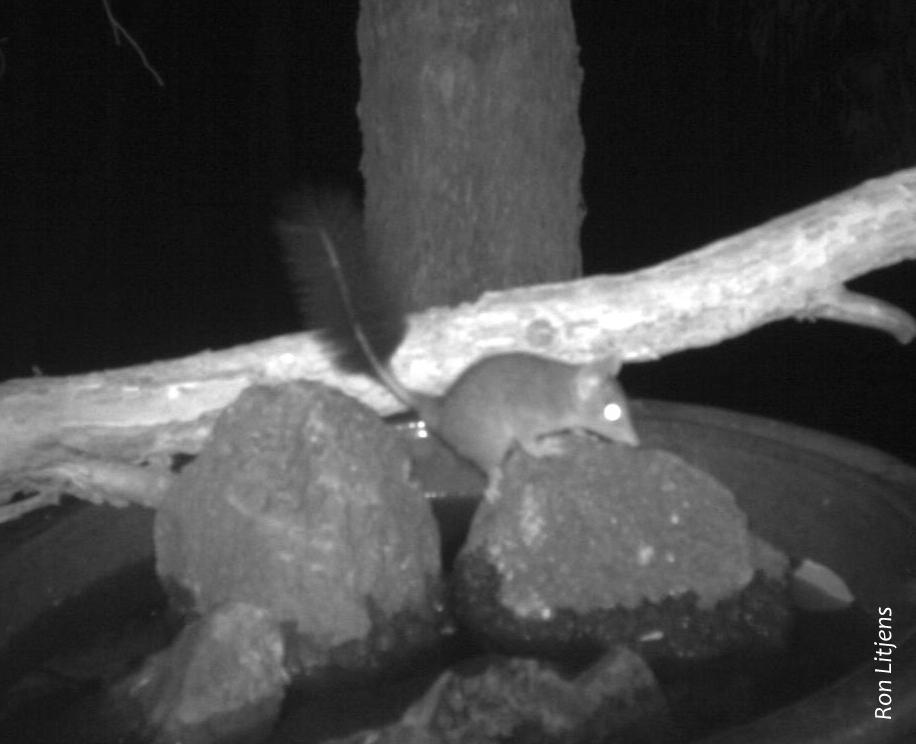 Brush-tailed Phascogales are regularly photographed by motion-sensing cameras on our property. They are frequent visitors to our bird-bath at night (pictured right) and individuals can be identified by their appearance e.g. shredded tail, white marking on the flanks. But we have never had one in a nest-box.
My expectation, now that the phascogale has moved in, is that the displaced Sugar Gliders will occupy the Sugar Glider nestbox and relieve the rosellas of the futile efforts they are making to widen the entrance hole. The rosellas in turn should move into the rosella nest-box displacing the treecreepers, ONJ and possums. Where will they sleep? Looks like the next project is to build more nest-boxes – of the correct design, of course.
A good guy with a bad name
Sometimes your name can give people the wrong impression. For example, as soon as people find out that a rakali is an Australian native water-rat, the term rat just puts them off. And a rakali is one of the cutest critters going. Similarly for cockroaches. They are automatically associated with spreading germs and disease. However there are a lot of native cockroaches out there who do not deserve that reputation.
The cockroach pictured below is a native Austral Ellipsidion Cockroach (Ellipsidion australe).

It is a daytime active insect. Unlike many other cockroaches it is not a scavenger but feeds on pollen, honeydew and mould so is a good guy around your garden and one of the native pollinators.
Beware the assumptions in a name.
Dressed to impress
At some point in our lives we have all dressed to impress a potential partner. Combed the hair (a dim, distant memory for me!), polished the shoes, put on sharp threads. Surprisingly some birds do the same thing (not the shoes though).
 The bird pictured left is an Eastern Great Egret (Ardea modesta) –formerly Ardea alba, hunting for dinner. It is the tallest of the Australian egrets with a head and neck being almost 50% longer than the body. Note the smooth feathers and the yellow bill. This bird, photographed last year, is in non-breeding mode, just mooching around minding its own business.
This time of the year is the breeding season for egrets and herons and some go all out to attract a mate. The picture below, taken this week, is of an Eastern Great Egret (not the exact same bird) in ‘dressed-to-impress’ breeding attire. During breeding season the bill turns black, the facial skin turns green and the bird displays erectile plumage that drapes over the back. If I were a potential partner I’d be impressed.

 Compare this to the breeding display of a Nankeen Night Heron (Nycticorax caledonicus) photographed last week on the banks of the Yarra River in Melbourne. It consists of one to three white plumes extending from the back of the head.
Sometimes less is more.
Spot the Rakali

Spot the Rakali
The SCLG event has been held annually for at least 10 years now. This year no platypus were sighted, which was disappointing but doesn’t necessarily mean there were no platypus in the section of creek surveyed. However, observers at four of the five sites were lucky enough to spot a rakali. Given the timings of sightings and the distance between sites, it is likely there were at least three, and probably four, individual animals.
The best sighting was by Janet and Terry who had a rakali that perched on a log in the creek (click on photo above), then swam around in front of them for 5 minutes.
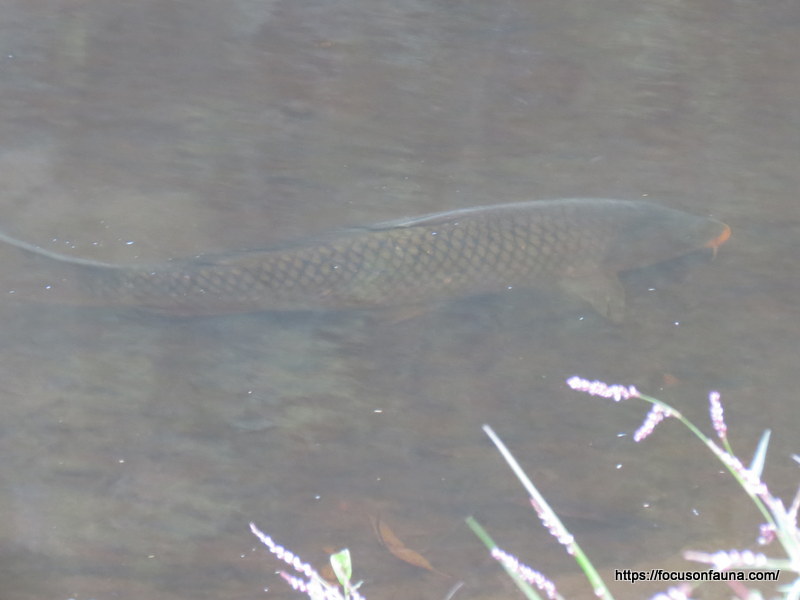
Carp

Electro-fishing

Macquarie Perch
The healthy state of fish stocks in the creek was shown last week during an electro-fishing demonstration at Moores Road Reserve, following a meeting of Goulburn Broken Catchment Management Authority staff and local Landcare group representatives with Karen Lau, the newly appointed Executive Director of Catchments and Waterways at DELWP. In a fairly short time, in only about 100m of creek, ARI scientists had collected a bucket-full of temporarily stunned fish, including many Blackfish, both River and Two-spined, trout, a Freshwater Cray and two endangered Macquarie Perch. As a rule of thumb, electro-fishing captures about 20% of the fish in a given length of stream, so in this section of the King Parrot, there were clearly a lot of fish indeed!
Well I never
It is not every day that I see an insect that I am at a total loss to identify, even at an Order level, i.e. beetle, butterfly, wasp, etc. Usually I can guess what it is by looking at the physical characteristics and because I have seen it, or something similar, before or have seen a picture of it.
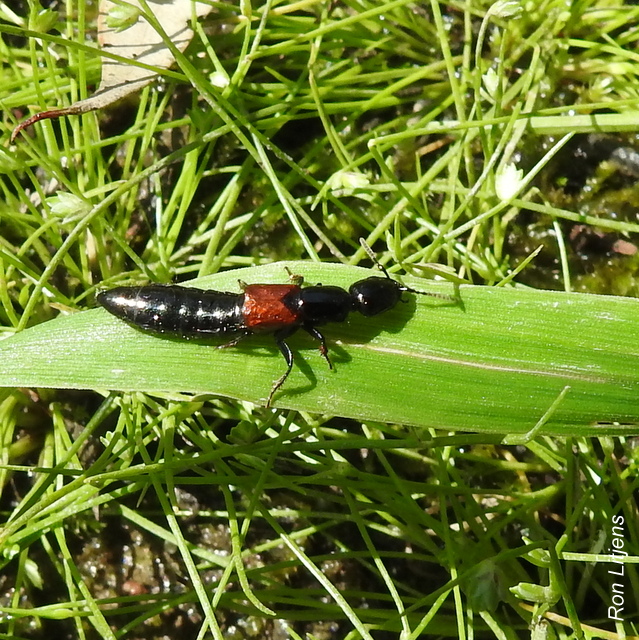 Take the Rove Beetle for example (pictured left). Even though looking at it one would be hard pressed to identify it as a beetle I had seen pictures of it before so the identification was not that difficult.
 This week a night insect (see picture right and below) flew into the lounge and landed on a lamp shade. It had a long tapered body consisting primarily of abdomen which it waved around energetically and wings which only extended part way down the body. It also had short antennae and fly-like eyes – sort of lacewing, sort of owlfly, but not quite. My usual ‘go-to’ websites of insects photos like http://www.brisbaneinsects.com and http://www.lifeunseen.com did not come to my rescue this time. I’ve never been in this situation before. So my blogger colleague Macwake posted the picture on www.bowerbird.org.au and asked the question. And sure enough someone (Simon Ong) identified the critter as a beetle of the family Lymexylidae of the genus Atractocerus.
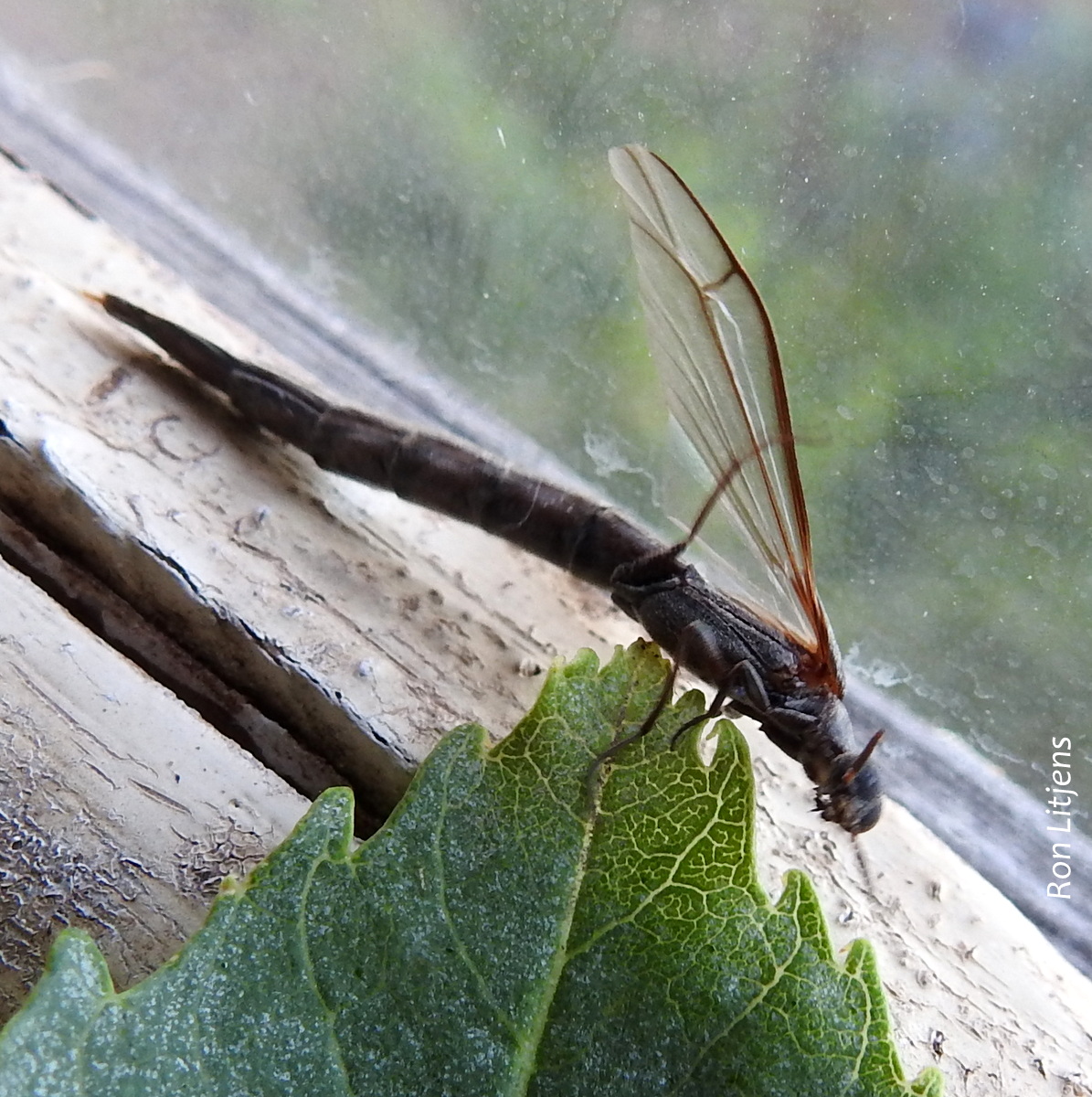 Larvae of this genus are wood-boring. The eggs are deposited in the crevices of bark by means of a long ovipositor and the larvae when hatched bore straight into the wood. The wood shavings are used to block the tunnel from predators or parasites.
To say the insect is boring is factually correct but the hunt for its identity was not.
Soundz of Summer
Almost everyone has a sound that they associate with summer. For some it is the call of the cicadas at dusk. For others it may be the tick-tick of the garden sprinkler. For me it is the muscular buzz of the robber fly hurtling past looking to catch its prey on the wing. Robber flies are the terminators of the insect world and though I hear them I rarely see them flying such is their speed.
Recently I heard a buzz almost as powerful. The source was easily seen and luckily landed on a nearby bush. It was a pair of mating March Flies –in this case Yellow Tangle-vein Flies (Trichophthalma sp.), I think.
.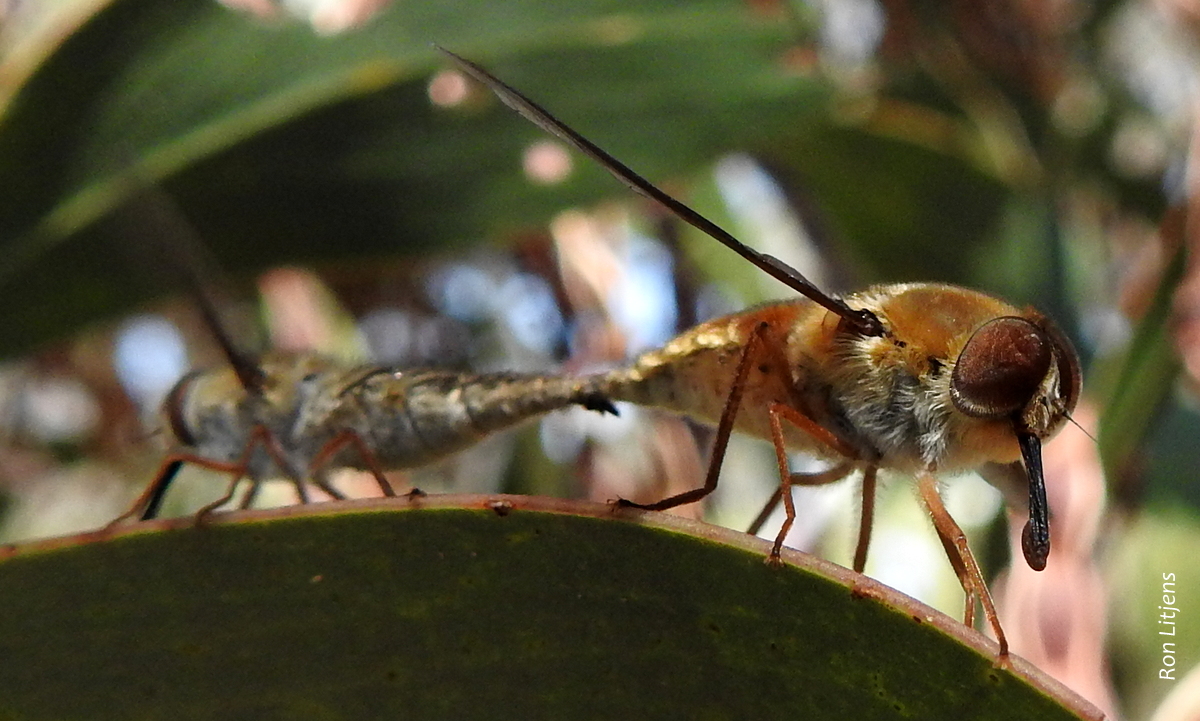
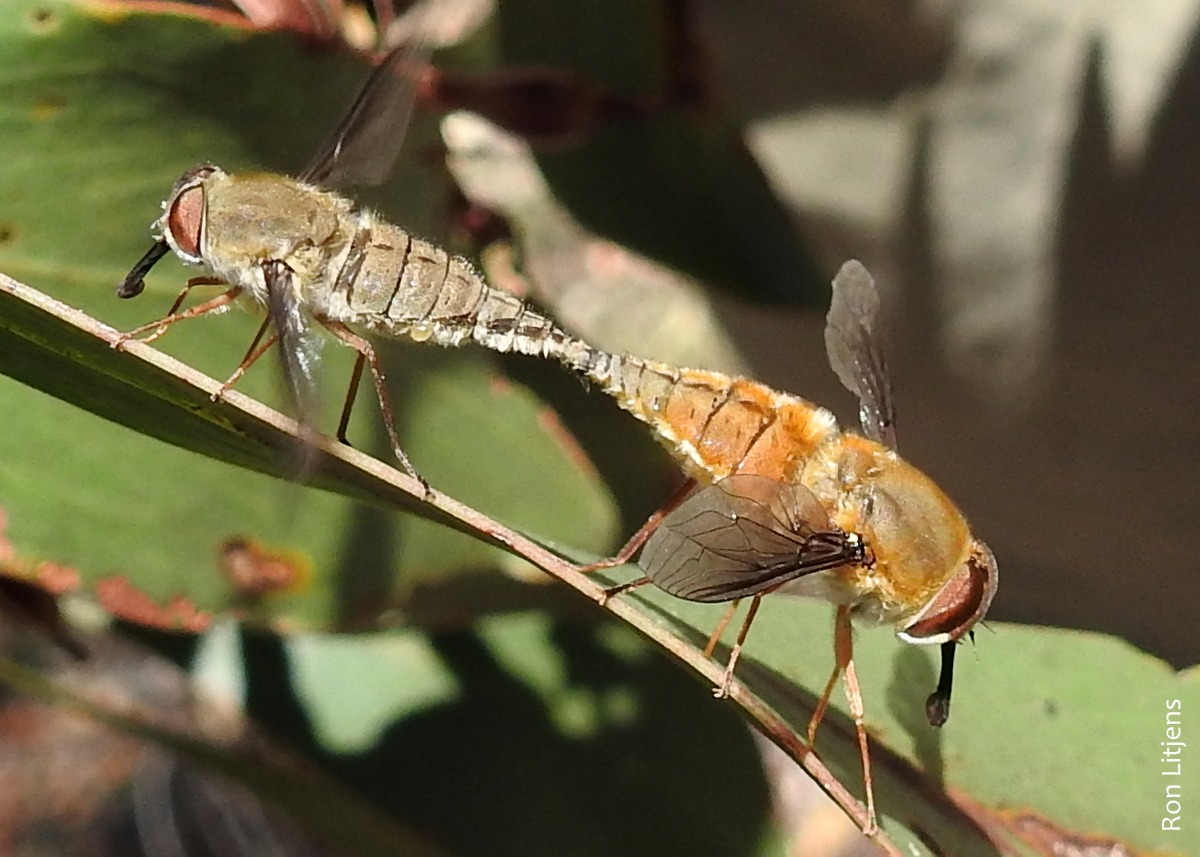 Both male and female flies feed on nectar and plant juices. However when the female fly is producing eggs it requires protein which it gets by extracting the blood from warm-blooded animals particularly livestock, domestic pets and humans. The mouth parts are equipped with two knife-like appendages with which to pierce the skin and a sponge to soak up the blood. The sponge can clearly be seen in the photo above. Although the bites may trigger allergic reactions in some people, most only feel a short pain followed by itchiness which is due to the anticoagulant the fly injects to ensure a continuous flow of blood.
This pair sat mating until the camera got too close after which they took off still connected. Because of the difference in wing strength between the two flies they flew off spinning quite rapidly. Mating in the air can be a dizzying experience (I’ve been told).
Quite a mouthful !
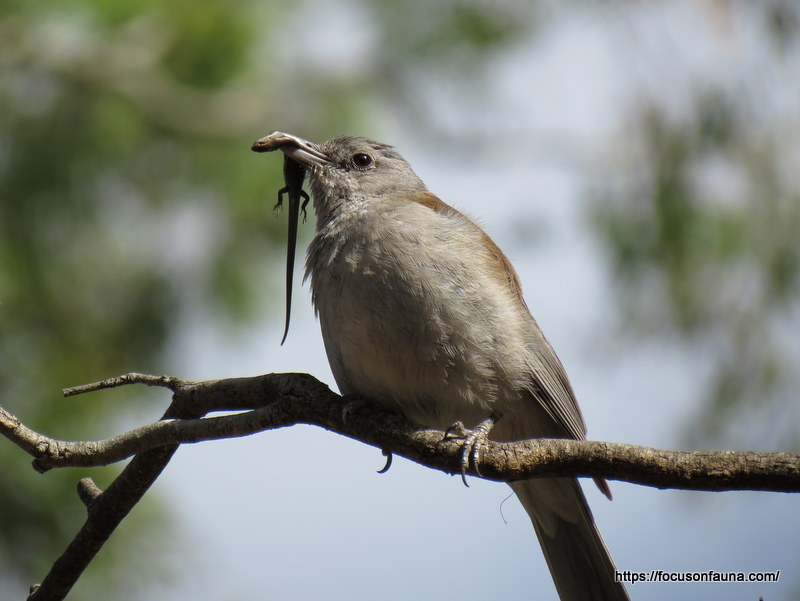
As is their custom, our resident Grey Shrike-thrushes have again nested in the corner of our shed, and their three eggs have successfully hatched. The parents have been warily landing in a tree just outside the shed before going inside, and it is interesting to see the wide range of prey they are carrying to the hatchlings: a great variety of insects, spiders and even small reptiles, like the skink pictured above, probably the common Garden Skink.
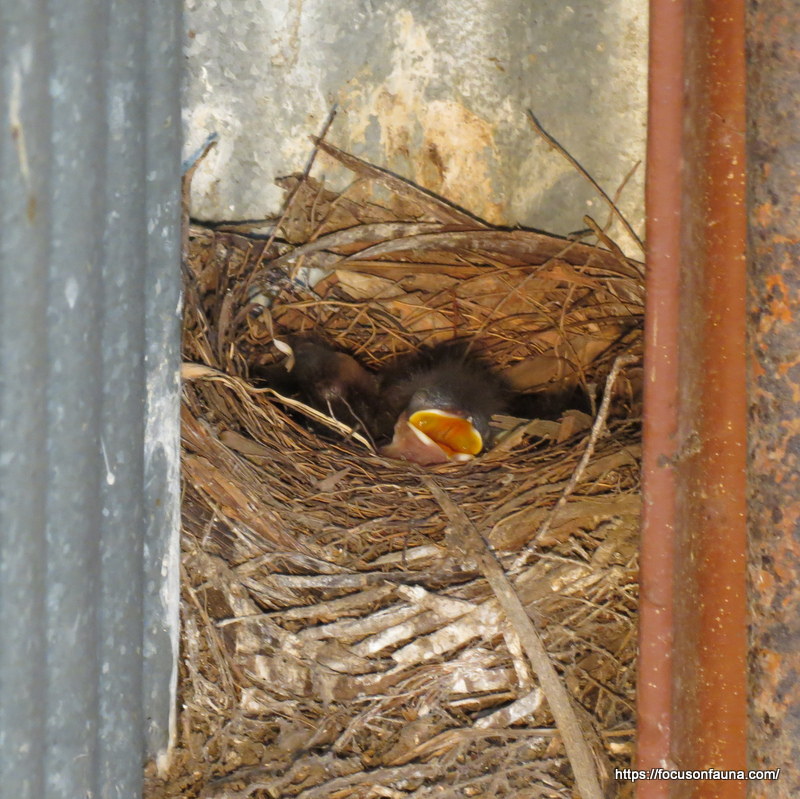
What’s surprising to us is that the skink was taken straight to the nest when the chicks were, we think, only a couple of days old, still blind and largely bald – see picture at right. This particular visit by the parent seemed short – not long enough for it to tear the skink into manageable bits, so presumably the young chicks were somehow able to handle the meal themselves!
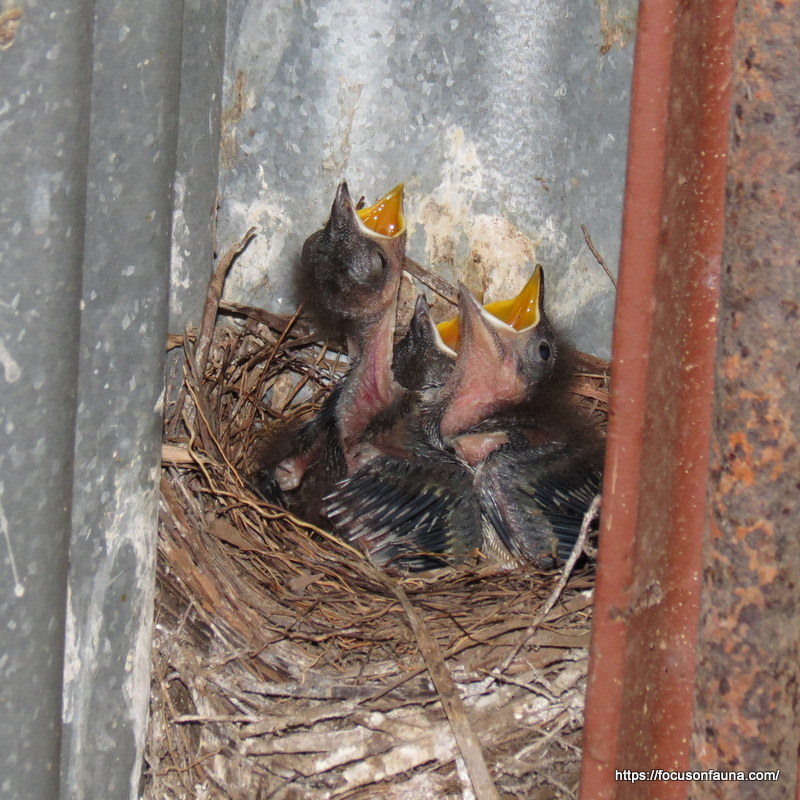
A few days later, and a noise made by us in the shed was often enough to trigger the gape response in the hungry chicks expecting a parental visit, as seen in the photo below, which clearly shows their yellow/orange gapes.
No Heinz baby food for these youngsters!
The Bristly and the Beautiful
Flies in Australia get a bad rap. I grew up in the era of the antihero, Louis the Fly, who came ‘straight from rubbish tip to you’. And I cannot count the number of times that flies have made an outdoor summer event less than ideal. However there are flies and then there are flies.
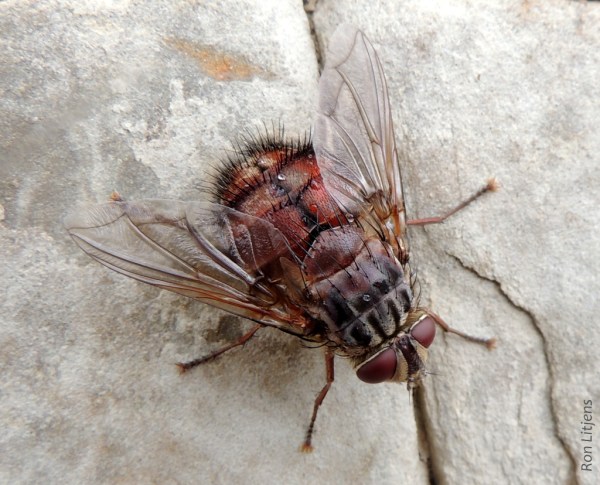
Rutilia sp.
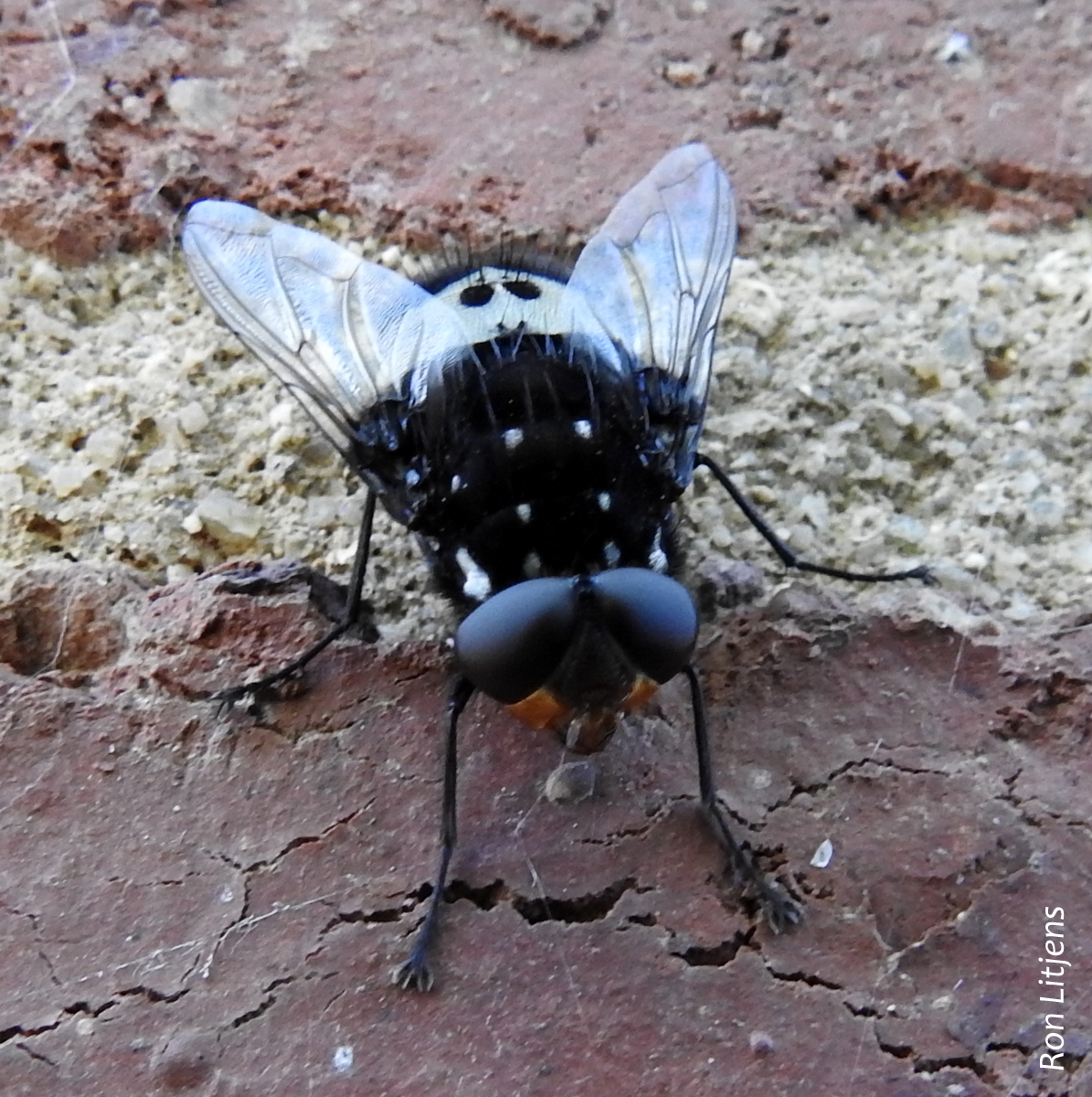
Bristle Fly (Amphibolia vidua)
Last month Macwake published a blog on the Golden Headed Rutilia Fly (Rutilia argentifera). This fly is of a group known as Tachinid Flies. With the advent of summer a number of tachinids have been seen in the district. On first sight they look like any other fly but are distinctly bristly, hence the name Bristle Flies. Tachinids are generally larger than the common house fly and in the case of those photographed, much larger. The adults feed on nectar and the honeydew excretions from insects such as aphids and scale insects (not a rubbish tip in sight!). As Macwake noted, flies like these are important players in the pollination of plants.

Microtropesia sinuata
***WARNING – GRUESOMENESS AHEAD*** Most tachinid flies deposit eggs on a live host, usually the larvae of butterflies and moths. After a few days the eggs hatch and the maggots bury themselves into the host and proceed to eat it from the inside, eventually killing the host. For flies of the Rutilia genus, the eggs are laid on the ground and the hatched maggots dig into the ground looking for the larvae of Scarab Beetles which they parasitise. These flies are important controllers of pests and some species have been used as biocontrols.

Rutilia sp.
.
.
.
A close examination of photos shows these flies to be both bristly and beautiful – just like (dare I say it) my partner’s legs…this may be my last blog!




 Focus On Fauna