Looks can be deceiving
Spring is the time for planting the vegie garden and with that comes the influx of insects all keen to lay eggs on the lush new vegetation. But not all insects are pests in the garden. Some insects and their young are beneficial and predate on those things that harm your plants. The difficulty is telling apart the good guys from the bad. This is made all the more complex because different insects develop in different ways.

The vegie patch – a predator playground
 Take the preying mantis for example, one of the good guys in the garden. The mantis is an ambush predator. Both the nymphs and the adults wait motionless until prey comes within reach and then grab it with their raptorial forearms. Baby mantis are easy to recognise because they look exactly like the parent, only wingless and smaller (see picture left). Their lifecycle is known as partial metamorphosis (hemimetabolism). The young are called nymphs and hatch looking very similar to the adult. They grow larger through a series of moultings until the final moult when the winged adult emerges. Other insects that develop in this way include grasshoppers, crickets and earwigs.

Common Spotted Ladybird (Harmonia conformis) larva
So be aware when you wage war on insect pests in your garden that you don’t kill your allies with friendly fire. Looks can be deceiving.
Now you see ’em…
The basic survival skills in nature are the ability to elude the predators hunting you and to remain unseen by the prey that you are stalking. There are many ways animals can do this but one of them is by camouflage, using shapes and colour to blend into the background. One has to wonder then what is happening when you see an extremely white spider sitting on a brown stalk of vegetation trying to catch a meal. Has evolution gone astray?
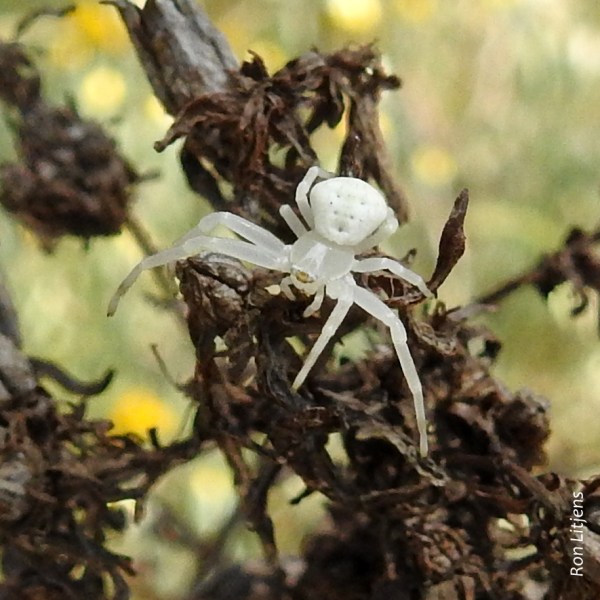
Observed at Murchisons Gap Lookout, the spider in question was a White Crab Spider (Thomisus spectabilis), pictured above. The White Crab Spider is an ambush predator. It waits within the structure of a flower and then grabs any pollinator that stops by. This may seem at odds with its striking white colour. This spider however belongs to a family of spiders, Thomisidae, which can change colour from white to yellow depending on the colour of the flower on which it is hiding. It does this by secreting a yellow pigment into the outer skin layers. The colour change can take up to three weeks to complete and about a week to reverse.
So on what was this spider perched? A dead stalk of St John’s Wort, a striking but unwanted yellow-flowered plant in the district. Like my dress sense, this spider’s colour is out of season. My next challenge will be to try and find one of these critters in full yellow dress.
Not more about lerps!
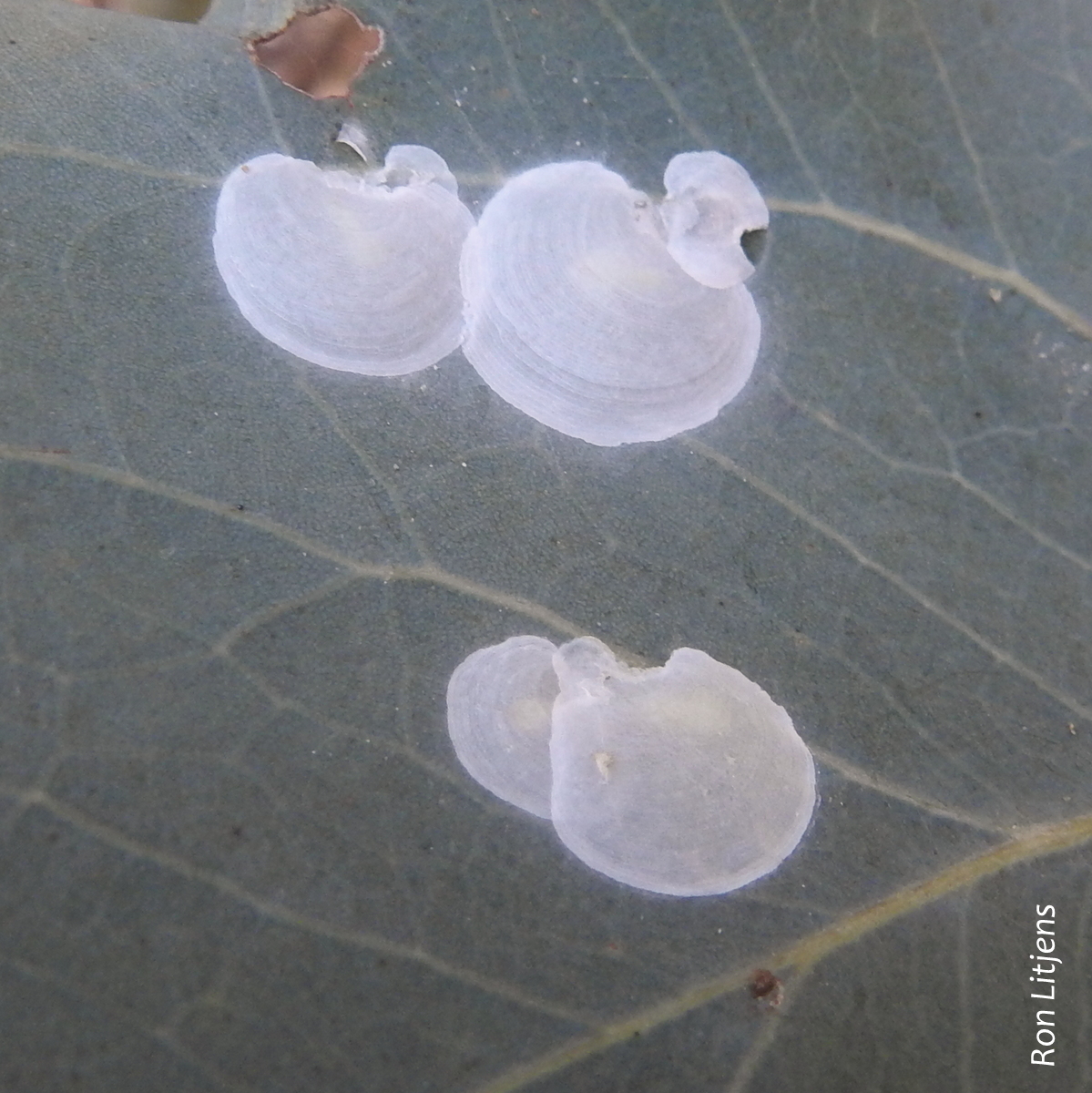 Psyllids are tiny winged insects that look like small cicadas. In fact both psyllids and cicadas are Hemipterans meaning that they are characterised by sucking mouthparts. Adult and nymph psyllids suck the sap of plants. The psyllid nymph extrudes a mix of wax and sugar-rich honeydew from which it constructs a shelter under which it hides from predators and parasites. This ‘house’ is called a lerp. Lerps provide a food source for a variety of birds such as pardalotes and bell miners and are also an indigenous food source.
Different species of psyllids build lerps of different structures and composition. The Sugar Psyllid (Glycaspis sp.) builds a conical sugar-rich lerp. The Lace or Basket Psyllids (Cardiaspina sp.) builds a scallop-shaped lerp. A current infestation of them is causing the large-scale browning of eucalypt leaves in the district.
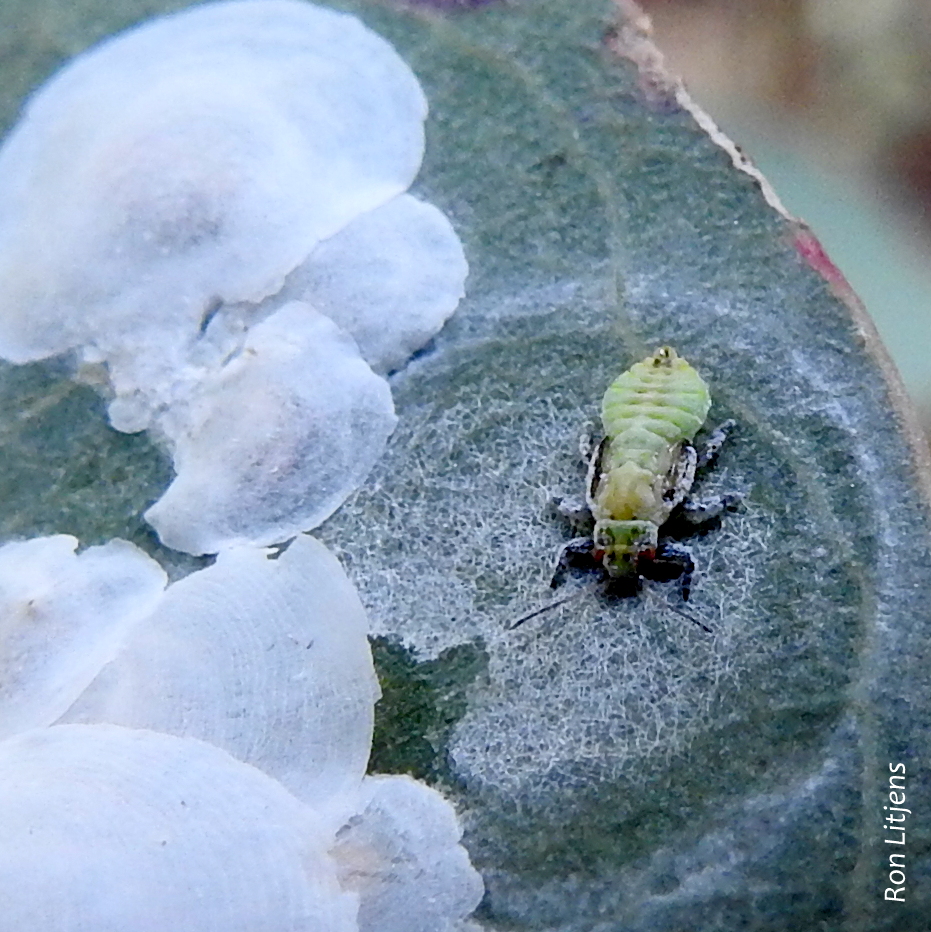 While on a bird survey with the Murrindindi Birdwatchers last weekend we found a grove of Red Box supporting a large population of White Clam Psyllids (Hyalinaspis sp.). If you look carefully in the photo above you can just make out the nymph underneath the lerp. The White Clam Lerp presents as a white, flat structure and although there were many of them the trees and their leaves did not seem to be affected.
Peeling back the lerp revealed the psyllid nymph underneath (pictured right). It didn’t harm the nymph but there is a spot of house reconstruction needed!
Redheads

Scarlet Honeyeater
There has been much interest in birding circles lately concerning sightings of Scarlet Honeyeaters around Victoria in locations well outside their usual range. In our general area this stunning small bird has been seen in Yea and Seymour, but we are not as yet aware of any reports of the bird around the Flowerdale and Strath Creek areas. We had one briefly visit our garden in late 2009, and there was an interesting report of one turning up in the Strathbogies in 2013.
Usually confined in Victoria to Gippsland coastal areas in spring/summer, the Scarlet Honeyeater in some years can proliferate and spread far and wide, an event known as an irruption.
On a recent trip to the Capertee Valley in NSW we came across a flock of Scarlet Honeyeaters feeding on the flowers of Needle-leaved Mistletoe, Amyema cambagei, in River She-oaks, Casuarina cunninghamiana. We thought ourselves lucky to have, for us, such a rare sighting, that is until we returned to Victoria and in every town we stopped at, the first thing we seemed to hear was the familiar tinkling song of the male Scarlet Honeyeater!
Another eye-catching redhead is the Red-capped Robin and, although not one of our regular local birds, we couldn’t resist sharing the image below of the handsome male, taken in Chiltern-Mt. Pilot National Park the other day, where, incidentally, we also encountered – yes, you guessed it – a Scarlet Honeyeater!
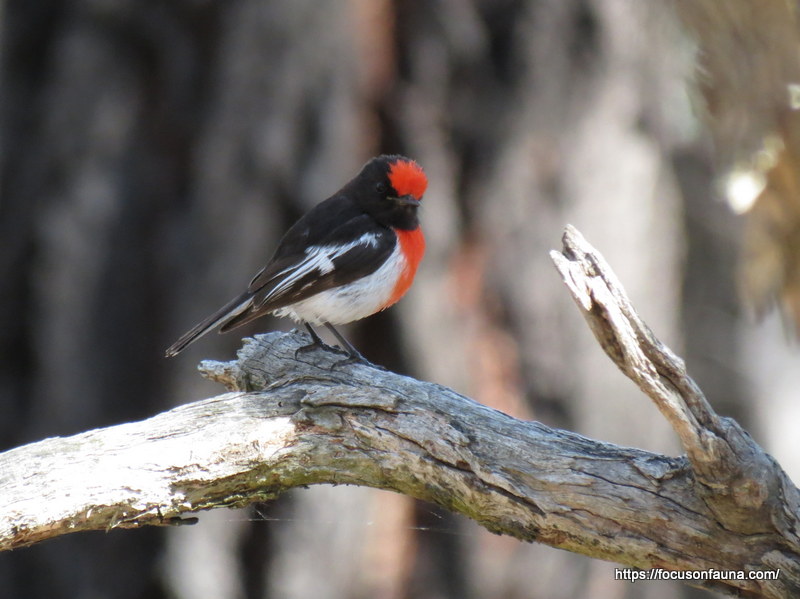
The Red-capped Robin is mentioned (but not pictured) in our local bird booklet Birds of the lower King Parrot Valley, where it states “The small Red-capped Robin has been reported in the Red Box woodland along the Yea Spur [near Strath Creek], but would normally be found in drier areas to the north.” Certainly it is regularly spotted in the bushland reserves near Seymour.
So, watch out for the redheads!
My, what big feet you have!
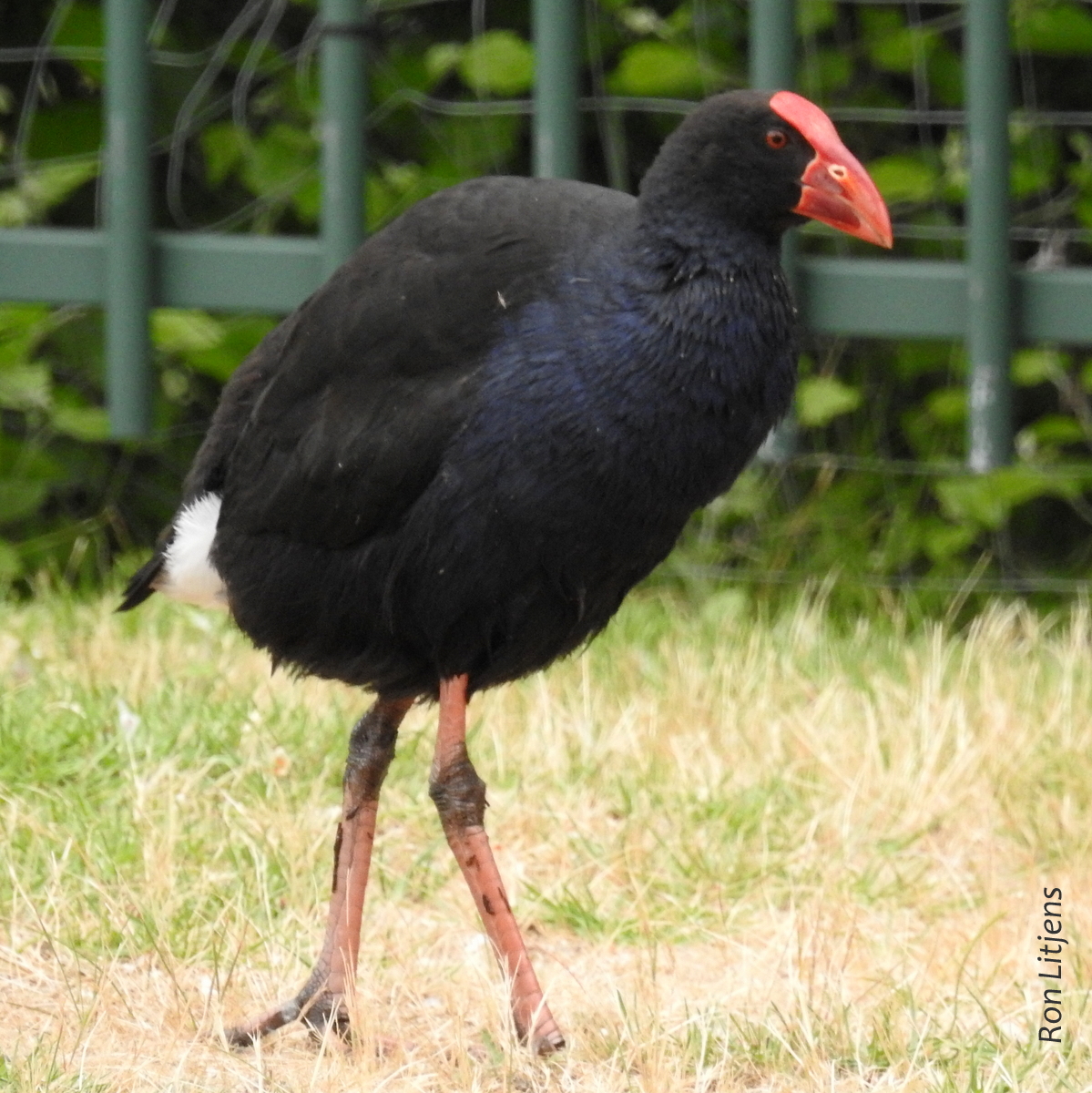 Getting a good look at the water birds which inhabit the vegetative fringe of dams is fraught with difficulty. Although they are often seen foraging in the pastures around a dam, the mere slight of a human will send them scurrying out of view into the reeds. This is particularly true of their chicks. This week however I had occasion to spy some Purple Swamphens (Porphyrio porphyrio) (adult pictured left) and their chicks out in the open.
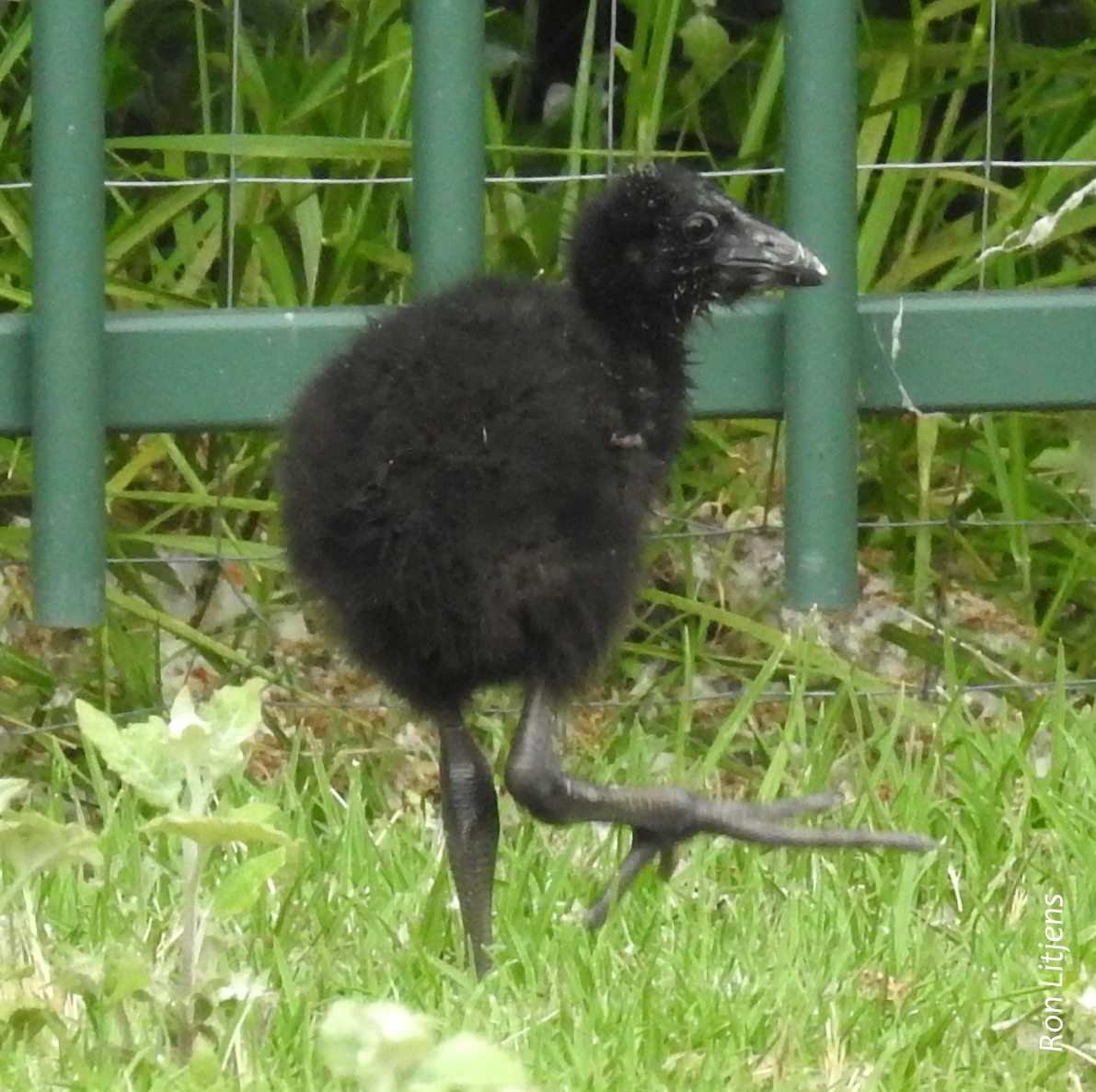
Swamphens are good swimmers despite the fact they do not have webbed feet. Their diet mainly consists of reed shoots and aquatic fauna such as frogs. Nests are built of matted reeds or on floating debris just above the water level in swamps and dams.
Swamphens are able to clamber across reed beds because their large feet spread the weight of the bird over a large area. The size of the feet is unremarkable until you see them on the chicks (pictured right and below). The feet are also used to grasp food.
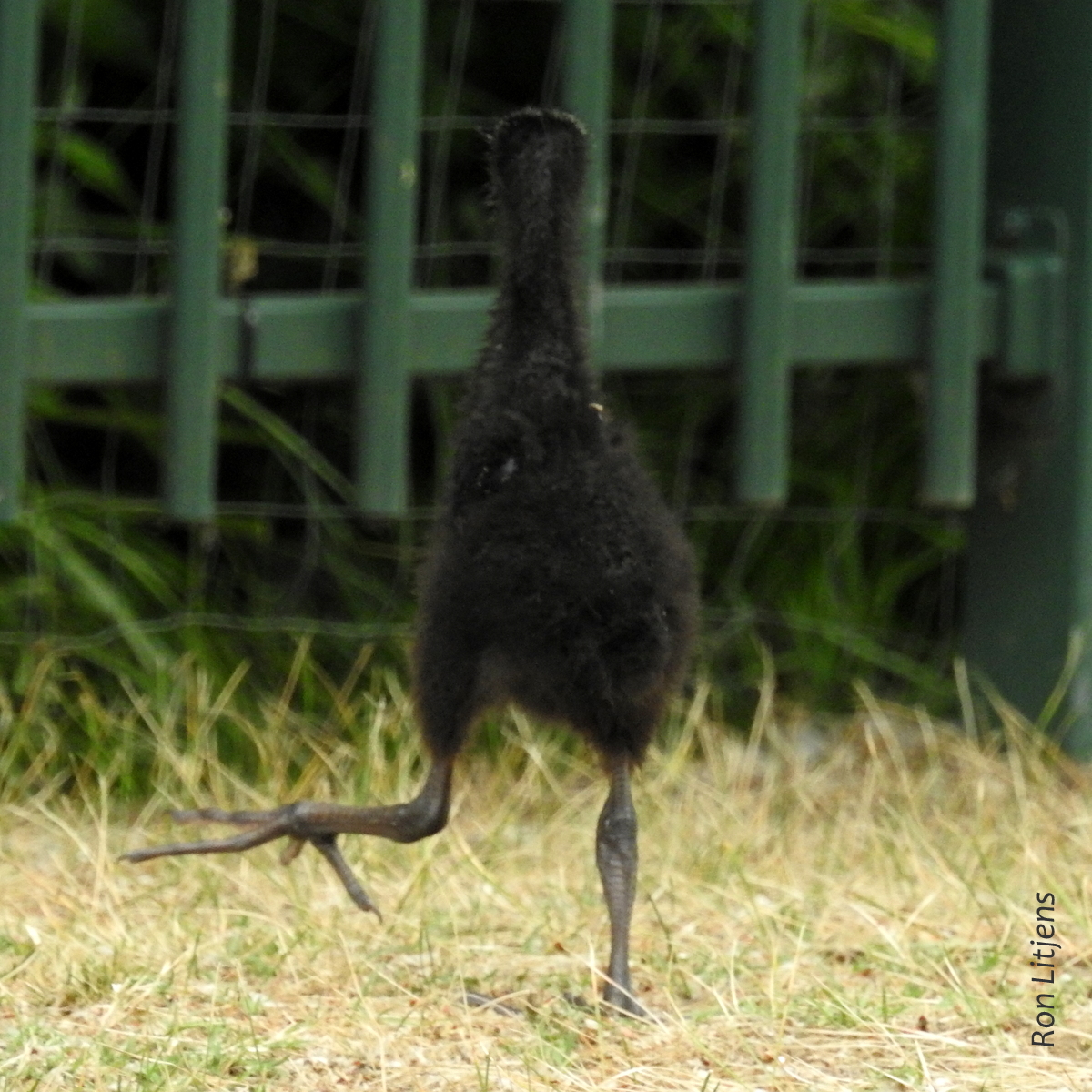
With feet that big a Double Whopper with Cheese would present no problem at all.
Circle work in the bush
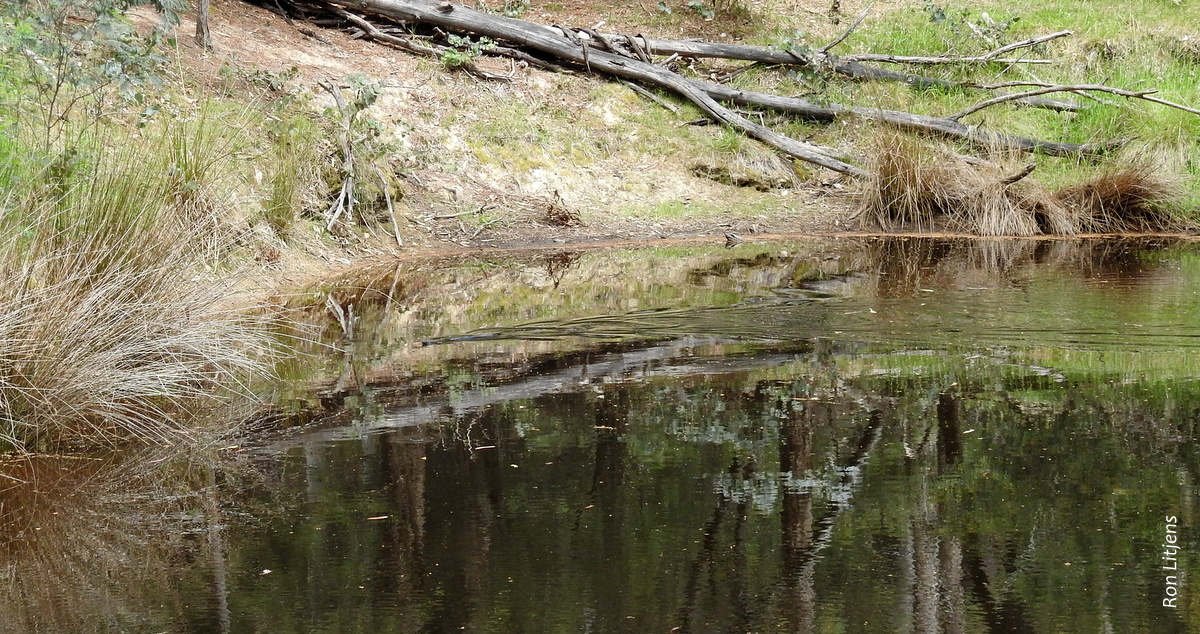 The bush dam on our property is a mecca for all sorts of fauna and approaching it with stealth is often rewarded with the sight of something unusual. This week a flash of blue indicated the presence of a Sacred Kingfisher, a bird rarely seen in our area but arguably the most beautiful one around. An even more cautious approach did not reveal the bird but I did notice ripples in the water on the far side of the dam (see photo above). Thinking the rakali was back I settled quietly into the rushes to watch.
 What I saw was a Red-bellied Black Snake (Pseudechis porphyriacus) slowly and ever so gracefully swimming around the edge of the dam checking in at every reed clump – presumably for food such as frogs (no frogs were croaking!).
I would have assumed that a Black Snake would be a land-based hunter but this specimen swam around the edge of the dam twice before realising I was there. It then swam underwater across the other side of the dam before reappearing and wrapping itself around the base of a reed (see below).
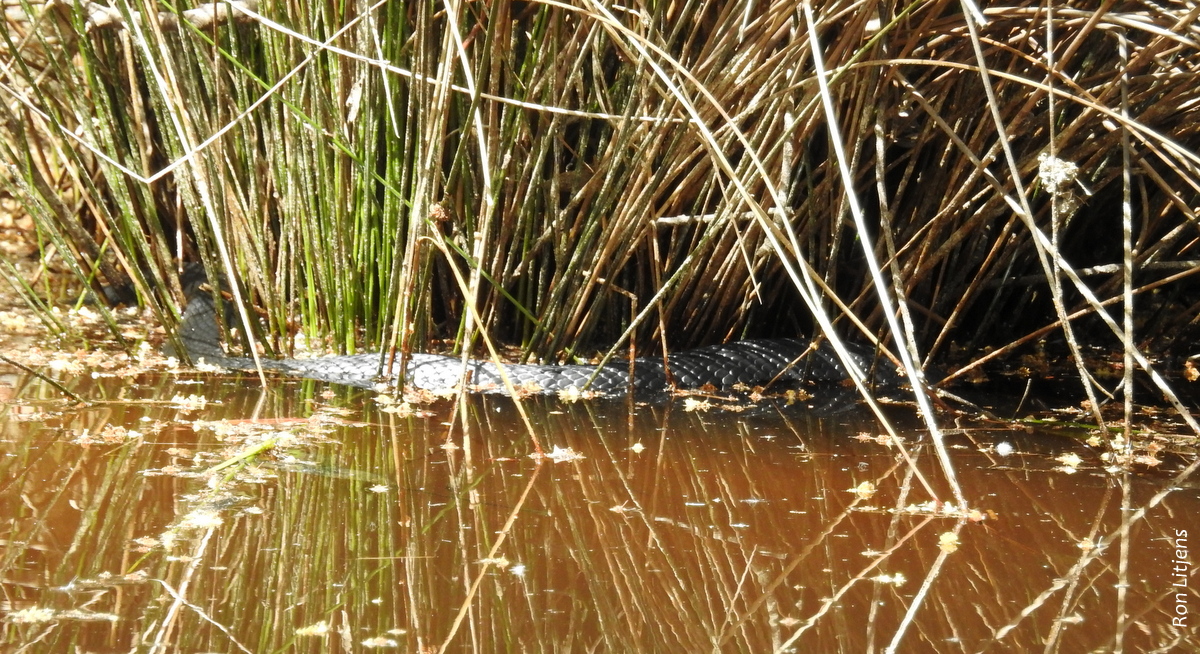 Two thoughts came to mind. Firstly these snakes are obviously just as much at home hunting in the water as they are on land. Secondly, I spend a lot of time around this dam. I am always consciously looking for snakes but in this case, even though I knew where the snake was I could not see it from a land-based vantage point.
This event is shaping up to affect my photography in the same way Jaws affected my surfing all those decades ago – that niggling worry in the back of the mind…
Some privacy please!
 Spring is well and truly here. The plants are flowering and the animals are doing what they always do in spring – mate.
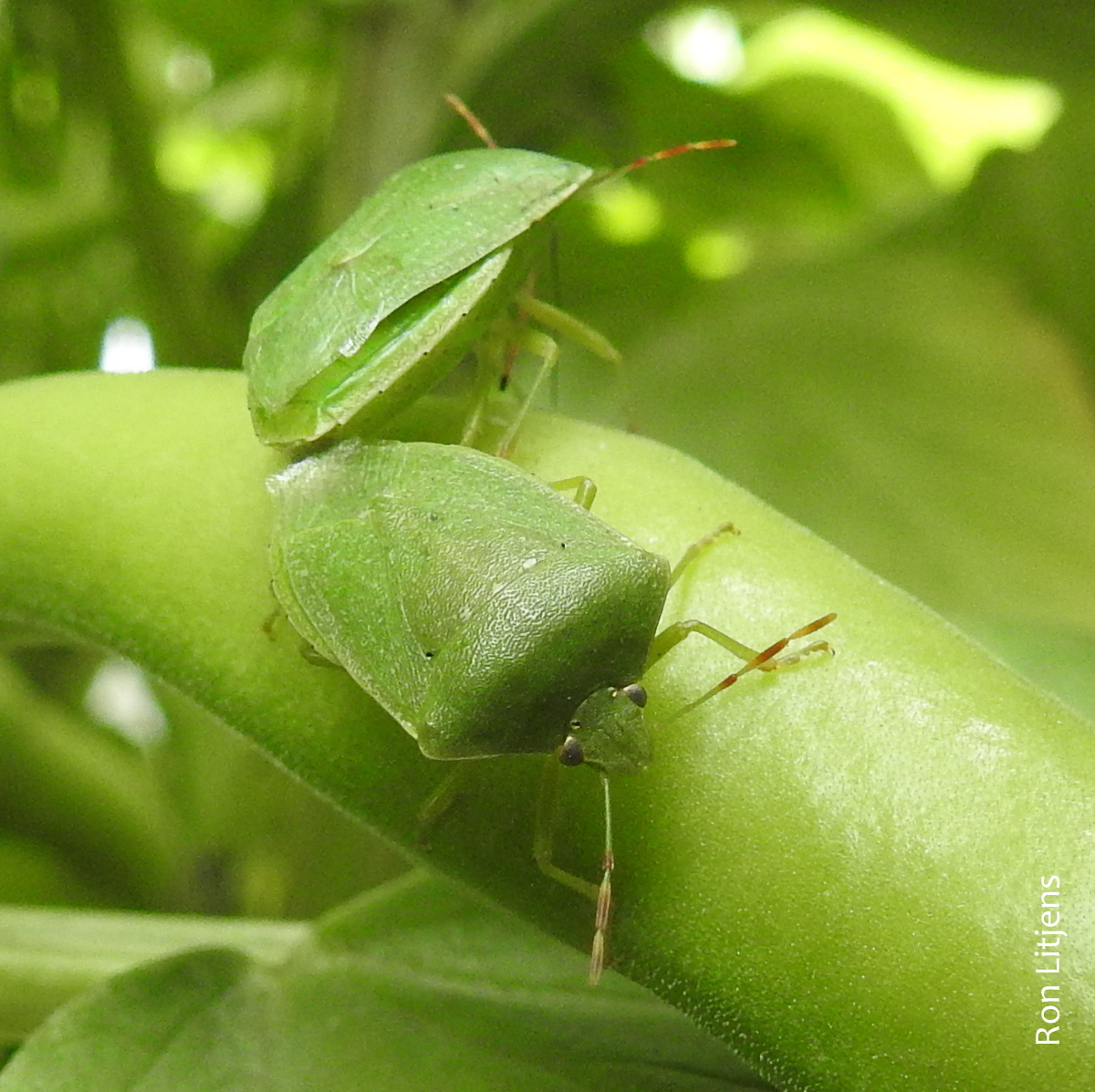
But just consider the plight of most insects. They have to do the deed al fresco which means they have to contend with the elements rain, hail or shine. In many cases insects can find a secluded spot away from prying eyes deep within the vegetation, for example this pair of Southern Green Stink Bugs (Nezara viridula) mating on a broad bean (pictured left).
.
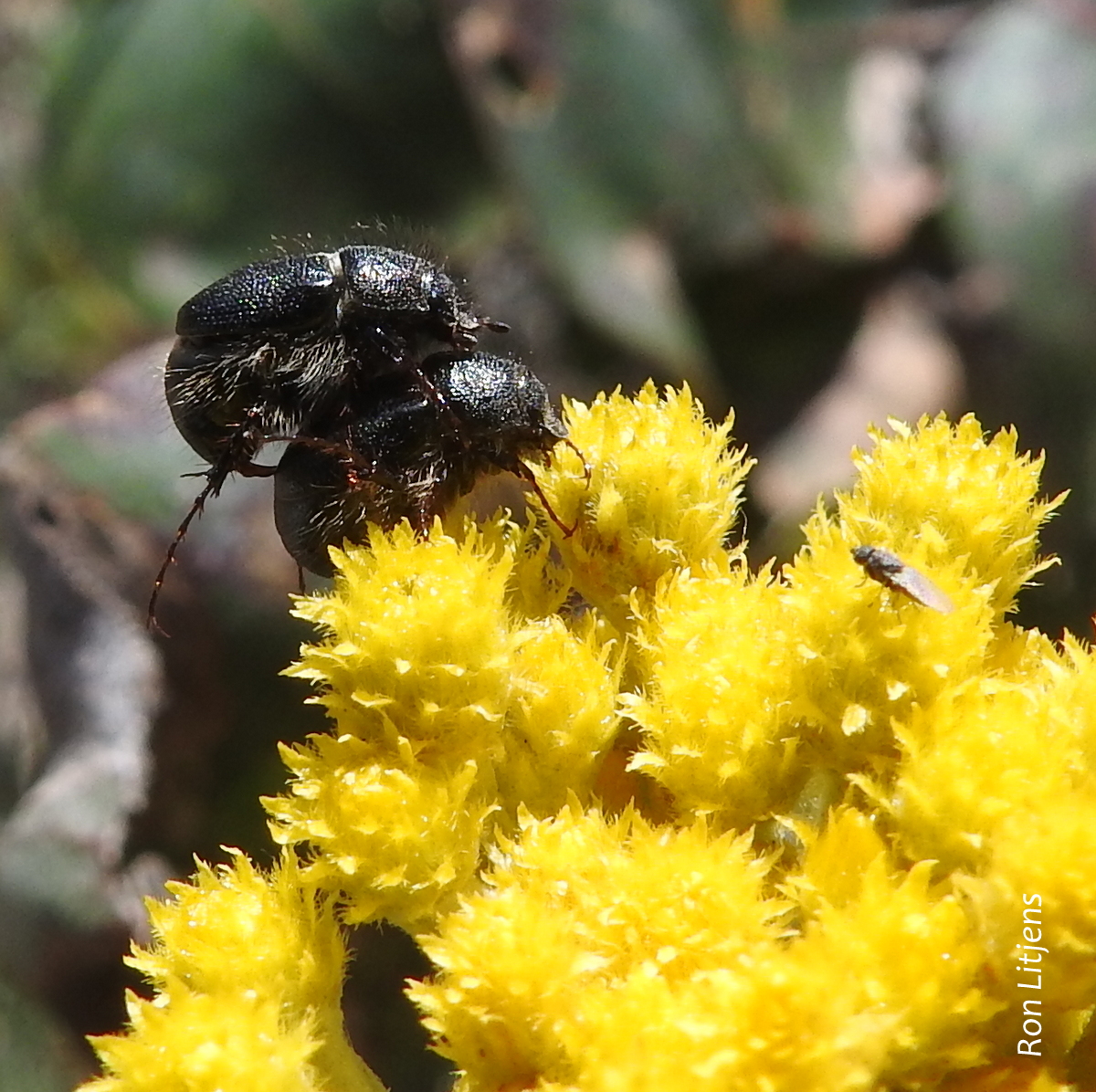 However, for these beetles pictured right a floret of Clustered Everlastings (Chrysocephalum semipapposum) might make a romantic setting but where’s the privacy.
And then you have to put up with others dropping in to watch. It is enough to put you off.
I know it puts me off.
Return of the cuckoo
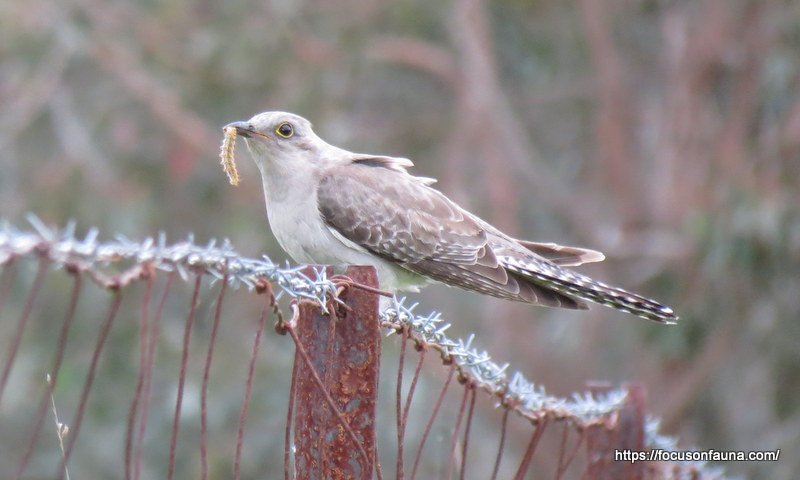
Surprisingly, we had not recorded a Pallid Cuckoo on our place since 2011, despite it being a regular spring visitor for many years before that. But this year it has returned and we are seeing and hearing Pallid Cuckoos (as well as Fan-tailed Cuckoos and two Bronze-Cuckoos: Horsfield’s and Shining) not only on our property but at various spots around the district.
It’s good to hear again the familiar and distinctive call, although we know that our smaller birds will have an added threat to contend with when nesting this year. The call is a series of rising notes that can be heard by clicking on the audio bar below. It’s worth getting to know the various cuckoo calls for easy identification of their presence – in a previous post on this blog in 2011 the calls of all the cuckoos mentioned above can be heard.

Grey male Pallid Cuckoo

Browner female (or immature?)
The Pallid Cuckoo uses a perch and pounce technique to catch insects on the ground and is often seen along fence-lines waiting patiently for its next meal. It seems particularly fond of caterpillars (see top photo above), even those hairy ones spurned by many other birds – must have a strong stomach!
Relatively little
 A number of Australian birds have the epithet “little” in their common name. But for some of these there is only a marginal difference between the “little” species and another closely related species. So, unless you happen to see both species close up and together, for the non-expert it is not immediately obvious which is the “little” species, and therefore other distinguishing features such as plumage, habits or call must be used for their identification. For example, we have the Little Corella only slightly smaller than the Long-billed Corella, and the Little Raven only marginally smaller than the Australian Raven. Similarly, the Little and Red-chested Button-quails are essentially the same size.
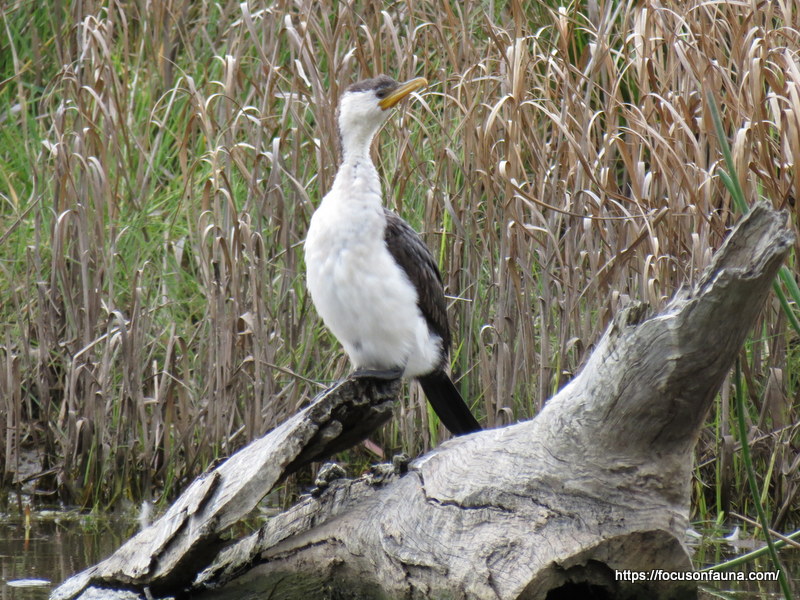
For the pied cormorants there is undoubtedly a size difference between the Little Pied and Pied, but when trying to identify and photograph a wary bird through rushes and sedges on the other side of a wetland (see photo above), size is not so easy to determine. With declining eyesight and without binoculars at hand it was only by studying the photos later that we were able to recognise our bird as a Little Pied Cormorant, because of its (relatively) stubby orange/yellow bill and its all-white face, compared with the Pied Cormorant’s long slender pale bill and distinctive face colourings. The Pied also has a shorter tail and black thighs/flanks, and in fact is in a different genus, Phalacrocorax, from the Little Pied’s Microcarbo. The clincher is the Little Pied’s crest on the forehead which can just be seen slightly raised in the photo at right which was taken a couple of days later from a more advantageous spot on our wetland.
Interestingly, there has been some recognition of the inadequacy of the “little” descriptor: the Australasian Grebe was formerly known as the Little Grebe despite being only slightly smaller than the Hoary-headed Grebe, and the Little Thornbill was changed to Yellow Thornbill, acknowledging that it is in fact much the same size as other thornbills.
So with bird identification, maybe size doesn’t matter – there are more important things to consider?!
Ol’ Blue-eyes
During my latest excursions with the Murrindindi Birdwatchers I have learned a new word – ‘Lifer’. A lifer is a bird that you have observed for the first time ever, and of course everyone is keen to do that. Last weekend whilst wandering in the bush I saw a lifer. Strangely enough it was not really the bird that I was interested in but one of its constructs – a bower. Ever since I was a kid I had heard of the bower that a Satin Bowerbird (Ptilonorhynchus violaceus) makes and how the male decorates it with blue articles to attract and impress the female Bowerbird.


And there it was in the middle of the bush, a collection of blue articles (pictured above) – packing twine, packing straps, plastic lids, even the top of a BIC ballpoint pen. It took four visits to the bower over several days to eventually see the constructor of the bower (pictured right). The male is solid black in colour (the female is green/brown) but when the light is at the correct angle it diffracts off the feathers to give the male bird a distinctly metallic blue appearance. Most striking however are the violet-blue eyes.
This particular male was quite mature. Younger males are coloured like the female and decorate their bowers with both blue and yellow objects. As a bird matures the feathers become darker and the decorations become more blue.
Which got me thinking…all the items in this bower were man made. Blue is not a common colour in nature and I wonder what was used to decorate bowers before man appeared. Berries maybe, even flowers.
If I was a Crimson Rosella I’d watch out for my tail feathers.