Well spotted
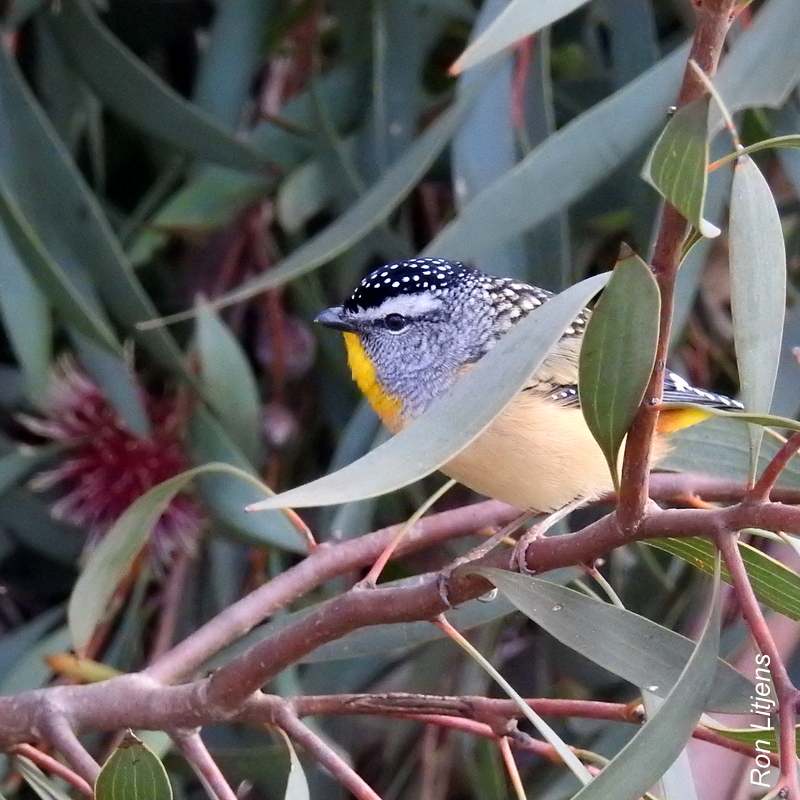 Even though winter is still with us the LBJ (little brown job) brigade of birds is starting to make an appearance. Although this group commonly contains birds that are actually brown – thornbills, treecreepers, scrub-wrens and the like – a recent addition to the gang, hanging out in the Western Australian hakea currently flowering in our yard has been a pair of Spotted Pardalotes. And they are anything but brown (see picture left).
Spotted Pardalotes are small birds distinguished by distinct spots on the head and wings. The males have a bright yellow throat and an orange rump. The related Striated Pardalote has stripes on its head and no spots on the wings.
 The scientific name of the Spotted Pardalote, Pardalotus punctatus, is derived from the Greek words pardalotus meaning spotted like a leopard and punctus meaning sting hence spot. They are distributed along the east and south of Australia. Pardalotes are insectivorous and feed on psyllid insects and lerps, the sugary houses that psyllid exude to live in.
The pardalote pair have spent some time darting from the hakea to a patch of long grass on the edge of the vegetable garden. It seems a bit early but I’m hoping they are constructing a nest, which is usually a bark and grass lined tunnel dug into a bank or heap of dirt. It is time for the motion sensing camera to be deployed. Watch this space.
Pieds a problem?
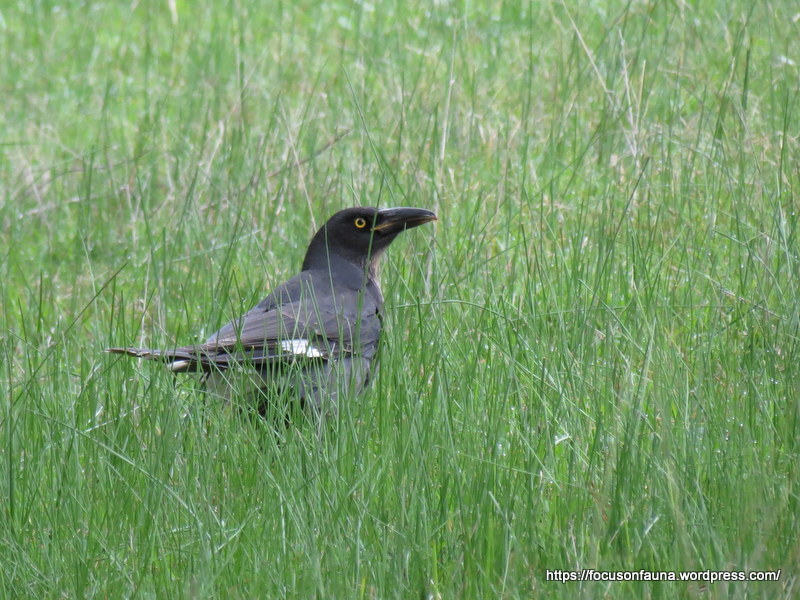
 The Pied Currawong is partially an altitudinal migrant, with many birds moving from the forested ranges to spend winter at lower altitudes – although more birds are now spending all year lower down, especially in urban areas where backyard gardens can provide rich pickings.
Our open paddocks near Strath Creek are dotted with many Pied Currawongs at present. A loose flock of 20 or more spend the day wandering around probing and jabbing in the grass, presumably for worms and grubs (beetle larvae) such as cockchafers, which can be pasture pests that feed on grass roots. So the currawongs’ current activity can be seen as beneficial.
However, there is a more sinister aspect of having so many currawongs around. As well as being omnivorous scavengers feeding on insects, berries, small lizards etc, they are also voracious predators on small and young birds. According to BirdLife Australia’s Birds in Backyards website, “a pair of Pied Currawong may kill about 40 broods (up to two kilograms) of small birds to raise one brood of its own”. With many woodland birds in decline and the nesting season coming up, we therefore have mixed feelings towards our currawongs.
At times they can be a noisy lot, particularly when they come together in groups, with a diverse range of calls. On our frequent foggy days they can sound quite eerie and mournful, at other times rather plaintive. Click below to hear a selection of their calls.
Incy Wincy Long-Legs
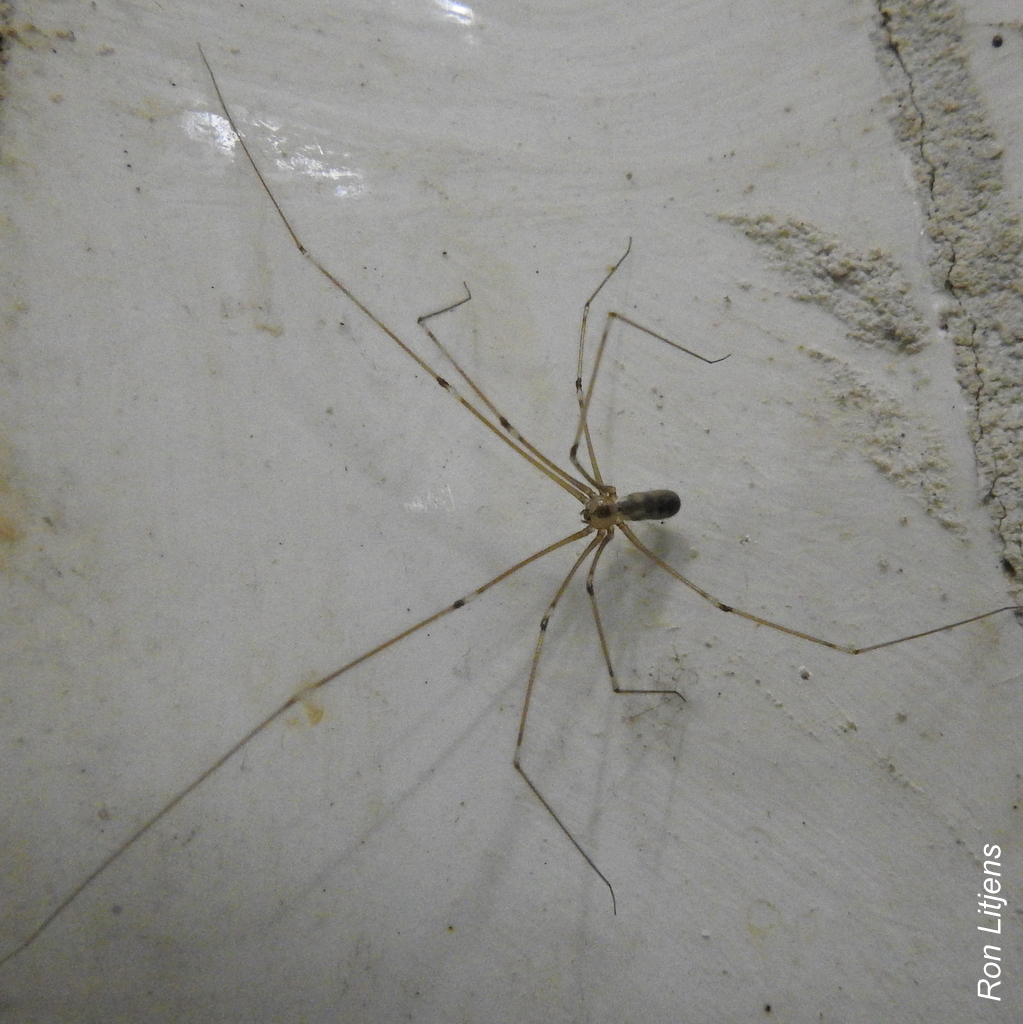 There were three spiders that dominated my childhood – the Redback Spider, which we were warned to watch out for, particularly under the seat of our outdoor toilet; the Huntsman Spider, which used to pour out in great numbers when I pulled the bark off trees looking for insects; and the innocuous Daddy Long-Legs Spider. When reciting the Incy Wincy Spider nursery rhyme it was the latter that came to mind.
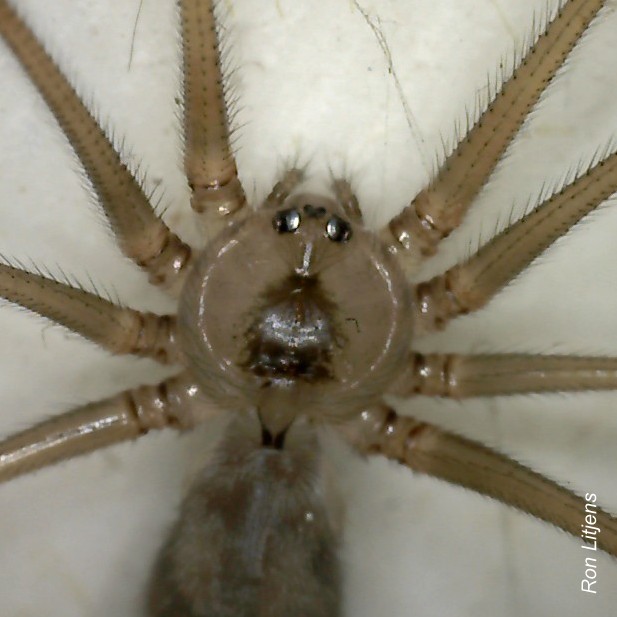
Daddy Long-Legs Spiders, as the name suggests, have legs that are extremely long when compared to the body size (see picture above). They are usually found upside-down in webs built in undisturbed areas of buildings such as in the corners of ceilings. They build three-dimensional, messy webs that unlike other spider webs are not sticky. Prey gets entangled in the web and is quickly paralysed and wrapped in silk by the waiting spider. A Daddy Long-Legs web is littered with such silk bundles. These spiders are not native to Australia.
Daddy Long-Leg Spiders eat Redbacks so are good to have around the house. Good ol’ Incy Wincy.
In full voice
 Common Froglets (Crinia signifera) are calling day and night at present in wetlands around the district. Two (or perhaps more) in particular are battling it out for supremacy in our garden pond, as can be heard in the audio recording below.
Those who attended the recent talk on Frogs and Reptiles by Steve Wilson at Flowerdale would be aware that only the males call to advertise their presence. With the Common Froglet, the males call throughout the year and breeding can occur in any month, unlike many species where breeding is seasonal. This little frog is one of Victoria’s most common and widespread frog species, absent only from the far north-west Mallee region. Its colouring and markings can vary greatly, so we hope we have correctly identified the frog above which was photographed next to the pond – we would welcome any other suggestion.
Anyway, take a minute to listen to the hypnotic clickety-click calls by clicking on the audio below.
Slip, slop, slap
 A marsupium (from the Greek marsupion meaning pouch) is a specialised pouch for protecting, carrying and nourishing newborn young. Animals which have one are called marsupials. In some marsupials such as kangaroos the marsupium is a fully developed pouch. In other marsupials the marsupium is simply a flap of skin.
For marsupials that perambulate on all fours close to the ground, for example wombats, the pouch faces backwards (see picture left) – you can just imagine a forward facing pouch scooping up all sorts of debris. A previous post has featured a photo that clearly shows a young wombat peering out from the backward facing pouch.
 Young wombats when old enough to leave the pouch looks very much like, but a smaller version of, the parents (pictured right). They are haired and eat grass but still rely on sustenance from the mother. Before they get to that stage the young wombats are pink and hairless and depend entirely on the protection and nourishment offered in the mother’s pouch. At this age they are commonly referred to as pinkies.

Chris, our local landcare facilitator, recently found a dead wombat on the side of our road. The animal had been killed by a car. Examining the body he found a ‘pinky’ still alive in the pouch (pictured left). Pinkies rarely live if the mother is killed. However the local wildlife carer it was taken to thought this one was sufficiently advanced in age to survive with the proper attention.
Let’s hope it grows some hair before summer otherwise it’s definitely a case of sunscreen and a hat for the little critter.
Bathing beauties
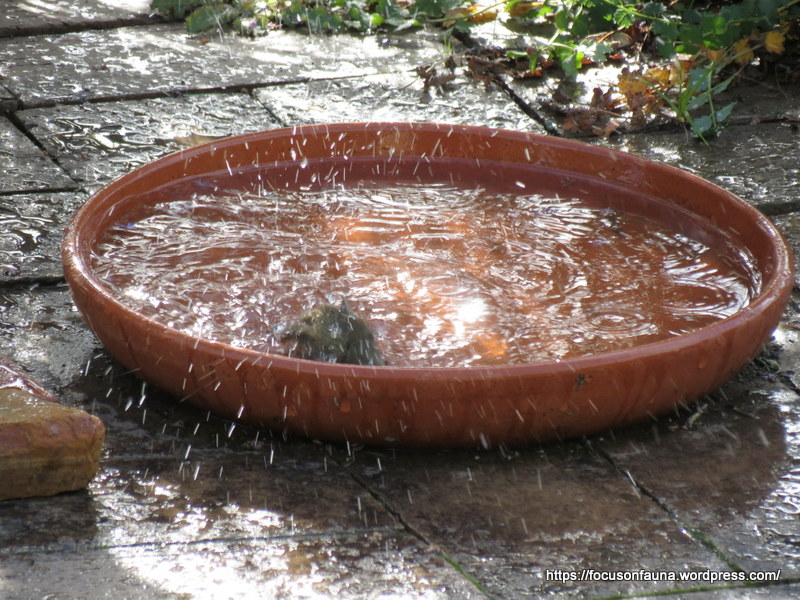
Making a splash
The study is due to start on 1st August and run for 4 weeks. You will be asked to monitor the birds visiting your bird baths and/or feeders 3 times a week. To take part, all you have to do is register with the Australian Bird Feeding and Watering Study at their website.
-

- Buff-rumped Thornbill
-
- Brown Thornbill
-

- Superb Fairy-wren
-

- Eastern Spinebill
Click on any of the photos for a closer look.
Red rumps
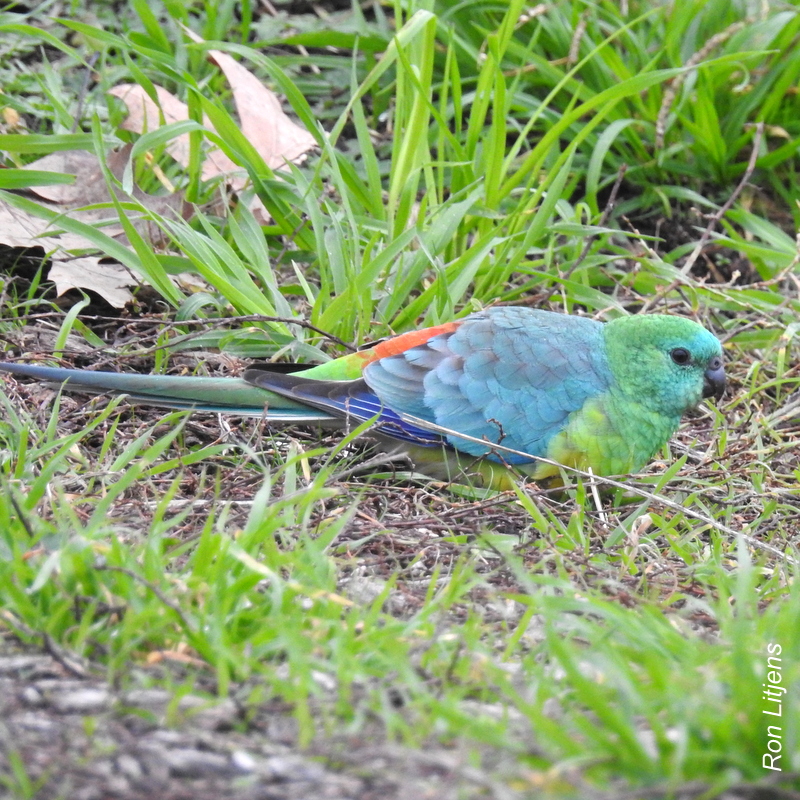 One of the most beautiful parrots in the district is the Red-rumped Parrot or Grass Parrot (Psephotus haematonotus) (from the Greek haima meaning blood and noton meaning back). The male bird (pictured left) is mainly emerald green in colour with a bright red rump which is very visible when it is flying away. The female’s feathers are a more sedate olive in colour (pictured below).
 Red-rumps are open country birds and are ground foragers, feeding primarily on grass seeds. Clearing of land for agriculture has extended the range over which they live. They are particularly well camouflaged on the ground which means your first sight of them is usually as a group of red bottoms flying away into the distance.
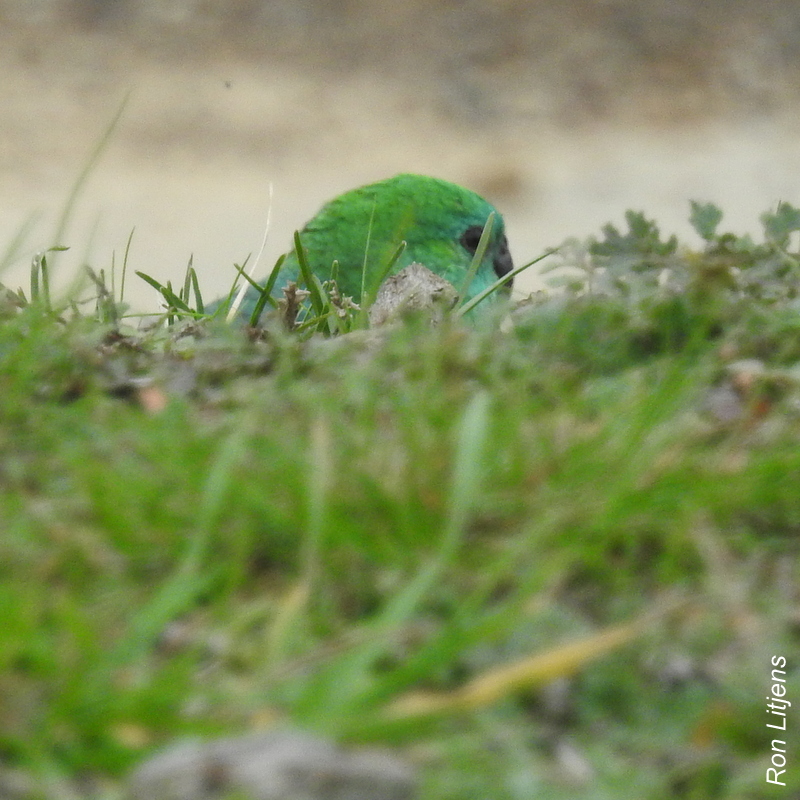 However the other day I noticed ahead of me the head of a male parrot just over a slight rise – and he didn’t see me. After a few minutes of slithering across the ground on my stomach I was rewarded with the sight of several pairs quietly feeding on grass seeds – a great day for me and no doubt a talking point for any neighbours who may have been watching.
Porphyry pearl
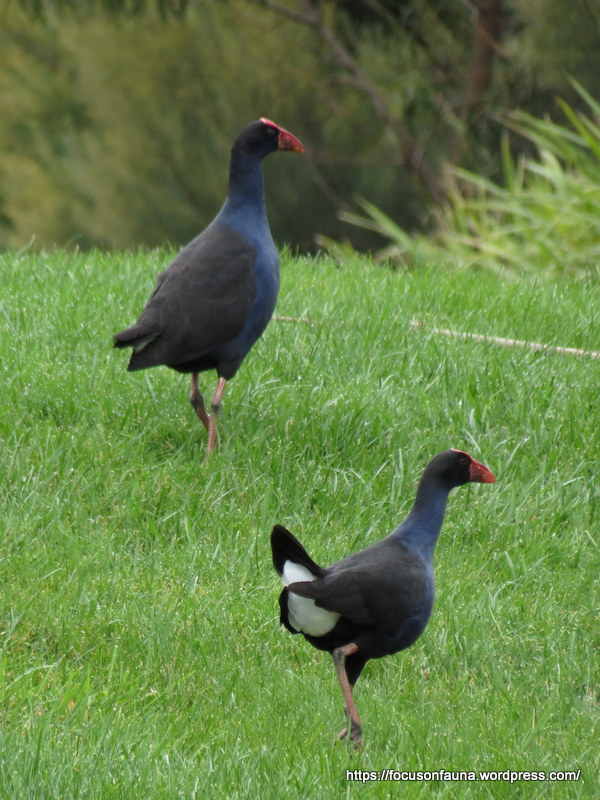 No, the title doesn’t refer to that much-maligned sparkling wine of the 1960s (for those old enough to remember it!), but instead to that strikingly colourful waterfowl, the Purple Swamphen, which has the delightful scientific name Porphyrio porphyrio meaning ‘Purple Water-hen’, originally from the Greek porphuroeis, purple.
A group of these birds can regularly be seen on the roadside on Upper King Parrot Creek Road, just a short distance out of Strath Creek. They are presumably attracted there by the lush watered grass outside ‘Callandoon’ and have become quite accustomed to passing traffic. But they are also often found along the banks of the King Parrot Creek in the same area.
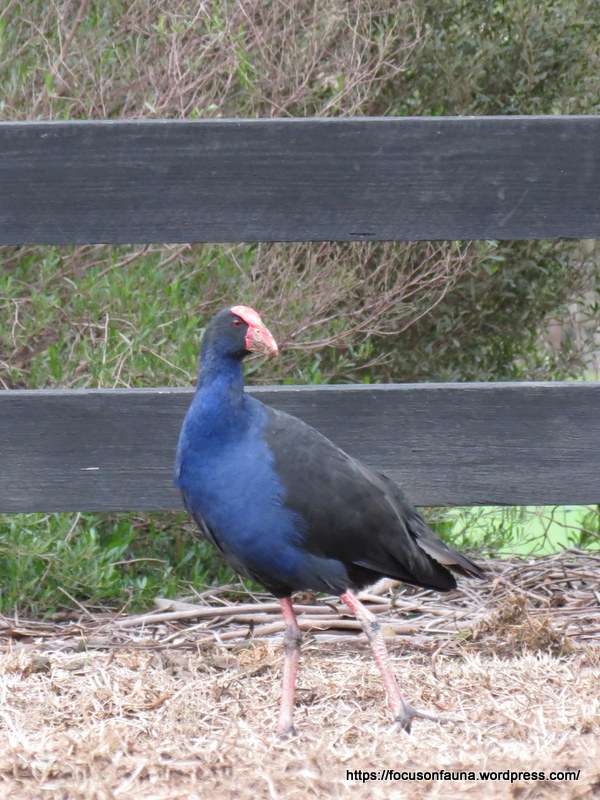
The purple swamphen spends much of its time on land, strutting on big feet and long legs, flicking its tail to show the white underneath. It is an accomplished if rather clumsy flyer and doesn’t often swim, being essentially a wader in swampy vegetation on the margins of various wetlands. It feeds on soft shoots of water plants, but also small animals such as frogs, snails and reportedly even ducklings – and remarkably, lerps in trees, according to a reference in Where Song Began by Tim Low.
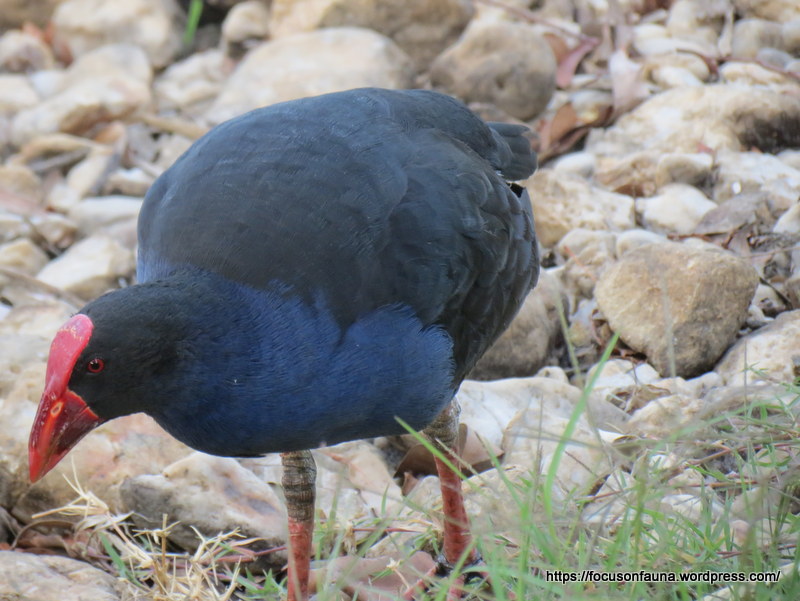
Purple swamphens are common across most of northern and eastern Australia, with a separate sub-species in southwest Western Australia. It is also found as various sub-species in parts of Europe, Africa and Asia.
It emits quite a variety of sounds – brief examples of its calls recorded near Shepparton by Jo Wood from the Goulburn Broken CMA can be heard by clicking on the audio bar below.
Prepare to be (fly) blown away
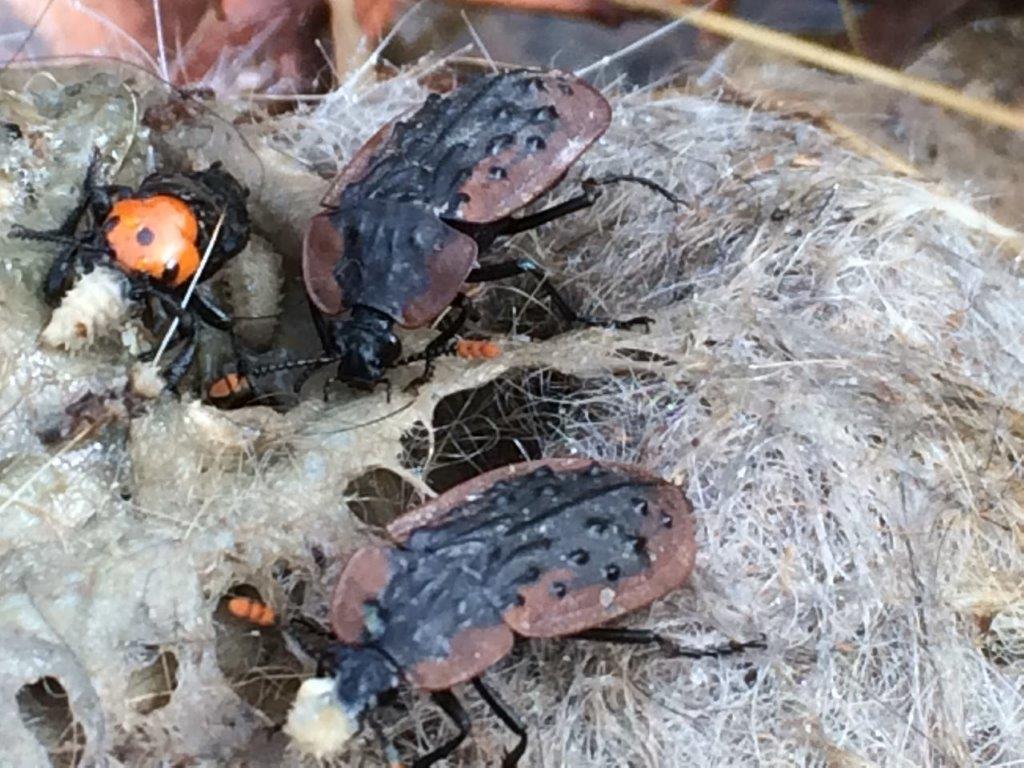 In the biological cycle we tend to overlook the things that die. What happens to them? How come we are not knee deep in carcasses? A set of photographs sent in by Judy from Limestone really shows you what a dog-eat-dog or in this case a beetle-eat-maggot world it is out there. The pictures were taken of a fly-blown fox carcass. In them you can clearly see fly maggots feeding on the carcass but feeding on the maggots are two species of beetle.
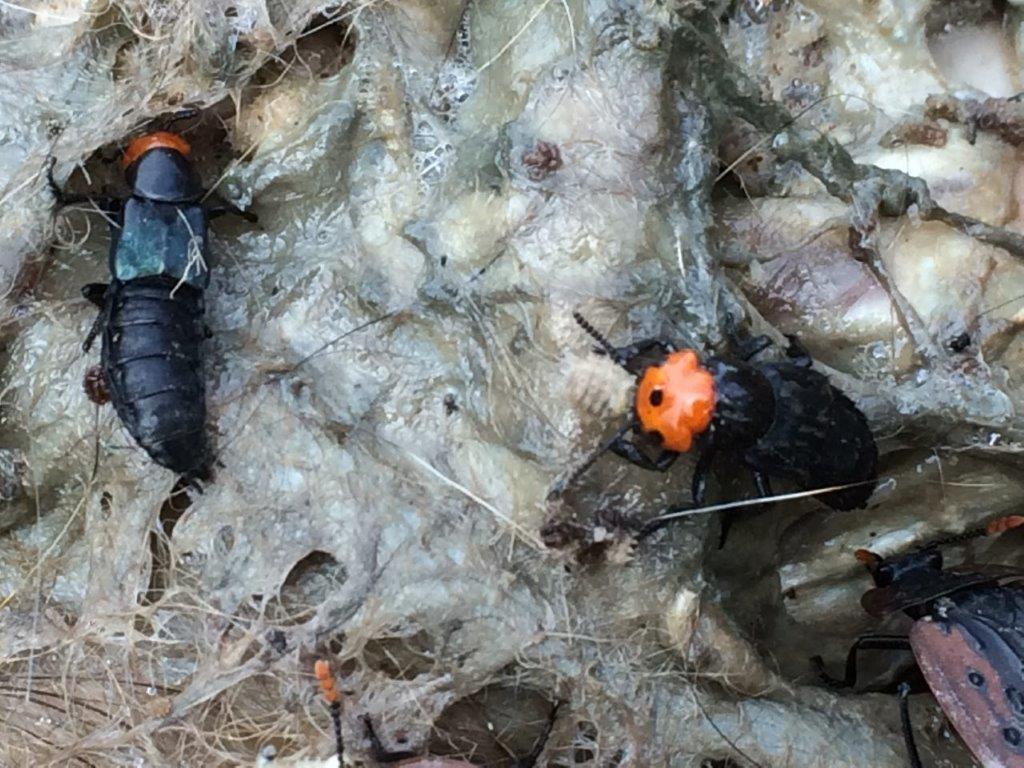 The beetle with the red head is known by the ominous name, Devil’s Coach Horse (Creophilus erythrocephalus) (from the Greek eruthros meaning red and kephale meaning head). It has large powerful jaws for cutting open prey. Unlike many beetles, its hard wing-casings only cover a small part of the abdomen. Active mainly at night the Devil’s Coach Horses are one of the first species to arrive at a dead animal (obviously after the flies have been there). The adult beetles feed on maggots and pupae of flies. The upper left photograph clearly shows a beetle with a maggot clenched firmly in its jaws. These beetles lay eggs in the carcass and the emerging larvae also voraciously predate on maggots.
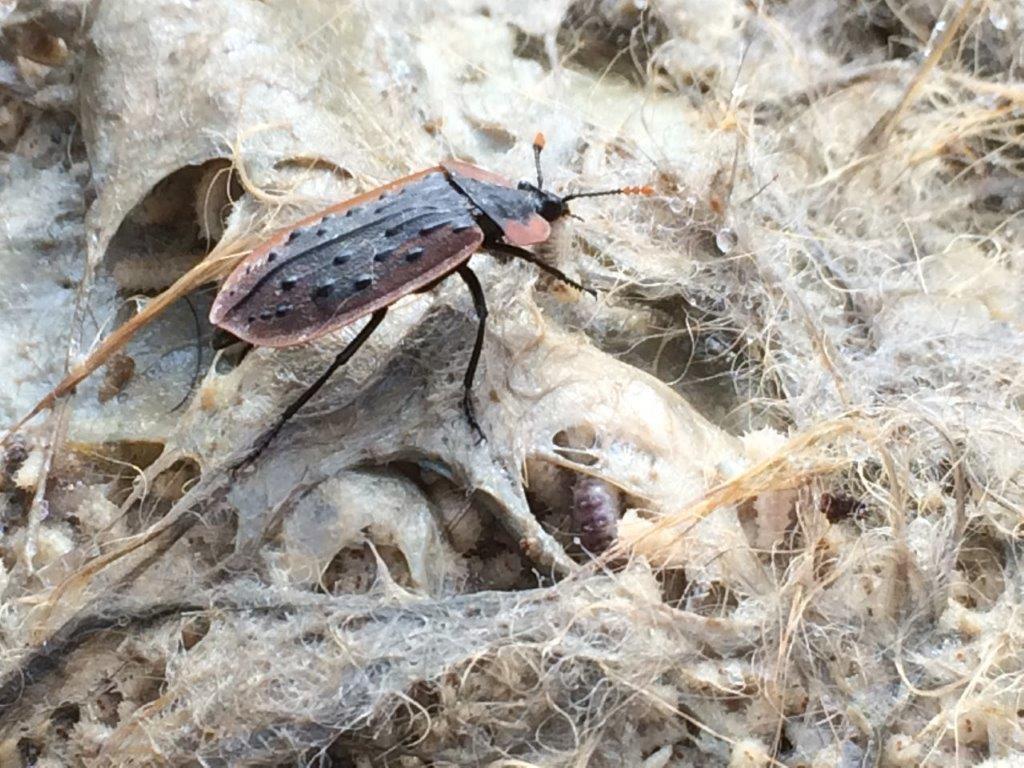 The brown, flattish shaped beetle with the handsome orange-tipped antennae is a Carrion Beetle (Ptomaphila lacrymosa) which as the name suggests feeds on the flesh of dead animals but also on fly larvae. They are distinguished by short, longitudinal ridges (called tubercules) on the wing-casings. Both beetles play an important role in maintaining a clean environment and reducing the risk of disease by consuming carcasses and/or fly larvae.
Alien (the movie) has nothing on real life!
Frogs, lizards and lots more at Flowerdale
 It’s amazing what you find in the woodpile – not just the usual suspects like spiders, woodlice, ants and earwigs, but frogs, skinks and even bats. The little frog pictured here was one of three that appeared as we were moving split wood into the woodshed – after being relocated near the garden pond, it promptly hopped straight in (photo below).

We think it’s a Plains Brown Tree Frog (Litoria paraewingi), but we’ll have a much better idea after Steve Wilson’s talk at the Flowerdale Hall on Friday evening. Steve will be talking about the frogs and reptiles of the Goulburn Broken Catchment. This is a natural follow-on from the previous Focus on Fauna talk on Turtles, and will complete the picture of our local reptiles and amphibians. Steve will have lots of wonderful photographs of the geckos, lizards, skinks, dragons and snakes, as well as frogs, that may be found in our district, some of which have featured in previous posts on this blog.
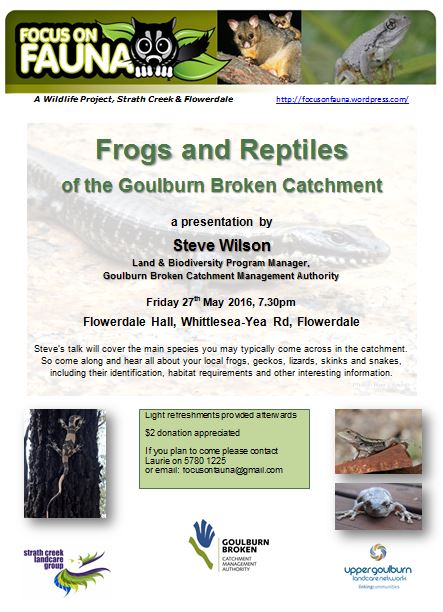
For full details of the presentation, click on the flyer at left. And if you plan to come, please let us know by email to focusonfauna@gmail.com .



 Focus On Fauna