The Dilemma of Political Correctness
We have recently become dog owners for the first time. The said canine is very grey around the muzzle, half deaf and half blind (some would say just like me). It is now my companion whenever I journey out to find another blogging subject and will sit patiently by me while I try to get THE photographic shot, irrespective of how long it takes. HOWEVER…
 Whenever I go into town the dog seems to have the knack of poo-ing in the most public of places – usually in the middle of the broad grass median strip separating the highway that traverses the middle of town. And being a new conscientious dog owner I am always ready with the plastic bag to pick up the deposits and place them in the nearest rubbish bin.
In the time it takes me to get out the plastic bag and bend down to scoop up the poo, dung beetles have arrived (even before the flies) and are already burrowing in. They come from everywhere. Not being an aficionado of dung beetles I have no idea of the genus or species. Australia has over five hundred species of dung beetles and about two dozen species which have been introduced.
 What I do know is that it leaves me with a problem. Do I leave the poo where it is and let nature’s little poo scavengers do their job? Do I pick up the poo (and the beetles) in a plastic bag, knot it up and then deposit the bag in the rubbish (and thereby consigning the beetles to a certain death)? Or, do I pick up the poo and beetles in a plastic bag and then deposit them sometime later under a bush or shrub? I have opted for the latter…but geez it’s a hassle.
The dilemma of political correctness (or is it council by-laws?)
A rude awakening
 There we were, trying to enjoy a post-lunch siesta in the searing heat, when we were disturbed by a scuffling sound followed by a clatter and thud as something plummeted past the window. We jumped up to see what it was and discovered a lizard clinging to the brick window ledge – a rather dazed looking lizard that had collected a few cobwebs and spiders on the way down (see picture at left).
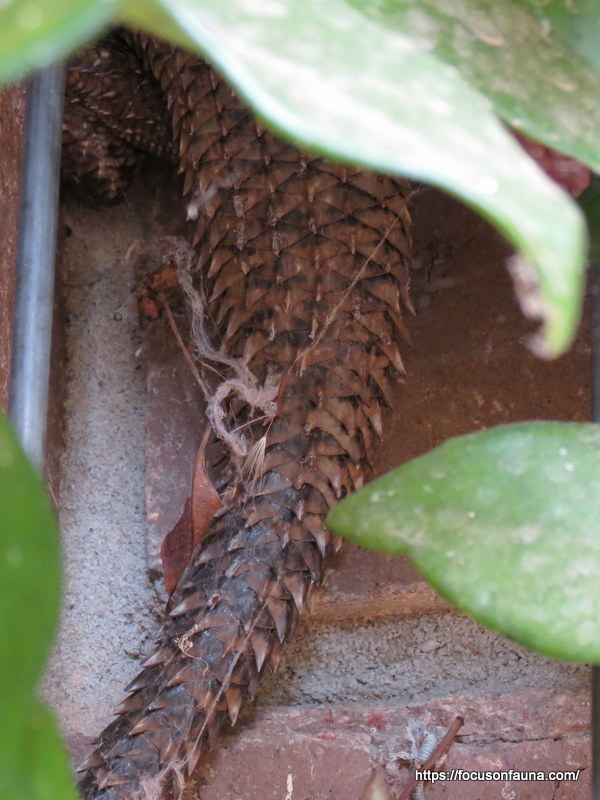
Heading outside we took a quick photo before it took cover between a climbing vine, Hoya sp., and the brick wall, where it remained for most of the afternoon. But we could see its tail had spiny scales, and after closely studying the photos we took, decided it was probably a Cunningham’s Skink, Egernia cunninghami. The head scale pattern, the lobes in front of its ear opening and the longer fourth toe all seemed to point to the genus Egernia, but we would welcome any dissenting identification.


It seems it was on the polycarbonate sheets covering a porch area when it lost its footing and slipped down the gap between the roofing and wall. Actually, with its clinging feet, it’s hard to believe it accidentally slipped. There were some more scrabbling sounds above and we suspect there was another skink and they were fighting on the roof’s edge – in an active commmunal species like Cunningham’s, there’s bound to be a bit of squabbling.
Anyway that meant the end of our siesta for the day!
I feel like a Greek god
Those familiar with the Greek classics will know the tale of the 12 Labours of Heracles (Hercules in Roman mythology). As penance for killing his own family Heracles was told by the Oracle at Delphi to serve King Eurystheus. The King assigned him twelve tasks, all of which put Heracles’ life in great danger. The third task was to capture the Golden Stag of Artemis which after a year of traipsing around the Mediterranean (sort of like the first Contiki tour) he accomplished.
This week I accomplished the same task in a fraction of the time. Rustling in the undergrowth in the garden was a Golden Stag Beetle ( Lamprima aurata) – or maybe it’s a Golden Green Stag Beetle (Lamprima latreilli). Either way it’s an impressive looking insect – iridescent green wing casings, blue legs and an orange-pink head.

 The male and female beetles of this genus are vastly different in size. The one pictured is a female so the large mandibles which give the beetle the ‘stag’ description are very small (right). The adults feed on dead wood and the larvae inhabit rotting trees. When I was a kid I seem to remember collecting handfuls of these around Xmas time. Up until this week I hadn’t seen one in years.
Maybe capturing the image of a Golden Stag Beetle doesn’t rate with capturing the Golden Stag. Given it’s lunchtime, maybe I don’t really feel like a Greek god – I’ll settle for a Greek yoghurt instead.
The Hunters and the Hunted
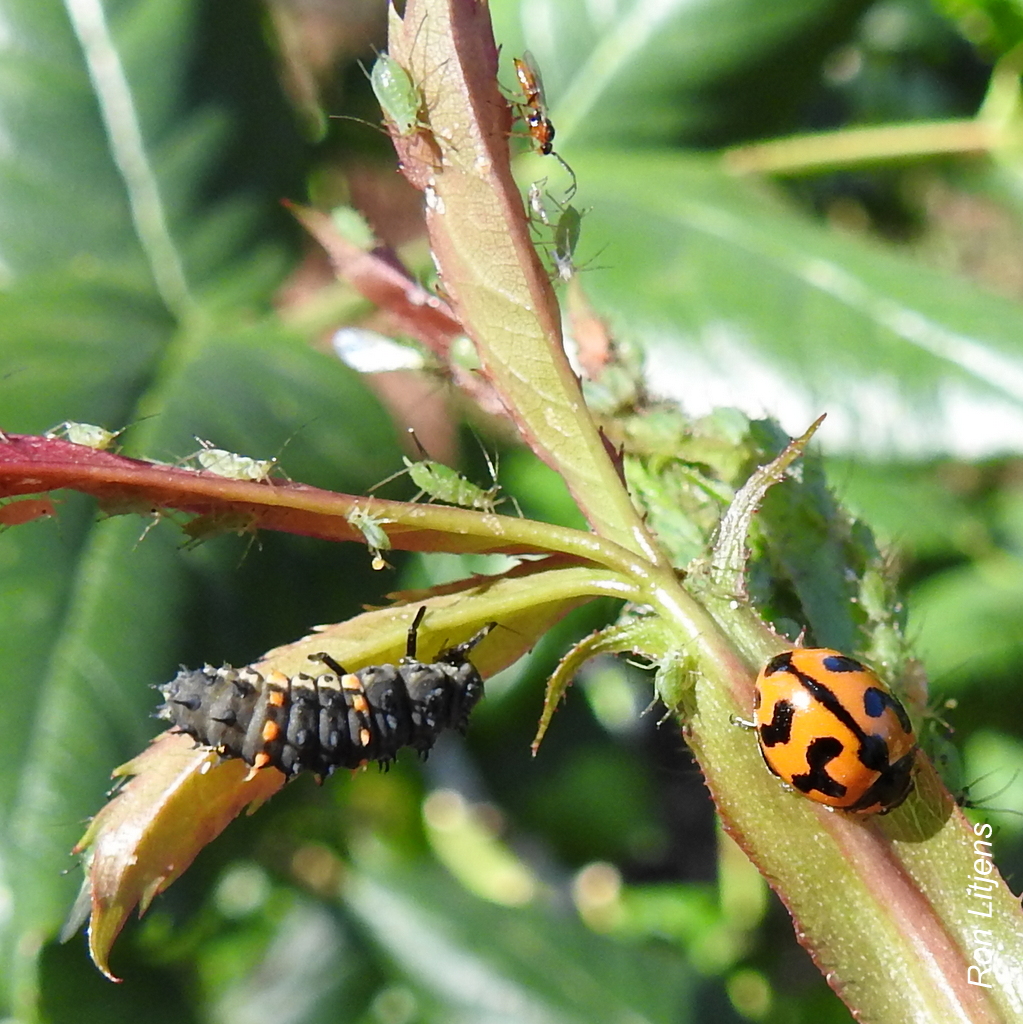
Transverse Ladybird (Coccinella transversalis), adult and larva, & aphids
Spring and early summer are the time of garden shows in the valley. For those with the taste for European gardens, roses seem to be the showy flower of choice. But whilst visitors walk around admiring the blooms, right under their noses, on the millimetre scale, nature’s life and death struggles continue unabated.
Most gardeners, particularly of roses, will acknowledge aphids as one of their main garden pests. Aphids are soft bodied sap-sucking insects. Many species are plant specific in that they only feed on one type of plant. They congregate on plants in large numbers. When a particular stem or flower becomes overcrowded new aphids are born with wings so that they can move to another food source.
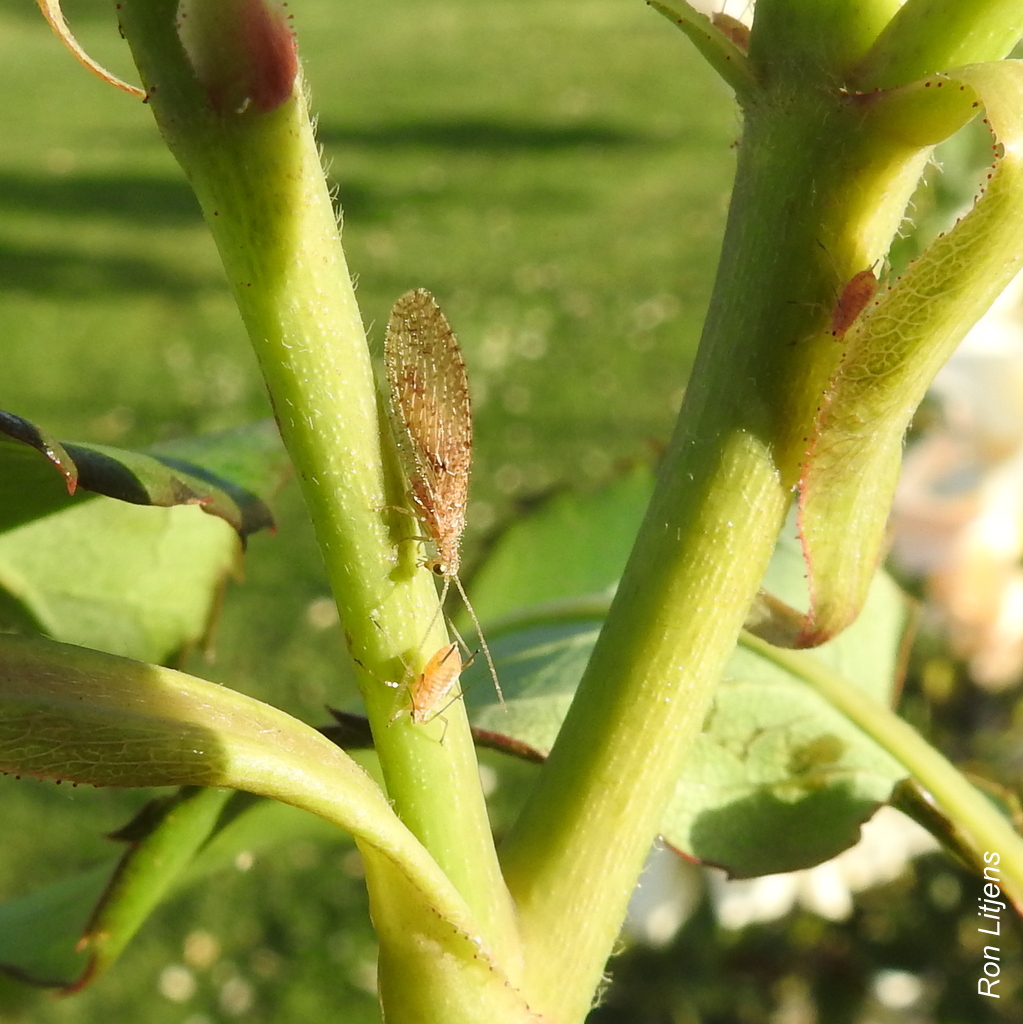
Lacewing
What can stop these ravenous hordes? There are a number of insects (and their larvae) that feed on aphids. A surreptitious peek at the underneath of the blooms during the garden shows revealed not just aphids in abundance but also their predators grazing on them. Ladybirds, ladybird larvae, lacewings and parasitic wasps were all there – nature’s balance being maintained.

Parasitic Wasp
In fact there were so many aphids and things feeding on them I am sure if people walked around the gardens listening, the visual feast of the flowers would have been accompanied by the audio soundtrack of quiet sucking and munching.
A Tawny tale
 Arriving at the chook shed to fix a hole where a fox had got in and wreaked havoc with our hens, we discovered that someone had left a feather duster outside the shed – or so it seemed. It turned out to be a fluffy Tawny Frogmouth chick who presumably had fallen out, or prematurely tried to fly out, of a giant Yellow Box tree that overhangs the shed.
With the young bird looking very vulnerable and a fox known to be around, the question was: to intervene or not? Unable to locate a nest or any adult birds in the tree, we felt there was the possibility that the chick had been abandoned, but there was also a chance the parents were keeping an eye on it – and us! In the end we lifted the ball of fluff, without protest, from the ground onto the low roof of the shed, hopefully out of reach of any fox.
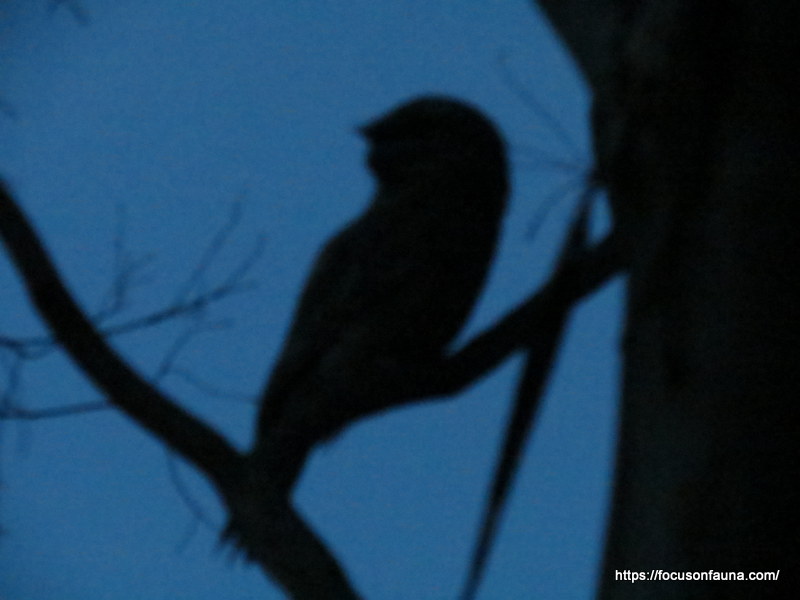
After dusk we discovered the chick gone, but a couple of frogmouth silhouettes swooping low around us and emitting a soft ‘woop-woop-woop’ (rather than their usual resonant ‘oom-oom-oom’ call) indicated that it had not been abandoned. Next morning the chick was back in the same spot on the ground outside the shed gate. So repairs were again put on hold.
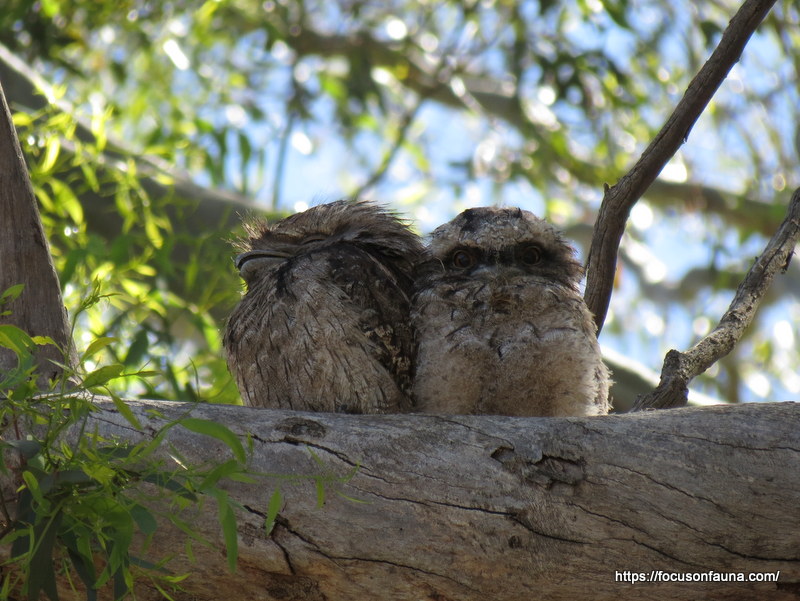
A more careful scan of the tree finally revealed the rudimentary nest with one adult bird and what could have been another fluffy juvenile beside it. Further out on a limb was another adult showing its beautifully patterned plumage. A couple of hours later the presence of a second wide-eyed chick was confirmed as it had shifted position to be beside the second adult – see photo at left.
On nightfall our little friend showed it could at least get off the ground as it flapped up onto fence wire then the top of a couple of gates. Somewhat reassured we left it to its own devices.
After a wild windy night none of the frogmouth family were visible the following morning – not surprising as the nest was on the exposed windward side of the tree. But the fate of the brood is unknown. It’s a tough world out there and we can only hope for the best. But at least the repairs to the chook shed can proceed in time for the arrival of a new lot of hens today.
Click on any of the photos below to view as a slide show.


Third time lucky
 Back in September we ran a post about a pair of Eastern Spinebills nesting in a bushy bay tree close to our house. That event ended badly when we discovered the two still unfeathered chicks gone and the nest abandoned. The parents were not having much luck as that was the second nest in the same tree. We suspected the culprit in both failed attempts was a Grey Currawong which had been hanging around the garden.
Being persistent, but perhaps not very smart, the pair of spinebills soon started building a third nest in the opposite side of the same tree. To our surprise their persistence paid off and two fledglings eventually left the nest. A couple of days later one was spotted in a melaleuca, lacking the coloration of its parents and trying to pretend it was invisible – see photo above.
Here today, gone tomorrow
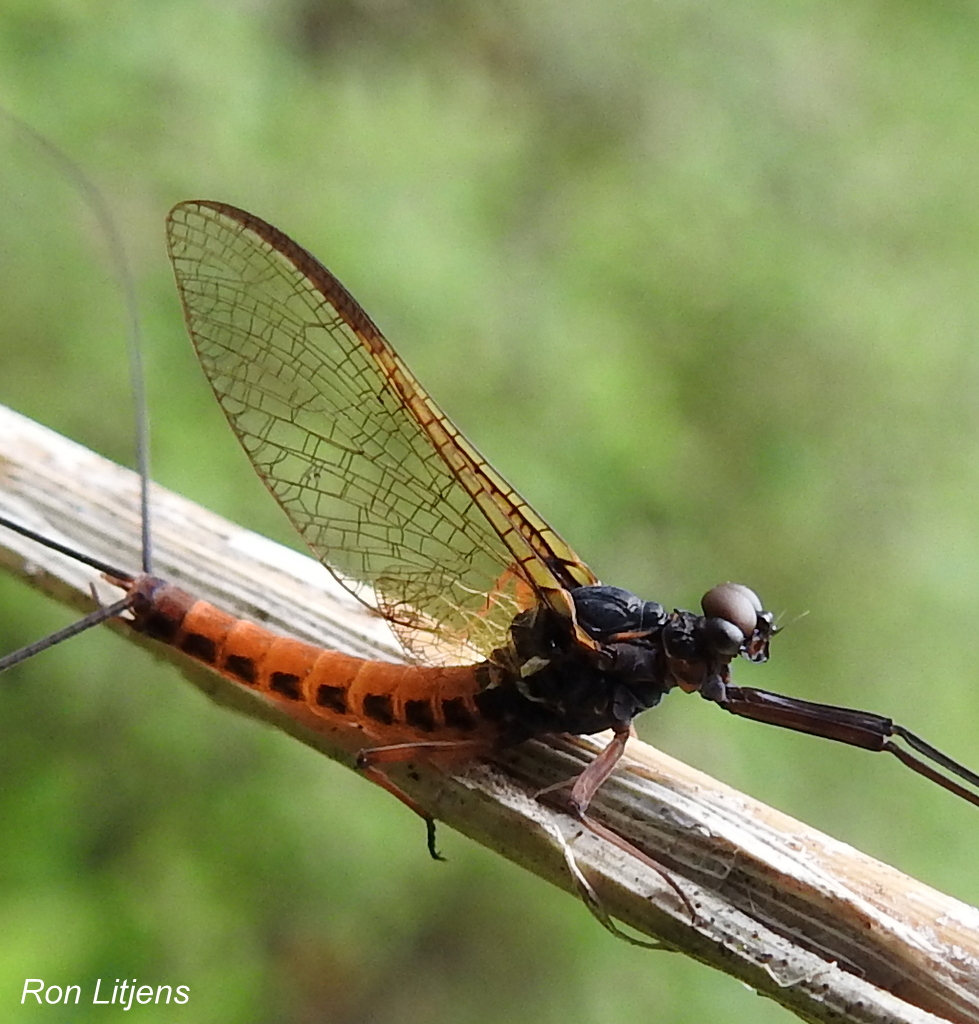 The wet winter and warm spring have meant that insects which have an aquatic nymph stage have had a great season – think mosquitoes. Another such insect is the Mayfly (pictured left). Living most of its lifecycle (years) as a nymph the lifetime of an adult mayfly is brief – measured in hours. This stage of the lifecycle is so small the insect has no need to eat and therefore the adult has no mouthparts. When the conditions are right (i.e. now), mayfly nymphs leave the water en masse, emerge from their sub-imago state and in the time they have left, mate and then die.
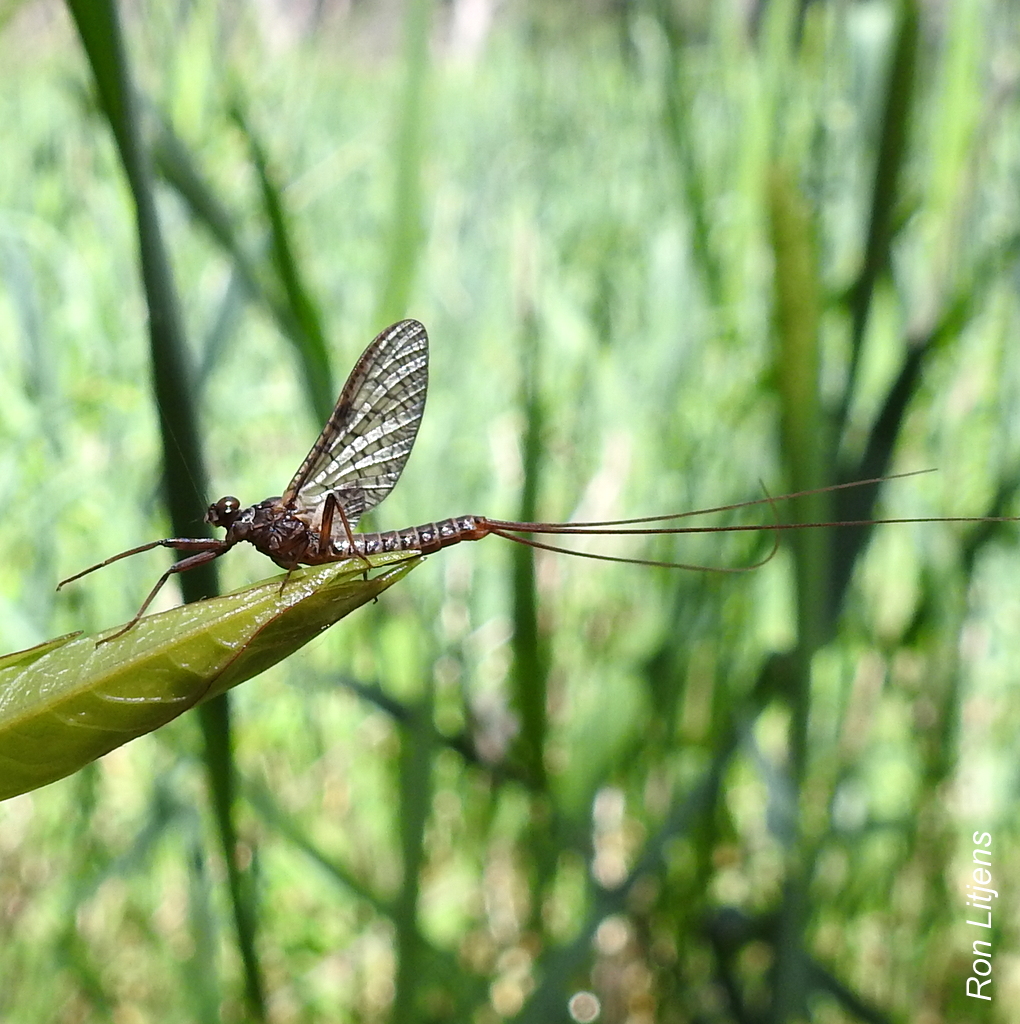 The nymphs live in clean water environments and feed on underwater vegetation and detritus. Over the period of months/years they progress through several moulting events before they emerge from the water after the final moult as a sub-imago. The sub-imago (pictured right) is sexually immature and does not have the colouration of the sexually mature adults. After a couple of days the adult mayfly ‘hatches’. The pictures below show various stages of the adult emerging.
 Mayflies are of the same order as Damselflies and Dragonflies and look similar. However there are some characteristics by which you can tell the difference. They have two pairs of wings but one pair is much smaller than the other. At rest the wings are folded over the back like most damselflies. Male mayflies have very long front legs. These are used to grasp the female in flight so that airborne mating can occur (Fly United indeed). Extending from the back of the insect are three filaments. The outer two are called cerci. A lot of insects have cerci. In mayflies they are sensory organs. In insects such as earwigs they form defensive pincers.
 It is the head of the mayfly that is most distinctive. Like their related cousins, the dragonfly and damselfly, mayflies have a pair of compound eyes and three ocelli (a set of simple eyes thought to detect light and dark and therefore help an insect fly level). In addition the adult mayfly has two huge ‘turban eyes’ mounted on the top of the head. These eyes detect ultraviolet light and are thought to assist in the detection of females flying overhead.
At this time of the year adult mayflies can be found in their thousands resting on aquatic vegetation and flying above the water looking for mates.
Live fast, die young – the mayfly motto.
Rock’n’roll lives
The view from my bedroom window is down the valley to the Tallarook Range. The King Parrot Creek (the water body around which this blogsite is based) flows generally north to the Tallarook Range and then skirts north-eastwards along its base to join the Goulburn River at Kerrisdale. Recently I had the opportunity to go to the AGM of the Dabyminga Landcare Group, situated on the other side of the Tallarooks from our Strath Creek Landcare Group.
After the meeting Eamon, the son of the president (now ex-president), took me to see his scorpion collection. Producing an ultraviolet light source (commonly known as black-light) the fish tank in which the creatures were kept was suddenly populated by brightly glowing animals. Pictured below is one of Eamon’s Black Rock Scorpions (Urodacus manicatus) seen under ultraviolet light.

Scorpions fluoresce a bright cyan colour under ultraviolet light. The exact reason for this is unknown. It has been suggested that the shell is a giant sensory organ so that the animal can find shelter in the low light conditions in which it lives. Other explanations include that the fluorescence either attracts prey, warns predators or enables scorpions to recognise each other.
Either way, the phenomenon is well known to the lads on the other side of the range who, equipped with UV lights, go out at night ‘rock-rolling’ to locate and collect the scorpions as pets. Even though I have never encountered a scorpion on the rocky slopes where I live further up the valley from the Tallarooks, I think I’ll give it a try.
I’m a rock’n’roller from way back.
Beetle control
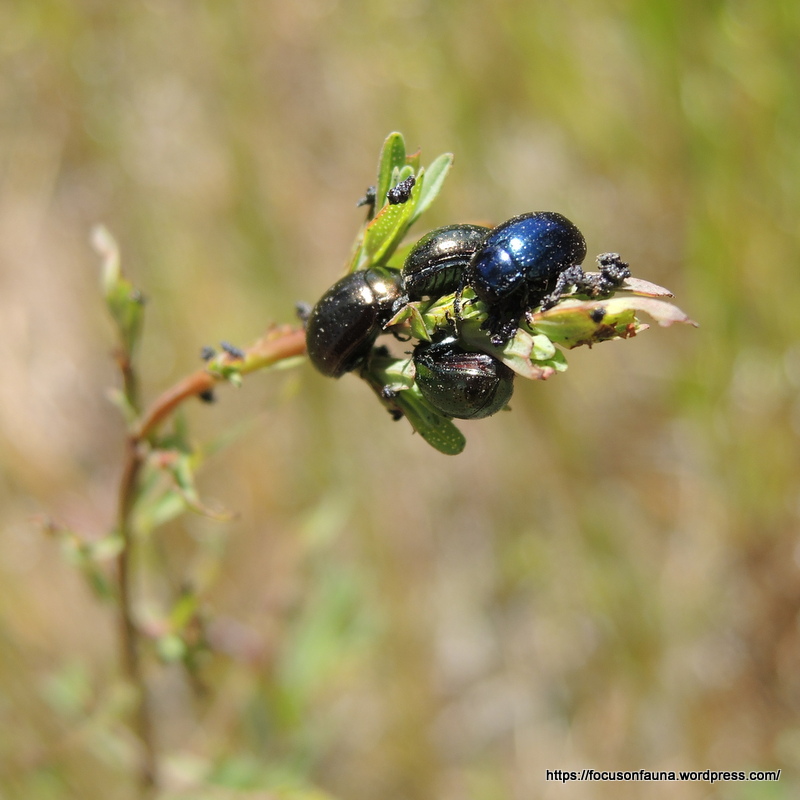 Despite its magical properties in folk lore and its current popularity as a medicinal plant, St. John’s Wort (Hypericum perforatum) can be an invasive environmental weed and a serious noxious weed in grazing paddocks. The reason for the latter is that it contains a substance called hypericin which can induce a strong photosensitive reaction in livestock, sometimes leading to a severe loss in condition and even death. It is a declared Regionally Controlled Weed in most of Victoria which means landholders must take all reasonable steps to control it and prevent its spread.
The common means of control is by chemical spraying, but there are some little beetles that can provide an alternative biological control. These are active in small numbers on our roadside at present – see photos. They are Chrysolina beetles which in sufficient numbers can cause heavy defoliation of St. John’s Wort plants, suppressing flowering and seed set. Individual beetles have a metallic sheen varying in colour from green to bronze or blue.
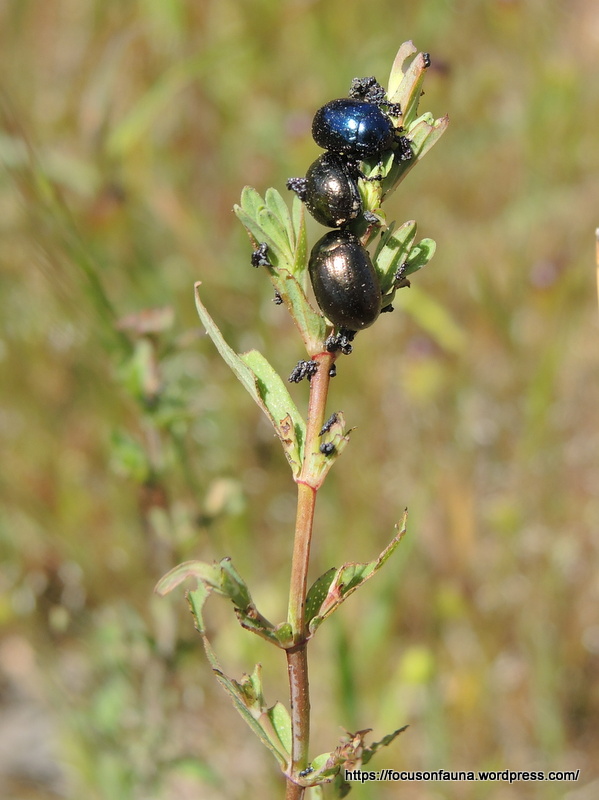
These beetles have an interesting story to tell. Two species, Lesser St. John’s Wort Beetle (Chrysolina hyperici) and Greater St. John’s Wort Beetle (Chrysolina quadrigemina) were introduced from Europe into Australia in the 1930s as biological agents for the control of this weed. (Australian-bred beetles were subsequently introduced to New Zealand and North America.)
Both the larvae and the adults feed on St. John’s Wort leaves, and consequently ingest significant amounts of hypericin, enough to make them photosensitive. But they have adapted their feeding habits to counter this accumulation of toxin. Young larvae feed at night and hide in leaf-buds in the daytime, while older larvae spend the day burrowed in the soil. Adults avoid flying from plant to plant during the day, as their elytra (wing covers) when closed protect them from light, so the toxic hypericin cannot become activated. They will move about in daylight, exposing the cuticle, only when threatened with starvation, although they sometimes drop to the ground and play dead when disturbed.
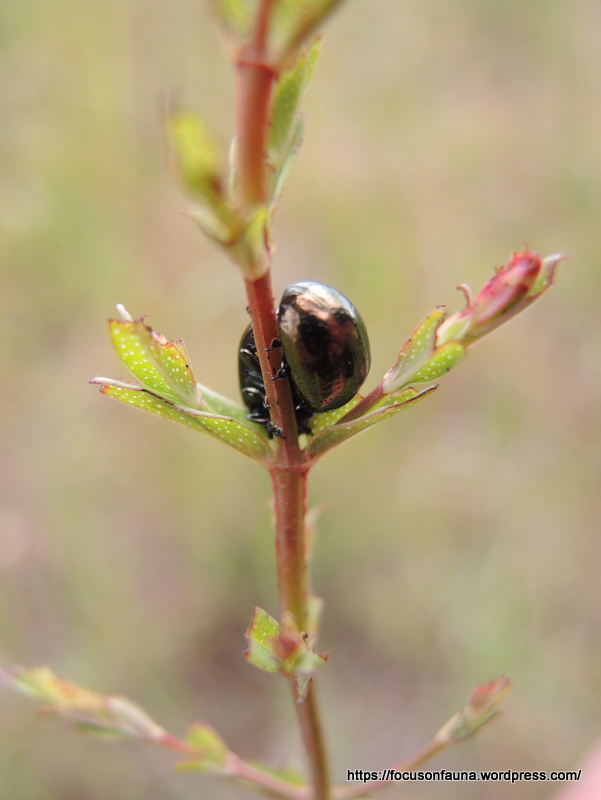
So, if you find clusters of shiny beetles on your St. John’s Wort, hold off on the spraying and let these little fellows do the control work for you!
[Incidentally, one sure way of identifying young non-flowering St. John’s Wort from superficially similar native Pimelea species which also grow on our roadsides is the presence of numerous translucent hypericin-containing oil glands on the leaves of St. John’s Wort – these can be seen in the photo at left – click for a closer look.]
It’s the citizens that count
Science is expensive – research, clinical trials, collecting data. The trend in recent times has been to involve the general public. Across the country there are thousands of people only too happy to help, particularly with data collection.
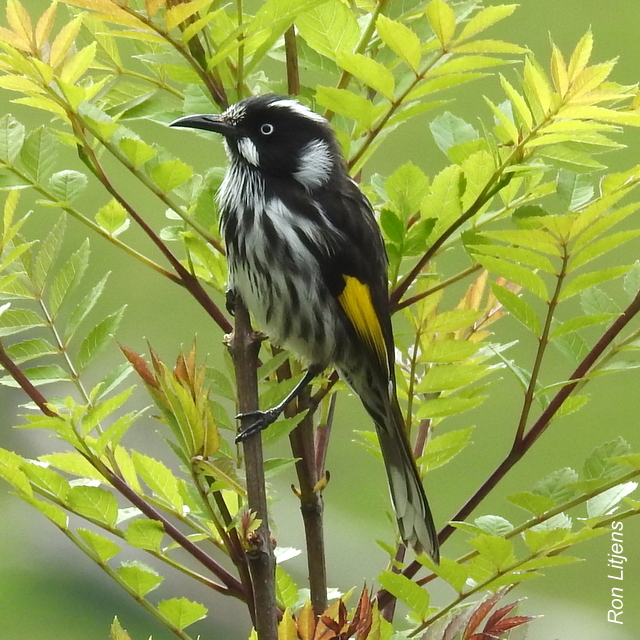 The Aussie Backyard Bird Count is one of those activities. Participants are asked to sit for 20 minutes and record the bird species they observe. It is run every year for a week in October. This year there were over 1.4 million bird records submitted. The cost of privately funding that type of data collection would be prohibitive.
Not only is sitting still for 20 minutes a nice contemplative practice but in that time the birds seem to either not realise or they forget that you are there. This can afford an opportunity to observe them in greater detail, particularly those birds which are particularly flighty and take off as soon as you appear. In my garden one such bird is the New Holland Honeyeater (Phylidonyris novaehollandiae). Looking like a cross between a Collingwood and a Richmond supporter (in colour that is), the New Hollands are very active birds and are easily spooked. As their name suggests these honeyeaters feed on nectar and spend their time flitting between flowering bushes.
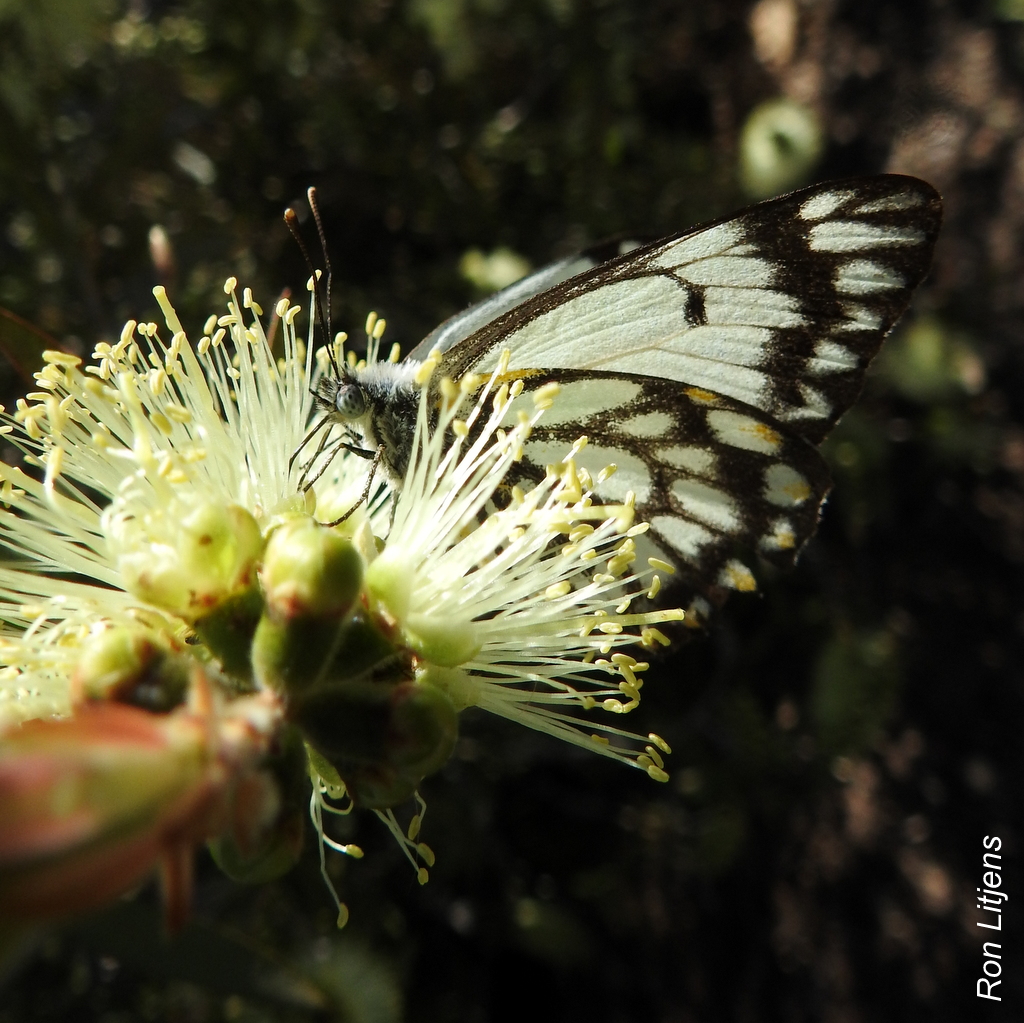
Another citizen science project coming up next week is the Spring Wild Pollinator Count held between 13 & 20 November 2016. With a similar format to the Bird Count, people are asked to observe a flower for 10 minutes and record what pollinators come to visit it.
When one thinks of pollination the Honey Bee immediately comes to mind but you would be amazed at the variety of fauna that fulfil this function – many species of insects, birds and even animals.
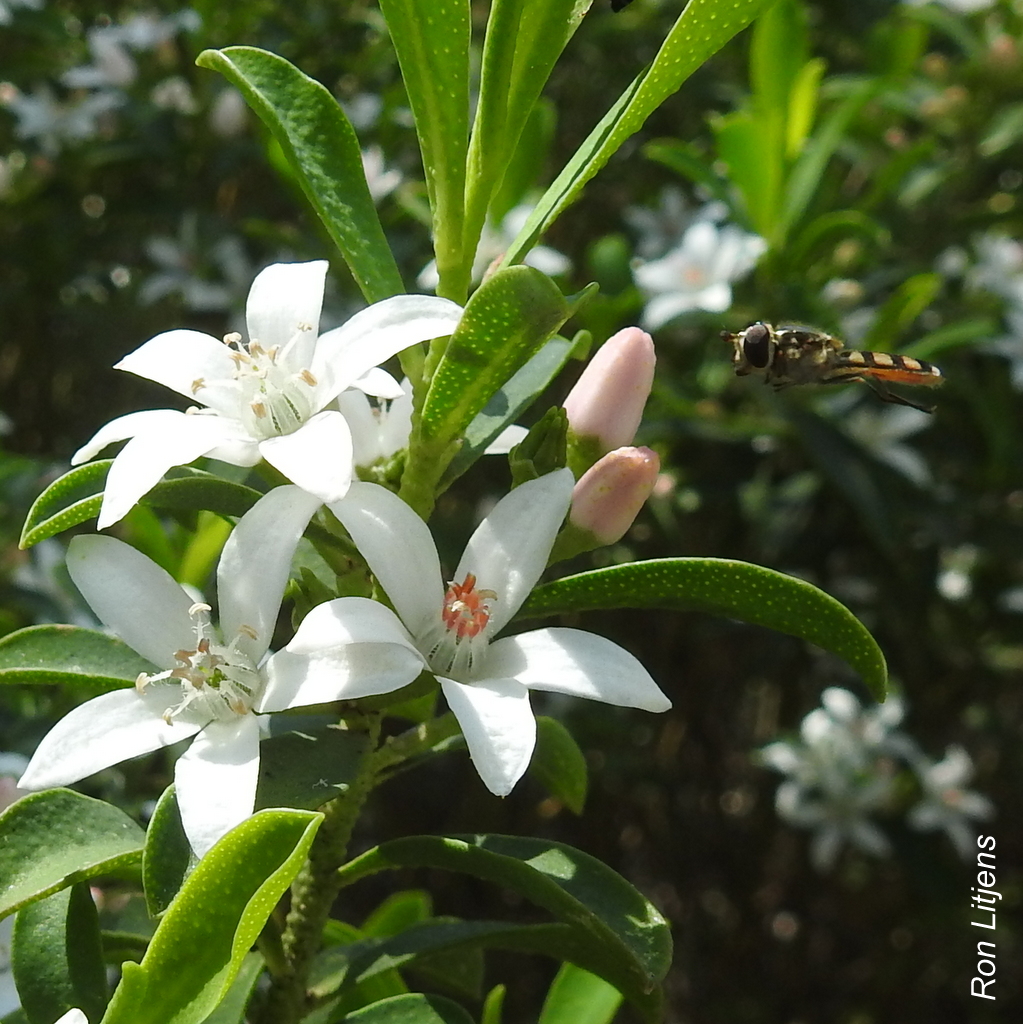
This week I have been ‘warming-up’ to the task. Pictured are a couple of pollinators around at the moment.
So next week spend 10 minutes watching a flower. It might surprise you what turns up.