Where’s the Rexona?
An interaction with a bright green beetle recently left me doubting my personal hygiene.
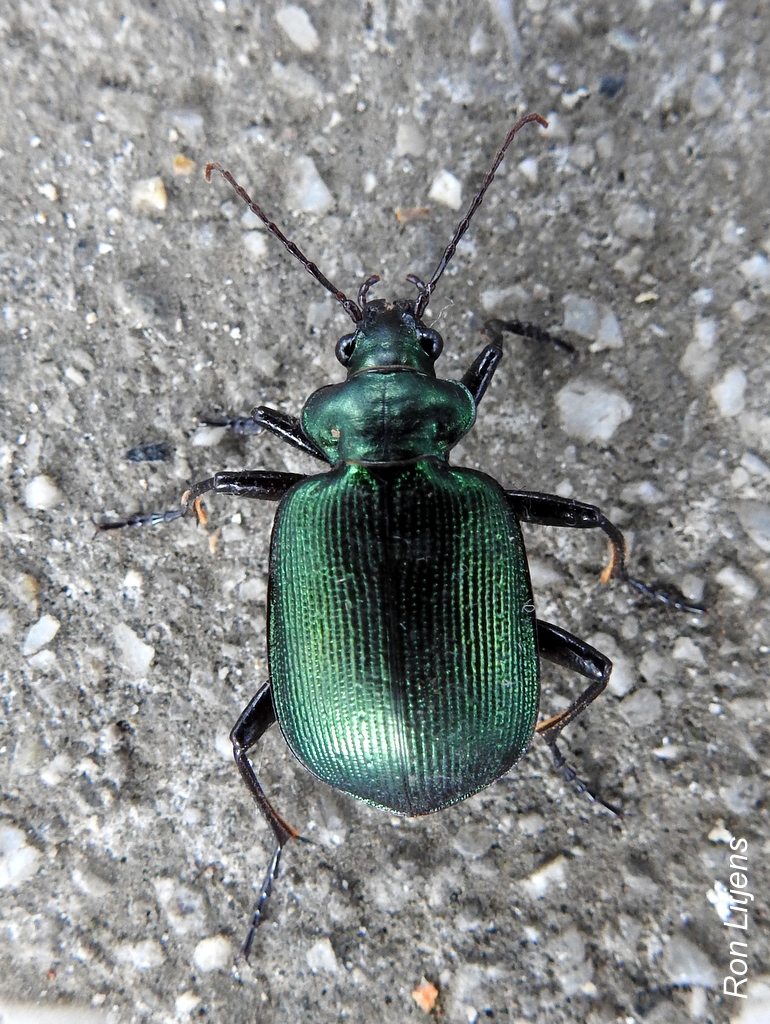
The critter in question was a Green Carabid Beetle (Calosoma schayeri), pictured above. Regarded as a beneficial insect this beetle has long legs for fast movement and is a voracious predator of caterpillars. The head of the beetle is equipped with an impressive array of mandibles and palps to help it sense and eat its prey (pictured below) and the wing-cases are ridged. The larvae are also predacious feeding on the eggs, larvae and pupa of other insects. The adults live under bark on trees and the larvae live underground.
 This beetle is a member of the larger family of beetles known as Carabidae or Ground Beetles. One of the features of this family is that members have glands on the abdomen which produce noxious fumes. In some species (not this one) the fumes can be injurious if not deadly to mammals and invertebrate animals looking to eat it for lunch.
Naturally I picked up the beetle to have a good look at it and it ‘bombed’ me. Only later when researching this blog did I realise my Rexona was working.
Nice to look at but…
A one-bird band
 The Olive-backed Oriole pictured left is a bird familiar to many in our district over the warmer months, mostly recognised initially by its distinctive, repetitive “Orry-orry-ole” call. What is probably less well-known is that the oriole is quite an accomplished mimic. Not in the same class as lyrebirds to be sure, but on occasions snatches of mimicry are included with its regular call, along with other harsh notes and warbles. (We once searched for a Golden Whistler near Mt. Black in the Heathcote-Graytown National Park that appeared to be singing in a group of low trees, only to discover the culprit was an Olive-backed Oriole!)
We have been hoping for a long time to record this mimicry (see a 2013 post, A distinctive call) and had the chance the other day with an oriole calling in roadside trees near Strath Creek. For about half an hour it warbled away with a mix of its regular call and a sub-song that included mimicry. Unfortunately there was a strong wind blowing (when hasn’t a strong wind been blowing lately!) – not good for sound recording!
But in the audio files below we think, with a little imagination, we can hear snippets of the calls of Rufous Whistler, Yellow-tailed Black Cockatoo, Common Blackbird, Sacred Kingfisher (the lovely trill) and perhaps others we haven’t identified. The only other bird close by was a Yellow-faced Honeyeater, whose call can be clearly heard, but the oriole seemed to be trying to mimic that too.
Then again, perhaps this is all just wishful thinking!?
nga’chuq rites
Fans of Star Trek, particularly those who can read or understand the Klingon language will know that nga’chuq rites are the mating rituals of the Klingon species. These rituals are physically demanding resulting in blood being shed and often bones being broken. In fact the breaking of a collar-bone on the wedding night is an extremely auspicious sign for the wedded union.
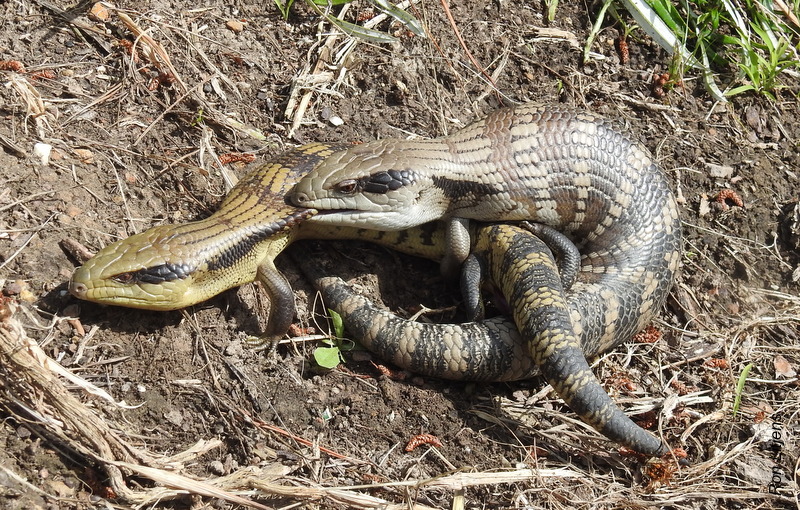
A cry of ‘snake in the garden’ from my ‘urban’ sister resulted in several people running to observe, instead of a snake, two Eastern Blue-tongue Lizards (Tiliqua scincoides) mating. Blue-tongue Lizards are the largest members of the Skink family. Eastern (otherwise known as Common or Northern) Blue-tongues are distinguished from their closely related cousins, the Southern Blue-tongues, in that they have striped rather than blotched markings. Eastern Blue-tongues mate between September and November and give birth to three to five live offspring between December and April.

In the garden the male lizard had grasped the female firmly on the back with its teeth as the latter tried to escape (see picture above top). After several minutes of gyrations the female escaped with a gaping back wound. Last seen the female lizard was heading into the bush being hotly pursued by its mate (with genitalia clearly on display), pictured above.
Although no bones were broken the incident looked very Klingon-esque.
Grey eminence
 BirdLife Australia is currently running the Great Aussie Bird Count which has had us out searching for local birds over a chosen 20-minute period the last couple of days. One of our regular visitors, but not yet recorded in the count, is the Grey Currawong. Perhaps because of its rather elegant grey plumage or its more solitary nature, this bird always seems a little more endearing and less threatening than its cousin the Pied Currawong, which we reported on in July.

The Grey Currawong’s slender bill provides it with an efficient tool for winkling out invertebrates from under the bark on tree trunks and branches, so rough-barked trees like the one pictured at right form one of its favourite hunting grounds.
From a distance it’s not always easy to distinguish between the Grey and Pied Currawongs because the shades of their plumage can vary, but in flight the Pied’s white feathers at the base of its tail can be seen – this white is lacking in the Grey. The best distinguishing feature of the Grey is its ringing “cling-cling” call.
Listen to the call, recorded yesterday at dawn, by clicking on the audio bar below.
Hanging the washing out to dry
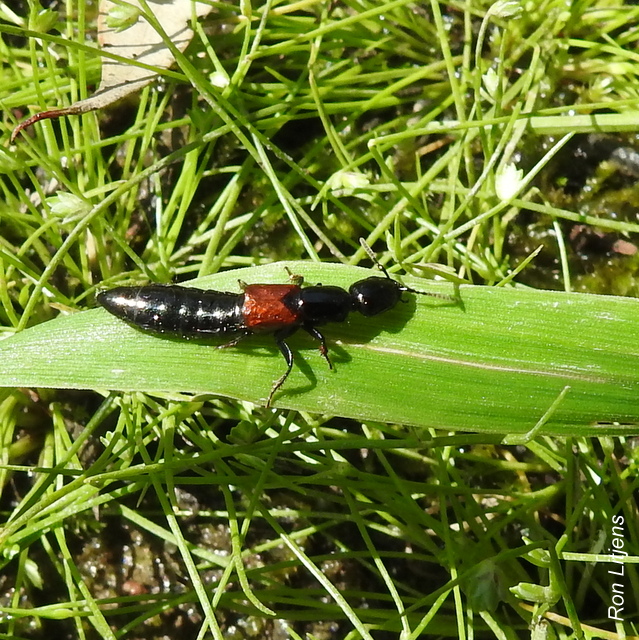 The recent heavy rains and subsequent flooding have been a boon to observers of insects. Insects too slow to avoid the rising waters are found helplessly floating on the surface searching for a piece of vegetation or a passing snail to cling to. Plucking them out of the water and carrying them to a leaf or blade of grass affords a good opportunity to observe them up close as they recover and dry out.
A case in point is this recently rescued rove beetle (pictured left). Rove beetles eat almost anything but are voracious predators of insects and other invertebrates. Like other beetles they have outer hard wing casings (elytra) that protect the more fragile flying wings underneath. In most beetles this outer casing covers the entire abdomen. However one of the characteristics of the rove beetle is the very short elytra (brown coloured in this species).
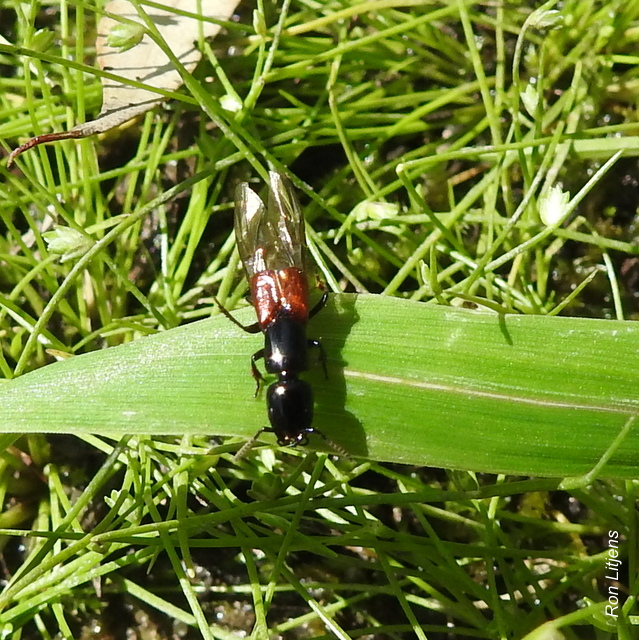 As this critter was drying off it unfolded its large flying wings to dry them in the sun (pictured right). After a few minutes it quickly folded them up and packed them under the tiny elytra.
We need some of that know-how to help us repack the portable marquee the Strath Creek Landcare Group has just purchased.
Spiders: learning to love them
 This is the title of our next Focus on Fauna presentation, and with that in mind we have included this unusual photo of a Water Spider (Dolomedes sp.) despite our policy of not immediately confronting possibly arachnophobic followers with a large spider photo.
The spider talk by Lynne Kelly will be held at Strath Creek Hall on 23rd October and all are welcome to attend. Click on the flyer at right for full details.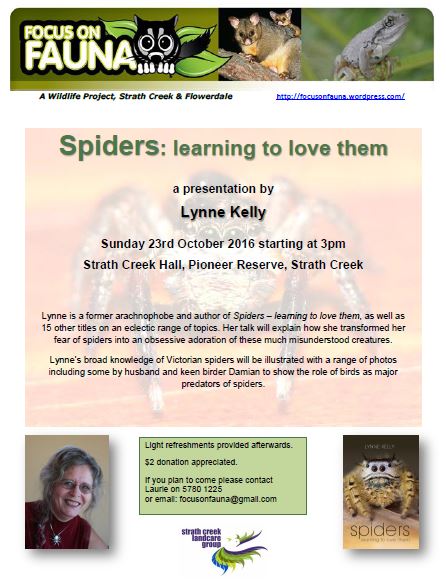
With the rainfall pattern we are experiencing, any container left outside at present is full of water in no time. And just as quickly, it seems, comes a captive population of aquatic wildlife: mosquito larvae, mites, springtails possibly – and even occasionally a spider like the one pictured here in a bucket.

Water Spiders, also known as Fishing Spiders, are in the family Pisauridae. They have hairs on the tips of their ‘feet’ (tarsi) that enable them to walk on water without breaking the surface tension. In effect they use the water surface as a web, detecting small prey by the ripples they create. But they can also dive and catch prey below the surface.
You’ve gotta love ’em!
Attention entrepreneurs!
The stunning photo of an Eastern Spinebill on the nest in the last post requires more than good photography. It also requires knowledge of what types of birds build what types of nests and then a keen eye to spot the comings and goings of our feathered friends to indicate where the nest is for this season.
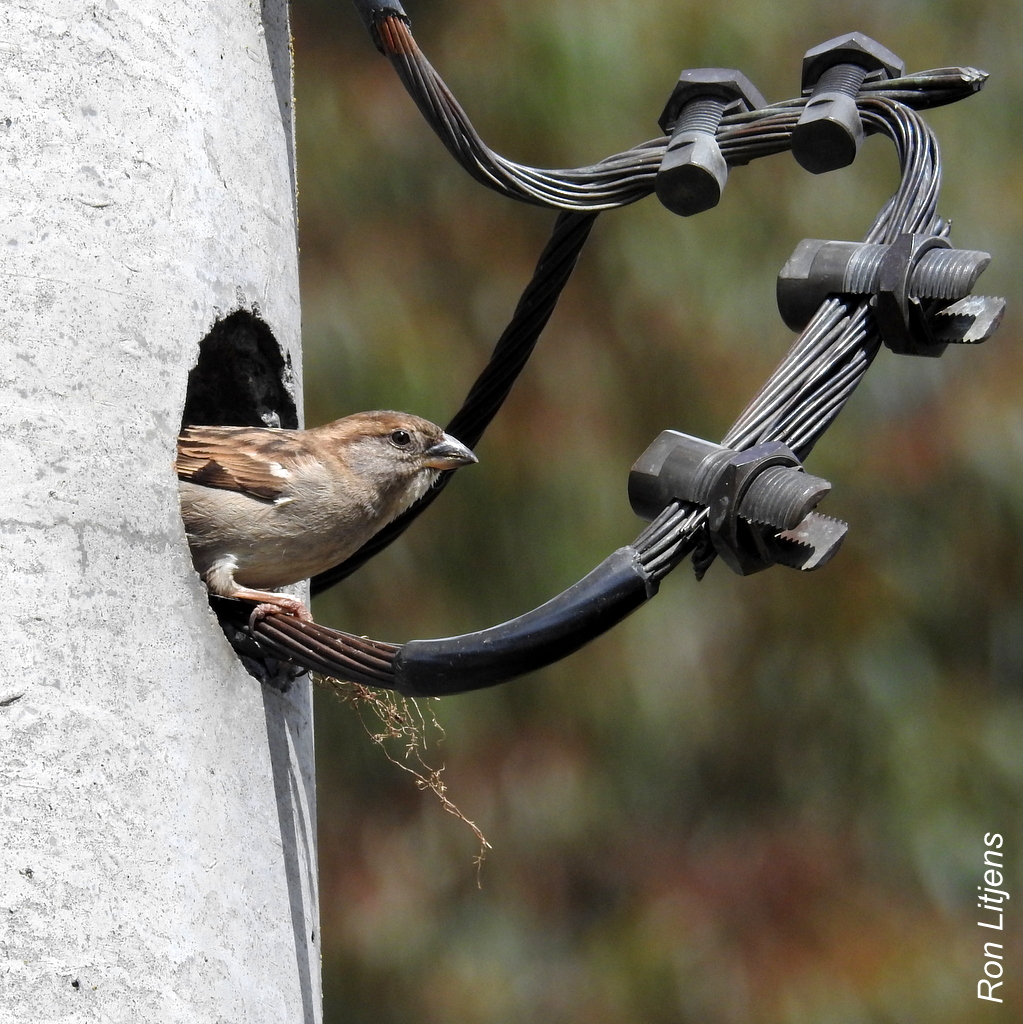 Or…you can do what I do and identify nest sites in artificial structures that the birds visit every year. In this way the ‘where is the nest?’ question is removed from the equation and it is just the ‘when?’ and the ‘who?’ questions needing answers.
Every spring I eagerly await the return of a pair of Striated Pardalotes that nest in a hole in a concrete power-pole. Every year they turn up and I follow their activities from delivery of leaves and twigs to the nest hole through to the appearance of the fledglings. This year however I was surprised and very disappointed that the hole was commandeered by a pair of House Sparrows (Passer domesticus) (above left).
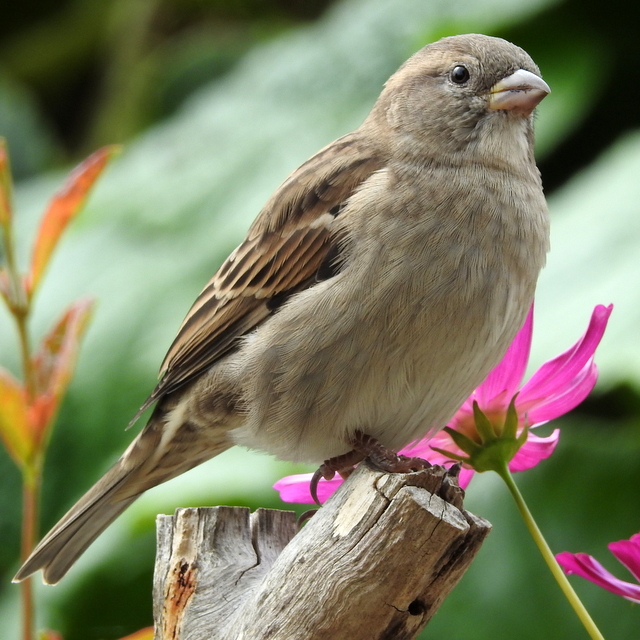 House Sparrows were introduced to Melbourne in the 1860s to combat insect pests but soon became pests themselves. As with other introduced bird species such as Indian Mynas and Blackbirds, these ‘ferals’ aggressively compete with our native birds for nest sites and food. Interestingly, House Sparrow numbers have declined in their native Europe to such an extent that they are now classed as a species of high conservation concern.
I can sense an export opportunity for a budding entrepreneur!
Trusting
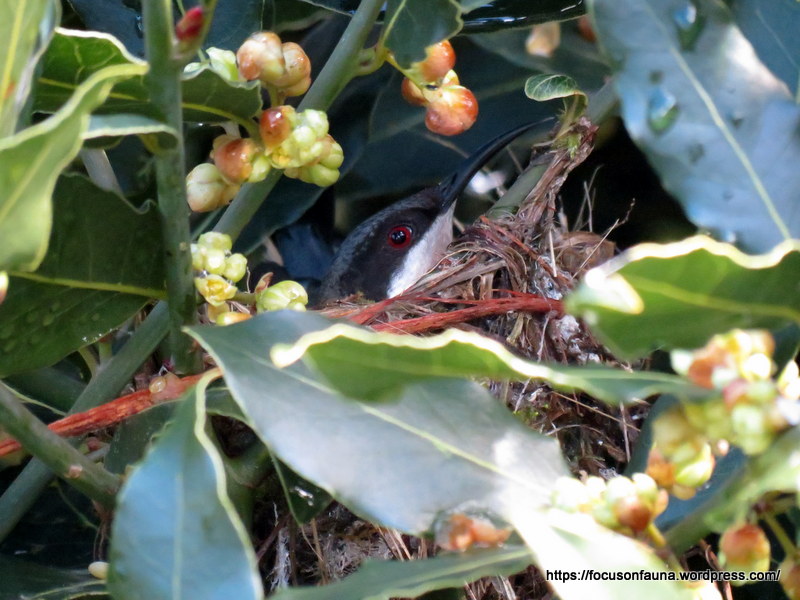
Eastern Spinebill on nest
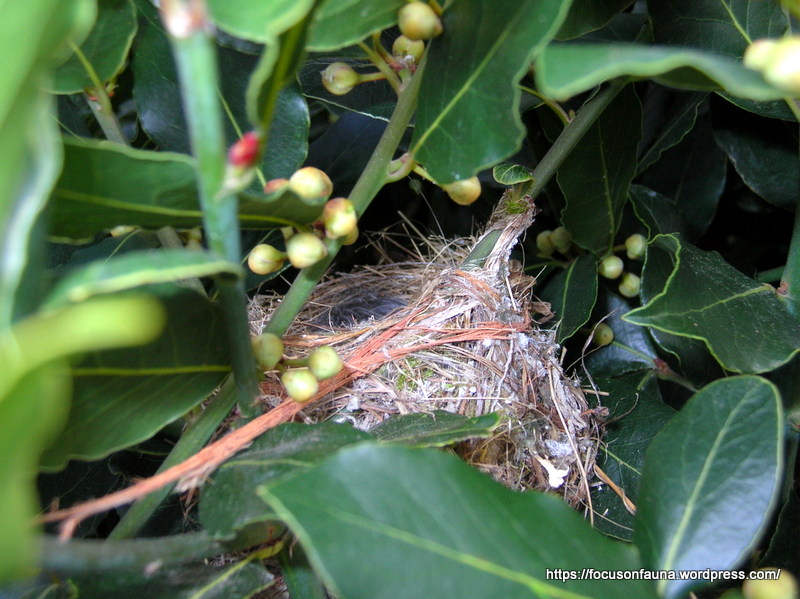
E. Spinebill nest
We have even wondered whether birds choose to nest in places close to regular human activity as a deliberate ploy to deter predators such as currawongs, that are wary of humans and never dare venture close to the house.
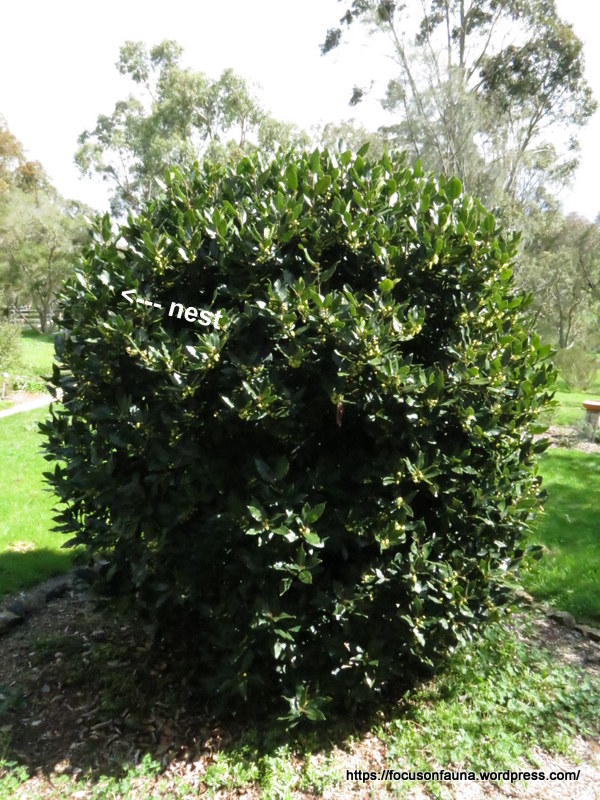
Sweet Bay
A pair of Yellow-faced Honeyeaters took this strategy (if that’s in fact what it is) to extremes last spring when they successfully nested in a native Weeping Baeckea (Baeckea linifolia) whose spindly branches overhang the garden path, and we would brush past within inches of the nest on a daily basis. That intricate and apparently flimsy nest is still there intact twelve months later (see photo below), having survived rain, hail and winds.
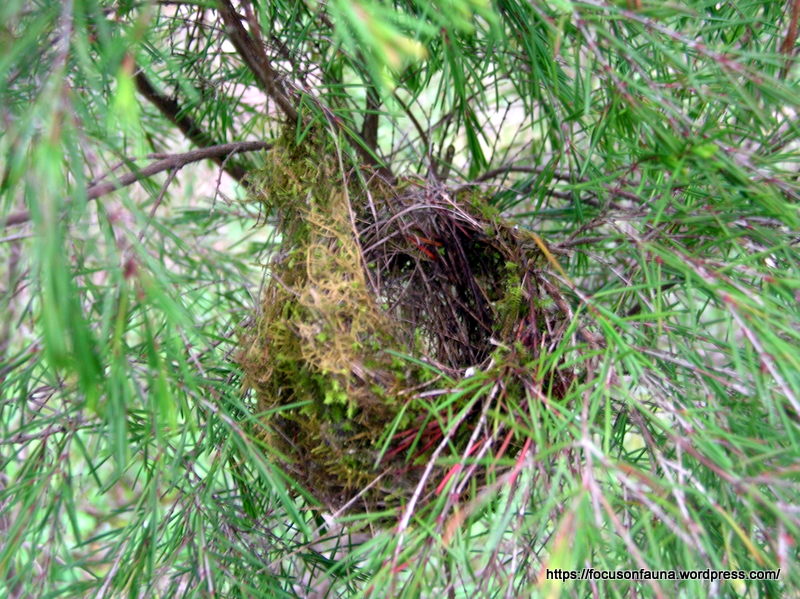
Old Yellow-faced Honeyeater nest
We look forward to having a close-up view of the spinebills’ brood.
Now I’m beginning to get it
The quest this season is to be able to identify the LBJ’s (little brown jobs), those birds of indeterminate species that to the untrained eye all look the same as they go about their daily business – in particular the Thornbills.
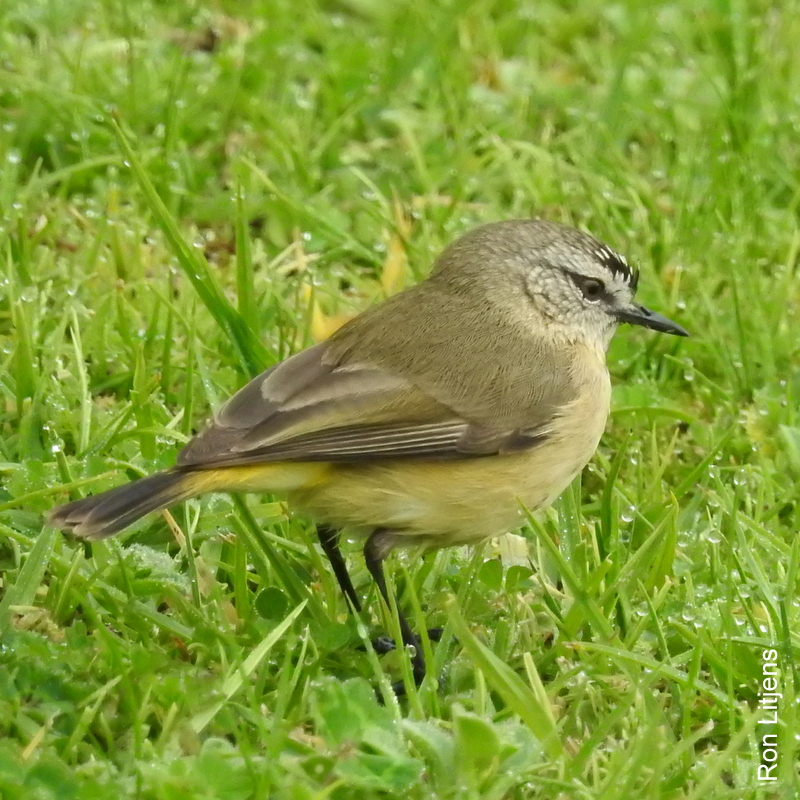 With names like the Buff-rumped Thornbill and the Yellow-rumped Thornbill one would assume the task would be easy. But in reality when these critters are sitting down or flitting high in the tree tops the rump can either not be seen or is too far away to determine the exact hue. So the plan is to get a reasonably good photo of each so that I can get a really good look at them.
This is the start – and telling them apart is really not that difficult if you know what you are looking for.
Pictured above left is the Yellow-rumped Thornbill (Acanthiza chrysorrhoa). Apart from its obviously yellow rump it has a black crown with white flecks. I should be able to see that at a distance.
 Pictured right is a Striated Thornbill (Acanthiza lineata). It has a tan crown with dense white streaks (I think the streaks are the give-away).
I think I have these two sorted. Only two or three more to go (in this district at least).
Whistling in the Wind
 Even though I could not see it, it wasn’t hard to identify the bird from its call (click on bird call below). The distinct whistling sound said Whistling Kite (Haliastur sphrenurus). But when its partner/friend/competitor alighted in a nearby tree (see picture left) the species was confirmed. These kites frequently call to each other when in flight and when perched, so are more often located by sound rather than by sight.
The scientific name is derived from the Greek words hals meaning sea and astur meaning hawk and sphen meaning wedge and oura meaning tail – a wedge tailed seahawk. It is a pity I did not get a shot of its tail whilst in flight to confirm the description.

Whistling Kites are distributed across most of Australia. As with most raptors the female is larger than the male. They live near water and usually feed on live prey which they take from the ground or from the surface of the water. Food includes mammals, fish, reptiles and amphibians.
And from the look of the beak the hapless prey would soon get the point.
Whistling Kite’s call: