Right-hand drive
It did not take much rain to bring out the mushrooms – and all the fauna that rely on mushrooms as a food source. One of those creatures is a slug, a name used generically to include all snails that do not have a shell. Scientifically slugs make up a group of gastropods (snails) that have lungs instead of gills.
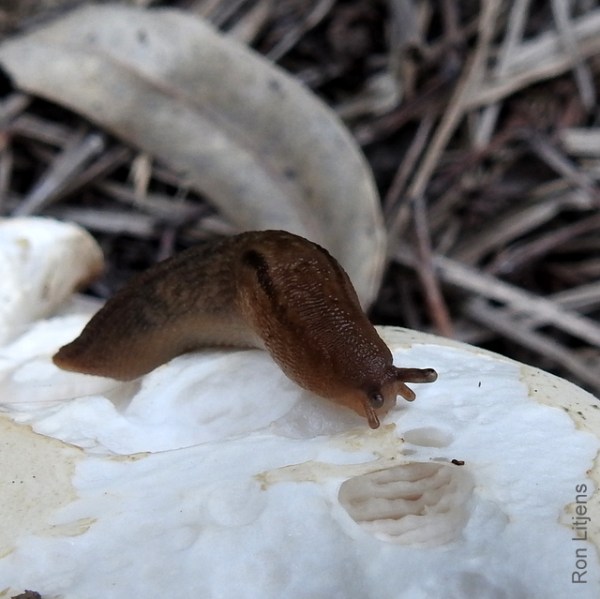
Slugs, it turns out, are fascinating creatures. Most have two sets of feelers (pictured above). The larger pair, set high on the head, contains light sensing organs and is tipped by eye-spots. Lower down, the smaller feelers give the slug a sense of smell. When threatened, the slug can retract these feelers. In addition the slug will produce extra mucus on its body to make it difficult for a predator to pick it up.
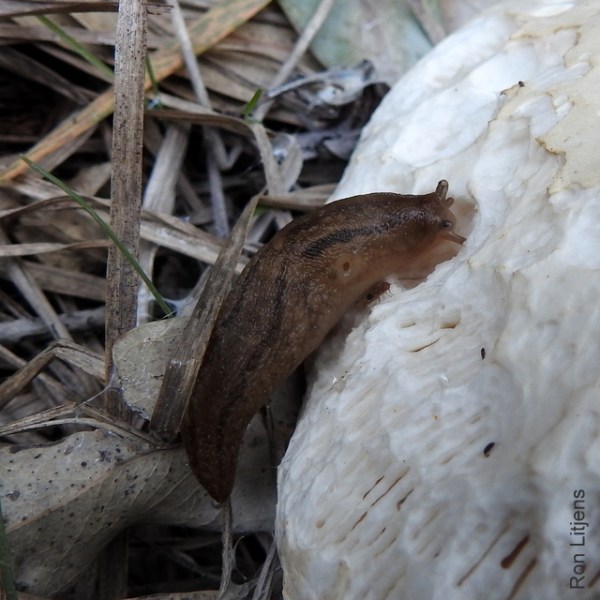
On the right hand side of a slug is the pneumostome, an opening through which air is drawn into the single lung-like organ. If you look closely at the photo (immediately above) you can just make out the opening. Slugs are also simultaneously hermaphroditic meaning that they have both sex organs at the same time. They are located near the head. During mating, fertilisation of the eggs occurs in both partners. Afterwards each goes off to lay eggs. Incidentally the sex organs are also located on the right-hand side of the body.
It makes one wonder whether in Europe and the US, the slugs have all their organs on the left-hand side.
Low flow – any fish?
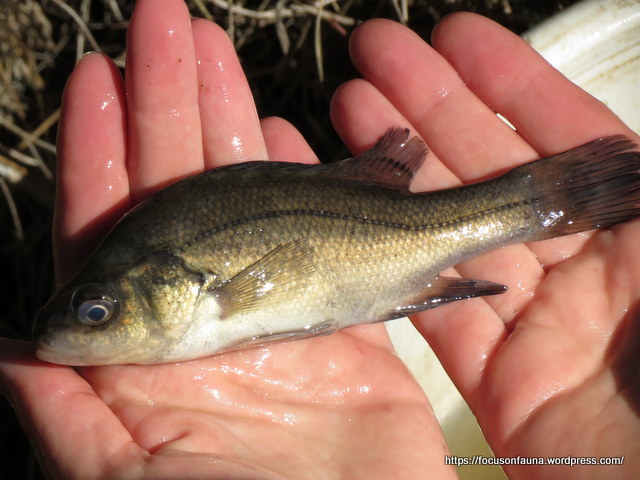
Macquarie Perch
There were also good numbers of other native fish including River Blackfish, Mountain Galaxias, Southern Pygmy Perch and Flat-headed Gudgeon. Brown Trout made up most of the introduced fish catch – one carp was caught at Richards Bridge and two Eastern Gambusia were also found there – the first time in the 10 years of surveying the King Parrot Creek. The by-catch also included 1 Platypus and 13 Snake-necked Turtles, all of which were released uninjured.
-
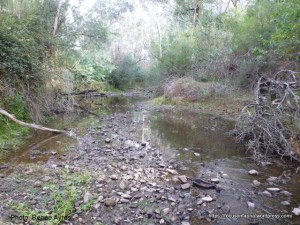
- Low flow at Draytons Bridge
-
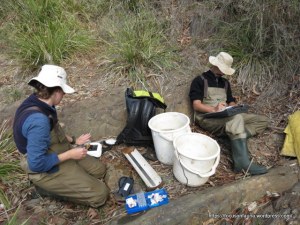
- Renae and Adrian hard at work
-

- Flat-headed Gudgeon
-

- Southern Pygmy Perch
-
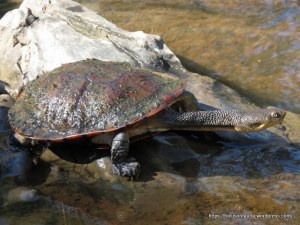
- Snake-necked Turtle
-

- Lernaea parasite after removal
The surveys this year involved both fyke netting and electro-fishing. Caught fish were measured, weighed and inspected for external parasites and lesions before being released back into the creek. Macquarie Perch also had fin samples taken for genetic analysis and were checked for presence of previously installed tags – this year there were only 6 recaptured fish.
One parasite found on a few fish is Lernaea cyprinacea, commonly called Anchor Worm, although it is actually a copepod crustacean rather than a worm. It burrows into the fish’s flesh using horns on its head to anchor itself. It causes lethargy and may lead to death if embedded in a vital organ. The survey team carefully removed these 1cm long parasites with tweezers.
A worrying aspect highlighted in the report was the lack of connectivity in the stream caused by the construction of illegal rock weirs which represent a barrier to fish passage.
Just like school kids
We only had one bully at primary school and he wasn’t very good at it. Although I was never directly affected I was vaguely aware of where he was in the schoolyard and when he got close I kept my head down. What I was aware of was the circle of yelling school kids on the oval after school that formed as the bully tussled (not always successfully) with his latest victim.
 I was reminded of this last week when I observed a circle of a dozen Australian Magpies (Cracticus tibicen) carolling loudly around two birds having a rough and tumble (pictured left). A search of the web to explain such behaviour revealed that this is not an uncommon occurrence in magpies with many explanations given for such behaviour – a territorial dispute between flocks, determining the pecking order within a flock or a battle for food or even breeding rights.
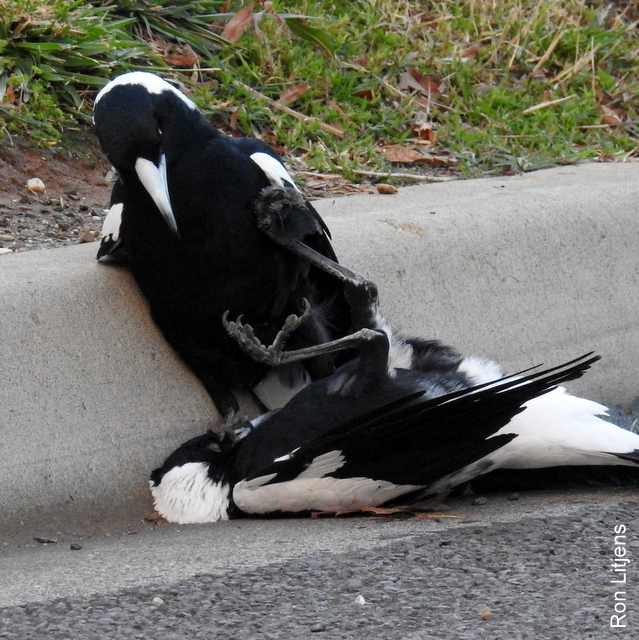 Dust ups between birds I am used to seeing (see Wattlebird Wars). They are usually over and done with in a flash. However in this case the dominant magpie in the fight held the other magpie down for several minutes occasionally delivering a peck or two to the prostrate victim which just laid there (pictured right). The carolling onlookers also added a peck or two for good measure.
What disturbed me about the whole proceeding was that it somehow looked vaguely – human!
Frog legs on the menu
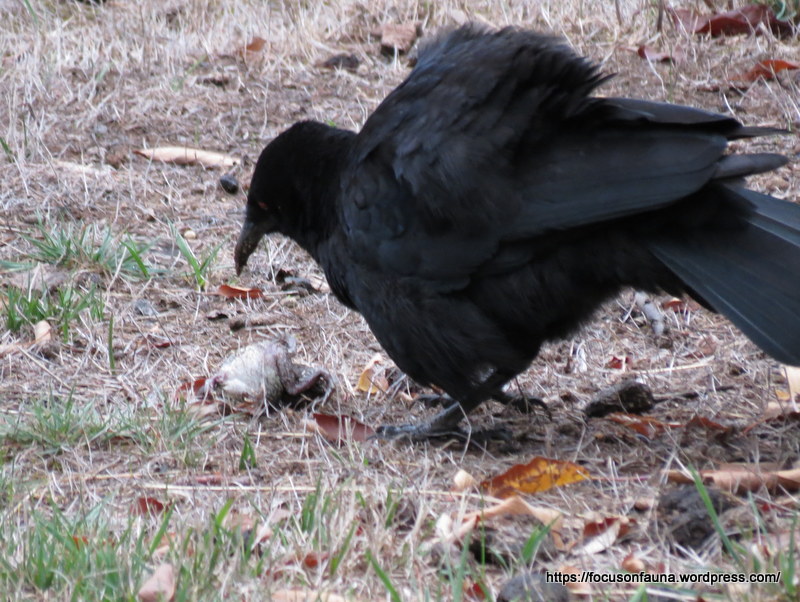 We’re used to periodic outbreaks of noisy squabbling among our local White-winged Chough tribe, but this kerfuffle was more animated and louder than usual. One of the choughs had discovered a large frog, probably a Pobblebonk, and was stabbing at it with its long, curved and very sharp bill. With tail fanned out, plumage puffed up and bright red eyes bulging, the chough had got the whole group excited, but was not going to let any other bird near its prey, except for one young bird that followed it around closely, begging to get at least a leg or two.


The recent rain seems to have produced a food bonanza of earthworms, insect larvae etc for the choughs after months of slim pickings foraging among parched dry grass and leaf litter. This frog would be a substantial addition to their usual fare.

The photos here are less than ideal because every time we got at all close, the chough would pick up its meal in its bill and scuttle away out of sight behind a bush with the youngster in tow. The rest of the group, which numbered about twenty, eventually lost interest and resumed their foraging elsewhere, leaving the now-mangled remains to a very chuffed pair!
Time to go
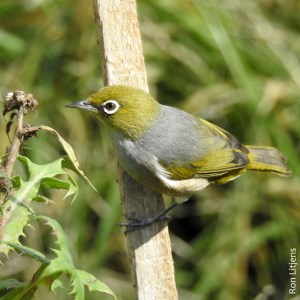 At the moment there are large flocks of Silvereyes in the garden. That can only mean one thing. It’s time to quit this town. The Silvereye is a small olive-winged bird with a very obvious white ring around its eye. They are found in Australia and the South Pacific and are distributed in Australia along the entire east and south coasts.
The scientific name, Zosterops lateralis, is derived from the Greek words zoster meaning girdle and ops meaning eye, referring to the light eye-ring. Lateralis is Latin for side. Silvereyes have a number of sub-species or races which are distinguished by the colour of their flanks. My guess based on the colouring of the birds in the garden and the distribution map of the races is that the birds at our place are of the race westernensis.
 In late Autumn/early winter the birds gather to migrate north to warmer climes. The Tasmanian races migrate to Victoria, the Victorian races to NSW and so on.
I guess what you consider warmer depends on where you start.
Bee-mused
 The Wild Pollinator Count was again held around the country last week. This citizen science project involves simply watching a flower or group of flowers for 10 minutes and recording what insects land there and presumably aid pollination.
Our predominantly native ‘garden’ is lacking many flowering plants at present – a few bluebells, Austral Stork’s-bill and Rock Isotome – but what was really buzzing was a Weeping Bottlebrush (Callistemon viminalis – a ring-in from coastal areas of Queensland and northern NSW). At first sight it seemed to be mainly attracting European Honey Bees (Apis mellifera) but on closer inspection amongst the numerous bottlebrush stamens were lots of small insects that we couldn’t identify.
But with the help of Karen and Manu from Wild Pollinator Count we were able to label them as native bees in the Subfamily Hylaeinae. These bees, which appeared to be from two related genera, Hylaeus and Amphylaeus, are among around 2,000 native bee species, all of which play an important role in pollination.
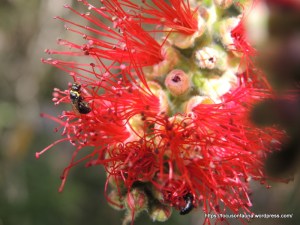
Hylaeine bees are distinguishable from other bees in having yellow markings on their face and/or body and appearing smooth and shiny since they don’t have as many hairs on their bodies as other bees. On close inspection of our bees there seemed to be several species with different markings, but as Manu pointed out, males and females of a single species usually have different face markings, so it is easy to mistake them for different species. Even so, there were perhaps two or three species. The pollinator count has shown that Hylaeus bees in particular are very keen on callistemon flowers.
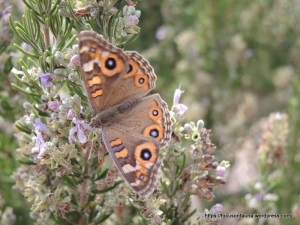 A rosemary bush also seemed to attract a range of pollinators, including butterflies – a rather showy Meadow Argus (left) and a delicate Common Grass Blue (below).
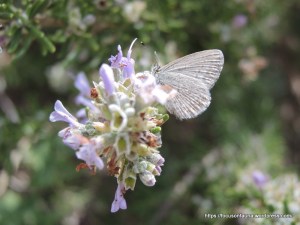
The Wild Pollinator Count has a Flickr album with a wonderful range of photos submitted during the count. And if you want to see our bees in closer detail, click on the photos above.
My, what a big osmeterium you have!
 The Dainty Swallowtail butterfly (Papilio anactus), otherwise known as the Little Citrus Butterfly, was featured last year in a blog when it laid eggs on the lemon tree in our garden. The same thing must have happened this year because the lemon tree looks like it has been attacked by a chain-saw. Most of the leaves have been eaten back to the stem. The culprit was not difficult to find … a Dainty Swallowtail caterpillar (pictured left). While I was trying to dislodge the caterpillar from the leaf, a bright orange protuberance grew out from the caterpillar’s head (pictured below). It was its osmeterium.
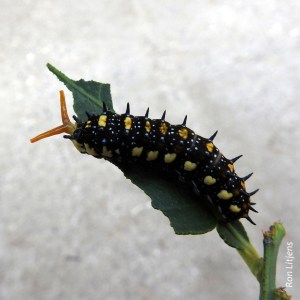 The osmeterium is a defensive organ that looks like a snake’s tongue and is everted by the caterpillar when disturbed. The idea is to discourage predators such as birds and reptiles from attacking. This organ is found in papilionid butterfly species. In addition to the ‘fright’ value, the osmeterium emits an offensive odour to ward off spiders and insects that might otherwise consider the caterpillar as lunch.
So there is a new word for your vocabulary. Try using it in a dinner table conversation.
Ancient survivors
 You may see this as just a common pest responsible for damage to books and fabrics around the home, but this Gray Silverfish, Ctenolepisma longicaudata, belongs to the Order Thysanura, regarded as one of the oldest and most primitive groups of insects. Silverfish have a number of interesting features:
- their eyes are either greatly reduced or absent
- they are wingless – in fact they have never had wings, unlike other wingless insects that evolved from winged ancestors
- they undergo many moults, even as adults
- females can produce numerous offspring throughout their lives, being sexually mature as early as two months old and before being fully grown – some can lay a clutch of eggs between each moult
- they can survive extremely dry periods by absorbing atmospheric moisture – through their anus!
- they can also survive long periods without eating
- they can live for up to four years – not bad for a small insect!
After managing to photograph one of these introduced pesky and very elusive insects we got to wondering about native silverfish and discovered from the Australian Museum blog that they are well represented with about 50 species described and many more yet to be described, but still relatively little is known about them. Researchers keep finding new species and even new genera filling specialised ecological niches in diverse habitats such as caves, cracks in underground rocks and even in ant and termite colonies.
Like cockroaches, these little animals are great survivors and probably well equipped to deal with climate change!
Taking it in your stride
On many a sunny afternoon have I sat by the dam watching the passing parade of insects – dragonflies on the prowl for food, wasps digging up mud to build nests and flotillas of water striders cruising on the surface. Of the three, the latter seem the most ‘chilled’ and I often wondered what goes through their minds as they float about. Well the answer is sex and food.
 Water Striders are of the order Hemiptera, true bugs with sucking mouthparts. This order includes gumtree hoppers, psyllids and cicadas. These three insects use their mouthparts to suck sap from leaves. The water striders however are voracious predators, feeding on insects and spiders. They detect prey that has fallen in the water by ripples made on the surface. The small front legs are used to grasp prey and then with their mouthparts they pierce the victim, inject enzymes which dissolve it and then suck up the resultant liquid. The photo (above) shows a water strider surrounded by, if you look closely, the husks of several victims.
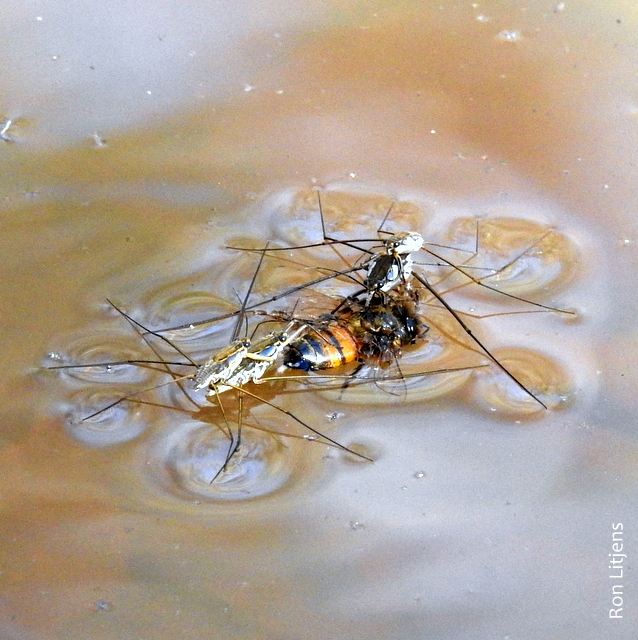 The ability of water striders to remain on the water surface is a result of several factors. Hydrogen bonding between water molecules creates a surface tension. In addition thousands of tiny hairs on the feet of water striders repel water. The wide stance of the legs means the body weight is spread over a wide area. The combination of these factors means that water striders can stay afloat, even in choppy surface conditions using the middle pair of legs to propel themselves and the back pair of legs to steer.
During mating season water striders do not associate in communal groups. Territories are aggressively defended by male striders and potential mates are attracted by creating ripples on the water surface. After mating the female insect is ‘protected’ so that no other male can mate with them. The photo (above right) shows two mating pairs of water striders feasting on a honey bee…sex and food simultaneously.
Little Aussie battle

Australian Raven

Little Raven
Corvids, i.e. ravens and crows, present quite an identification challenge for bird-watchers and twitchers. In our district there are only two species, the Australian Raven (Corvus coronoides) and Little Raven (Corvus mellori), but correctly choosing between the two can be quite a battle. Incidentally, there are no crows in Victoria.
Let’s look at the validity of what should be some key identification features:
- Size. Obviously the Little is smaller! Well, yes, but only by a centimetre or two, so not a reliable indicator.
- Call. The Australian’s call has a drawn-out descending finish. Yes, but not always, and the Little’s call can often end on a descending note. And the calls of young birds are generally indistinguishable.
- The Australian Raven has throat hackles that appear as a shaggy beard, especially when it calls. True, but the Little does have throat hackles, though much less prominent.
- The Little always flick its wings when calling. This does often occur, but ain’t necessarily so.
- Ravens in flocks are likely to be Littles. Probably true – we had about 40 or 50 in our front paddock a few weeks ago. But immature and unattached adult Aussies can form small flocks at times.
So, you can see that many potential identifying characteristics are not definitive. As an aid to corvid identification Sean Dooley wrote an article in Australian Birdlife magazine in 2012 titled The Trouble with Ravens. The article includes an informative table of features for all five Australian corvids, compiled by Andrew Silcocks, manager of BirdLife Australia’s Atlas of Australian Birds. Owing to the difficulty of identification, the Atlas has undergone a review process of corvid records, particularly in contentious areas, and in some cases downgraded records to unconfirmed status.
-

- Australian Raven showing throat hackles
-

- Immature A. Raven – note brown eye
-

- Handsome Little Raven
-

- Little Ravens under plum tree
The most reliable distinguishing features between the Australian and the Little are probably the more prominent throat hackles on the Australian, together with its wailing call with a long descending finish. The Little’s call is mostly a series of harsh level lower-pitched caws. Click on the audio bars below to hear locally recorded calls.
When submitting local observations to the Atlas’s online database Birdata there is a convenient additional check-box for unidentified corvids labelled “Crow and Raven species”, which we tend to use unless we are absolutely sure of what we have seen or heard. And considering how wary these birds are, definitive records are not that common!
Australian Raven:
Little Raven:




 Focus On Fauna