Ancient survivors
 You may see this as just a common pest responsible for damage to books and fabrics around the home, but this Gray Silverfish, Ctenolepisma longicaudata, belongs to the Order Thysanura, regarded as one of the oldest and most primitive groups of insects. Silverfish have a number of interesting features:
- their eyes are either greatly reduced or absent
- they are wingless – in fact they have never had wings, unlike other wingless insects that evolved from winged ancestors
- they undergo many moults, even as adults
- females can produce numerous offspring throughout their lives, being sexually mature as early as two months old and before being fully grown – some can lay a clutch of eggs between each moult
- they can survive extremely dry periods by absorbing atmospheric moisture – through their anus!
- they can also survive long periods without eating
- they can live for up to four years – not bad for a small insect!
After managing to photograph one of these introduced pesky and very elusive insects we got to wondering about native silverfish and discovered from the Australian Museum blog that they are well represented with about 50 species described and many more yet to be described, but still relatively little is known about them. Researchers keep finding new species and even new genera filling specialised ecological niches in diverse habitats such as caves, cracks in underground rocks and even in ant and termite colonies.
Like cockroaches, these little animals are great survivors and probably well equipped to deal with climate change!
Taking it in your stride
On many a sunny afternoon have I sat by the dam watching the passing parade of insects – dragonflies on the prowl for food, wasps digging up mud to build nests and flotillas of water striders cruising on the surface. Of the three, the latter seem the most ‘chilled’ and I often wondered what goes through their minds as they float about. Well the answer is sex and food.
 Water Striders are of the order Hemiptera, true bugs with sucking mouthparts. This order includes gumtree hoppers, psyllids and cicadas. These three insects use their mouthparts to suck sap from leaves. The water striders however are voracious predators, feeding on insects and spiders. They detect prey that has fallen in the water by ripples made on the surface. The small front legs are used to grasp prey and then with their mouthparts they pierce the victim, inject enzymes which dissolve it and then suck up the resultant liquid. The photo (above) shows a water strider surrounded by, if you look closely, the husks of several victims.
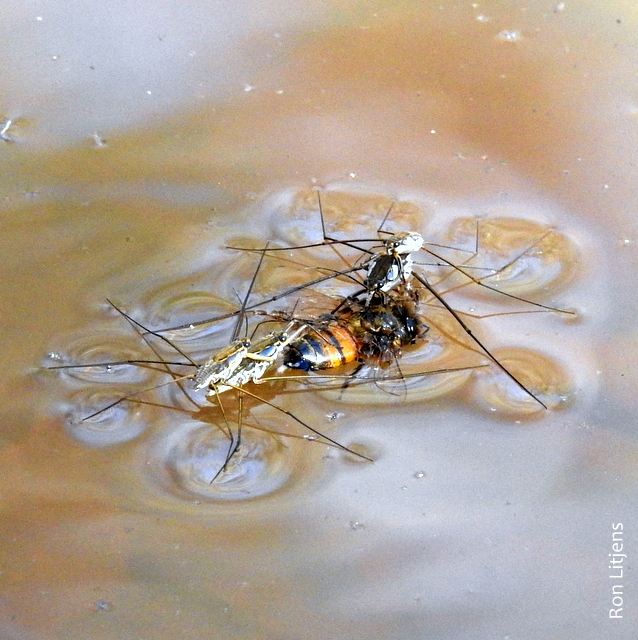 The ability of water striders to remain on the water surface is a result of several factors. Hydrogen bonding between water molecules creates a surface tension. In addition thousands of tiny hairs on the feet of water striders repel water. The wide stance of the legs means the body weight is spread over a wide area. The combination of these factors means that water striders can stay afloat, even in choppy surface conditions using the middle pair of legs to propel themselves and the back pair of legs to steer.
During mating season water striders do not associate in communal groups. Territories are aggressively defended by male striders and potential mates are attracted by creating ripples on the water surface. After mating the female insect is ‘protected’ so that no other male can mate with them. The photo (above right) shows two mating pairs of water striders feasting on a honey bee…sex and food simultaneously.
Little Aussie battle

Australian Raven

Little Raven
Corvids, i.e. ravens and crows, present quite an identification challenge for bird-watchers and twitchers. In our district there are only two species, the Australian Raven (Corvus coronoides) and Little Raven (Corvus mellori), but correctly choosing between the two can be quite a battle. Incidentally, there are no crows in Victoria.
Let’s look at the validity of what should be some key identification features:
- Size. Obviously the Little is smaller! Well, yes, but only by a centimetre or two, so not a reliable indicator.
- Call. The Australian’s call has a drawn-out descending finish. Yes, but not always, and the Little’s call can often end on a descending note. And the calls of young birds are generally indistinguishable.
- The Australian Raven has throat hackles that appear as a shaggy beard, especially when it calls. True, but the Little does have throat hackles, though much less prominent.
- The Little always flick its wings when calling. This does often occur, but ain’t necessarily so.
- Ravens in flocks are likely to be Littles. Probably true – we had about 40 or 50 in our front paddock a few weeks ago. But immature and unattached adult Aussies can form small flocks at times.
So, you can see that many potential identifying characteristics are not definitive. As an aid to corvid identification Sean Dooley wrote an article in Australian Birdlife magazine in 2012 titled The Trouble with Ravens. The article includes an informative table of features for all five Australian corvids, compiled by Andrew Silcocks, manager of BirdLife Australia’s Atlas of Australian Birds. Owing to the difficulty of identification, the Atlas has undergone a review process of corvid records, particularly in contentious areas, and in some cases downgraded records to unconfirmed status.
-

- Australian Raven showing throat hackles
-

- Immature A. Raven – note brown eye
-

- Handsome Little Raven
-

- Little Ravens under plum tree
The most reliable distinguishing features between the Australian and the Little are probably the more prominent throat hackles on the Australian, together with its wailing call with a long descending finish. The Little’s call is mostly a series of harsh level lower-pitched caws. Click on the audio bars below to hear locally recorded calls.
When submitting local observations to the Atlas’s online database Birdata there is a convenient additional check-box for unidentified corvids labelled “Crow and Raven species”, which we tend to use unless we are absolutely sure of what we have seen or heard. And considering how wary these birds are, definitive records are not that common!
Australian Raven:
Little Raven:
My, what big jaws you have
 Bull Ants (Myrmecia sp.) are a genus of large Australian ants well known for aggressively defending their territory. Despite this behaviour the adult ants surprisingly feed on nectar. The larvae are carnivorous and are fed insects, etc. by the worker ants in the nest. In normal circumstances I steer clear of these insects and their painful stings.
Recently my morning bike ride was interrupted by a moving cloud on the road which as I approach resolved itself to be a swarm of winged, mating Bull Ants. During their nuptial flight the male and female ants pay no attentions to intruders in their space and are simply focused on mating. The queens climb grass stalks and branches and emit a secretion which attracts the male ants – lots of them. Some queens were buried beneath a number of males all trying to mate.
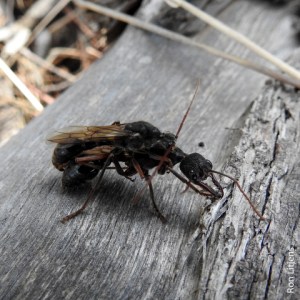 The queen ant (above) is much larger than the male drone. It is maroon in colour (the male is black) and has larger mandibles. During the mating process the drone has to fight off the other drones while trying to mate with the queen. If it is distracted from the latter task and loosens its grip on the queen, the queen will simply turn around, grasp the drone in its mandibles and toss it aside whereby another drone takes its place.
Riding back an hour later and the same spot was a picture of serenity – not a Bull Ant to be seen. To see this spectacle it’s a case of being in the right place at the right time.
Duck for cover

Male Chestnut Teal with chick
With the annual state-sanctioned slaughter of wild native waterbirds, otherwise known as the Victorian Duck Hunting Season, now underway, it was pleasing to see a family of Chestnut Teal sheltering safely on our dam. For company they had an Australasian Grebe with a couple of its chicks.

Female Chestnut Teal and chick
The permitted game species this year are: Australian Shelduck, Australian Wood Duck, Pink-eared Duck, Grey Teal, Chestnut Teal, Pacific Black Duck, as well as, inexplicably, the Hardhead, a species that is classified as ‘Vulnerable’ in the government’s own Advisory List of Threatened Vertebrate Fauna in Victoria.
-
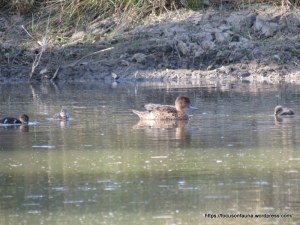
- Female teal with 3 chicks
-
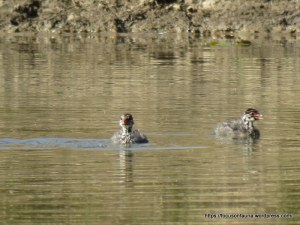
- Grebe chicks (with mum underwater)
As a concession to the extremely dry period we have been experiencing, bag limits have been reduced (8 birds per day on opening day and 4 per day thereafter). The Australasian Shoveler, whose conservation status is also ‘Vulnerable’, has been removed from this year’s list of game species, although some will almost inevitably be shot because of mistaken identity. The open season on ducks continues until June 13th 2016.
A life-cycle in one shot
The Common Paper Wasp (Polistes humilis) is an insect found in most parts of Australia, New Zealand (an unfortunate export from Oz) and is now nesting under my deck. The latter location is unfortunate as they aggressively defend their nest and surrounding territory and have a very painful sting.
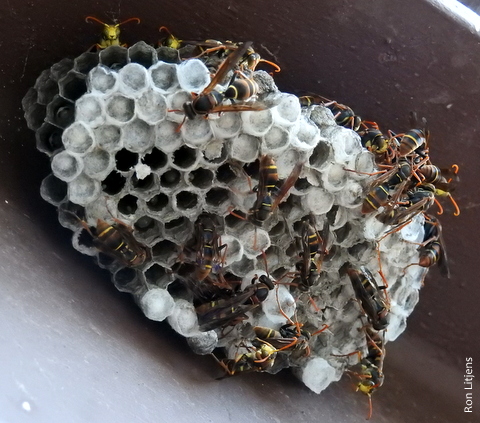
The nest, which has the appearance of grey paper, is made from chewed wood fibre and saliva and consists of a series of hexagonal cells. Unlike many Australian wasps, this paper wasp can and does reuse the nest with new cells added to the outside of the existing structure every season. It is into these new cells that the eggs are laid by the one or two queen wasps that service the nest.
The adult wasps are nectar feeders but the larvae feed on caterpillars and spiders which are brought to the nest by the worker females. When the larvae pupate the cell is capped until the new adult emerges.
If you look carefully at the photo you can make out in the cells the eggs and the white form of the larvae. The capped pupal cells are also clearly visible. Somewhere in the mass of wasps is the queen who is indistinguishable in appearance from the worker wasps. The entire life-cycle is right there in one photo.
Another thing I noticed when looking at the photo that I didn’t notice at the time was the wasps on the top of the nest watching me, watching them. I reckon I was millimetres away from disaster!
Wheel of life #2
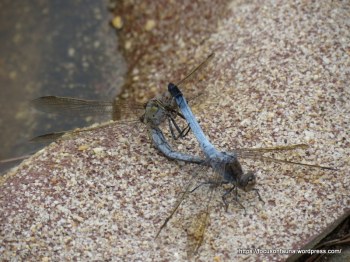
Ronlit’s recent post Wheel of life on this blog described the mating habits of dragonflies. Our garden pond has been a magnet for a number of these attractive creatures, particularly Blue Skimmers (Orthetrum caledonicum) which are surprisingly approachable and obligingly performed the ‘wheel of life’ for the camera – see photo at left.
Another smaller dragonfly, the Black-faced Percher (Diplacodes melanopsis), was flying around at the same time, and was occasionally buzzed in mid-air by the male skimmer when it got too close.
-
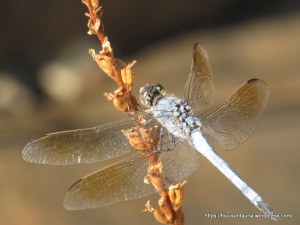
- Blue Skimmer on Triggerplant (Stylidium sp.)
-

- Blue Skimmer with Blue Devil (Eryngium ovinum) in the background
-

- Blue Skimmer clinging to a Flax-lily (Dianella sp.)
-
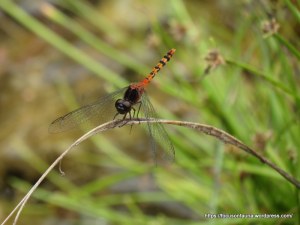
- Black-faced Percher
We have much to learn about these insects and were grateful for Ron’s help with identification. We also referred back to his 2013 post When beliefs are shattered, which was a delightful story about the differences between dragonflies and damselflies, and which elicited a wonderfully detailed comment from the late Russell Best, co-founder of the NatureShare website.
Evolution at work?
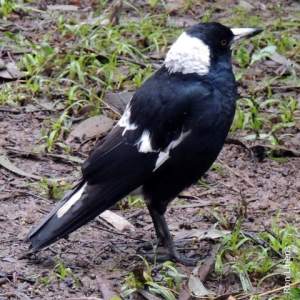 The Australian Magpie is a well-known bird distributed across most of mainland Australia and Tasmania. It consists of one species Cracticus tibicen but has three recognised forms: the Black-backed Magpie (pictured left) of which there are four races, the White-backed Magpie (pictured below right) of which there are three races and the Western Magpie. Each race is distinguishable by different black and white patterning. The races easily hybridise, forming many intermediate patterns.
.
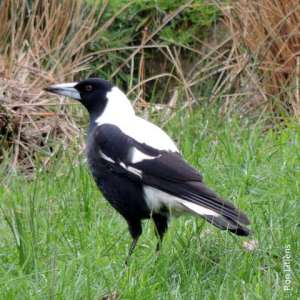
In southern Victoria (including the King Parrot Creek Valley) the nominate race is the White-backed Magpie (Craticus tibicen tyrannica). However the avid twitchers among us and those who have run the gauntlet of swooping magpies when getting to their washing lines in Spring will also have observed Black-backed Magpies, even though their typical range is further north.
Driving along the King Parrot Creek last week I noticed this magpie (picture below), which doesn’t seem to fit any of the recognised colour forms. I am calling it the Whiter-than-white-backed Magpie (Craticus tibicen ronlitians). It is not an albino, as albinism is the total lack of colouration and this bird has dark eyes and 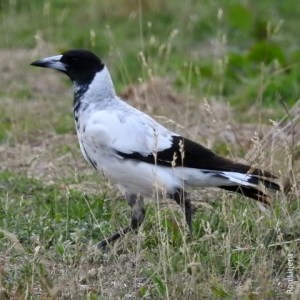 patches of black. But it is much whiter than any magpie I have seen before.
Bearing in mind the theory of evolution and the survival of the fittest, and relating this to the dismal form of the Collingwood Football Club over recent years, maybe this magpie represents the next step in the slow evolution to a more successful bird … maybe a (white) Swan. Often seen on football ovals in Sydney of course.
Creek life
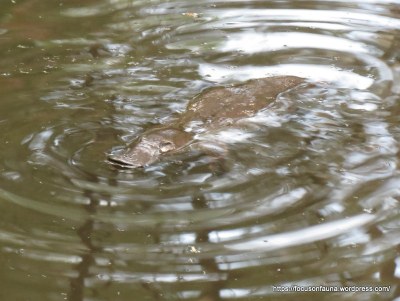 There was perhaps some degree of scepticism after the Strath Creek Landcare Group’s recent Platypus Group Watch on King Parrot Creek when one of the organisers was the sole person to spot a platypus, but had no photo to confirm it. Ron at least had the presence of mind to get a picture of the only rakali (Water Rat) seen during the evening. Then we got word that the Green Army team working on weed control in Coonans Reserve had spotted a platypus in the creek on their early morning arrival at the reserve.
So the other morning we went to see for ourselves and were immediately rewarded with a rakali paddling like mad downstream and disappearing under a fallen log. Then, a few minutes later, a platypus appeared in mid-stream and we were finally able to get a few (poor quality) photos.
The creek is still flowing (just) and there are still plenty of deepish pools for the aquatic life, but Waterwatch and the Catchment Management Authority are keeping a close eye on dissolved oxygen (DO) levels so as to be prepared for the possibility of intervention to save the endangered Macquarie Perch, should the need arise. Low flow and raised water temperature, combined with the decay of organic matter, can cause DO to fall to levels that result in stress and even death to fish.
Meanwhile …
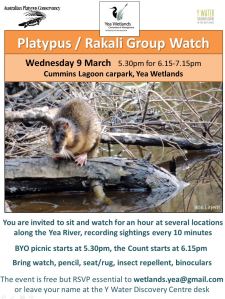
… the Yea Wetlands is holding the inaugural Platypus/Rakali Group Watch on Wednesday 9th March. A BYO picnic and briefing begins at 5.30pm in the Cummins Lagoon car park. For full details of the event, click on the flyer.
Wheel of Life
At around this time last year we posted a blog featuring the mating practices of damselflies, one of the groups of insects in the order Odonata. Well those odonatans are at it again. This time it is the dragonflies that we have watched cruising above the dam.
 Male dragonflies at this time of the year aggressively defend a territory, in this case a section of the dam. Any other male entering that airspace is swiftly driven away. Anything else entering the area is likely to be eaten. I was attempting to photograph a damselfly (species unknown), which is a poor flyer that usually flutters vertically into the air when disturbed. My camera shutter opened a split-second too late as a dragonfly grabbed the hapless damselfly, flew away and ate it. On the other hand, female dragonflies entering the zone are courted.
 In preparation for mating the male places sperm packets in an easily accessible position on its body. A mating pair is established when the male grasps the female behind the head with claspers on the end of its abdomen. The pair then grab onto a branch or stem and form what is known as the wheel position (see picture above) where the female curls her abdomen underneath the male and picks up the sperm from under the thorax.
Still attached, the pair then fly above the water body so the female can deposit eggs on submerged vegetation (pictured right). During this time the male still has to defend the female from other male dragonflies which can, given the chance, scoop out the rival’s sperm packet and replace it with their own.
And so the wheel of life rolls on.