Quit while you’re a-head
If you are only into feel-good stories – look away.
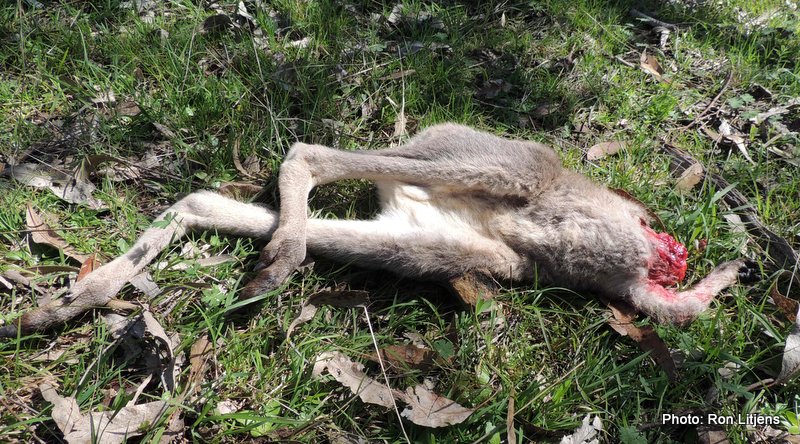 A recent gruesome discovery up on the hill behind the house was the fresh body of an Eastern Grey Kangaroo (Macropus giganteus) joey minus its head and right arm. It was hard to imagine any predator killing such a large creature – the Flowerdale panther perhaps! Later in the day the pictures from a remote motion-sensing camera situated at the back of the property revealed a Red Fox (Vulpes vulpes) wandering past with a kangaroo head clasped in its jaws. The fox in question has been observed every day following the same route in front of the camera.
Foxes are omnivores meaning that they will eat both meat and vegetable  matter. Fox scats around our place clearly show that berries and insects are part of its diet. It is also known that foxes eat birds and small mammals. Even after they are not hungry, foxes will continue to hunt, often burying food in caches under leaves or underground.
So many questions still remain. Did the fox kill the joey or did it opportunistically scavenge the body? If it didn’t kill the joey, what did? In the photo, was the fox going to feed its young or add to a food bank? I’ll probably never know.
Nature is not all butterflies and flowers!
Insect artistry
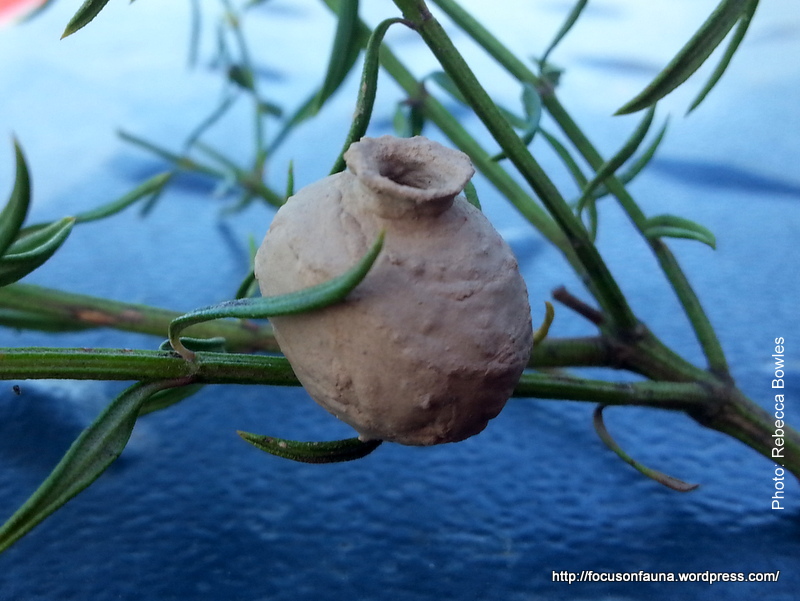 We received this photo of a beautifully formed pot from Bec, follower of this blog as well as being our local Blackberry Action Group project officer.
This small work of art is actually made by a potter wasp, one of a number of species of wasps in the subfamily Eumeninae. Many potter wasps stock their nest with caterpillars for their larvae to eat. The wasp grasps its caterpillar prey with its sharp forceps-like mandibles, immobilises it with its sting and flies/drags it to the nest. An egg is laid, then the nest is sealed. When hatched, the larva eats the caterpillar(s) live before pupating and emerging from the nest as a nectar-feeding adult wasp.

Potter wasp – photo: brisbaneinsects.com
Potter wasps are solitary, not social like some wasps, such as the European Wasp. They can sting but are not normally aggressive. The constructor of Bec’s nest would be similar to the wasp pictured at right.
The Ugly Duckling (Australian style)
Ugly
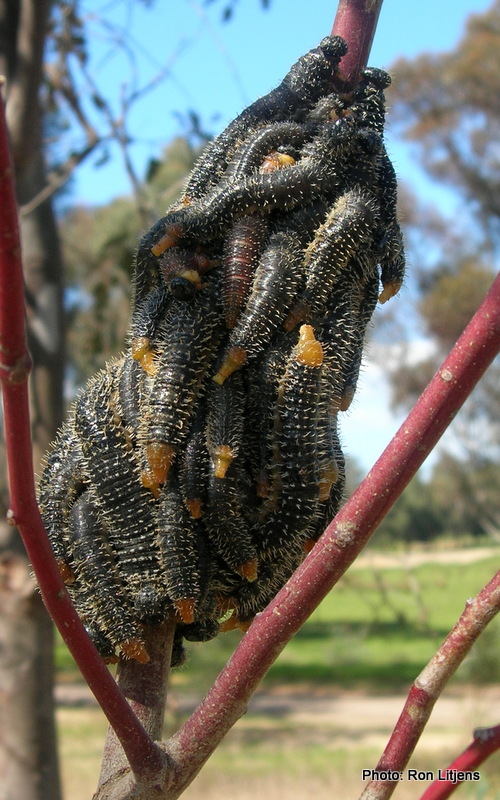
We can probably all remember the Hans Christian Andersen tale of The Ugly Duckling – the story of a cygnet that thought it was ugly but grew up to be a graceful swan. (If it is any consolation, I think that cygnets look kind of cute). I am about to rewrite this tale to suit Australian conditions. The main role will be filled by a Spitfire, left.
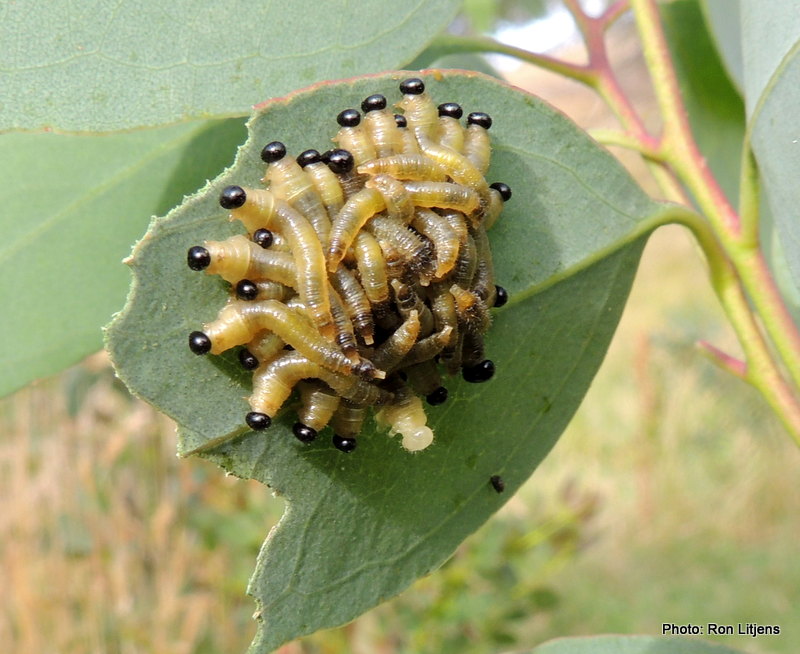
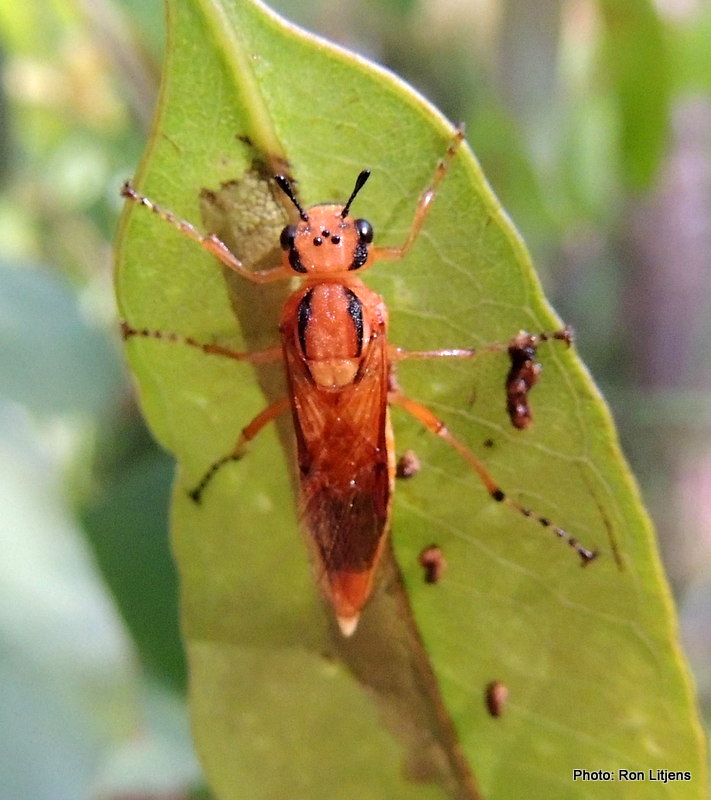
Spitfires are the larvae of Sawflies. This name is misleading as a Sawfly is a type of wasp. The term is derives from the saw-shaped ovipositor that the female uses to cut into plants to lay eggs.
Beautiful?
There are many different species of Sawfly, many of which lay eggs only on specific tree types but they all discharge a strong smelling liquid when disturbed. Pictured above right is a group of Small Brown Sawfly (Pseudoperga guerinii) larvae. They feed on the leaves of young eucalypts. In early summer the larvae will dig into the ground and pupate. This phase could take several years, depending on species, until the adult sawfly appears.
When these spitfires grow up they turn into adult Small Brown Sawflies, pictured left – not as beautiful as a swan but definitely an improvement in appearance.
Even so I suspect a fairy tale called The Ugly Spitfire, as Aussie as it is, will not catch on.
Ant antics
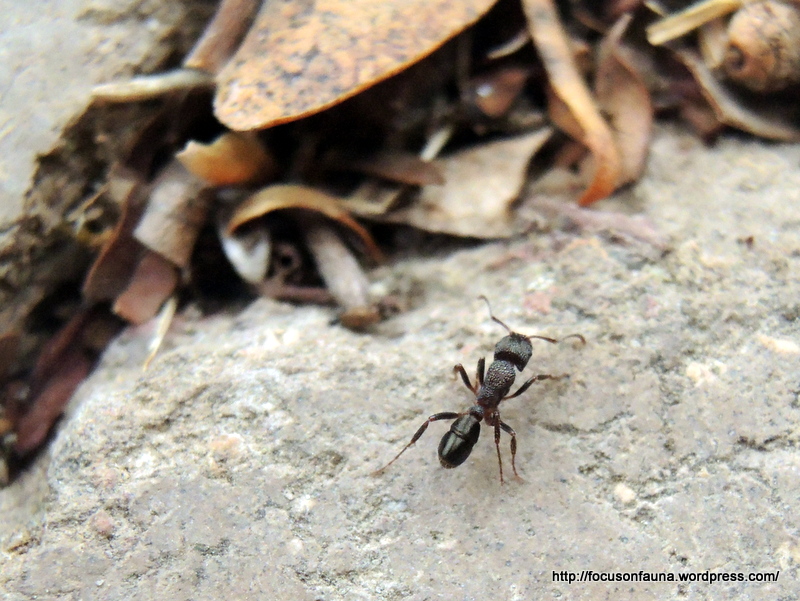
Green-head Ant
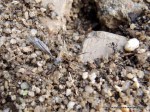
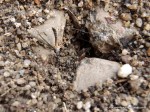
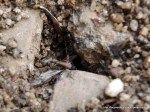
Recently, an ant struggling with an insect corpse across our brick pavers caught our attention. We stopped to watch the activity around the nearby ant-hole, where some ants were busily excavating, while others appeared to be building a stockpile of leaves and stalks.
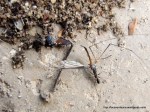
When we checked with Max Campbell, our invertebrate expert who gave a Focus on Fauna presentation earlier this year, he advised us that these are Green-head Ants (Rhytidoponera metallica). Max said “… the carcase is a crane fly (family Tipulidae) and was more likely to be carrion than prey. All food is used by the ant community for both adults and larvae. It is likely that most proteinaceous food (meat as it were) gets used for feeding developing young, whereas the adults would need high energy food such as nectar and other carbohydrates to maintain their active existence.”
Another interesting fact from Max is that this species of ant often has inquilines, such as specialised isopods or a type of cricket, sharing the nest with them. Inquilines are named from the Latin inquilinus meaning ‘lodger’or ‘tenant’, and are described as living commensally, which means that one of the co-inhabitants benefits from the arrangement, without affecting the other.
The ant’s colouring can vary – some from eastern Victoria are more obviously green headed and brilliantly metallic, as seen in Max’s photo.
[Click on any of the photos and then scroll through the gallery using the arrows.]
-
- Excavation
-
- Carrion collection – pulling …
-
- … and pushing
-
- Nearing the nest …
-
- … almost there …
-
- … down the hole
-

- Collecting leaves – for what?
-
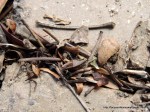
- Vegetation stockpile
-
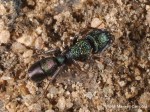
- Clearly a Green-head Ant!
Here’s to the Long-necks
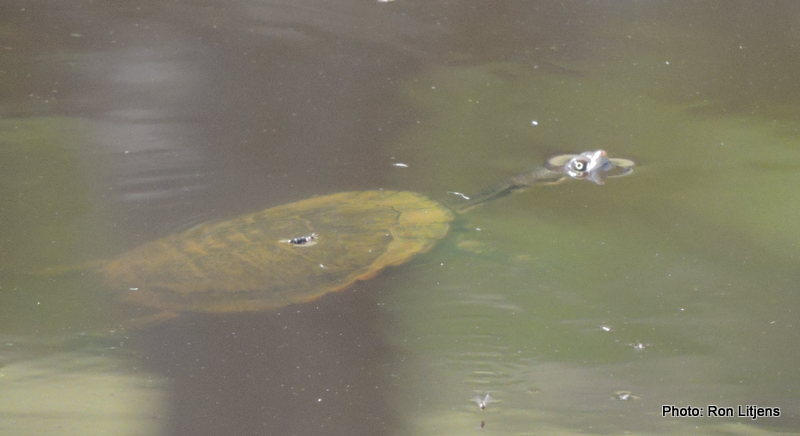 When I was young a ‘long-neck’ referred to one of the larger bottles of beer that you could buy. These days now that I am more eco-savvy it refers to a type of turtle.
The Eastern Long-necked Turtle (Chelodina longicollis) is found throughout south-eastern Australia. It feeds on insects, worms, frogs, fish and crustaceans. It is sometimes known as a  Stinker because if disturbed it will emit an offensive odour from musk glands. I never get that close to them to find out. In our dam they float with only their nostrils and eyes above the water level (pictured above) and soon disappear below the surface if disturbed.
Recently I had the rare pleasure of seeing one basking in the sun on a log (pictured right). It is obvious why the alternative name is the Snake-necked Turtle.
Behind the scenes …
 When we took a road-kill Brush-tailed Phascogale to be preserved for the Strath Creek Landcare Group, the taxidermist Dean Smith kindly showed us his workshop in the basement of the Melbourne Museum, where exhibits on display in the museum are prepared, preserved and restored.
This proved to be a fascinating experience, with Dean revealing some of the art and techniques he uses. We later visited his home workshop, and discovered more of his skills in preparing replicas and inter-active displays for education.

Now you too have a chance to see some of Dean’s work and hear some of the tricks of his trade !
Join us on Friday 14th November at the Flowerdale Hall, at 7.30pm. Click on the flyer at right for full details.
For a preview of Dean’s artistry visit his website HERE.
In one end and out the other
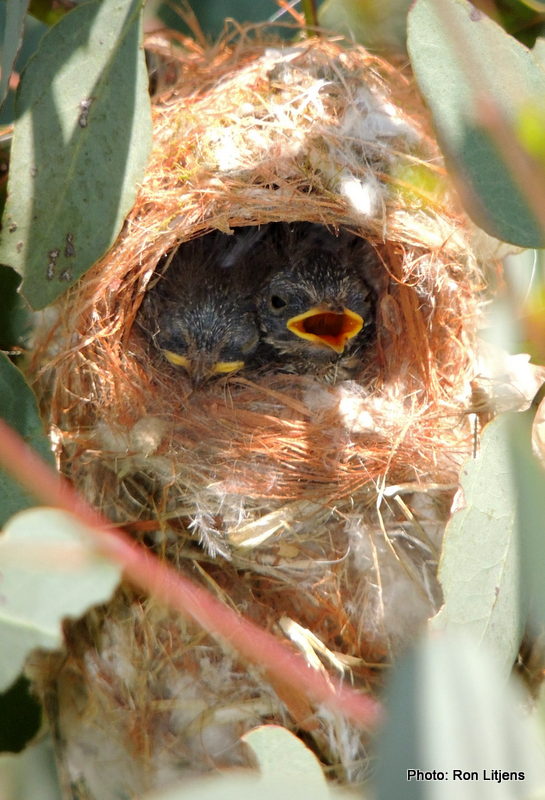 A grove of Yellow Box (Eucalyptus melliodora) saplings that germinated after the ’09 fires has been a continual source of interest, mainly because of the invertebrates that live on it. This year one of the saplings has been strong (and bushy) enough to support a Striated Thornbill nest, pictured left.
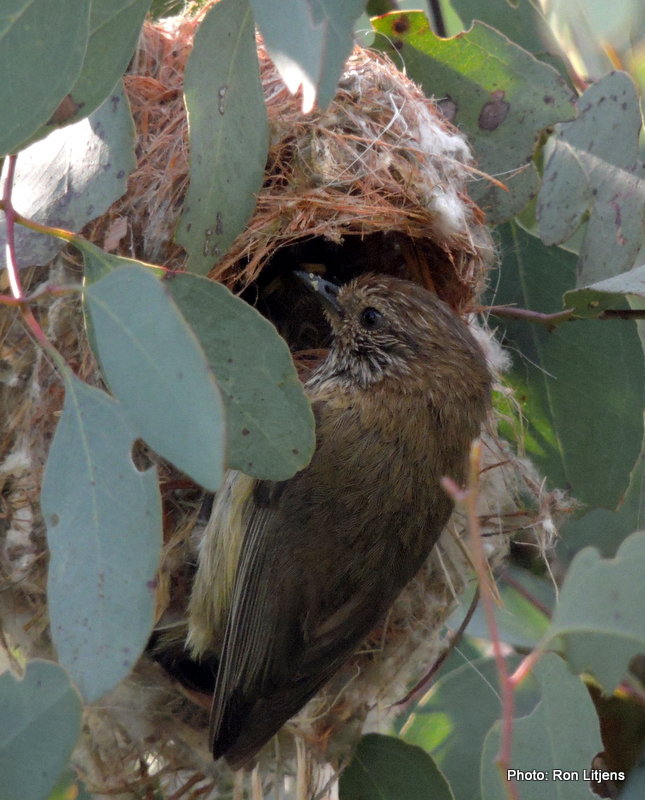 The Striated Thornbill (Acanthiza lineata), pictured right, is a member of the Acanthizidae family, which contains other birds such as Weebills, Gerygones and Scrubwrens. It is only found in mainland south-eastern Australia. The scientific name is derived from the Greek words acantheon meaning a thorn-bush and zao meaning to live in, and the Latin word lineatus meaning lined, referring to the markings on the head – literally a ‘lined thorn-bush dweller’.
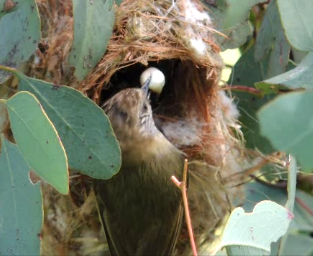 The nest is an oval domed construction with a hooded opening near the top. It is made out of bark, spider webs and moss and is lined with fur and feathers. The female incubates the eggs. Both parents feed the young. Immediately after feeding, the chicks defecate a faecal sac – a translucent gelatinous membrane containing all the excrement. In practice one parent flies in and feeds the chicks followed by the second parent which removes the faecal sac (pictured left).
They must feel pooped.
Same species, different outfit
 This is not about local sightings, but does highlight what you may come across when getting out and about to some of the wonderful Biodiversity Spring events being held across the Goulburn Broken catchment and north-east Victoria, coordinated by the Euroa Arboretum. After attending the ‘Taminick Walk and Squawk’ (and seeing the promised Turquoise Parrots) we made our way up to the northern (Killawarra) section of Warby-Ovens National Park and were lucky enough to spot this Lace Monitor (Varanus varius) pictured at left climbing up a Mugga Ironbark tree (Eucalyptus sideroxylon). This particular goanna is the less common ‘Bell’s form’ of the Lace Monitor, characterised by the broad banding on its body and tail.
When first spotted it had a small colourful feather stuck to the edge of its mouth – hopefully its last meal wasn’t a Turquoise Parrot!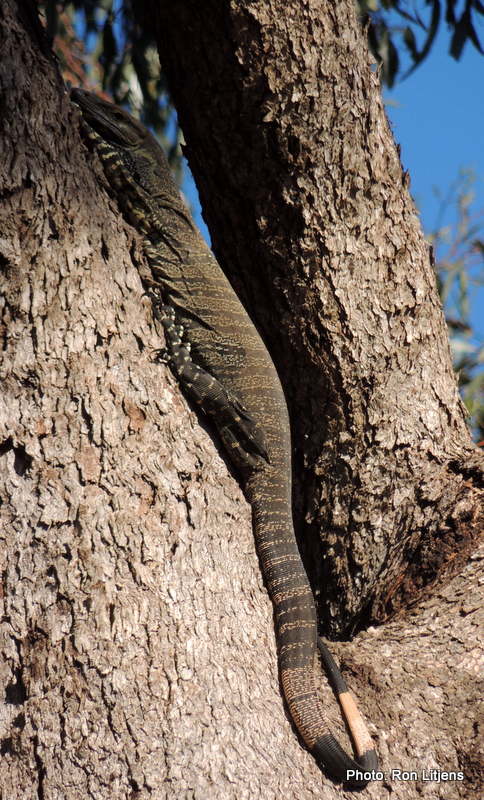
The following day we attended the first of the Grassy Woodlands Field Days held at Dookie College. Following a morning of informative talks, we headed to the college’s bushland reserve where we again came across a Lace Monitor climbing a tree, this time the more usual form with a patterning of more subtle bands and spots – see the photo at right.
You are probably unlikely to encounter a Lace Monitor in the Flowerdale/Strath Creek area, but please, prove us wrong and report any sighting by leaving a comment below.
One lump or two?
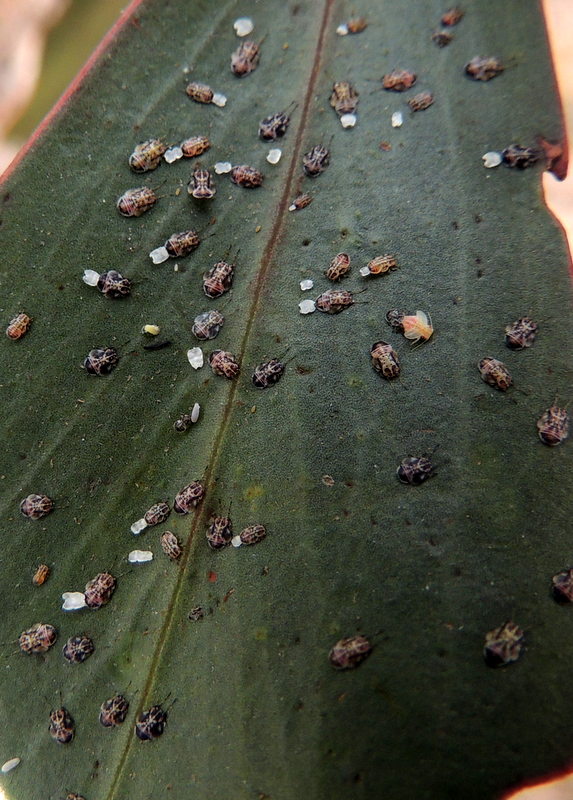 Hemiptera is an order of insects characterised by having sucking mouthparts. Some species suck sap from plants. Others just suck the life out of each other. Insects of this group include gumtree hoppers and psyllids, featured in previous blogs.
The sap suckers try to extract protein from the sap. This is their food. However, the protein is in such small quantities that the insects have to suck up an enormous amount of sugary sap to meet their requirements. To do this they simply suck in the sap and remove the proteins while, at the same time, expelling the waste sugar from their anuses in the form of honeydew.
 Recently I found hemipterans known as Wattle Plant Lice (Acizzia sp.) on a Golden Wattle (Acacia pycnantha). Probably the fourth and fifth instars of the lice are shown in both photos. The white packages dragged along by some of the instars are crystalline honeydew. It’s a bit like going to a tea party where it’s BYO sugar-cube. An element missing from this scene is the presence of ants. Ants would usually attend these creatures to harvest the honeydew in return for protecting them from predators.
Maybe the ants were out getting the scones and bikkies.
Metamorphosis 3

10th October – full tail
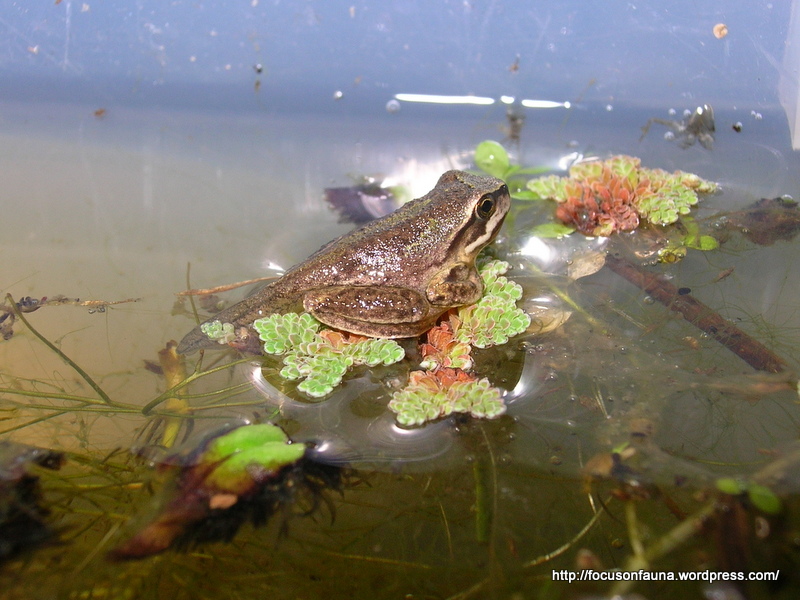
11th October – tail shrinking

13th October – tail almost gone
At the risk of tadpole overload, we will finish the Metamorphosis series of posts with some pictures of our last home-raised frog. What amazed us about this one was the speed of change in the last few stages of development, particularly the shrinking of the tail, as you can see from the dates on the photos.
This tadpole/frog turned out to be a brown tree frog, but without hearing its call, we can’t be sure whether it is a Southern Brown Tree Frog (Litoria ewingii), or a Plains Brown Tree Frog (Litoria paraewingi), as it seems we are on the overlap of distribution of the two species. In the past we have heard the calls of both of them here. Either way, we returned it to our ephemeral wetland, where we hope it will be able to avoid the interest of the White-necked Heron currently residing there.
The other tiny frogs we previously managed to raise from tadpoles appeared to be Common Froglet (Crinia signifera) and Plains Froglet (Crinia parinsignifera), which were also returned to the wetland.