Same name, different creatures
 When we lived in Brunswick we lived next to a household of ferals. We called them that because they called themselves that. They were invariably goatee wearing (the males), tattooed (both males and females), dreadlocked and the nicest set of neighbours you could ever want – even if the parties got a bit loud on the weekends.
 Now we are in Flowerdale our neighbours are still ferals, of a different type. The motion-sensing camera set up for a week revealed several species of feral animals cavorting on our back lawn.
Both the Rabbit (Oryctolagus cuniculus) and the European Fox (Vulpes vulpes) were introduced to the Australian mainland in the 1840s and 1850s for recreational hunting. Both species have been a disaster to the Australian environment. Rabbits are prodigious eaters of vegetation. It would be OK if they tucked into the Capeweed, Thistles and Patterson’s Curse but at our place they appear to mow through all the native vegetation including the native orchids and lilies. And the foxes decimate the native fauna. The only saving  grace is that the foxes also eat the rabbits.
Cats (Felis catus) arrived as domestic pets but sometime later were released to keep to rabbits down (go figure). They also keep everything else down as well.
Even though I far prefer living in the wilds of Flowerdale, as loud as they were, I think for overall niceness, I prefer my feral neighbours in Brunswick.
Metamorphosis
 Armed with a net and bucket, we headed off to sample some dam water among the rushes to see what waterbugs were present. Sifting through the sample, we discovered a variety of little darting creatures: tiny water mites, beetles, backswimmers, waterboatmen etc. – as well as a few tadpoles, which we took back to the house to examine.
With the aid of our newly-acquired copy of Marion Anstis’s superb book Tadpoles of South-eastern Australia, a hand lens, a USB microscope and camera, we endeavoured to find out which species they were.
Tadpole identification is not easy, and requires the careful study of a range of features such as body/tail shape and size, location and arrangement of mouth parts, eyes and nostrils, pigmentation and many more. These features are used to work through a scientific key to hopefully arrive at the correct identification. Use of the key requires beginners like us to learn a whole new glossary of terms, such as flagellum, iridophores, nares, papillae and spiracle.
The amazing metamorphosis from egg to frog, which can take months, has been divided by biologists into 46 developmental stages. The tadpoles we found seem to be of two or perhaps three species and were fairly well developed, with almost complete mouth parts and hind limbs emerging.
With little confidence we decided that the tadpoles we had would develop into Plains Brown Tree Frog (Litoria paraewingi) or Whistling Tree Frog (Litoria verreauxii), which have fairly similar tadpoles – and Pobblebonk, aka Banjo Frog (Limnodynastes dumerilii). We know from their calls that all of these frogs frequent the dam, but clearly we need more practice in tadpole ID!
Here come the clowns
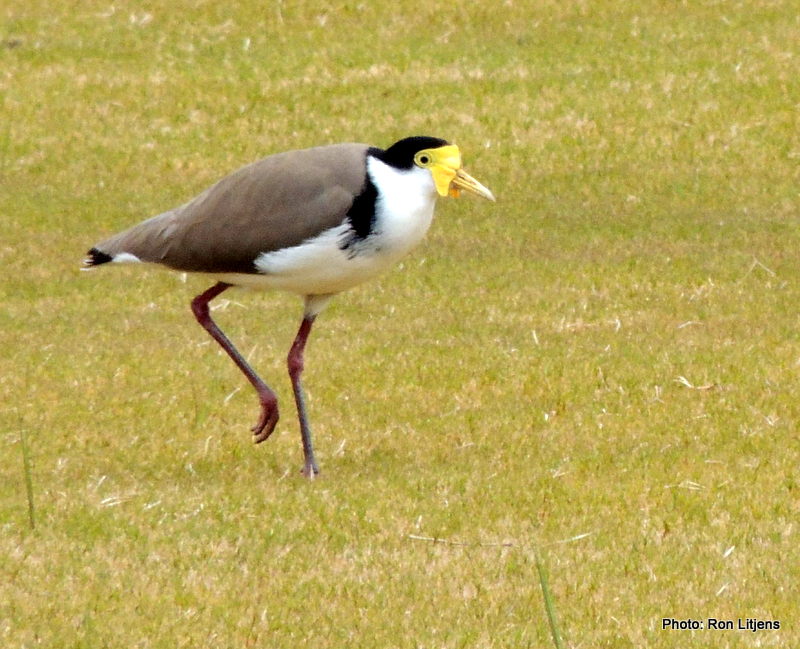 I was driving deep in the heart of Flowerdale recently when I noticed sitting in the middle of someone’s lawn what we call in our household a ‘Clown bird’ (pictured left). It is in fact a Masked Lapwing (Vanellus miles) but with a face like that we prefer our name. I had seen them before but never around our neck of the woods. The bird pictured is of the subspecies novaehollandiae identified by the black marking around the breast.
Masked Lapwings are raucous birds and very territorial, particularly in nesting season. They will nest in highly open spaces. As I approached, 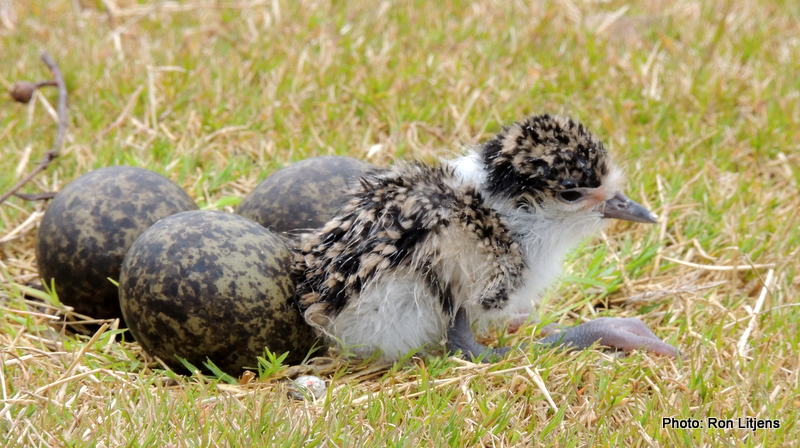 camera in hand, the bird staggered off pretending a broken leg and leaving a clutch of three eggs and a chick (pictured right). The nest consisted of, well, nothing — barely a scrape in the ground. I wondered what evolutionary tactic has led this bird to lay eggs on the ground in such highly visible areas. The chick is normally well camouflaged against sticks, leaf litter and soil – but not on a lawn.

Chick. What chick?
The Masked Lapwing used to be called a Spur-winged Plover but the name was changed as it was shared by a totally different bird on the African continent. In the photo left you can clearly see the yellow spur protruding from the wing. The spur, which is non-venomous, is used by the bird when defending its territory or chicks. In fact the species name miles is Latin for soldier, probably referring to the weapon on its wings and its aggressive attitude. On a second visit the bird remained sitting on the ground and pretended there were no chicks for miles. However a close look underneath will reveal another pairs of legs. I wonder where the chick is?
It might look like a clown, but watch out if you get too close and there are young to protect.
At bay
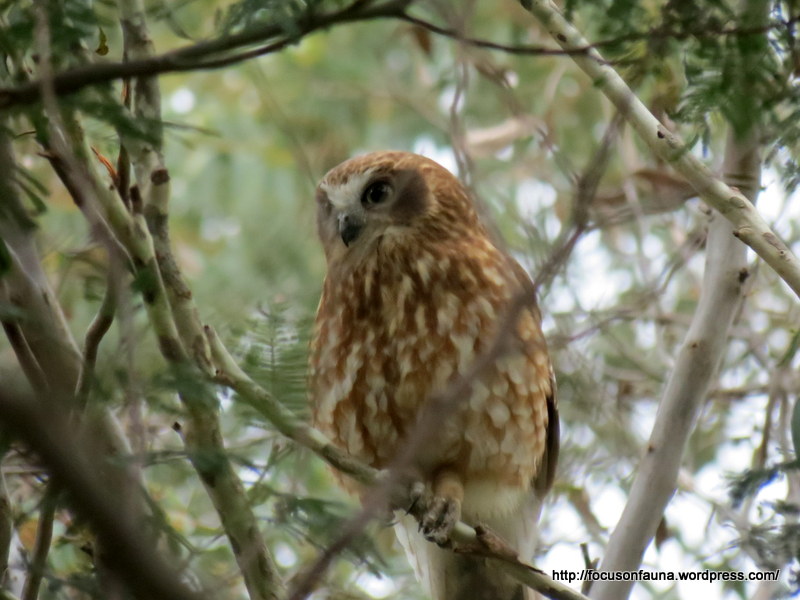
Southern Boobook
Heading down to lock up the chooks before dusk, we were surprised to see this Southern Boobook (Ninox novaeseelandiae) emerge from a dense Sweet Bay tree not 5m from the house. After a brief spell in a Sweet Bursaria bush, it flew across to a Black Wattle where it perched for a while, arousing the interest of a curious Grey Shrike-thrush.
Then all hell broke loose as a raucous Red Wattlebird flushed it into a nearby Yellow Box tree. The wattlebird was then joined by a pair of noisy Grey Butcherbirds, who proceeded to pester the hapless little owl with dives and beak-clicking for a good ten minutes. All the while the wattlebird kept up a manic cackling as we watched from a distance.
The owl kept the birds at bay and was finally left in peace, except for the howling wind which was blowing, making photography difficult. This mobbing behaviour by other birds seems to be a common occurrence in the life of a boobook.


Tales from the woodpile #5
The results are clear. The most popular subjects on this blogsite are the warm and fuzzy ones. Phascogales, rakalis and owls are in. Creepy-crawlies that live in woodpiles are out. Having said that, here’s another Woodpile blog.
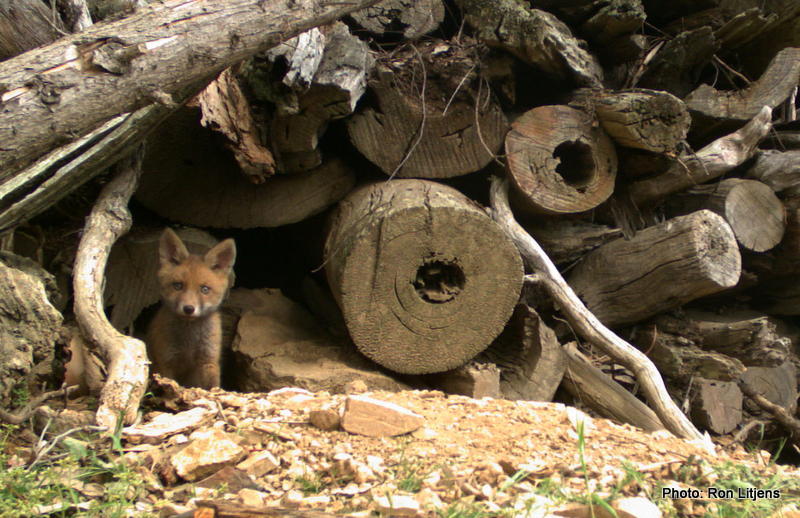 For all you fuzzy-philes, this picture (left) taken at our woodpile should satisfy you (or maybe not!). The Red Fox or European Fox (Vulpes vulpes) needs no introduction. Unfortunately they are a common sight in our district and there is a family of them, including four cubs, in our woodpile.
On a less cuddly note, a recent excursion to the woodpile turned up this Australian Wood Cockroach (Panesthia sp.), pictured below, 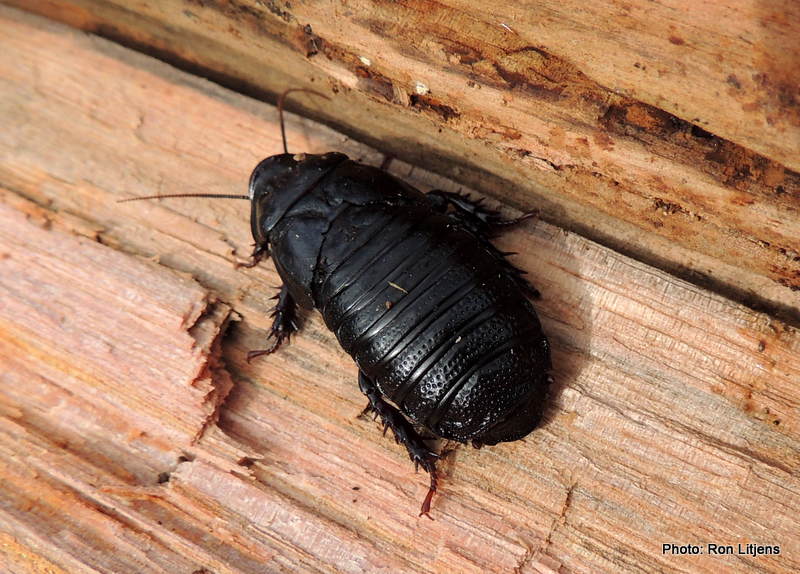 different from the species of cockroach previously reported. The Aussie wood cockroach lives in family groups in rotten logs and the females gives birth to live nymphs. The families tell each other apart using chemical markers. Wood cockroaches are a key agent in the breakdown of wood, using specialised amoebae in their gut to digest the cellulose. Some species of Panesthia are wingless, but others, like the one pictured, shed their wings. If you have a close look at the thorax you can see the wing stumps (click image for larger view).
These wood cockroaches are not warm and fuzzy, but then again they do not spend their lives decimating native wildlife.
Agile by name …
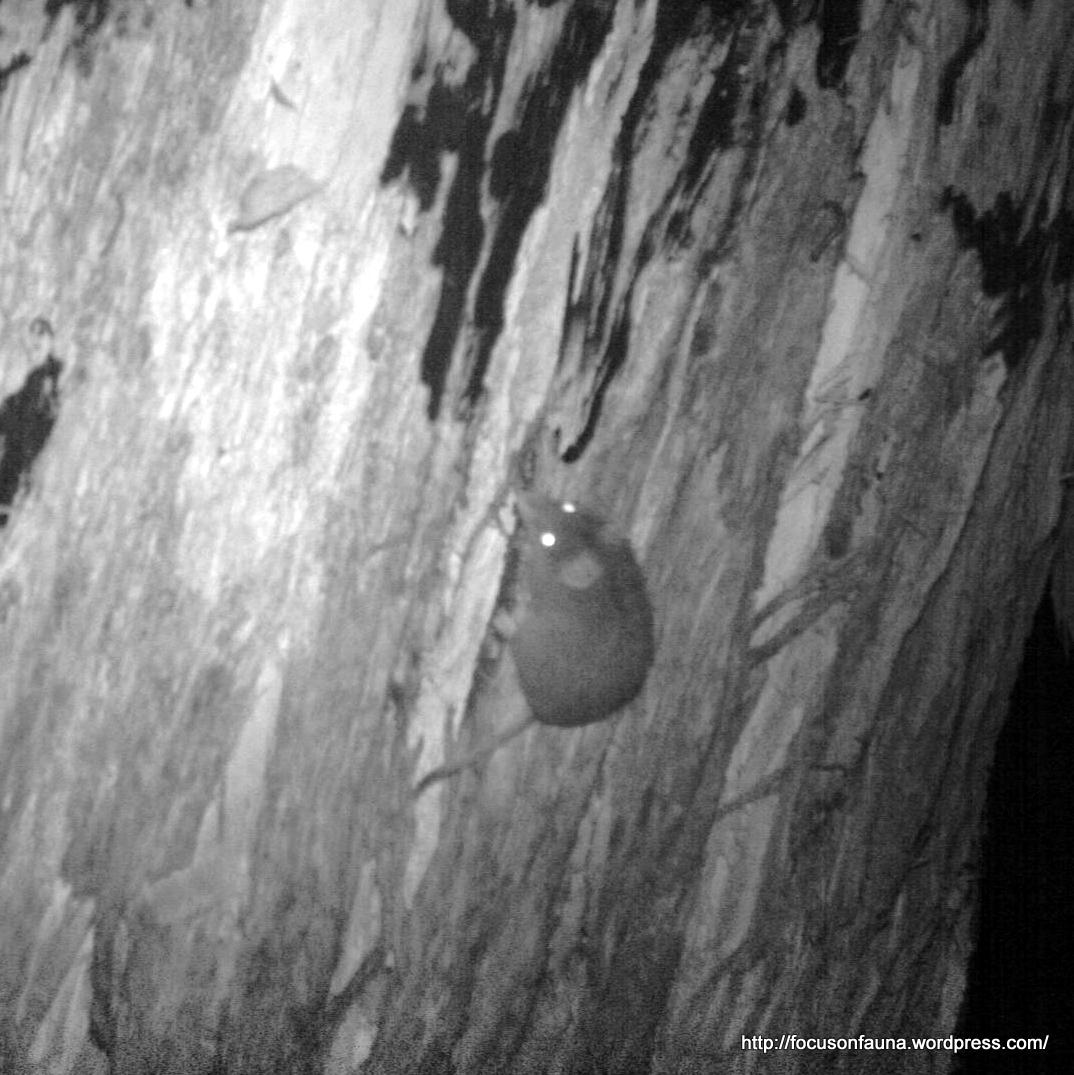 The same remote camera that recorded images of a Grey Currawong featured in our previous post also captured night-time pictures of a small animal darting around the trunk of a Long-leaf Box tree. It is an antechinus, most likely an Agile Antechinus (Antechinus agilis), a carnivorous native marsupial related to quolls, phascogales, dunnarts – and the Tasmanian Devil. Living up to its name, the Agile Antechinus is a swift and acrobatic climber, though it does spend time on the ground foraging for invertebrates.
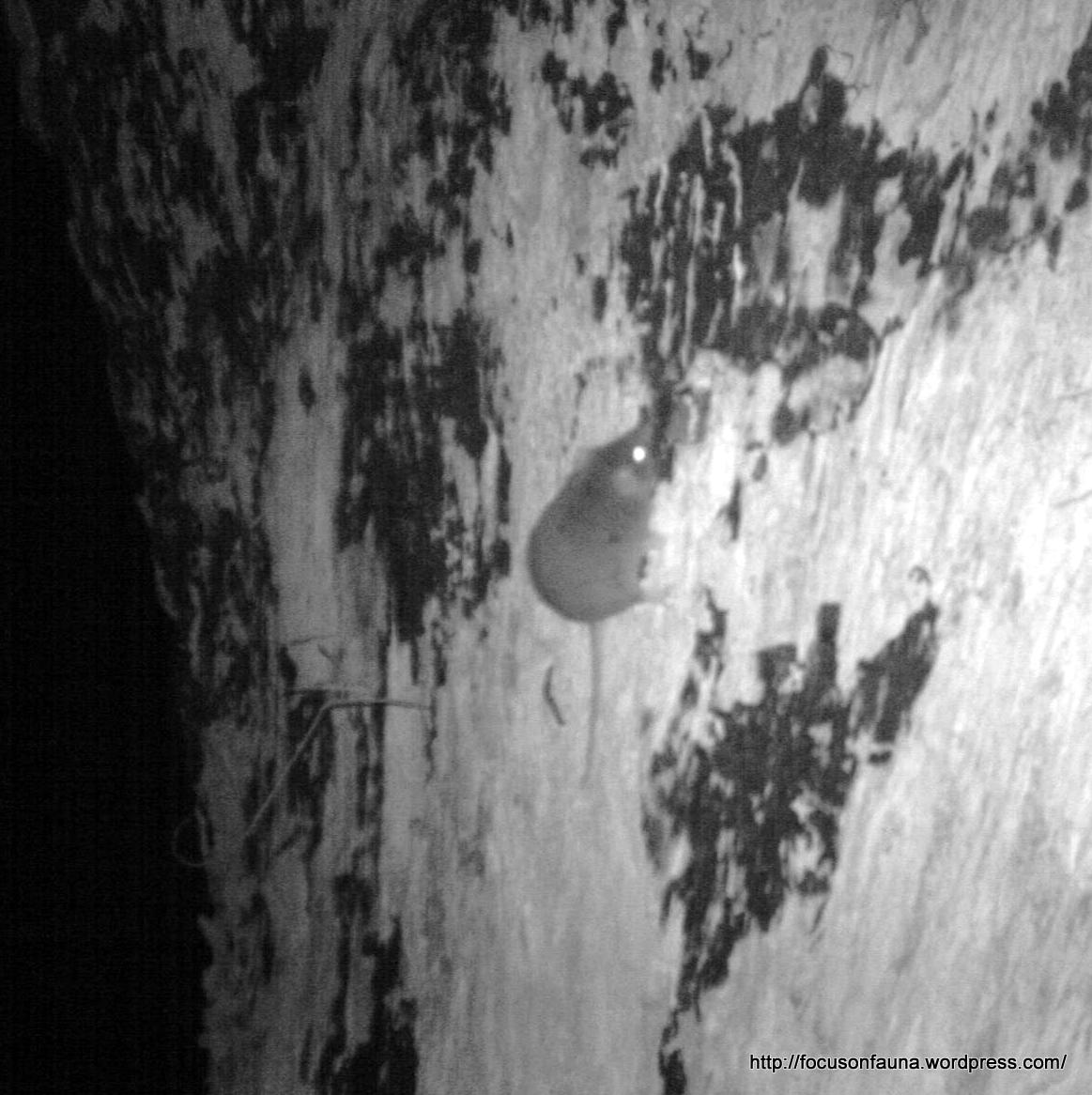
As with phascogales, the winter mating period of the antechinus ends with the abrupt death of all males from stress-induced breakdown of the immune system. Many of the females also have a short life and die before having the chance of a second breeding. They nest in tree hollows, and have been found to readily adapt to artificial nest-boxes.
Barking up the wrong tree?
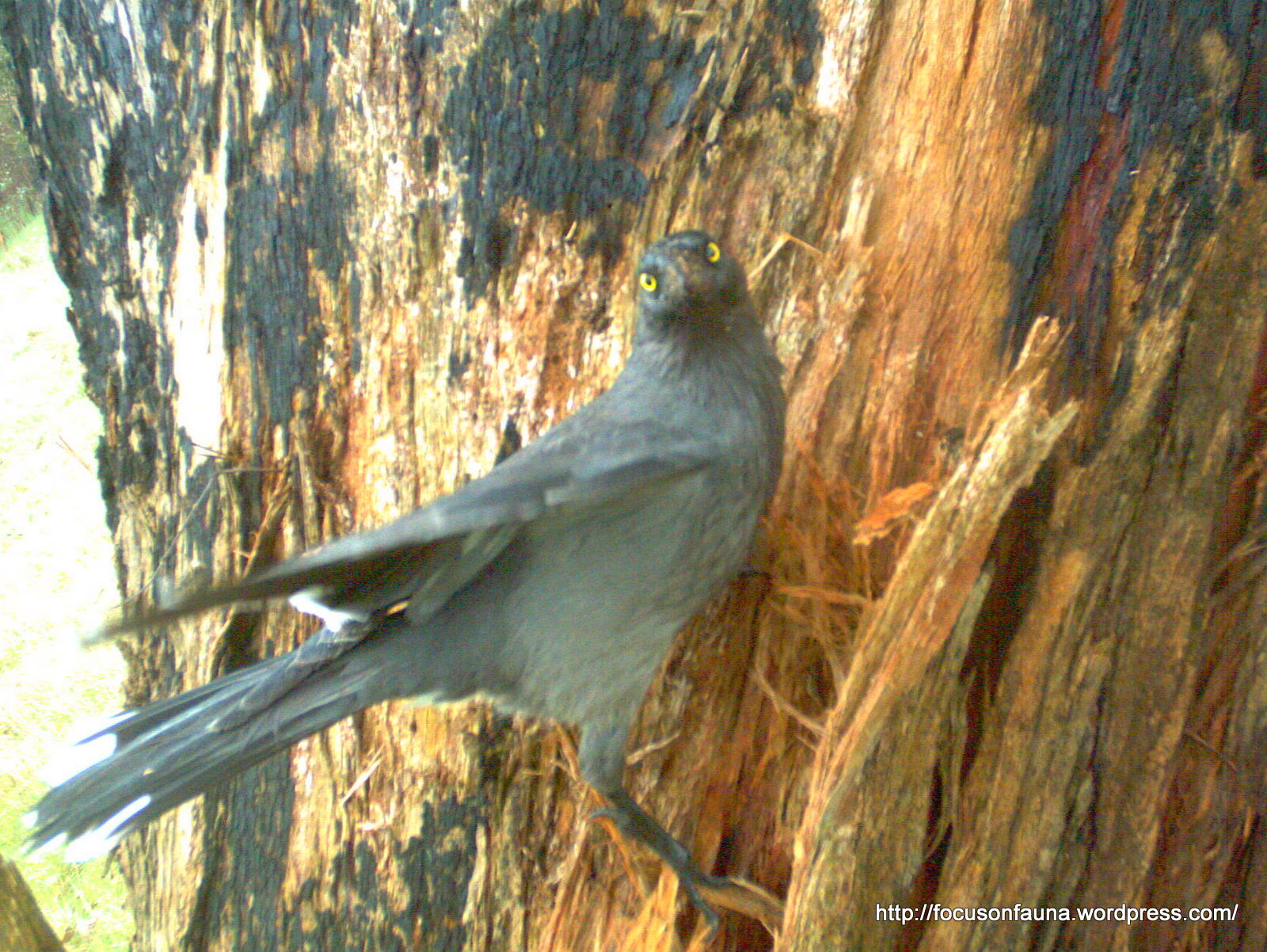 This Grey Currawong (Strepera versicolor) was recorded on remote camera at a Strath Creek Biodiversity Project site on a steep slope of the ‘Three Sisters’, Flowerdale. It seemed to be searching for something under the bark of a Long-leaf Box tree (Eucalyptus goniocalyx), which still shows the scorch marks from the 2009 Black Saturday bushfires.
It spent about 15 minutes on one day without apparent success, then returned for a short period the next day, before flying off empty-handed (-billed?).
As can be seen in the video, the Grey Currawong has a long pick-like bill that it often uses to lever off bark and winkle out invertebrate prey hidden underneath. Its main vocalisation is a ringing two-note call which can be heard by clicking on the audio bar below.
Caught out late
Part of our daily routine involves a power walk up the hill to the top of the road and back. Not only is this a great start to the day but it gives me a chance to spy the next subject for the blogs. Given my walking shoes have orthotics in them which makes them squeak, anything with ears is miles away before I get near. Generally I only come home with pictures of fungi or flowers.
However on this day as I came squeaking around the bend we saw a flash of grey and black hurtling up a Long-leaved Box (Eucalyptus goniocalyx). Close examination of the upper branches revealed a Brush-tailed Phascogale or Tuan (Phascogale tapoatafa) staring down at us. We have previously seen images of these creatures captured on our remote camera as they visited our birdbath at night, but never during the day and never in real-life. Seeing this individual was a huge treat.
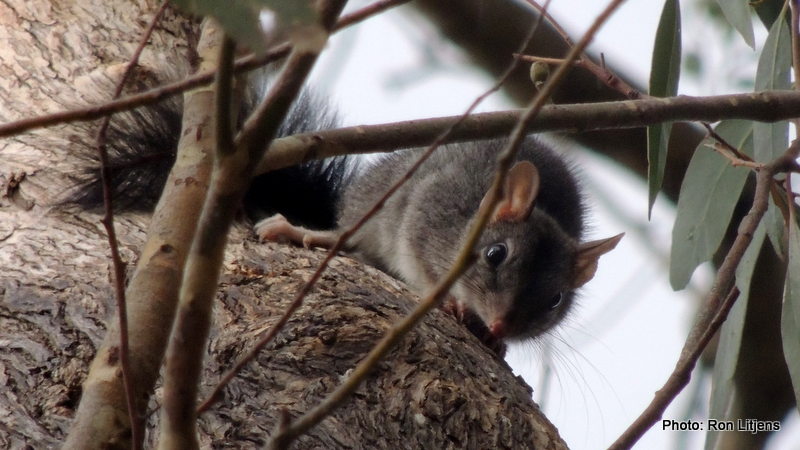 Typically phascogales hunt in trees for birds, reptiles and other small mammals at night. But the mating season is between June and August and we may have observed a male travelling between female partners during the daylight hours. Famously, male phascogales usually die before they are 12 months old as a result of frenzied mating.
Its continued sighting in our area begs the previously asked question about phascogales – endangered or just elusive?
The Bristly Goatsucker returns
 As bird names go, the Australian Owlet-nightjar is a bit of a mouthful. However, I think it is far more preferable than its scientific name, Aegotheles cristatus, which translated from Greek and Latin means Bristly Goatsucker: aigo is Greek for goat, thelazo is Greek for to suckle and cristatus is Latin for crested. The scientific name is derived from the legend that this bird at night suckles from she-goats. The ‘bristly’ part of the name refers to the hairs that stick out from the top of the beak — see photo left.
Anyway, over the past few years an owlet-nightjar has been one of the regular tenants in the nestbox situated in a tree next to our deck. For the past nine months the box has been untenanted and then last week the Bristly Goatsucker returned. The breeding season is between August and December. We hope the bird has moved in to start a family.
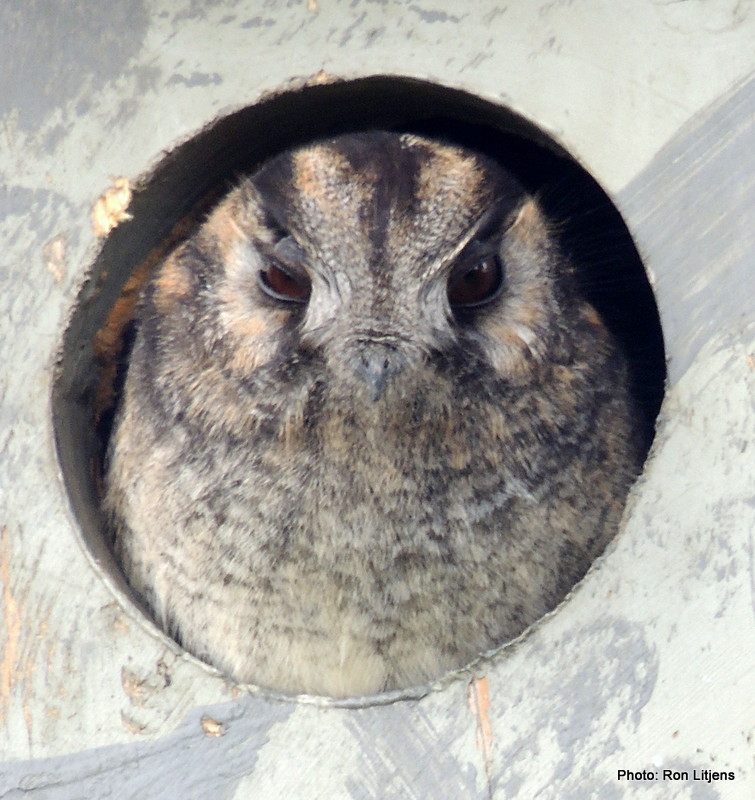 The Australian Owlet-nightjar is the only owlet-nightjar species in Australia. It is extremely inquisitive and none too scared. Any noise we make outside the nestbox, like visiting the wood stash, results in the bird sticking its glider-looking head outside the box for a sticky-beak (pictured right).
We don’t know how long it will stay this time. If previous visits are any indication, not long. But we always know that they are around by the characteristic ‘churring’ courtship call we hear during the dark hours – the name nightjar is said to originate from this sound, as in night-churr.
Moonlight serenade
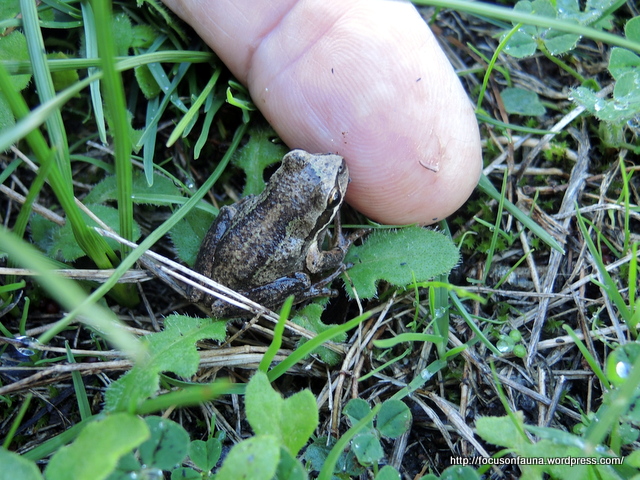 In recent weeks we have been serenaded to sleep by a single frog calling intermittently somewhere near the back door. Listen to the call by clicking on the audio bar below.
We think it is the frog pictured above, a Plains Brown Tree Frog (Litoria paraewingi) which we found close by, hiding under a plastic sheet covering a firewood stack. Well, perhaps it’s not this particular frog, but it does sound like that species.
Meanwhile, down at our large dam and adjacent wetland area, the frog of the month is the Common Froglet (Crinia signifera), which is present in large numbers and in full voice (click below to hear), though it is proving far too wary to allow a photograph. It can also be heard in the background of the previous recording.




 Focus On Fauna