What’s lurking in the leaf litter ?
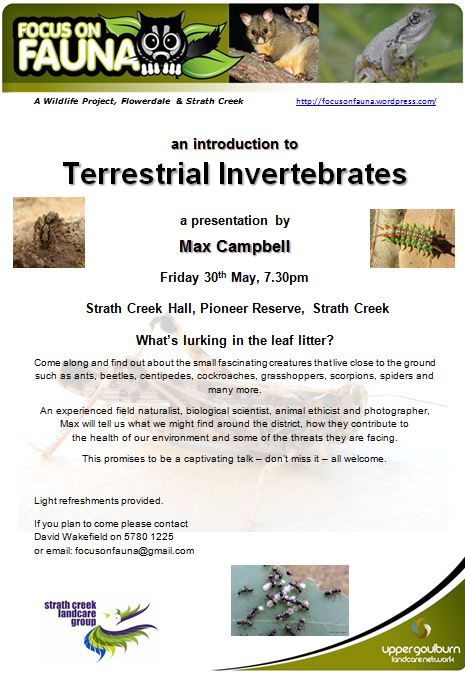 Another Focus on Fauna community information evening is to be held at Strath Creek on 30th May. This time the topic is “An Introduction to Invertebrates with Special Reference to Leaf Litter Faunae” and the presenter is Max Campbell.
Max is an experienced and active naturalist and educator, and current convenor of the Terrestrial Invertebrate Group of the Field Naturalists Club of Victoria. He is also an accomplished photographer and will have plenty of fascinating photos to illustrate his talk.
Invertebrates sit at the lower end of the food chain and are critical to the functioning of ecosystems by recycling nutrients and providing food for the higher levels. They are extraordinarily diverse, complex and adaptable.
Click on the flyer above to see full details of the presentation.
Ever seen a toadstool fly?
The answer probably depends on whether you ate it or not.
 Along our ridgetop after the recent rains a group of Giant Boletes (Phlebopus marginatus) (pictured left) has appeared. This mushroom is Australia’s largest terrestrial fungus. Some specimens have weighed in at over 20 kg.
Where there are Giant Boletes you will find Toadstool (or Fungus) Flies (Tapeigaster sp.) If you look carefully at the photo will find a toadstool fly diligently guarding its domain (from me!). In the brief time I have spent observing these insects the mushroom surface alternates  between a boxing-ring and a boudoir. Male flies patrol their particular mushroom and if another male lands, both rear up on the two pairs of rear legs and appear to box each other with their front legs until one is forced to fly off. If a female lands the process of courting and procreation begins. The resulting larvae feed on the fungus. As they feed, they reduce the large mushroom to a large oozing mess soon afterwards.

Back off! It’s my mushroom.
These flies have been seen patrolling the parasols of several species of mushrooms out at the moment. To see a toadstool fly you don’t need to eat it, just sit patiently nearby and watch.
Focal species found

Southern Whiteface – click on the photo for a closer look
While conducting a bird census last week on one of the Strath Creek Biodiversity Project sites, we were pleasantly surprised to come across a small group of Southern Whiteface (Aphelocephala leucopsis). This small bird (about thornbill size), which is one of a number of woodland species in decline due to habitat loss and fragmentation, was highlighted in the ‘Focal Species’ section of the local booklet ‘Birds of the lower King Parrot Valley’ produced by the Strath Creek Landcare group in 2007. It has not been recorded on the Victorian Biodiversity Atlas database in this district since 1999 (and that sighting was in fact on our own property), although we do recall a later sighting on ‘HumePark’ about 9 years ago.
With its mainly grey-brown plumage, it is not easy to detect, but the white forehead patches are unmistakeable. From front on, it seems to have fallen head first into a bin of flour! It feeds on the ground, often in association with other species such as Yellow-rumped Thornbill. It’s sturdy bill is well-suited to eating seeds as well as insects.
The Southern Whiteface builds an untidy nest in a dense shrub, or often in a hollow tree limb (spout). It has been known to use nest-boxes.
Manky and moth-eaten
 The Crimson Rosella (Platycerus elegans), pictured left, is a beautiful bird. The word elegans in the scientific name refers to this fact. On an elevated, wooded bush block such as ours, these are the only rosellas that visit our birdbath. Not 500 metres away down the valley in the open pasture land, Eastern Rosellas (Platycerus eximius) rule. But not up here.
Normally our birdbath is frequented by quiet and sedate pairs of adults, sometimes with juveniles in tow, quietly chattering to each other. The adult 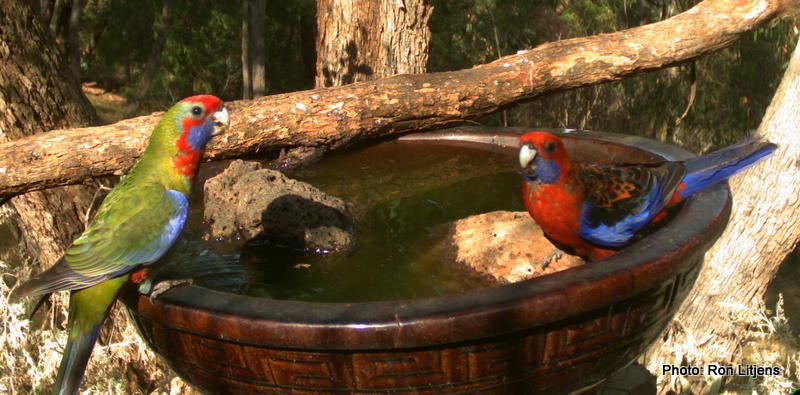 and juvenile Crimson Rosellas have markedly differently coloured plumage. As stunning as the crimson of the adult plumage is I think the juvenile plumage of red, green and turquoise is just as striking (pictured right).
For the past month, especially in the late afternoon, our birdbath has been invaded by  boisterous groups of sub-adult rosellas. They travel in flocks of half a dozen or more, are loud and extremely active, and usually use the bath as a diving pool. We call them the teenagers. Their plumage is starting to transition from the green juvenile feathers to the crimson feathers of the adult. They have a manky and moth-eaten appearance (as a lot of teenagers do) when patches of crimson feathers start to appear all over the body.
It looks like a form of avian acne.
Sluggish snake
 This Tiger Snake (Notechis scutatus) was looking decidedly sluggish when spotted the other day with the temperature only 14°C. It stayed motionless for a long time , despite our moving out of its view, before slithering off very slowly indeed.

The colouration of Tiger Snakes is quite variable and the banding on the body is not always obvious. To confuse matters, juvenile Eastern Brown Snakes can show some banding. One of the distinguishing features is the frontal shield (large scale on the centre of the head), which in the Tiger Snake is about as wide as long, whereas the brown snake’s shield is longer than it is wide. Fortunately, with a super-zoom camera you can get a clear view of a snake’s head without fear of getting bitten – see picture at right.
A hive of activity
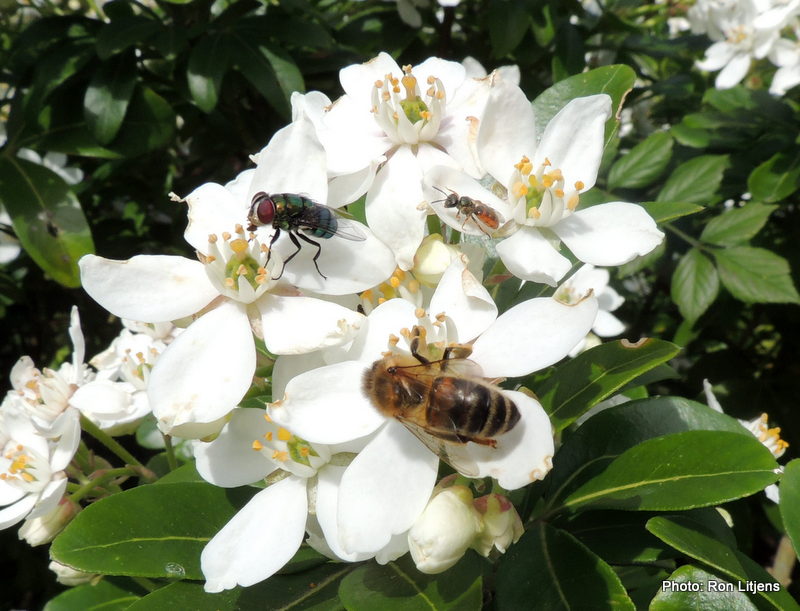 Looking across the landscape at the moment not much is flowering. At our place the Mexican Orange Blossom (Choisya ternate) is the one showy exception. An exotic shrub planted by the previous owners, it is currently in full bloom and attracting a vast collection of insects – similar to the Burgan (Kunzea ericoides) earlier this year (click HERE to view). The plant is a hive of activity, literally. Honey Bees, various native bees and even some bee look-alikes are all in a feeding frenzy.
 Pictured above, a European Honey Bee (Apis mellifera), a Blowfly (Chrysomya sp.) and a smaller native Reed Bee (Exoneura sp.) share a flower head. A lot has been written about the European Honey Bee and the detrimental effect its larger mouthparts (compared to native bees) have on the native flora. The photo clearly shows the difference in size between the two.
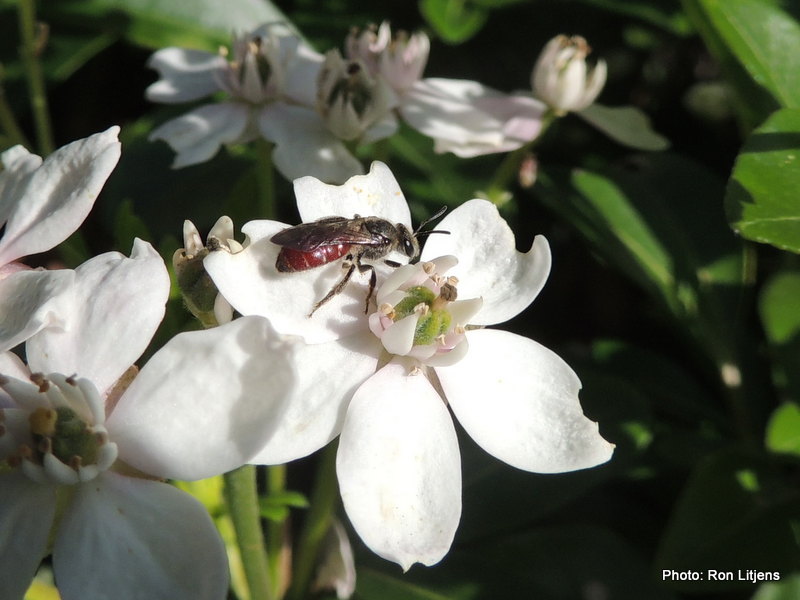
The Reed Bee (pictured right) is so called because it generally nests in the dried-out stems of plants, particularly plants with a soft-cored stem like 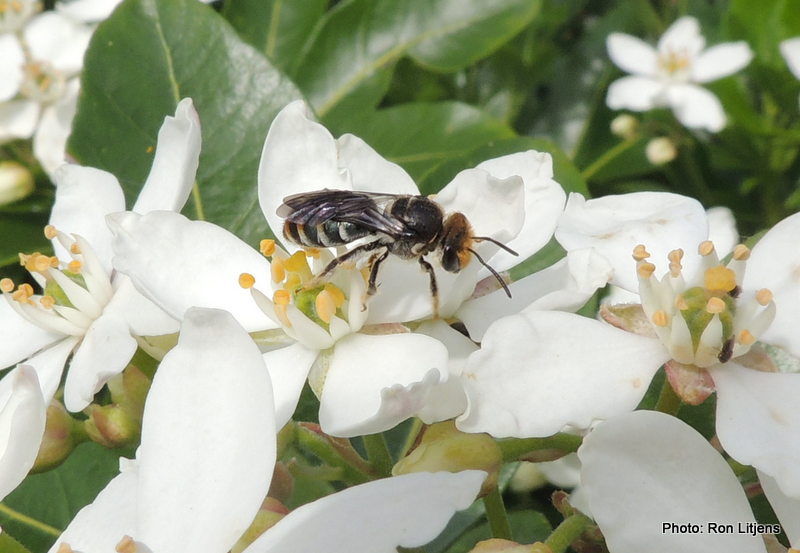 Native Raspberry (Rubus parvifolius) or Blackberry (Rubus fruticosus). They are a social bee, co-operatively looking for food and sharing and guarding a nest. During the winter the adults hibernate, meaning that the bee pictured is probably starting to feel a little sleepy.
Another native bee present, pictured left, is possibly a Gold-barred Nomia Bee (Nomia sp.). Also a social bee, the Nomia bee builds a nest in the ground that is shared by a small number of 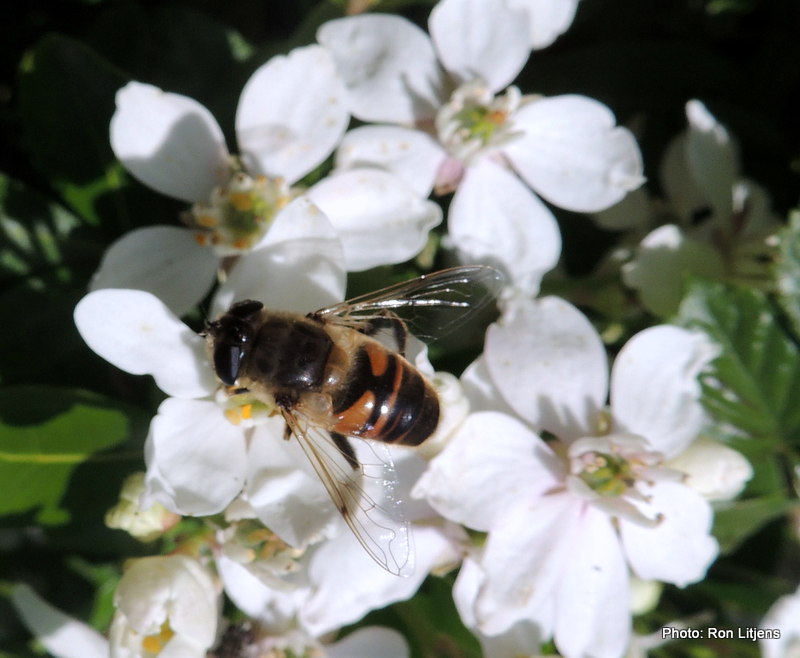 females. As with the Reed Bee, the adults collectively forage and guard the nest. In the case of both the Reed Bee and the Nomia Bee the female guards the nest by blocking the nest entrance with her body. During the day she uses her head and at night she turns round and uses her ‘bee-hind‘.
Also contributing to the activity is a bee look-alike, the European Drone Fly (Eristalis tenax), pictured right. From a distance it looks like a honey bee and even more like a honey bee drone, but being a true fly it only has two wings. Its name is derived from the high-pitched drone caused by the rapid beatings of its wings. What a buzz.
Spreading our wings
This blog is supposed to be about wildlife in the Flowerdale-Strath Creek area, or at least the Upper Goulburn catchment, and indeed most of the posts are. But occasionally we receive amazing pictures from further afield and can’t resist sharing them with our followers. In this case, Bronnie and Gavin, well-known Strath Creek residents, sent us photos from Peru of a few of the spectacular birds they have come across on their South American travels.
With over 1,800 species of birds, Peru is a paradise for bird watchers. This total includes 21 species of toucans and an incredible 135 species of hummingbirds!
Thanks to Bronnie and Gavin for the pictures and we wish them well on the rest of their trip.
The picture tells the story
 The devastating effects of barbed wire on wildlife have been previously posted on this website (click HERE to view) and have recently featured on the King Parrot Creek Environment Group website. Let me state up front that I am not a farmer and have never been one. I have not experienced the vagaries of ovine or bovine mentality. Therefore, to those who run stock, the following commentary may appear naïve or biased. I do realise that to replace all the barbed wire on a property is expensive, but if you are building a new fence consider the effect that barbed wire has on the native fauna.
These photographs were taken last week. They were taken on a piece of land so rocky and so steep that only a cow or sheep with a  hover pack could have reached it (therefore any justification for barbed wire based on stock pushing through fences is probably invalid). The bloodied tufts of feathers on the ground suggest that the ensnared Southern Boobook (Ninox boobook) struggled to free itself for some time, and probably died a slow and painful death from hunger or thirst or both. No creature, whether it be a magnificent owl or a humble moth (featured previously), deserves a death like that. The picture says it all. End of commentary.
P.S. The views expressed by this author do not necessarily reflect the views of other authors on this website (although I suspect that they do).
Not so commonly seen
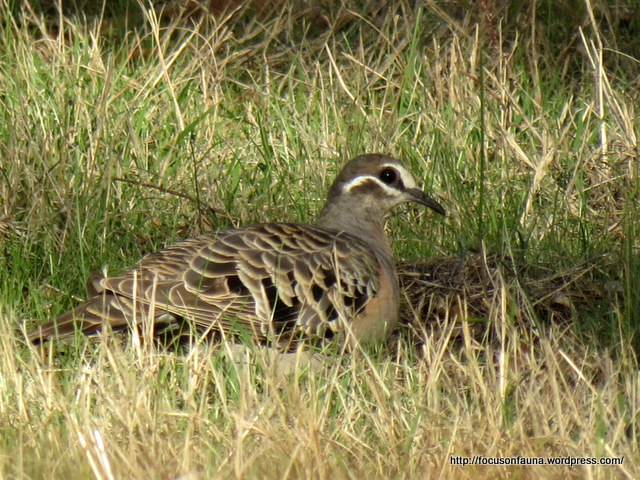 This attractive pigeon may be dubbed Common Bronzewing, but common doesn’t always equate to being seen often. It is normally a shy and wary ground-feeding bird that flies off rapidly with a clatter of wings when disturbed. Despite its iridescent wing colouring and white cheek stripe, it is often well camouflaged, especially in the dappled shade of its usual habitat of drier forests or woodland, including roadsides, and heathy scrub. The ‘common’ label was probably given to separate it from its similar-looking but less widely distributed relative, the Brush Bronzewing.


The bird pictured, which was photographed between Strath Creek and Flowerdale, is a male. Like many birds, the female has generally duller plumage, although she retains the distinctive wing colouring and white facial line.
The call of the Common Bronzewing is a deep, resonant and repetitive ‘oom’, which can be heard by clicking on the audio icon below.
The lores of nature
 The part of a bird’s head between the eye and the beak is termed the lores. Even though all birds have them, for most birds the lores do not get a mention in any field guide. However for some bird species the lores are critical for identification purposes. An example is the Superb Fairy-wren (Malurus cyaneus). The red-brown lores and eye-ring of the female fairy-wren (see picture left) distinguish it from other fairy-wren species.
 .
.
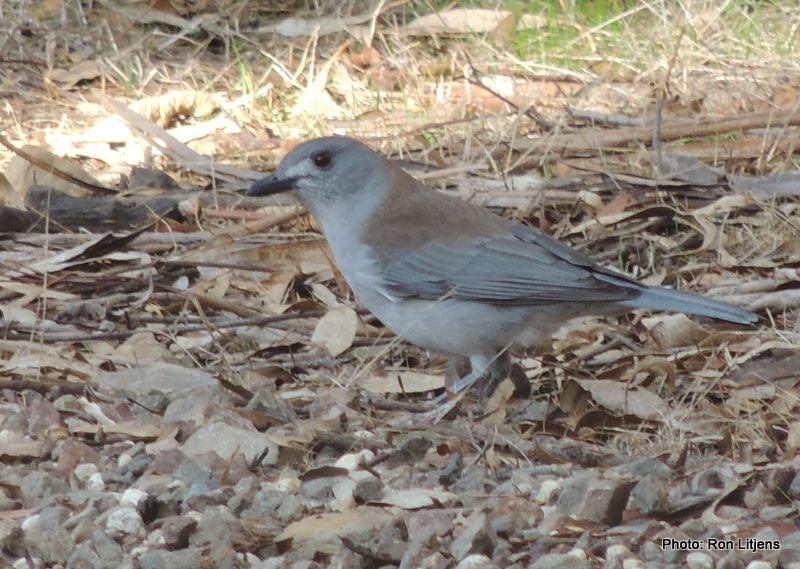
For another local resident, the Grey Shrike-thrush (Colluricincla harmonica), the colour of the lores is one of the features that distinguish the male (pictured right) from the female, the male having white lores, the female grey.
.
.
 A recent visitor to our dam has been a Great Cormorant (Phalacrocorax carbo), pictured left. The lores on this specie are not feathered but comprised of bare skin. The colour and intensity of the lores can also indicate breeding status, level of aggression and the extent of any stresses the bird might be under.
.

There are no lores against Black Snakes
Birds are not the only creature with lores. Reptiles and amphibians have them too. In snakes the scale between the eye and the nose is called the loreal scale (not a weighing device for cosmetics). Interestingly, this scale is missing in snakes of the Elapidae family – 99 venomous species in Australia including our local Tiger Snakes, Black Snakes and Brown Snakes. So if you see a snake whilst you are bush-walking, the absence of a loreal scale should tell you to keep clear. Of course to get close enough to see that you would have to disable the snake. And there are laws against that.




 Focus On Fauna