Floating nest
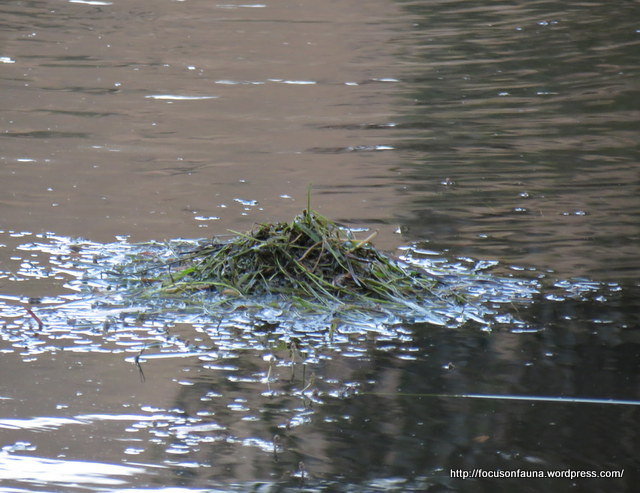 A pair of Australasian Grebes has built this nest of floating plant material right in the middle of our large dam. The nest appears to be anchored to underwater stems of Floating Pondweed (Potamogeton sp). It may seem vulnerable but, at the slightest disturbance, the sitting Grebe is very adept at quickly covering the eggs, slipping off into the water and pretending it’s just hanging out near a pile of reeds with not a care in the world. A hide set up in bushes on the bank and a lot of patience were needed to get the photos below.
See also a previous post on grebes: Dressing down for winter
They’re driving us Raven mad

Adult (left), chick (right)
If you haven’t noticed the young ravens around the place this season you must have industrial-strength earmuffs on or you are clinically deaf. Starting when the sun comes up the incessant squawking for food from the chicks doesn’t stop until the sun sets. A new family of Little Ravens (Corvus mellori) has taken up residence around the bird bath. It consists of mum, dad and two bawling chicks (more effective than any alarm clock). The chicks seem to be able to squawk even as food is being shoved down their throats.
Two types of raven inhabit the King Parrot Creek valley—the Australian Raven (Corvus coronoides) and the Little Raven. On first sight the difference is hard to pick. As the name suggests the Little Raven is slightly smaller than the Australian Raven with a smaller beak. The call of the Little Raven also lacks the drawn out ‘aaaaaaaaahh’ at the end.
Pictured are adult and chick at the bird bath. You can usually pick the chick by the gaping beak begging for food. And that squawking. Another sign is the eye colour. In young ravens the eye is brown. It then progresses through hazel and is white in the third year. I have also noticed (although I haven’t read it anywhere) that the beak of the chicks shows flashes of pink.
A change of diet?

Fireblight Beetle
In September 2012 we posted a brief story about Fireblight Beetles (Peltoschema orphana) attacking local wattles (see What’ll happen to the wattles ?). The wattles mentioned were those with feather-like (bipinnate) foliage: Silver Wattle (Acacia dealbata) and Black Wattle (Acacia mearnsii).

Defoliated Cinnamon Wattles
So, are Cinnamon Wattles a recent addition to the Fireblight Beetle’s diet ? We would welcome comment from anyone who has come across this sort of defoliation before. Interestingly, nearby stands of other post-fire regrowth wattles in the forest such as Mountain Hickory Wattle (Acacia obliquinervia) and Narrow-leaf Wattle (Acacia mucronata) appeared to be unscathed, but Silver Wattles around the Strath Falls area again looked scorched, indicating attack by Fireblight Beetles similar to last year.
-
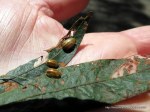
- Fireblight Beetles on Cinnamon Wattle
-

- Cinnamon Wattle leaf damage
Substituting ingredients
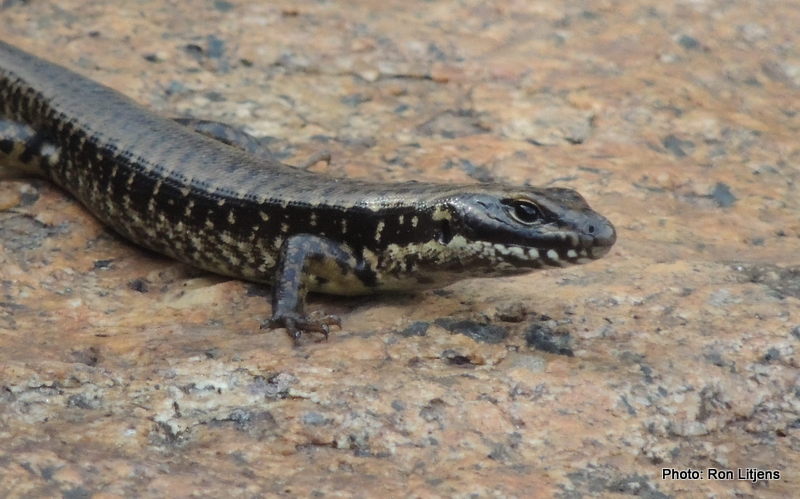
 I like cooking exotic recipes but sometimes you just can’t get the ingredients that the recipe calls for. Take the recipe for my favourite enchantment, borrowed from Shakespeare – ‘Eye of newt and toe of frog, wool of bat and tongue of dog’. I don’t know about you but I haven’t seen a newt around these parts for ages. In this case I go for the next best thing – from our own backyard, eye of Jacky Lizard (Amphibolurus muricatus) (pictured left) or for that special occasion eye of Yellow-bellied Water Skink (Eulamprus heatwolei) (pictured below) , so the experts say, recently seen in Tallarook State Forest. Not being an expert on reptiles I hope that the identification is correct otherwise my recipe is ruined.
 Jacky Lizards belong to the family of lizards known as Dragons (Family Agamidae), of which there are 78 Australian species. They are characterised by small and rough body scales, an upright posture and hind legs that are significantly longer than the front ones. I have often seen lizards of this family running around on hind legs.
Skinks belong to the Family Scincidae and there are 431 Australian species. Typically they have smooth, overlapping scales and are often seen sunning themselves.
Not only do these ‘newt’ substitutions add a local flavour to the invocation, but in line with Yea’s Cittaslow philosophy, I am also helping the planet by reducing the ‘food miles’.
Intimate encounters
 Apart from the chance to record the occasional shot of a threatened species, one of the benefits of remote surveillance cameras is that they provide glimpses into aspects of the daily lives of our common wildlife that most of us rarely get a chance to observe. A camera set up over a two-month period on one of the Strath Creek Biodiversity Project sites on Allandale Road, Strath Creek, recorded many shots of Eastern Grey Kangaroos (Macropus giganteus) feeding, lounging, socialising and mating.
We have put together two video clips – one shows the quite intimate relationship between a joey and its mother, who develop a strong bond until the youngster is able to fend for itself. The other clip includes part of a long sequence of shots of a male and female kangaroo copulating, an encounter that lasted about 20 minutes with two short breaks, although “Mammals of Australia” – ed. Ronald Strahan, states this can last up to 50 minutes!
Note: You may need to stop the videos and let them fully download before playing right through.
Warning: sensitive viewers may choose not to watch the following video !
The singing trees of Tallarook

Redeyes ‘sucking it up’.
The first day of summer, being hot and sunny, deserved something special – a bushwalk in the Tallarook Range, a granite intrusion looming over the King Parrot Creek valley. The familiar summer sound of cicadas got louder as we walked deeper into the forest until it became almost deafening. Young smooth-barked eucalypts and acacias were festooned with thousands if not tens of thousands of cicadas known as Redeyes (Psaltoda moerens), so called for obvious reasons (see picture left).
Redeyes, common to south-eastern Australia, appear between November and February. They spend most of their lives feeding on the sap of young eucalypts and angophoras, which they do by puncturing the bark. After mating, they lay eggs in dead plant tissue. Unlike the previously featured Greengrocer cicada, which makes its sound by rubbing the top of its wing against its thorax (click HERE to view post), the Redeye does so by flexing its abdomen upwards. Click the video below to see the sound action.
My summer PPE (personal protective equipment) kit is quickly taking shape. As discussed in previous posts it now consists of a helmet (protection from dive-bombing magpies and falling pine cones released by black cockatoos), gaiters (for keeping snakes and grass seeds at bay) and now industrial earmuffs for protection against cicadas. And I wonder why people run the other way when they see me bushwalking.
Four of a kind

Four young galahs

The parents watch from a distance
It’s back – at its bushy best
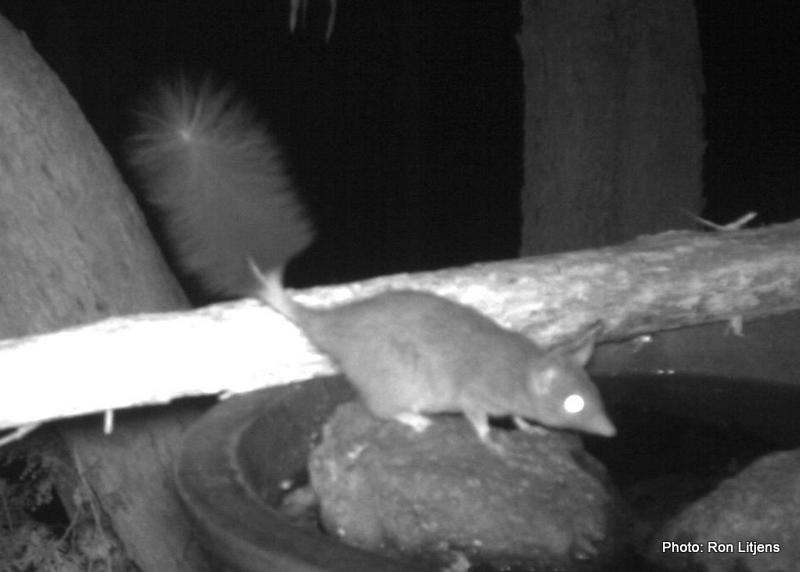 We have been remotely recording the nocturnal comings and goings at our birdbath for three years now. In that time we have only managed one visit from this critter (click HERE to view). This week we were surprised to find the Tuan or Brush-tailed Phascogale (Phascogale tapoatafa) was back in town and proudly displaying the eponymous body part. Even though it has featured in previous posts, it is the most exotic of the creatures to visit our bird bath (to date), so here it is again.
Not to be out-done, if you look carefully you can see the eye-shine of Wally the Southern Brown Tree Frog (Litoria ewingi) peeking out from under the branch to the right of the phascogale’s left ear. We haven’t seen Wally in a long time either.
 P.S. Speaking of exotic animals visiting the birdbath, on the night before going to press, for the first time ever a Koala (Phascolarctos cinereus) decided to stick its snout into the picture frame. Where’s Wally? It was obviously too much for Wally. It is nowhere to be seen.
Life Lesson #1 – Camouflage
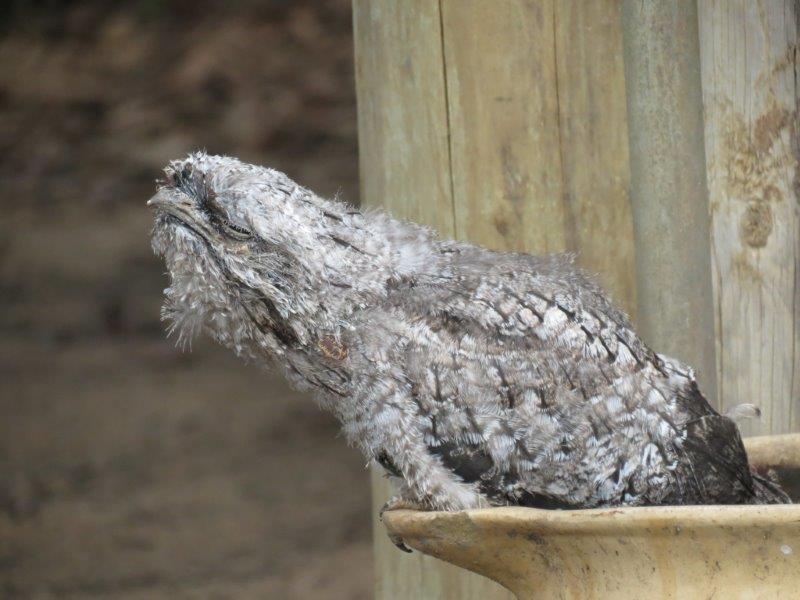
I wonder where the Tawny is!
As promised in a previous post (click HERE to view), we are continuing to follow the development of the Tawny Frogmouth chick at Trude and Len’s place. The chick is beginning to learn the life lessons essential for survival.
One of the features of Tawny Frogmouths (Podargus strigoides) is their outstanding ability to blend into the scenery. Sometimes even when you know where a Tawny Frogmouth is roosting, it is difficult to distinguish it from the branch on which it is perched. When threatened, a Tawny Frogmouth sits still with its beak pointed up in the air, looking just like a part of the tree.

Proud parent
Pictured above is the baby Tawny Frogmouth demonstrating the camouflage pose. Even though the pose is well executed, here is a life lesson for the young bird – if you are going to pretend to be a tree branch, don’t do it sitting in a bird bath. It doesn’t work. We can still see you. Try sitting in a tree.
Why pick on me ?!
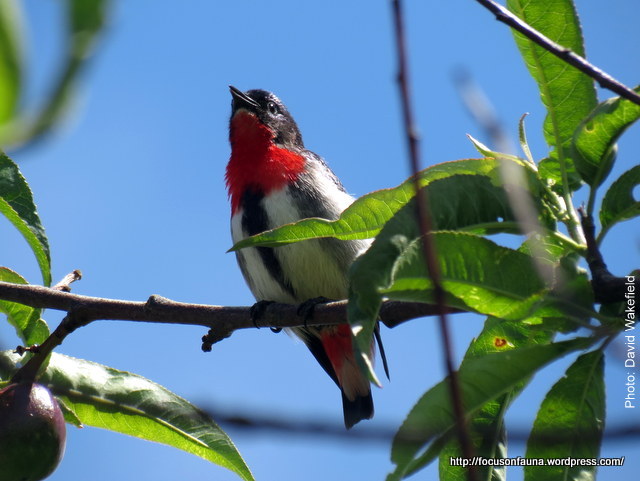 The colourful little bird pictured here is a male Mistletoebird. It is one of two specialist bird species, the other being the Painted Honeyeater, that feeds almost entirely on mistletoe fruit, although they can supplement their diet at times with insects and other fruit. Both species defecate the mistletoe seeds rather than regurgitate them after digesting the pulp. The sticky seeds need considerable pecking and wiping on a branch to release them from feathers around the vent. The widely-held belief that mistletoebirds deliberately turn side-on to deposit the seeds on a branch is apparently largely a myth. In his excellent book “Mistletoes of Southern Australia”, David Watson calls into question another widespread claim that the mistletoe specialists, Mistletoebird and Painted Honeyeater, account for the vast majority of newly-established mistletoe. Research shows that Mistletoebirds tend to stick to areas which already contain mistletoe, and it is the non-specialist mistletoe feeders, including a number of honeyeaters, the Olive-backed Oriole and the Silvereye, that may be the principal dispersers of mistletoe to new areas.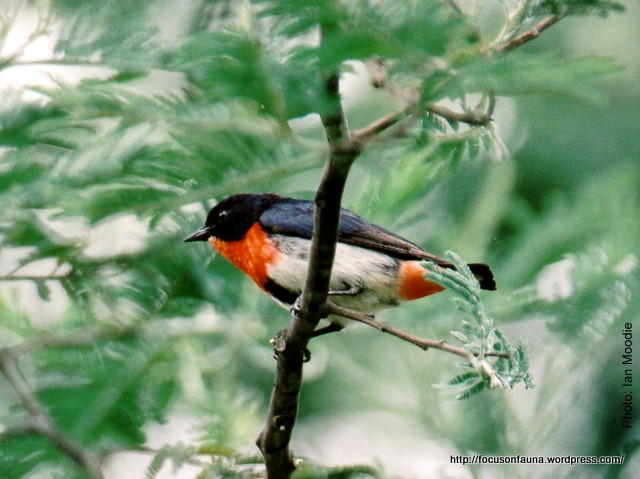
Historically the Mistletoebird has come in for a lot of flak, literally. David Watson quotes a 1939 letter to a beekeeping journal entitled ‘Mistletoe bird is spreading the mistletoe pest’:
“I have cut 26 mistletoe growths off only a fair sized Red Ironbark tree. I decided after some years of cutting off and pulling down to make war on the birds that were responsible, but found them a tougher problem than I expected, for I never guessed they were so numerous. I have destroyed well over twelve hundred [our emphasis] of these birds during the past six years, nearly all on my own property, and still there are a few coming in from other parts.”
This attitude was apparently shared by many landholders and even naturalists at the time, and persists to some extent even today, which is a pity as the Mistletoebird may prove not to be the main disperser, and mistletoe itself should be recognised as an important natural component of the Australian environment. Excessive mistletoe is a result of over-clearing of understorey vegetation, creating environmental imbalances, with the loss of regulators such as possums and butterfly larvae which consume the foliage. It is surely better to rectify those imbalances rather than shoot the messenger!
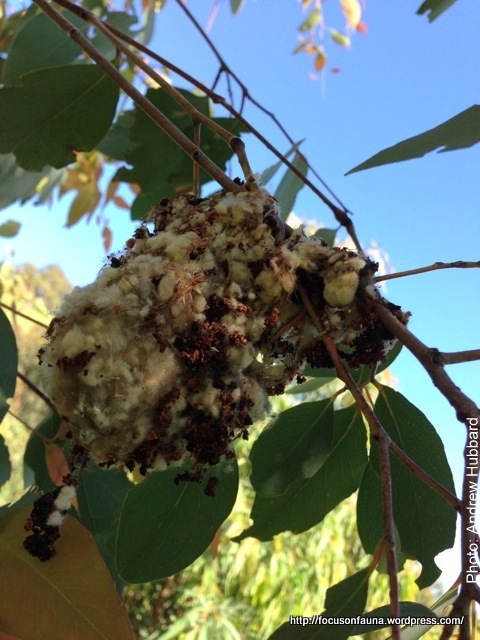
At left is a nest photographed by Andrew on the Three Sisters property between Flowerdale and Strath Creek. The hanging purse-like shape with a side entrance looks to us like a typical Mistletoebird nest. Although usually made of plant down and cobwebs, this one is mostly wool, probably because there was a pile of sheep crutchings close by – a good example of opportunism. The female builds the nest and does all the incubating.
Incidentally, Mistletoebirds have been sighted in Tasmania in recent years despite there being no mistletoe in that state. Evidence of mistletoe has been found in the fossil record there, but it is unlikely that mistletoe populations will be re-established by birds from the mainland considering the rapid passage of seeds through the Mistletoebird’s gut and the long journey involved.
The audio below is of a Mistletoebird calling in synch with a Peron’s Tree Frog. Is it coincidence, or call and response?




 Focus On Fauna