Just hanging out
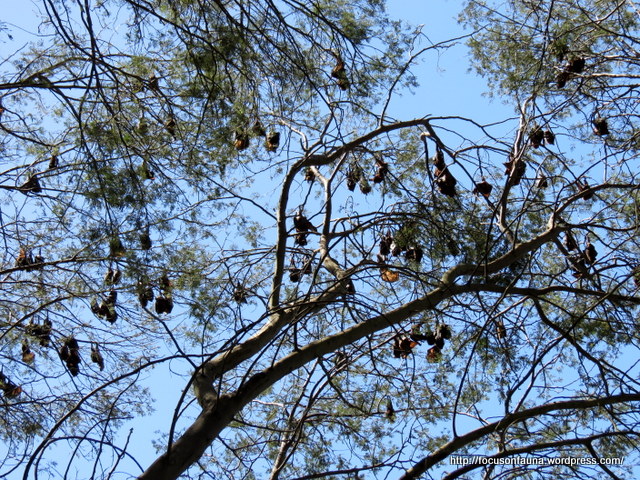 These Little Red Flying-foxes (Pteropus scapulatus) are not exactly local to Flowerdale/Strath Creek – they were photographed recently beside the Goulburn River at Seymour – but they are interesting visitors to the general area, and do provide an opportunity to mention an upcoming talk on Bats by wildlife ecologist Rob Gration this Friday 31st January in Yea. Full details can be seen by clicking on the flyer thumbnail image below.
Little Red Flying-foxes are not the species found in the Melbourne area that has caused problems in the Botanic Gardens in the past – that is the Grey-headed Flying-fox (Pteropus poliocephalus). The Little Reds are highly nomadic, searching for flowering eucalypts (mainly River Red Gum, Eucalyptus camaldulensis) as a source of nectar, their staple food. They can congregate in very large numbers, but only a small fraction of the total population occurs in Victoria (mostly northern Victoria) at any one time. 
At Seymour there may have been up to 200 gathered. While we watched they were constantly restless, shuffling and squabbling for position, and seemed only occasionally to wrap up and get some sleep, like the one shown below. 
Q: How many choughs can you fit in a birdbath?
A: The whole family
 Last week’s spate of very hot weather prompted some unusual scenes at our bird bath, which was a very popular venue indeed. Over 20,000 shots were taken by the remote camera in four days before the SD card filled up and the camera stopped. The temperature shown in the upper right of the images is probably overstated, but only by 1 or 2 degrees. It was HOT.
The bath was hogged for the majority of the days by the resident White-winged Choughs (Corcorax melanorhamphos). Highly social birds, they had no problems all squeezing in to the bath together. The photo above shows nine choughs but the record we counted was sixteen. A family that bathes together, stays together.
 The smaller bird species had no problem in sharing the facility (photo right). It is the first time we have seen the Eastern Yellow Robin (Eopsaltria australis) at the bath since the ’09 bushfires. Bathing buddies included a Yellow-faced Honeyeater (Lichenostomus chrysops) and on the branch a White-throated Treecreeper (Cormobates leucophaea).
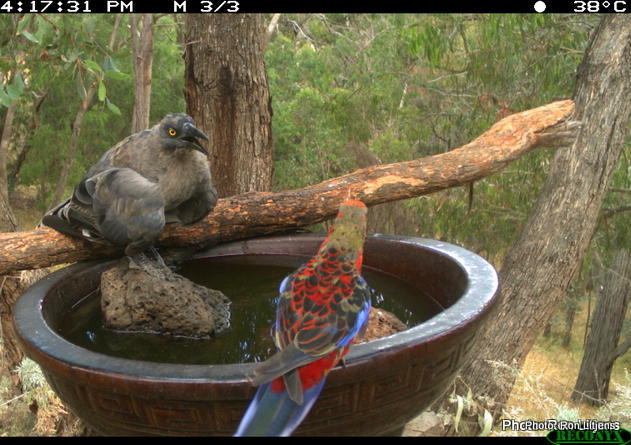
More unusually the larger bird species that never bathe together were seen to throw politeness out the window and participate in a little ‘argy-bargy’ for first use of the water. Pictured left a Grey Currawong (Strepera versicolor) and a young Crimson Rosella (Platycercus elegans) ‘get it on’.
First time users of the birdbath included an Australian Magpie (Cracticus tibicen) and an Olive-backed Oriole (Oriolus sagittatus ).
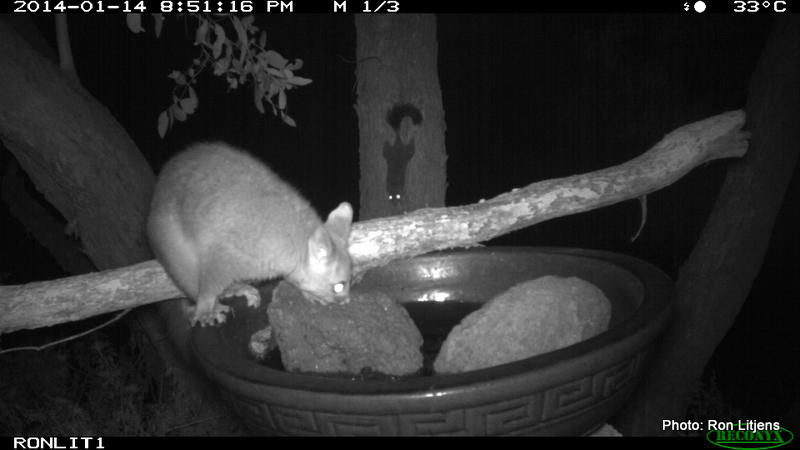
Brush-tailed Phascogale (background) waiting for a Brush-tailed Possum to finish.
Common Ringtail Possums were photographed having a drink during the day while at night the fauna respected one another’s personal space and formed an orderly queue.
As I look out the window today a light rain is falling on the valley and behaviour around the birdbath is as it ever was. The natural order has returned.
Snake v snake
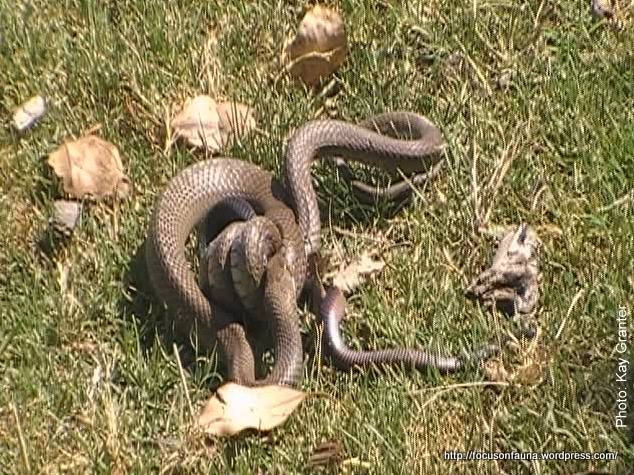 Kay and Neil from Strath Creek, who have alerted us to several interesting wildlife sightings, have done it again. Kay and her children spotted this tangle of snakes close to their house last week and managed to record a fascinating sequence on video, some of which is shown in the clip below. It took a few moments for them to realise that it was, in fact, an Eastern (or Common) Brown Snake (Pseudonaja textilis) eating a Red-bellied Black Snake (Pseudachis porphyriacus).
The Eastern Brown Snake feeds on a wide range of vertebrates, with reptiles forming a large part of its diet. It often holds its prey in tight coils of its body, as in this case, while its powerful injected venom takes effect.
This is a noteworthy observation because : a) the Eastern Brown Snake is a relatively slender snake compared to an adult black snake (so this is probably a young black snake) and b) there is a commonly held belief that black snakes are aggressive towards other snakes and will keep them away from the immediate vicinity (perhaps we have busted that myth?)
The video ends rather abruptly when the brown snake became aware of its audience who rapidly retreated as it unravelled and took off with half the black snake trailing from its mouth !
Kay’s report reminded us of a similar incident back in 1991 (showing our age !) when we observed one brown snake consuming another of the same species, prompting us to seek an explanation for this cannibalism from the Questions and Answers section of the excellent magazine Australian Natural History put out at the time by the Australian Museum. The lengthy response (ANH Vol 23 No 9) provided some interesting information. “Many Australian snakes do eat other snakes as a normal part of their diet.”, and “The eating of the same species has been observed in [among others] the Copperhead, Red-bellied Black and Eastern Brown Snakes.” Allan Greer from the Australian Museum who penned the reply also raised the possibility of the eating of another snake being accidental, ie “… should two snakes start feeding at the opposite ends of the same prey animal, one of the two is very likely to engulf the other, as if it failed to distinguish where the prey left off and the competitor for the prey began. This seems to be due in part to an apparent obsessiveness evident in many species of snakes to finish feeding once it has begun. This single-mindedness may be related to the relatively infrequent feeding opportunities snakes (and other carnivores) often have: when prey is captured, its consumption becomes an almost total, short-term priority.”
Allan finished with the words “… almost everything we know about snake diets comes largely from three sources: the detailed examination of museum specimens, the careful observation of captive specimens and chance observation in the field. The third source shows the importance of serendipitous observations, often made by members of the general public, in advancing scientific understanding.”
So, well done Kay and family – keep on being observant and adding to our knowledge of native wildlife !
An unexpected visitor
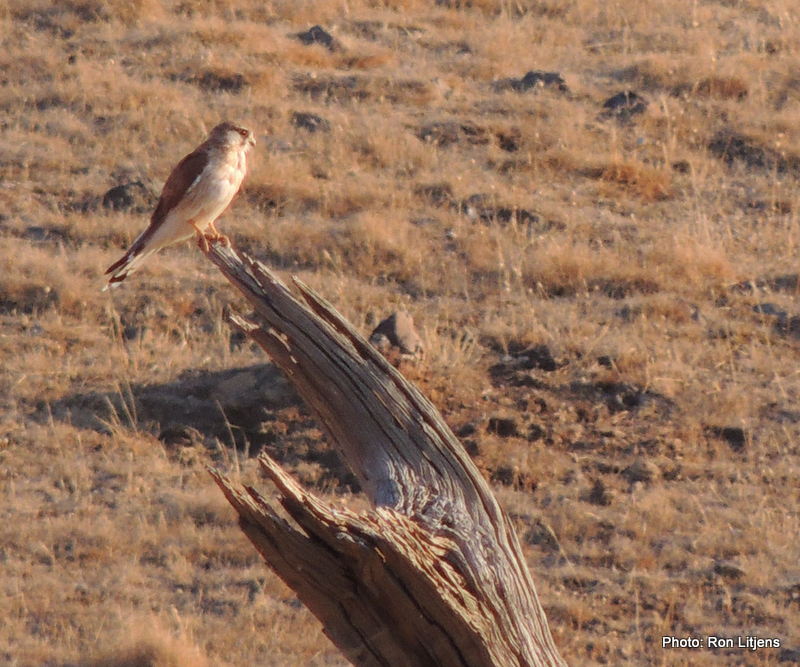
Australian Kestrel – a long way away
My favourite group of birds is the raptors (birds that hunt or feed on other animals). It includes eagles, owls, kites and harriers. Unfortunately due to their finely tuned hunting senses, particularly sight, it is extremely difficult to get close enough to afford a good look. The best I can usually do is a grainy over-enlarged digital photo taken with a telephoto lens (see pictured left).
Birds, particularly raptors can ‘see’ things that are invisible to the human eye. The ability to see in the infrared means that birds such as eagles can see the thermals which they use to get lift in the air. Similarly, being able to see in the ultraviolet means that they can see the reflections of scent trails mammals (a.k.a. food) leave on the ground to navigate by.
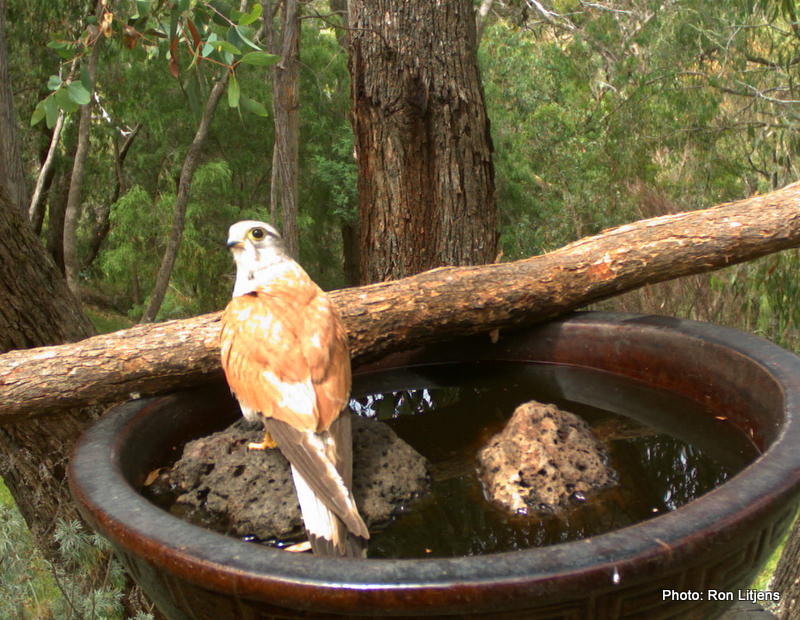
Nankeen Kestrel – much closer
Apart from Wedge-tailed Eagles (Aquila audax), which regularly soar up the valley, the most common raptor around our place is the Nankeen Kestrel (Falco cenchroides). It is often seen perched high in a dead tree surveying the surrounding paddocks or hovering in a stationary position before diving on some unsuspecting prey. Nankeen Kestrels are small falcons that feed mainly on small mammals, reptiles, birds and even insects.
Unexpectedly, a Nankeen Kestrel recently visited our bird bath (see photo right). The remote camera captured images so we could have a good look at the bird. It looks so close you can almost touch it (sort of like having front-row seats at a Justin Bieber concert – substitute your own music idol here).
And it’s another tick on the Birdbath visitors list.
Empty nest
 When starting the pump at our dam the other day, we noticed something different – one of the resident Australasian Grebes slipped off its nest into the water as usual (see previous post Floating nest), but this time it didn’t bother covering the nest with bits of plant debris. A few seconds later a couple of small fluffy balls flopped from the nest into the water and bobbed around like corks. We suspect that these two little striped chicks had only just hatched.
A short time later one of the adults swam over and the chicks clambered up under its wings, a safe haven which they will often resort to in the coming weeks, especially if there is any perceived threat around, eg a stalker with a camera ! A couple of days later they were a bit bolder and were seen perched on the back of one of the parents.
The usual clutch is reported to be four or more, but there were no abandoned eggs visible in the empty nest, so it seems this pair of grebes only managed two offspring.
Postscript added on 19th January: Just discovered that there are in fact four chicks – the other two must have been hiding among one of the parent’s feathers, the nest material or rushes on the bank.
Borgen inside, Burgan out
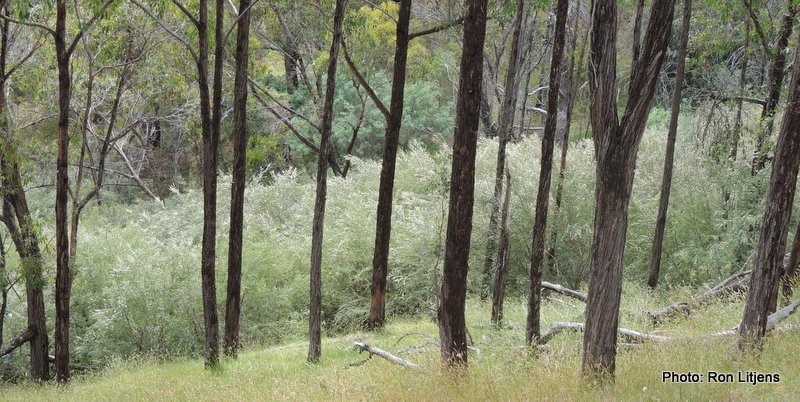
Xmas snow in Flowerdale
In our household the current favourite TV program is Borgen, a Danish political drama showing on SBS1 on Wednesday nights. However outside, if you are an insect, Burgan is where it is at. Burgan (Kunzea ericoides), sometimes called White Tea-tree or Kanuka, is a large shrub found in Australia and New Zealand.
For almost a decade I have watched with trepidation as the Burgan has taken over one of our valleys. The thickets it creates are so dense that nothing grows on the ground beneath it and most other vegetation has been choked out of existence. It does however provide nesting sites for a number of bird species and a wonderful place to hide for the resident Swamp Wallabies (Wallabia bicolor).
In early summer Burgan flowers so profusely that it looks like it has snowed in the valley. The sheer volume of insects and number of species that visit the flowers is astounding. Check out some of the visitors on the clip below.
As it turns out, the characters in the Burgan are far more diverse and colourful than anything you see on telly—including Borgen. I guess that’s life.
A cool skink
 While sampling water from the King Parrot Creek at Burslems Bridge the other day, we noticed this lovely little skink sitting motionless on the bank staring out at the stream, partly shaded by some native knotweed (Persicaria sp.). It’s a water skink, but the question is – which species? In a recent post on this blog (see Substituting ingredients) Ronlit featured a Yellow-bellied Water Skink (Eulamprus heatwolei) in his fanciful recipe. But according to experts we consulted, it is quite difficult to differentiate that species from the Southern Water Skink (Eulamprus tympanum tympanum). Both species occur in our area.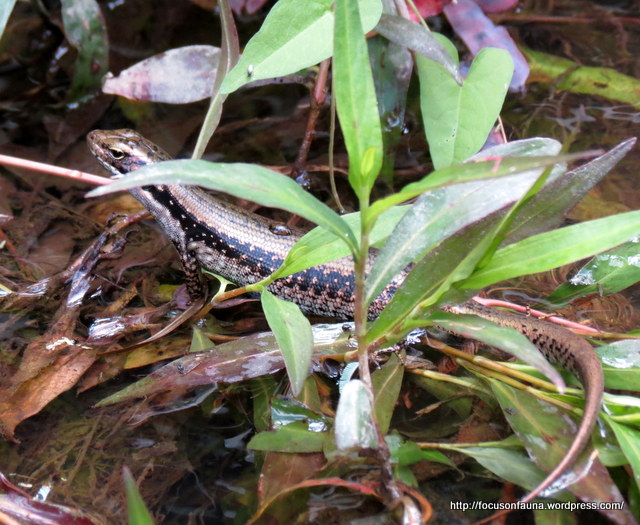
The main distinguishing feature of the Southern Water Skink is a pale line around the front edge of its ear opening (tympanum), rather than black in the Yellow-bellied Water Skink. Other small differences in patterning on the back and under the throat can help with identification, but they are not always clear-cut in photos. It’s difficult to know in the field what to look for – it’s only after consulting references or experts back home that you find what features are significant. We will have a stab at this being a Southern Water Skink (even if just to be different from Ron), but would be quite happy to be corrected.
I ain’t lyin’
 In the sand around our house there are conical-shaped depressions (see picture left). These are traps set by ant-lions (family Myrmeleontidae, from the Greek myrmex for ant and leon for lion). Ant-lions are the larval form of an insect commonly known as a lacewing. Lacewings are nocturnal insects that look superficially like damselflies but are of a different Order. They differ from damselflies by having clubbed antenna and whereas a damsel fly has a very strong and directed flight, the lacewings appear to ‘flutter’ about.

After mating, lacewings lay eggs in the sand. The hatched ant-lion builds a pit in the sand by working its way in a backward spiral, shovelling sand on to its head which it uses to flick the sand out of the ever-widening pit. When finished the ant-lion buries itself at the bottom of the pit (see picture right) with just the two pincers showing. If ants or other small insects walk too close to the pit they slip down the steep sides. If the ants attempt to escape, the ant-lion will flick up sand grains causing the walls to slip, sending the ant into its waiting jaws.

Revealed!
If you see these ant traps you can gently blow the sand out of the pit to reveal the ant-lion crouched in the bottom. Don’t do this too often – how would you like your house blown away every day? An interesting fact about the ant-lion is that it has no anus. I ain’t lyin’.
A sleek skink
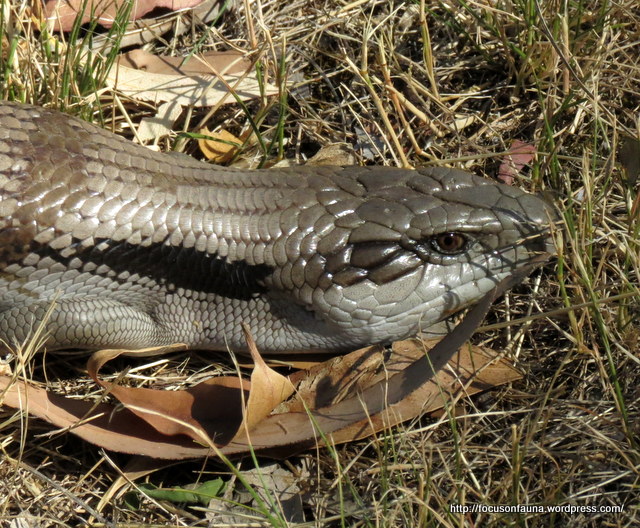 It’s not exactly a rarity, but it’s still a bit of a thrill to come across a sleek blue-tongue lizard basking out in the open, allowing close inspection and photos. This is a Common (or Eastern) Blue-tongue (Tiliqua scincoides). Its colouring and markings can be variable, but it is generally characterised by the banding across its body and tail, as well as the dark stripe and large temporal scales behind its eyes. This one was so placid, it didn’t bother showing us its impressive blue tongue.
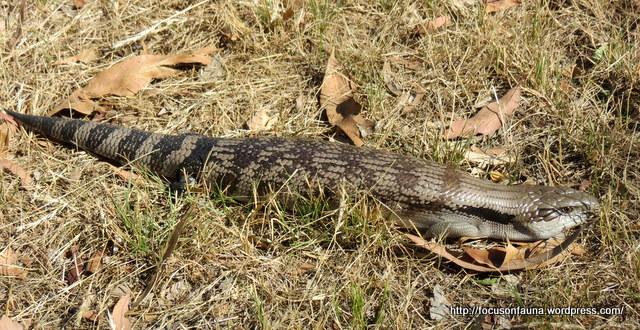
Another species of about the same size, the Blotched Blue-tongue (Tiliqua nigrolutea) can be found quite commonly in the Strathbogie Ranges to the north of us – click HERE to see some great pictures of the Blotched Blue-tongue on the Strathbogie Ranges – Nature View website.
Sexual dimorphism your thing?
 Then look no further than the Flower Wasps of the family Tiphidae. Sexual dimorphism of course is where there is a difference in the size and/or form of the female when compared to the male.
There are several subfamilies of flower wasps. In those sub-families where the female is winged, both sexes are the same size. However in the sub-families where the female is wingless, the female is much smaller and is often mistaken for an ant. These wasps feed on the nectar from flowers. As the female cannot fly it relies on being carried from flower to flower by the male during the mating process. To attract the male, the female climbs a grass stalk and emits male-attracting pheromones. Pictured above is a mating pair of Flower Wasps (Thynnoides sp) found on Burgan (Kunzea ericoides). The male wasp (right) has grasped the smaller female with its claspers, part of the genitalia (click on photo to view in greater detail).
Nectar Scarab feeding frenzy
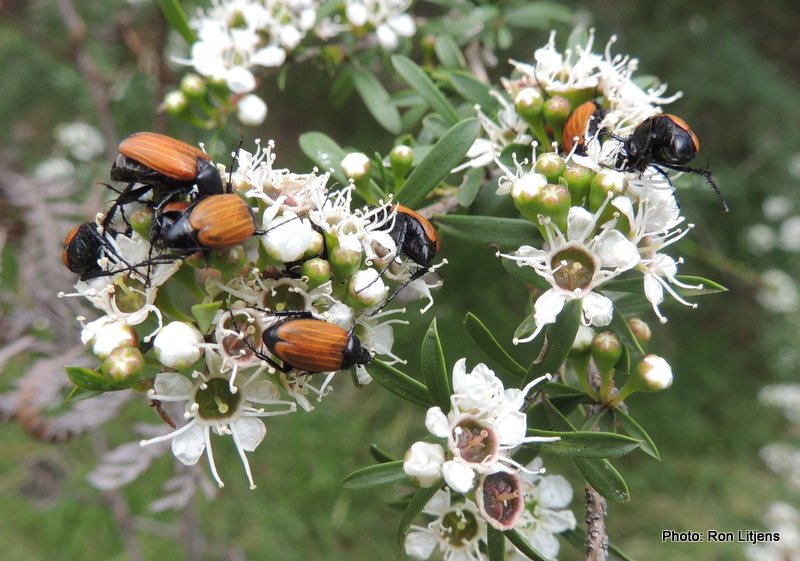
After mating, the female wasp burrows in the ground searching for beetle larvae, particularly Scarabs, which they paralyse. The wasp eggs are laid on the larvae. In the Burgan where this photo was taken, there are currently thousands of Nectar Scarabs (Phyllotocus apicalis). Some of their offspring are destined to be wasp larvae food.




 Focus On Fauna