Birds of a feather…
The interesting thing about watching a bird bath is not only the different species of birds that visit, but the way in which they do it. Some birds are solitary visitors such as the Sulphur-crested Cockatoo or the White-throated Treecreeper. Some visit with their partner (and offspring in the right season). The Scarlet Robin and Grey Currawong fall into this category. And then there is what we call at our place ‘the tribe’, a mixed group of wrens, robins, fantails and thornbills that roam the bush as a wandering flock.
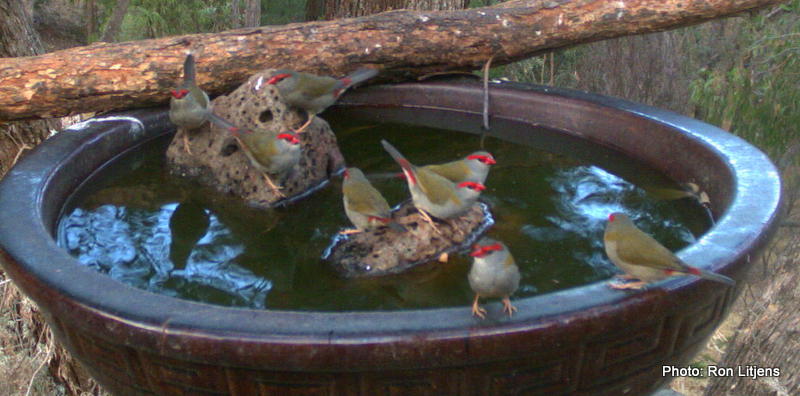 What are particularly interesting to watch are the species that travel in extended family groups. As with most families there are obvious dynamics at play and definite pecking orders. Recently we posted a blog about the White-winged Choughs (click HERE to view). Lately Red-browed Finches (Neochmia temporalis) (from the Greek neokhmos meaning new as in ‘new bird’ and the Latin word temporalis meaning to do with the temples – on the head) have been visiting en masse. Highly social, these finches are usually seen in parties of 10 to 20 birds in autumn and winter. They feed on grass seeds and insects and build domed nests in prickly shrubs.
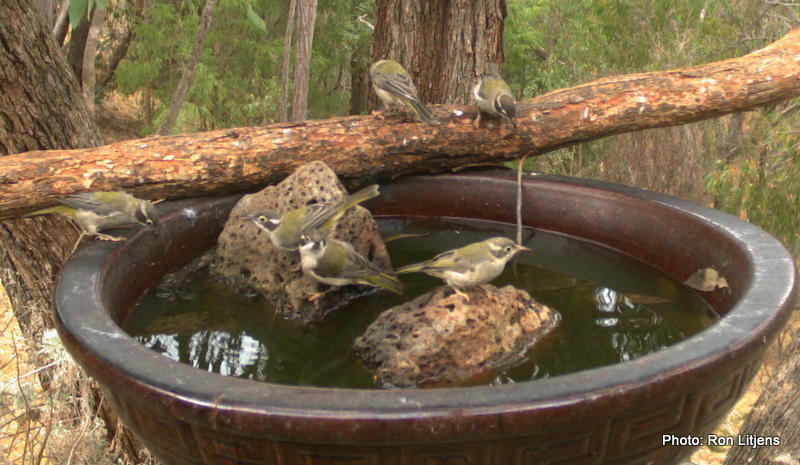 Another family of birds currently visiting are the bespectacled Brown-headed Honeyeaters (Melithreptus breirostris) (from the Greek word melithreptos meaning ‘honey-fed, and the Latin words brevis meaning short and rostrum meaning bill). These birds feed on insects and breed cooperatively. Groups of juveniles and adults will all help to incubate eggs and feed the young. Juveniles sport a blue eye-ring. As with humans the young are just tooo trendy.
Rich reserve

Silvereye
Wandering around the streamside reserve on the King Parrot Creek at Coonans Bridge, Flowerdale the other day, we came across the usual array of small birds – Red-browed Finches, Grey Fantails, Eastern Yellow Robins, thornbills, pardalotes and honeyeaters – flitting through the dense vegetation. But the most abundant bird at present seems to be the Silvereye, whose constant testy-sounding contact call dominates the small bird chorus – click on the audio arrow below to hear.
Each year at about this time, numbers of Silvereyes in Victoria are boosted by an exodus of birds from Tasmania moving north for winter. There are several subspecies of Silvereye – the birds of the Tasmanian subspecies can be distinguished by a rufous wash on their flanks.
The colouring of the Silvereye’s plumage is nuanced (click on the photo for a closer look), often blending with the foliage of shrubbery in which it forages, making it surprisingly hard to see, though its call is a give-away.
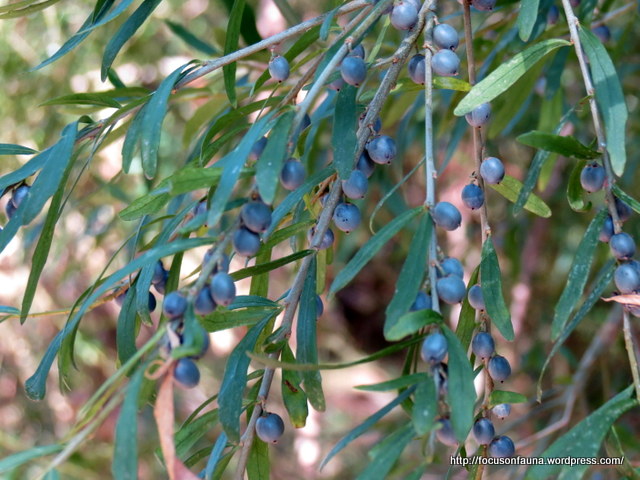
Tree Violet

Common Elder
There is no shortage of food for Silvereyes in the reserve. Apart from numerous insects, there are the berries from Tree Violet (Melicytus dentatus) and Prickly Currant Bush (Coprosma quadrifidus) as well as the increasingly prevalent introduced weed Common Elder (Sambucus nigra). Blackberries (Rubus spp.) are present, but in greatly reduced numbers due to ongoing control by Landcare members and the Goulburn Broken Catchment Management Authority.
Following the recent Platypus Watch organised by the Strath Creek Landcare Group and King Parrot Creek Environment Group (click HERE for a report on the event), some participants went on a spotlight walk through the reserve and were rewarded with a sighting of a Common Ringtail Possum, as well as close up views of birds roosting in the shrubbery, particularly Silvereyes, whose white eye-rings shone out as the birds froze in the spotlight.
A couple of days later, we returned to where the only platypus was seen and were able to get a clear photo and very brief video of this sleek animal.
Pardalotes love eating lerps
Most households have words or phrases that have special meanings to them. To outsiders these phrases have a different meaning or even appear nonsensical. One of our phrases is ‘Pardalotes love eating lerps’. We read this sentence on an information board while camping at Wyperfeld National Park in northern Victoria. As we lived in the city at the time, we had no idea what a pardalote was, let alone a lerp. In our house this term is used to describe anything said that is meaningless or unintelligible. It is often directed at the TV, especially at politicians.

Spotted Pardalote looking for a lerp
Now that we live in the bush, pardalotes and lerps are our neighbours. Pardalotes (Pardalotus sp.) (from the Greek pardalotus meaning spotted like a leopard) are brightly coloured birds closely related to scrubwrens and thornbills. They are common but not often seen birds that tunnel into the ground to build nests. The Spotted Pardalote (Pardalotus punctus) pictured left and the Striated Pardalote (Pardalotus striatus) are widespread through southeastern Australia.
Lerps on the other hand are the protective covers that the larvae of psyllid insects build to protect themselves from predators and
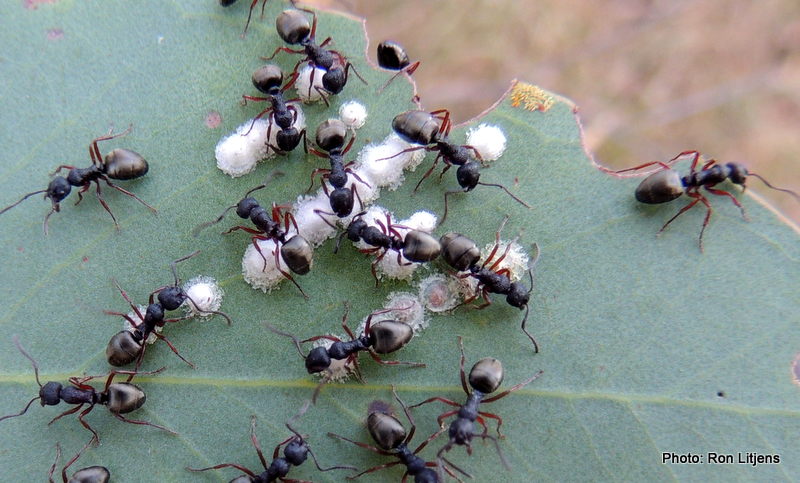
Ants tending Sugar Lerps (Glycaspis sp.)
parasites. The larvae exude honeydew which mixes with amino acids to form the crystallised honeydew lerp. As with the recently featured Gumtree Hoppers, which also exude liquid honeydew (click HERE to view), lerps are usually tended by ants (pictured right). In exchange for honeydew the ants offer protection against predators. Given the writing on the information board, I am guessing the ants aren’t very effective against predators such as pardalotes.
If this article makes no sense to you at all, you know what phrase to use. We will get the message.
Gazumped ?
We recently recorded some lovely images of a house-hunting Common Ringtail Possum (Pseudocheirus peregrinus) inspecting a nest-box near Strath Creek, but apparently reserving judgement on its suitability – see video below.
A few days later, another potential tenant, a Brush-tailed Phascogale (Phascogale tapoatafa) was recorded at the same box, and this time seemed to find it to its liking. It seemed particularly impressed with the view, spending a considerable period staring out from the front entrance (a sequence shortened in the following video because of lack of action!).
This once again shows that there is a demand for housing among our arboreal mammals, and that nest-boxes can provide an acceptable substitute when natural tree hollows are lacking.
We vill takeoff…

Weevil take-off
…is the last thing a Lufthansa airline pilot says to the control tower before heading down the runway. It also makes a great caption for the photograph to the left (click photo to enlarge). It shows a Eucalyptus Weevil (Gonipterus scutellatus), otherwise known as the Eucalyptus snout beetle or the gum-tree weevil, fleeing a wannabe nature photographer.
Eucalyptus Weevils (pictured below), as the name suggests, are beetles that live in gum trees. When young the adults are rust red in 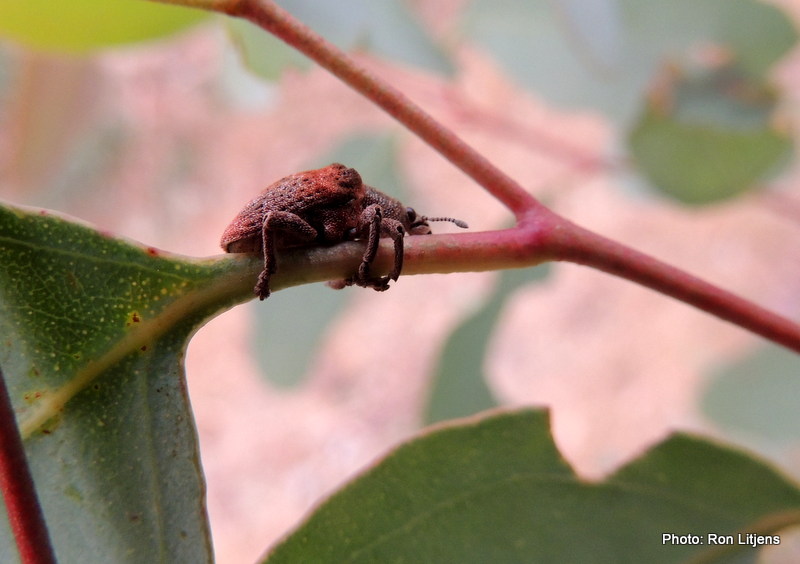 colour, which fades to dark brown as the insects mature. Some have a pale marking on their backs (below). They can usually be found with all six legs wrapped around a leaf stem or small branch looking as if they are hanging on for dear life. If disturbed the weevil will simply drop to the ground to avoid detection.
Both the adults and the larvae damage eucalypt forests. From August to February the adult weevils feed on mature gum leaves and  produce the scalloped edges on leaf boundaries that is so often seen. The larvae feeding cause the most damage, resulting in complete defoliation of stems, which often die-back and cause stunted gum tree growth. This insect is considered a serious pest in eucalypt plantations.
Not all the Yellow Box saplings in the grove where these photos were taken have been attacked by weevils. Maybe the weevils are saving them for later. We-vill see.
Look what the cat dragged in
 Members of the family of snakes known as blind snakes (Typhlopidae) are not often encountered because of their cryptic nature and burrowing habit. They are generally found under rocks and rotting logs, or in ant or termite nests. But they do venture above ground on warm humid nights, especially after rain – which is what the specimen pictured here was presumably doing when it unfortunately met up with a cat and was killed. It was found on a property on Junction Hill, just east of Flowerdale.
All blind snakes in Australia belong to a single genus, Ramphotyphlops, and are non-venomous and completely harmless, although if handled roughly they can emit a foul-smelling substance from anal glands – believed to be a defense mechanism to deter predators.
There are four species in Victoria, two of which are restricted to the north-west of the state and another, the Woodland Blind Snake, R. proximus, is a species now listed as near-threatened and mostly confined to the box-ironbark regions and northern plains. According to knowledgeable reptile enthusiasts Bertram and Steve, the Junction Hill snake is most likely Gray’s (or Blackish) Blind Snake (R. nigrescens) due to its appearance and location. A positive identification would depend on the number of rows of mid-body scales and the shape of the snout – in the case of Gray’s Blind Snake, 22 scales and a rounded rather than lobed snout .
According to the Victorian Biodiversity Atlas, the last confirmed record of a Gray’s Blind Snake in Flowerdale was in 1949, but Bertram did find one at Homewood near Yea during a Striped Legless Lizard search in 2005.
It can grow up to 75cm long and is found throughout central and north-east Victoria, and right up to south-east Queensland. It feeds mostly on soft-bodied burrowing invertebrates, including ant eggs, larvae and pupae, termites and earth-worms.
Blind snakes are not totally blind, but they do have poor vision due to greatly reduced eyes covered by a transparent scale – not a great disadvantage for a burrowing animal.
New AND surprising
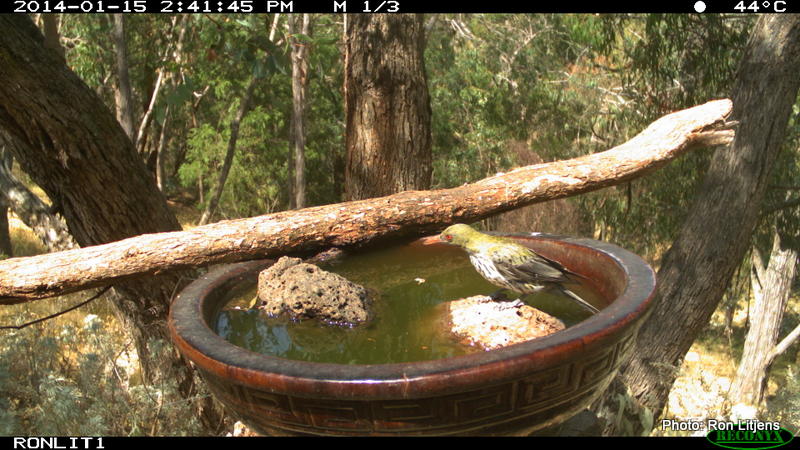 The reward of logging the daily visits of the furred and feathered to our birdbath is occasionally something new puts in an appearance. We classify these as either ‘new but not surprising’, which applies to creatures we know are in the area but they just haven’t bothered to visit, and ‘new AND surprising’ – first-time visitors we just would not expect to see.
In the former category is the Olive-backed Oriole (Oriolus sagittatus) (from the Latin word aureolus meaning golden and sagitta meaning arrow – referring to the arrow-like markings on the breast). It was photographed recently (above) during a long bout of high temperatures. The characteristic ‘orry, orry-ole’ call is common in the surrounding bush. The deep-pink bill and red eyes make it memorable.

Trash-talking with the Rosellas
In the category of ‘new AND surprising’, was the Australian Kestrel (click HERE to view post), which turned up at the bath during the same spell of hot weather. Last week, a visitor in the same category was a Sacred Kingfisher (Todiramphus sanctus), pictured right. The Sacred Kingfisher (previously featured, click HERE to view) is a common woodland bird but in our ten years on Junction Hill we had neither seen nor heard one. A close relative of the Laughing Kookaburra, it feeds on insects, fish, crustaceans, small rodents and reptiles.
 On a more sobering note, the photo left shows a ‘new but UNFORTUNATELY not surprising’ visitor – a cat (Felis catus). It was just a matter of time before this night-time wildlife hotspot got some attention it didn’t need. Stay tuned for developments. When I catch the critter I am going to nail his tail to the wall. Is this a cat-ass-trophy? For the cat I guess it is.
Unearthed !
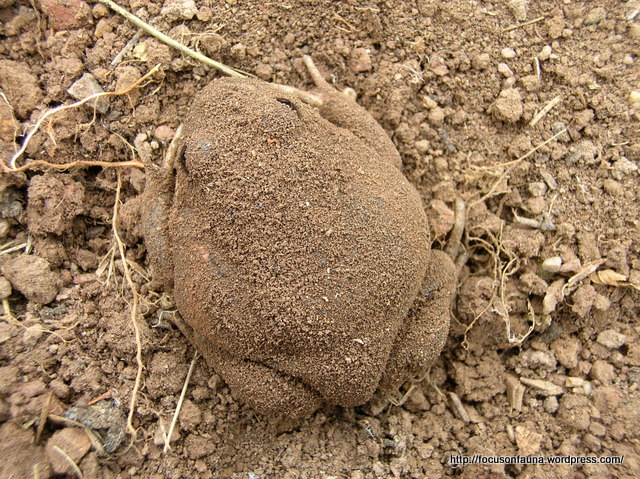 While digging over a shrivelled-up patch of beans in our rather sad-looking vegie garden the other day, this frog-shaped lump, about 60 to 70 mm long, flopped out of a clod of earth. A quick hose down revealed it to be a healthy Pobblebonk or Banjo Frog (Limnodynastes dumerilii) that had fortunately avoided the sharp edge of the spade.

Pobblebonk exposed
The obvious swelling (tibial gland) on its lower hind leg, and the pale raised stripe below its eye, readily distinguish it from the other large burrowing amphibian that may be found in our district, the Common Spadefoot Toad (Neobatrachus sudelli). Another identifying feature of the latter is that its eyes have vertical pupils as opposed to the horizontal pupils of the Pobblebonk (and most other frogs). The tibial gland is thought to emit secretions that deter potential predators, although it obviously doesn’t always work – see a previous post Excuse me. I’ve got a frog in my throat.
This season’s look is …
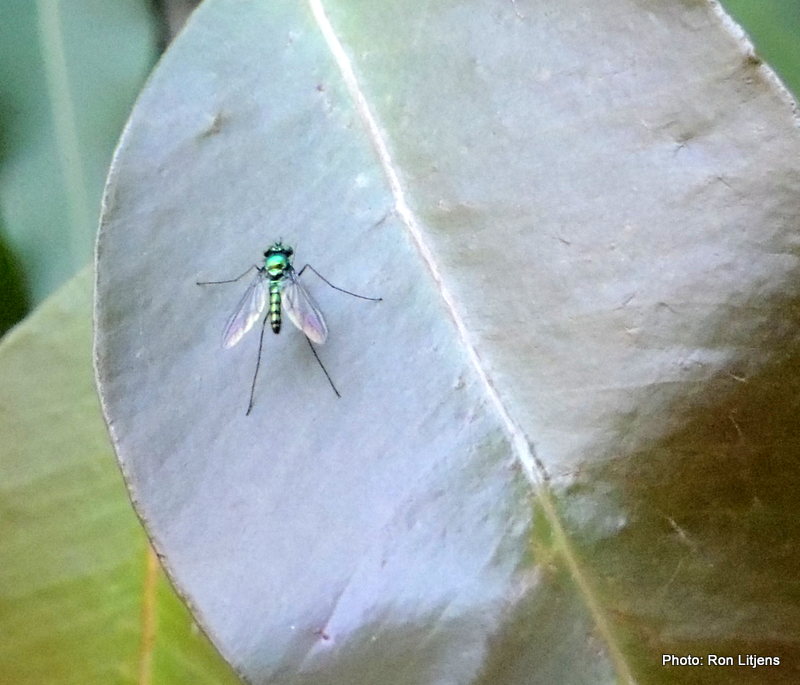
Green Long-legged Fly (Dolichopodid Fly) – iridescent body and wings
The insect fashionistas have spoken – and the look for this season is iridescent. Iridescence (from the Greek word ‘iris’ meaning rainbow and the Latin word ‘escent’ meaning becoming or resembling) is a term used to describe the rainbow-like play of colours seen in such things as soap bubbles, sea shells and insects (see photo left). In insects the colours are caused by ridges or veins on the surface of the body or wings. If the spacing between these ridges is of similar distance to the wavelength of light, approximately tens of thousandths of a millimetre, iridescence will be observed. The colour depends on the spacing of the ridges and the angle of the light shining on the creature.
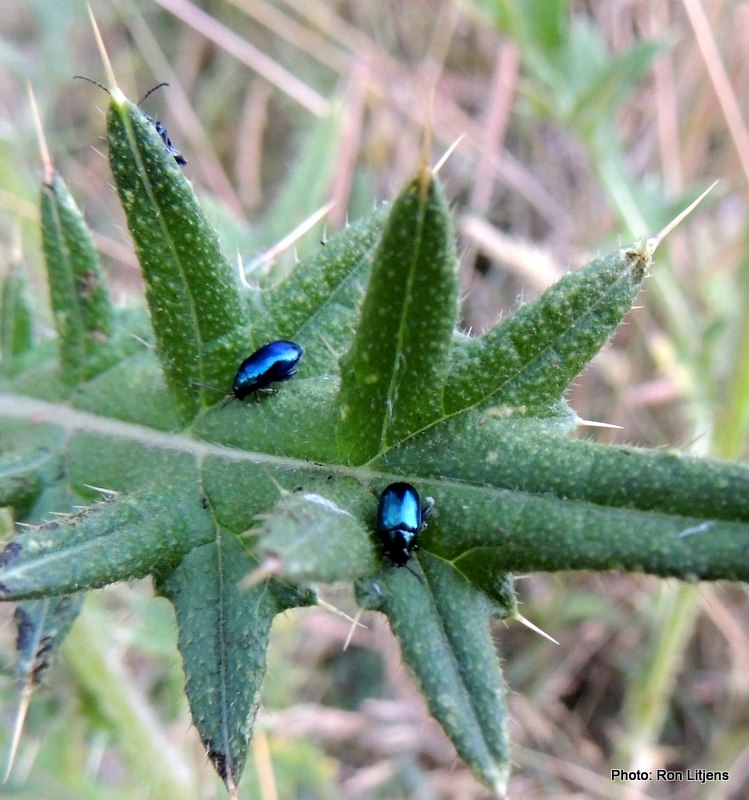
Black or blue? – depends on the viewing angle
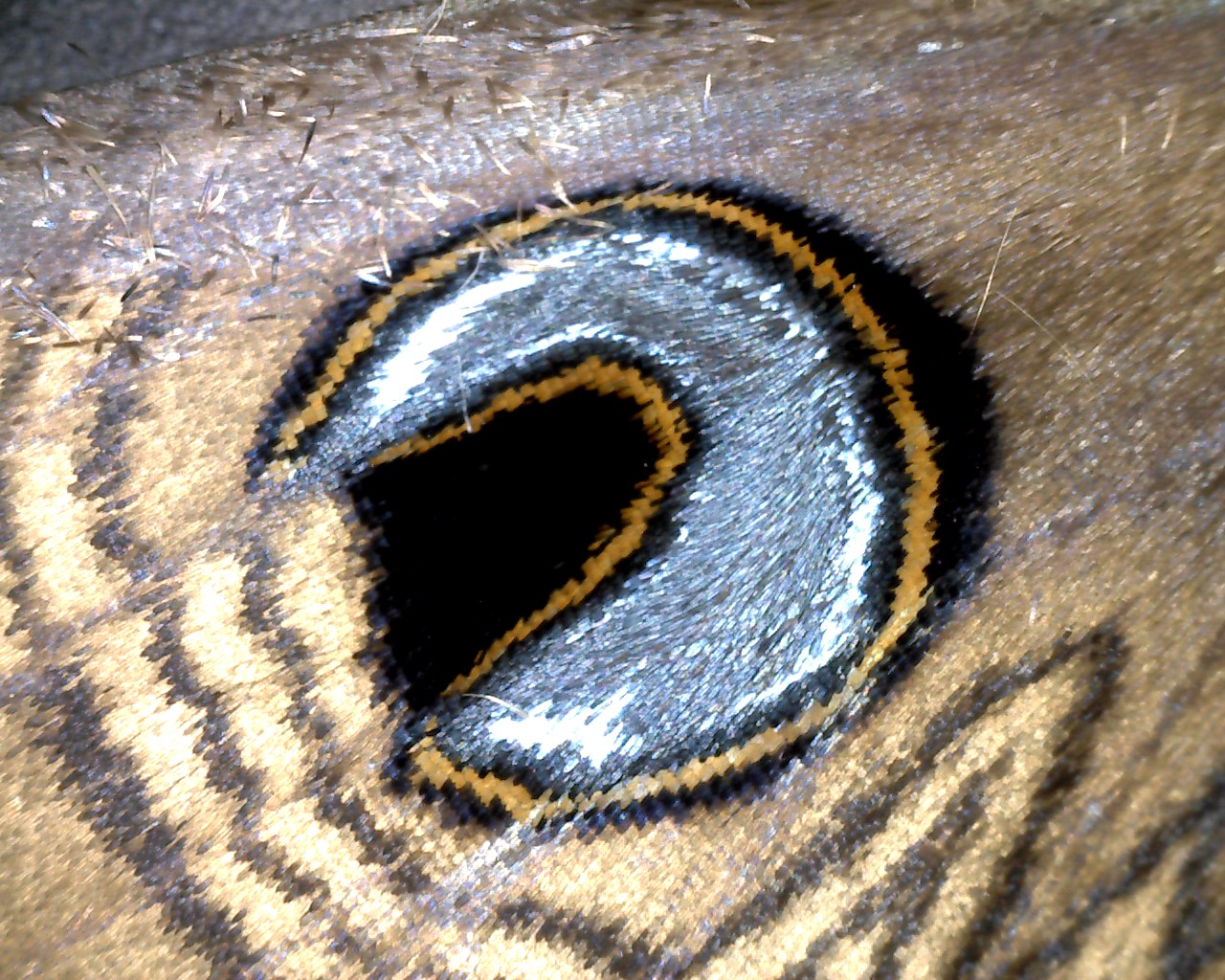
In the beetles (pictured right), membranes on the outer wing casings are made up of slanted plate-like layers. These layers bend and then reflect light to give the observed colours. Similarly butterfly and moth wings are covered with overlapping layers of scales that are lined with parallel veins. In the example of the Southern Old Lady Moth (Dasypodia selenophora) pictured below, the scales on the eye-spot (shown below right) have the right spacing to cause visible iridescence. In some tropical butterflies the entire wing is iridescent. Strangely enough it is a camouflage mechanism. Because the effect also depends on the angle of the light striking the wings, when the butterfly is flying it seems to appear and disappear as it flaps its wings, thus putting predators off their game.
For any of the local Flowerdale Ute Club members now thinking of painting their vehicles with iridescent paint to make them appear and then disappear (for whatever reason) as they drive by, I’m not sure it works like that.
Roadside raptor
 In a recent post (click on An unexpected visitor), Ronlit mentioned the difficulty of getting close enough to raptors to get a good look and to take half-way decent photos. One exception in the more open areas of this district is the Brown Falcon (Falco berigora) which can sometimes be seen on roadsides, perched on a dead tree, fence-post or power pole, which offer the falcon clear views of prey crossing the road and open farmland.
A number of times in past weeks we have screeched to a halt at the sight of a Brown Falcon perched beside one of our local roads. A pity our photographic skills don’t match our enthusiasm !
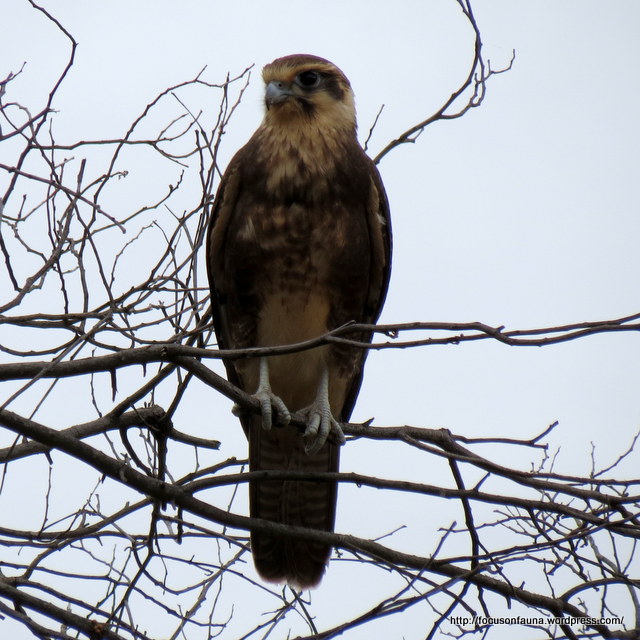
Brown Falcon, Murchison Spur Rd, Strath Creek
The Brown Falcon is easily recognised by the double dark streaks either side of its paler cheek patch, but its plumage can vary considerably from almost uniform dark brown to various shades of brown above and whitish below. In flight it is often noisy, emitting screeches and high-pitched cackles.

Brown Falcon, Fairview Rd, Kerrisdale
For clear photos of raptors it would be hard to beat Geoff Park’s “Natural Newstead” blog. The grassy plains around Newstead in central Victoria provide ideal habitat for a range of raptors, and we would recommend going to the home page (click HERE) and select Bird observations/Raptors in the ‘Categories’ box – or simply scroll back through past posts to see superb images of local birds of that area.



 Focus On Fauna