I ain’t lyin’
 In the sand around our house there are conical-shaped depressions (see picture left). These are traps set by ant-lions (family Myrmeleontidae, from the Greek myrmex for ant and leon for lion). Ant-lions are the larval form of an insect commonly known as a lacewing. Lacewings are nocturnal insects that look superficially like damselflies but are of a different Order. They differ from damselflies by having clubbed antenna and whereas a damsel fly has a very strong and directed flight, the lacewings appear to ‘flutter’ about.

After mating, lacewings lay eggs in the sand. The hatched ant-lion builds a pit in the sand by working its way in a backward spiral, shovelling sand on to its head which it uses to flick the sand out of the ever-widening pit. When finished the ant-lion buries itself at the bottom of the pit (see picture right) with just the two pincers showing. If ants or other small insects walk too close to the pit they slip down the steep sides. If the ants attempt to escape, the ant-lion will flick up sand grains causing the walls to slip, sending the ant into its waiting jaws.

Revealed!
If you see these ant traps you can gently blow the sand out of the pit to reveal the ant-lion crouched in the bottom. Don’t do this too often – how would you like your house blown away every day? An interesting fact about the ant-lion is that it has no anus. I ain’t lyin’.
A sleek skink
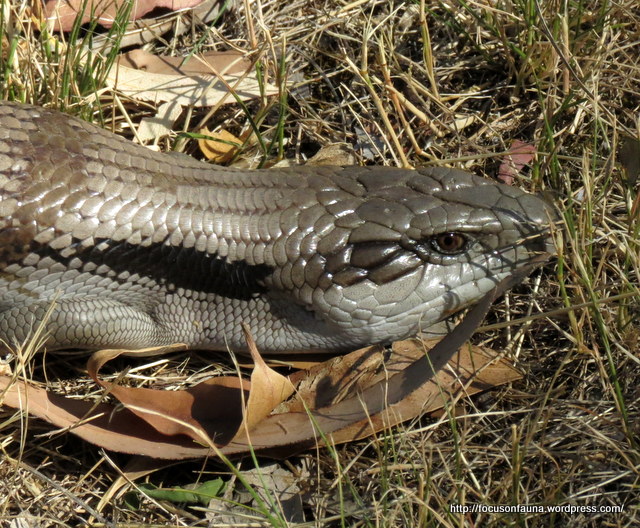 It’s not exactly a rarity, but it’s still a bit of a thrill to come across a sleek blue-tongue lizard basking out in the open, allowing close inspection and photos. This is a Common (or Eastern) Blue-tongue (Tiliqua scincoides). Its colouring and markings can be variable, but it is generally characterised by the banding across its body and tail, as well as the dark stripe and large temporal scales behind its eyes. This one was so placid, it didn’t bother showing us its impressive blue tongue.
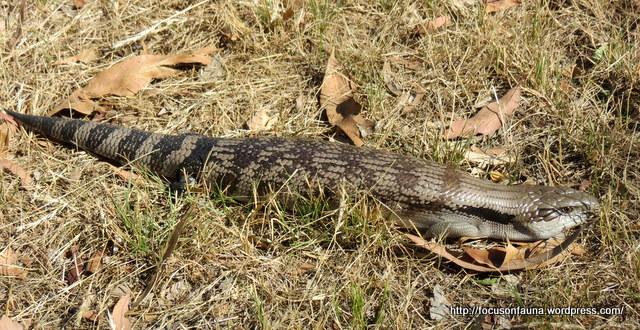
Another species of about the same size, the Blotched Blue-tongue (Tiliqua nigrolutea) can be found quite commonly in the Strathbogie Ranges to the north of us – click HERE to see some great pictures of the Blotched Blue-tongue on the Strathbogie Ranges – Nature View website.
Sexual dimorphism your thing?
 Then look no further than the Flower Wasps of the family Tiphidae. Sexual dimorphism of course is where there is a difference in the size and/or form of the female when compared to the male.
There are several subfamilies of flower wasps. In those sub-families where the female is winged, both sexes are the same size. However in the sub-families where the female is wingless, the female is much smaller and is often mistaken for an ant. These wasps feed on the nectar from flowers. As the female cannot fly it relies on being carried from flower to flower by the male during the mating process. To attract the male, the female climbs a grass stalk and emits male-attracting pheromones. Pictured above is a mating pair of Flower Wasps (Thynnoides sp) found on Burgan (Kunzea ericoides). The male wasp (right) has grasped the smaller female with its claspers, part of the genitalia (click on photo to view in greater detail).
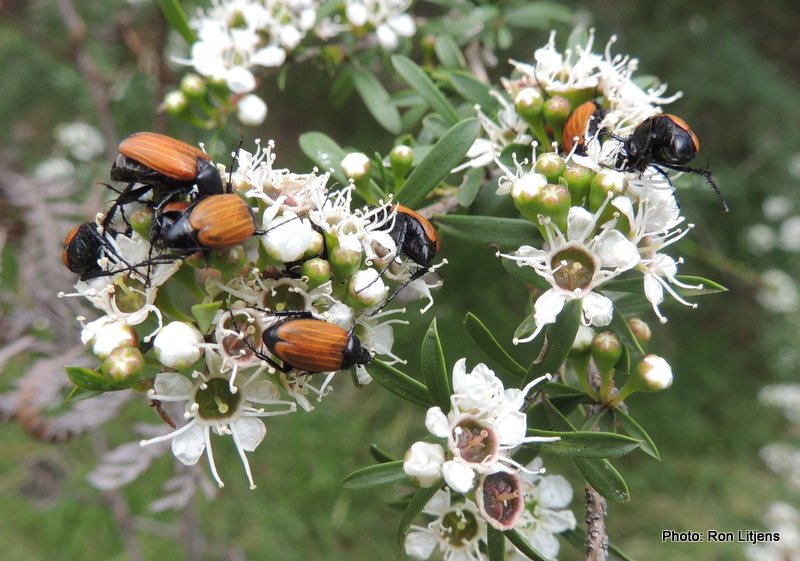
Nectar Scarab feeding frenzy
After mating, the female wasp burrows in the ground searching for beetle larvae, particularly Scarabs, which they paralyse. The wasp eggs are laid on the larvae. In the Burgan where this photo was taken, there are currently thousands of Nectar Scarabs (Phyllotocus apicalis). Some of their offspring are destined to be wasp larvae food.
Floating nest
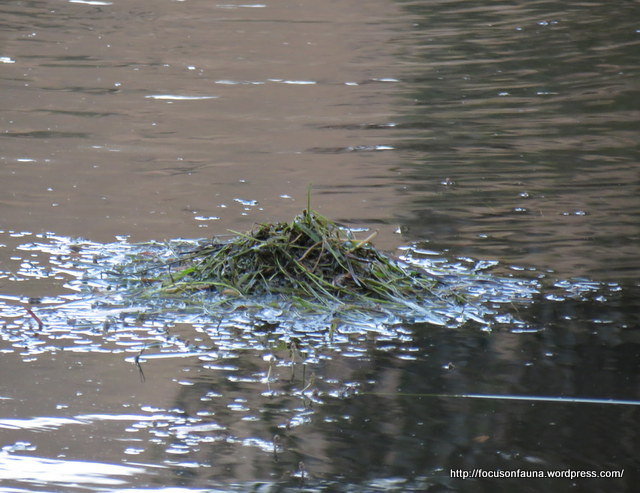 A pair of Australasian Grebes has built this nest of floating plant material right in the middle of our large dam. The nest appears to be anchored to underwater stems of Floating Pondweed (Potamogeton sp). It may seem vulnerable but, at the slightest disturbance, the sitting Grebe is very adept at quickly covering the eggs, slipping off into the water and pretending it’s just hanging out near a pile of reeds with not a care in the world. A hide set up in bushes on the bank and a lot of patience were needed to get the photos below.
See also a previous post on grebes: Dressing down for winter
They’re driving us Raven mad

Adult (left), chick (right)
If you haven’t noticed the young ravens around the place this season you must have industrial-strength earmuffs on or you are clinically deaf. Starting when the sun comes up the incessant squawking for food from the chicks doesn’t stop until the sun sets. A new family of Little Ravens (Corvus mellori) has taken up residence around the bird bath. It consists of mum, dad and two bawling chicks (more effective than any alarm clock). The chicks seem to be able to squawk even as food is being shoved down their throats.
Two types of raven inhabit the King Parrot Creek valley—the Australian Raven (Corvus coronoides) and the Little Raven. On first sight the difference is hard to pick. As the name suggests the Little Raven is slightly smaller than the Australian Raven with a smaller beak. The call of the Little Raven also lacks the drawn out ‘aaaaaaaaahh’ at the end.
Pictured are adult and chick at the bird bath. You can usually pick the chick by the gaping beak begging for food. And that squawking. Another sign is the eye colour. In young ravens the eye is brown. It then progresses through hazel and is white in the third year. I have also noticed (although I haven’t read it anywhere) that the beak of the chicks shows flashes of pink.
A change of diet?

Fireblight Beetle
In September 2012 we posted a brief story about Fireblight Beetles (Peltoschema orphana) attacking local wattles (see What’ll happen to the wattles ?). The wattles mentioned were those with feather-like (bipinnate) foliage: Silver Wattle (Acacia dealbata) and Black Wattle (Acacia mearnsii).

Defoliated Cinnamon Wattles
So, are Cinnamon Wattles a recent addition to the Fireblight Beetle’s diet ? We would welcome comment from anyone who has come across this sort of defoliation before. Interestingly, nearby stands of other post-fire regrowth wattles in the forest such as Mountain Hickory Wattle (Acacia obliquinervia) and Narrow-leaf Wattle (Acacia mucronata) appeared to be unscathed, but Silver Wattles around the Strath Falls area again looked scorched, indicating attack by Fireblight Beetles similar to last year.
-
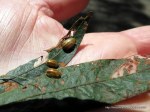
- Fireblight Beetles on Cinnamon Wattle
-

- Cinnamon Wattle leaf damage
Substituting ingredients
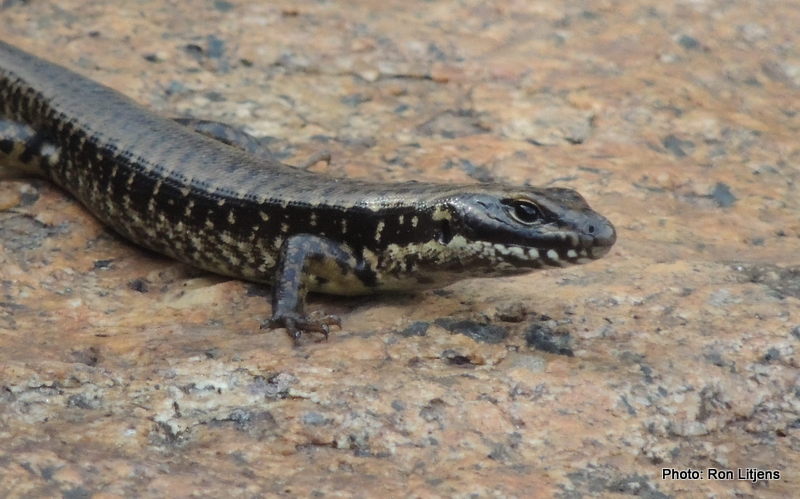
 I like cooking exotic recipes but sometimes you just can’t get the ingredients that the recipe calls for. Take the recipe for my favourite enchantment, borrowed from Shakespeare – ‘Eye of newt and toe of frog, wool of bat and tongue of dog’. I don’t know about you but I haven’t seen a newt around these parts for ages. In this case I go for the next best thing – from our own backyard, eye of Jacky Lizard (Amphibolurus muricatus) (pictured left) or for that special occasion eye of Yellow-bellied Water Skink (Eulamprus heatwolei) (pictured below) , so the experts say, recently seen in Tallarook State Forest. Not being an expert on reptiles I hope that the identification is correct otherwise my recipe is ruined.
 Jacky Lizards belong to the family of lizards known as Dragons (Family Agamidae), of which there are 78 Australian species. They are characterised by small and rough body scales, an upright posture and hind legs that are significantly longer than the front ones. I have often seen lizards of this family running around on hind legs.
Skinks belong to the Family Scincidae and there are 431 Australian species. Typically they have smooth, overlapping scales and are often seen sunning themselves.
Not only do these ‘newt’ substitutions add a local flavour to the invocation, but in line with Yea’s Cittaslow philosophy, I am also helping the planet by reducing the ‘food miles’.
Intimate encounters
 Apart from the chance to record the occasional shot of a threatened species, one of the benefits of remote surveillance cameras is that they provide glimpses into aspects of the daily lives of our common wildlife that most of us rarely get a chance to observe. A camera set up over a two-month period on one of the Strath Creek Biodiversity Project sites on Allandale Road, Strath Creek, recorded many shots of Eastern Grey Kangaroos (Macropus giganteus) feeding, lounging, socialising and mating.
We have put together two video clips – one shows the quite intimate relationship between a joey and its mother, who develop a strong bond until the youngster is able to fend for itself. The other clip includes part of a long sequence of shots of a male and female kangaroo copulating, an encounter that lasted about 20 minutes with two short breaks, although “Mammals of Australia” – ed. Ronald Strahan, states this can last up to 50 minutes!
Note: You may need to stop the videos and let them fully download before playing right through.
Warning: sensitive viewers may choose not to watch the following video !
The singing trees of Tallarook

Redeyes ‘sucking it up’.
The first day of summer, being hot and sunny, deserved something special – a bushwalk in the Tallarook Range, a granite intrusion looming over the King Parrot Creek valley. The familiar summer sound of cicadas got louder as we walked deeper into the forest until it became almost deafening. Young smooth-barked eucalypts and acacias were festooned with thousands if not tens of thousands of cicadas known as Redeyes (Psaltoda moerens), so called for obvious reasons (see picture left).
Redeyes, common to south-eastern Australia, appear between November and February. They spend most of their lives feeding on the sap of young eucalypts and angophoras, which they do by puncturing the bark. After mating, they lay eggs in dead plant tissue. Unlike the previously featured Greengrocer cicada, which makes its sound by rubbing the top of its wing against its thorax (click HERE to view post), the Redeye does so by flexing its abdomen upwards. Click the video below to see the sound action.
My summer PPE (personal protective equipment) kit is quickly taking shape. As discussed in previous posts it now consists of a helmet (protection from dive-bombing magpies and falling pine cones released by black cockatoos), gaiters (for keeping snakes and grass seeds at bay) and now industrial earmuffs for protection against cicadas. And I wonder why people run the other way when they see me bushwalking.
Four of a kind

Four young galahs

The parents watch from a distance




 Focus On Fauna