It’s back – at its bushy best
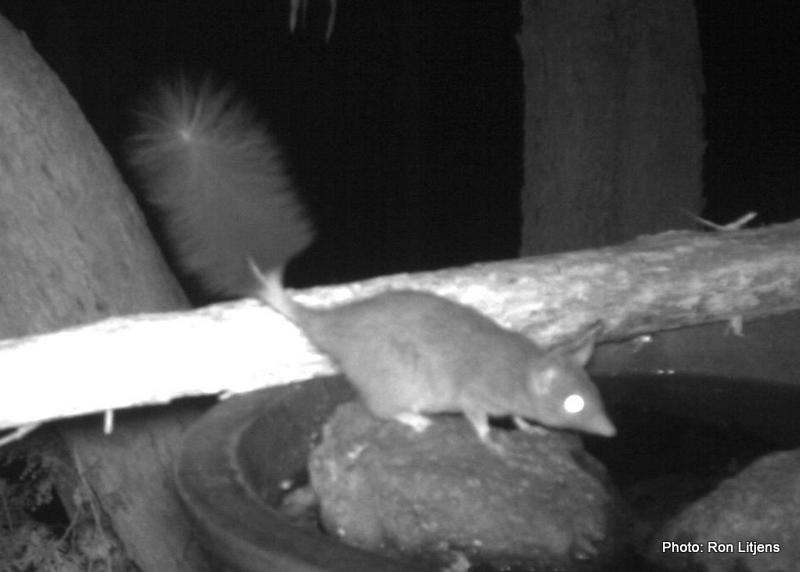 We have been remotely recording the nocturnal comings and goings at our birdbath for three years now. In that time we have only managed one visit from this critter (click HERE to view). This week we were surprised to find the Tuan or Brush-tailed Phascogale (Phascogale tapoatafa) was back in town and proudly displaying the eponymous body part. Even though it has featured in previous posts, it is the most exotic of the creatures to visit our bird bath (to date), so here it is again.
Not to be out-done, if you look carefully you can see the eye-shine of Wally the Southern Brown Tree Frog (Litoria ewingi) peeking out from under the branch to the right of the phascogale’s left ear. We haven’t seen Wally in a long time either.
 P.S. Speaking of exotic animals visiting the birdbath, on the night before going to press, for the first time ever a Koala (Phascolarctos cinereus) decided to stick its snout into the picture frame. Where’s Wally? It was obviously too much for Wally. It is nowhere to be seen.
Life Lesson #1 – Camouflage
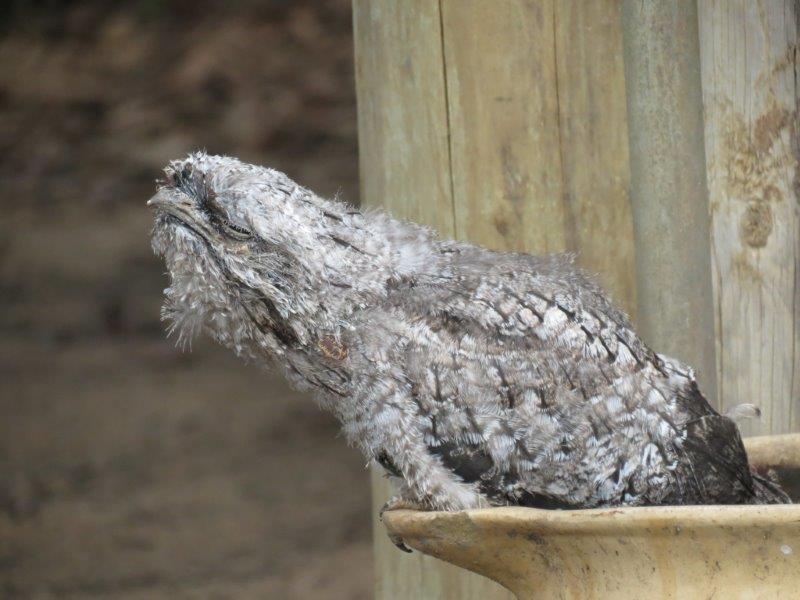
I wonder where the Tawny is!
As promised in a previous post (click HERE to view), we are continuing to follow the development of the Tawny Frogmouth chick at Trude and Len’s place. The chick is beginning to learn the life lessons essential for survival.
One of the features of Tawny Frogmouths (Podargus strigoides) is their outstanding ability to blend into the scenery. Sometimes even when you know where a Tawny Frogmouth is roosting, it is difficult to distinguish it from the branch on which it is perched. When threatened, a Tawny Frogmouth sits still with its beak pointed up in the air, looking just like a part of the tree.

Proud parent
Pictured above is the baby Tawny Frogmouth demonstrating the camouflage pose. Even though the pose is well executed, here is a life lesson for the young bird – if you are going to pretend to be a tree branch, don’t do it sitting in a bird bath. It doesn’t work. We can still see you. Try sitting in a tree.
Why pick on me ?!
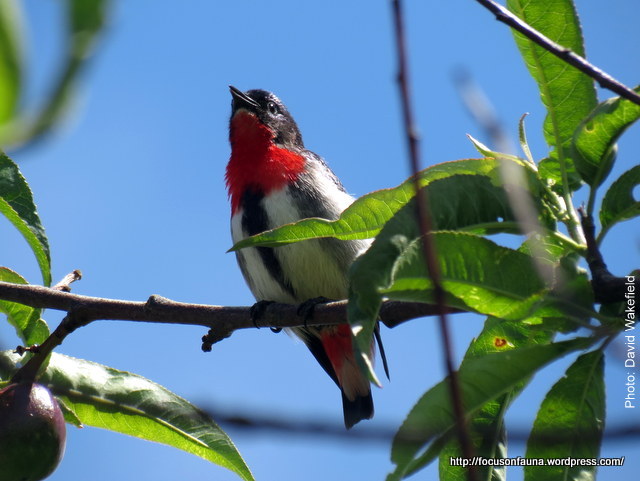 The colourful little bird pictured here is a male Mistletoebird. It is one of two specialist bird species, the other being the Painted Honeyeater, that feeds almost entirely on mistletoe fruit, although they can supplement their diet at times with insects and other fruit. Both species defecate the mistletoe seeds rather than regurgitate them after digesting the pulp. The sticky seeds need considerable pecking and wiping on a branch to release them from feathers around the vent. The widely-held belief that mistletoebirds deliberately turn side-on to deposit the seeds on a branch is apparently largely a myth. In his excellent book “Mistletoes of Southern Australia”, David Watson calls into question another widespread claim that the mistletoe specialists, Mistletoebird and Painted Honeyeater, account for the vast majority of newly-established mistletoe. Research shows that Mistletoebirds tend to stick to areas which already contain mistletoe, and it is the non-specialist mistletoe feeders, including a number of honeyeaters, the Olive-backed Oriole and the Silvereye, that may be the principal dispersers of mistletoe to new areas.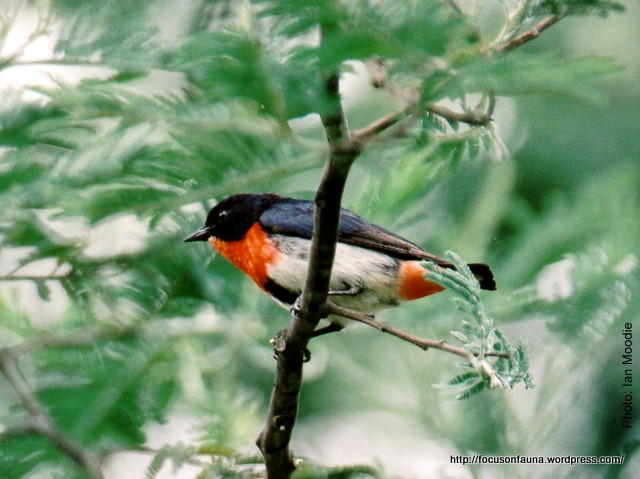
Historically the Mistletoebird has come in for a lot of flak, literally. David Watson quotes a 1939 letter to a beekeeping journal entitled ‘Mistletoe bird is spreading the mistletoe pest’:
“I have cut 26 mistletoe growths off only a fair sized Red Ironbark tree. I decided after some years of cutting off and pulling down to make war on the birds that were responsible, but found them a tougher problem than I expected, for I never guessed they were so numerous. I have destroyed well over twelve hundred [our emphasis] of these birds during the past six years, nearly all on my own property, and still there are a few coming in from other parts.”
This attitude was apparently shared by many landholders and even naturalists at the time, and persists to some extent even today, which is a pity as the Mistletoebird may prove not to be the main disperser, and mistletoe itself should be recognised as an important natural component of the Australian environment. Excessive mistletoe is a result of over-clearing of understorey vegetation, creating environmental imbalances, with the loss of regulators such as possums and butterfly larvae which consume the foliage. It is surely better to rectify those imbalances rather than shoot the messenger!
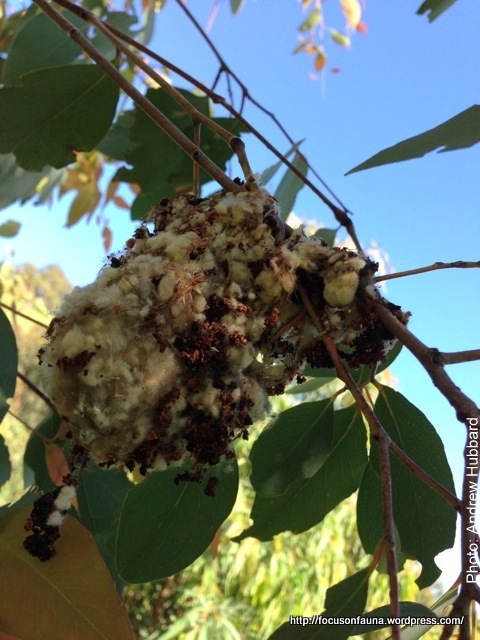
At left is a nest photographed by Andrew on the Three Sisters property between Flowerdale and Strath Creek. The hanging purse-like shape with a side entrance looks to us like a typical Mistletoebird nest. Although usually made of plant down and cobwebs, this one is mostly wool, probably because there was a pile of sheep crutchings close by – a good example of opportunism. The female builds the nest and does all the incubating.
Incidentally, Mistletoebirds have been sighted in Tasmania in recent years despite there being no mistletoe in that state. Evidence of mistletoe has been found in the fossil record there, but it is unlikely that mistletoe populations will be re-established by birds from the mainland considering the rapid passage of seeds through the Mistletoebird’s gut and the long journey involved.
The audio below is of a Mistletoebird calling in synch with a Peron’s Tree Frog. Is it coincidence, or call and response?
Get your lovely fruit and veg!
 Almost a year ago, a post (click HERE to view) described the sighting of many cicada exoskeletons hanging off the vegetation. Well, it is that time of the year again. Recently moulted was this Greengrocer Cicada (Cyclochila australasiae). The Greengrocer is the green form of this species. Other coloured forms include Yellow Monday (yellow), Chocolate Soldier (tan), Blue Moon (turquoise) and Red Warrior (red). The Yellow Monday cicada lacks the turquoise pigment that combines with the yellow to form green. Similarly, the Blue Moon cicada lacks the yellow pigment. This species inhabits the temperate and coastal regions of southern Queensland down to Victoria.
Adult Greengrocers live for only six weeks. They feed on the sap of plants and on summer evenings the males ‘sing’ to the females. Unique to this species, the sound is made by rubbing a scraper on the wing over ridges on the collar-shaped structure at the back of the head. The song can be extremely loud. In fact it is one of the loudest insect sounds in the world. After mating, the female deposits eggs into the branches of food plants. Four months later the nymphs hatch and burrow into the soil, emerging after seven years.
When I go to the Queen Vic market to buy fruit and veg I have to escape after a short while because of the incessant yelling by the vendors. Maybe loudness is a characteristic of greengrocers the world over, irrespective of species.
P.S. The three eyes in the centre of the forehead are called ocelli. They are thought to be very sensitive light receptors. As the insects pitch and roll in flight the ocelli detect minute changes in light level and thus help the insect maintain flight stability.
A distinctive call
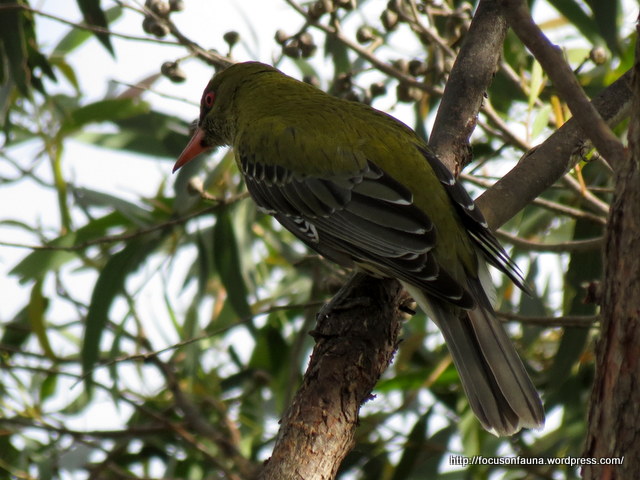 One of the distinctive sounds of the spring/summer period in this district is the far-carrying and repetitive call of the
Olive-backed Oriole (Oriolus sagittatus) which could be interpreted as a hesitant attempt to pronounce its name: “ori-ori-ole”.
[Click on the audio bar below to hear this call].
The similarity of the call to the name is coincidental rather than deliberate, since “oriole” actually comes from the genus name Oriolus meaning “golden (bird)”, a description more suited to other oriole species not found here: the Yellow Oriole and the Figbird.
The Olive-backed Oriole is a medium-sized arboreal bird that can be difficult to detect among green foliage and is usually heard before being seen. It feeds on fruit and insects. In autumn our orioles will head north for the winter.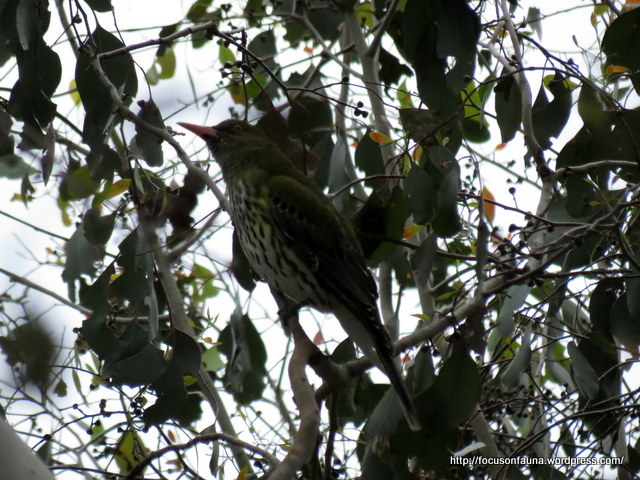
As well as its usual contact call, it also has a softer warbling sub-song which can include mimicry of other birds. The other day we came across an oriole that broke into this sub-song but we can’t include it here because, of course, the recorder had been left at home! But it’s worth listening out for this song when you next hear the oriole calling.
If you go down to the woods today…
…you’re in for a big surprise. The woods in question are a stand of about two dozen Monterey Pine (Pinus radiata) trees at the back of our property. I look at them with despair trying to pluck up the nerve to cut them down but they have in the past provided shelter for a pair of Powerful Owls and more recently a recreation area for a ‘squadron’ of Yellow-tailed Black Cockatoos (Calyptorhynchus funereus). The surprise is being clobbered on the head by a falling pine cone.
 A recent glancing blow to the shoulder from a cone travelling at terminal velocity taught me that I would not want to get hit on the head with one. Small numbers (2 or 3) of the cockatoos often frequent the grove, nipping off the tips of pine branches and dismembering the pine cones in search of the seeds. Normally you can pick your path to avoid the falling debris but with more than a dozen birds, the bush is alive with the thumping of cones falling to earth.
The male cockatoo pictured at left can be identified by the black beak and pink eye-ring. The female has a pale beak and grey eye-ring. Bicycle helmets are becoming ever more popular as the fashion item to wear – against magpie attacks and now pine-cone bombing.
P.S. There is no need to be caught out by their presence. Their distinctive calls can be heard for miles, as you can hear by clicking on the audio bar below.
Wildlife health presentation
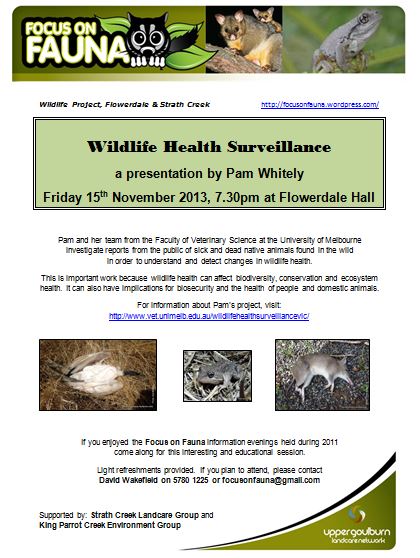
 During 2011, Focus on Fauna held a series of evening presentations in Flowerdale and Strath Creek covering various nature topics. These proved to be very popular and the Upper Goulburn Landcare Network is keen to revive the program.
To start off we have arranged for Pam Whitely to give a talk at Flowerdale on 15th November about her work on wildlife health at the Faculty of Veterinary Science, The University of Melbourne. Find out what to do if you do see sick or dead native animals in the wild, and learn about diseases and viruses that may affect our native wildlife. Their health can be important for biodiversity and may even influence human health. Some examples of what Pam and her team deal with are:
- the decline of amphibians due to introduced chytrid fungus
- facial tumor disease in Tasmanian Devils
- psittacine (beak and feather) circoviral disease in parrots and cockatoos
Click on the flyer below to see full details of the presentation. If you plan to attend please email: focusonfauna@gmail.com
Birth notice
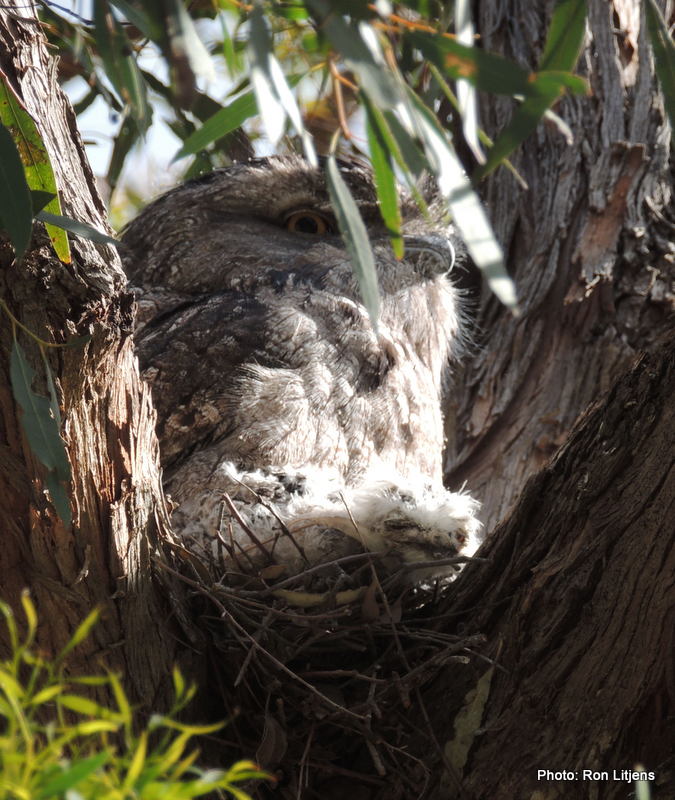
Self-appointed and proud grandparents Trudie and Len are pleased to announce the arrival of one (maybe two) Podargus strigoides, otherwise known as Tawny Frogmouths. A recent post (click HERE to view) featured the frogmouth nest in a tree outside Trudie and Len’s bedroom window. Mother and father are doing well. So far they have been observed to swap sitting duties at dusk.

The two photographs (click to enlarge) show a parent sitting on amorphous balls of fluff. You can just make out an eye of a chick in one image (above) and a beak in the other (right). Stay tuned for more photos in the near future when the chicks grow into something more than animated cotton balls.
Little Aussie battler
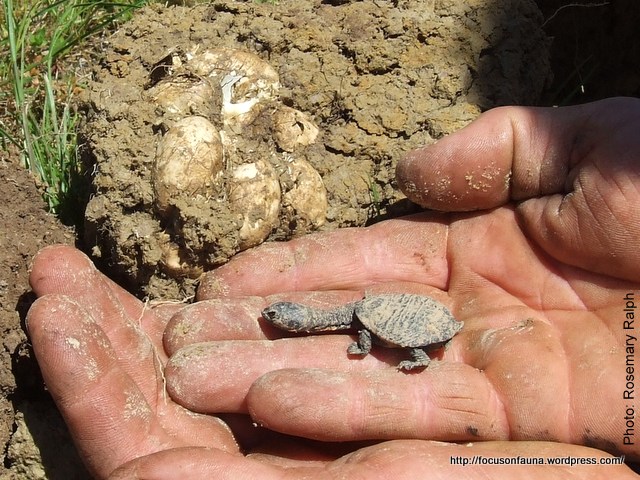 A small excavator operating beside Rosemary’s house near Strath Creek recently turned up an unusual find, a newly-hatched Eastern Snake-necked Turtle (Chelodina longicollis) together with a clutch of about 6 or 8 eggs, some apparently unhatched, set in a clod of hard-packed clay about 20 cm below the ground surface. The bobcat operator showed the turtle to Rosemary who transferred it to an adjacent large ornamental pond which has lots of rushes and other water plants that will hopefully provide cover and food and ensure the survival of this little battler.
When we later inspected the remaining eggs they all appeared to be either broken open or unfertilised, and certainly no embryos remained. So this seems to have been the last straggler from the clutch. It was surprising how hard the soil was – it would have taken quite some digging to lay the eggs as deep as they were.
Click HERE to see a post from last year about another young turtle near Strath Creek, together with more information on its life cycle.
And if you’re wondering why this is called a turtle and not a tortoise, ‘freshwater turtle’ is now the preferred term to distinguish it from its sea turtle cousins and from the true tortoises found on other continents which are wholly terrestrial and have domed shells.
Longicorn beetle larvae, watch out!
 This colourful critter is a wasp from the Braconid family, more specifically a White Flank Black Braconid Wasp (Callibracon capitator).
Braconid wasps are black, white, orange and red. They are shiny to look at but are covered in pale hair. The female is distinguished by a large ovipositor (the long ‘sting-looking’ part at the tail). Generally regarded as the gardeners’ friend, braconid larvae parasitise the larvae of other insects — moths, flies, sawflies and beetles. The female wasp uses the ovipositor to lay eggs just under the skin of the food host. The wasp larvae hatch and feed on the living host, eventually breaking through the surface of the skin and spinning cocoons. The host, still alive, will carry the cocoons around until the adult wasps emerge. Then the host dies.
And if you want to see what the preferred food of this wasp is click HERE to view.




 Focus On Fauna