A flurry of wings resolved
The vegetation on the eastern side of our property consists of open Box–Stringybark forest. The understorey consists mainly of grasses — natives with a few exotics. In summer the long grass hides a multitude of creatures, primarily Red-bellied Black Snakes, Brown Snakes and smallish birds that suddenly burst from the grass in a flurry of wings and disappear equally quickly back into the grass some distance away. We call these LQJ’s (little quail-ey jobs)—not to be confused with LBJ’s (little brown jobs), which are the unidentified birds that flit around the tops of trees. Trying to photograph the LQJ’s for identification purposes is almost impossible. They appear when you least expect them—sort of like the Highway Patrol, and then are gone.
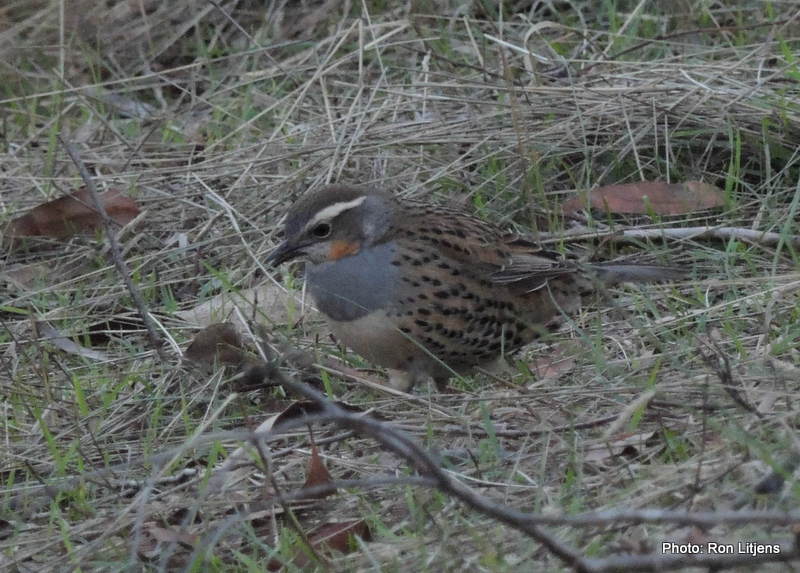 Because of the drought, the long grass is flat and there are not many places for the LQJ’s to hide at the moment. And so it was during my dusk stroll I saw an LQJ power-walking across my path. I managed to get a couple of photos that helped me identify it as a female Spotted Quail-thrush (Cinclosoma punctatum, from the Greek words kikhle meaning thrush, soma meaning body and the Latin word punctus meaning sting—hence spot).
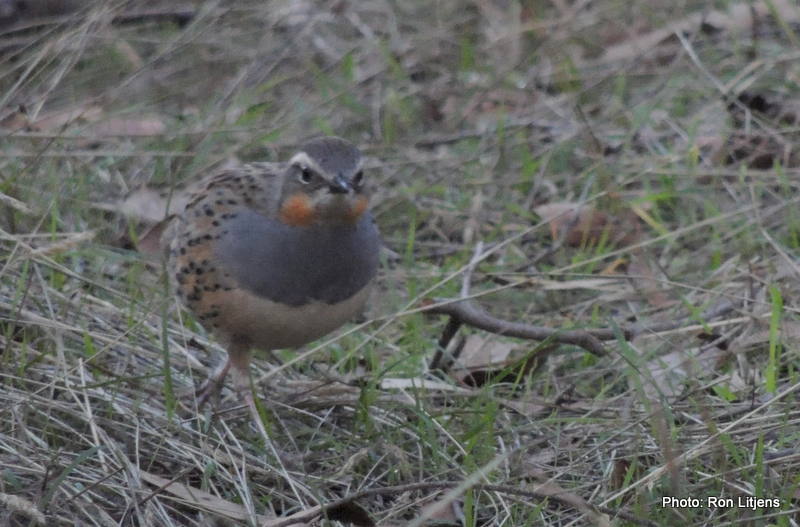
The Mrs. – note the orange cheeks
These birds build a loose nest of bark, leaves and twigs against rocks, stumps or native grass tussocks from June to November. This one was probably out looking for a date.
Now one species has moved from LQJ status to a big tick on the identified bird list. I wonder how many other LQJ’s are out there?
Colourful kingfishers
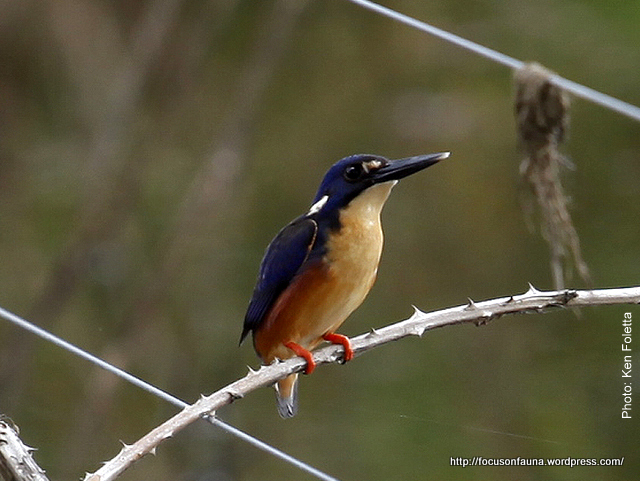
Azure Kingfisher
Last November we had a surprising appearance of an Azure Kingfisher in our garden near Strath Creek, but it was such a fleeting visit that we had no chance to get a photo. Fortunately, Ken from Alexandra, who provided the wonderful pictures of a Whistling Kite in the recent post, Kite flying, was either luckier or more patient, and managed to capture the image shown at left of this gorgeous little bird near the Goulburn River. If you ever get a glimpse of this bird in direct sunlight, as we did recently at Majors Creek near Mitchellstown, it is an absolute knock-out! The colours are extraordinarily vivid, and that’s coming from one of us who is supposed to be colour-challenged!
The Azure Kingfisher’s natural habitat is along well-vegetated waterways and it is occasionally spotted beside the King Parrot Creek. It is one of the birds that would definitely have benefited from revegetation works along the creek by Landcare and others.
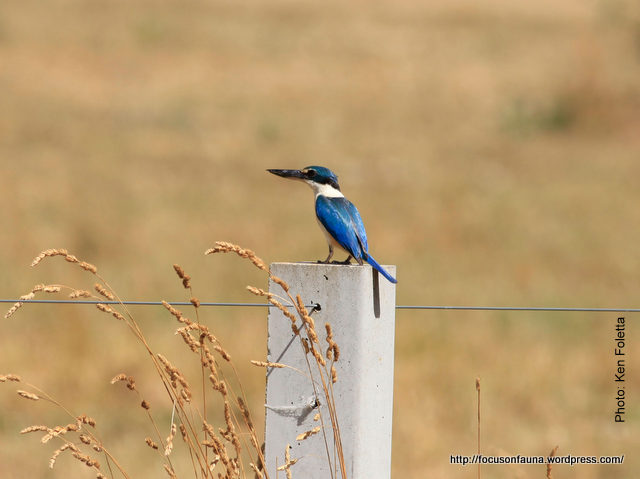
Sacred Kingfisher
Ken also sent in a picture of the slightly larger and more common Sacred Kingfisher (at right). It isn’t confined to waterways, and may be seen in open woodland where it feeds mainly on small reptiles and insects. Its plumage can be variable which may be confusing for identification. Its distinctive repetitious call is often the first indication of its presence. It also has other less easily identified calls, which can be heard by clicking on the audio bar arrowhead below.
A pleasant surprise

Superb Lyrebird
More than four years after the Black Saturday fires we thought we would set up remote cameras on a couple of the larger patches of bushland in private ownership. Paul’s 360ha bush property in the middle of Flowerdale was severely and totally burnt out in 2009, but the regeneration is quite impressive, especially in the moister gullies, with dense regrowth of a range of eucalypts, Silver Wattle, Blackwood, Hazel Pomaderris, Prickly Currant Bush, Victorian Christmas Bush and numerous other shrubs and ground flora.
Checking the cameras’ SD cards the other day, we scrolled through lots of shots of the expected wombats and wallabies, and, (ho-hum) the usual suspects among feral pests – foxes, Sambar, rabbits – and then a pleasant surprise … a Superb Lyrebird (Menura novaehollandiae) (pictured above).
Walking around the property, it is clear that many other bush birds are returning – and last year a Long-nosed Bandicoot was recorded on remote camera.
-
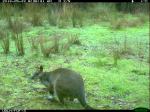
- Black Wallaby
-

- Sambar – a voracious browser of regenerating plants and spoiler of revegetation efforts
-

- Common Wombat
-

- Red Fox – a significant threat to recovering wildlife
We tend to think of dams as places where the feathered and furry come to drink – and of course they are. But if you hang around a dam long enough you’ll soon realise that dams also double as a swimming pool, bathroom and day spa.

Scarlet Robin – believe it or not
We all have our beauty routines. The bathroom at our house is littered with sample pots of pastes and potions with exotic names like ‘Doux Nettoyant Moussant’ (Gentle Foaming Cleanser) and ‘Masque ‘Anti-Soif’ Multi-Hydratant (Thirst Quenching Hydra-care Mask), which are applied in a set order at a set time every day. These are not mine. It may surprise you to know that fauna also have their set grooming routines. Some birds such as the Scarlet Robin (Petroica boodang) (pictured left) favour the cleaning regime that I use. It’s called the ‘splash-
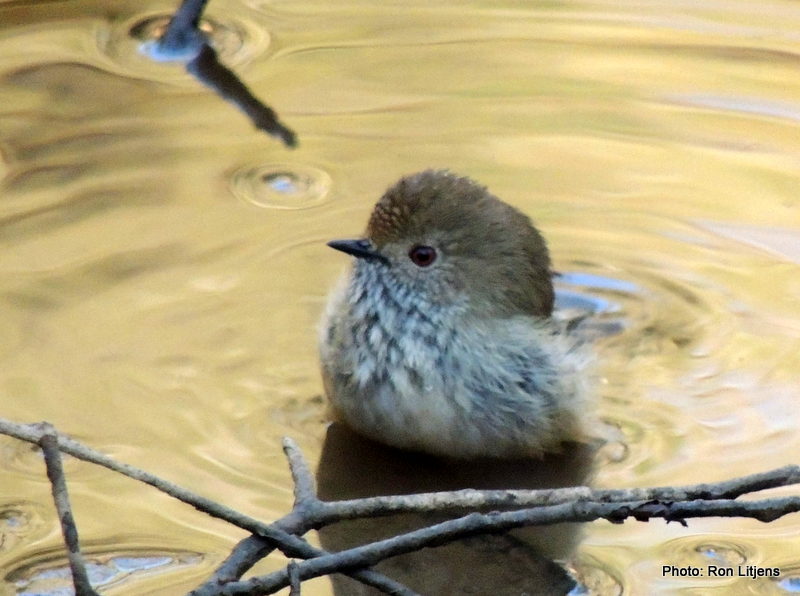
Brown Thornbill Sit-and-soak
and-dash’. Others like the Brown Thornbill (Acanthiza pusilla) (pictured right) prefer to ‘sit-and-soak’. However some animals have a far more complex routine. Take the Rakali (Hydromys chrysogaster) shown in the video clip below for example. Its technique consists of a self-manicure, followed by a facial, a facial mud-pack, a rinse, a bath, another facial and finally a swim.
It is amazing how the differing routines at the dam mirror what happens in our house.
P.S. For those who have never seen a Rakali close up before, note the webbed feet and the distinctive white-tipped tail.
(The video below is a large file and may take some time to load.)
And the SMS text message read…
‘The tawny frogmouths r back. Xxx trud’ 15:49 12May
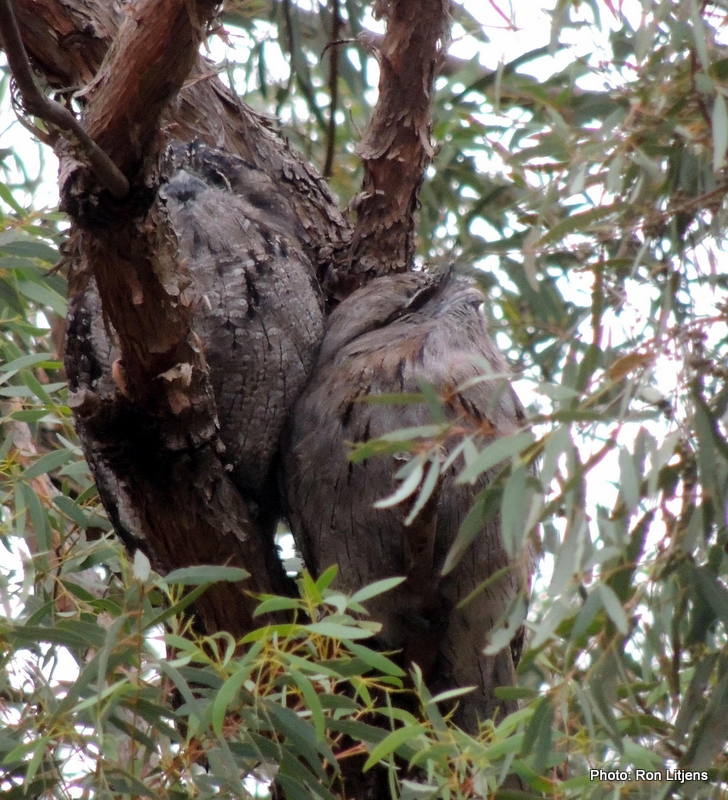 So around we went to observe the new arrivals. Trudie and Len live on a property nestled beneath what is officially known as Grannie Hill, between the pub and Coonans Reserve, Flowerdale. When we turned up, Len stood us in the middle of the yard and proudly pointed up at the nearby tree. I couldn’t see a thing. After several minutes of an ever-more frustrated Len waving his arms about, we spotted the two Tawny Frogmouths (Podargus strigoides) (from the Latin ‘strix’ meaning owl and ‘oides’ meaning form) sitting together on a branch (pictured left). They were perfectly camouflaged. Given our difficulty in seeing them and the fact that, chronologically, both Trud and Len have at least a decade’s head start on me, I politely inquired how they managed to see the birds in the first place. Apparently they heard the frogmouths calling.
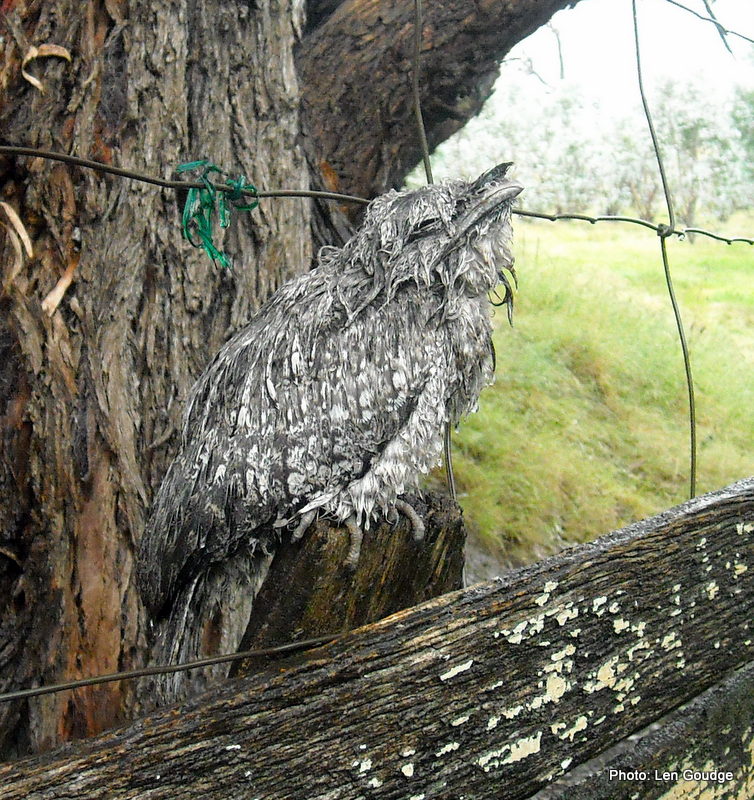
A young Tawny – still wet behind the ears – and everywhere else
Tawny Frogmouths are not owls. Their diet is almost exclusively made up of insects and instead of actively hunting on the wing, the birds wait motionless until the prey comes to them. (That’s my kind of lifestyle – not the diet, but the mode of getting it). Tawny Frogmouths are nocturnal birds that during the day roost very close to tree trunks with an erect stance, beaks up in the air. This makes them very difficult to see. Like owls they have excellent hearing and eyesight.
So if you are walking in the bush and think you are being watched but can’t see anything, you probably are – by Tawny Frogmouths. To locate them, sit down, wait until nightfall and listen for their calls. To hear an example of the call on BirdLife Australia’s Birds in Backyards website, click HERE.
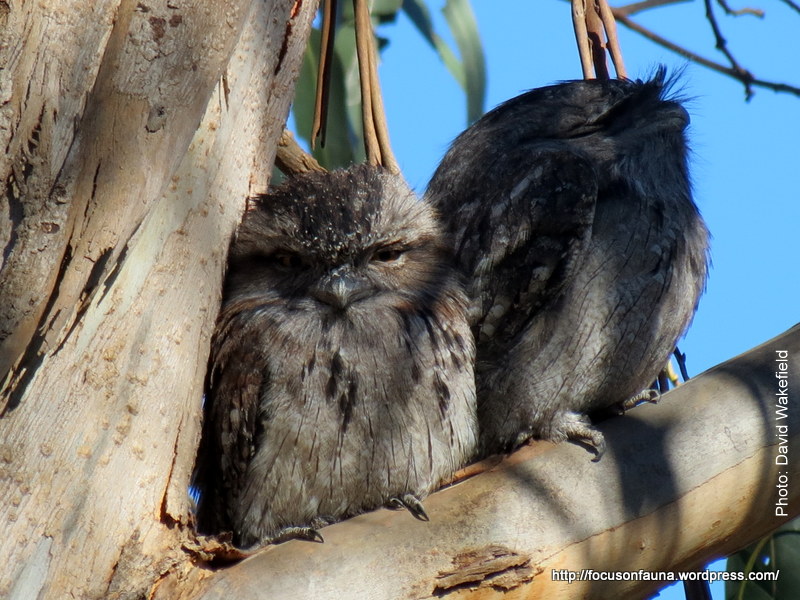
Tawny Frogmouths at Reedy Creek
Creek creatures

Mayfly nymph (Family Leptophlebiidae)
Waterwatch is again up and running in the Flowerdale/Strath Creek area with several local volunteers conducting monthly sampling and testing at various sites on the King Parrot and Strath Creeks. Waterwatch is a water quality monitoring network connecting local communities with river health and sustainable water issues and management.
Last Saturday David spent an afternoon with Waterwatch coordinators Danielle and Kirsten as they undertook a training and accreditation course on the King Parrot Creek run by Ed Tsyrlin, co-author of the wonderful guide to freshwater macro-invertebrates called ‘The Waterbug Book’. The afternoon course covered sampling techniques and identification of waterbugs.
So on Monday, armed with fresh enthusiasm, limited knowledge and a net, we collected a sample from the King Parrot Creek at Burslem’s Bridge and sorted through it to see what bugs we had. The more we looked, the more we found, with critters ranging from small shrimps to tiny specks. The photos below show just a few of them, which we have managed to identify with some help from Kirsten. Also included are a couple of photos from our wetland featured in a previous post, Dam right !, which we are now able to have a stab at identifying.
Outdoor art or athletic event?

‘Plop-on-a-rock’
If you have living in your locale Common Wombats (Vombatus ursinus), Eastern Grey Kangaroos (Macropus giganteus) or Swamp Wallabies (Wallabia bicolor) you will be familiar with the phenomenon known in our house as the ‘plop-on-a-rock’. You’re walking along and there you see precariously perched on a rock or piece of wood or even on a tuff of grass, poo from the aforementioned creatures.

‘Bog-in-a-log’
One can only wonder at why these public installations exist. A friend of mine who is a Swamp Wallaby guru suggests that as the wallaby drags its tail over a protruding object like a rock, hairs at the base of the tail trigger the events which lead to what we see. Far be it for me to second-guess the experts but there seems to be a degree of exhibitionism in the resulting structures. Thinking about it, the athleticism and sheer precision involved in the creation is staggering (not that I have tried it mind you). I have recently even found poo inside the upright hollowed tree stump of a Silver Birch (Betula pendula) (pictured above right). Precision indeed.

Evidence of ‘A**e-on-the-grass’
Are these installations a result of a macropod public art competition or an event in the kangaroo Olympics? I don’t know. If anyone can shed light on this please comment.
Who’s calling?
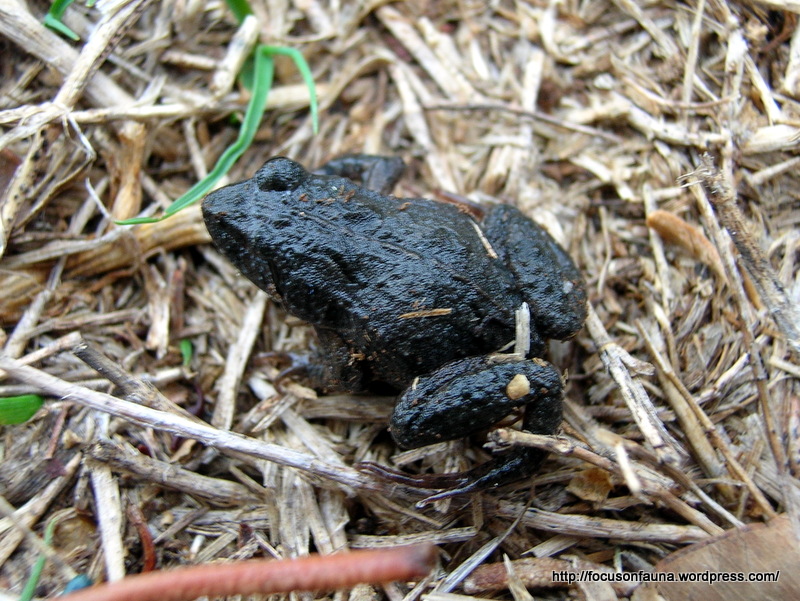
Bibron’s Toadlet ?
So we have yet to find the ubiquitous but cryptic Victorian Smooth Froglet. However, we did find the dark frog pictured above, which in the blown-up image doesn’t seem particularly small, until you see the comparison with a 5 cent piece in the photo below. We think (but are happy to be corrected) that it is a Bibron’s Toadlet (Pseudophryne bibronii) because of the coarse black and white marbling on its belly and the boomerang-shaped ridges on its shoulders, features typical of a Bibron’s Toadlet. It did tend to hop though, whereas Bibron’s Toadlets are reputed to prefer walking to hopping.

Anyway, we had a call but no frog, and a frog but no call! Further investigation however revealed that in amongst the numerous Victorian Smooth Froglet calls, there was an occasional short ‘cre-e-ek’ that seemed to correspond roughly to the field guide description of Bibron’s Toadlet’s call.
The audio below gives the VSF’s call, both individually and collectively, followed by what we assume is the BT’s call recorded at the wetland.
For more information on these notoriously secretive frogs, and indeed on all Victorian frogs, go to http://frogs.org.au/frogs/of/Victoria/
The Goulburn Broken Catchment Management Authority, in partnership with Museum Victoria, has developed the iSpy Frogs app which covers 20 frogs found within the Goulburn Broken Catchment. It is currently only available for Apple iPhone, iPod and iPad devices and can be downloaded free from the App Store.
The big and the small of it
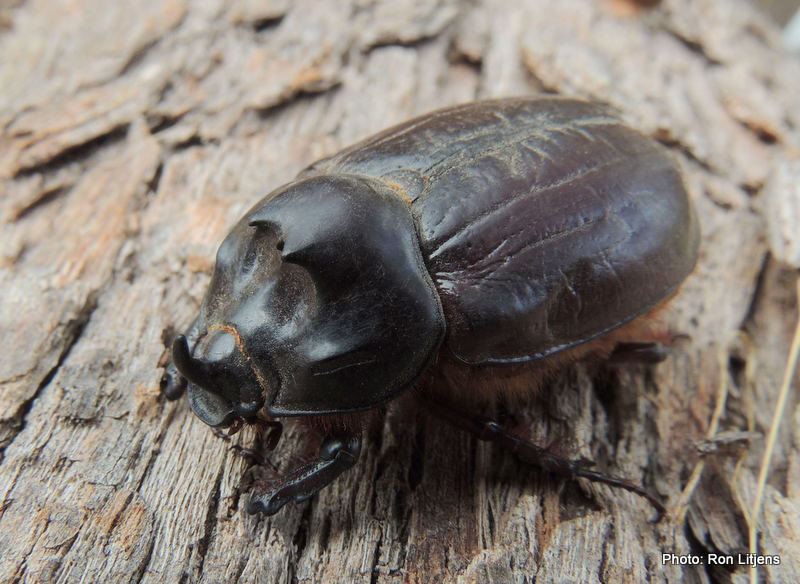 Beetles belong to the order Coleoptera (from the Greek koleos meaning sheath and ptera meaning wing). The name describes the two hard wing covers that protect the flying wings underneath. The Coleoptera make up more than 30% of the total number of animals on earth. So you would expect they would come in all different shapes and sizes.
This was evident when I was riding my bicycle recently and was hit in the helmet by a Rhinoceros Beetle (Dasygnathus trituberculatus), (pictured above), a member of the Black Scarab family. At over 3 cm long it is not the biggest beetle around, but it is large enough to give you a loud thump on the head. The male beetles have a single horn on the front and two forward-facing horns on the thorax. The horns are used for digging and for fighting other males during the mating season. These beetles, gram-for-gram, are some of the strongest animals on earth in terms of load-carrying ability.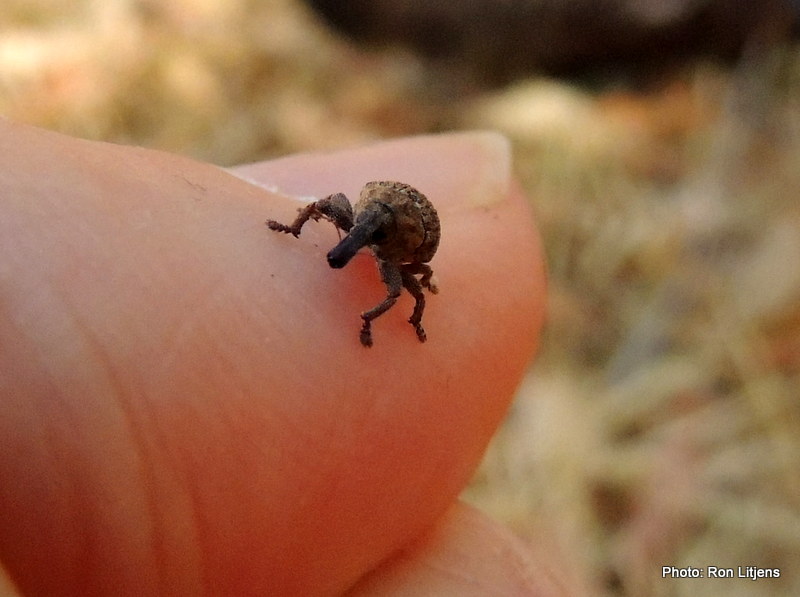
Compare that to the weevil (species unknown, pictured right) that invaded our picnic a couple of days after my bicycling encounter. At barely 2 mm long, this weevil is one of over 60,000 species worldwide. Weevils are herbivores — which is why you might have found them frolicking in your flour canister. So when I found this critter on my sandwich, it was a relief to know it wasn’t after the salami. That’s my favourite bit.
How much can a koala bear?

Forget Pink. I prefer the classics…maybe Mussorgsky’s Night on Bare Mountain
When it comes to listening to the music of Pink* it seems a koala can’t bear much. Driving up Junction Hill at lunch-time with the CD system in the truck playing (too) loudly I noticed a wombat-like creature hitch-hiking on the road ahead. As I got closer it proved to be a Koala (Phascolarctos cinereus), (derived from the Greek words phaskolos meaning ‘pouch’ and arktos meaning ‘bear’, and the Latin word cinereus meaning ‘ash coloured’). It didn’t appear too perturbed until I wound the window down. The dulcet tones of Pink seemed to give it fright and it didn’t stop galloping until the music was switched off. Then it proceeded to climb a tree and sat there looking at me.
Koalas feed mainly on eucalypts but will eat a wide range of plants in conjunction with their gum-leaf diet. In the Flowerdale area the main food sources include Victorian Blue Gum (Eucalyptus globulus ssp. bicostata), Manna Gum (E. viminalis ssp. viminalis) and Mountain Grey Gum (E. cypellocarpa). If you want to know what they eat where you live, check out the Australian Koala Foundation website (www.savethe koala.com/about-koalas/trees-koalas). The foundation has issued a National Tree Protection List by region that outlines the trees koalas prefer in your ‘hood.
As koalas spend the major part of the day sleeping and are usually only active at night when they feed, seeing one moving about in daylight hours was a real treat even if its grasp on pop music was questionable.
*Pink is a R&B/pop musician named by Billboard magazine as the #1 pop musician of the decade. Still no idea? – you need to get out more.




 Focus On Fauna