Finding phascogales
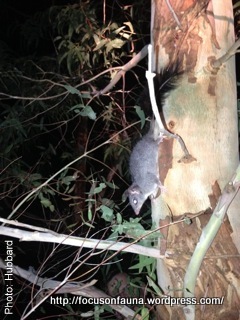
Brush-tailed Phascogale
A Focus on Fauna favourite, the Brush-tailed Phascogale (Phascogale tapoatafa), was photographed recently on “Three Sisters” on the Broadford-Flowerdale Road. Since the FoF project began in late 2010 there have now been at least four phascogale sightings at widely-spaced locations on this large grazing property adjoining the Mount Disappointment State Forest, which is encouraging since much of its habitat was severely burnt in 2009. Two of those sightings were reported in previous posts on this blog – click HERE and HERE to view.
According to the Victorian Biodiversity Atlas, the Brush-tailed Phascogale was found on “Three Sisters” in 1932 and 1933, but there were no subsequent records in the vicinity until Focus on Fauna entries in 2011. Although this phascogale is listed as a threatened species under the Fauna and Flora guarantee Act, we are finding it is a case of the more you look, the more you find, and a greater awareness in the community as well as remote surveillance (and mobile phone) cameras are making it easier to record sightings.
Brush-tailed Phascogales have an interesting, and somewhat precarious, life-cycle. Breeding is restricted to the cooler months, with frenzied mating in May and June, after which all males die of various stress-induced diseases, with only pregnant females surviving. They give birth from mid-June to early August, following about 30 days gestation. The photo above was taken on 11th August, so this would be a female, probably with several young attached to the teats in her pouch. Most females only produce one litter and survival beyond 3 years is rare.
Tales from the woodpile #2
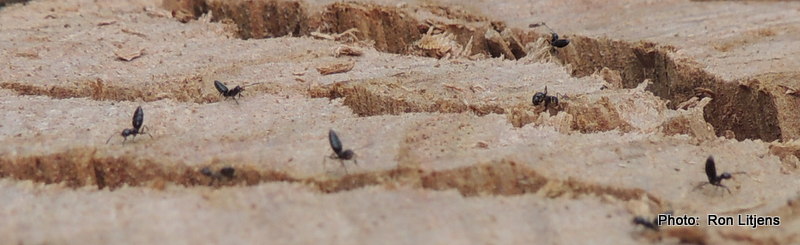
Annoy-ance
While splitting wood recently, the bark fell off a log revealing an colony of irate ants, which proceeded to scurry around with their abdomens in the air (pictured left, click image to enlarge it). They were threatening to spray formic acid (methanoic acid) as a defense mechanism. The word ‘formic’ comes from the Latin word for ant, formica.
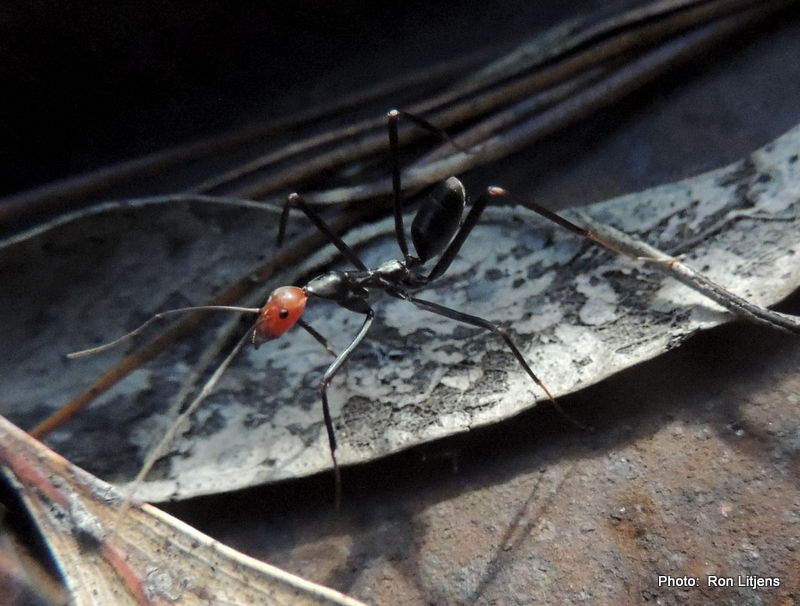
Defi-ance
Most ants use a mixture of formic acid and other chemicals to defend themselves. In some ants this is delivered as a painful sting. The Dolichoderinae family of ants lack a sting and therefore spray the chemicals by forcibly ejecting the formic acid from a poison gland in the tail. A Spider Ant (Leptomyrmex erythrocephalus) (from the Greek eruthros meaning red and kephale meaning head), pictured right, is shown with the abdomen raised in a defensive position. Another local ant from the same family (pictured below) is the Double-spined Dolly Ant (Dolichoderus doriae) (from the Spanish dorados for golden colour). It is named after the spines that protrude from the thorax. Annoying either of these ants will result in a defensive spray and the familiar ‘ant smell’.
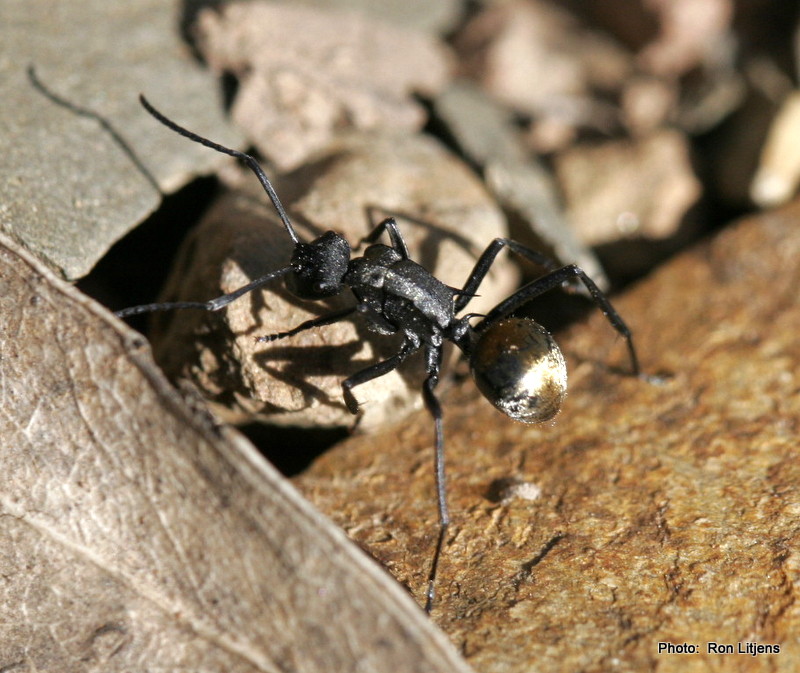
Protuber-ance
Other fauna use this ant behaviour to their advantage. Many birds, including some Australian birds such as the Regent Honeyeater, are known to perform ‘anting’ where they rub ants into their feathers. The ants get annoyed and spray formic acid, which acts as a combination insecticide, miticide, fungicide and bactericide. Some birds then eat the ant after all the formic acid has been eliminated.
In an amazing evolutionary step, creatures such as the Anteater (from the Americas) do not produce hydrochloric acid to promote digestion like most mammals. Instead they rely on the formic acid secreted by ants they eat to do the job. Hence the ants provide the acid to digest themselves.
And that is why you never see an echidna with a sore tummy. It’s full of ant-acid.
Small is beautiful
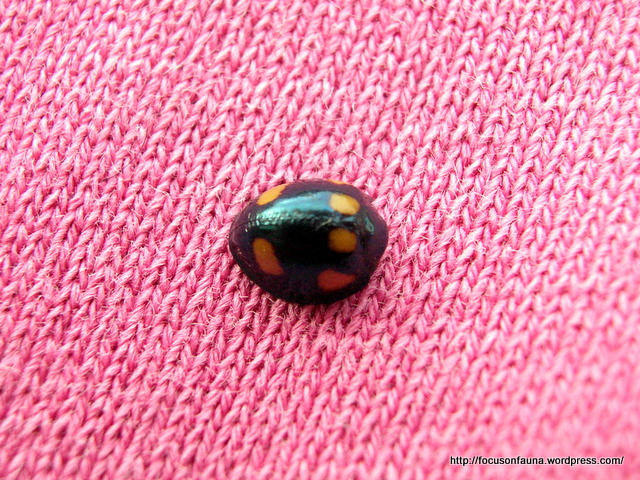 Just to show that size (or lack of it) is no barrier to qualifying for this blog, we’ve included this lovely little beetle that came in on the clean washing straight from the line. It’s an Orange-spotted Ladybird (Orcus australasiae) and the fine-knit windcheater background gives an idea of the size – approx. 5 mm long. This ladybird reverses the usual colour scheme of black spots on orange/red wing covers found on many species of the Family Coccinellidae, including the familiar Common Spotted Ladybird (Harmonia conformis).
Many ladybird beetles are not just pretty, but perform a useful role as predators on aphids, mealy bugs, mites and scale insects. So, despite their depiction in the ABC-TV’s Minuscule series as irritating little smarty-pants, they represent a valuable means of biological pest control.
Tollway planned for Flowerdale

Agile antechinus
I have spent a lot of time near our dams in recent weeks watching for the Rakali (Hydromys chrysogaster). (Who says I’m obsessive?) I’ve noticed that the critter frequents both our dams. Our driveway cuts between the two dams and the Rakali scampers between them through a culvert under the road. In an attempt to get some close-up photos of the Rakali I set up a remote camera at one end of the culvert.

South end of a north-bound wombat
The results were amazing. The culvert has more traffic than the Burnley Tunnel. Even though I have not photographed the Rakali using the short-cut, shown in this post are some regular commuters. Agile Antechinus (Antechinus agilis) and Common Wombats (Vombatus ursinus) use this passageway every night.

Too squeezy!
The only thing stopping the Eastern Grey Kangaroos (Macropus giganteus) from using the same thoroughfare is their ‘wide load’ status … the width of their hips.
Taking a leaf out of Richmond City Council’s book, I have plans to make the tunnel a tollway. It might even pay for my Murrindindi Council rates.
(Click on the photos to enlarge image).
Opportunism
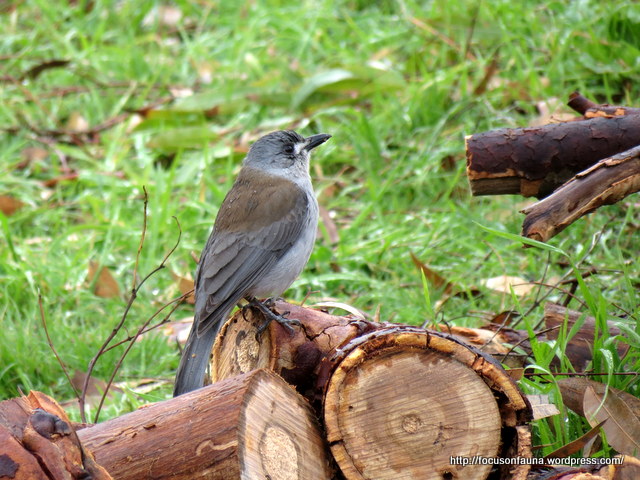
Grey Shrike-thrush

Angophora stump – spot the bird!

Wood-eating grub – possibly a longicorn beetle larva?
The species name from the Greek harmonikos, meaning skilled in music, is entirely appropriate for this wonderful songster. A sample of its range of calls can be heard by clicking on the audio bar below.
Tales from the woodpile #1
Whoever said that this July was one of the warmest on record wasn’t living on Junction Hill. We have been through a pile of firewood. Last weekend we headed up to the woodpile again to split some more fuel. What we discovered in doing so was a collection of animals equal in variety to those in the Healesville Sanctuary, but these ones don’t cost anything to visit.
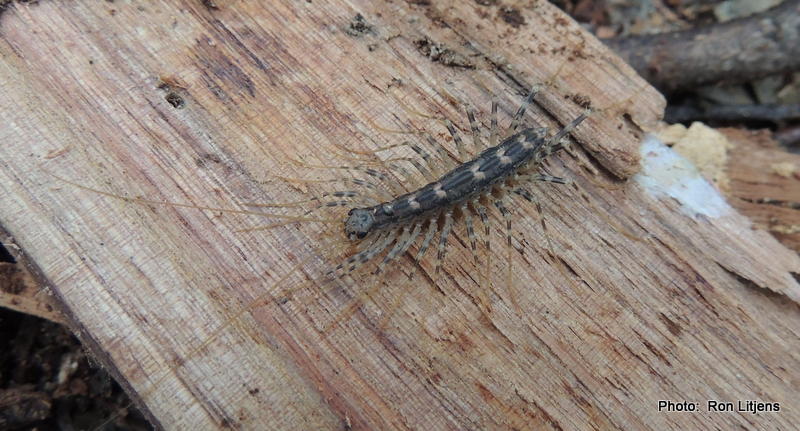 The critter pictured left is one of a number of species known as House Centipedes. They all belong to a group known as scutigeromorphs, which are distinguished by having compound eyes. All other centipedes have single-lens eyes. This one, an import from the Mediterranean, is Scutigera coleoptrata. You can tell by the pair of prominent spines on the first joint of legs 6 to 14 (true!). The adult has 15 pairs of legs. The centipede pictured only has eleven pairs, meaning it has only been through 4 of its nine moulting phases. Either that or I chopped off four pairs of legs when splitting the wood … only joking.
The other centipede I came across (pictured right) is of the Order Scolopendramorpha. Identifying it further meant getting up close and personal with it and it did not appear to be in the mood, hence I wasn’t either.
Both species are predatory, feeding mainly at night on spiders, cockroaches, ants and other centipedes. In S. coleoptera the antenna act as both a touch and a smell organ. These animals deserve to be left alone. As ferocious as they look, they play an important role in reducing invertebrate pests. And you should see them play soccer.
Is Roo-mance in the air?
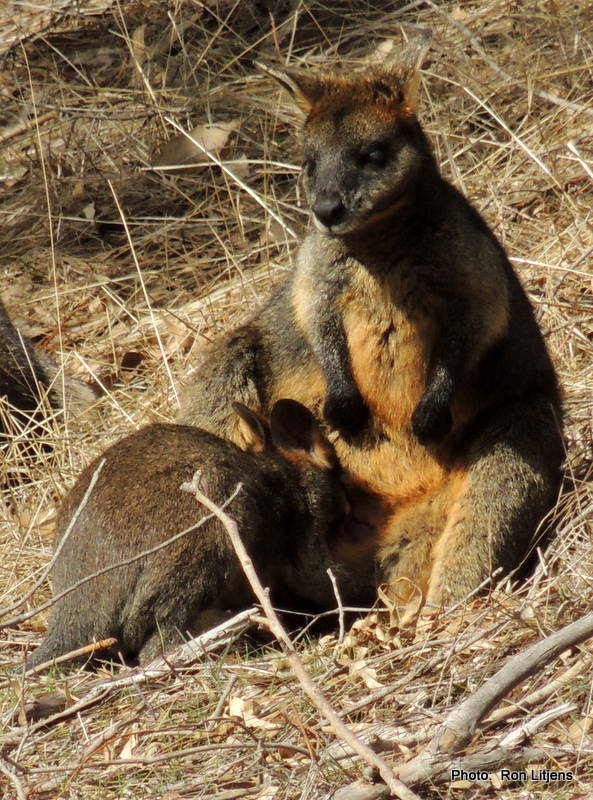
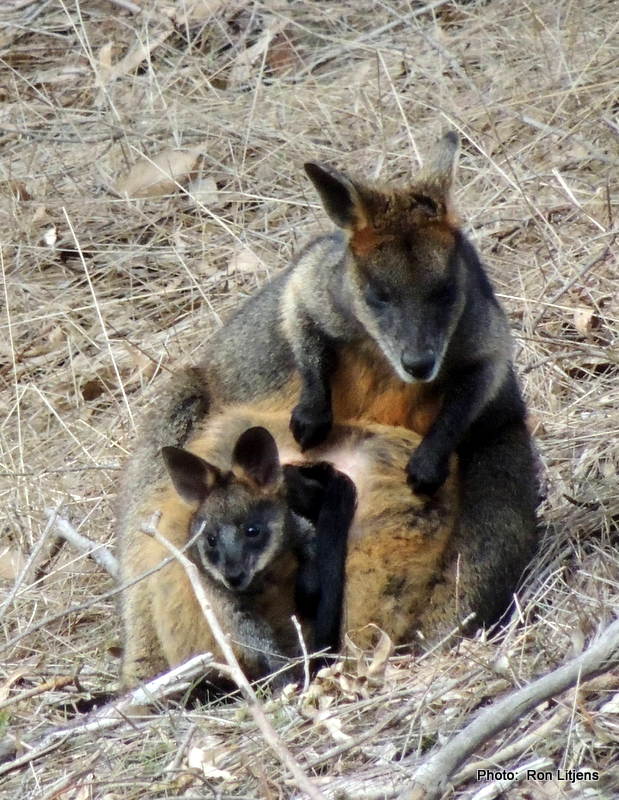 Swamp Wallabies (Wallabia bicolor) are mainly solitary creatures, getting together whenever there is something particularly good to eat or it’s mating season. On our property we have noticed four wallabies, each of which has its own range over which it moves and grazes. We rarely see them together. However in the past week or so the wallabies have been congregating. In fact yesterday I saw seven hanging together in the sun on one of the slopes. Either they have all found something delicious to eat in that particular locale or there is Roo-mance in the air. Given the guilty way (that’s my interpretation) they all thumped off in different directions when they saw me, I’m opting for the roo-mance.
Swamp wallabies are genetically different from other wallabies. They are the only remaining member of the genus
Dinner time
Wallabia. They live in dense thickets in forests and usually come out at night to feed. On our property, they hide in the valleys filled with dense Burgan (Kunzea ericoides) scrub.
Part of this group was a female with joey (see picture above). Judging by the size of the pouch passenger this joey is soon to be ejected into the great wide world. The joeys usually stay in the pouch up until the age of 8 or 9 months and thereafter continue to suckle until 15 months. At this age the wallaby is sexually mature and the cycle starts again.
Maybe we will soon hear more thumps of tiny paws. Stay tuned.
Bandicoot sightings
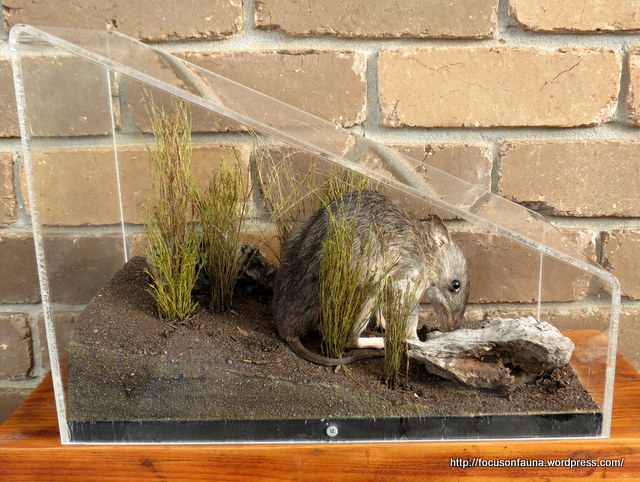 The Strath Creek Landcare Group has just taken possession of a preserved (sounds better than stuffed!) specimen of a Long-nosed Bandicoot (Perameles nasuta) that will be available for display locally, alongside an existing Brush-tailed Phascogale specimen. These exhibits have great educational and general interest value, as many people have never had a chance to see these delightful little creatures alive in the wild. The collection and taxidermy of the road-kill bandicoot was done under a Wildlife Permit held by the Upper Goulburn Landcare Network, a necessary requirement for handling any native wildlife.
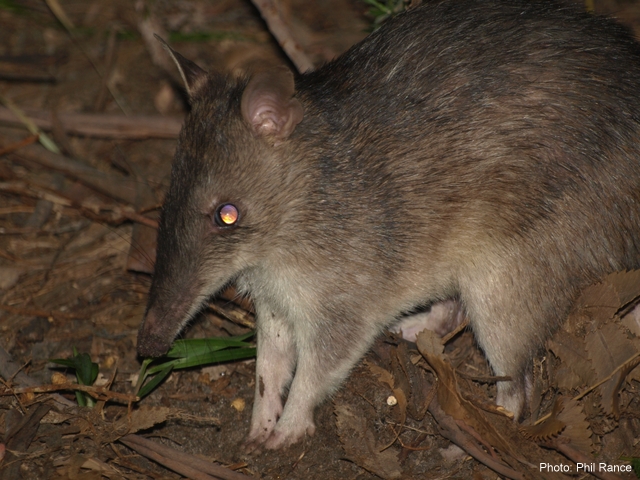
Long-nosed Bandicoot
Since mid-2011 there has been a spate of sightings of Long-nosed Bandicoots in the fire-affected areas of Flowerdale, the Kinglake Ranges, Toolangi and Glenburn, as seen on the map below. Many of the sightings were unfortunately road-kills, but live animals have been recorded on remote cameras in several locations, and a number of previous posts on this blog have been about the bandicoots (to view, just type ‘Long-nosed Bandicoot’ in the SEARCH THIS SITE … box at right). The Flowerdale sightings are significant as, according to DEPI’s Victorian Biodiversity Atlas, prior to the recent sightings the bandicoot had not been recorded in Flowerdale. The nearest sighting was in the Wallaby Creek catchment area of Kinglake National Park in 1975.
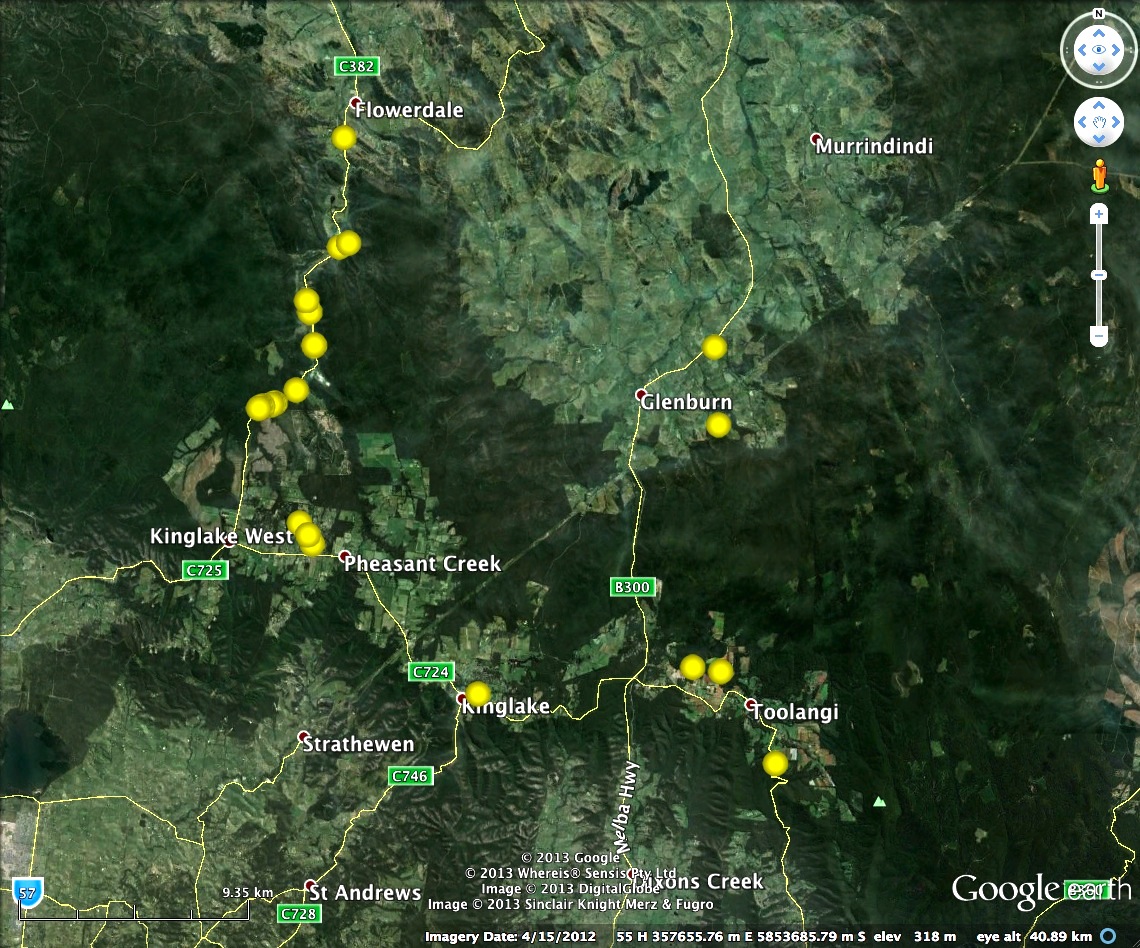
Long-nosed Bandicoot records since August 2011
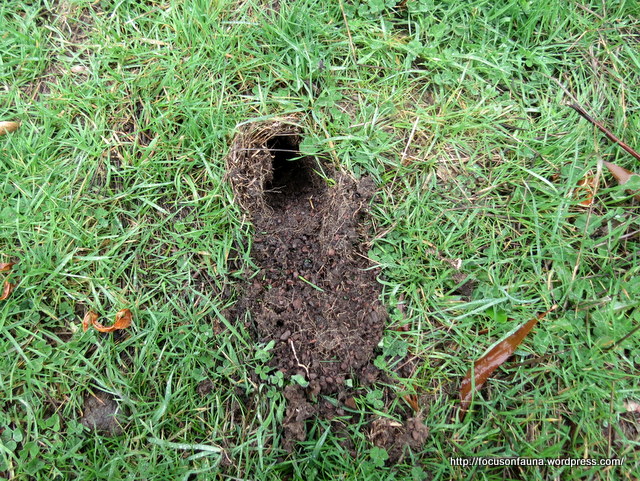
Long-nosed Bandicoot digging
The latest sighting was along a creekline at Flowerdale on one of the sites of the Strath Creek Biodiversity Project where tell-tale diggings had been spotted by Project Officer Steve Joblin and Landcare Coordinator Chris Cobern, who confirmed the bandicoot’s presence with a remote camera image (see below). The Long-nosed Bandicoot is thought to be omnivorous and digs with its forelegs for insects and their larvae, succulent plant material and fungi. Typical bandicoot digging is shown at right (sorry Chris, didn’t have a coin for size comparison, but the clover leaves give you an idea) – the hole can be compared with an echidna’s in a recent post Whodunnit ?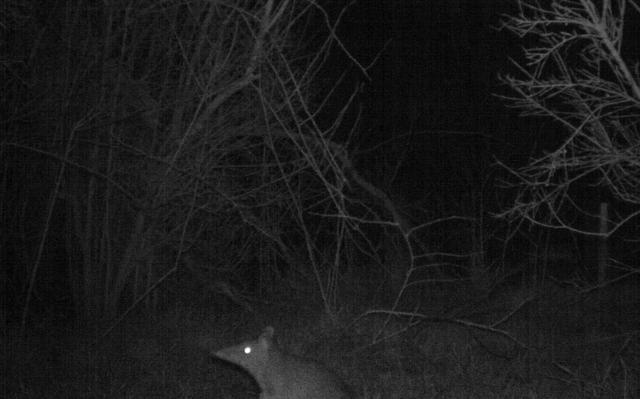
In times like these …
 Winter is a really tough time to be blogging about wildlife recovery. All self-respecting fauna are snuggled down, cosy and warm in their hollows or nests, probably sniggering as I wander past in the freezing cold and roaring gales camera in hand, looking for them.
In times like these I have to rely on the old standards … birds and animals that are around all the time and never get a mention on the blog for that very reason. With that in mind I introduce a bird that even in winter I see darting among the  grevilleas, the Eastern Spinebill (Acanthorynchus tenuirostris, from the Greek acantha meaning ‘spine’, rhunkhos meaning ‘bill’, and the Latin tenuis meaning ‘thin’ or ‘slender’ and rostrum meaning ‘bill’). Originally it was called the Slender-billed Spine-bill—one look at the photo and it is not hard to see why.
These birds are honeyeaters. The fine curved bill is used to probe the insides of flowers to extract the pollen and nectar. The male (pictured) has a black crown. All members of our household think the male has very handsome markings. The yellow flash on the head is a smearing of pollen from its lunch. The female has a grey crown. To hear to the call please listen to the clip from DJ Macwake’s extensive hip-hop avian audio library:
Out and about
 Regular followers of this blog may recall the January post showing graphic pictures of this Common Wombat (Vombatus ursinus) mother with her young appearing in various poses at the entrance of her pouch (click HERE to view). We have seen the mother around her regular territory several times since then, serving as our living lawnmower. But she’s always been alone, and we were beginning to think she had lost the young one. However, the other day we looked out the window and there she was with a chubby youngster at heel.


Many wombats are not as sleek and healthy as this pair and suffer, often terribly, from mange. A method of treating mange in wombats has been developed for cases where the infestation has not progressed beyond the point of recovery. Rick and Claire, keen participants in the Focus on Fauna survey program in 2011 and now enthusiastic wildlife carers, have organised a free information day in Yea on Sunday 1st September. Click on mange_day_flyer to see details of the day.