Whodunit ?
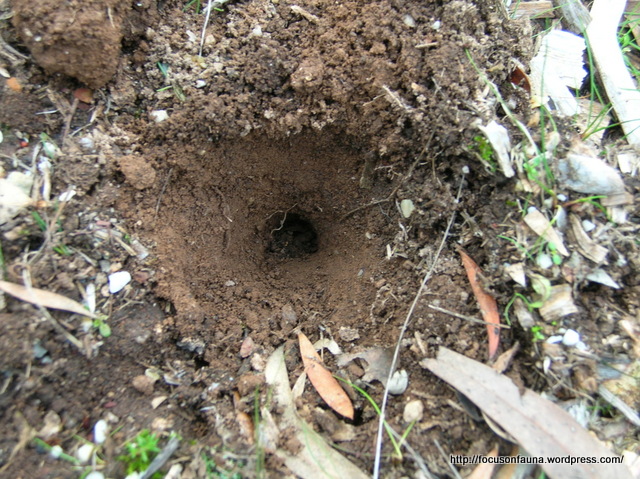
Who’s the culprit?

Short-beaked Echidna
Fun with birds and words

Ravens (Corvus sp.)
The collective noun for a group of crows is a murder. The origin of the term has been lost in time. Some think it is derived from the medieval torture of ‘crow cages’, where the guilty (and sometimes not-so-guilty) was left to die suspended in cages while the crows feasted on the body. Another school of thought is that crows will euthanise a sick or old member of their group. Either way, it probably doesn’t matter because the birds pictured are ravens (crows do not inhabit the King Parrot Creek valley). The collective term for ravens is an unkindness. This refers to an old legend that ravens push their young out of the nest to survive as best they can.

Powerful Owls (Ninox strenua)
The collective name for a group of owls is a parliament. Once again the origin of the term has been lost but in ancient times, owls were the symbol of Athena, the Greek goddess of wisdom. We can presume that wisdom would be a desirable quality for a parliament. Luckily whoever invented the term didn’t see our current parliament or else we would probably have a ‘rudeness’, ‘haranguing’ or ‘backstabbing’ of owls.
.
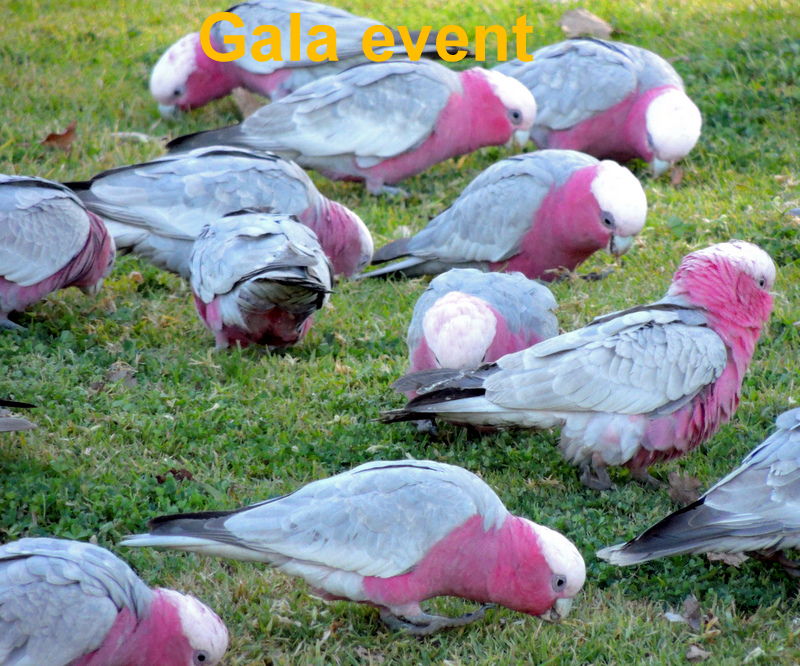
Galahs (Eolophus roseicapilla)
.
The term gala, meaning celebration or festive occasion, is derived from the Old French word galer meaning to ‘make merry’. The word galah of course has nothing to do with Old French; it just sounds the same. It is derived from gilaa, an Aboriginal term for these birds from northern NSW.
.
.
.
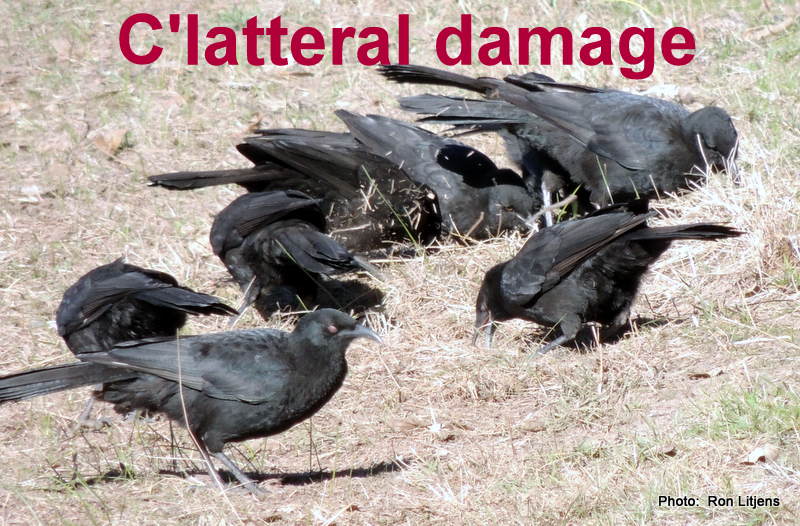
White-winged Choughs (Corcorax melanorhamphos)
A clatter or clattering is the collective name for a group of choughs…don’t ask me why. These birds live in matriarchal groups that roam the bush scratching the ground for things to eat. Anyone who has planted a vegetable garden with choughs nearby will know just how much damage they can do.
Thx to the Coretext crew for the inspiration.
Illegal !!
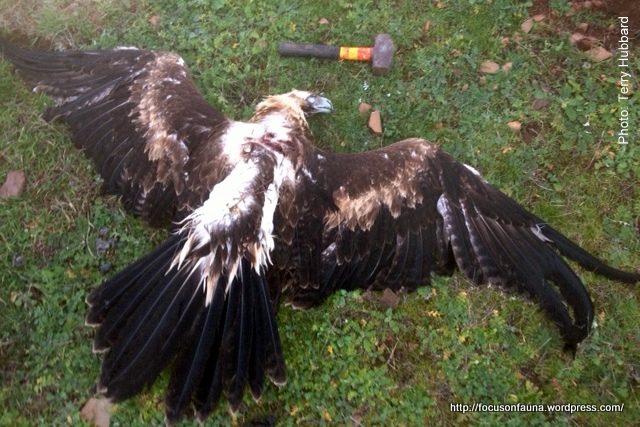
Wedge-tailed Eagle – the tree-guard mallet is for size comparison only!
And senseless ! This Wedge-tailed Eagle (Aquila audax) was found shot and killed last weekend on a property at Flowerdale. These magnificent birds, apart from being a joy to watch, provide a valuable service in cleaning up carrion in the rural landscape, and any threat to healthy livestock is greatly exaggerated.
Whoever did this should realise they are liable to prosecution under the Wildlife Act. It once again demonstrates the stupidity of a small number of people who feel they have the right to kill defenceless native animals for no reason.
Dressing down for winter

Australasian Grebe in winter plumage
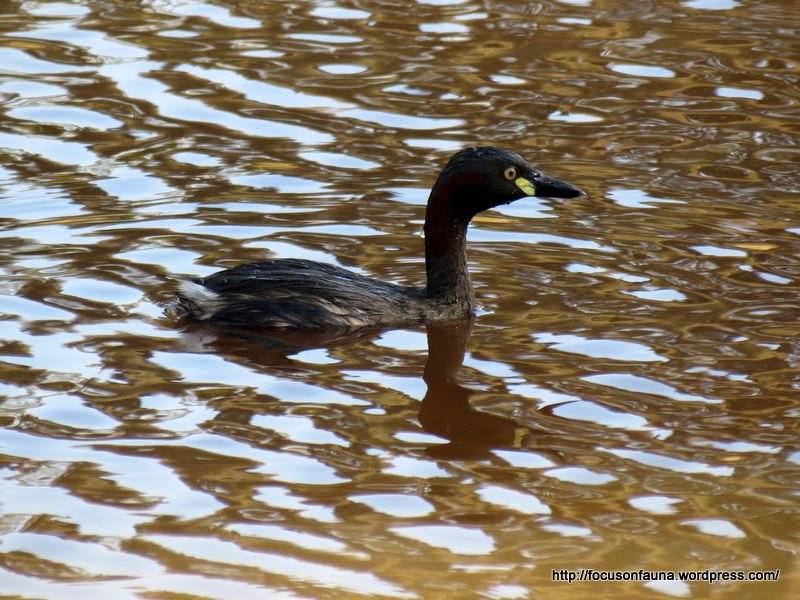
Australasian Grebe in breeding plumage
Known to many as the Little Grebe or Dabchick, the plumage of both sexes is actually similar but the black head, oval yellow face patch and black bill with pale tip are all confined to the breeding period which normally spans from September to January or even later. Our photo of a sleek very wet grebe unfortunately does not show the rich chestnut stripe on its face/neck that it also has during breeding. In the winter phase it can be confused with the Hoary-headed Grebe which is slightly larger, has a quite different breeding plumage and in fact belongs to a different genus, Poliocephalus meaning grey-headed.
The distinctive call of the Australasian Grebe can be heard by clicking on the audio bar below.
No utensils required
On the very rare occasions that I have attended posh restaurants (probably when I was trying to impress my girlfriend – now wife) I have found that if you order any seafood dish, you are confronted with a bewildering array of cutlery with which to dismember, probe and extract the meat from said seafood. Combine these with the separate cutlery for the appetiser, entrée, main meal, dessert and petit-fours and you have enough silverware to sink a Spanish galleon.
 Life does not have to be that complicated. Pictured left is a Rakali (Hydromys chrysogaster) dining on a freshwater yabby from our dam. No serviettes, no cutlery. Just dive in and select your crustacean, drag it to the shore and eat the delicacy tail-first while the claws are still snapping. If you look closely you can see the yabby claw hanging down. It’s pretty gruesome but I guess that’s nature at work. Rakalis tend to have a dining platform or area where they prefer to dine each time.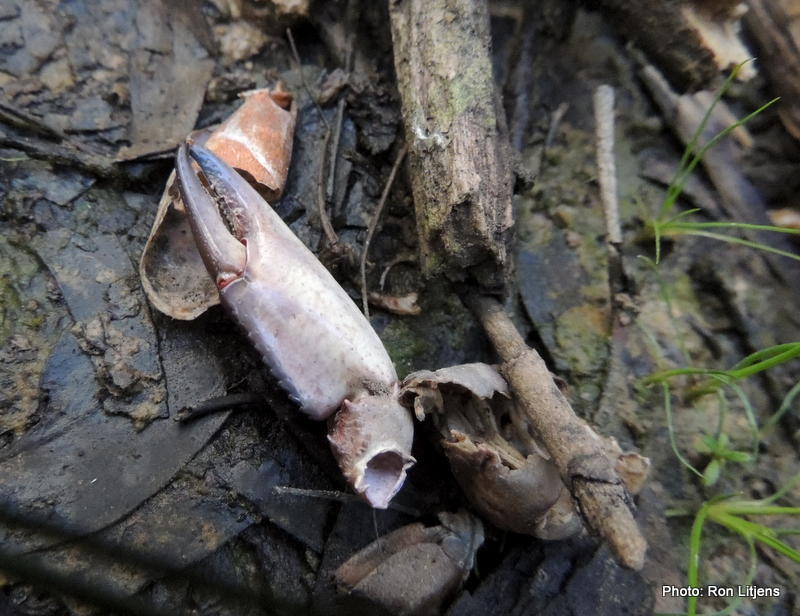
After the repast had been completed I walked down to the shore of the dam and viewed the remains of the carnage. It looked like Christmas had come in July – nothing left but Sandy Claws.
Multi-storey apartments

Candlebark
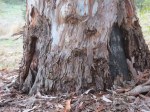
With overnight temperatures as low as -4°C and 11 frosts in a row in late June our thoughts turned to the small creatures that have to survive out there in such harsh conditions. Old trees with multiple hollows, such as the Candlebark (Eucalyptus rubida) pictured at left, offer a chance for animals to stay snug and warm. Sometimes lumped together with Manna Gum (E. viminalis) and derided by farmers and others as a “bloody white gum” because of its habit of shedding branches when older, the Candlebark is nevertheless one of the grandest and most wildlife-friendly trees in the Flowerdale-Strath Creek district.
This particular tree, with a diameter at breast height (DBH) of over 1.6 metres, is clearly many generations old and may even pre-date European occupation. Interestingly, there are three other old-growth trees with a DBH of more than 1m (Grey Box, Red Stringybark and a fallen Yellow Box) within a radius of 25m, but the Candlebark is the only one with a significant number of hollows and spouts. Known occupants of the hollows include Striated Pardalotes, Tree Martins and (unwelcome) Common Starlings, but Sugar Gliders and a Brush-tailed Phascogale have been recorded on remote camera a short distance away, so are likely to be utilising the tree hollows. This tree has also been host to nesting Brown Falcons and Nankeen Kestrels in the past.


-
- Tree Martins’ nest hollow
-
- Signs of a long-ago fire at the base
.
Net results
Macquarie Perch
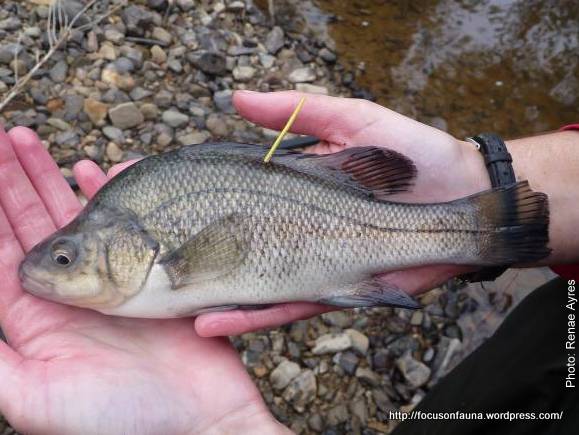
We have just received a report on the annual Fish Survey in the King Parrot Creek from the team at the Arthur Rylah Institute (see a previous post Gone fishing ! for details of the survey). The Macquarie Perch are clearly holding their own and are present in significant numbers right along the creek, despite the presence of introduced trout. It is good to see a range of other native fish also being identified. The capture (and safe release) of five Platypus supports our opinion that there is now a healthy population of platypus in the creek (see Successful platypus and rakali survey). Another encouraging result was the absence of Carp.
King Parrot Creek – Fish Survey Results April 2013
| Common name |
Moores Rd |
Callandoon |
Burslems Bridge |
Richards Bridge |
Draytons Bridge |
Total |
| Macquarie perch |
3 |
10 |
19 |
18 |
12 |
62 |
| River blackfish |
2 |
16 |
8 |
1 |
27 |
|
| Two-spined blackfish |
13 |
13 |
||||
| Riffle galaxias |
6 |
6 |
||||
| Mountain galaxias |
2 |
2 |
4 |
|||
| Flat headed gudgeon |
1 |
1 |
||||
| Brown trout* |
31 |
3 |
2 |
20 |
17 |
73 |
| Rainbow trout* |
1 |
1 |
2 |
|||
| Redfin perch* |
1 |
1 |
||||
| Yabby |
2 |
1 |
12 |
9 |
24 |
|
| Freshwater crayfish |
7 |
3 |
1 |
12 |
23 |
|
| Platypus |
1 |
1 |
1 |
2 |
5 |
|
|
63 |
36 |
31 |
55 |
56 |
241 |
* Exotic
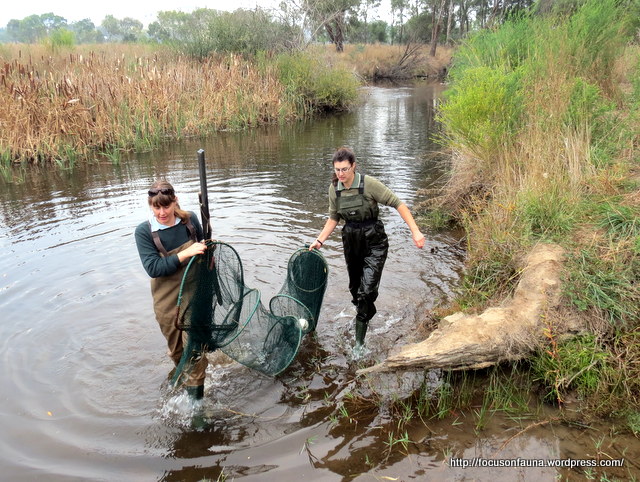
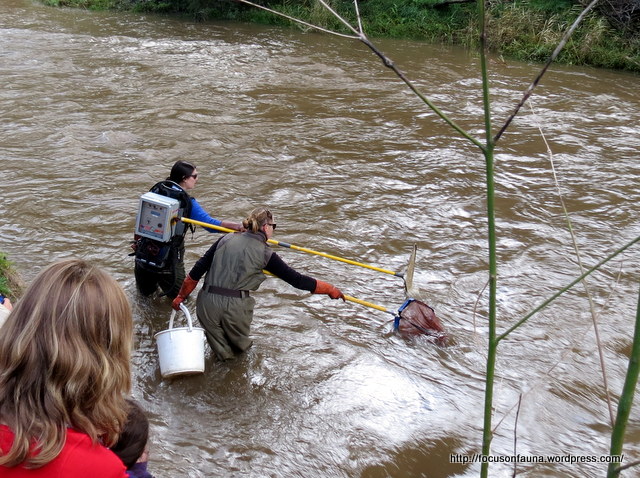
Incidentally, the two eminently competent female fish researchers undertaking the survey, Jo and Renae, have shown us a fascinating historical document – a 1933 letter from the Office of the Chief Inspector of Fisheries and Game:

Having watched with admiration Jo, Renae and Fern deftly set up long Fyke nets or wield heavy electro-fishing equipment in a fast-flowing stream with slippery rocks and deep pools, we can only be amazed that the attitude in the letter ever prevailed, and thank goodness times have changed !!
Illegal?
A man’s occupation?
Flowerdale 1 Strath Creek 1
 The rivalry between Flowerdale and Strath Creek has just intensified. Fellow blogger and Flowerdale resident Ronlit reported a rare sighting of a Spotted Quail-thrush on his property in early June (see A flurry of wings resolved). Not to be out-done, Kevin and Noreen saw and photographed a Spotted Quail-thrush while fencing along the creek on their Strath Creek farm. They were both surprised and intrigued by this lovely and unusual bird which obligingly stayed put while they rushed to get a camera and a bird field guide to confirm its identification.
The Strath Creek bird is a male with a white throat patch on a black face compared to an orange throat patch on the female bird at Flowerdale. Ronlit quipped that his bird “… was probably out looking for a date.” Perhaps the two birds will meet up and we can look forward to a productive mid-valley rendezvous leading to a detente between the two districts.
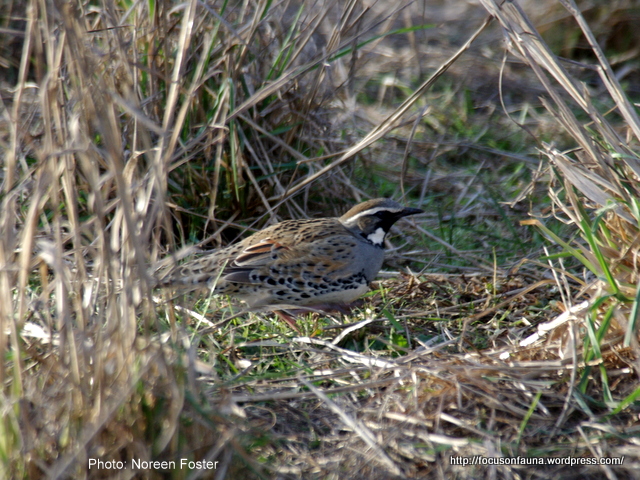
Male Spotted Quail-thrush
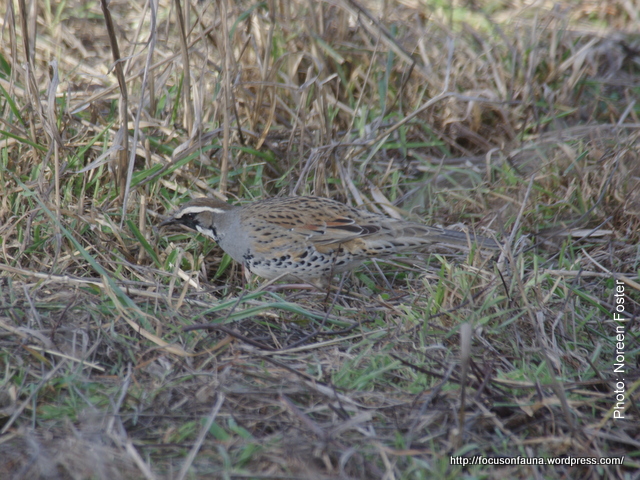
Well camouflaged
These sightings are significant as the Spotted Quail-thrush’s conservation status in Victoria is listed as “Near threatened”. In Kevin and Noreen’s case the sighting was particularly interesting as the bird’s usual habitat is upper slopes and ridges in drier forests, not creekside vegetation in low open farming land! The quail-thrush is reported to be shy and elusive and yet this bird quietly walked around in the grass in front of Kevin and Noreen, and Ronlit has seen his bird boldly walking past his kitchen window several times since his initial sighting.
[Since writing this, Steve Joblin, Project Officer for the Strath Creek Biodiversity Project, reports spotting (sic) another Spotted Quail-thrush on one of the project revegetation sites on “Three Sisters”, adjacent to the Mt Disappointment State Forest. This just happens to be on the dividing line between Flowerdale and Strath Creek, so the score remains even.]
Looking for a spring in autumn

A spring?
We moved to our property during the drought years. Living in the Spring Creek catchment I always wondered why it was so called. I had noticed that at the same elevation in each of our valleys there was an area of ‘greener’ vegetation. It hasn’t been until the last three years we have actually seen water welling up out of the ground. Now that we are deep into autumn, which usually brings rain, I am again looking for signs of the springs.
I recently noticed down the valley a bright patch of green standing out against the dried grass. The spring is back, I thought. Closer examination showed the green to be ‘pickings’ from an exotic Irish Strawberry (Arbutus unedo) a ‘nasty’ weed-of-a-tree, I’ve been told. And the culprits weren’t too difficult to spot against the green foliage… Crimson Rosellas (Platycercus elegans, from the Greek platukerkos, meaning broad-tailed and elegans meaning elegant, referring to the tail shape that is distinctive from other parrots). These birds, like most other parrots, must spend half their life shredding trees. Not only do they get food this way but they aid in propagating the tree by dropping the seed or flying off and distributing the seed in their droppings.
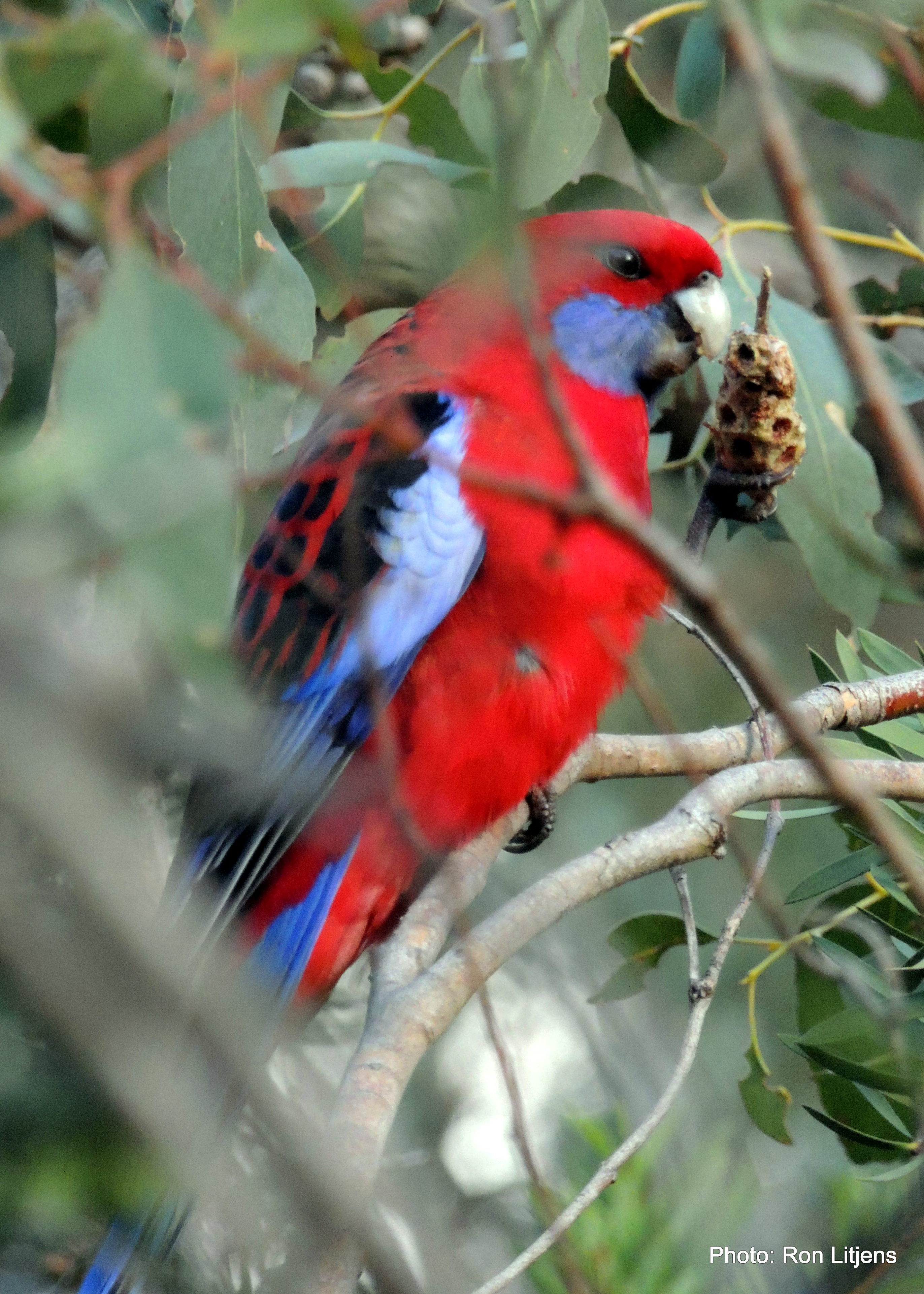 And to show that they get stuck into Aussie bush tucker as well, the photograph (left) shows a Crimson Rosella eating a Calllistemon seed pod ‘corn-cob’ style.
Not at all drab
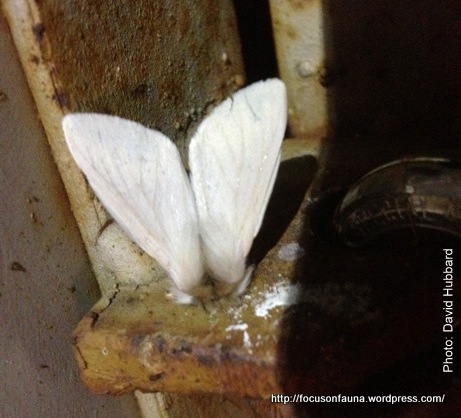
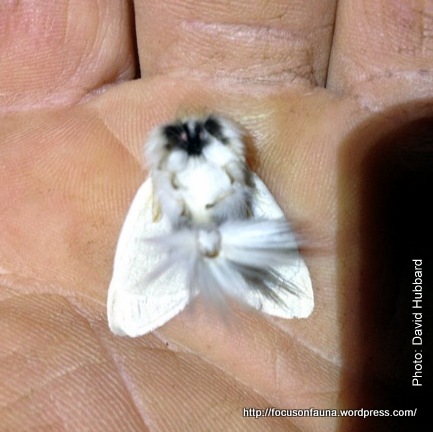
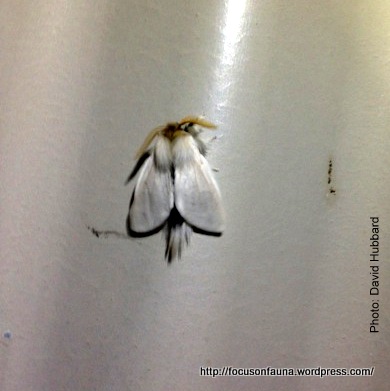
Sparshall’s Moth
Moths are sometimes thought of as rather drab and uninteresting creatures, but many of our native moths are in fact very attractive. A good example is this moth photographed recently on Three Sisters at Flowerdale. It is a Sparshall’s Moth (Trichiocercus sparshalli), identified as a male by the long white tufts of hair on its abdomen (see photo below). It’s coming to the end of its flying time, which peaks in April/May and again October/November.

Sparshall’s Moth larvae
Photo courtesy of P. Carwardine and Peter Marriott