Birds behaving strangely

Yellow-faced Honeyeaters
We received this report of strange bird behaviour from Susan and Joel from Strath Creek:
“Outside our kitchen window dead leaves from a Silky Oak have formed a platform in a spindly bottle brush (Callistemon sp.). The other day we watched young Yellow-faced Honeyeaters stretch and lie on this platform with wings spread, eyes closed and beaks up, as if dead. After a while they started to pant (the temperature was in the 30’s) and eventually jumped up. Several birds repeated the same behaviour and we noticed there was a preferred spot on the platform. As one bird moved from this spot, another would take its place. We have not seen them return since that day! We wonder what this behaviour means – could it be related to the summer solstice?”
A possible alternative explanation that occurred to us was that the birds were engaging in “anting”, whereby they allow ants to crawl over their body or in some cases pick up ants in their bill and rub them on their feathers. Theories on the reasons for this behaviour are many and varied, including using the ants’ formic acid to combat mites, fungi or bacteria, to obtain Vitamin D, or even to gain an intoxicating effect! Of course the birds may just have been sunning themselves – another means they may use for parasite control and/or for Vitamin D.
A Subaru it is not

Satin-Green Forester
December is the month that the Honey-myrtles flower. The blossoming of our Cross-leaf Honey-myrtle or Totem Poles (Melaleuca decussata) has caused an insect feeding frenzy in the trees along our driveway.
Imagine my surprise when I found in the driveway a bright, shiny Satin-Green Forester. Unfortunately it was not a funky-hued Subaru but an iridescent moth of the Zygaenidae family, Pollanisus viridipulverulenta. This Forester is a daytime moth that after mating lays its eggs on plants of the Hibbertia genus.
Also present were the tiny Sedge Moth (Glyphipterix chrysoplanetis), only 3 mm long, and the Nectar Scarab Beetle (Phyllotocus apicalis). Scarab beetles are important pollinators of native flora and are presently living in great numbers on the honey-myrtles and nearby Burgan (Kunzea ericoides). Despite their numbers they do no damage to the trees.
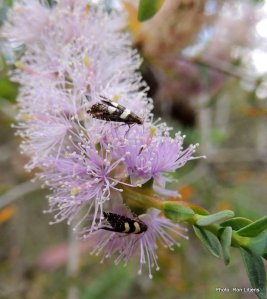
Sedge Moth

Nectar Scarab
Bird gallery
Here’s a collection of native birds we have managed to photograph in the Flowerdale/Strath Creek area in recent days. Click on any of the photos for a closer look. We also recorded the calls of the Sacred Kingfisher and Brown Goshawk – click on the icons to hear them.


Sacred Kingfisher call:
Brown Goshawk call:
Evening encounters
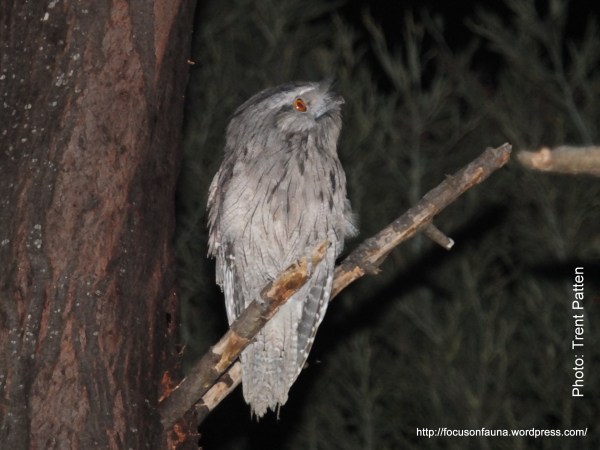
Tawny Frogmouth
Local wildlife enthusiasts Trent and Steve ventured into Coonans Bridge Reserve, Flowerdale the other evening to check out the resident wildlife. After catching a glimpse of a Platypus in King Parrot Creek, they proceeded to record an impressive list which included a Tawny Frogmouth, a Southern Boobook with chicks, a Sacred Kingfisher, a young Black Wallaby, six Common Brushtail Possums and a Sugar Glider.
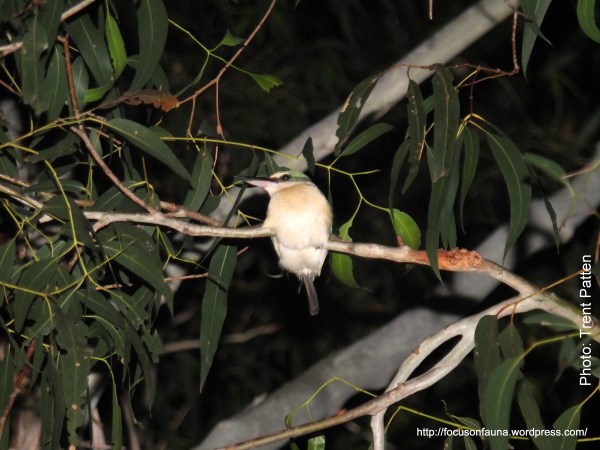
Sacred Kingfisher

Southern Boobook at nest hollow
Platypus – trust me!
Trent also took along his thermal imaging camera, which was able to detect feral bees in a tree hollow, a Common Brushtail Possum, also in a tree hollow, and the unidentified occupant of one of the many nest boxes installed in the Reserve.

Bees in tree hollow

Possum in tree hollow

Occupied nest-box
Summer memories
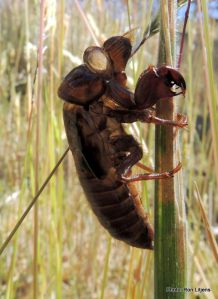
Nymph exoskeleton
Cicadas (Order Hemiptera, Suborder Auchenorrhyncha) are the sound and currency of my childhood. As a boy I used to listen to their deafening noise while having dinner on a summer’s eve. At school we used to trade them, dead of course. Greengrocers and Brown Bakers were legal tender in the playground and the rare Black Knight was the most coveted of all.
It is this time of year that the nymphs, which have spent their lives underground feeding on the sap from roots, emerge from the ground and take adult form. The strong burrowing front legs of the nymph, an adaption not needed by the adult, can be seen in the exoskeleton image (left). On grass stems, branches and leaves the empty husks left behind after moulting look like terrestrial Darth Vaders.
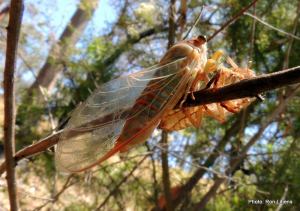
This week I came across this adult that had just emerged from the shell. It’s like the Hans Christian Andersen story of the Ugly Duckling all over again.
Renovate or move?
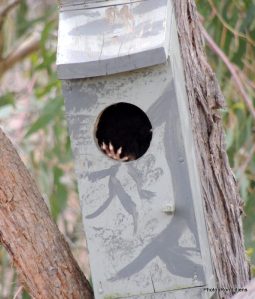
This is the question that perennially plagues us all. As our lifestyles change or the family gets bigger we all need to make this decision. In the case of this Common Brushtail Possum (Trichosaurus vulpecula) the crisis has been brought about by its own increase in size. One gum-nut pizza too many, methinks!
The house in question is one of the most popular pieces of real estate in Flowerdale. A previous post (click HERE to view) outlined the revolving tenancy of this nest-box. Over the past twenty-four months it has been previously occupied by a White-throated Treecreeper family (Cormobates leucophaeus), then an Australian Owlet-nightjar (Aegotheles cristatus) followed by a Ring-tailed Possum (Pseudocheirus peregrinus).

The space inside the nest box is getting so cramped that recently this Brushy has been seen sleeping with various appendages hanging out of the nest box entrance, especially in hot weather. Not a clever move given the Powerful Owls (Ninox strenua) roosting nearby. With the impending summer heat, it is probably just a matter of time before this possum moves on to a more spacious abode.
We wait with bated breath to see what the next nest-box tenant will be.
How sweet it is!
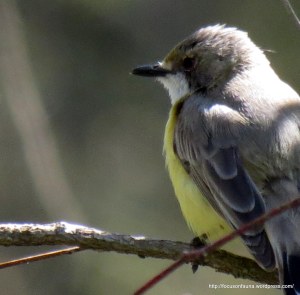
White-throated Gerygone
It’s well worthwhile keeping an eye out for this lovely little bird – a regular visitor to the Upper Goulburn catchment at this time of year. In fact, you are far more likely to hear it rather than see it during breeding time in spring and early summer. It’s a White-throated Gerygone (pronounced jer-rig-ony, not jerry-gone) and it has what is surely one of the sweetest songs of all our native birds.
If you do catch a glimpse of this colourful bird, it is likely to be flitting among the upper canopy of a eucalypt. However, we were lucky to come across one at the Yea Wetlands recently which was so absorbed with feeding and singing on low branches, it was quite unconcerned by our presence just meters away.
Click on the icon below to hear its silvery song.
Once bittern, twice shy
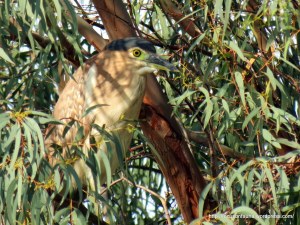
Nankeen Night-Heron
Actually, the bird shown here is neither a bittern nor particularly shy. There were unconfirmed reports of a bittern seen in the Strath Creek area earlier this year – perhaps an unlikely sighting given the shaky conservation status of the two bittern species that may be found in Victoria. We suspect the bird in question may have been a Nankeen Night-Heron.
The one in these photos was spotted by Brian and Jim one morning recently on a wooden fence at ‘Callandoon’, not far from King Parrot Creek. It then spent much of the day perched in a nearby tree in full view of interested observers and photographers.
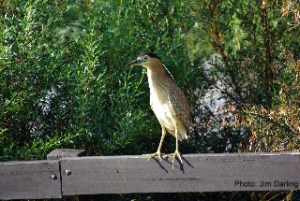
This chunky bird is in breeding plumage, with a couple of slender white plumes coming from the back of its head. Although not often seen around here, it is widespread and nomadic, and can congregate in large breeding colonies in the Murray Valley.
Talking of strangers …
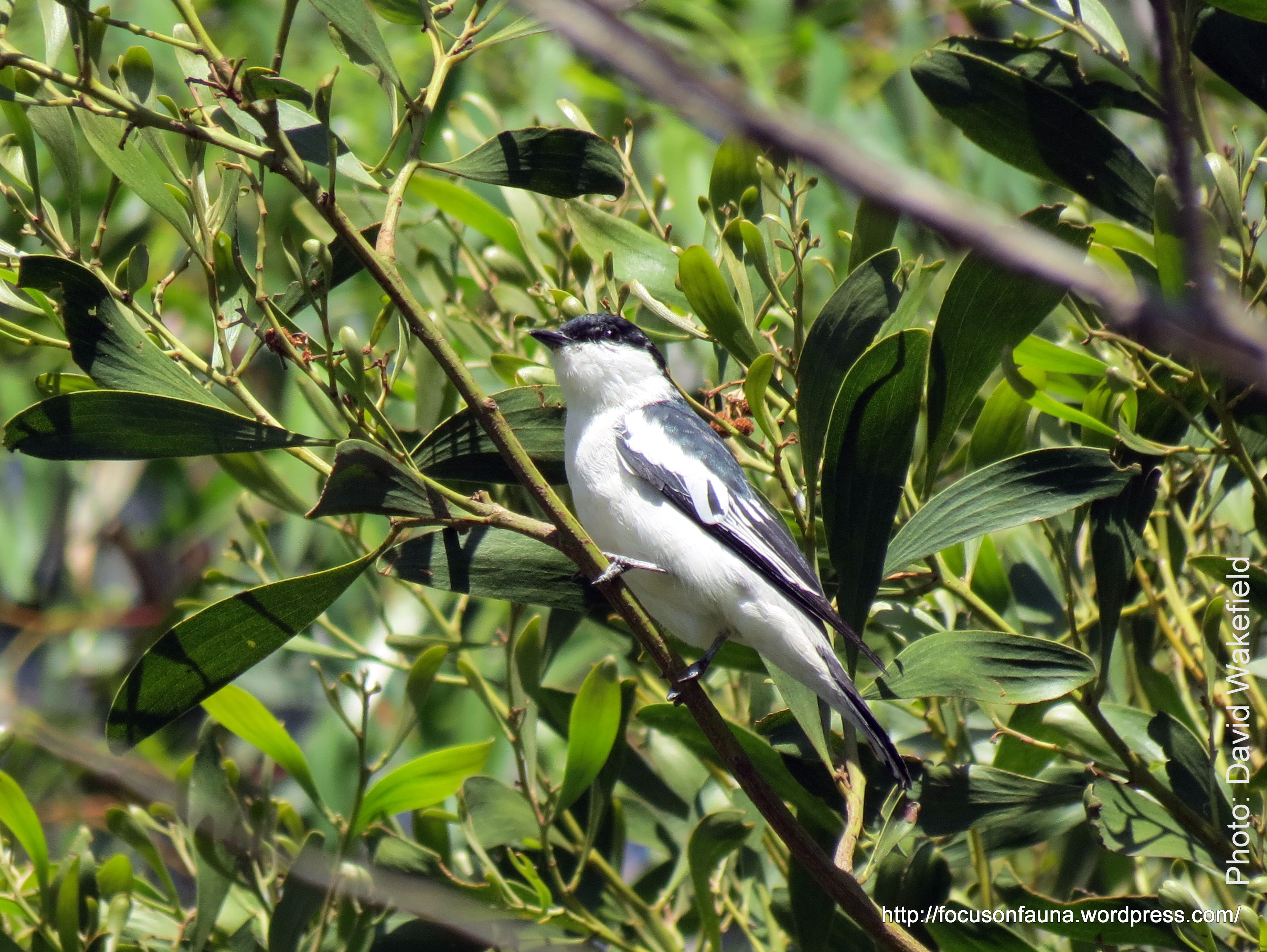
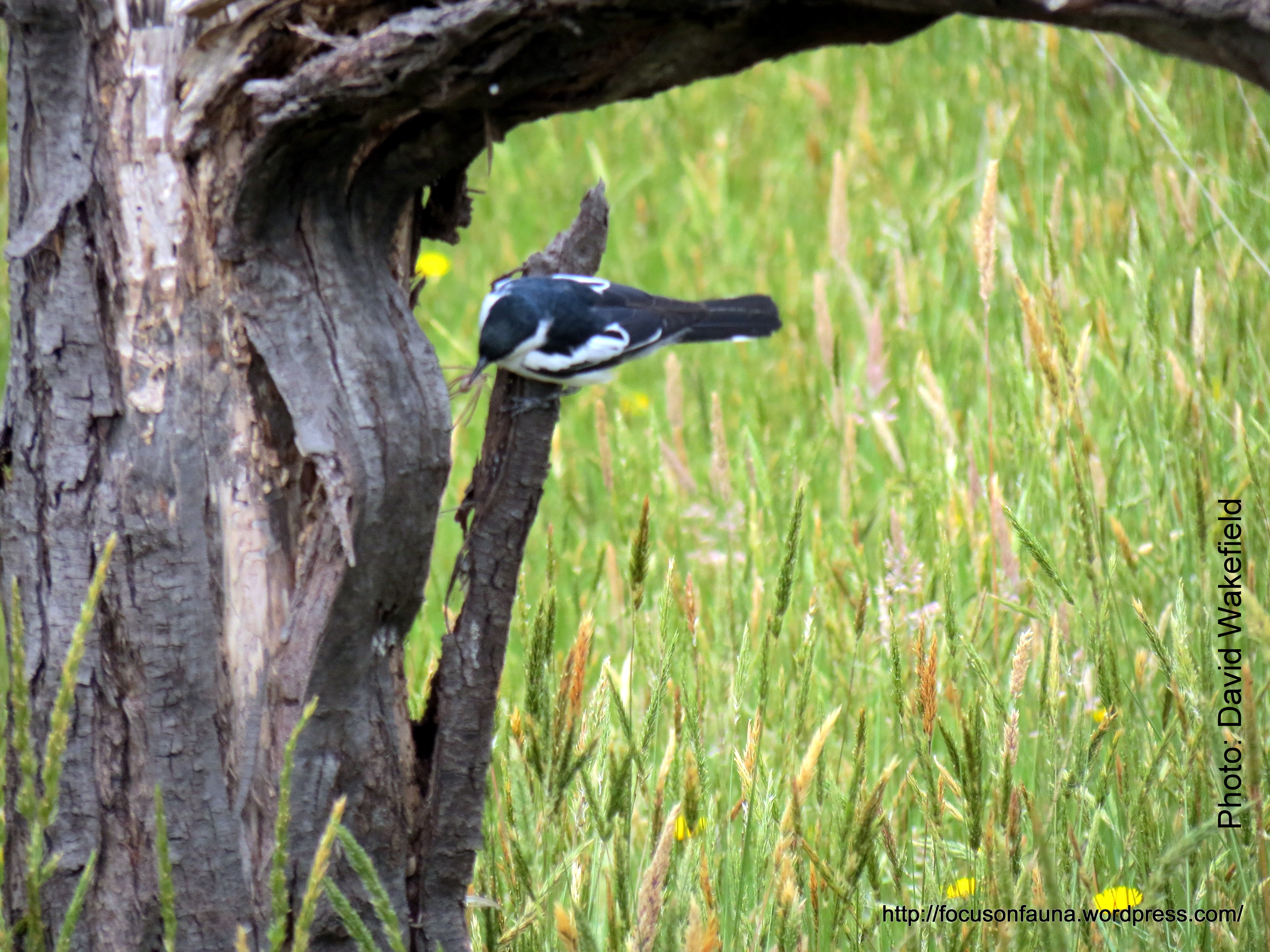
Male White-winged Triller
A couple of weeks ago, we were assisting Landcare coordinator Cathy Olive to assess farm dams for a local Landcare project, and told her of a somewhat uncommon sighting of White-winged Trillers on a property at Strath Creek. Just as we were telling her, a triller started calling nearby. After we subsequently saw White-winged Trillers at 5 out of the 7 properties we visited on 2 consecutive days, Cath understandably refused to believe it was any sort of rarity for the district. But in fact we have not seen one on our place since late 2009, and Steve Joblin, the Strath Creek Biodiversity Project Officer, has not recorded one on his Flowerdale property since 2008.
The pictured showy male triller turned up a week ago on our property. It will lose most of its black and white plumage in autumn and become more like the rather dull-plumaged female. Trillers are mostly migratory, spending the winter in northern Australia, then arriving back right across southern Australia to breed in spring. The numbers settling in a particular area vary from year to year, according to local conditions – so with the numbers around the Flowerdale/Strath Creek area this year, we must be doing something right !
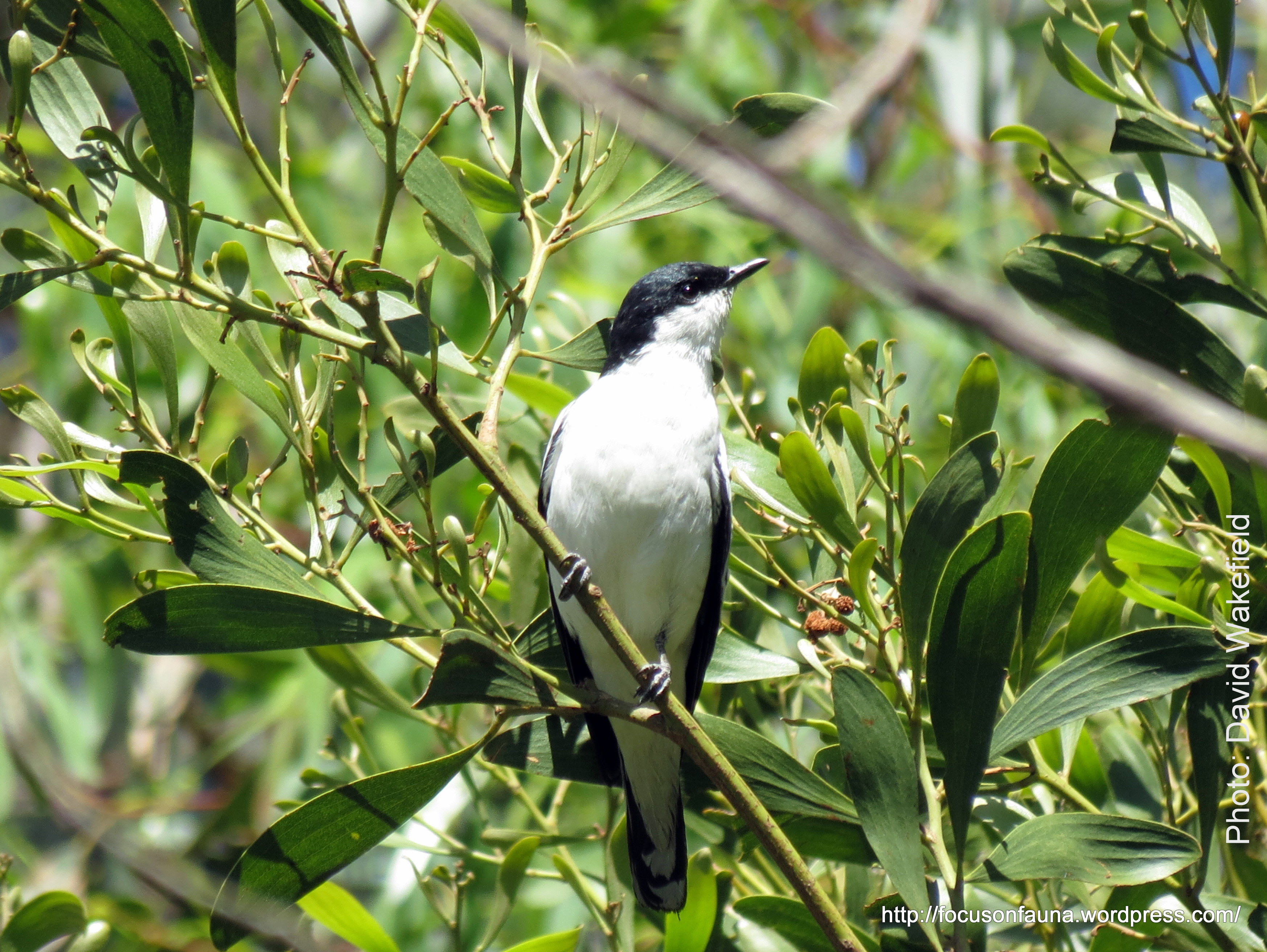
To learn more about the White-winged Triller, visit Birdlife Australia’s Birds in Backyards website.
We recorded the triller’s lovely call on Neil and Kay’s Strath Creek property – click on the icon below to hear the call.
Welcome back stranger

In times gone by, that is before the big barbie of 2009, the Eastern Yellow Robin (Eopsaltria griseogularis) was a steadfast companion during my outdoor activities. Whether I was digging in the garden or sawing firewood for the winter, this bird was never far away. In fact often it sat within easy grasp, probably waiting for a juicy meal to be uncovered. We have spent many hours together in companionable silence. After the fires, however, they disappeared from our property, to be replaced in great numbers by its longer wavelength cousin, the Scarlet Robin (Petroica multicolor). These were rare on the hill before the fires. But this year we have seen the Eastern Yellow Robin again in the bushland around our home. Welcome back.




 Focus On Fauna