Open for inspection
Australian has unique fauna in that many of it’s birds and animal use tree hollows for breeding or shelter sometime in their lifecycles. Seventeen percent of bird species, 42% of mammals and 28% of reptiles use tree hollows (Gibbons and Lindenmayer 1997). They include bats, possums, gliders (pictured below left), owls, parrots, ducks and kingfishers.
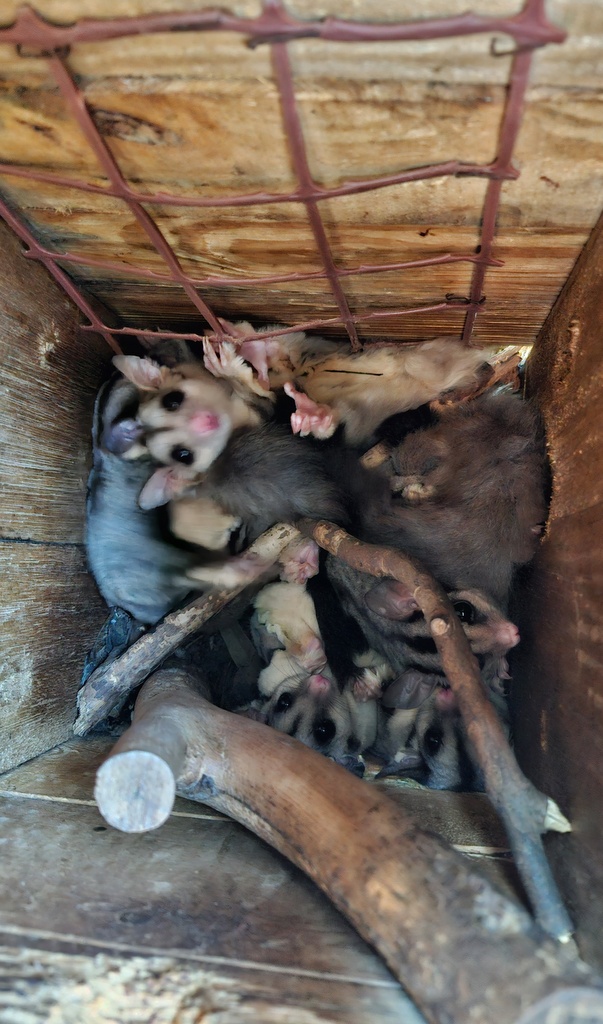
There is however an increasing dearth of tree hollows in our landscape. Depending on the tree species it takes over 100 years to develop a ‘decent’ tree hollow for fauna to live in. Old trees are disappearing due to old age, logging of old growth forests, land clearing for agriculture and housing and bushfire.
Recently several of our neighbouring Landcare groups have embarked on projects to increase the number of usable hollows in their area by installing nest boxes. Earlier this year Yea River Catchment Landcare Group purchased 105 nest boxes using a Habitat For Wildlife grant from the GBCMA. Last week Kinglake Landcare Group launched their Boxes for Birds project, a collaboration with Birdlife Australia’s Yarra to Yea bird conservation effort. They acquired 105 nest boxes using a Victorian Government Landcare grant. The boxes will be distributed across 21 private and public sites.
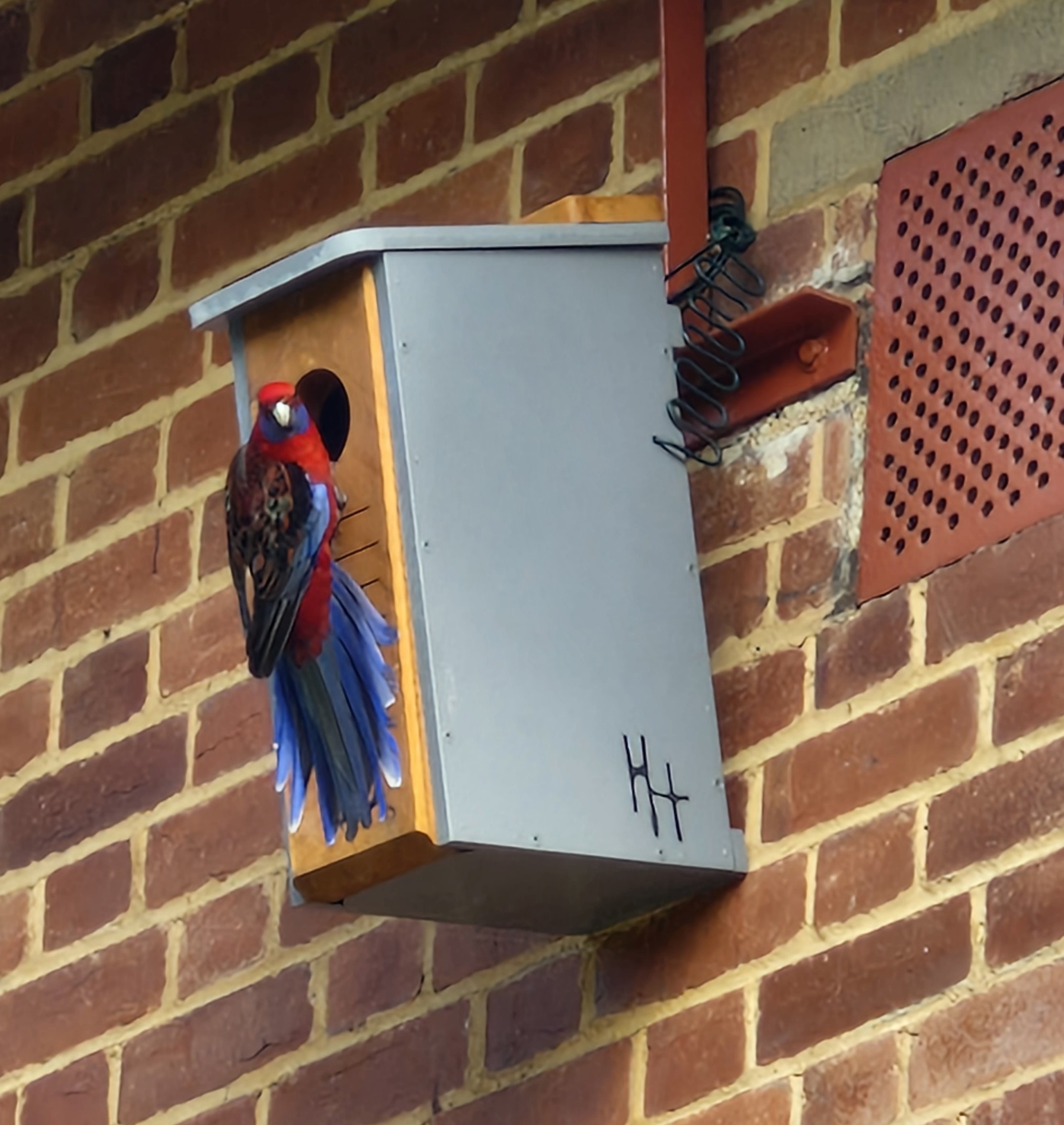
In autumn I installed nest boxes from the Yea River Landcare project and today I observed the first visit (that I know of) of a prospective tenant to one of those boxes (pictured above). Crimson Rosellas (Platycercus elegans) breed between September and January producing 5 – 8 white rounded eggs. They nest in tree hollows and cavities in buildings. The reason the nest box has been placed 7 metres up on the side of my building is to encourage them not the nest in the roof space, again!
Looks like it is working.
Chocolates with a gooey centre
I love chocolates with a gooey centre. Caramello Bears and Turkish Delight immediately come to mind. But I was surprised by a filling I recently found in one of my treats. My latest fave when it comes to chocolates are those that contain a peanut butter centre (the brand name has been withheld for obvious reasons). These chocolates come in a waxed paper cup, individually wrapped in foil and then sealed in a plastic bag.
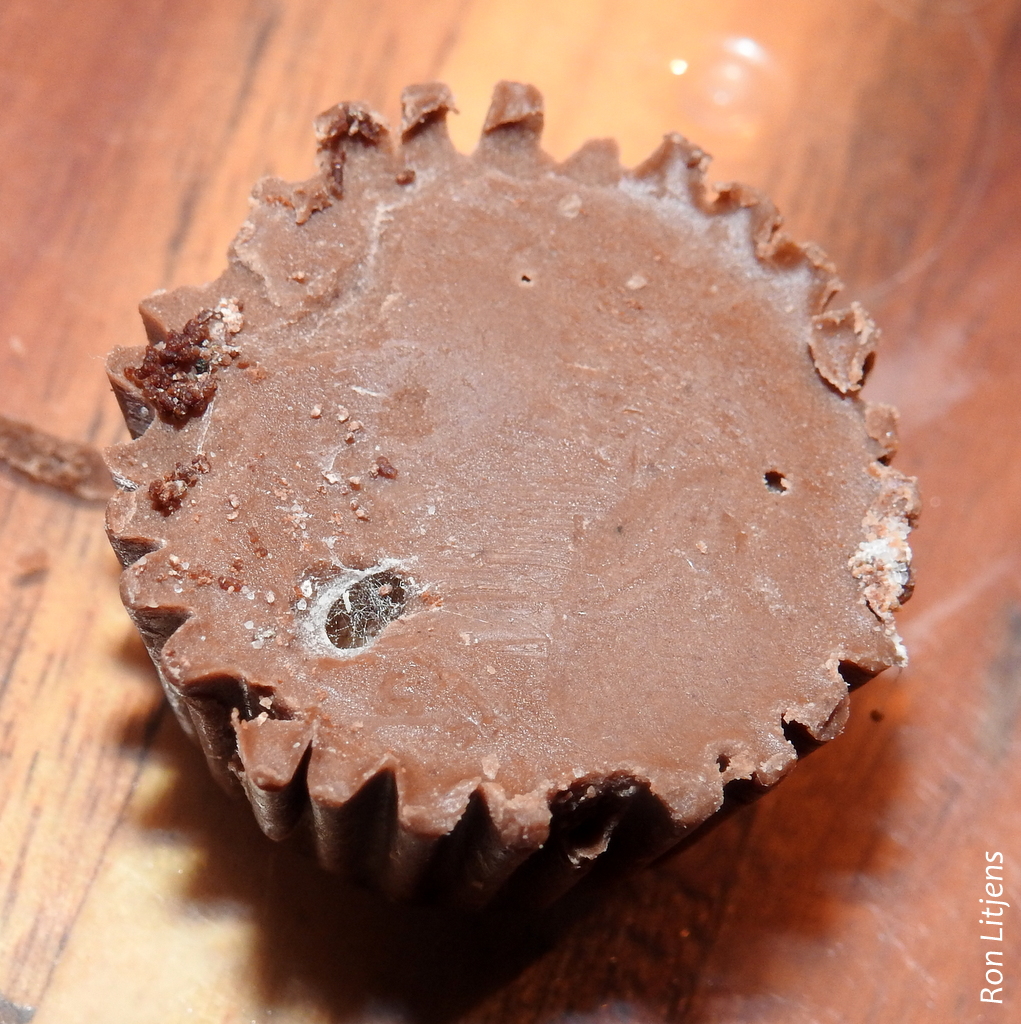
I noticed when unwrapping the foil of one that the confection had a hole in the top of the chocolate (pictured left) and that the hole appeared to contain a web. After carefully paring back layers of the sweet with a razor blade I came across a burrow in the peanut filling that contained a caterpillar, pictured below right. It emerged soon afterwards appearing none to please by the intrusion, pictured below left. Examination of the rest of the packet revealed that about 10% of the chocs had been similarly infested.

Google Lens identified the caterpillar as a Mediterranean Flour Moth larvae (Ephestia kuehniella) a pest of cereal grains and flour worldwide that has been introduced into Australia. Given that this grub was found in chocolate and not flour I suspect it is the larvae of one of the other moths of the Pyralidae family, all of whom look similar but infest different foodstuffs. To positively identify the culprit the only thing to do is to put the affected chocolates into a container, watch the lifecycle unfold and then identify the adult moth.

That is of course unless someone in the meantime finds the container and eats the contents. Love those gooey centres.
Watch this space.
That’s bad luck
Mayflies are of the order Ephemeroptera from the Greek words ephemeros meaning short-lived and pteron meaning wing. The short-lived refers to the life span of the adult insect. They belong to an old group of insects including dragonflies and damselflies that share the characteristic of not being able to fold their wings down along their backs.
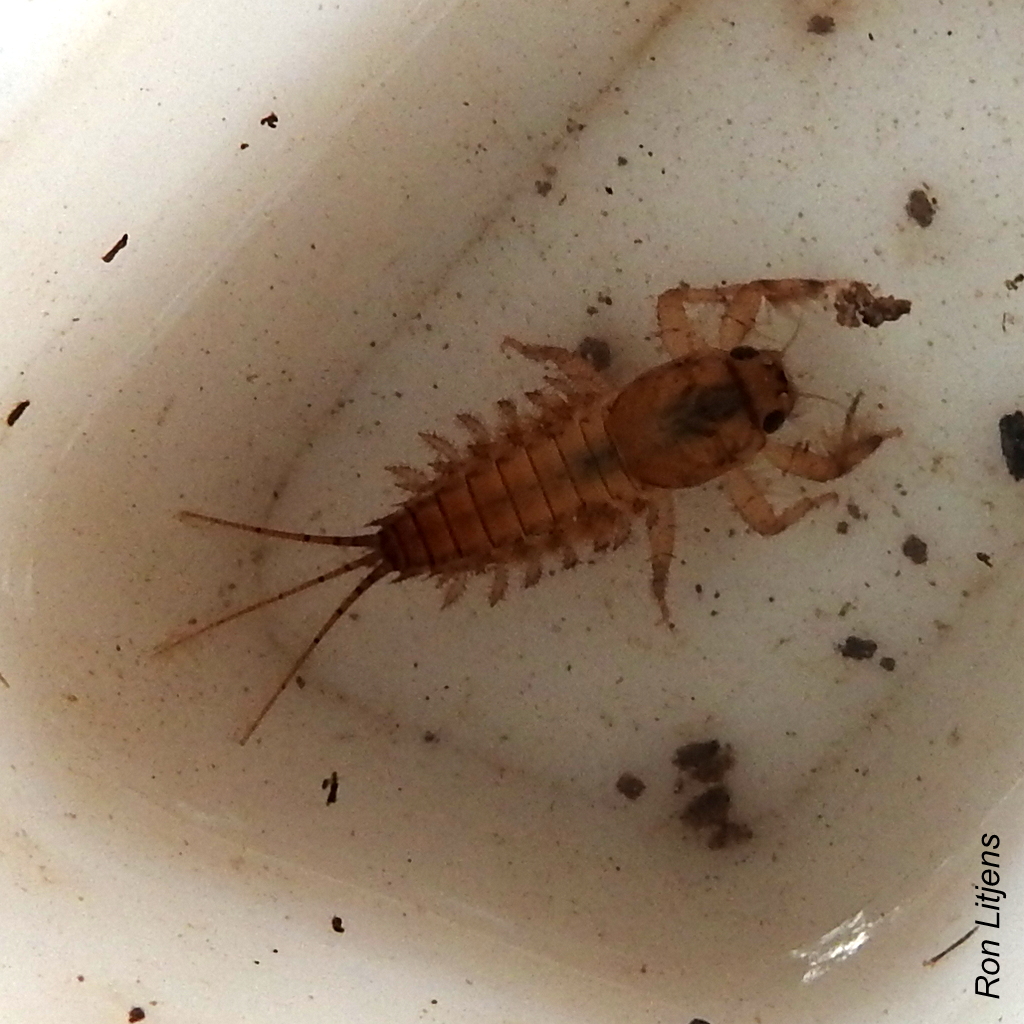
Like dragonflies and damselflies, mayflies spend the majority of their lifecycle as an aquatic nymph (pictured left). The nymph is characterised by having pairs of gills distributed along the abdomen and three tail filaments – a pair of cerci, usually containing sensory organs and a central terminal filament.
The nymphal form lives for years under water. It emerges from the water for the pentultimate moult producing a winged, sexually immature adult. This stage lasts minutes/hours before the final moult produces the sexually mature adult.
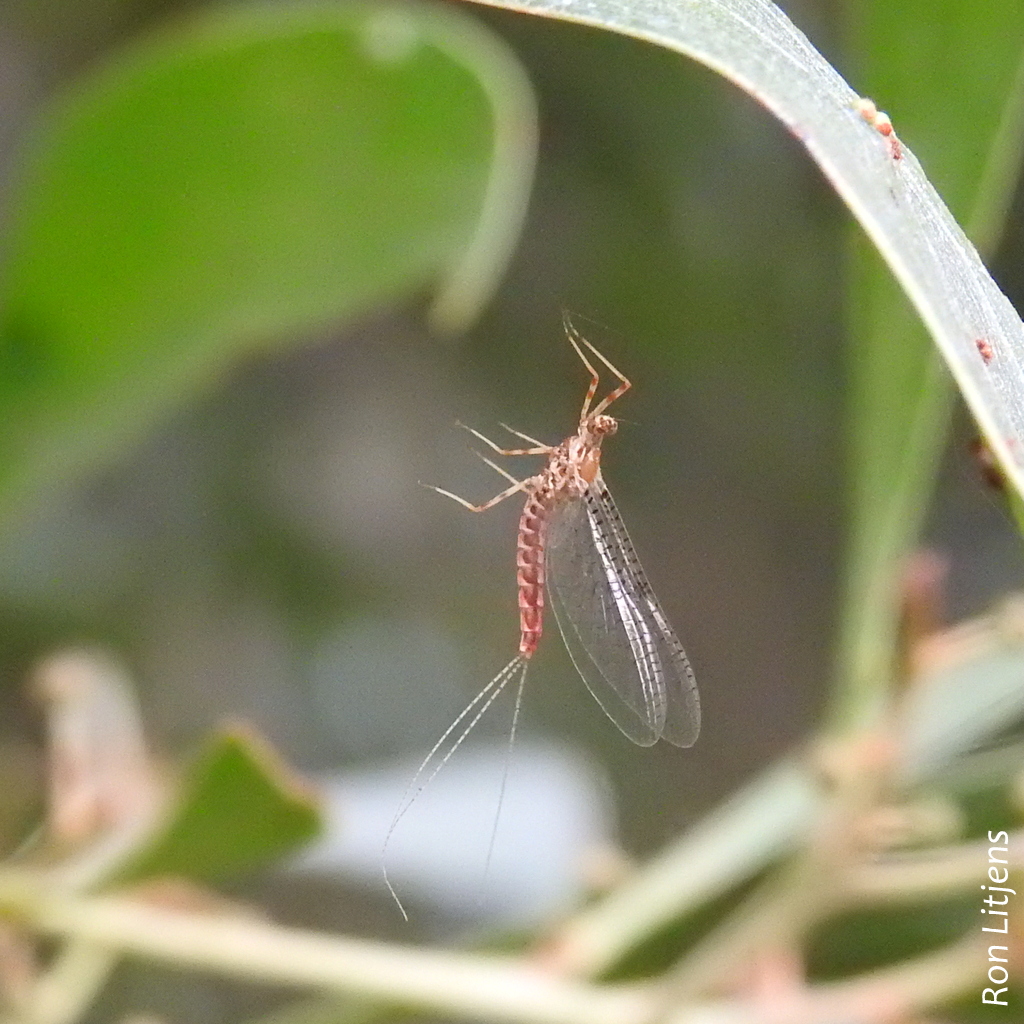
The sole purpose of the adult mayfly is to reproduce so much so that most do not eat and therefore have no mouthparts. The lifespan of the female mayfly is measured in minutes whilst the males may live up to two days. After mating the female mayfly deposits eggs in water and then dies.
With such a short lifespan it’s bad luck if your life is cut even shorter by being trapped in a spider’s web (pictured right).
No animals were hurt writing this blog. The spider had done its job before I got there.
Living alone
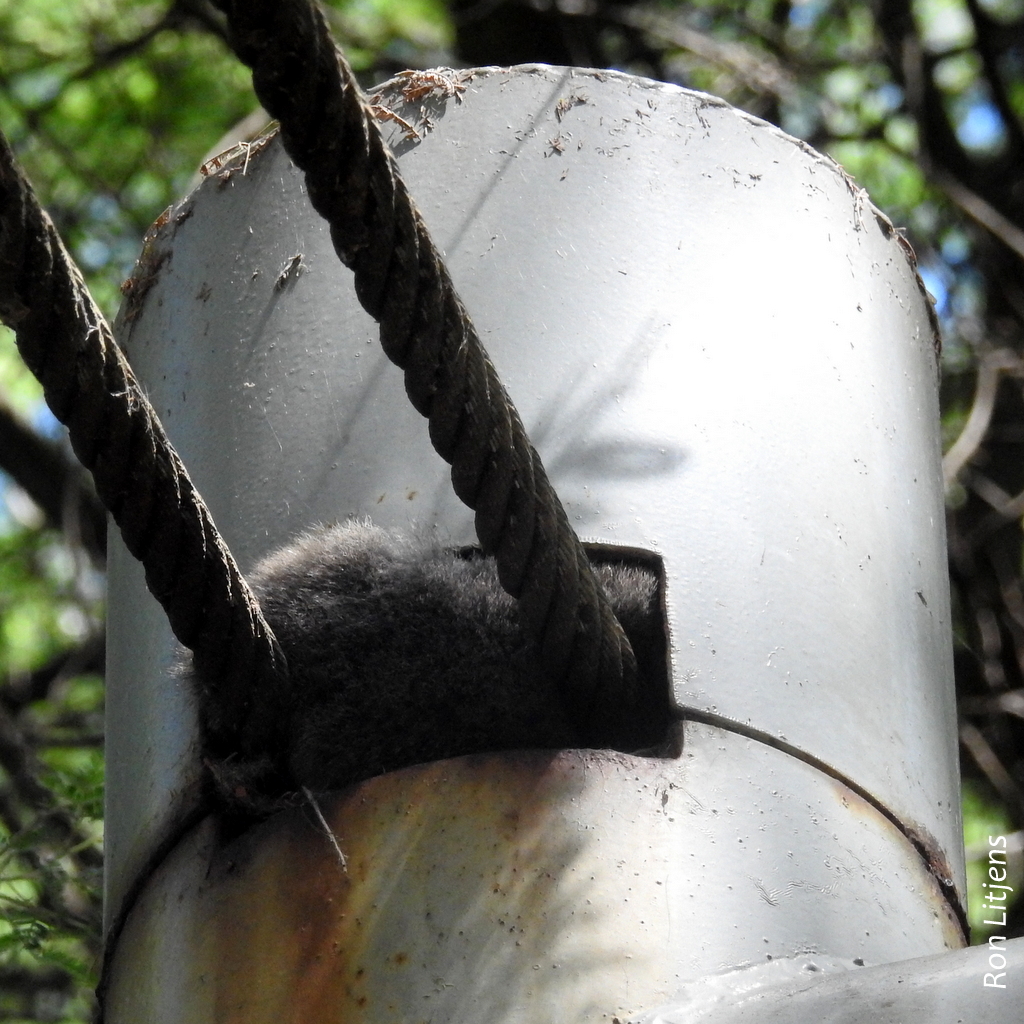
A recent blog described a drey – a bark, leaf and twig construction built by Ring-tailed Possums (Pseudocheirus peregrinus) to live in. ‘Ringies’, as they are affectionately known are gregarious, live in dreys in family groups of a male, several females and their young.
At some point in time the young leave the group to strike out on their own. Until they form a new family group and build their own drey young ringies will inhabit hollows – of any kind. Pictured left is a ringie that has taken up residence in one of the stanchions of a suspension bridge.
Living in a drey is but a pipe dream.
Dining with mates
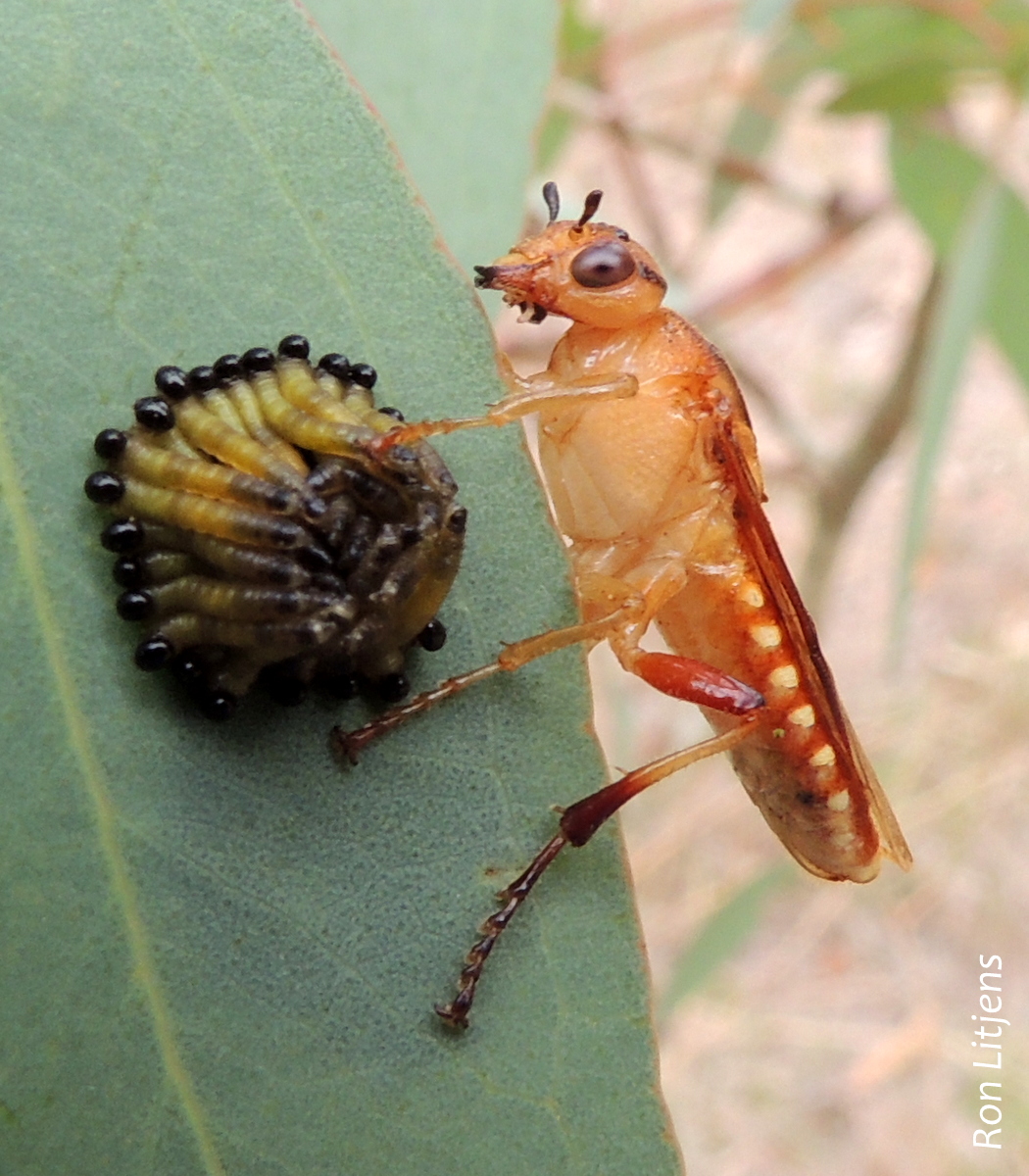
Sawflies have to be one of the least recognised insects, pictured left. They make up the order Hymenoptera along with bees, ants and wasps and are distinguished from the latter three by not having a thin waist between the thorax and the abdomen. From an evolutionary aspect sawflies are the ancestors of all the insects of the order Hymenoptera.
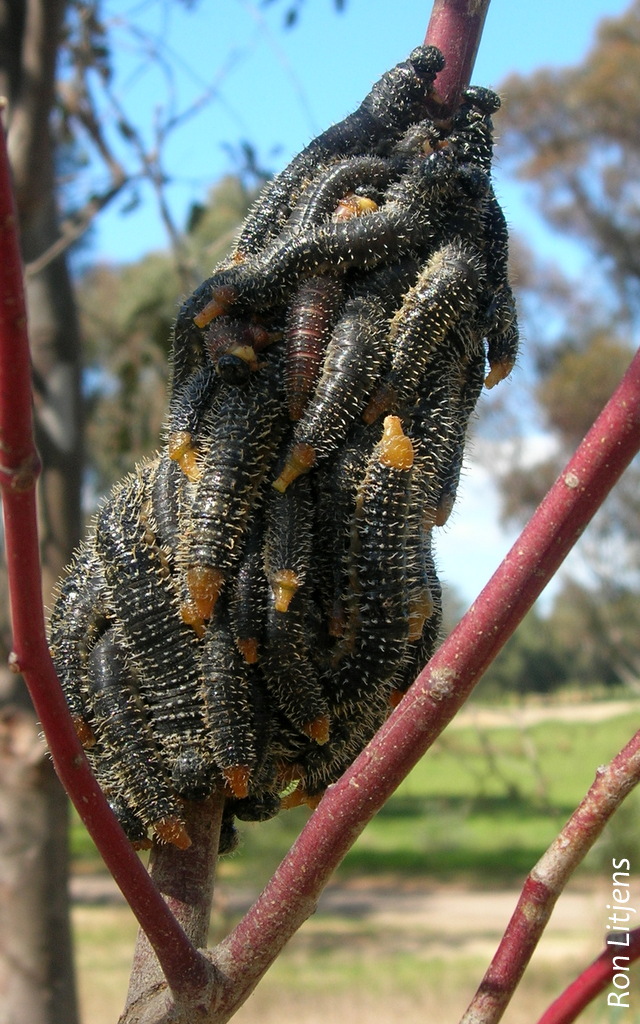
The life of an adult sawfly is short-lived, around about a week. This and the fact that they look very wasp-like means that people either do not see them or recognise them for what they are. People are however familiar with the larvae. As a kid I was equally fascinated and repulsed by what I called spitfires, pictured right. Sawfly larvae are leaf eaters extraordinaire. Certain species of sawfly larvae form large aggregations for protection and sometimes, particularly after storms these masses can get dislodged from trees and fall to the ground where the disturbed spitfire larvae regurgitate an irritant fluid to drive away predators. Sawfly larvae can do enormous damage to trees sometimes stripping entire forests causing stunted tree growth or in the worst case the death of trees.
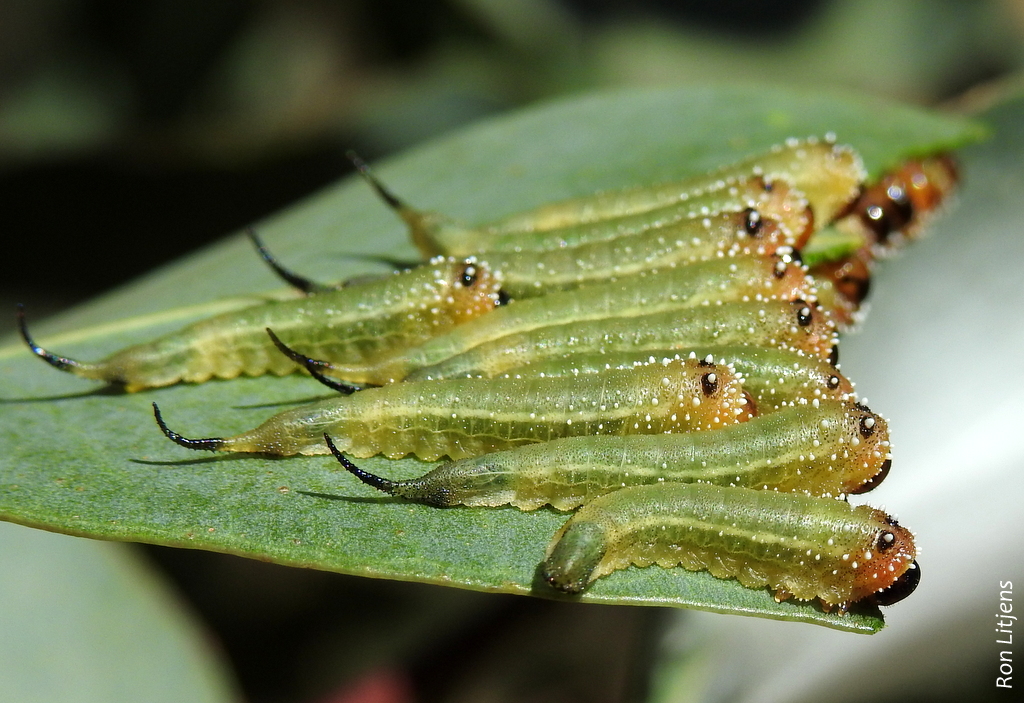
Larvae of the Green Long-tailed Sawfly (Lophyrotoma interrupta) have recently appeared on some of the eucalypt saplings on our property, pictured left. Unlike those pictured above they do not form large aggregations but they do like to eat together. They will line up next to each other on the edge of a leaf a systematically devour it, pictured below.
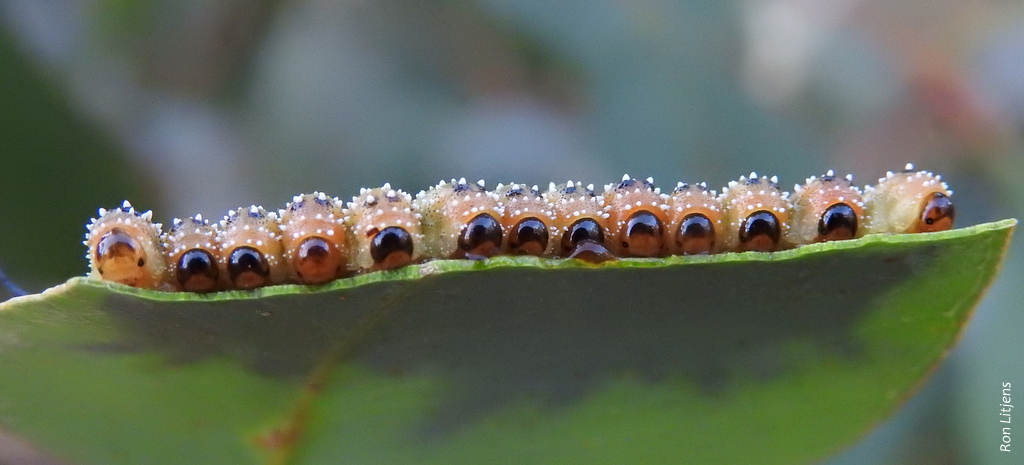
Pass the salt!
External support
Human have what is termed an endoskeleton, a bony framework internal to the body that is covered in soft tissue. Many creatures however have an exterior skeleton, an exoskeleton. The advantage of an exoskeleton is that this hard shell forms a rigid structure to support the body and also provides protection for the fragile internal organs. Insects, crustaceans, spiders and crabs all have exoskeletons. Interestingly turtles and tortoises have both an exoskeleton (shell) and an endoskeleton.
The downside of having an exoskeleton is that the rigid shell restricts the size of the growing animal. As the animal grows it needs to moult (a process known as ecdysis) out of its old shell and form a new bigger one. After it has left its old shell the creature is soft and pale in colour and very vulnerable to predation. Over the course of hours the creature pumps itself up with air and the new, larger shell hardens. It may take weeks for the new colour to be fixed. The wings appear at the final moult.
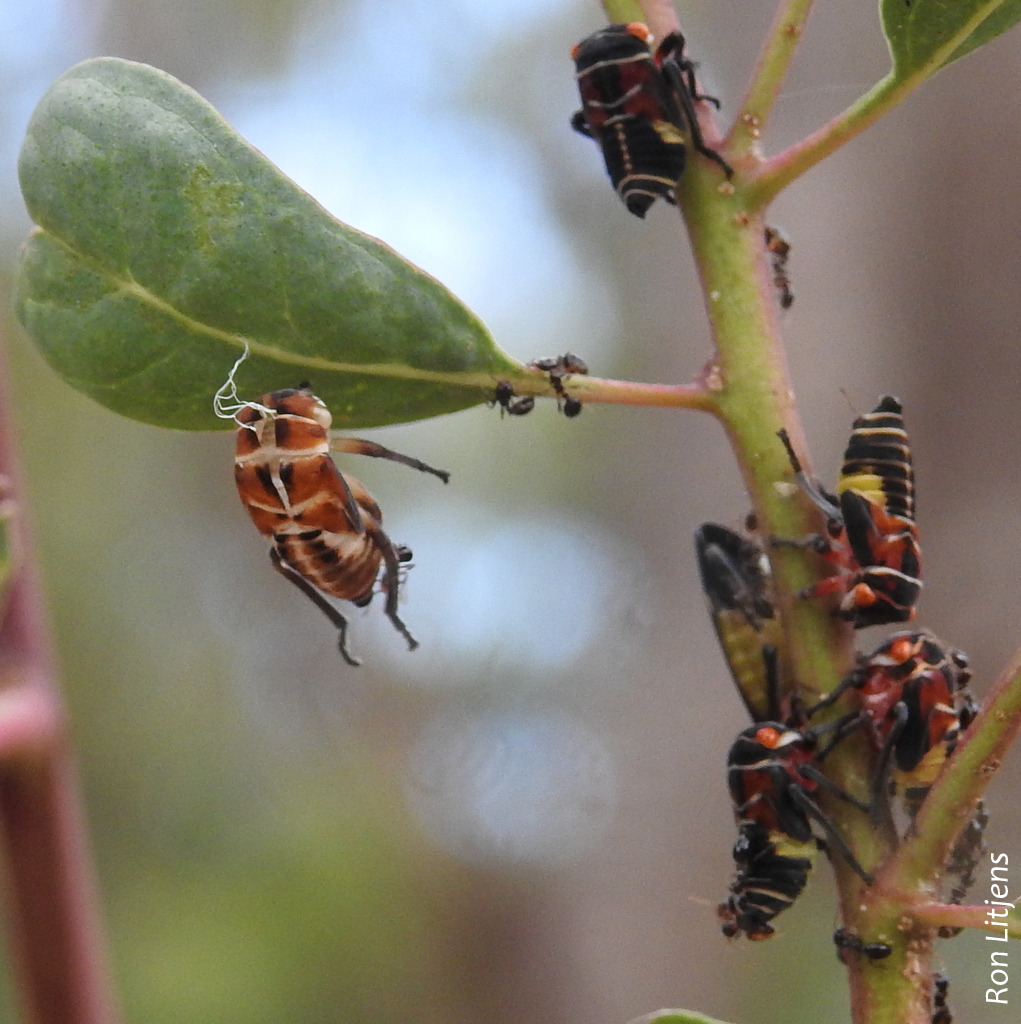
This blog site has pictorially documented several moulting animals – cockroaches, mayflies, dragonflies & cicadas. To add to this list are Gumtree Hoppers (Eurymeloides pulchra), pictured below.
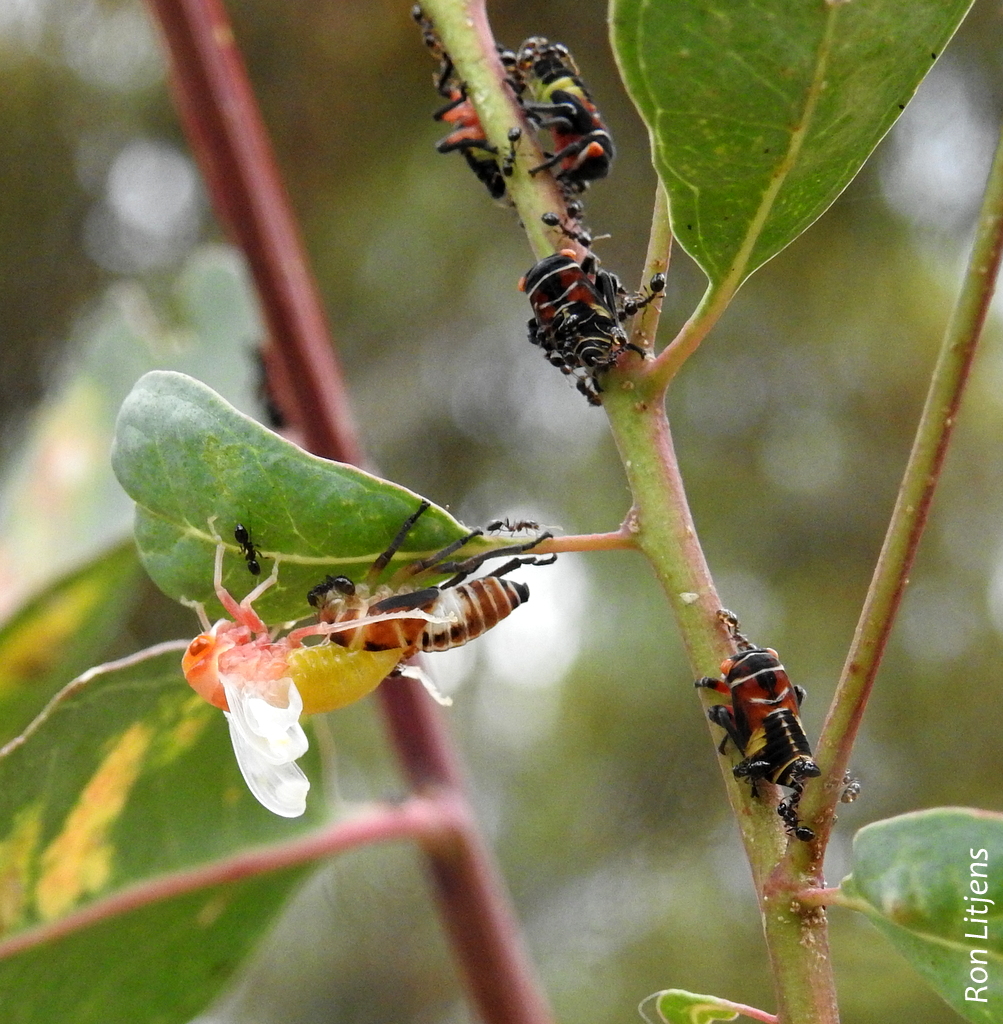
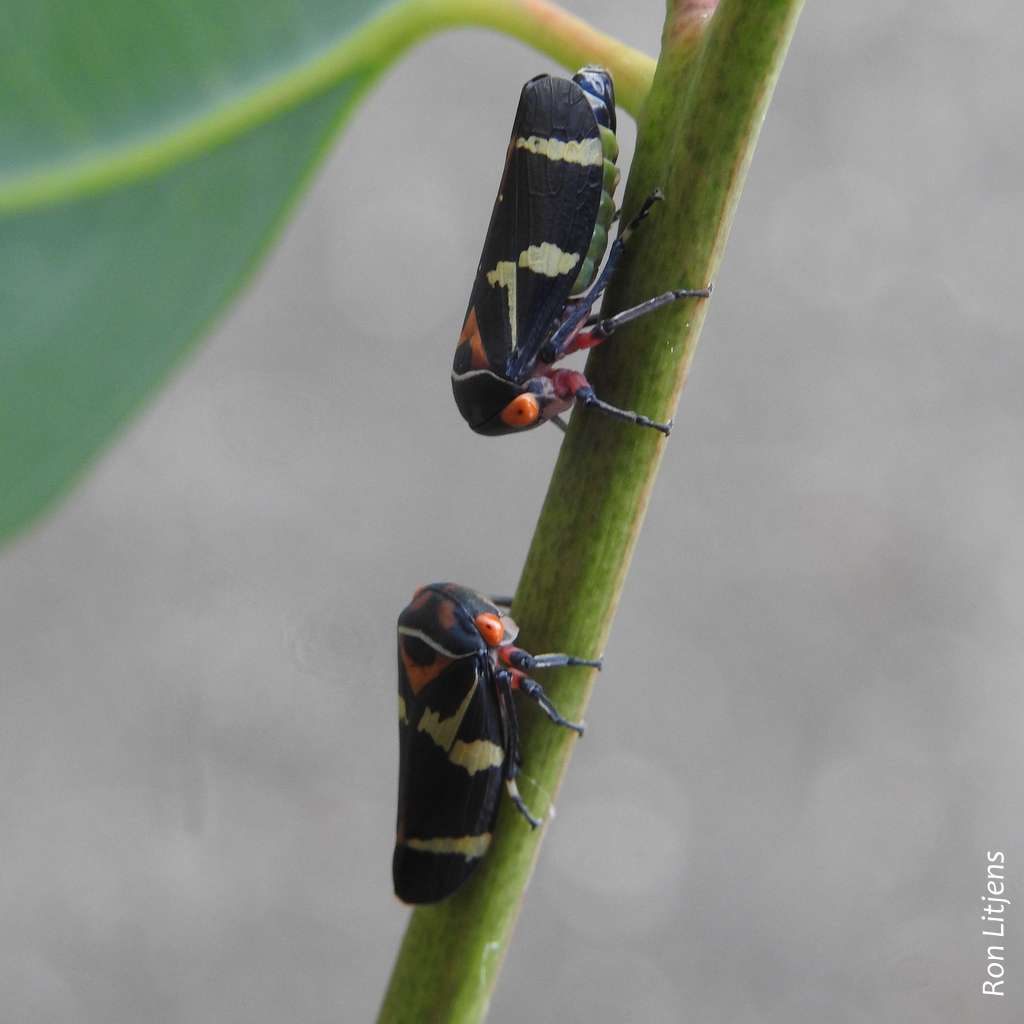
Gumtree hoppers are sap-sucking insects found on eucalypt trees in great numbers during summer. They come in a variety of colours and sizes. As part of their life-cycle Gumtree Hopper nymphs or instars go through a number of moulting steps before a fully formed adult finally emerges. In the photo above the pale winged adult (left) can be seen emerging from the old exoskeleton whilst a number of instars look on.
After some time, days or weeks depending on species, the new adult becomes fully coloured (pictured right). All that is left is an empty shell hanging from the branch (pictured below).
Hypothetical
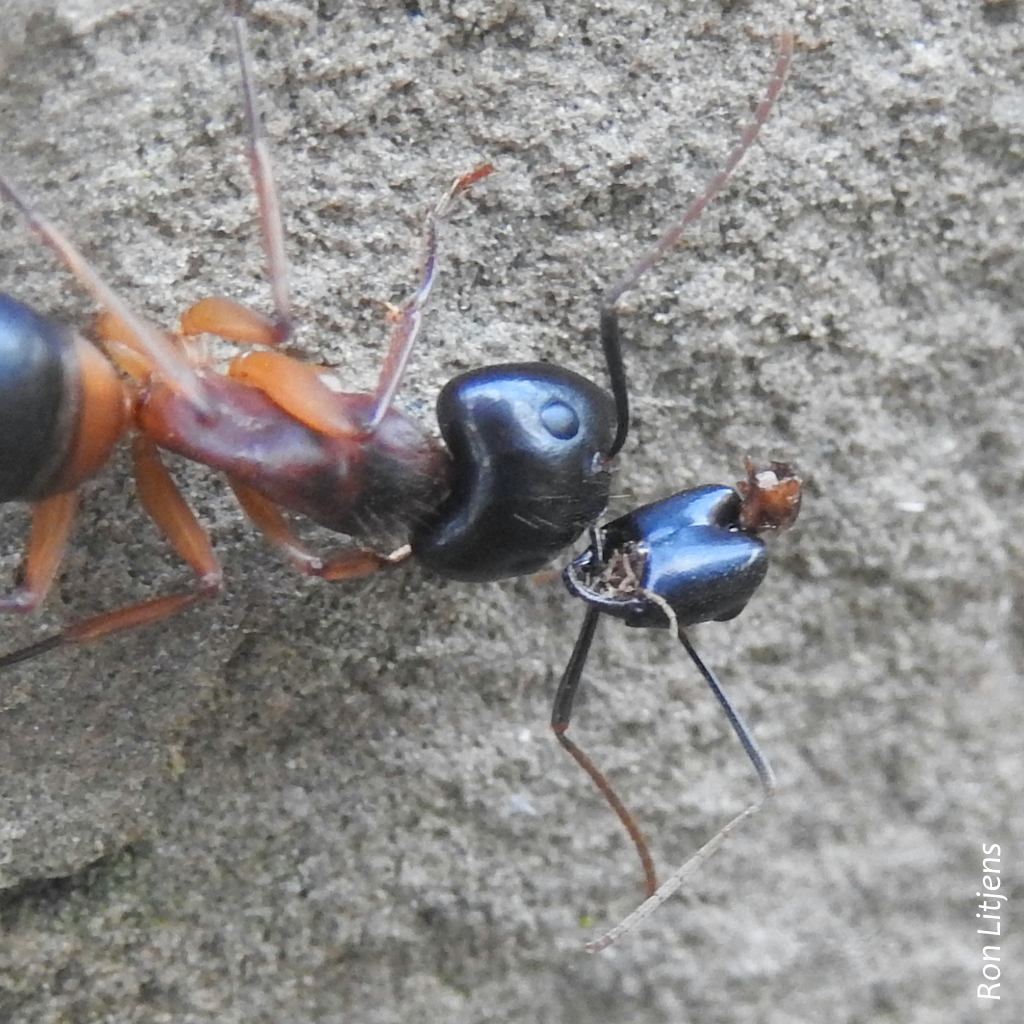
Imagine that you are a Sugar Ant (Camponotus sp.). You have spent your life serving your queen – providing her with food and security. And then imagine one day you are required to defend the nest against raiding Sugar Ants from another nest. You engage in leg to leg combat with the dreaded foe and after a long battle seize the opportunity and bite your opponent’s head off. But in your moment of triumph the enemy latches its jaws onto your antenna (see below). What would you do?
I don’t know. I’m not an ant. You figure it out.
Holiday souvenirs
The title conjures up images of postcards, sea shells and holiday snaps. The souvenir of my recent holiday consists of a plastic vial containing ticks, all extracted from my body.

Ticks are arachnids just like spiders and scorpions and Australia has about 75 species. They are external parasites feeding exclusively on blood. Once on a host a tick will puncture the skin and inject an anaesthetic so the host is unaware of its existence and an anti-coagulant to stop the blood from clotting. It will then consume blood until it has had enough and then drop off.
There are four life stages – egg, larva, nymph and adult with the nymphal stage going through several moulting steps. Each nymph instar requires the ingestion of blood. In this way a tick will have several hosts in its lifetime. Contrary to popular belief a tick cannot leap onto a passing host. A tick will sit on vegetation with its two back pairs of legs. The front pair of legs contain both smell and heat sensors. They are held aloft as the tick searches for a host. When a suitable host brushes past the vegetation on which the tick is sitting it steps on board.
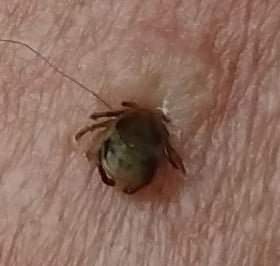
Back to my holiday, I woke up one morning with 5 ticks on my neck and shoulders, pictured right. Ticks can transmit diseases so the recommended treatment for a tick is to kill it and either let it drop off naturally or if you have an experienced medical professional in the vicinity, like I did, get them to remove the tick. It is important to remove all of the tick particularly the head that can cause infection if left in the skin.
I now have a vial of five ticks (including heads). As far as a holiday souvenir goes it does not get a tick of approval.
A family that plays together…

The definition of the word ‘drey’ in the Oxford dictionary is ‘the nest of a squirrel, typically in the form of a mass of twigs in a tree’. In Australia the term is used to describe the communal nest of the Common Ringtail Possum (Pseudocheirus peregrinus), pictured left.
Ringtail possums are distributed along the east coast of Australia and also Tasmania. Unlike Common Brushtail Possums that are solitary creatures preferring tree hollows to sleep in, Ringtails are gregarious in nature and prefer to live in dreys, spherical structures made out of tree branches and sticks and lined with leaves and bark.

The drey is well camouflaged and is usually built in a sheltered place high in a tree (pictured right). It can vary in size from a soccer ball to a metre in diameter. Several individuals including offspring inhabit a drey with family groups inhabiting dreys in close proximity to each other.
The entrance is a small ‘possum-sized’ hole in the side of the structure and if you’re lucky you may just get a glimpse of the inhabitants inside (see below).

Handsome AND beautiful

The Fallen Bark Looper Moth (Gastrophora henricaria) is a moth named for the looping motion its caterpillar makes whilst walking. The caterpillar feeds on eucalypts and Brush Box (Lophostemon confertus). Being of the Geometridae family the caterpillar has three pairs true legs near the head and only two pairs of pro-legs at the other end.
The moth is otherwise known as the Beautiful Leaf Moth. The male moth at rest, pictured left is quite distinctive with a black line across its outer wings. I would call it handsome rather than beautiful! The female is larger in size and lacks the black line, pictured below right.

The surprise comes when the moth is disturbed and shows displays its hind wings that are a striking orange and black in colour, pictured below. The colours probably act as a ‘startle’ signal when disturbed to buy it a bit more time to get away from predators.

Agreed. It’s both handsome and beautiful.


 Focus On Fauna