Spring – footy finals, bird’s nests, spitfires!
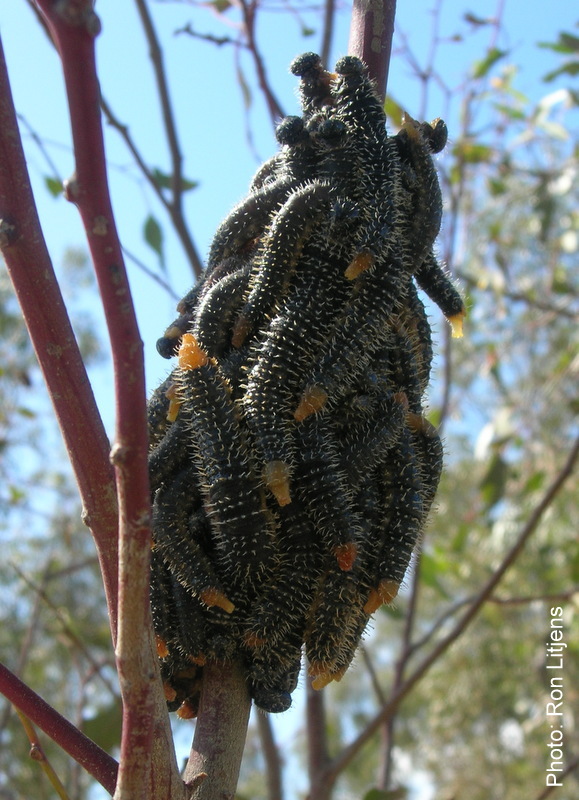
You know spring is in the air when the footy finals have started, the birds are in a nesting frenzy and Spitfires make an appearance. Spitfires are the larvae of Sawflies (Perga sp.) a common but rarely seen relative of the wasp. The term sawfly relates to the saw-shaped egg laying device on the female wasp who lays eggs in eucalyptus leaves. When hatched the larvae congregate in large groups on the branches of trees and feed on the leaves. They store eucalyptus oil in their gut and regurgitate it if disturbed, hence the term spitfire. The larvae burrow into the ground to pupate in summer and the adults emerge in autumn to continue the cycle.
Pictured are the recently seen larvae of the Steel-blue Sawfly (Perga dorsalis).
Flora & Fauna of ‘Hidden Valley’

Sticky Everlasting (Xerochrysum viscosum)
‘Hidden Valley’ (not a proper name) is at the back of the Three Sisters, off Moore’s Rd in Flowerdale and is one of the project sites of the new Strath Creek Biodiversity Project. A short survey, visiting the properties of Hubbard and Watson, was organized to gain some understanding of the flora and fauna of the area.
The morning dawned cool and overcast, but the previous day’s rain had gone. Though six of us set out on the walk, two had other duties and only joined us for the first leg. Four of us then spent about three hours traipsing up and down rather steep slopes recording the plants and animals of the area, with some surprising results. Read more…
What’s for dinner?
A “chattering” of White-winged Choughs (pronounced “chuff”) has regularly nested in a small pine plantation on our Strath Creek property in recent years, with varying degrees of success. This is not surprising as they have had to cope with nest predators such as currawongs and kookaburras, not to mention foxes and cats after fledging, as well as fierce storms splintering trees around them.
All members of the group help build the mud nest and incubate and feed the nestlings. This year, there are about 10 in the group, so they may stand a better chance of successful breeding. We’ll be following with interest the progress of the three young shown in the slide show above, and will keep you posted.
To hear calls of the choughs, click on the sound icons below:
Adults
Chicks
Nest-box update 2
 Curiosity got the better of us and we decided to carefully inspect the nest-box featured in previous posts on 14th August and 9th September. We suspected it was being used by a Brush-tailed Phascogale, although our remote camera had not managed to record it entering or leaving the box.
The photo at left shows what appears to be a typical phascogale nest of shredded bark and some leaves. There is a baffle across the top right-hand corner where the entrance hole is located. From a quick look after taking the photo the nest appeared to be empty, but the phascogale (and young?) could well be snuggled down in the base of the nest.
There has certainly been a lot of activity near the nest-box, with the remote camera recording Sugar Gliders, Ring-tailed Possums and a Black Duck in recent weeks, as well as a few more shots of the phascogale.
I hear you knocking but you can’t come in
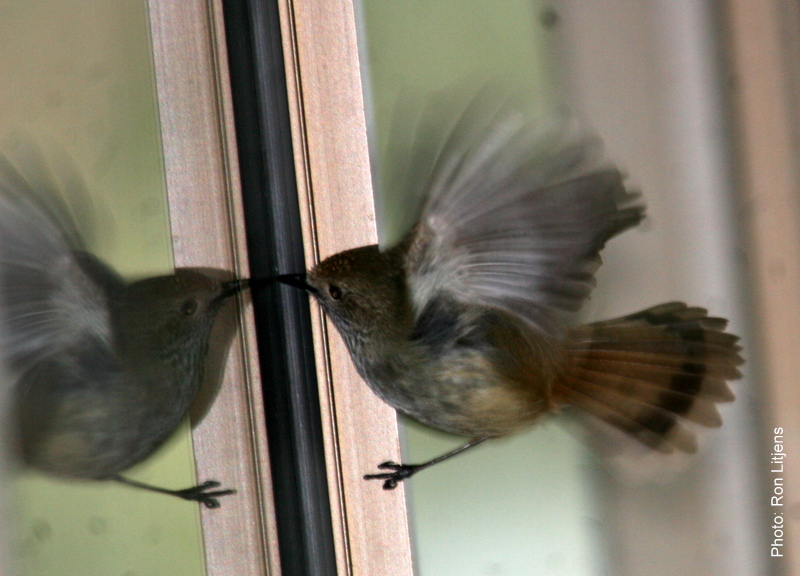
Hello handsome!
Over the past fortnight we have been regularly visited by a Brown Thornbill (Acanthiza pusilla). Up to a dozen times a day it will hang on the flywire screens or cling to the rubber seals on the glass sliding doors, chirping loudly. These serenades can go on for up to five minutes.
Originally we thought it was searching the flywire for insects hidden there or maybe spider web with which to build its nest. However it often just hangs there singing to its own reflection. Whatever the reason, these visits do provide a rare opportunity to see up close what are referred to at our place as LBJs (little brown jobs).
Rare lizard found
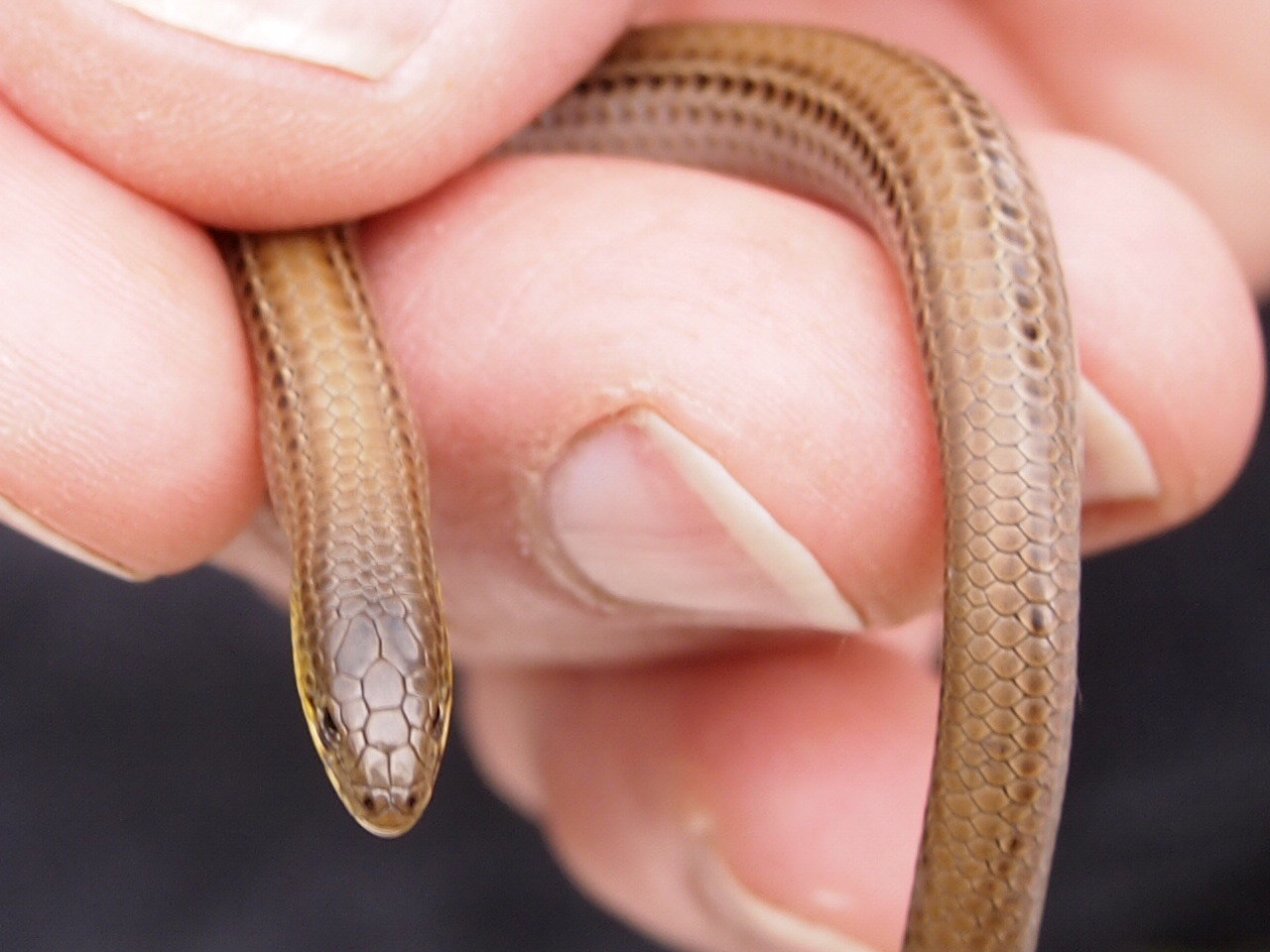
Striped Legless Lizard at Broadford
Back in May, Kay told us about a small “snake” she had come across while planting trees in a paddock on her property at Strath Creek. The significant additional information Kay supplied was that it “squeaked”. This was a sure indicator that it wasn’t a snake at all, but a legless lizard (Delma sp.), hopefully a Striped Legless Lizard (Delma impar)! We passed this information on to Bertram Lobert, coordinator of the Upper Goulburn Striped Legless Lizard Project, who, in the absence of a corroborative photograph, registered it as an ‘anecdotal’ sighting.
However, this week a confirmed sighting of the Striped Legless Lizard not that far away in Broadford gives weight to Kay’s observation. The following report of the Broadford find was sent by David Laurie of the Dabyminga Catchment Cooperative:
“A rare Striped Legless Lizard (Delma impar) has been found on a rural property just north of Broadford township (see photo). This is the first time the lizard, listed as a threatened species under the Flora and Fauna Guarantee Act, has been recorded in the Broadford area. The lizard was found during the Landcare group’s monitoring event on Sunday 23rd September. Led by Bertram Lobert, the monitoring morning attracted 10 local Landcarers who were thrilled with the find. There had been an unconfirmed report of the lizard in 2011 at a nearby property, which prompted the group to undertake a more comprehensive search.
The Striped Legless Lizard is generally found in native grasslands and grassy woodlands, where it spends much of its time within dense grass tussocks or underground in cracks in soils. It feeds on moth larvae as well as crickets and spiders. When disturbed the lizard makes a distinctive squeaking call and, like many skinks, can drop its tail to distract a potential predator. Major threats to the lizard include loss and fragmentation of habitat, the destruction of habitat by the removal of rocks and fallen timber, increased predation by introduced foxes and cats and being killed by landholders after being mistaken for snakes.
The lizard grows to 30 cm long and is the thickness of a pencil. It can be distinguished from the smaller snakes by its longitudinal stripes, the presence of ear openings, having a broad rounded tongue rather than a forked tongue and the small scaly flaps present as vestigial hind limbs.”
If you find what you think may be a legless lizard, particularly in the Strath Creek/Flowerdale area, please post a comment on this blog or email either focusonfauna@gmail.com or bertram.lobert@activ8.net.au
For more information on the Striped Legless Lizard in the Goulburn Broken Catchment click HERE.
Friends of windpower !

Photo by Rosemary Ralph
No deceased Orange-bellied Parrots here! Rosemary from Strath Creek sent in this unusual shot of a Laughing Kookaburra roosting on her domestic wind-power generator. Although it has a much faster blade rotation than a large community generator, Rosemary tells us, despite some apprehension after its installation, she has never found a bird carcase near the base of the generator. Other birds do however use the body of the generator as a perch, even a Wedge-tailed Eagle which tried to balance without success.
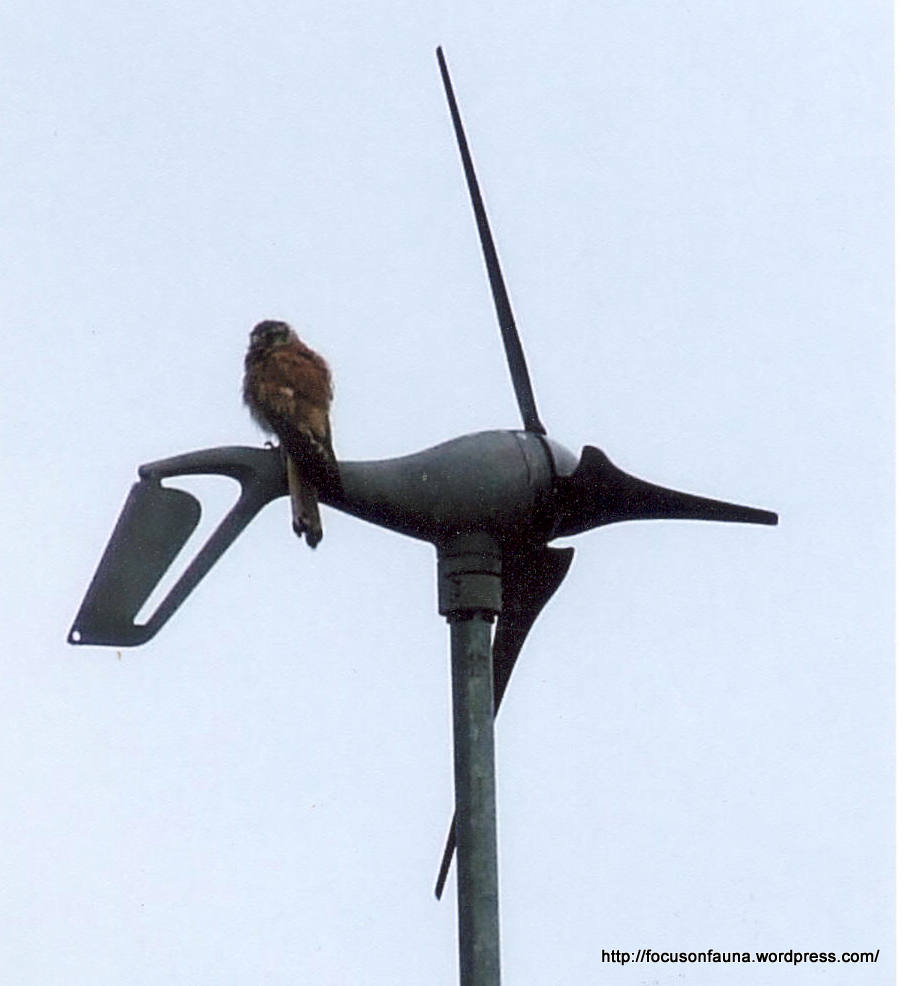
Another unidentified bird can also be seen on the turbine in the less-than-clear photo below. Any ideas on what it may be? We’re guessing a smaller raptor, perhaps a hobby or kestrel.
Gala Dinner for one
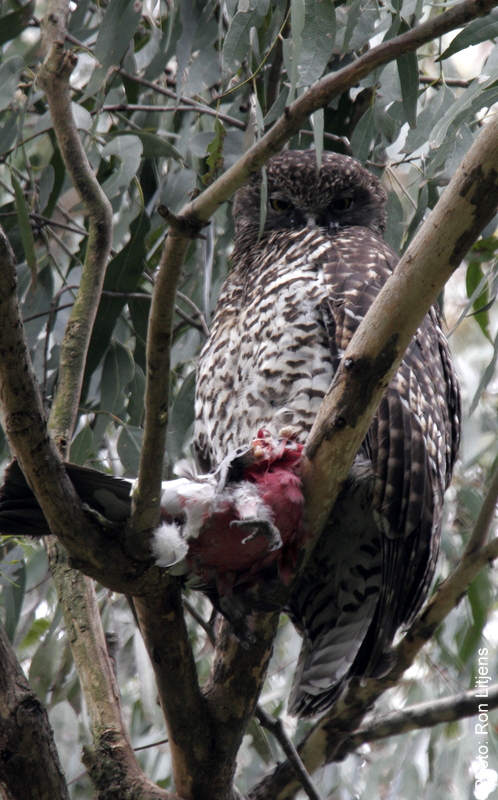
Don’t even think about it. Get your own meal.
Or should that be a Galah dinner? This week we found grey and pink feathers strewn about an area of 20 m radius on our property on Junction Hill. Knowing the debris was underneath a regular roosting spot of the resident male Powerful Owl (Ninox strenua), we did not have to look up to know that it was there dining on a hapless Galah (Cacatua roseicapilla).
The owl has not been seen with its mate since late July. Assuming a family is on the way and the incubation time for the eggs is between 36 and 39 days, we are quite excited that we might soon hear the tappings of tiny talons. But the location of the nest tree remains a mystery. This week, investigation of a possible nest site revealed the hollowed out tree to be just that, a hollowed out tree and nothing more. As to where the nest is, now we’re really stumped.
What’ll happen to the wattles ?
 You may have noticed the rusty-browning and defoliation of wattle trees around the district recently. This was particularly noticeable to us on a trip to the Strath Falls the other day – the effect can be seen in the centre of the photo at left, where much of the dense post-fire regrowth of wattles appears to be dying.
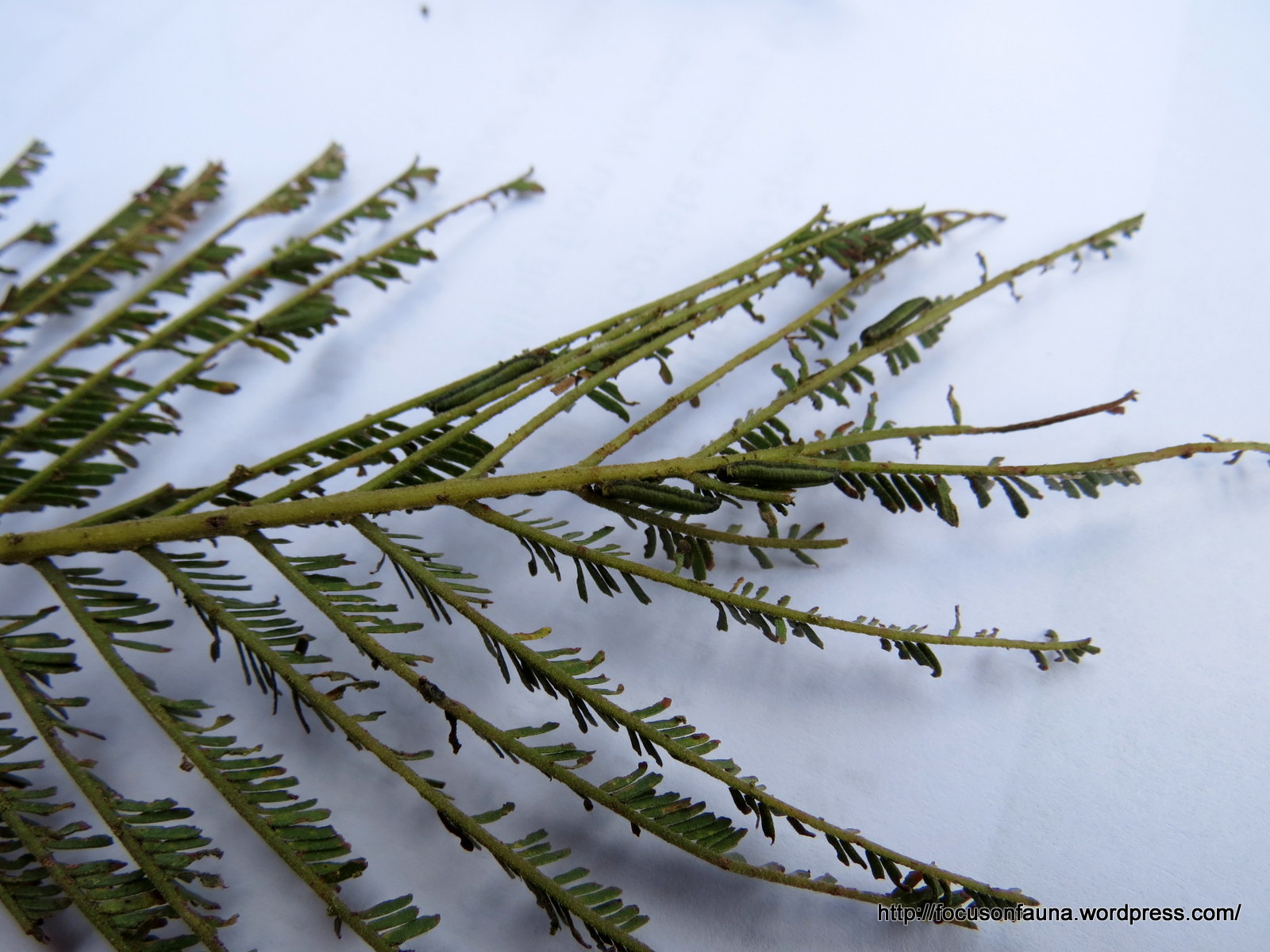
The wattle species affected are those with feathery bipinnate foliage: Silver Wattle (Acacia dealbata) and Black Wattle (Acacia mearnsii). The culprit is what appears to be a small caterpillar, as seen in the photo at right (click on it for a closer look).

Fireblight Beetle larva
In fact the offender (approx. 1 cm long) is the larva of the Fireblight Beetle (Peltoschema orphana – formerly Pyrgoides orphana) as seen at left. The beetle is native to south-eastern Australia and feeds on Silver and Black Wattles.
The defoliation of these wattles is another interesting aspect of the post-fire recovery of the bush. Not all of the wattles will recover and, in the meantime, the thinning of the canopy will allow other native plants (and unfortunately weeds!) to regenerate.
Don’t let the coy looks fool you
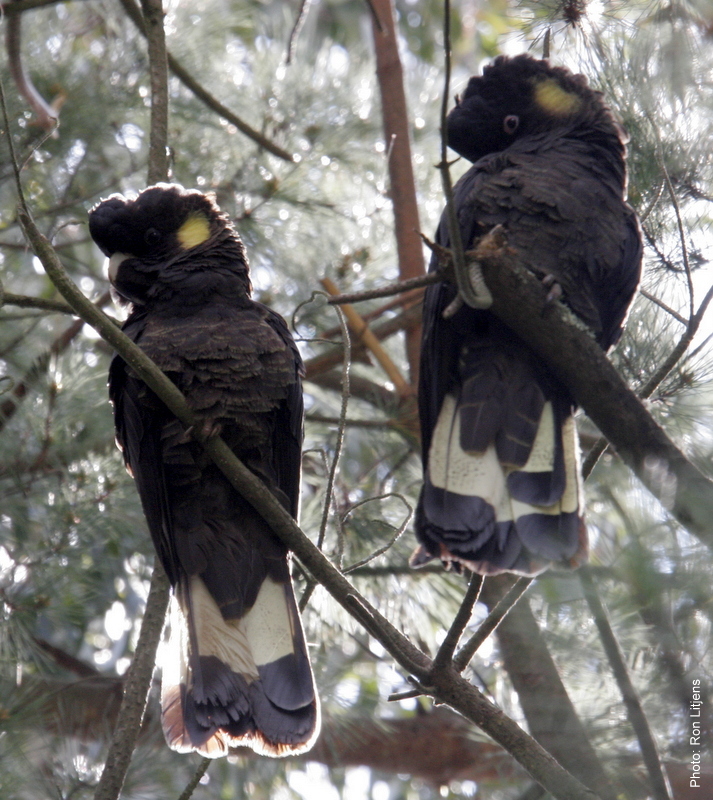
While on my daily reconnoitre looking for the most recent roosting place of the local Powerful Owl (Ninox strenua), I was assailed by a shower of falling pine cones and branches. Perched in the trees high above me was a ‘squadron’ of Yellow-tailed Black Cockatoos (Calyptorhynchus funereus) doing what they do best – destroying vegetation. Don’t let the coy look of the Cockatoo on the right fool you. Minutes before this photo was taken, the truncated branch on which it is perched wasn’t so truncated. Their powerful beaks can easily grind through pine cones and two-centimetre-thick branches. Long known as harbingers of rain the only thing raining on this day was pine debris.




 Focus On Fauna