Think pink ?

 This plump little bird is clearly a robin and was displaying typical robin behaviour in Steve and Heather’s garden at Flowerdale the other day – flicking its wings and tail, and darting from a low perch onto prey on the ground. But the question is, what sort of robin? Identifying the species of female and immature ‘red robins’ (genus Petroica) – Scarlet, Red-capped, Flame, Rose and Pink Robins – is never easy, but Steve thinks this is a Pink Robin (Petroica rodinogaster) and we agree, even though it seems well out of its usual forest habitat of shady fern gullies. The key identifying features of the female Pink Robin are: buff rather than white wing markings, no white on tail and a small buff patch above its bill.
Steve and Heather’s shady garden must be to its liking because, on checking his photo records, Steve found he had recorded a similar bird in 2006 (see photo at right), but was unsure of the identification at the time. Now all we need is for the distinctive pink male to turn up! For more information and a photo of the male click HERE to visit the Birdlife Australia’s Birds in Backyards website.
Now showing at a dam near you

1 – Nymph climbing a reed
A recent post described the many cicada exoskeletons that currently adorn our trees and shrubs (click HERE to view). Watching the adult cicadas emerge from the shells is difficult because it generally occurs at night and can happen in trees just about anywhere on your property.
Similarly spectacular shows are now also happening – the emergence of dragonflies and damselflies from their nymph stage. Even though they also happen after dusk, the good news is the events are far easier to find. They occur only in dams within centimetres of the water’s edge on upright reeds and branches.
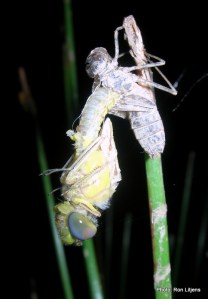
2 – Adult emerges
A previous post (click HERE to view) discussed the mating and subsequent egg laying process of these insects. Once hatched, the nymphs can spend from months to several years under water feeding on mosquito larvae and tadpoles. At maturity the nymph climbs out of the water on a suitable reed or branch. The exoskeleton splits along the back and the adult emerges. Once freed, the adult uses an internal hydraulic system to ‘pump up’ its various body parts to their full size. Over the next few hours the wings and body harden and another dragonfly is ready to take to the air.
So for those of you addicted to the SBS reality show ‘One Born Every Minute’, switch off the telly, put on the wellies and get a real dose of reality. There are hundreds being born every minute … right now, at a dam near you.
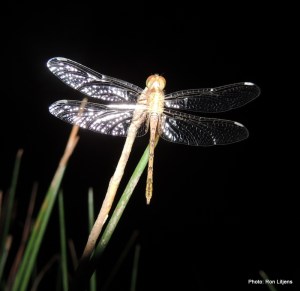
4 – Ready to go

3 – Wings still folded back
2012 in review
WordPress.com prepared a 2012 annual report for the Focus on Fauna blog which contains some interesting statistics.

Here’s an excerpt from the report:
The blog got about 9,000 views in 2012. There were 83 new posts, growing the total archive of this blog to 150 posts. There were 591 pictures uploaded, taking up a total of 340 MB. That’s about 2 pictures per day.
The busiest day of the year was September 28th with 102 views. The most popular post that day was Rare lizard found.
Wattlebird wars
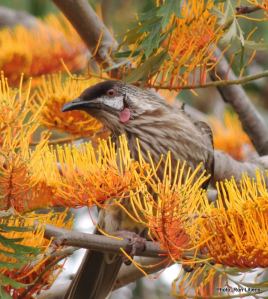
From our bedroom we look out on a Silky Oak (Grevillea robusta). For most of the year it is an unremarkable tree. The birds think so too as they seldom perch in it. However for 5 or 6 weeks at the end of the year this tree comes to life and puts on an amazing yellow–orange floral display. Now it is time for the Wattlebird Wars.
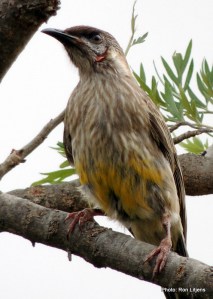
The Red Wattlebird (Anthochaera carunculata), called so because of the striking red wattles that hang from the cheeks, is a loud and aggressive honeyeater. It is very territorial and for most of the year will harass any bird that strays within the vicinity of the various grevillea shrubs on the property. In December the flowering Silky Oak is prized territory and throughout the daylight hours up to a dozen wattlebirds will tirelessly (and noisily) chase each other up, down and around the branches — an avian version of snakes and ladders.
We have noticed a definite territorial pecking order among the other bird species. The Red Wattlebirds trump the smaller Eastern Spinebills and Superb Fairy-wrens and will even drive off the larger Pied Currawongs. The big kid on the block though is the Sulphur-crested Cockatoo (Cacatua galerita). When a group of them decide the Silky Oak flowers need shredding there’s not a Wattlebird in sight.
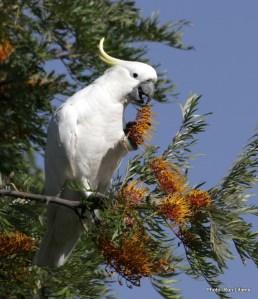
Boss cocky!
Birds behaving strangely

Yellow-faced Honeyeaters
We received this report of strange bird behaviour from Susan and Joel from Strath Creek:
“Outside our kitchen window dead leaves from a Silky Oak have formed a platform in a spindly bottle brush (Callistemon sp.). The other day we watched young Yellow-faced Honeyeaters stretch and lie on this platform with wings spread, eyes closed and beaks up, as if dead. After a while they started to pant (the temperature was in the 30’s) and eventually jumped up. Several birds repeated the same behaviour and we noticed there was a preferred spot on the platform. As one bird moved from this spot, another would take its place. We have not seen them return since that day! We wonder what this behaviour means – could it be related to the summer solstice?”
A possible alternative explanation that occurred to us was that the birds were engaging in “anting”, whereby they allow ants to crawl over their body or in some cases pick up ants in their bill and rub them on their feathers. Theories on the reasons for this behaviour are many and varied, including using the ants’ formic acid to combat mites, fungi or bacteria, to obtain Vitamin D, or even to gain an intoxicating effect! Of course the birds may just have been sunning themselves – another means they may use for parasite control and/or for Vitamin D.
A Subaru it is not

Satin-Green Forester
December is the month that the Honey-myrtles flower. The blossoming of our Cross-leaf Honey-myrtle or Totem Poles (Melaleuca decussata) has caused an insect feeding frenzy in the trees along our driveway.
Imagine my surprise when I found in the driveway a bright, shiny Satin-Green Forester. Unfortunately it was not a funky-hued Subaru but an iridescent moth of the Zygaenidae family, Pollanisus viridipulverulenta. This Forester is a daytime moth that after mating lays its eggs on plants of the Hibbertia genus.
Also present were the tiny Sedge Moth (Glyphipterix chrysoplanetis), only 3 mm long, and the Nectar Scarab Beetle (Phyllotocus apicalis). Scarab beetles are important pollinators of native flora and are presently living in great numbers on the honey-myrtles and nearby Burgan (Kunzea ericoides). Despite their numbers they do no damage to the trees.
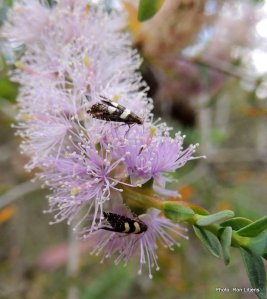
Sedge Moth

Nectar Scarab
Bird gallery
Here’s a collection of native birds we have managed to photograph in the Flowerdale/Strath Creek area in recent days. Click on any of the photos for a closer look. We also recorded the calls of the Sacred Kingfisher and Brown Goshawk – click on the icons to hear them.


Sacred Kingfisher call:
Brown Goshawk call:
Evening encounters
Tawny Frogmouth
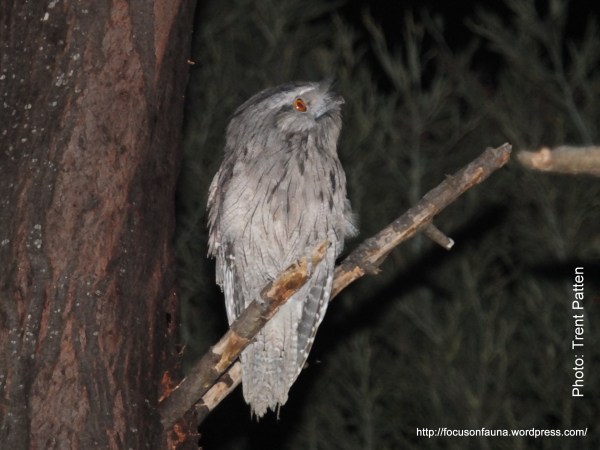
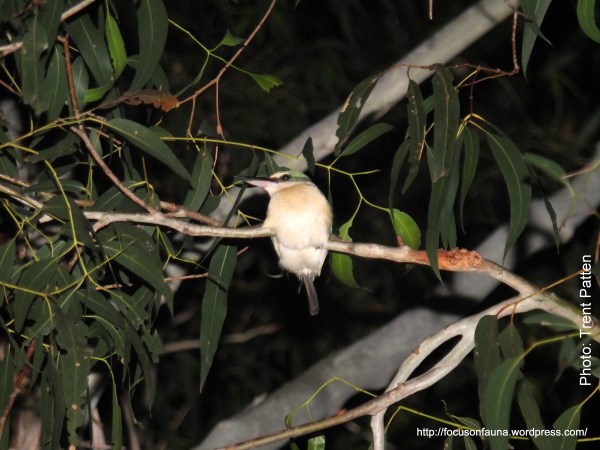
Local wildlife enthusiasts Trent and Steve ventured into Coonans Bridge Reserve, Flowerdale the other evening to check out the resident wildlife. After catching a glimpse of a Platypus in King Parrot Creek, they proceeded to record an impressive list which included a Tawny Frogmouth, a Southern Boobook with chicks, a Sacred Kingfisher, a young Black Wallaby, six Common Brushtail Possums and a Sugar Glider.
Sacred Kingfisher

Southern Boobook at nest hollow
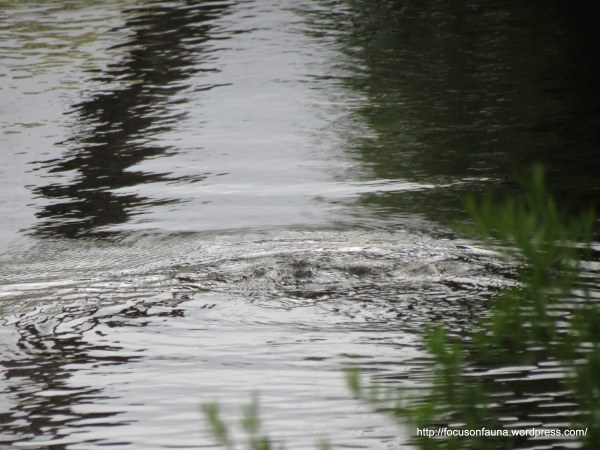
Platypus – trust me!
Trent also took along his thermal imaging camera, which was able to detect feral bees in a tree hollow, a Common Brushtail Possum, also in a tree hollow, and the unidentified occupant of one of the many nest boxes installed in the Reserve.

Bees in tree hollow

Possum in tree hollow

Occupied nest-box
Summer memories
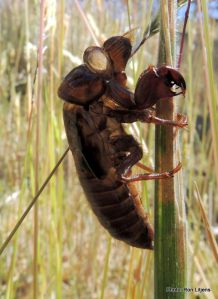
Nymph exoskeleton
Cicadas (Order Hemiptera, Suborder Auchenorrhyncha) are the sound and currency of my childhood. As a boy I used to listen to their deafening noise while having dinner on a summer’s eve. At school we used to trade them, dead of course. Greengrocers and Brown Bakers were legal tender in the playground and the rare Black Knight was the most coveted of all.
It is this time of year that the nymphs, which have spent their lives underground feeding on the sap from roots, emerge from the ground and take adult form. The strong burrowing front legs of the nymph, an adaption not needed by the adult, can be seen in the exoskeleton image (left). On grass stems, branches and leaves the empty husks left behind after moulting look like terrestrial Darth Vaders.
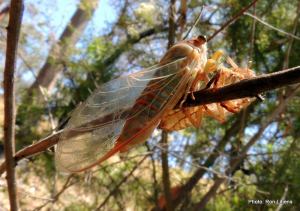
This week I came across this adult that had just emerged from the shell. It’s like the Hans Christian Andersen story of the Ugly Duckling all over again.
Renovate or move?
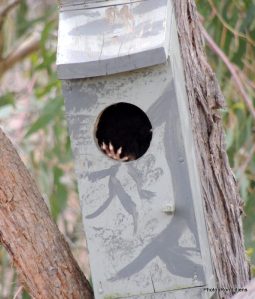
This is the question that perennially plagues us all. As our lifestyles change or the family gets bigger we all need to make this decision. In the case of this Common Brushtail Possum (Trichosaurus vulpecula) the crisis has been brought about by its own increase in size. One gum-nut pizza too many, methinks!
The house in question is one of the most popular pieces of real estate in Flowerdale. A previous post (click HERE to view) outlined the revolving tenancy of this nest-box. Over the past twenty-four months it has been previously occupied by a White-throated Treecreeper family (Cormobates leucophaeus), then an Australian Owlet-nightjar (Aegotheles cristatus) followed by a Ring-tailed Possum (Pseudocheirus peregrinus).

The space inside the nest box is getting so cramped that recently this Brushy has been seen sleeping with various appendages hanging out of the nest box entrance, especially in hot weather. Not a clever move given the Powerful Owls (Ninox strenua) roosting nearby. With the impending summer heat, it is probably just a matter of time before this possum moves on to a more spacious abode.
We wait with bated breath to see what the next nest-box tenant will be.




 Focus On Fauna