Rare lizard found
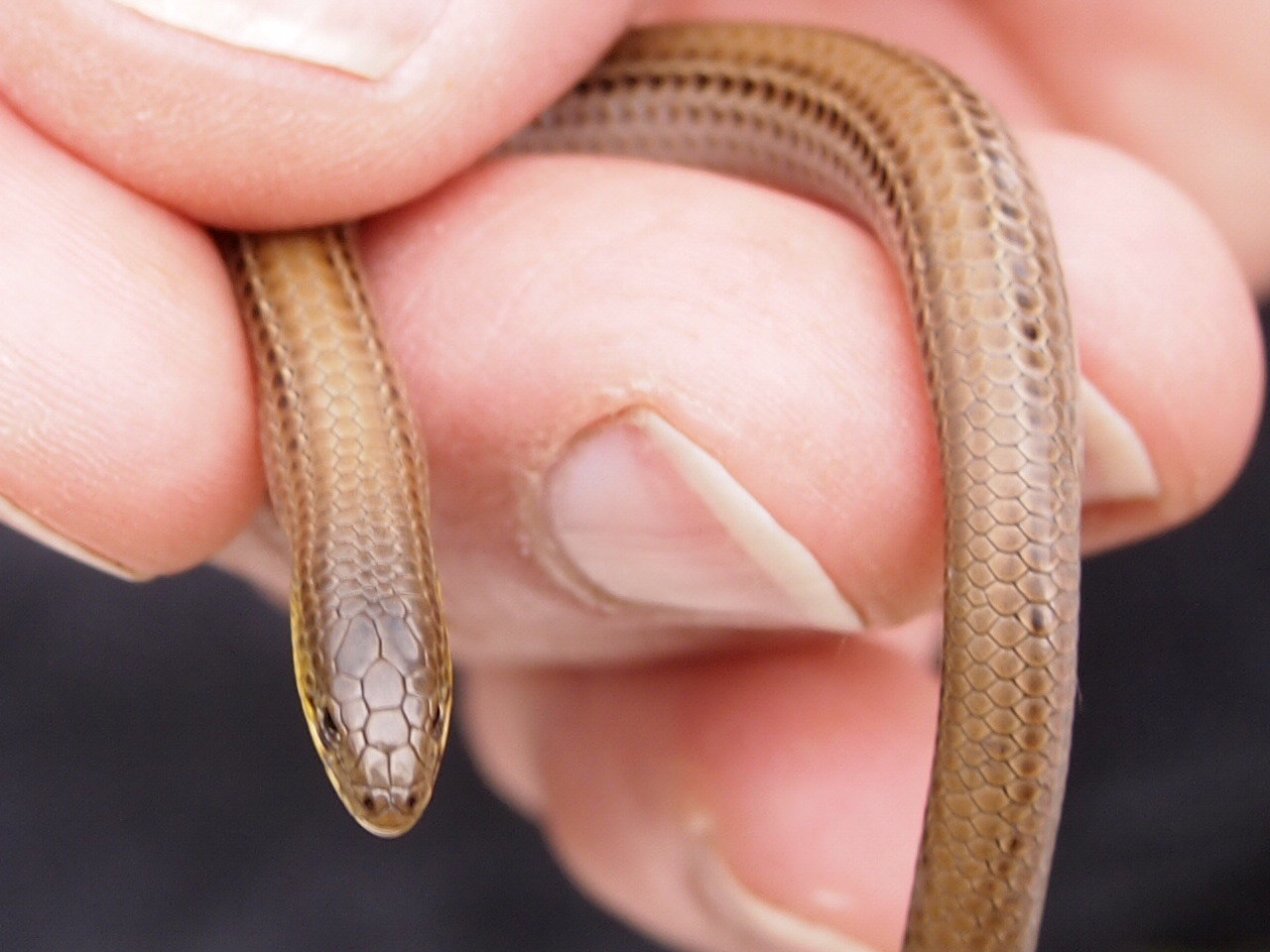
Striped Legless Lizard at Broadford
Back in May, Kay told us about a small “snake” she had come across while planting trees in a paddock on her property at Strath Creek. The significant additional information Kay supplied was that it “squeaked”. This was a sure indicator that it wasn’t a snake at all, but a legless lizard (Delma sp.), hopefully a Striped Legless Lizard (Delma impar)! We passed this information on to Bertram Lobert, coordinator of the Upper Goulburn Striped Legless Lizard Project, who, in the absence of a corroborative photograph, registered it as an ‘anecdotal’ sighting.
However, this week a confirmed sighting of the Striped Legless Lizard not that far away in Broadford gives weight to Kay’s observation. The following report of the Broadford find was sent by David Laurie of the Dabyminga Catchment Cooperative:
“A rare Striped Legless Lizard (Delma impar) has been found on a rural property just north of Broadford township (see photo). This is the first time the lizard, listed as a threatened species under the Flora and Fauna Guarantee Act, has been recorded in the Broadford area. The lizard was found during the Landcare group’s monitoring event on Sunday 23rd September. Led by Bertram Lobert, the monitoring morning attracted 10 local Landcarers who were thrilled with the find. There had been an unconfirmed report of the lizard in 2011 at a nearby property, which prompted the group to undertake a more comprehensive search.
The Striped Legless Lizard is generally found in native grasslands and grassy woodlands, where it spends much of its time within dense grass tussocks or underground in cracks in soils. It feeds on moth larvae as well as crickets and spiders. When disturbed the lizard makes a distinctive squeaking call and, like many skinks, can drop its tail to distract a potential predator. Major threats to the lizard include loss and fragmentation of habitat, the destruction of habitat by the removal of rocks and fallen timber, increased predation by introduced foxes and cats and being killed by landholders after being mistaken for snakes.
The lizard grows to 30 cm long and is the thickness of a pencil. It can be distinguished from the smaller snakes by its longitudinal stripes, the presence of ear openings, having a broad rounded tongue rather than a forked tongue and the small scaly flaps present as vestigial hind limbs.”
If you find what you think may be a legless lizard, particularly in the Strath Creek/Flowerdale area, please post a comment on this blog or email either focusonfauna@gmail.com or bertram.lobert@activ8.net.au
For more information on the Striped Legless Lizard in the Goulburn Broken Catchment click HERE.
Friends of windpower !

Photo by Rosemary Ralph
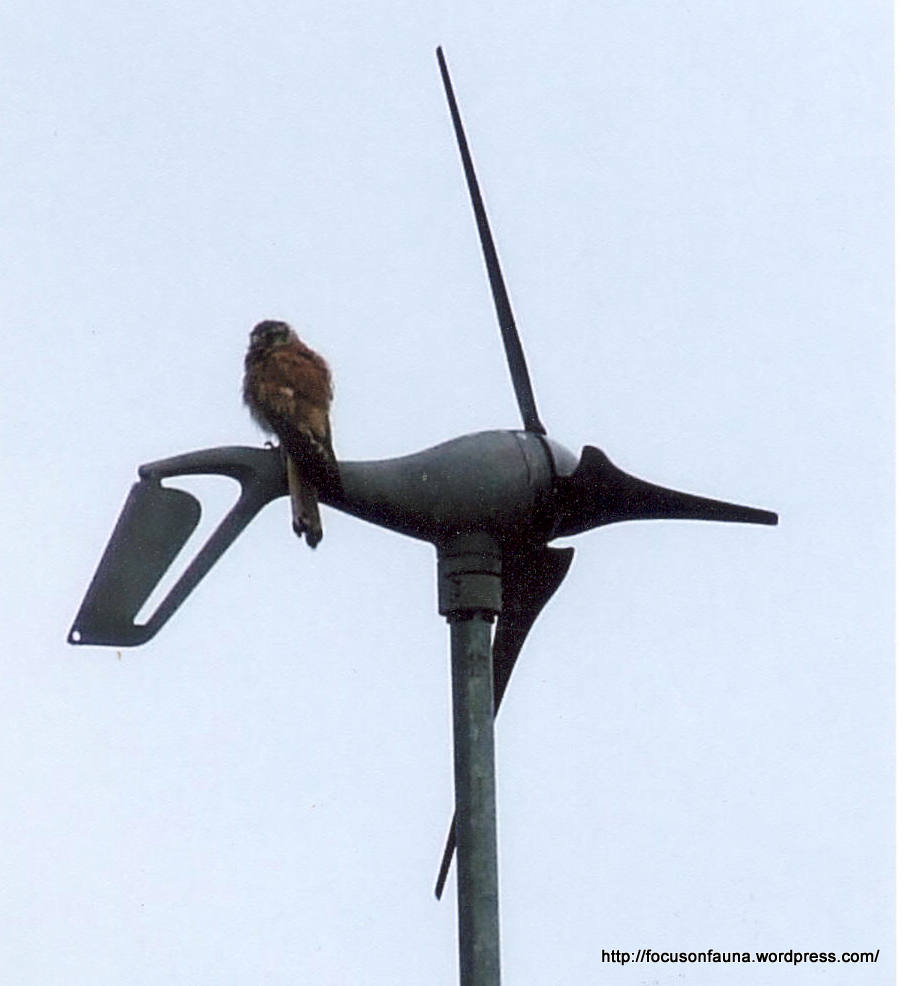
No deceased Orange-bellied Parrots here! Rosemary from Strath Creek sent in this unusual shot of a Laughing Kookaburra roosting on her domestic wind-power generator. Although it has a much faster blade rotation than a large community generator, Rosemary tells us, despite some apprehension after its installation, she has never found a bird carcase near the base of the generator. Other birds do however use the body of the generator as a perch, even a Wedge-tailed Eagle which tried to balance without success.
Another unidentified bird can also be seen on the turbine in the less-than-clear photo below. Any ideas on what it may be? We’re guessing a smaller raptor, perhaps a hobby or kestrel.
Gala Dinner for one
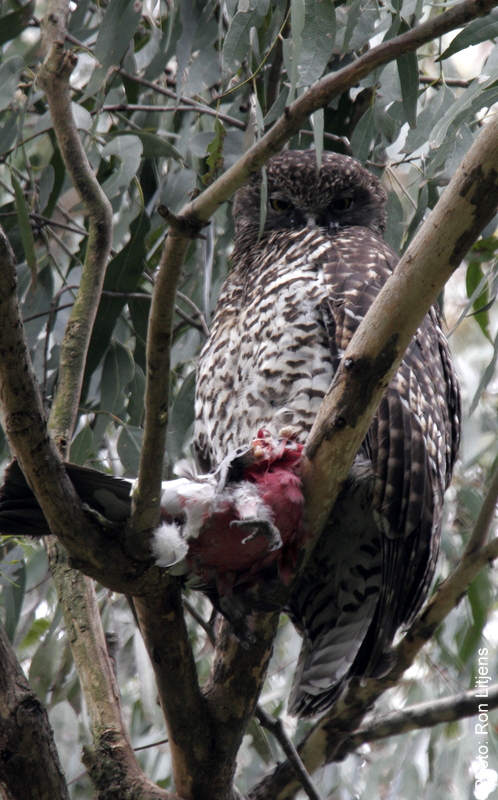
Don’t even think about it. Get your own meal.
Or should that be a Galah dinner? This week we found grey and pink feathers strewn about an area of 20 m radius on our property on Junction Hill. Knowing the debris was underneath a regular roosting spot of the resident male Powerful Owl (Ninox strenua), we did not have to look up to know that it was there dining on a hapless Galah (Cacatua roseicapilla).
The owl has not been seen with its mate since late July. Assuming a family is on the way and the incubation time for the eggs is between 36 and 39 days, we are quite excited that we might soon hear the tappings of tiny talons. But the location of the nest tree remains a mystery. This week, investigation of a possible nest site revealed the hollowed out tree to be just that, a hollowed out tree and nothing more. As to where the nest is, now we’re really stumped.
More on the Fireblight Beetle
The Fireblight Beetle (Peltoschema orphana) is a native beetle and their larvae are part of the natural succession of the forests as they recover from the 2009 fires and a natural way of thinning out dense stands of wattles. Although they can also be seen in un-burnt roadside areas close to Yea on the Whittlesea-Yea Road.
They have previously been recorded severely impacting on Silver and Black Wattles in plantations in Tasmania. Where only a small portion of the wattles have been observed to recover.
Hopefully many birds, mammals and other insects are able to feed on the grubs. It would be interesting to hear any observations of wildlife seen feeding on the grubs or beetles.
This article below was from the The Courier-Mail Saturday 24 February 1934.
THE BÜSHLOVER By “FABIAN”
Fireblight
THE wattles seem to me the most unfortunate trees in the bush as far as parasites are concerned. A young healthy wattle Is a lovely thing, its foliage the softest and most delicate of all, but I do not think I have ever yet seen even a half grown one not disfigured by insect pests.
During a recent walk I came on a patch of small wattles in a little hollow. All were ugly, untidy, sickly, doomed, with very few leaves left, as though a fire had recently been through them.
On a close approach I saw that they were simply swarming with dirty looking little greenish grubs, and one had to come up close to see these at all. They were the larvae of the fireblight beetle (Paropsis orphana).
They looked like tiny twigs or leaves, but birds would soon see them, and I concluded that they must be unpalatable and therefore left alone. They had simply destroyed this little grove by eating the leaves.
I do not know whether what is called fireblight among orchard trees, is a disease or just the result of damage by insects, but this particular beetle is well named.
It lays its eggs by the thousand on wattles, and the hatched grubs do the rest.
What’ll happen to the wattles ?
 You may have noticed the rusty-browning and defoliation of wattle trees around the district recently. This was particularly noticeable to us on a trip to the Strath Falls the other day – the effect can be seen in the centre of the photo at left, where much of the dense post-fire regrowth of wattles appears to be dying.
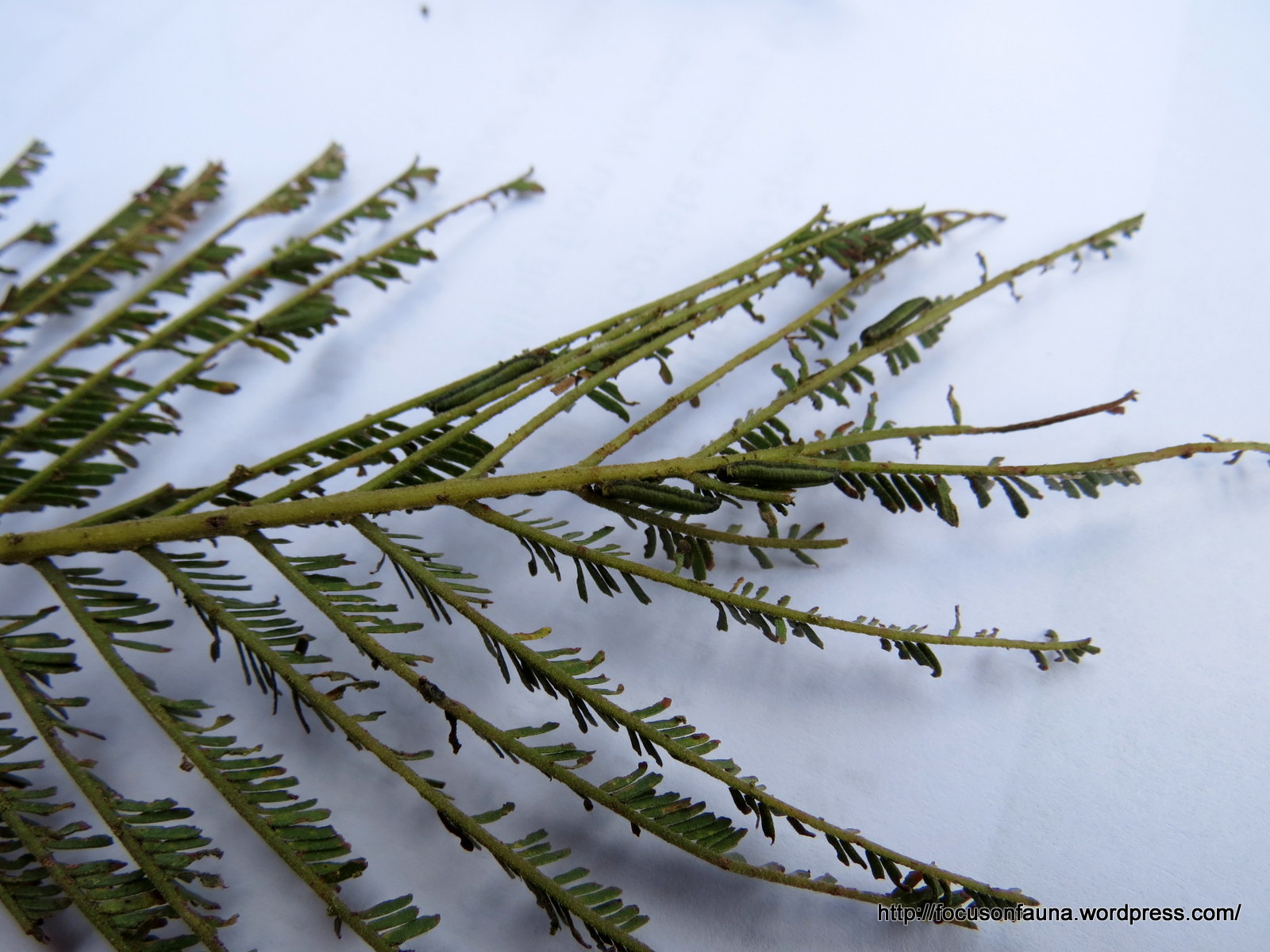
The wattle species affected are those with feathery bipinnate foliage: Silver Wattle (Acacia dealbata) and Black Wattle (Acacia mearnsii). The culprit is what appears to be a small caterpillar, as seen in the photo at right (click on it for a closer look).

Fireblight Beetle larva
In fact the offender (approx. 1 cm long) is the larva of the Fireblight Beetle (Peltoschema orphana – formerly Pyrgoides orphana) as seen at left. The beetle is native to south-eastern Australia and feeds on Silver and Black Wattles.
The defoliation of these wattles is another interesting aspect of the post-fire recovery of the bush. Not all of the wattles will recover and, in the meantime, the thinning of the canopy will allow other native plants (and unfortunately weeds!) to regenerate.
Don’t let the coy looks fool you
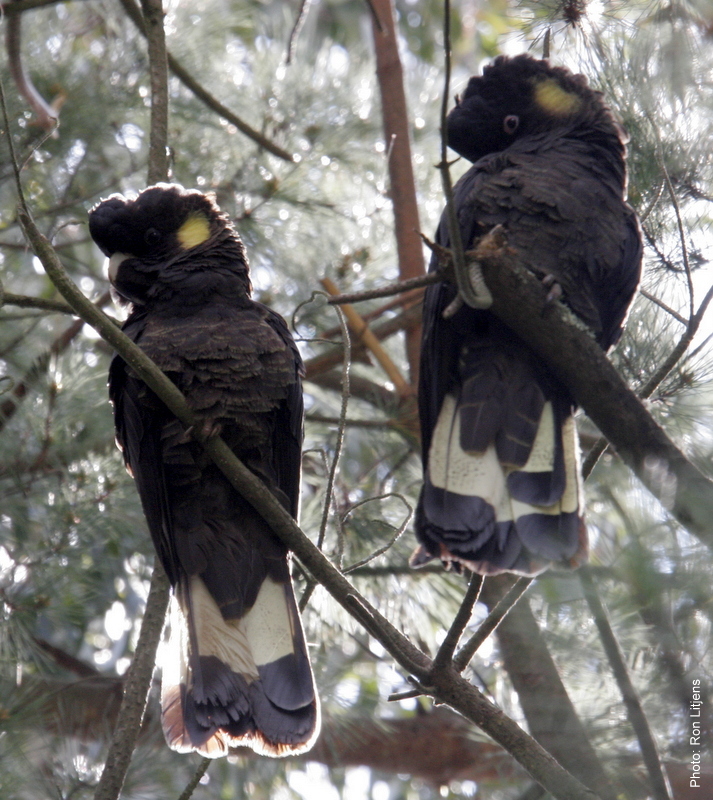
While on my daily reconnoitre looking for the most recent roosting place of the local Powerful Owl (Ninox strenua), I was assailed by a shower of falling pine cones and branches. Perched in the trees high above me was a ‘squadron’ of Yellow-tailed Black Cockatoos (Calyptorhynchus funereus) doing what they do best – destroying vegetation. Don’t let the coy look of the Cockatoo on the right fool you. Minutes before this photo was taken, the truncated branch on which it is perched wasn’t so truncated. Their powerful beaks can easily grind through pine cones and two-centimetre-thick branches. Long known as harbingers of rain the only thing raining on this day was pine debris.
Ibis exposed
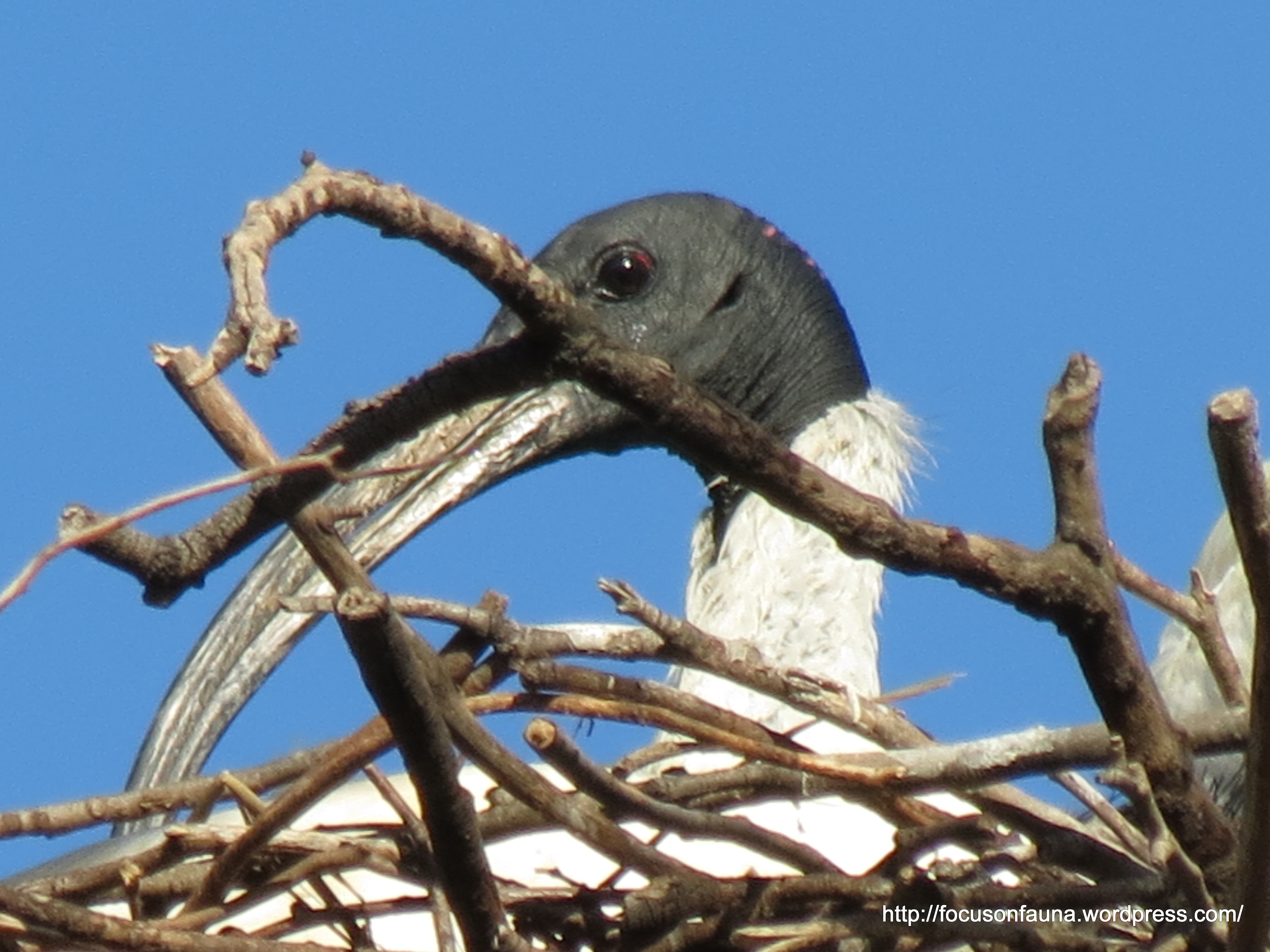 The other day, we noticed a large nest high in a sparsely foliaged Swamp Gum right beside the Broadford-Flowerdale Road, west of Strath Creek, in the intermittently-flowing Queen Parrot Creek. It turned out to be an Australian White Ibis nest, with 2 adults and a pesky youngster, apparently close to fledging.
What is unusual is that these ibises commonly nest in colonies, sometimes with the Straw-necked Ibis, whereas this nest was isolated. Also it is probably more usual for them to nest lower to the ground in secluded cover with a more reliable water-body nearby.
The chick was certainly insistent in its calling, as can be heard by clicking on the icon below.
Nest-box update
Just a brief update on the 14th August post Anyone at home? – our remote camera eventually did record a Tuan (aka Brush-tailed Phascogale) near the nest-box, but unfortunately did not capture it entering or leaving the box.
This adult phascogale has to be a female since all the adult males would have died abruptly from stress-related disease shortly after mating in May/June. We are reluctant to inspect the nest-box at this time, for fear of her abandoning the nest. So the questions remain: is this really her nursery nest site, does she have young in the pouch (there may be up to 8) or are they already at the stage of being left at the nest at night? The gestation is about 30 days and the newborn are permanently attached to the teats for about 7 weeks.
We’ll keep you informed if we get any further pictures, especially of young.
September 6 – the start of hostilities
Where’s that bicycle?
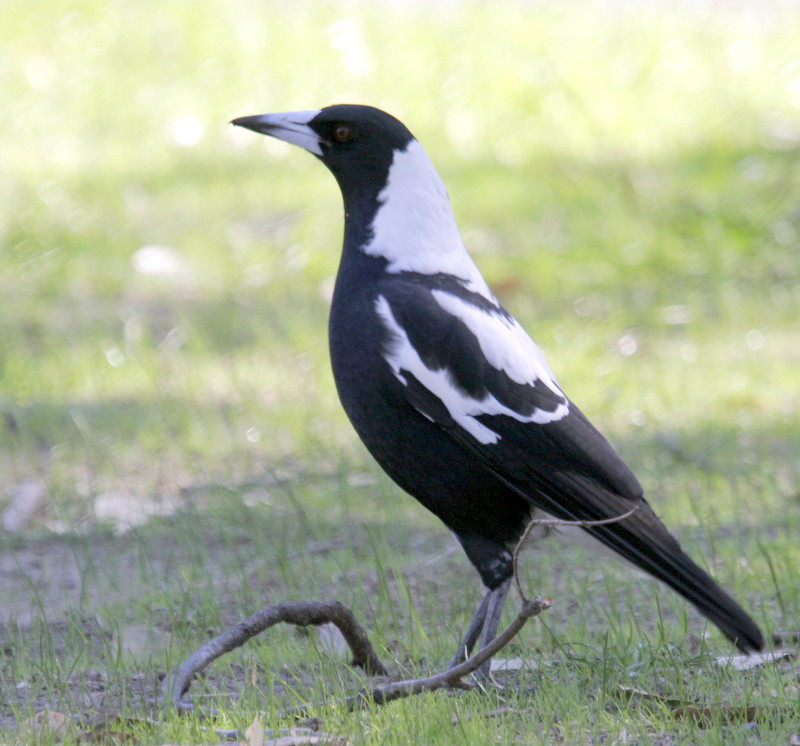
Today marked the start of hostilities in the annual assault on yours truly by the Australian Magpie (Gymnorhina tibicen). For the past two weeks I have peacefully ridden my bicycle to the General Store to pick up the mail without incident. However today the magpies fired the first salvos – initially attacking on the bicycle path at Moore’s Reserve, then outside the Primary School and then finally at the bottom of Old Spring Valley Road.
I was surprised everything was quiet along ‘Divebomb Alley’, a notorious stretch of magpie heaven along Spring Valley Road. But the signs are ominous. Trouble (for me) is brewing. For the past month about twenty black and white marauders have been gathering, regularly carousing in the paddocks along the road. Sharpening their beaks.
I still bear the scars from last year when a magpie took a piece out of my ear on Melbourne Road in Yea. This year I have put in my order to Santa: Kevlar body armour, a full-faced helmet and a beach umbrella for the bike. However I suspect the Christmas delivery timeframe may be too late.
Nobel Prize in the offing
 Call me crazy but I think I have discovered a solution to the global reliance on fossil fuels.
Coming back from a holiday in North NSW we found a nest built into the engine compartment of our Holden Astra which we had left parked at the house for two weeks. Popular opinion suggests, since the nest was so neat and tidy, the owner builder was a Rat (Rattus sp.) as opposed to the wished for Ring-tailed Possum (Pseudocheirus peregrinus).
All I have to do now is figure a way to entice a large population of the critters to live there and then harness them to the drive-shaft.
From small ideas big things grow. Stockholm here I come.




 Focus On Fauna