Another Tuan caught on camera
Inspired by the variety of wildlife turning up at the bird-bath on Ron and Kate’s Flowerdale property, we installed a new bath close to some eucalypts and a firewood stack in our front yard, and set up one of our motion-sensor cameras. Lo and behold, on the very first night, we recorded a very healthy-looking Brush-tailed Phascogale. This site is about 10km from Ron and Kate’s, so we can safely assume it is a different animal from the one recorded there. It is in fact very close to the nest-box where we first recorded a phascogale in February last year. Click HERE to view the post featuring that sighting.
The results from our camera surveys are starting to show that the Brush-tailed Phascogale may be more common and widespread than we first thought.
Antechinus using nestboxes

Two Agile Antechinus using a nestbox.
This nestbox may seem a rather large for these little fellows, but its a safe haven, at least. This and several other nestboxes were installed in July 2011 at Happy Valley in Flowerdale, by Chris Coburn and the Upper Goulburn Landcare fire recovery project. These boxes are actually designed for Sugar Gliders (Petaurus breviceps) and were built by volunteers from Rotary, South Australia.
Agile Antechinus (Antechinus agilis) are carnivorous marsupials related to quolls, devils and thylacines. You’d know it too, if you were ever to hold one in your bare hands, as they have a mouth full of sharp teeth used to catch and eat invertebrates. Their bite hurts, but rarely draws blood! You can see their dentition and skull on the Museum of Victoria website.
These two are last years babies. Either they’re just visiting, or they haven’t yet begun making a nest in this box. At this age, they’ve only recently been weaned and this could be two animals looking for a new home. Sexes are similar so its not possible to tell the sex of these two. In a recent study here in the Strathbogies, dispersing Antechinus travelled between 400m and 1750m (straight-line distance) from their mother’s home range!!, so these fellas might be strangers in town and very grateful to find an empty hollow.

Agile Antechinus, by Michael Sale/Wikipedia
Tuan turns up !
The owners of the partly-burnt Flowerdale bush block featured in a number of our previous posts have been hoping to record on camera a Brush-tailed Phascogale (Phascogale tapoatafa), otherwise known as a Tuan. And, sure enough, this week one turned up at their bird-bath on three nights, providing us with the fascinating images shown in the clip below.
It is wonderful to see this small carnivorous marsupial species still surviving in the district after many years of drought, followed by the Black Saturday fires. This is Focus on Fauna’s third photographic record of the Brush-tailed Phascogale in the Flowerdale/Strath Creek area. It has also been recorded in the Kinglake Ranges in the past year.
More on bird-baths …
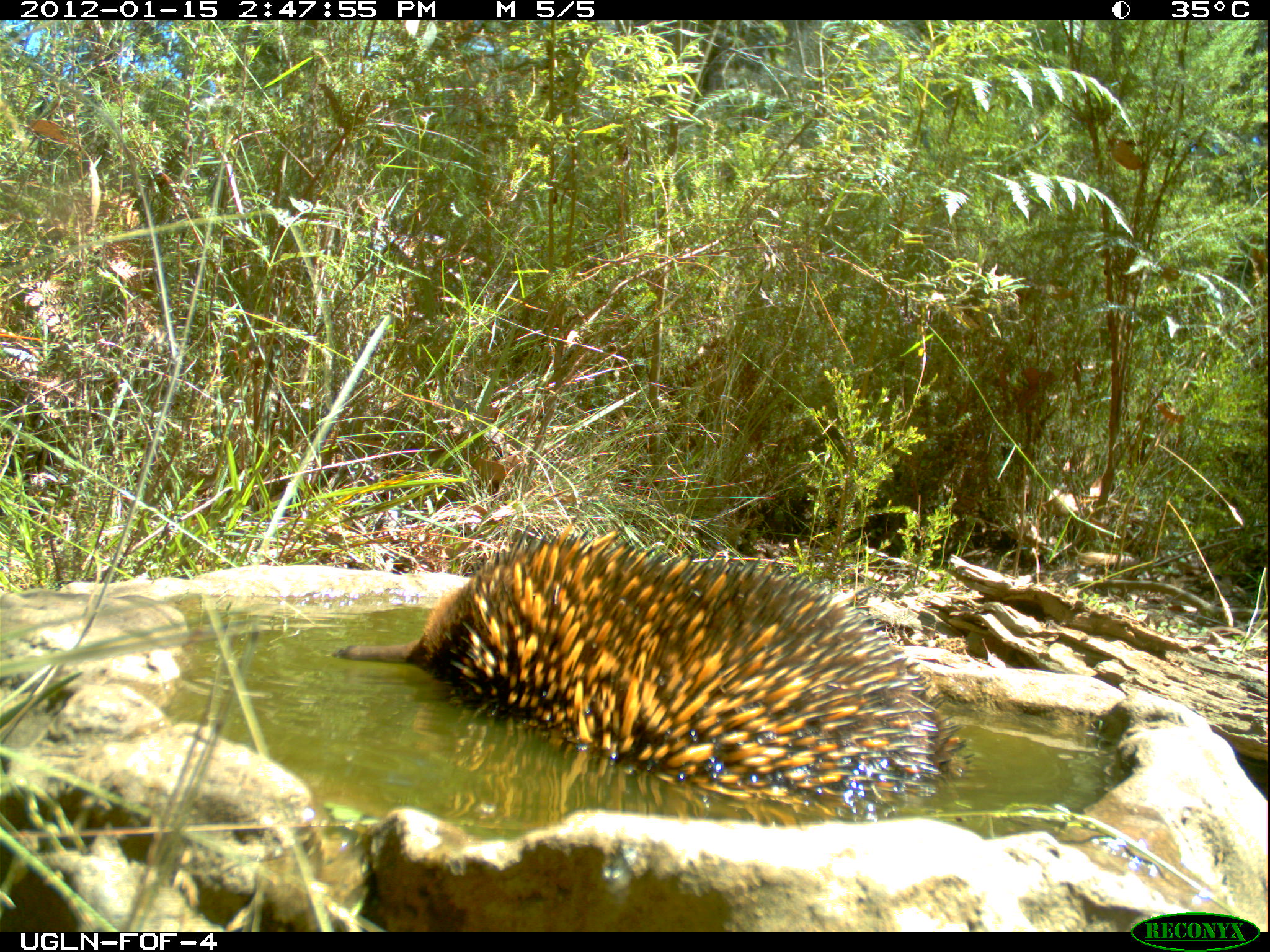 Continuing the saga of bird-baths, we received these unusual pictures of a Short-beaked Echidna from Landcare Fire Recovery Coordinator Chris Cobern, taken with a remote camera at Kinglake West. Having taken a dip in the heat of the day, the echidna returned the following day for a drink in the relative cool of the evening.

Meanwhile, back at Flowerdale, the possums and gliders continue to regularly visit the bird-bath featured in previous posts, as shown in the following video clip, which may take a few moments to load.
Where’s Wally ?
 More on the bird-bath featured in the 15th January post Not just for the birds! …
Ron and Kate, owners of the bush block where the bath is set up, have been fascinated by the little frog (which appears to be a Southern Brown Tree Frog – Litoria ewingi) which has regularly turned up in various locations among the numerous remote camera images that have been recorded. It’s been a case of spot the frog among the Sugar Gliders, Common Ringtail Possums, Common Brushtail Possum and Black Rats that are also using the bath.
“Wally” is too small to trigger the camera alone, so only appears after a larger animal has set off the infra-red flash sensor. He has so far managed to evade the rats, but is clearly not happy when they go for a swim !
Look closely for the tiny frog’s eye-shine in the sequence of photos below.
What rat is that ?
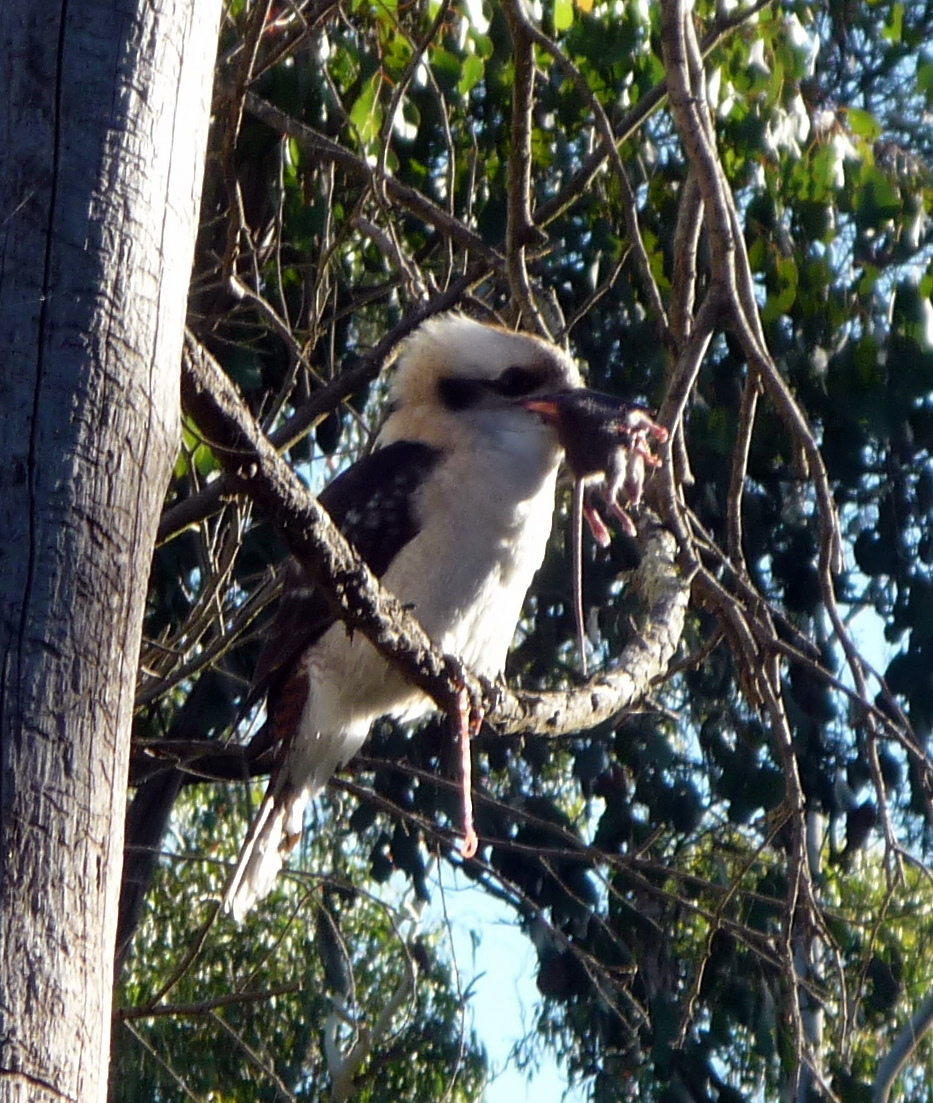
Photo by Alan Robertson
This Laughing Kookaburra, photographed on a property at Reedy Creek, has captured a fair-sized meal, but what exactly is it ? Judging by the relative proportions of the bird and the prey’s tail, our guess is it’s a Bush Rat (Rattus fuscipes) – any other ideas out there ?
A kookaburra’s diet can include snakes, lizards, rodents, frogs and small birds, but they live mainly on insects and other invertebrates.
Not just for the birds !
 Following our recent post on bird baths (click HERE to view), a pair of enthusiastic landholders at Flowerdale modified the bird bath in their garden and set up one of our remote cameras to see who was using it. Not only were a total of 14 bird species recorded drinking and bathing, including this delightful group of Brown-headed Honeyeaters, but both Common Ringtail and Common Brushtail Possums used the bath, as well as a Black Rat and House Mouse.
The videos may take a few moments to load.
Koala at Strath Creek
The latest report was from the heart of Strath Creek – a Koala (Phascolarctos cinereus) was spotted high up in a youngish River Red Gum in a farm garden, but was unwilling to turn around for a good photo opportunity. The koala spent at least two days in the tree before moving on. We set up a remote camera near the base of the tree, and managed to capture a few images of it leaving at around 3.30am.
Birds beat the heat
With the recent heatwave, and the promise of more extreme heat on the way, spare a thought for the birds, particularly around your garden. A bird bath (or 2 or 3) will be greatly appreciated by a wide range of birds. Over three sweltering days, a total of 16 species of birds were observed using 3 shallow baths in our Strath Creek garden. A few of these are shown below.
Some tips for bird baths:
- locate the bird baths close to shrubbery for protection and shade
- choose shallow baths or place a rock or two in deeper baths to avoid accidental drownings
- clean out the baths regularly – birds should have clean water for drinking and washing
- keep the baths topped up – water is rapidly depleted on hot days through evaporation (or being splashed out by larger birds!)
- keep cats indoors!
Highly desirable residence !
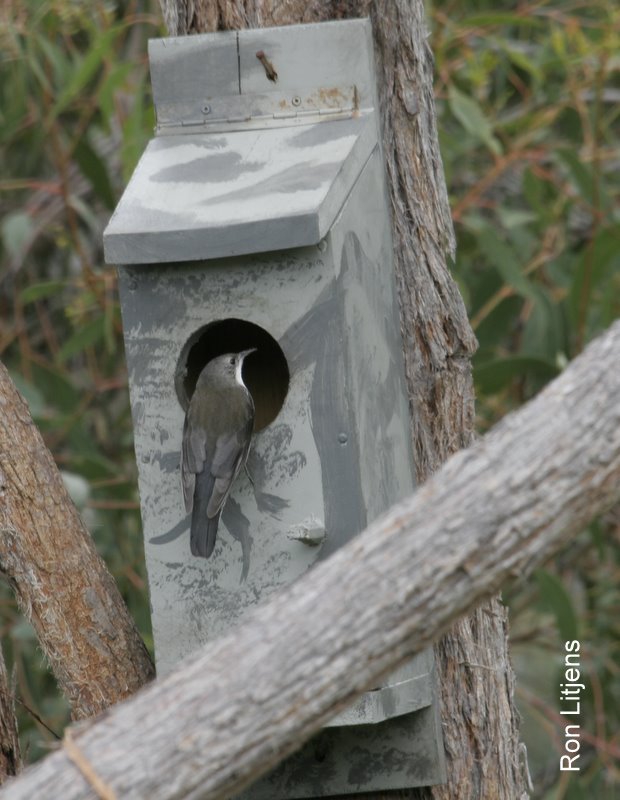
 The value of artificial nest boxes, especially in fire-ravaged areas, was highlighted this week when we received this photo. The owner of the tail, presumably a Common Ringtail Possum, is the third known occupant of this particular box in the last 15 months. The first tenant was a White-throated Treecreeper which successfully raised a brood in spring 2010.
Then an Australian Owlet-nightjar regularly used the box during 2011 (click HERE to view previous post) and is apparently now quite peeved at the new arrival, judging by its constant calling.
As the landholder said “… this sort of revolving tenancy is probably quite common with natural tree hollows – it’s been fascinating to watch!”. Thanks to Ron and Kate for their many interesting wildlife reports.