Two bees or not two bees
That is the question. And the answer is NOT two bees.
In the picture below there are two insects that superficially appear to be the same. The one on the left is a European Honeybee (Apis mellifera). The insect on the right is a Drone Fly (Eristalis sp.), seen in much greater detail in the photo at the bottom left. Both are active pollinators and when buzzing around a flower look much the same. The Drone Fly spends more time hovering when feeding on pollen whereas the Honey Bee has a more direct approach. The Drone Fly has short stubby antennae and only one pair of wings, the Honey Bee has bent antennae and two pairs of wings, not that either characteristic is obvious in the frenzy of feeding.
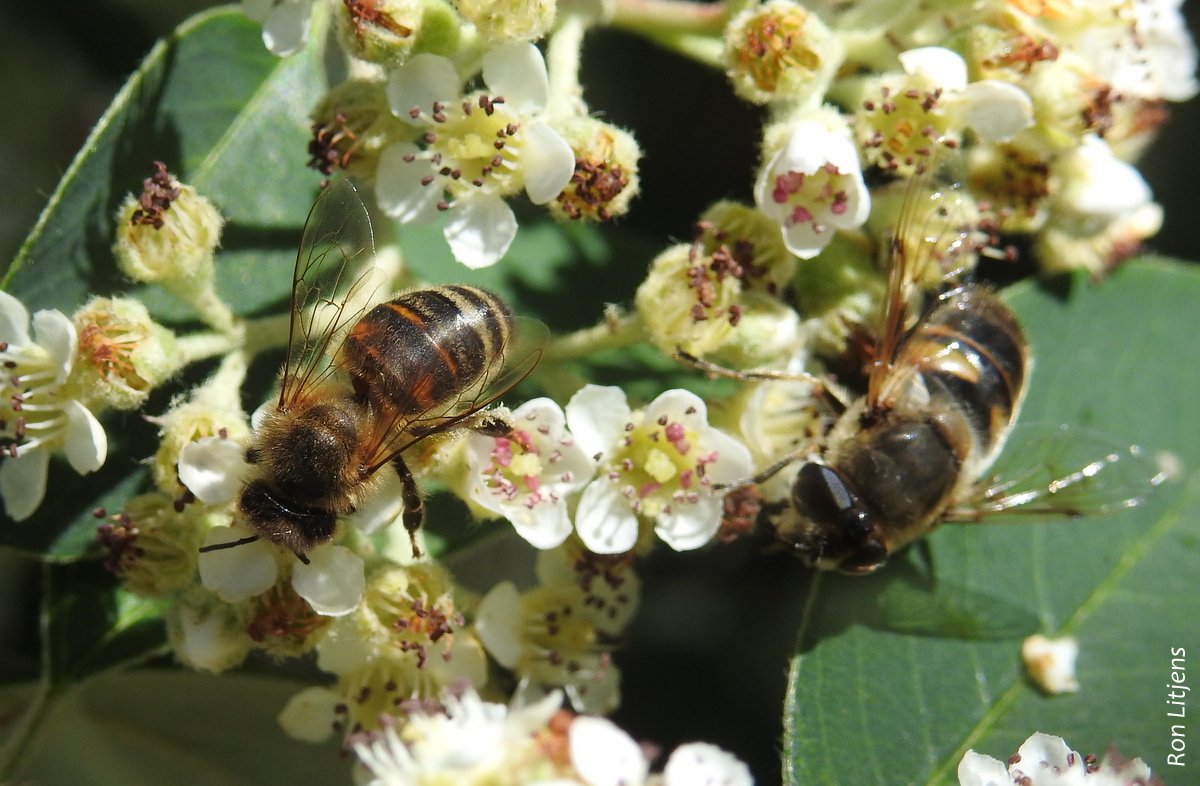

The similarity between the two insects is a classic case of Batesian mimicry where a creature that is harmless against a predator i.e. the Drone Fly takes on the visual characteristics of a creature that is harmful or dangerous to the same predator i.e. the Honey Bee. In this case the harmless Drone Fly has taken on the characteristics of the Honey Bee that has stinging capability. The Drone Fly is relying on the fact that its shared predator such as a Robber Fly can’t distinguish between the two and it will leave it alone fearing being stung. Drone Flies are not the only insect to demonstrate this type of antipredator adaption. Many species of moths and beetles also mimic the Honey Bee in appearance.
If I were to adopt Batesian mimicry I’d probably have to start taking steroids and speak with a guttural German accent.
Scratchy Songbird
One of the great sounds of Spring and Summer that catches my ear every year is the scratchy call of the Rufous Songlark (Megalurus mathewsi). The books describe it as witcher-weedle witcher-weedle as well as other trills and phrases. The call of the male heralds the onset of the breeding season and it is so loud it can be heard from a great distance. In the non-breeding season, both sexes are fairly quiet and unobtrusive but, anyway, they migrate North or inland for Autumn and Winter.
Twice this year, I have come across two males having a ‘Battle of the Band’ duel. One pair was at Mangalore, and the other on the Rail Trail near Cheviot Tunnel. One would fly to an exposed perch belting out his song, then the other would appear and chase him away before choosing another perch to stage a reprise. In neither case, did I spot a female, so I’m not sure who they were trying to impress, but they sure impressed me.

Occasionally in our district I have come across the related Brown Songlark (Cincloramphus cruralis), which is a bigger bird, more often found on the ground or perched on a fence-post to sing and display.
The Rufous prefers a few trees and is often found on farms that have retained some paddock trees. As my photo suggests, they don’t mind a fence-post either.
The path to enlightenment is never smooth.
Several years ago the answer to the simple question about a discovery found in the vegie garden, ‘What eggs are these?’ resulted in much angst (click HERE). Using book and web resources to identify adult insects is hard enough. Identifying insects by their larvae is even harder and by their eggs, nigh on impossible unless you’re an expert. To answer the question the eggs were placed in a jar until they hatched. This resulted in the positive identification of the larvae but their subsequent release back into the garden was not a great success. They grew into bugs that decimated the tomato crop that year.

So when the same question was asked of a similar vegie patch discovery this year, caution was observed. The eggs in question, pictured left, were yellow and clustered on the underside of a vegetable leaf. The eggs were again placed in a jar and did not hatch until the leaf to which they were attached was a dried scrap.

The resultant larvae, pictured right, looked more like tiny iguanas than anything else but easily identifiable – ladybird beetle babies. Adult beetles and their larvae are highly beneficial in the vegie patch as they voracious consumers of aphids. No dramas in reintroducing these into the wild.
Occasionally the path to enlightenment is smooth.
Frogmouth squats in Chough’s Nest
The craft that goes into the construction of a White-winged Chough’s nest (Corcorax melanorhamphos) is extraordinary. The family work together to sculpt a beautiful mud bowl. ANU researcher Dr Connie Leon was fascinated by the complex family dynamics and noticed that they practised a type of slavery – young birds from neighbouring clans are coerced into the work gang, building the nest, taking a turn on the nest for brooding, and then helping to feed the very demanding chicks. In other words, the clan is augmented by additional young workers lured from other clans and kept there by vigilance.
Chough families are often seen on roadsides in our area and can grow to as large as 20 birds, although I have seen super flocks in Autumn at times of many more than that. It seems a waste of energy to build a beautiful mud bowl nest each year. This family of choughs left an excellent nest behind and built a new one for the season on the other side of the same tree.

So in moved a Tawny Frogmouth pair (Podargus strigoides) to occupy a perfectly-good choughs’ nest from the previous year. Frogmouths normally build a very flimsy nest on a fork on a horizontal branch where they train up a couple of lugubrious fluffy chicks to sit as still and stiff as their parents.
It must have been an irresistible opportunity to squat in this elaborate nest that no frogmouth could ever construct and bring up the family in security and comfort.

The slogan they follow seems to be: reduce (work), reuse, recycle.
It’s a Breeding Frenzy
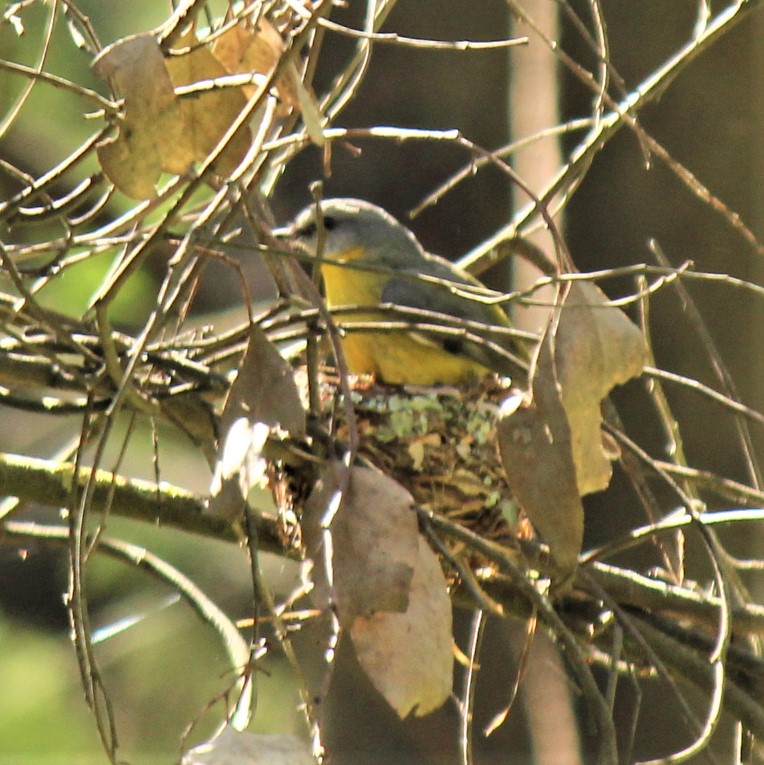
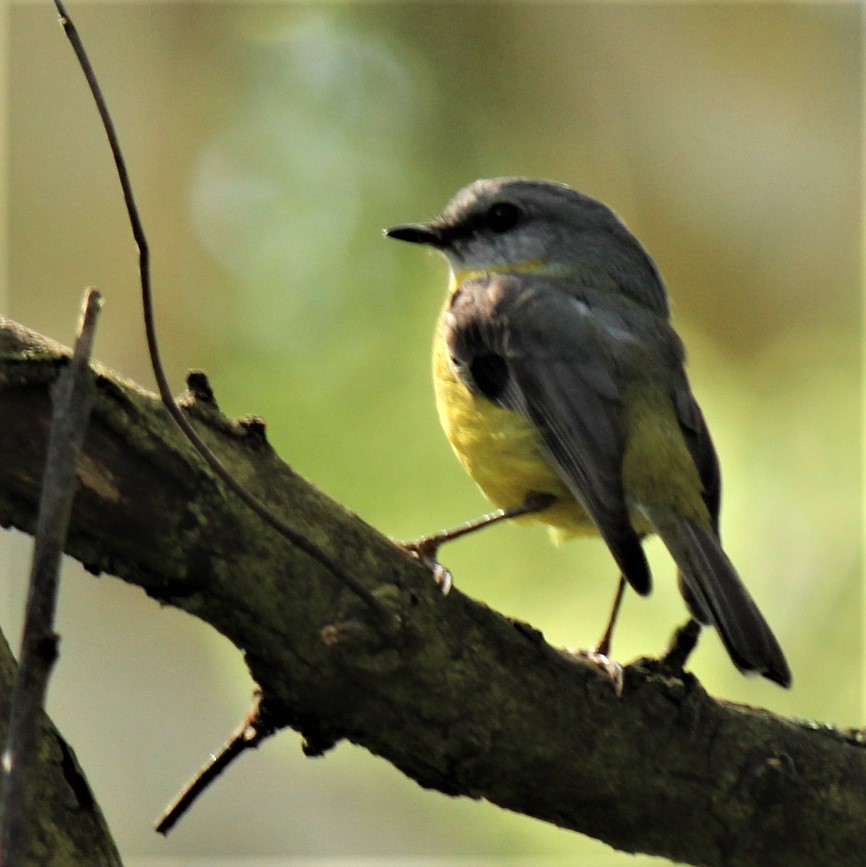
It’s a lively breeding season in this lush Spring after generous rain over the year thus far. One of the easiest birds to observe, to wonder at, and to photograph is the Eastern Yellow Robin (Eopsaltria australis) because they are bold, they forage at eye-level or lower, and they tend to settle calmly when they land, not be restless like a thornbill.
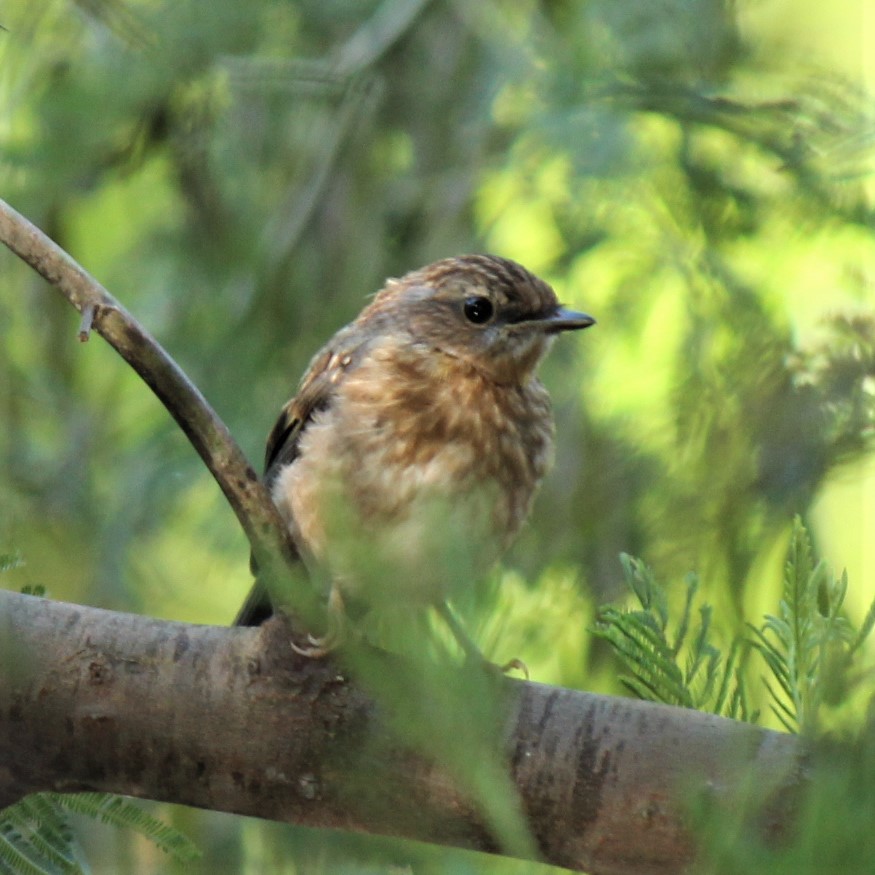
Though I always try to keep my distance from a nesting bird, this Eastern Yellow Robin in the Yea Wetlands makes little effort to hide itself or its nest. There seem to be several pairs nesting at the moment and although the one pictured at the nest has very young chicks, some parents have got ahead in the race. I found one very young individual with rich brown plumage moving alone through the trees by the river. It will probably still get occasional feeding from its parents, like a teenager still likes to go home for Sunday lunch, but I saw no adult while I was watching, making me unsure of its identification till I checked up later.
It’s a good year for birds, a good year for breeding, a good year for learning more about birds.

The Greeblies are here
After three anxious weeks of watching them on the nest – a floating structure built way to close to the shore by my way of thinking and in the vicinity of a big ol’ Red-bellied Black (Snake), mum and dad Australasian Grebes (Tachybaptus novaehollandiae) hatched what can only be described a three cotton balls with paddles.

Although the three Greeblies (not the official term for a Grebe chicks!) are quite capable of swimming at birth when danger threatens they clamber aboard the back of one of the parents and hide under their wings (see picture above and below). If the parents are concerned then they do the usual grebe-thing of diving under the water only to reappear metres away. The young ones are taken along for the ride.
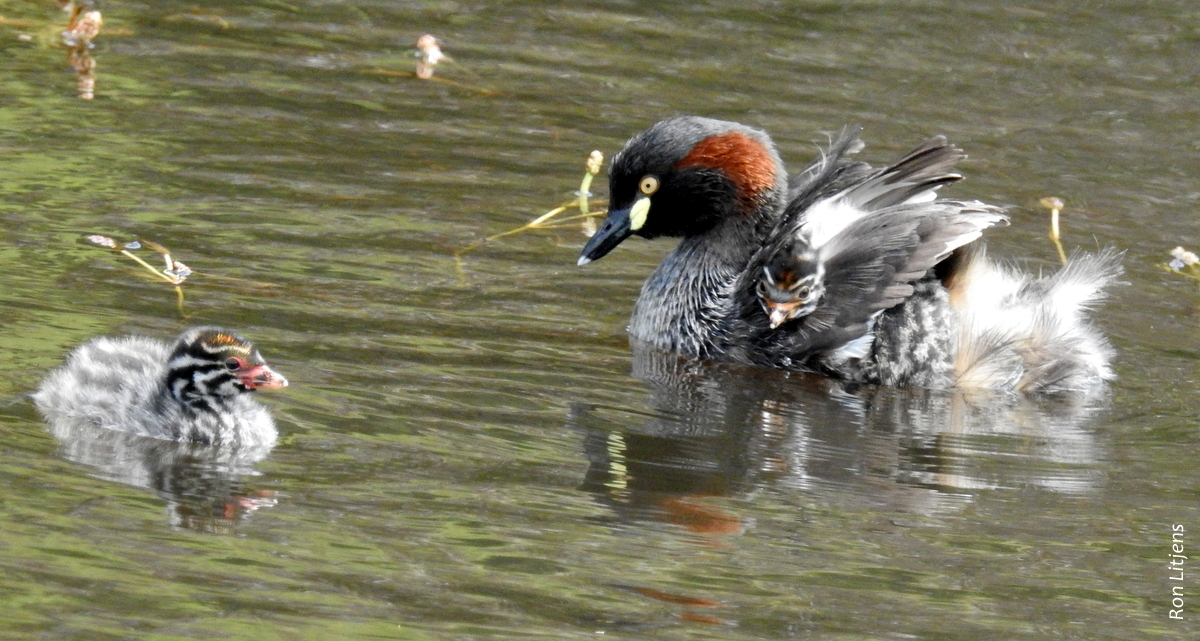
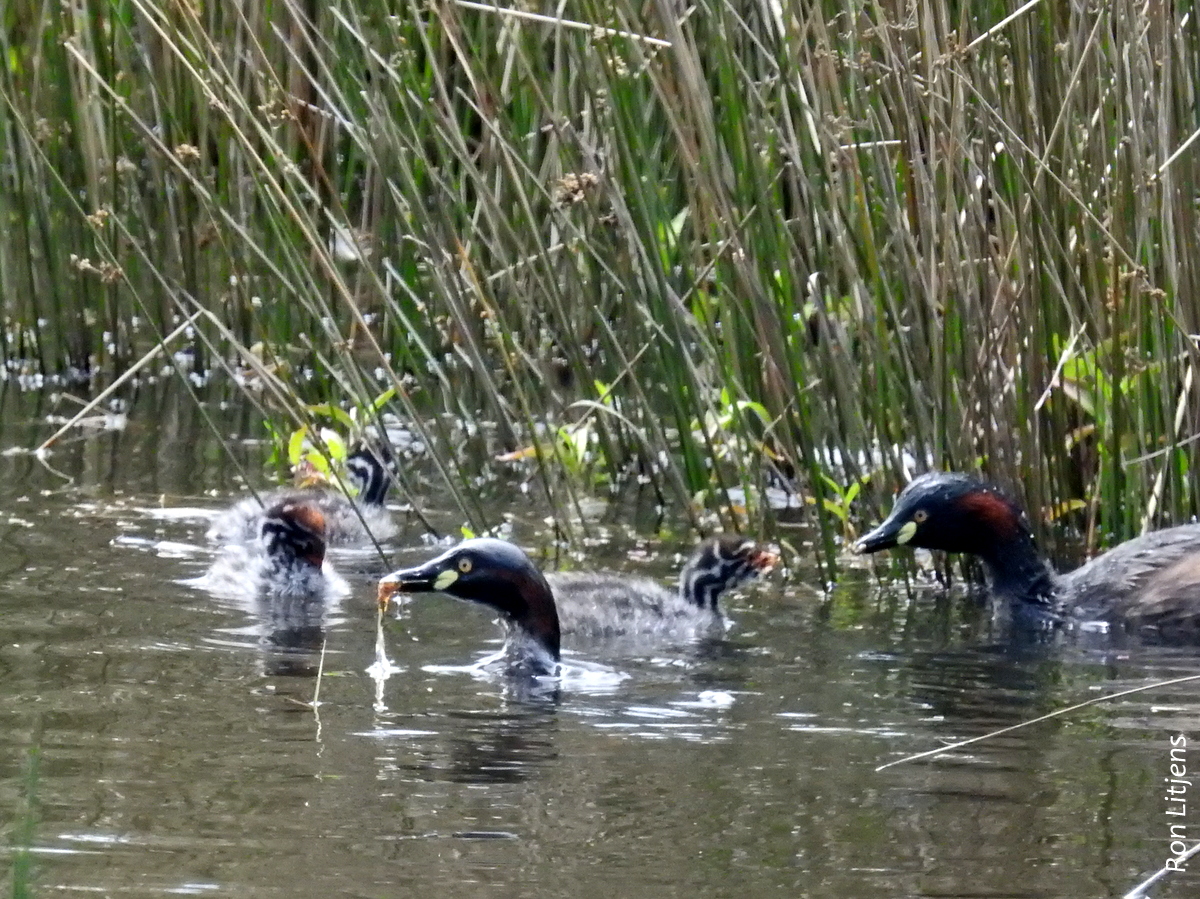
This form of chick transportation only takes place in the first few weeks after hatching. By then the greeblies are too big to fit on their parents’ backs and have themselves learned the art of diving when danger approaches. Daily life now appears to consist of the adults diving down and picking up food that is voraciously eaten by the chicks as soon as they surface.
After a couple of months the parents will leave the young to fend for themselves. In good seasons they may reuse the nest to lay a second clutch of eggs.
I don’t think I could stand the stress of waiting again.
Is that a gun in your pocket?
Cup moths are so named because of the shape of their cocoons. Their caterpillars feed on new gum leaves and are therefore rarely seen because they are usually in the uppermost reaches of eucalypts where the new growth is. However after a storm like the one we had last week there is a good chance some of these caterpillars will be found on the ground having been dislodged by the wind. Pictured below is a Painted Cup Moth (Doratifera oxleyi) caterpillar found last week in these circumstances. This species is found predominantly in central NSW but is also found in Victoria (obviously), South Australia and Tasmania. The larvae feed on River Red Gum leaves (E. camaldulensis).


For protection the caterpillar can deploy spines, that in some species are loaded with irritant liquid. The spines are kept in pockets on the front and back of the caterpillar. The larva pictured above, has eight such pockets, four at the front and four at the back each containing yellow spines. In the picture the spines at the back are partially everted – only mildly annoyed! When very annoyed the caterpillar can erect all eight spine clusters from their pockets (picture left).
Not a gun in the pocket but a weapon none the less.
Insect origami
Like most insect Orders the name for the group of insects that includes beetles is derived from two Greek words describing the insect’s wings. Coleoptera comes from koleus meaning sheath and pteron meaning wing. It describes the hard ‘shield-like’ outer wings that protect the more fragile flying wings underneath. All members of this order have two pairs of wings. The outer wings are known as elytra. When the beetle is in flight the elytra are drawn up and away to allow the flying wings to unfurl. For most beetles the elytra cover the entire length of the abdomen.
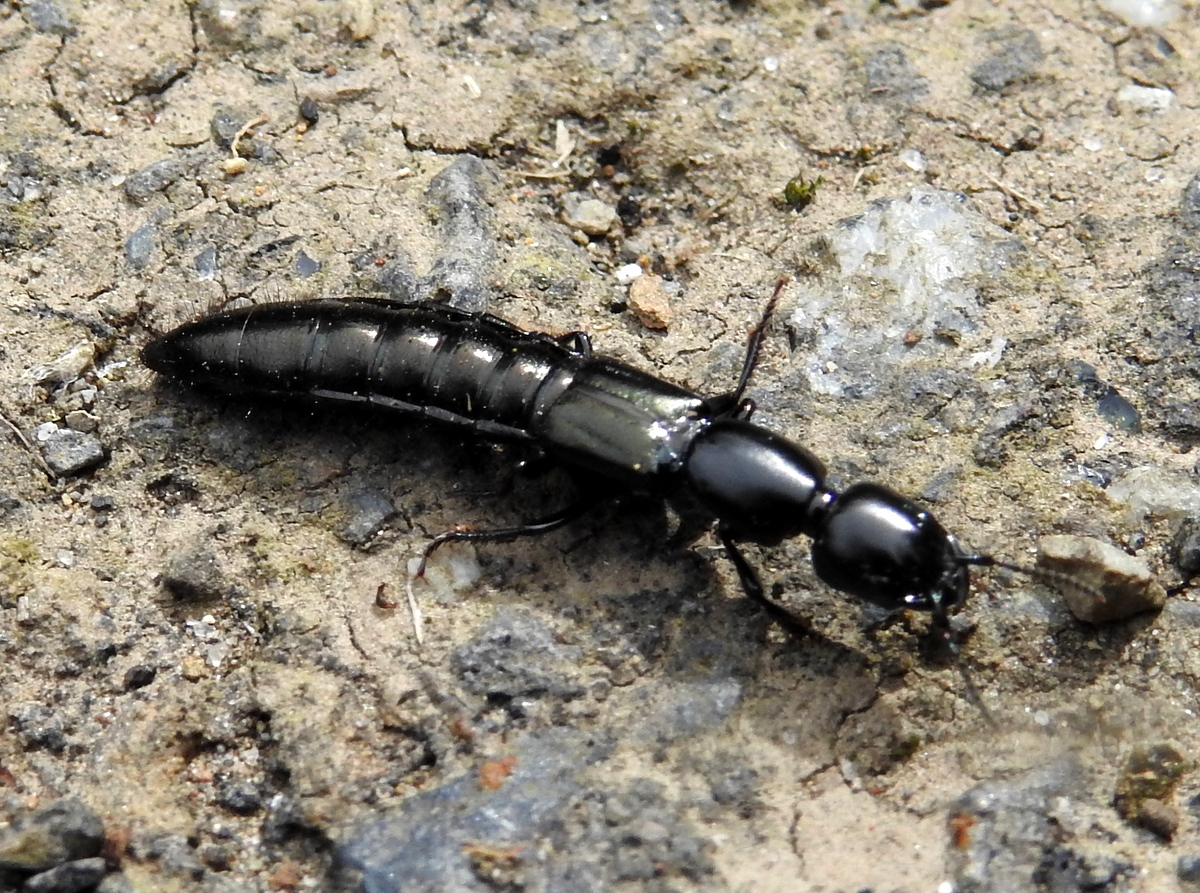
Rove Beetles (pictured above) comprise a group of insects where the elytra are significantly shortened. In the natural world the Rove Beetle family comprises the largest number of organisms in a single group. As such they are widely varied in their habits and distributions. These beetles in our district are typically varied combinations of black and red. The elytra usually only cover the first few segments of the abdomen.
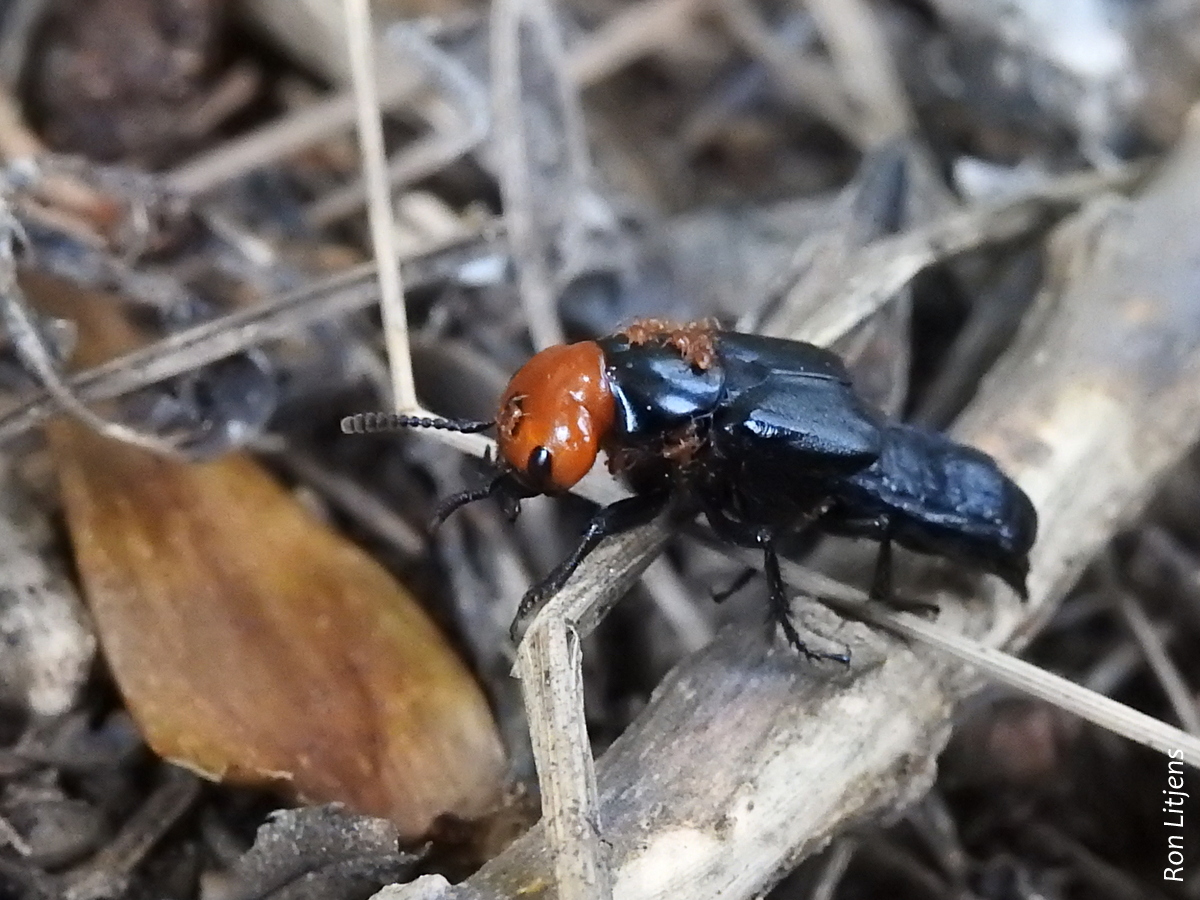
The majority of Rove Beetles, both adults and larvae, are voracious predators feeding on insects and other invertebrates. The Devil’s Coach Horse (Creophilus erythrocephalus), pictured left, feeds on maggots (fly larvae) and can be found in carcasses of mammals. They neither bite nor sting humans but contain a powerful toxin that can cause contact dermatitis when touched.
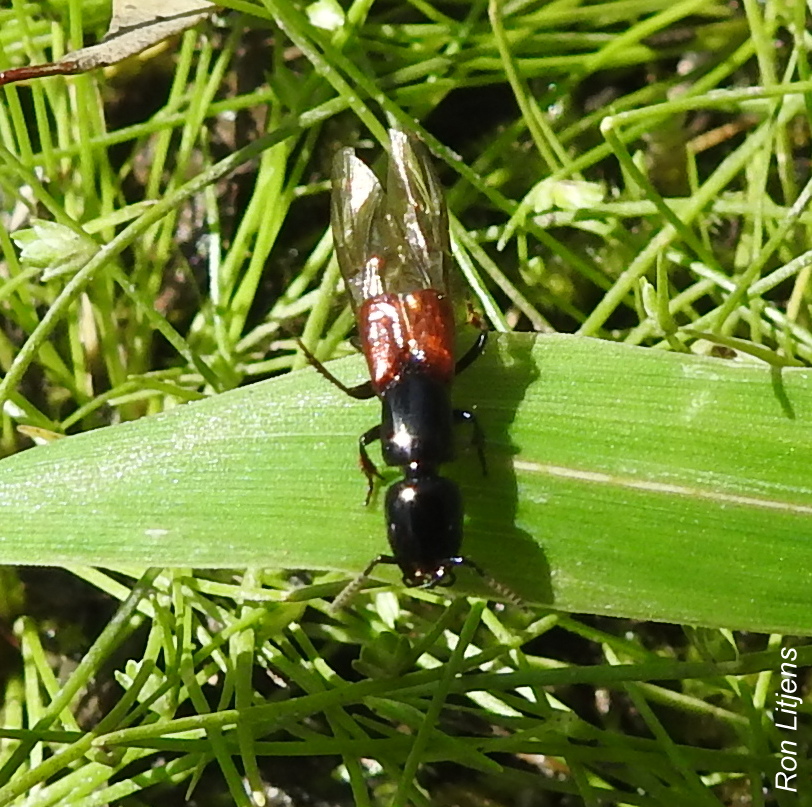
It is wrong to assume that due to the small elytra the rove beetle has small flying wings and is therefore a poor flyer. The picture right shows a Rove Beetle with its flying wings extended. When at rest the beetle needs to undertaking a complex folding manoeuvre to store its flying wings under the red elytra.
Insect origami.
Illegal Immigrants
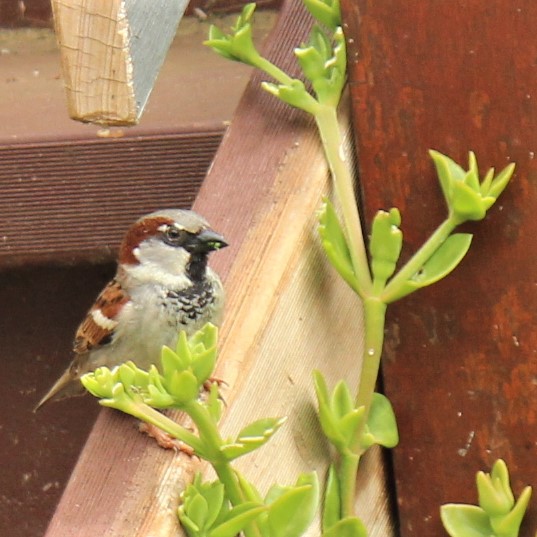
House sparrows (Passer domesticus) are a native bird of Europe that has been introduced to many parts of the world, including Eastern Australia. They are not established yet in Western Australia, and that State wants to keep it that way. There is a hotline for anyone sighting a House Sparrow in WA and they will send out professionals to ‘disestablish’ them.
Back in the years when we used to travel, I was visiting Port Hedland in WA and in a touch of glorious irony, I was standing outside the Immigration Detention Centre in Port Hedland when I saw a small group of House Sparrows at the edge of the car park. In this place where “illegal immigrants” were to be detained, some feathered ones had flown in. I rang the hotline and felt insulted when the person at the other end asked, Are you sure they are House Sparrows? Hmmph! I’m from Victoria.
Once the most common of introduced birds, House Sparrows are now in serious decline. They’re hard to find in Great Britain, in India, and getting less frequent in Australia. No one is sure just why – one study blames the rise of the mobile phone.
I still have a small flock at my place; they like our chook pen and the food it provides. I learnt an interesting fact about House Sparrows. The male sports a fine black bib that functions much the same as the blue on male Superb Fairywrens: the colours are rich and bright in the breeding season but fade or dissipate in the off-season. Except for the Alpha males; these are dominant, at least 3 years old, high in the pecking order and carrying enough testosterone to sustain breeding colours in the non-breeding season.
In any flock of sparrows, watch out for the cock sparrows that have the biggest, blackest bib. They’ll be strutting and swaggering, shoving the commoners aside.
Related post Attention Entrepreneurs!
The Greeblies are coming!
Any one who has been cycling in the last month knows it is nest-building season and has run the gauntlet of magpies protecting theirs. On a more sedate note in our local dams Australasian Grebes (Tachybaptus novaehollandiae) have been quietly constructing their own nests.
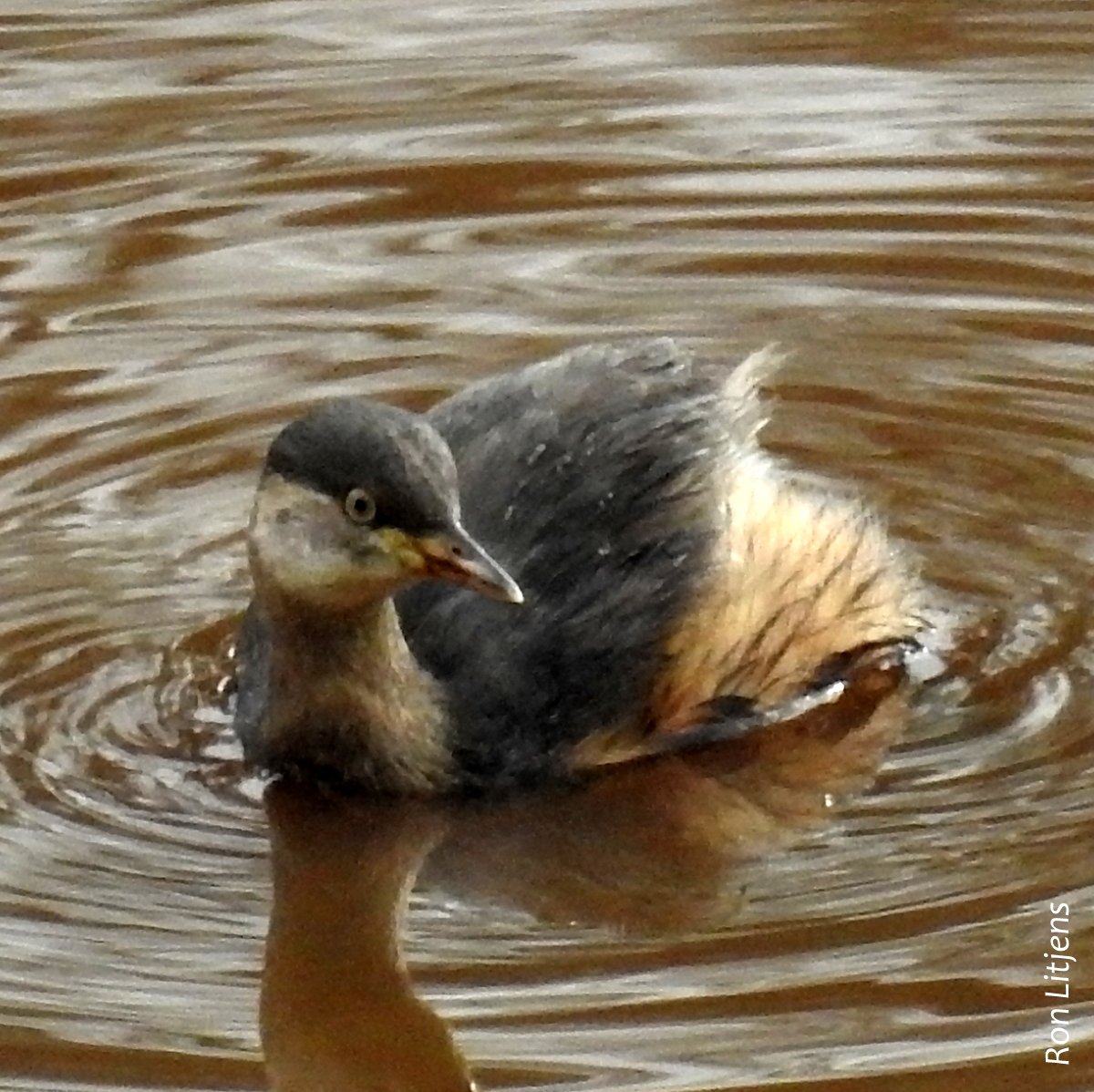
Australasian Grebes are freshwater birds. During winter the plumage is quite plain (see photo left) but as breeding season approaches the birds display distinctive plumage (see photo below) including a yellow facial patch, a darker head and a striking chestnut stripe extending from the back of the eye down the neck (see photos below).
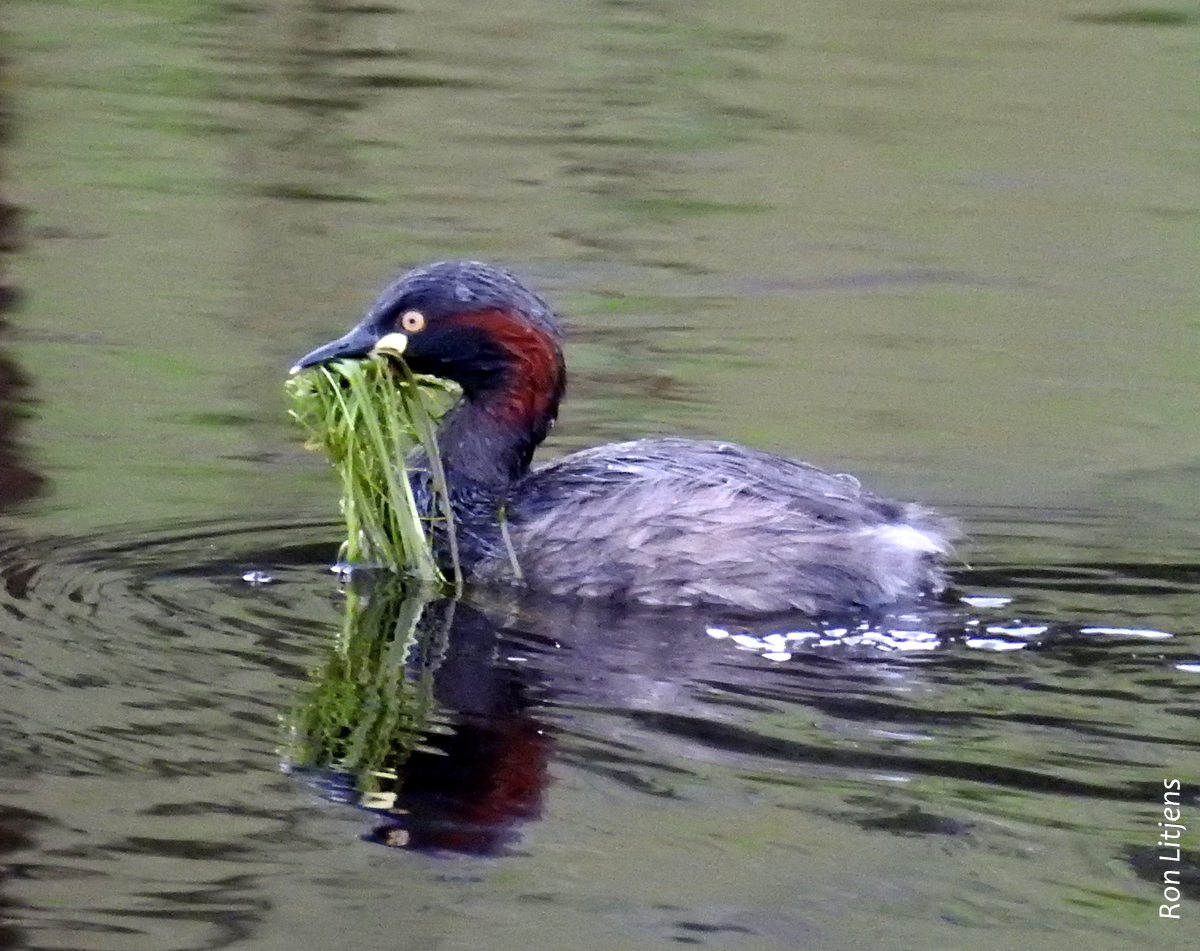
In early spring the breeding pair accumulate reeds and grasses (pictured right) and constructs a floating nest tethered in a body of still water away from the shore. This is to protect the adult birds and the eggs and chicks from land based predators e.g. cats and foxes. The eggs take about three weeks to hatch so in a couple of weeks expect another blog on the arrival of the greeblies.

Grebes are good swimmers and divers (tachybaptus in the scientific name is Greek for rapid dipper). It is hard to get good photos of these birds because when approached they dive under the water and resurface many metres away. Quite the opposite of what happens when approaching a magpie nest.
We’re just never happy!