A prickly story
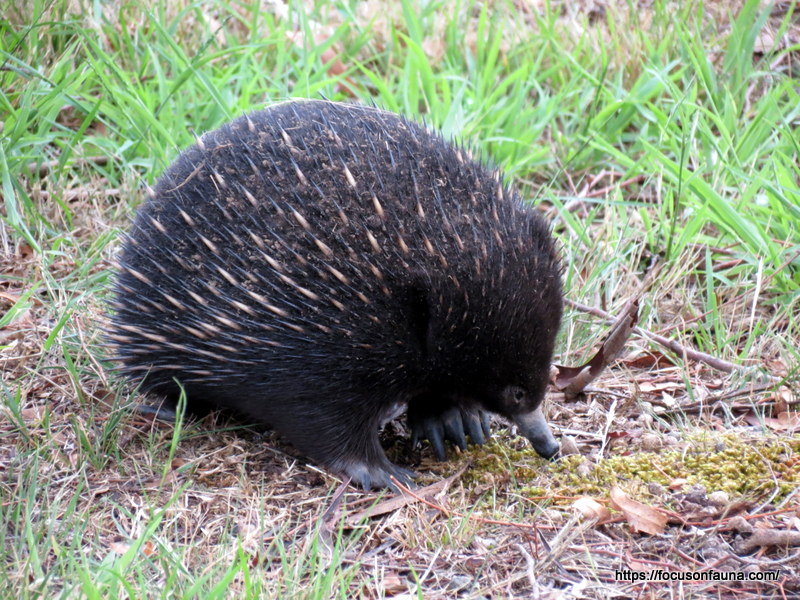
 Just after we put a post about Short-beaked Echidnas on this blog in early January, we discovered an echidna burrow with a puggle (young) in it only 30m from our house, and the adult featured in that post was most likely the mother. We only located the burrow when we noticed a small patch on an old pile of top-soil was moving up and down, as if it were “breathing”. When a bit of soil was brushed away, a creature with short sharp spines was revealed.

Puggle being fed
Puggle’s first outing
After setting up a remote camera, we were able to record the comings and goings of the mother over the next month or so, and occasionally watch her during the daytime. Her visits to the burrow were an average of 4 days apart (maximum of 7 days), and after uncovering the entrance and getting in with the puggle, she spent an average of 2 hours feeding it, before packing the entrance with soil and heading off to forage for ants and termites. With such intermittent feeding the echidna milk is necessarily very rich (imagine being fed only once a week!) and the puggle ingests up to 20% of its body weight.
When first discovered the puggle was probably about 4 – 5 months old, and is now almost fully spined and getting ready to leave the nest. In fact a few days ago we watched as the young one appeared and ventured off on its first little jaunt. It’s a bit wobbly on its pins, but a capable digger and very attuned to sounds and smells, immediately becoming a partially buried prickly ball when feeling threatened.
It eventually made its way back to the burrow and during its mother’s next visit we were able to sneak up and record the repetitive rasping sound of the puggle suckling on its mother’s milk patch (click audio below) as they lay only partially-buried beside each other.
There is limited knowledge and conflicting reports on echidna weaning. One reference has the young not weaned until about 7 months old after which mother and offspring may continue to share shelter sites and forage together until the puggle is 9 – 12 months old. Another reference states the mother has no further contact with her offspring after weaning it at about 6 months in mid-January to the end of February.
If the latter is the case, we can only hope our puggle’s natural curiosity is sufficient to let it find food and survive out in the big wide world, without heading onto the road!
More photos below:
It pays to be lazy (and sneaky)
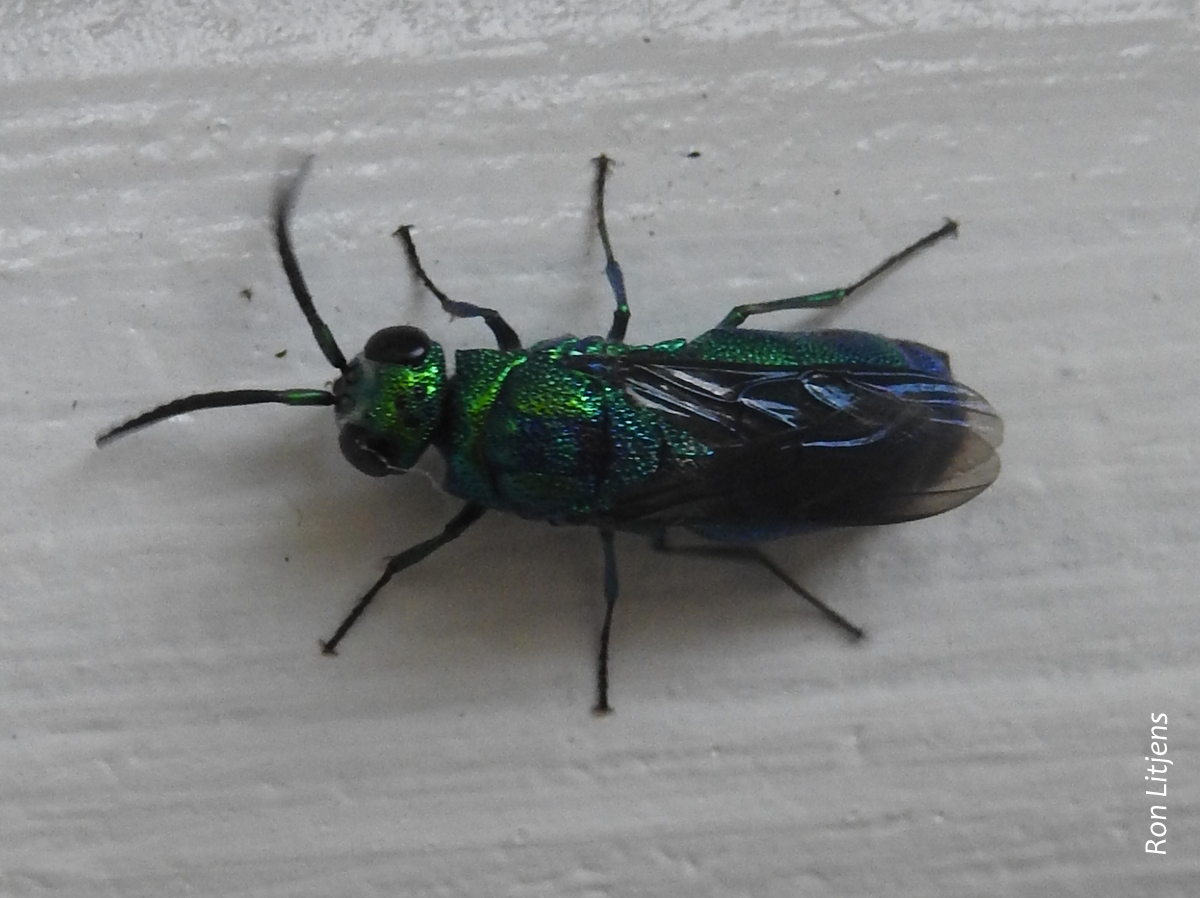
 Arguably some of the most beautiful insects in Australia are the Cuckoo Wasps (pictured). Sometimes called Jewel Wasps the colours are due to the way their multi-layered and pitted exoskeletons interact with light – the same as for Stag Beetles. They are a frequent visitor to the Blue-banded B&B. I found to my surprise that they are not at all interested in the Blue-banded Bees nesting in the structure like many of the other wasp visitors, but rather the Mud Wasps building nests there.
Cuckoo Wasps are named because the process by which they rear their young uses the same principle employed by Cuckoos, laying eggs in the nest of another species. Cuckoo Wasps are parasitoid meaning they are parasitic but the end point is the death of the host. Furthermore they are klepto-parasitoid (from the Greek word kleptein meaning to steal). They steal both nests and the food provisions from other wasps.
 Throughout summer wasps such as Potter Wasps and Mud-dauber Wasps are busily constructing mud nests of different shapes and sizes. Into these nests they place spiders, caterpillars, etc (depending on the species of wasps) that have been paralysed. The female wasp then lay eggs on the prey and seals the nest. When the eggs hatch they have a supply of fresh food to eat.
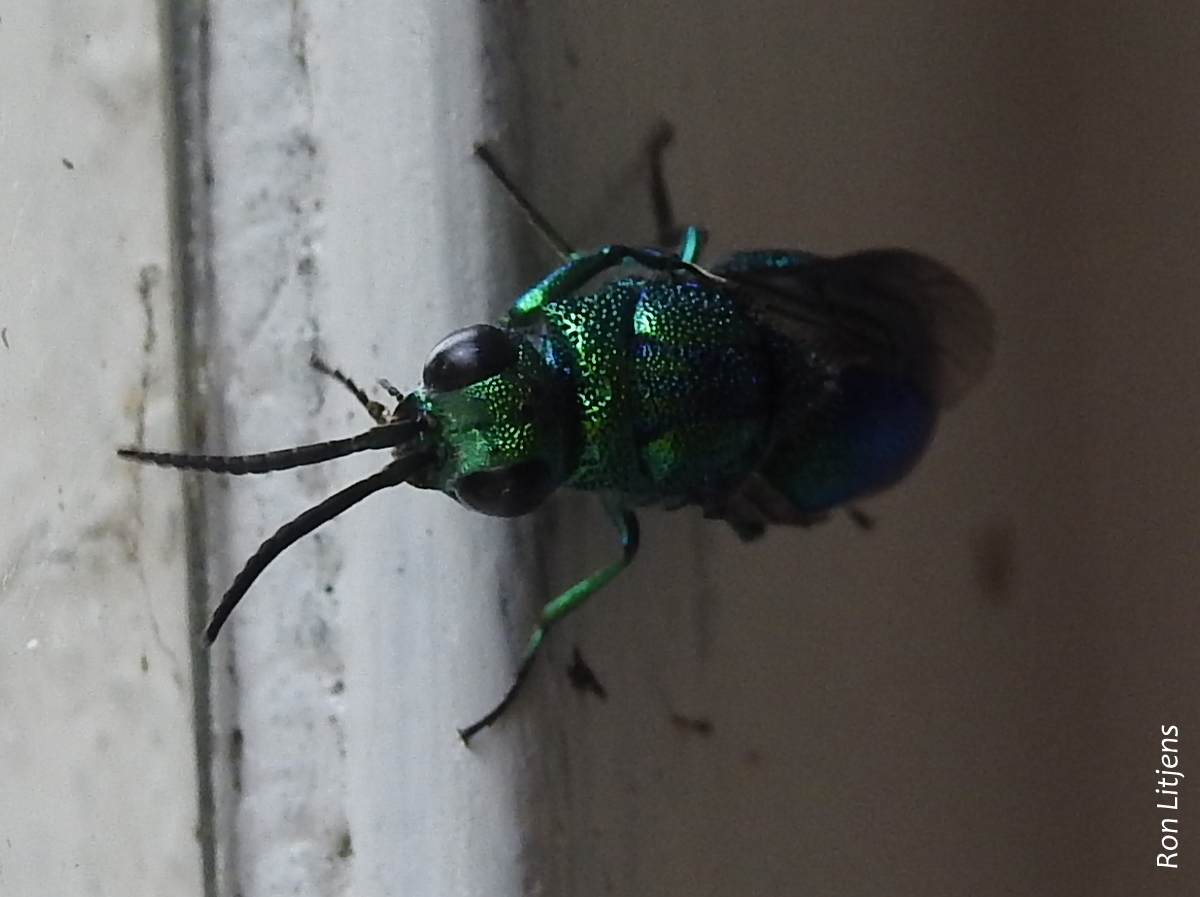 In steps the Cuckoo Wasp. The Cuckoo Wasp does not build a nest. It waits around the nest site of a Potter Wasp, for example and when the Potter Wasp leaves the nest to hunt for more food the Cuckoo Wasp lays its eggs in the Potter Wasp nest. The Cuckoo Wasp eggs generally hatch first. The larvae consume the stored food supply and then the Potter Wasp eggs.
The pictured wasp flew into the house and was trying to get out. Though temporarily detained, no wasps were hurt making this blog.
Aye, Aye, Skipper
Australian butterflies are divided into six families. Some of these families have members which are familiar to most people, for example the Common Brown is of the Nymph family, the Cabbage White is a White and any of the swallowtails are of course of the Swallowtail family. One of the lesser known families is Hesperiidae, commonly known as the Skippers. The appellation comes from the tendency for this group of butterflies to dart and skip low over the ground when in flight. Pictured is a member of the family, a Greenish Grass-dart (Ocybadistes walkeri).

Skippers are small butterflies usually brown and orange in colour. They can be distinguished from other butterflies by several key features. Like all butterflies they have clubs on the ends of their antennae but in the case of Skippers the club is hooked, like a crochet needle (see photo above).
Unlike most other butterflies that hold their wings vertical when at rest, the skipper when at rest holds its back pair of wings horizontal and its front pair of wings at an angle to the vertical (pictured below). As a kid its stance reminded me of an F-111 (although the purists among you will tell me that the aircraft has its front wings horizontal and its tail ‘wings’ at an angle).

Skippers are key pollinators of flowering plants, therefore are good to have in your veggie patch. Their sensitivity to toxins and pesticides makes them important environmental indicators.
Unlike the adage about cooks and broth, lots of skippers are good.
A noisy visitor
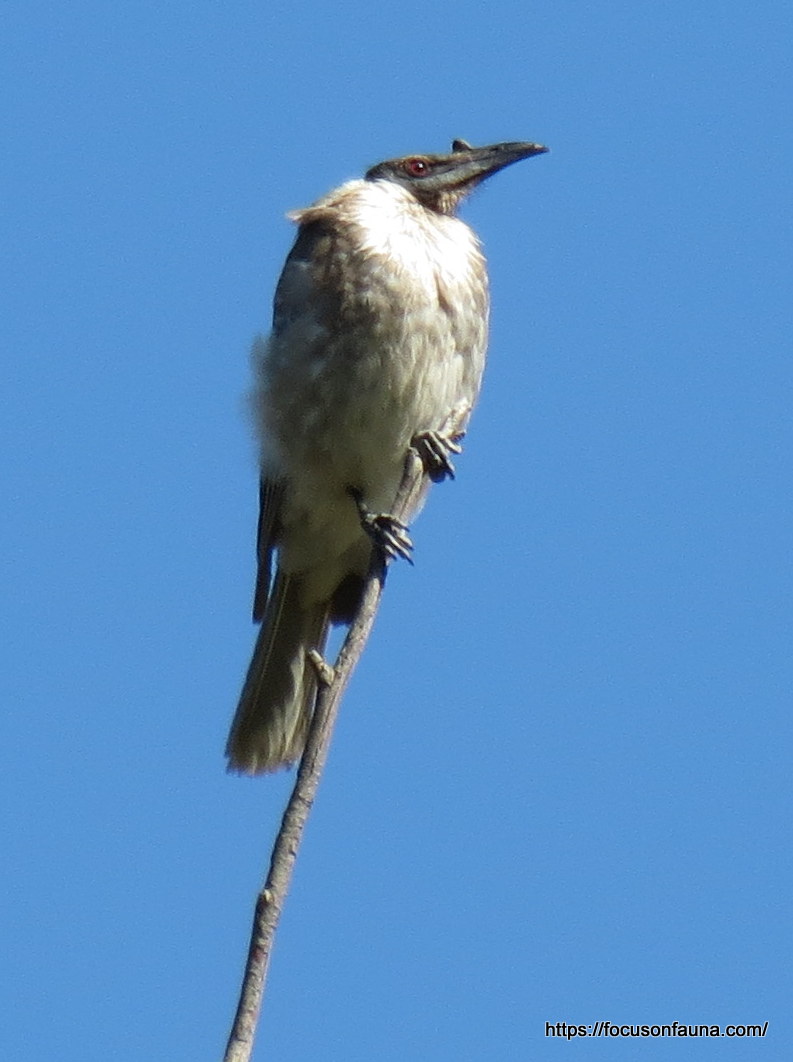 We were surprised to hear the burbling call of a Noisy Friarbird at our place the other day. We then spotted a lone bird perched high in a dead tree, which didn’t make for great photography, especially as it only stayed for a very short time. The friarbird is an uncommon visitor to this district – we have only recorded it here eight times in the last twenty years, always from October to April since it is mostly migratory in the southern part of its range, heading north as far as central Queensland for winter.
The Noisy Friarbird’s bald black head (the origin of the “friar” tag – think of a monk’s tonsure) and the knob on its strong bill distinguish it from the other Victorian species, the Little Friarbird, and from the other large honeyeaters, the wattlebirds.
It feeds on nectar, insects and fruit and can gather in noisy squabbling groups among blossoms, often with other honeyeaters. Considering its gregarious nature it seems our lone bird must have been scouting out new territory, or had simply lost its way.
The call, recorded locally, can be heard by clicking on the audio icon below.
Wilt thou suck?
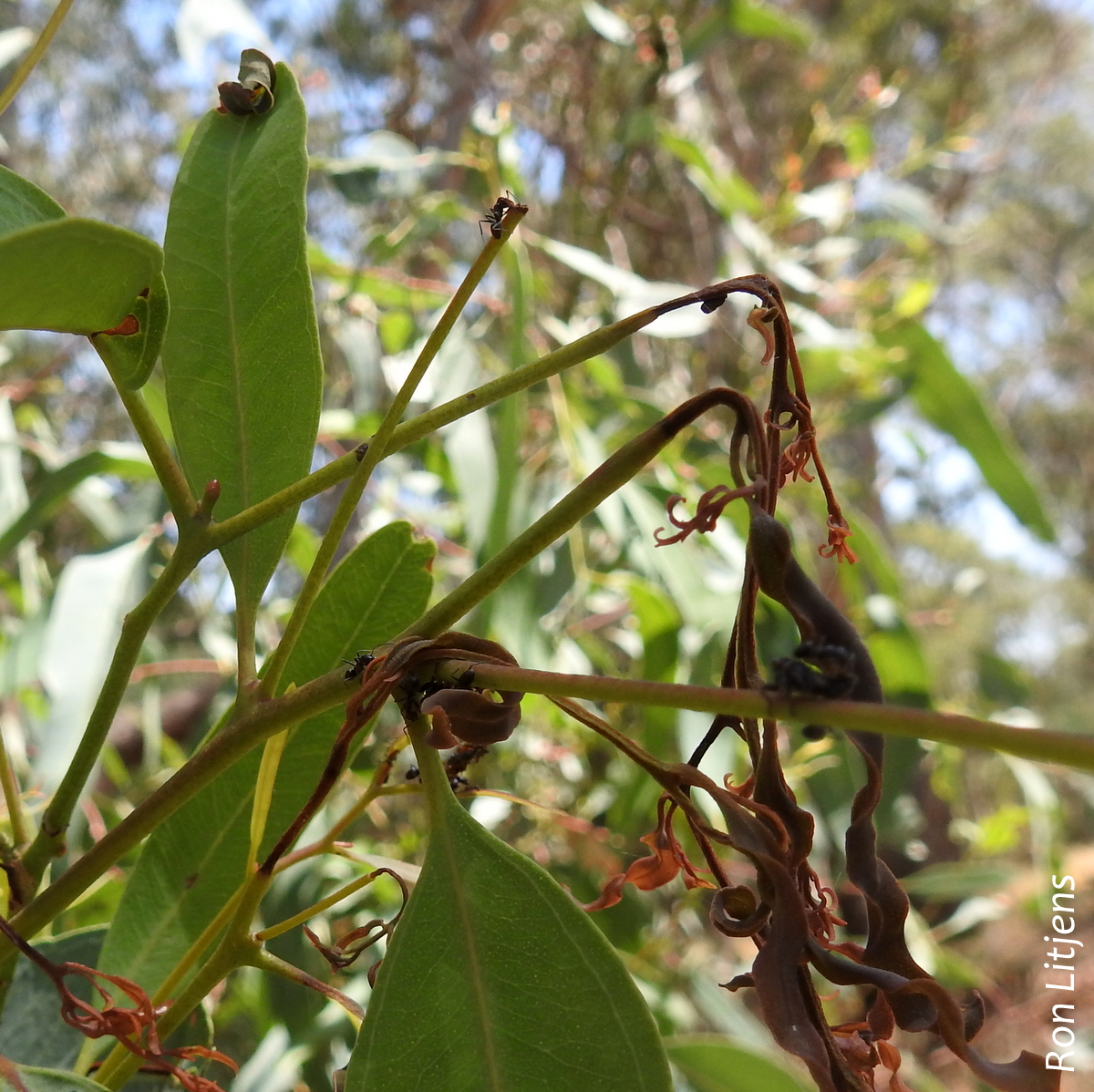 The recent summer rains seem to have kick started, or at the very least prolonged, the growth of young eucalypt leaves in the local gum trees. For small trees it is easy to get a good look at them. On some of the trees the tips of the new leaves appear to have been wilted and dried, see picture left.
If you carefully examine the trees thus afflicted you will probably find the presence of small brown insects (see photo below). These insects unsurprisingly are known as Eucalyptus Tip-wilter Bugs (Amorbus sp.). They are of the Order Hemiptera meaning that they have sucking mouthparts. Both the adults and the young (known as instars) suck the sap out of the newly developed leaves leaving them dry and shriveled. An infestation of bugs will not kill a tree but could severely stunt its growth.
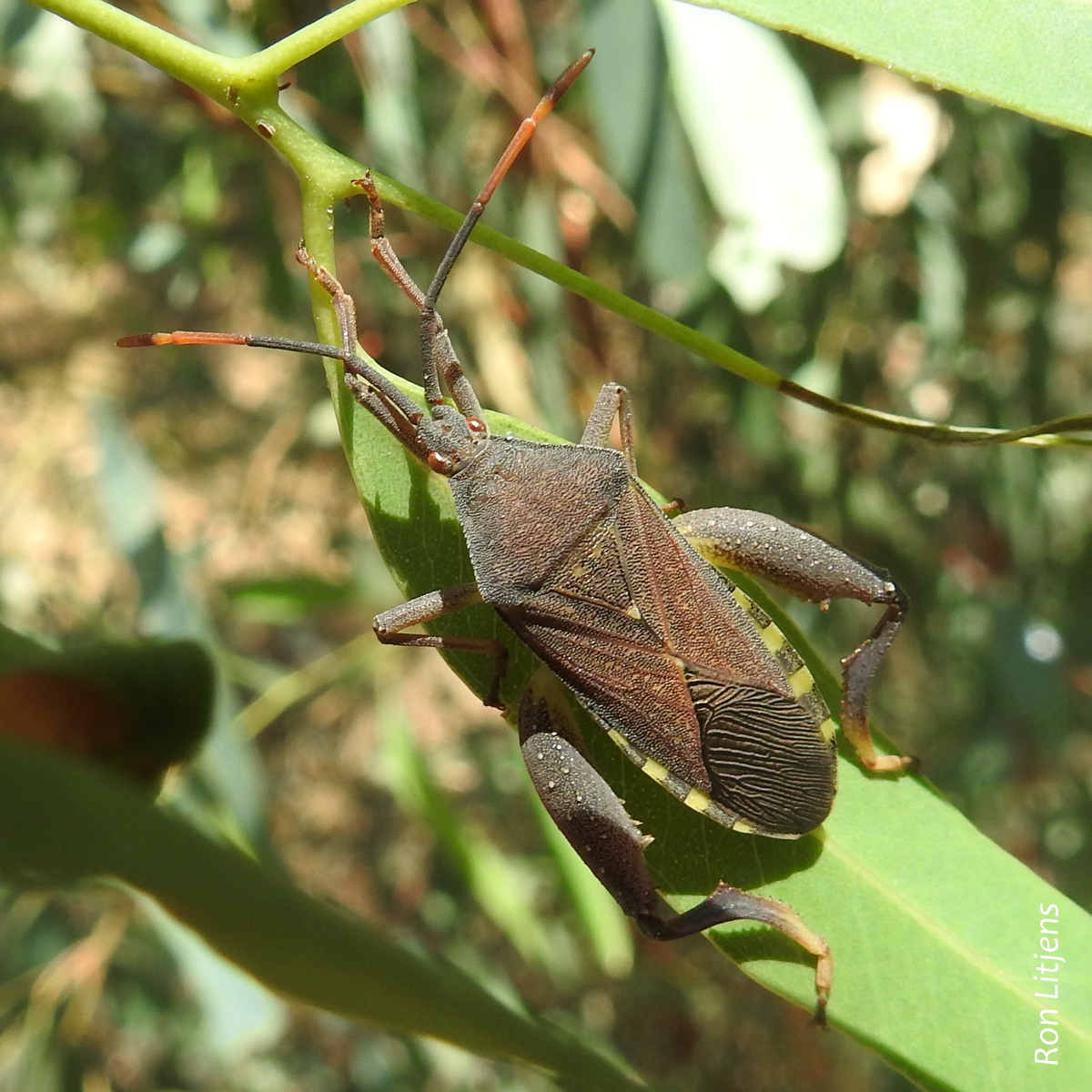
 The adults are brown in colour and have wings. They usually hang upside down camouflaged among the wilted tips. The male (pictured) has ‘fat thighs’ on the back pair of legs. The female bug does not. The bug develops through a number of moulting stages. The instars at each stage are wingless, although wing buds can be seen, and highly coloured (see picture right). The colour and the pattern define which instar stage it is.
If nothing else, you can see that adult bugs have had a colourful past.
When is an ant not an ant?
When it is a wasp of course. A Blue Ant (Diamma bicolor) is so called because the female is wingless and is a bright, metallic blue in colour (with orange legs) so it actually looks like an ant (pictured below). It is a species of Flower Wasp. Flower Wasps have previously been discussed in this blog but there are some key differences between a Blue Ant and other flower wasps.

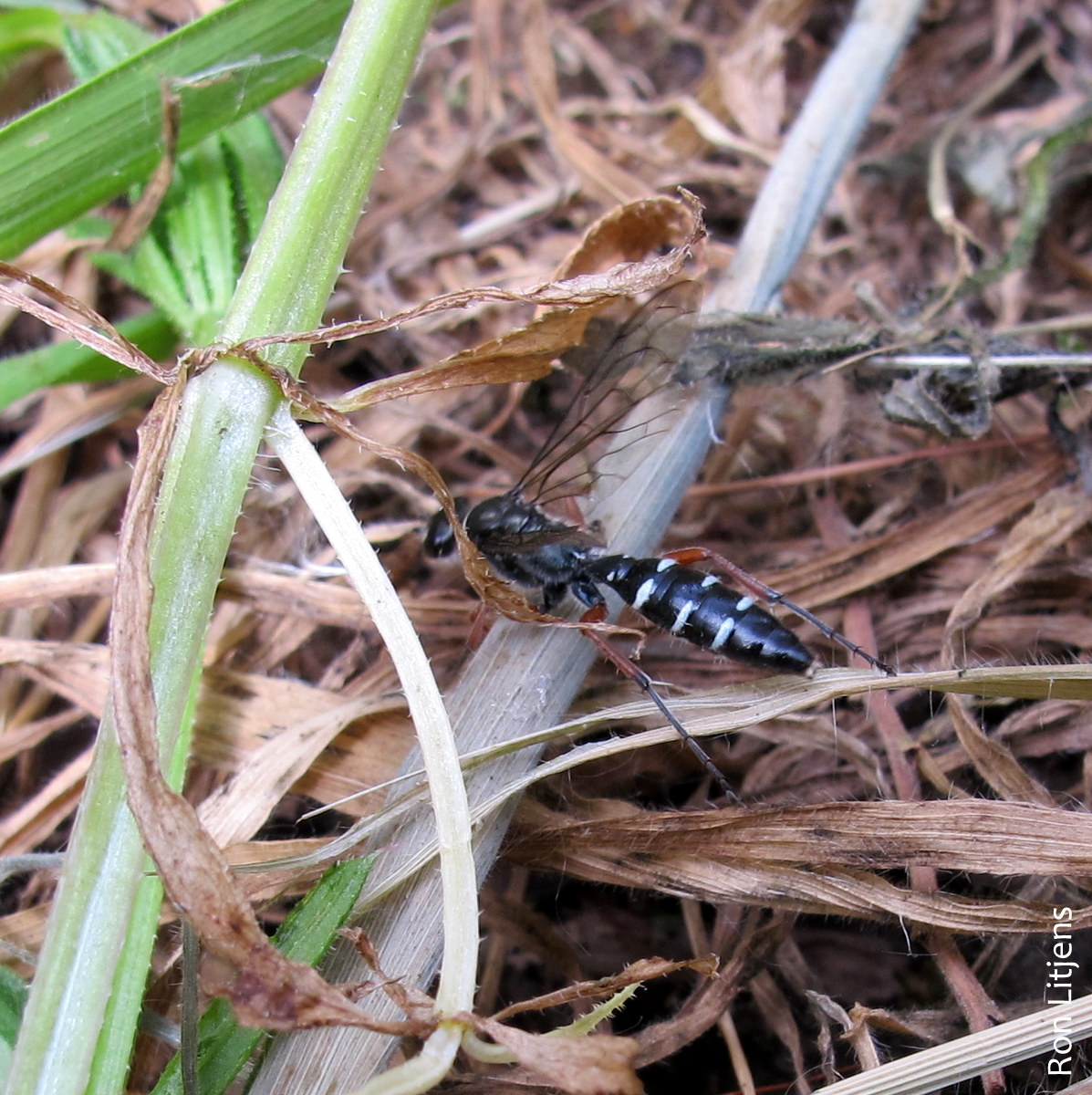
Male Blue Ant
All female flower wasps are wingless. There is sexual dimorphism in flower wasps where generally the female wasp is much smaller than the male. In Blue Ants the female is the larger insect. The picture above shows several smaller males trying to mate with the larger female.
Adult flower wasps are nectar feeders. Because it is wingless, to get to the higher flowers the female wasp sends out a mating pheromone and mates with the male. Afterwards, when the male flies off to feed, the female remains attached and stays so until she has had enough to eat whereafter it drops to the ground. Due to the size discrepancy it is hard to imagine that this strategy works for a female Blue Ant.
Female flower wasps paralyse and lay their eggs on beetle larvae. The food of choice for the young of Blue Ants is mole crickets and their larvae.
I always thought that Blue Ant would make a great name for a new superhero – and a female role model at that.
To quote Monty Python…
and now for something completely different…
An order of insects seldom seen is Neuroptera (from the Ancient Greek, neuron meaning sinew and pteron meaning wing), the nerve-winged or net-winged insects. It includes antlions, lacewings and mantis flies but also the weird and wonderful fishflies, alderflies, snakeflies, and dobsonflies. Most are nocturnal and are seldom seen. A neuropteran spotted recently during a bird-watching jaunt was an Owlfly (Suhpalacsa sp.) pictured below.
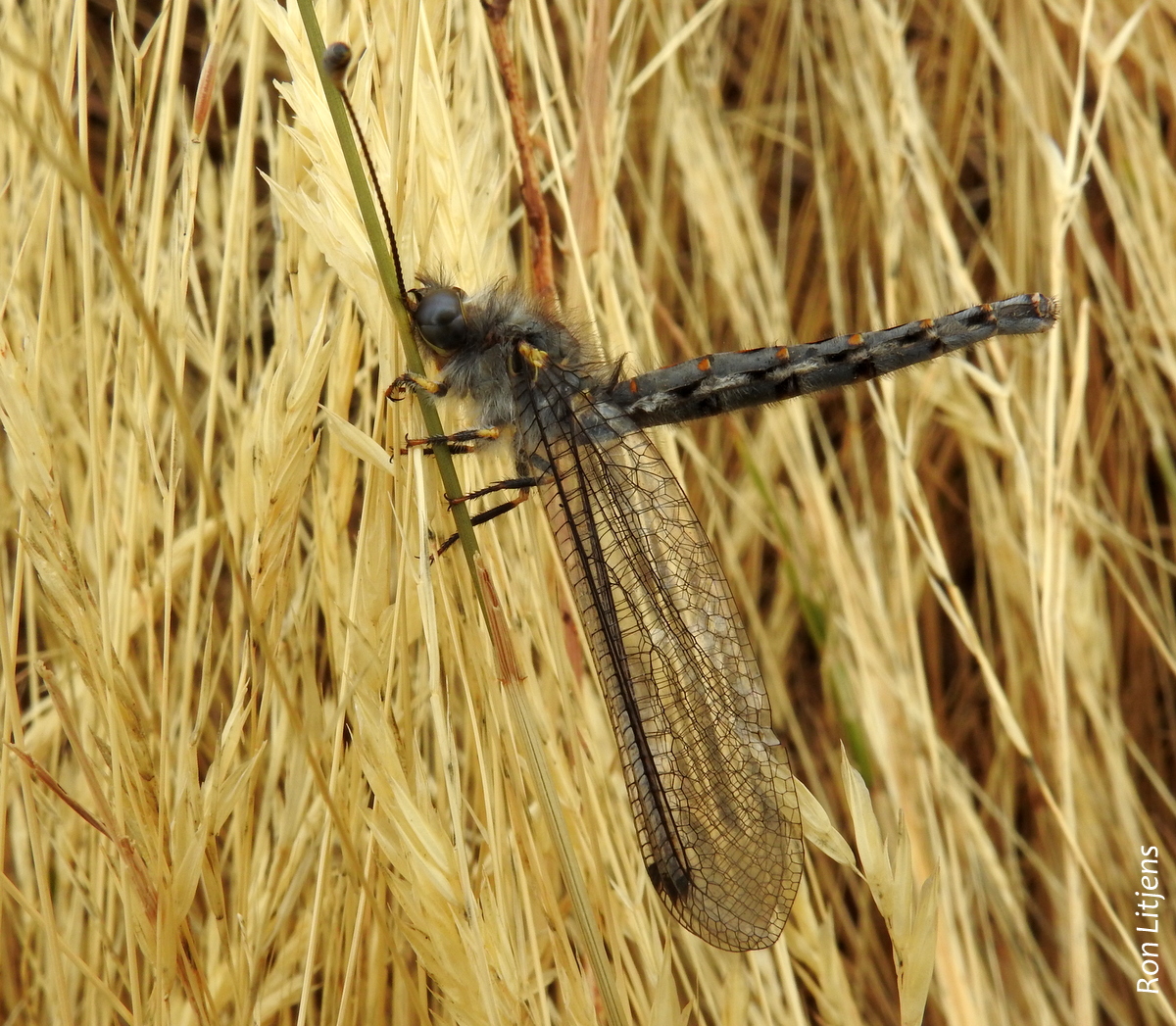
Owlflies are fast flying dawn/dusk aerial predators, catching and eating their prey on the wing. They can be distinguished from other neuropterans by their long club-tipped antennae and their large owl-like eyes. During the day they rest on grasses or twigs with the wings folded down and the abdomen pointing upward resembling a stick (see picture above).
The larvae look like those of the antlion but instead of building sand traps they sit in the leaf litter and ambush their prey. They are equipped with pincer-like jaws through which the larvae can suck the juices out of soft bodied prey.
And on the Monty Python theme this specimen was almost an ex-owlfly as my foot descended from the heavens to just miss its resting place.
What’s next?
The last blog was the result of someone sitting on the riverbank looking for platypus and noticing a Sacred Kingfisher nest. I have spent a lot of time recently at that spot on the river bank photographing the comings and goings of those kingfishers. Last night whilst waiting for the kingfisher’s final food delivery for the day a Rakali (Hydromys chrysogaster) suddenly popped out of the water on to a partially submerged log and began devouring a very large freshwater crayfish (photo, bottom right).
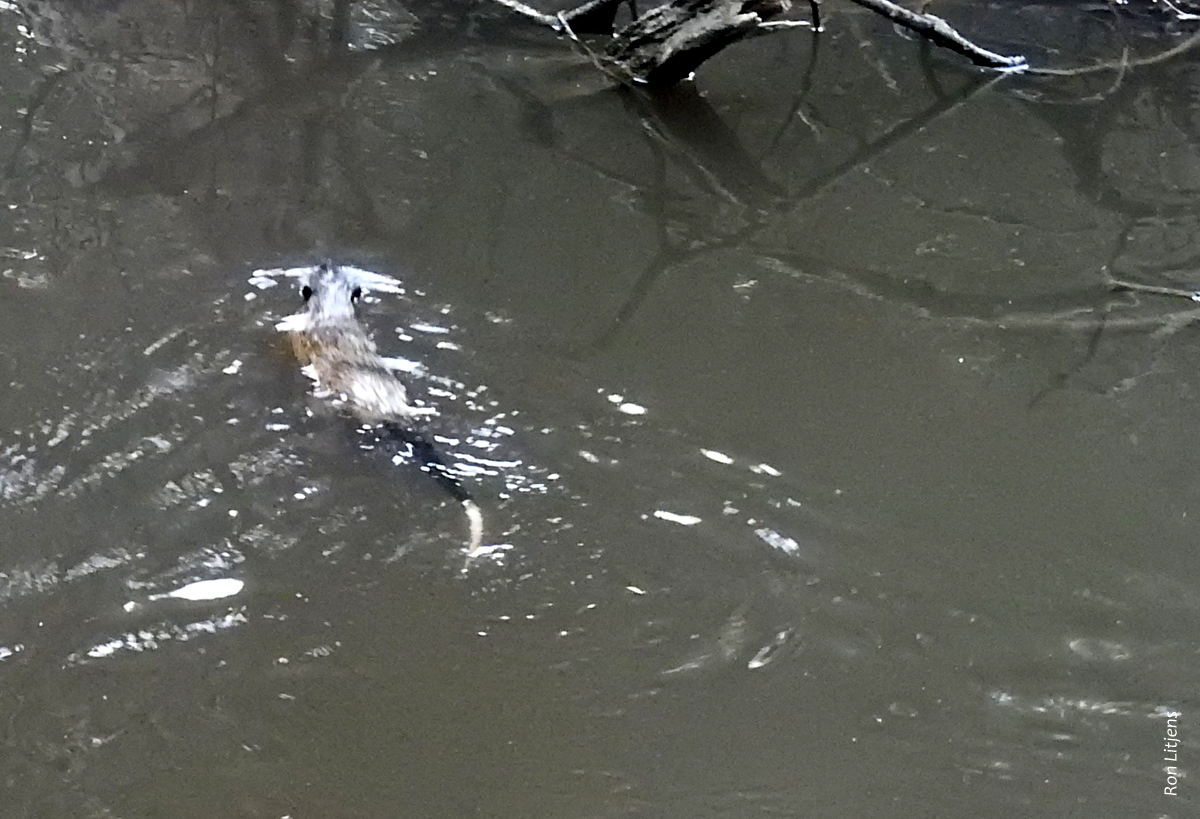 The rakali (previously known as the Native Water Rat) is Australia’s largest rodent. The photo (left) clearly shows the long white-tipped tail. The tail makes up about half the animal’s body length and is used both for propulsion (by swinging it from side to side) and as a rudder. The photo also shows that when swimming the rakali has its nose, eyes and ears above the water level whilst maintaining a low profile in the water.

 In muddy water the rakali relies on its whiskers (see photo above) to detect food. The whiskers are wider than the body which prevents the animal swimming into spaces where it is likely to get stuck. Incidentally this photo was taken when the rakali finally realised I was there. It then disappeared under water.
The back feet are partially webbed to aid in paddling but the front feet are not. They are used to grasp food (see picture right).
Given the current trend going to observe something and something else popping up, if I go down to the creek tonight to watch for rakali I wonder what animal will make an appearance. I hope it’s a bunyip!
What’s for dinner?
 The trick to writing this blog is to always have the camera with you because you never know what you will see or when you will see it. Sometimes it’s a pain to do so. Rarely, careful observation will make the task far more predictable.
A friend of mine has been platypus watching on the warm evenings. When I say platypus watching I mean sitting on the side of the stream waiting to see a platypus. In doing so he noticed that a Sacred Kingfisher (Todiramphus sanctus) had built a nest in the river bank and had young because the adults were regularly flying from the nest and coming back with food. Before flying to the nest the adults would sit on a dead branch in the middle of the stream.

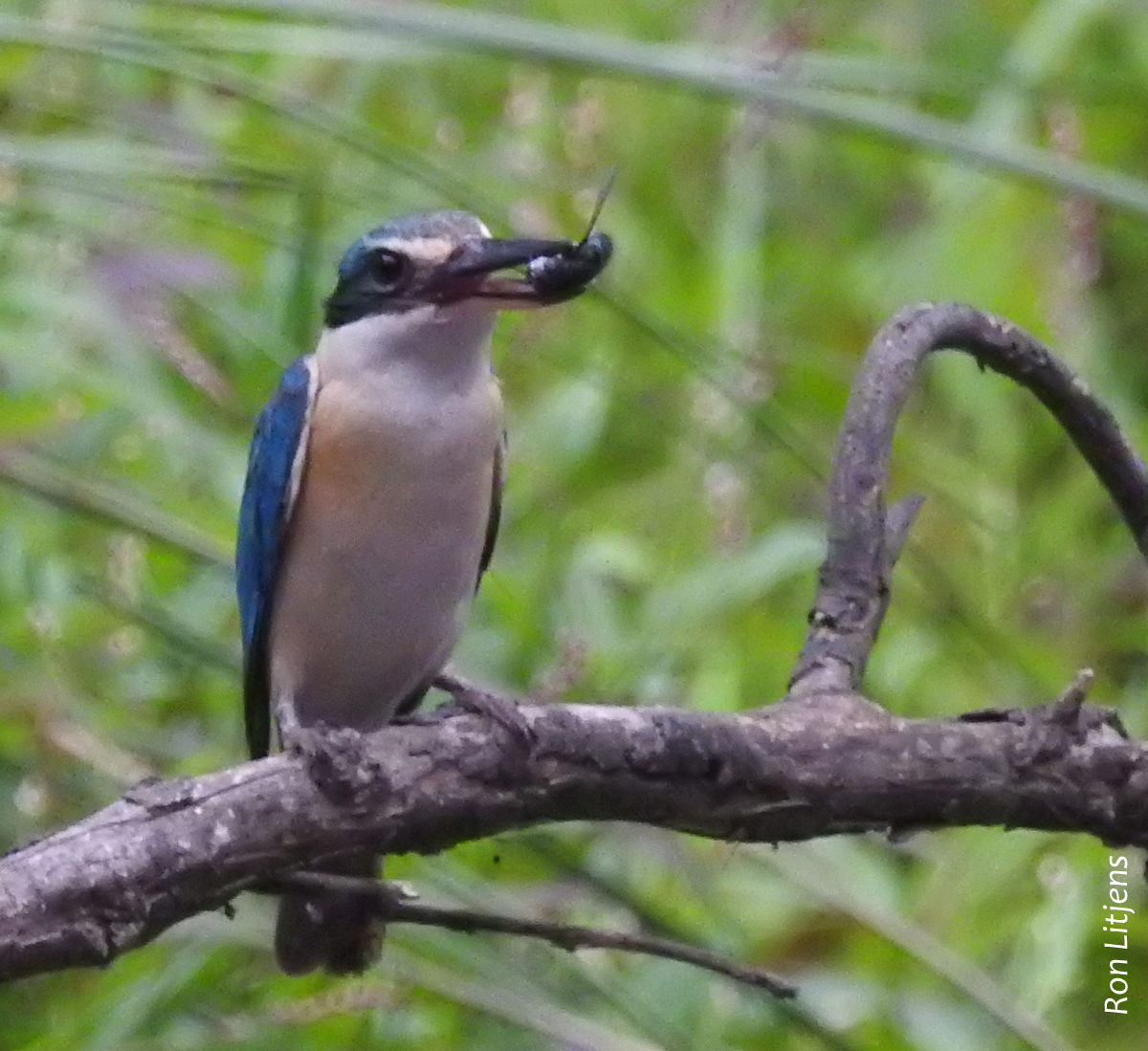 Not only does this provide a regular photo opportunity but if you sit there long enough you can see what type of food kingfisher chicks eat. During the day the main fare is lizards, see photo above left (I guess it’s because that’s when lizards are out and about). As dusk settles the adults come back with insects like grasshoppers (pictured above) and flies…big flies (pictured right).
So far despite the bird’s name, no fish for tea. Maybe I’ll have to wait and watch a little bit longer.
All is forgiven
 Our household has a love-hate relationship with Sulphur-crested Cockatoos (Cacatua galerita), so much so that they are simply referred to as Bastard Cockies (Cacatua illegitimii). Over the years they have picked at a substantial portion of the window frames of our house and have recently destroyed the windscreen and sunroof rubbers of our new car. I’m guessing all in the name of fun because the calorific value of automotive rubber must be as close to zero as you can get.
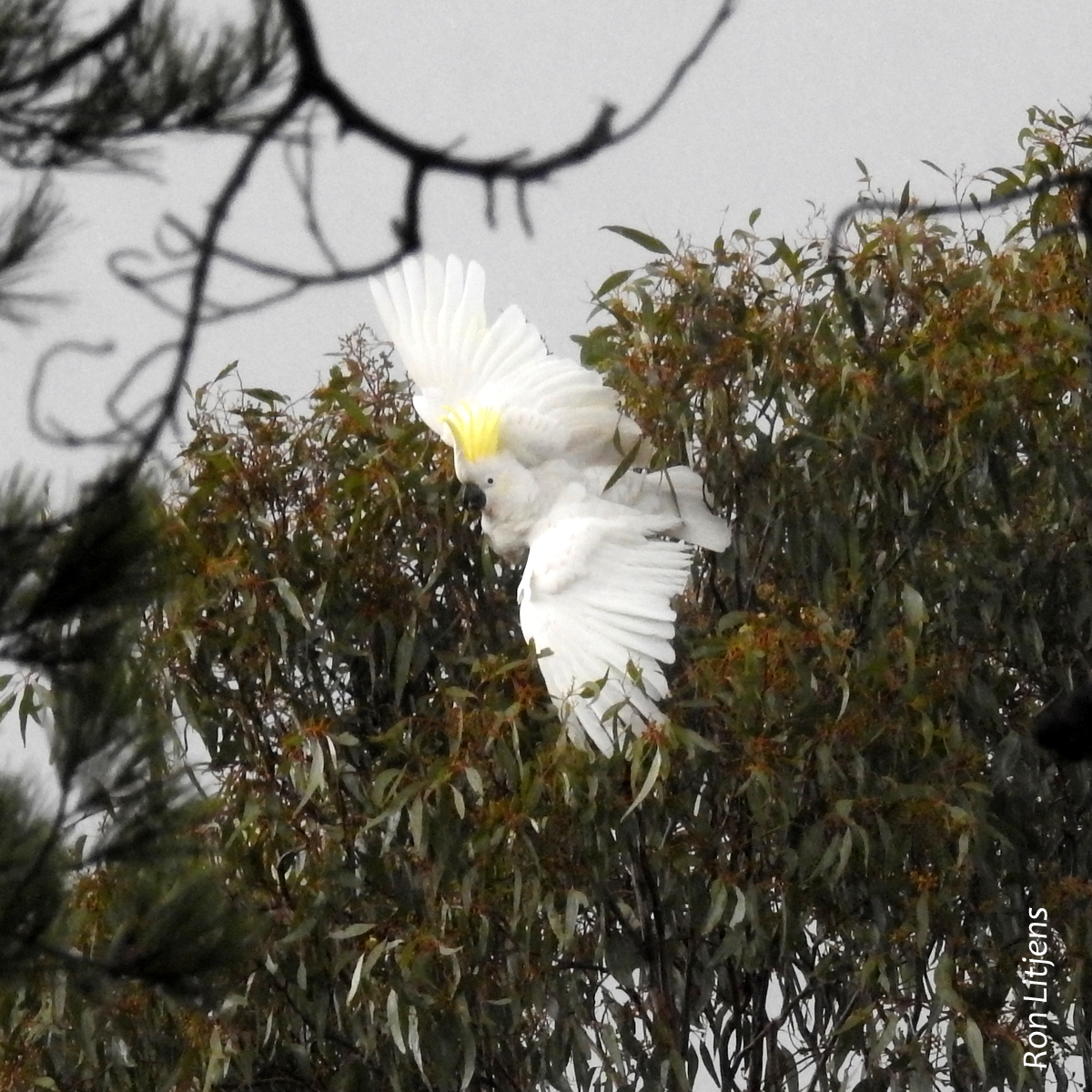
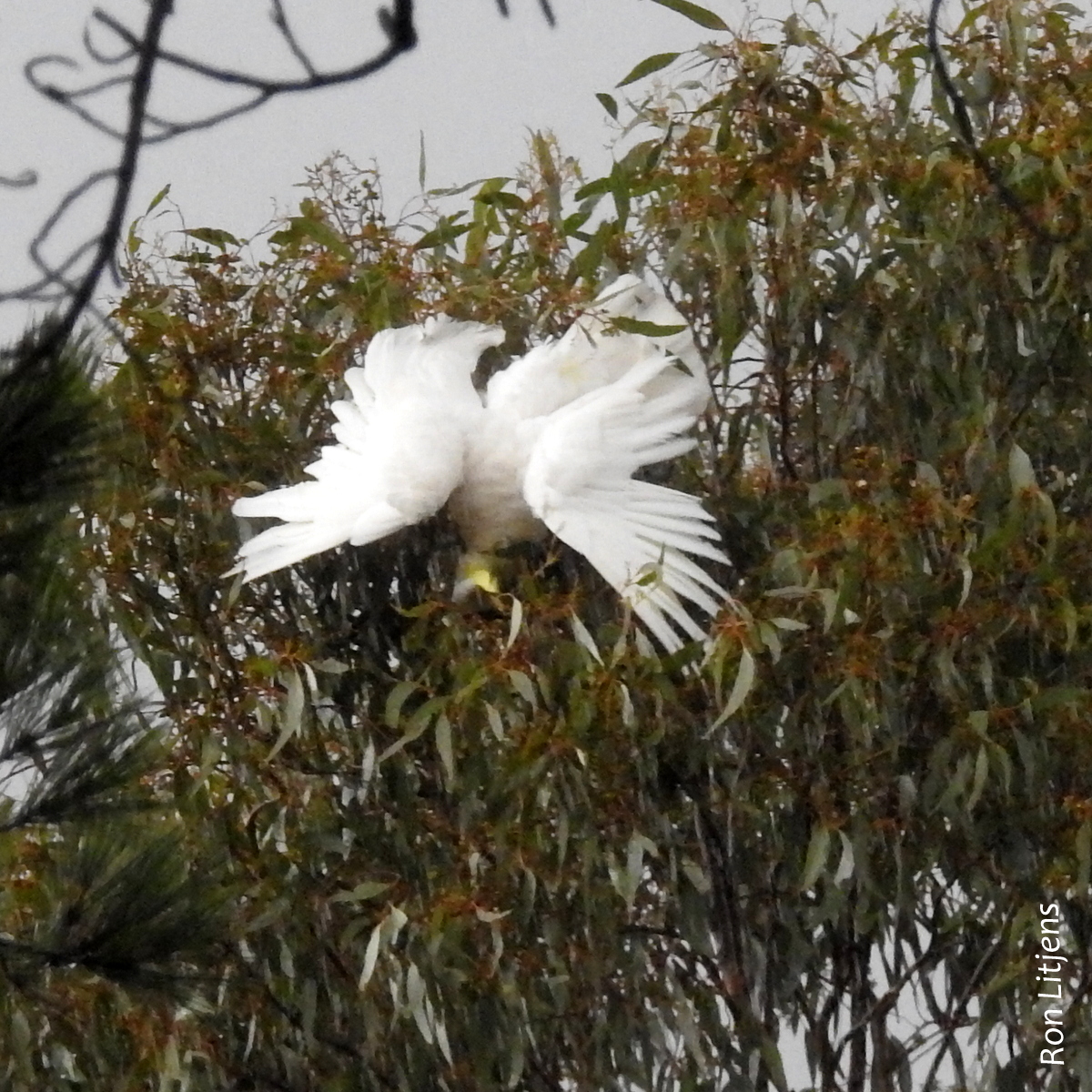 On the plus side they are prodigious weeders of Onion Grass or Guilford Grass (Romulea rosea), arriving in flocks in early spring to dig for the bulbs, clearing vast areas of the weed. However they come into their own during a summer rain storm after a spell of hot weather. The joie de vivre they seem to express by squawking loudly, stretching out their wings, hanging upside down and performing other acrobatics, to make sure all of their bodies get drenched in the soaking rain is great to watch (see photos). Maybe it is the same joy they get from destroying my car.
Either way the joy is infectious. All is forgiven..almost!




 Focus On Fauna