They’ll soon be wearing sunnies at night
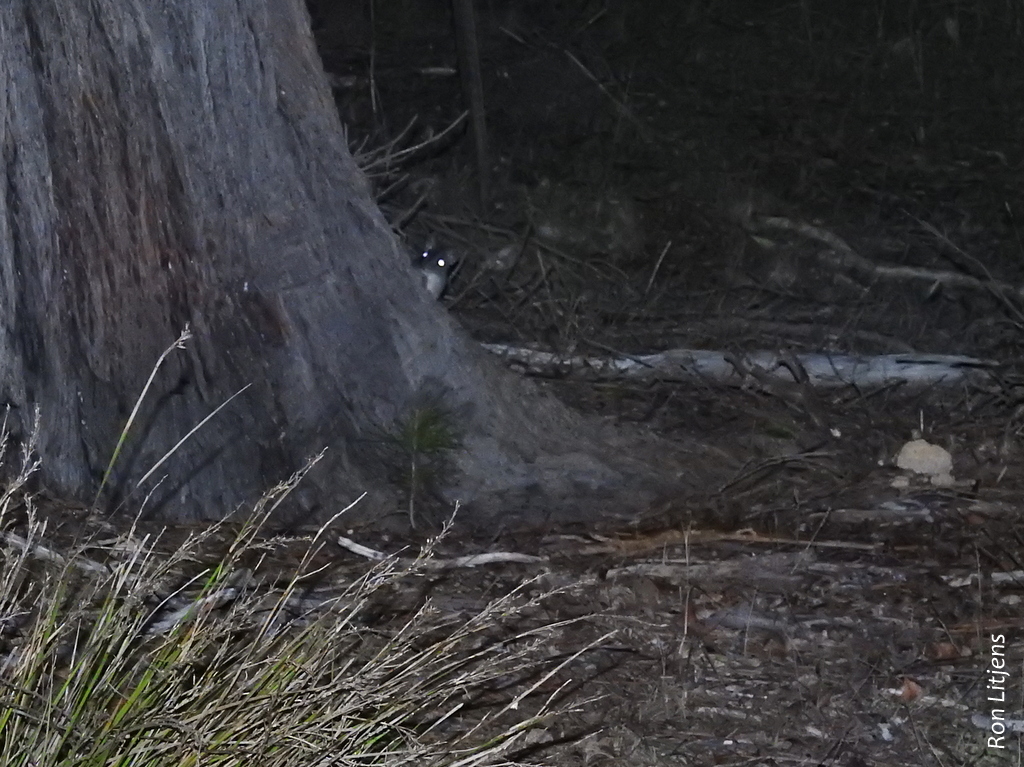 A recent blog discussed using eye-shine to find fauna (spider, frogs, mammals) at night. I have started carrying a head-torch and a camera when taking Mac the Border Collie out for his nightly walk. Recently two pinpoints of light at the base of a large Red Stringybark in the road reserve (see photo left) alerted me to the presence of a critter. It was not perturbed by our presence maybe because we were hidden by the bright light, and continued to go about its business.
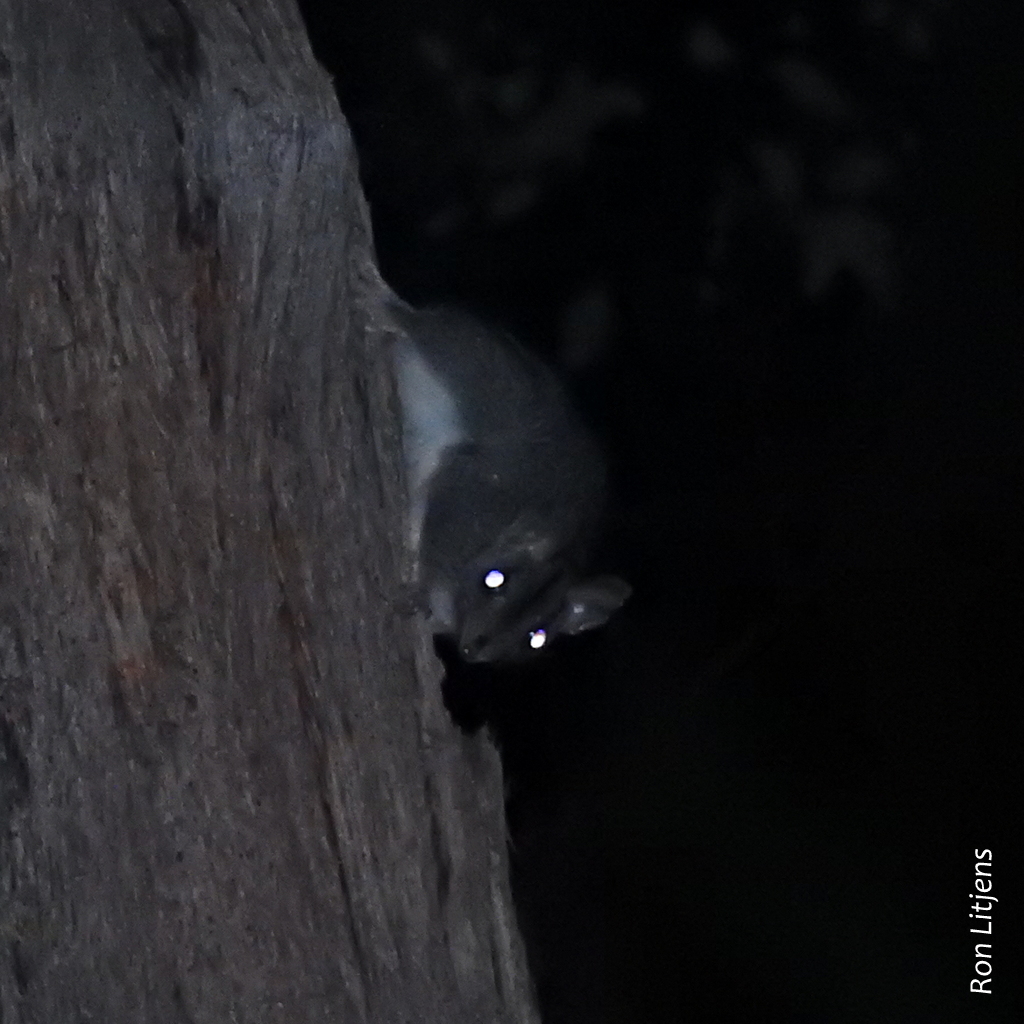
It soon revealed itself to be a Brush-tailed Phascogale (Phascogale tapoatafa tapoatafa) or Tuan, a shy and not often seen small, arboreal marsupial. As the name suggests it is characterised by a large tuft of hair on the end of its tail (see photo below).
Phascogales feed on invertebrates (insects, spiders, centipedes, etc) which they find by foraging around fallen logs and leaf litter. The home range of the male animal is about 100 hectares so even if they are in your area the chances of you seeing them are slight.
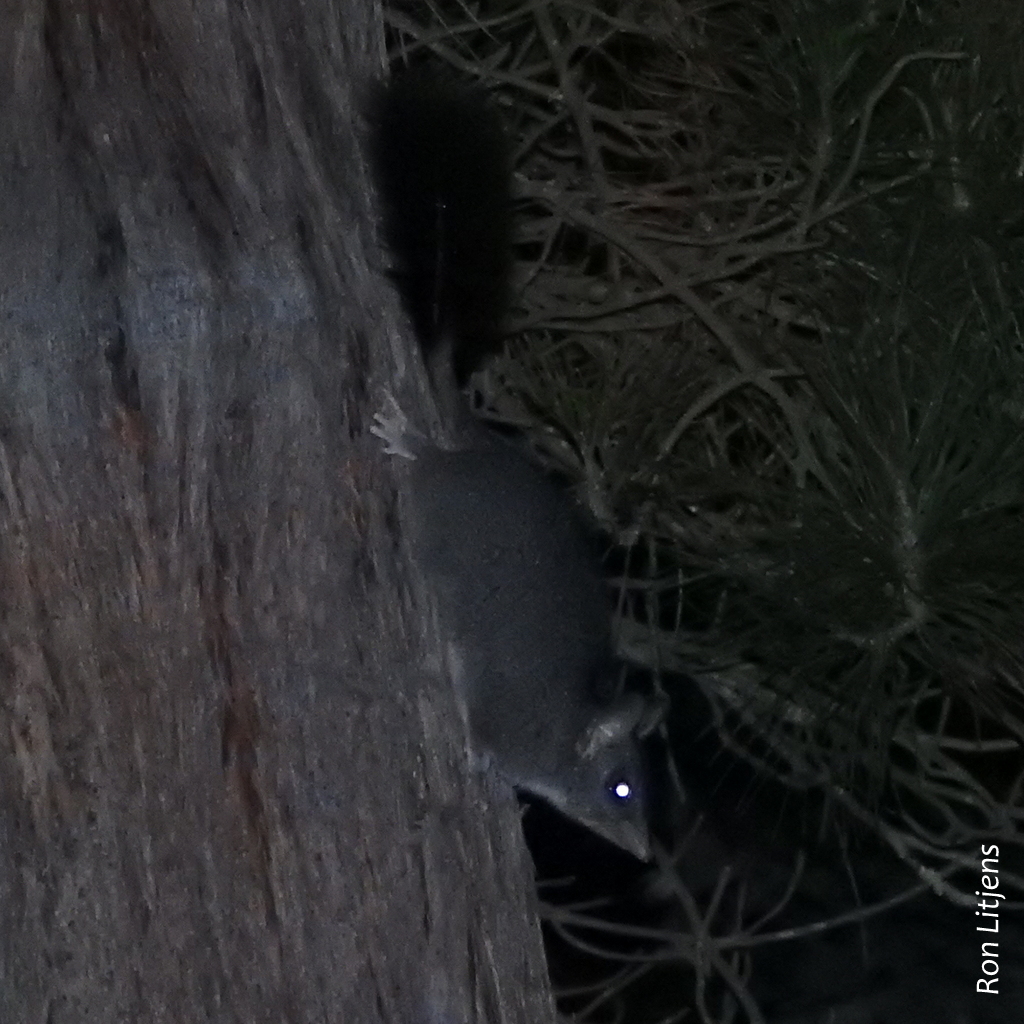
Phascogales are currently listed as Threatened under the Flora and Fauna Guarantee Act (1988). This is mainly due to the loss of hollow bearing trees and widespread clearing of its preferred habitat (open dry sclerophyll forest) for agriculture. This affects both the number of nesting sites and its food supply. Happily the phascogale nest-box set up on our property is currently occupied.
Our night-time walks will continue. I am sure it won’t be long before the native fauna, in an attempt to avoid detection will close their eyes as Mac and I wander past … or in the very least start wearing sunnies.
Spotlight at your peril
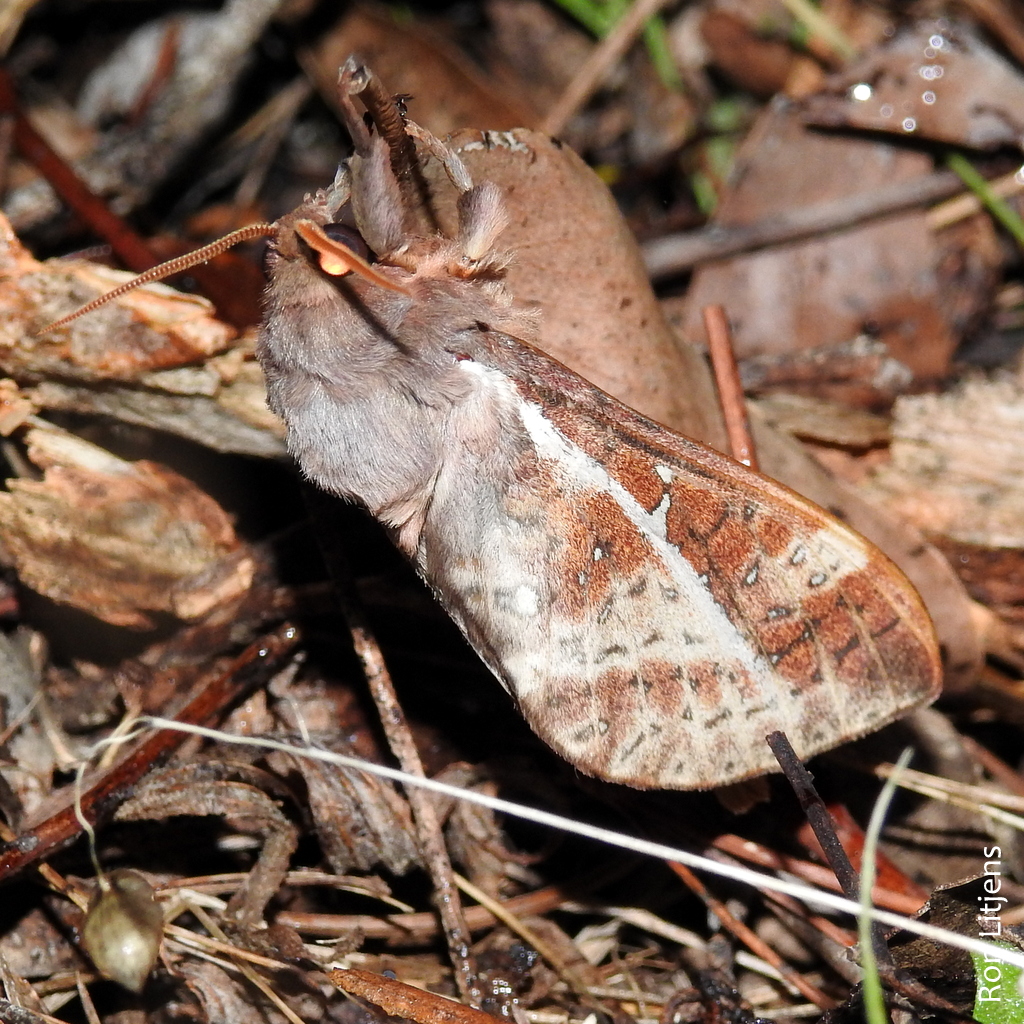
Variable Oxycanus Moth (Oxycanus dirempta)
.
.
.
.
.
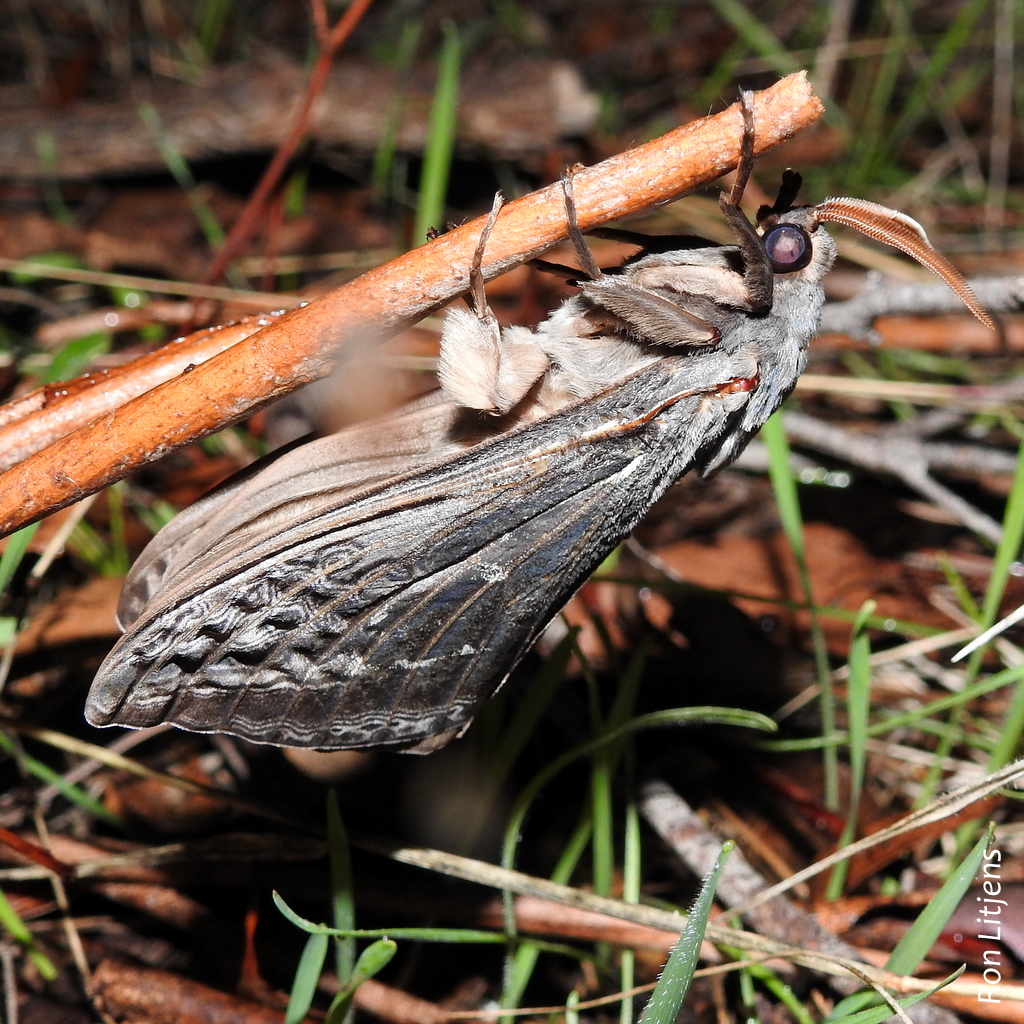
Abantiades sp.
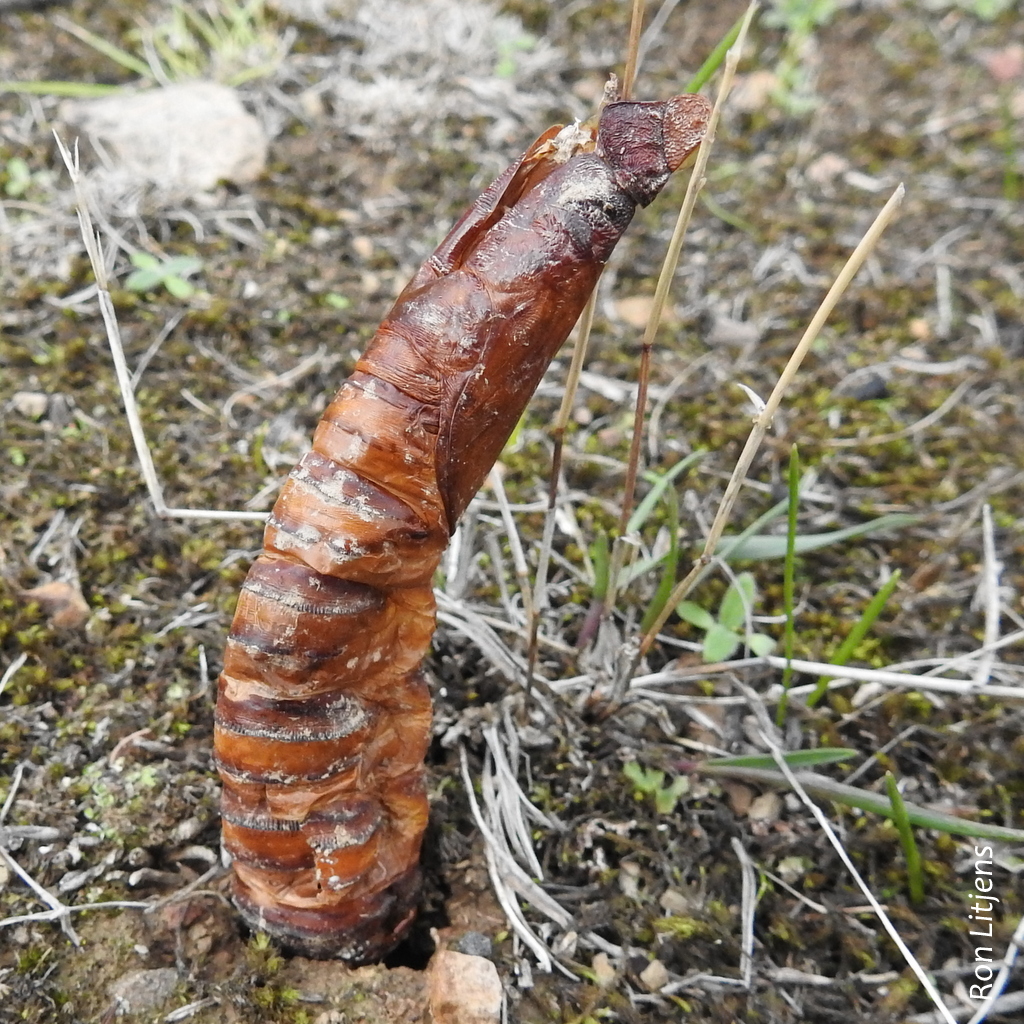 The male moth is smaller than the female. After mating the female moth spreads eggs over a wide area by distributing them whilst in flight. The resultant larvae build burrows in the ground which they line with silk. They then feed on leaf litter or tree roots. The moths pupate in their burrow and when ready the pupa wriggles to the surface and the adult emerges. The empty pupa skin is often found lying on the ground or still poking out of the burrow (see picture right).
At the moment there are several species flying about. For those of you who do not heed the warning, a word of advice. Whilst spotlighting keep your mouth closed. One of the moths tastes kind of bitter. I think it’s the brown one!
Whistling wings
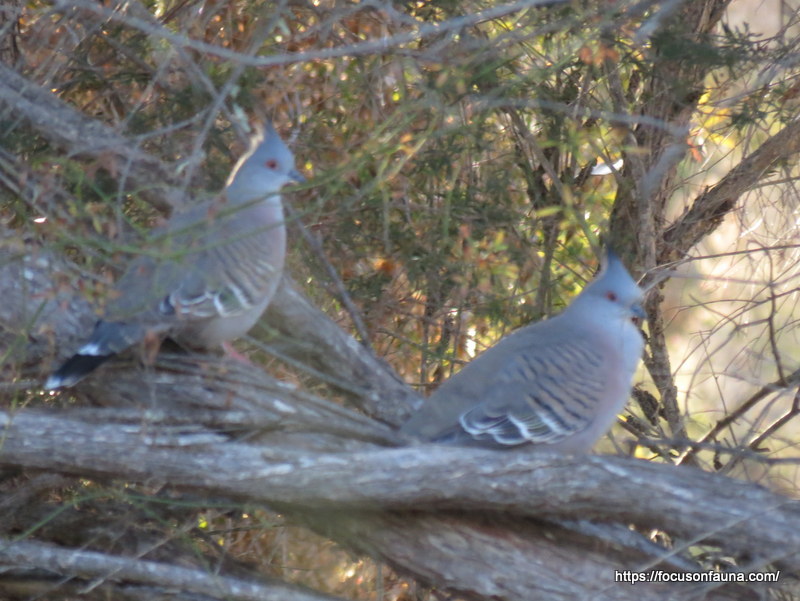
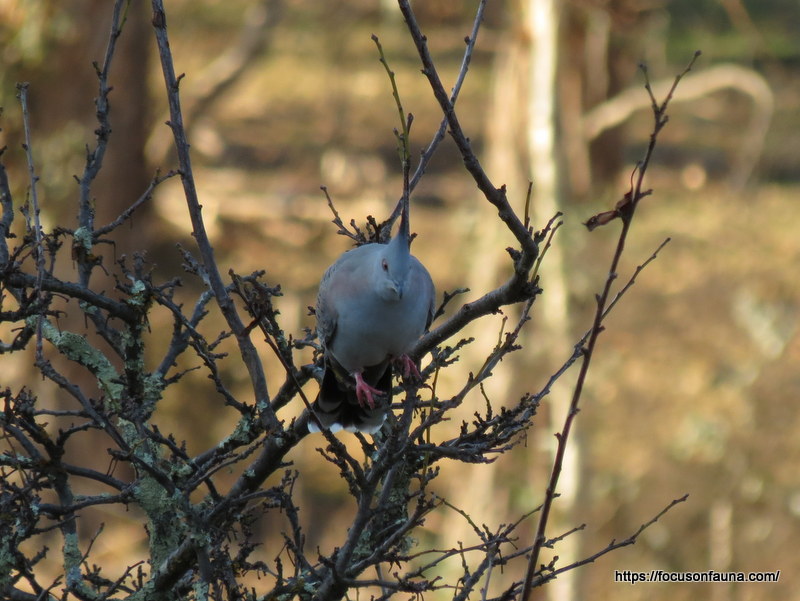 Crested Pigeons are not a particularly uncommon sight in our district, especially where grain is being fed to livestock, but it was a rare occurrence to have about ten of them visit our garden the other day. The rushed “insurance shot” of them at left is a bit out of focus and the next shot of one of them (below, right) is directly front on, which doesn’t do justice to the brilliant patterns and iridescent bronze colouring of their wings.
So for a better view we’ve included (below) a photo of a “crestie” taken at Maryborough some years ago.
They soon departed with their characteristic clatter of whistling wing-beats which can be heard in the audio below, together with their “whoop” call. The loud wing noise is apparently created by the particular alignment of a single flight feather.
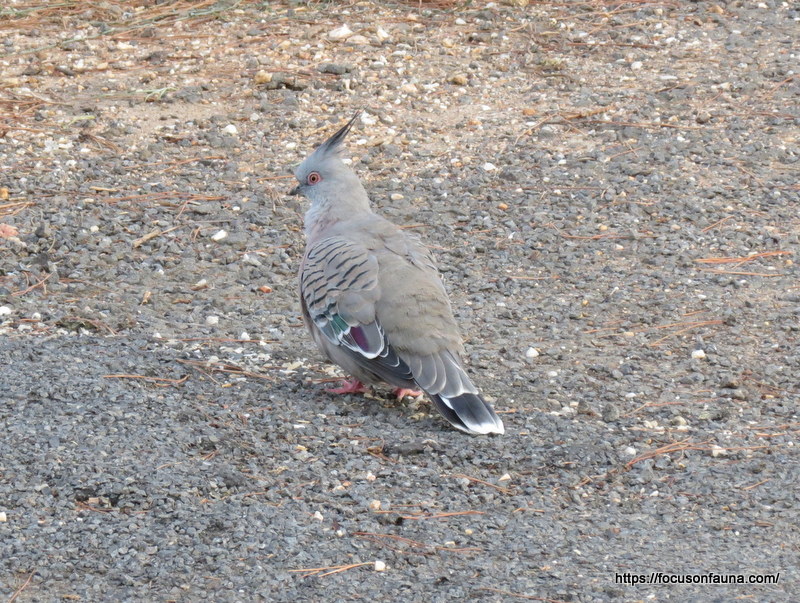
The scientific name of the Crested Pigeon (Ocyphaps lophotes) means, unsurprisingly, “crested swift pigeon” and they are indeed very fast flyers. They typically intersperse their rapid wing-beats in flight with periods of gliding, which is very graceful to watch.
Crested Pigeons were originally confined to dry lightly-timbered parts of inland Australia, but have been able to greatly expand their range with the widespread clearing of native vegetation for crops and grazing. Their distribution now covers most of Australia, only excluding the far north and eastern Victoria.
We’re more than happy to have them join our local bronzewings. They are always easy to identify with their distinctive crests (more like a spike really), and of course their whistling wings.
The ‘Funny-shaped Beak’ Club
Ibises and spoonbills form a family of birds known as Threskiornithidae. As with most scientific nomenclature, the words are usually derived from Latin or Greek and you could be mistaken for thinking that Threskiornithidae might be translated as ‘birds with funny beaks’ or something similar. It fact the word derives from the Greek thrêskos meaning religious and órnis for bird, a reference to the sacred status of the ibis in early civilisations such as Egypt. Nothing to do with funny shaped bills at all. Physically the birds in this family have long necks and legs and 11 primary feathers (if you ever get close enough to count them)!
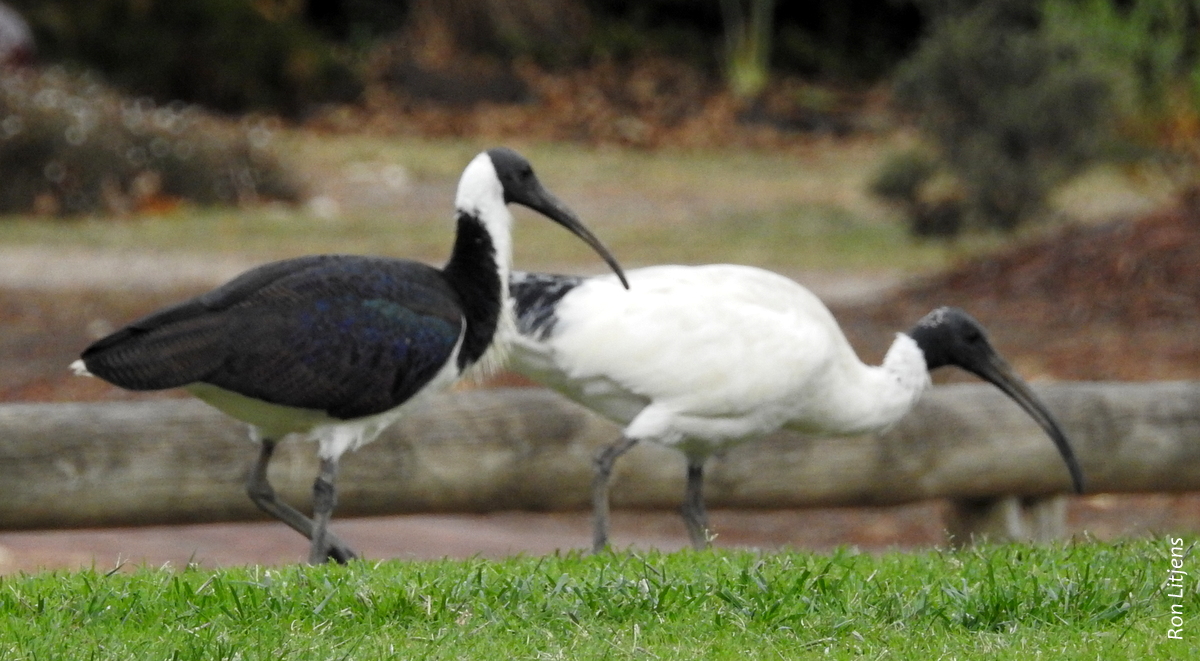
Ibises, pictured above have long, decurved beaks. They are distributed around the Australian coast line (apart from the Nullabor) and over the eastern half of Australia. Traditionally they inhabited wetlands (freshwater, brackish and saline), irrigated areas, floodplains and tidal margins. However a series of droughts has forced the populations into urban areas where the birds happily inhabit lawns, public gardens and rubbish tips.
Ibis feed by probing mud for crustaceans, molluscs and aquatic invertebrates. On land they feed on insects, frogs and reptiles.
The photograph shows two of the three Australian species of ibis, the Straw-necked Ibis (Threskiornis spinicollis) on the left and the Australian White Ibis (Threskiornis molucca) on the right. Missing is the Glossy Ibis (Plegadis falcinellus).
Two out of three ain’t bad.
Bring out ya dead
Coming around the bend on the approach to Strath Creek last week I came across the sight of a Whistling Kite (Haliastur sphenurus) feeding on a fox carcass (pictured below). The Kite seemed none-too-perturbed by the approaching car until I stopped and turned the car around to get a better look. Then it was quickly off into the nearest tree to sit with its mate (pictured below left). Unfortunately I did not have the time to wait for them to come down and feed again.

Whistling Kites are one of the apex predators in our district and are generally found near water – wetlands, creeks, etc. During breeding season (June to October) they feed on a range of live prey including mammals, fish, insects and amphibians which they snatch from the surface. At other times they feed on carrion and are often seen along roadsides searching for road-kill. Kites and other scavengers provide an essential role in removing dead things from the landscape.
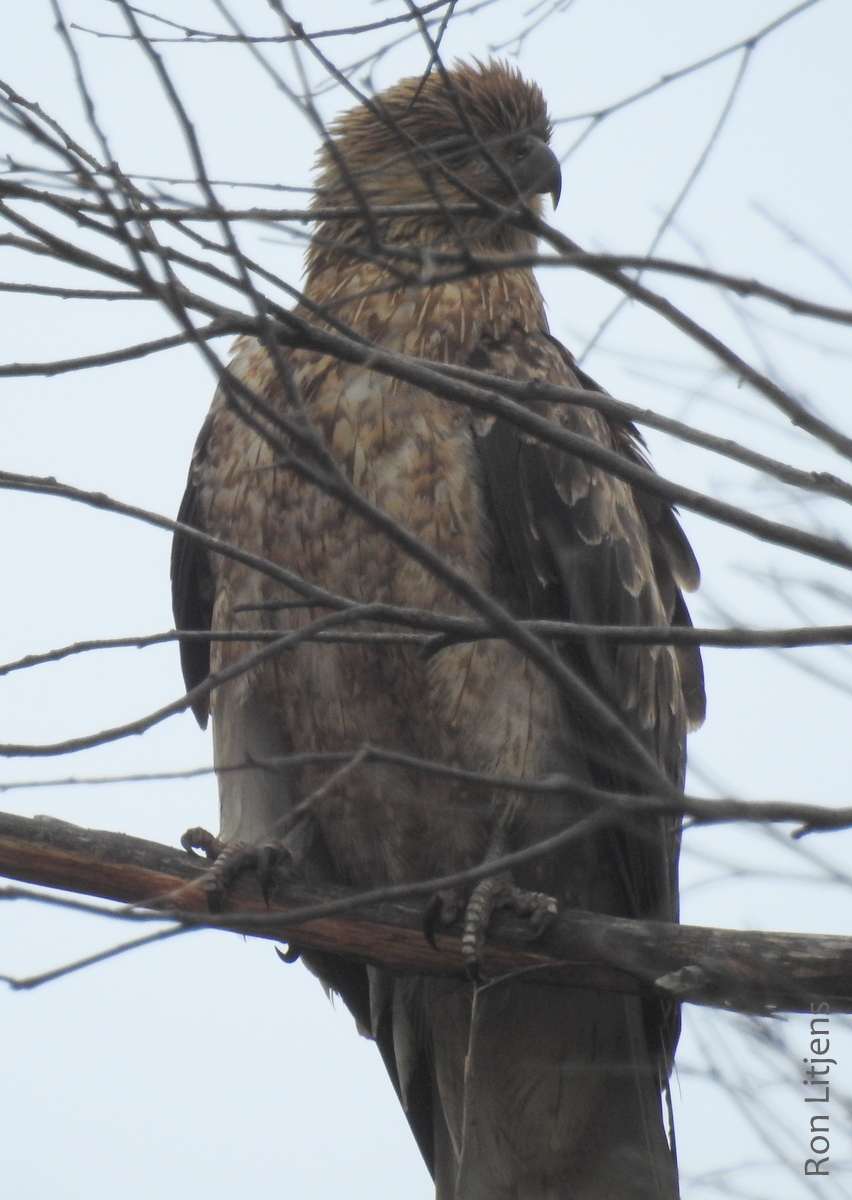 An occupational hazard for raptors which scavenge along the roadside is becoming road-kill itself. These Whistling Kites took to the air very quickly but bigger birds such as Wedge-tailed Eagles become victims to cars because they take longer to get airborne.
In retrospect with more time and more appropriate clothing I would have dragged the carcass further off the road. Luckily when I drove back later in the day there were no Kites dead on the ground.
The eyes have it
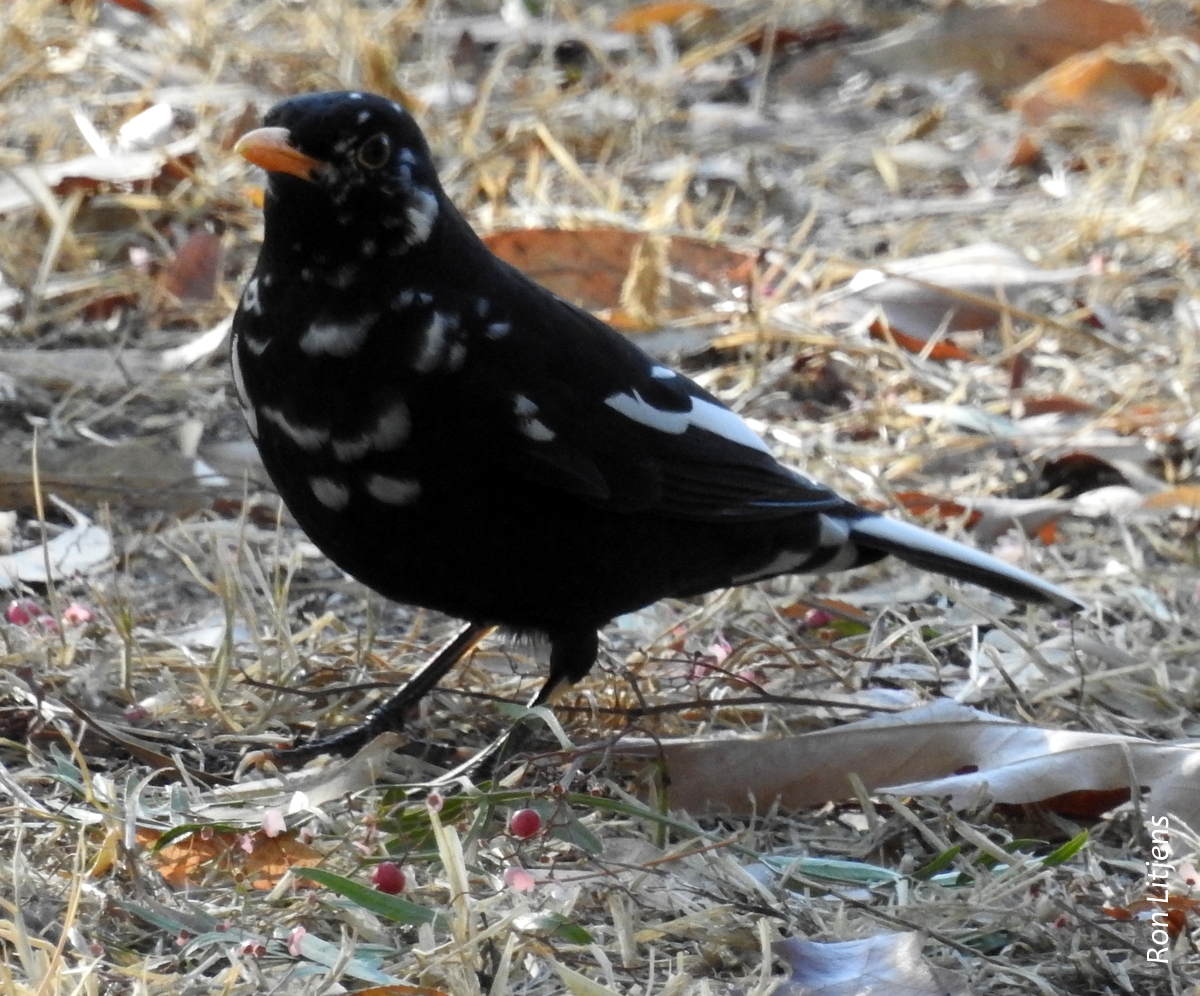 A recent blog described the appearance of an unusually coloured bird in the neighbourhood, a pink and white Sulphur-crested Cockatoo, the colouring of which had a number of possible explanations. This week another oddity turned up – a black and white Common Blackbird (Turdus merula), see pictures left and below right. The reason for this colouring is more easily explained.
This bird is leucistic (from the Greek word leukos meaning white). Leucism is a condition where an animal has a partial loss of pigmentation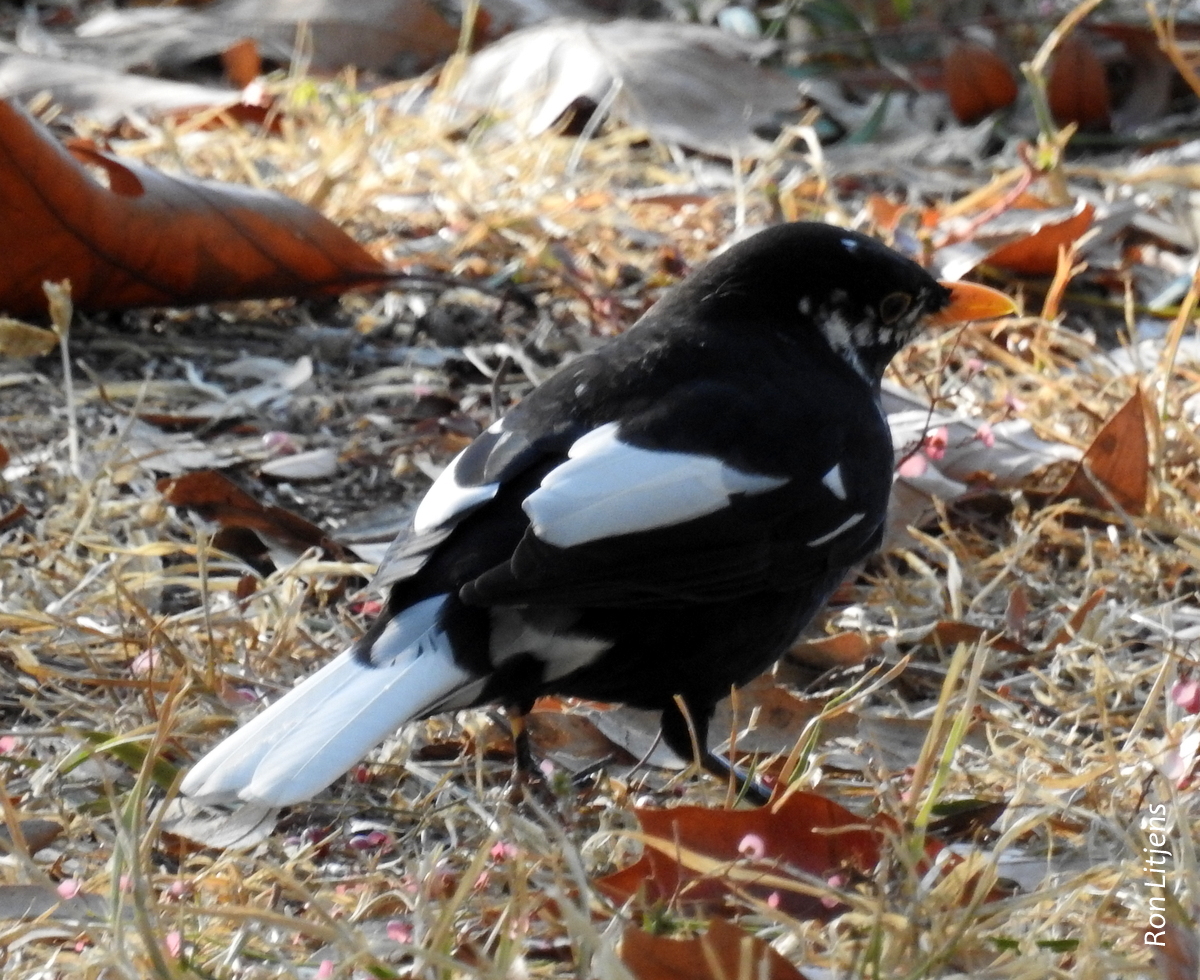 causing white patchily coloured skin, hair or feathers. It is debatable whether the condition is a mutation or is caused by a disruption to the development of pigmentation during growth.
Leucism is different from albinism which is the absence of melanin, a natural pigment found in most organisms. As well as an absence of colour in the skin, hair or feathers albinos also characteristically have no pigmentation in their eyes. The eyes therefore tend to look pink or red which is the colour of the blood vessels within. Leucism does not affect eye colour.
 The Blackbird clearly has dark eyes as has the leucistic magpie (pictured left) previously reported.
If I next see a pink elephant in the street I’ll be sure to check out the eyes to determine the cause of its colouration. I’ll also give up alcohol.
Who’s a pretty boy then?
 The hottest animal in the district at the moment is a pink and white Sulphur-crested Cockatoo (Cacatua galerita) recently seen mingling with a flock of plain white ones. Many have been trying to photograph it. Darren from Yea has the best shot to date (see left). There has been a lot of conjecture about what the bird actually is. Geoff from the Murrindindi Birdwatchers has offered a number of possible explanations.
Many species of birds are known to have genetic mutations which affect their colour. A bird with excess white in the normal colouring, as per the Magpie reported in 2016, is known as leucistic, from the Greek word leukos meaning white. Similarly melanistic (from the Greek melanos meaning black) mutations produce an excess of black colouration and xanthism (from the Greek xanthos meaning yellow) is a condition of excess yellow. But Pink???
Alternatively the bird could be a hybrid, maybe between a Sulphur-crested Cockatoo and a Galah (maybe a Glockatoo!)
This photo was posted to the Facebook group ‘Australian Bird Identification’ to see if anyone had any alternative ideas. The overwhelming opinion from members there was that the pictured individual has been stained by a marker dye used in aerial spraying. Dyes are mixed with liquids for aerial spraying so that the pilot can see which areas have been covered. Similarly the CFA use a dye mixed in with aerially delivered fire retardant for the same reason – not the most romantic of explanations to explain such a colourful character.
Irrespective of the reason there is no doubt that it is the ‘prettiest boy’ in the bunch.
There is no room at the inn
 Nor at the Blue-banded B&B. You could be mistaken for reading the title and thinking that Xmas is upon us, but no. There has been action though at the Blue-banded B&B. As previously reported the Blue-banded Bees and their parasitic entourage have long left. Similarly the Cuckoo Wasps and Mud Wasps are no longer hanging around the building.
The recent arrival as of last week has been a European Wasp of the queen variety. European Wasps (Vespula germanica) are a highly invasive wasp species known to drive native insect species out of an area and create havoc with outdoor human activities over the summer period. In the past couple of years the problem has not been as bad due in part to late spring rains flooding nests along the local waterways.
 Nests are started in spring when a fertilised queen lays eggs in a number of cells, usually underground. These eggs hatch into workers who over summer continue to expand the nest. Over this period the queen wasp lays thousands of eggs which mature into workers, drones and new queens. In autumn the newly hatched queen wasps emerge from the nest and search for a place to overwinter. Common places are wood-piles, holes in the ground- either found or created, and cracks in the brickwork of old buildings.
In their native Europe and the Middle East populations of European Wasps are controlled by the climate with very cold weather killing many nests. However in the more temperate Australia, nests survive the winter and continue to grow.
Apparently there were no cracks in the building suitable for the new arrival. I do not want to appear racist but as far as wasps are concerned, Europeans are not welcome at the Blue-banded B&B.
Round robin

On hearing a kerfuffle at the back door, we looked out to see a plump yellow and grey bird fluttering and then landing on a beam under the eaves. It was an Eastern Yellow Robin which seemed distressed and confused, perhaps having been chased by another bird: currawong, butcherbird or even our often-seen brown goshawk – who knows? After about 15 minutes, it had settled down enough to fly off, but in the meantime, we had a chance to have a close look at this lovely little bird.

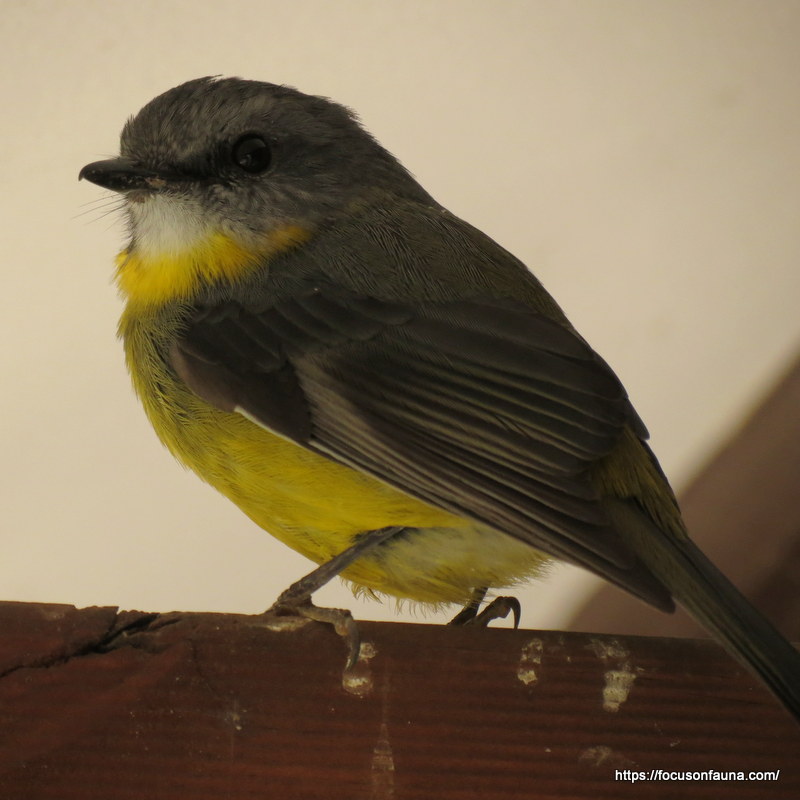
The Eastern Yellow Robin is mostly sedentary and can be seen or heard occasionally, all year round, in native vegetation remnants, roadsides, creeklines and even gardens in the King Parrot catchment.
Both sexes emit a persistent piping call, sometimes in lengthy bursts. The male also gives a loud two- or three-note territorial call. Both calls can be heard by clicking on the audio bar below.
Birds like this robin must be doing it tough in this extended extremely dry period, with food sources depleted. So here’s hoping for a break in the weather soon!
A climbing wombat?
 We couldn’t resist posting this fine picture of a Koala (Phascolarctos cinereus) that was sent to us by Ian from the Yellow Creek Dairy Creek Landcare Group. The koala sauntered past Ian as he was fencing on his property near Yea.
Koalas are a relatively rare occurrence in our district. There have been only 9 recorded since 2000 on the Victorian Biodiversity Atlas data base within a 15 km radius of Ian’s property – an area that includes Flowerdale and Strath Creek. A few of the sightings have been animals translocated from French Island to Mt. Disappointment Forest in 2004.
It is interesting to ponder the ancestry of koalas. They are quite agile (though vulnerable) on the ground and are not at first sight obviously adapted for arboreal existence: dumpy, no prehensile tail (or any tail to speak of!), no gliding membranes and relatively small forward-facing eyes not particularly suited to night-time manoeuvring among branches. To compensate for these deficiencies they do of course have powerful hands and feet with long sharp claws.

So what are the roots of this unique creature? Apparently the fossil records provide very little information about the origins of koalas and their relationship to other marsupials. Comparisons with the characteristics of living marsupials offer the best clues, and it turns out that koalas share many features with wombats, such as a rudimentary tail, a backward-opening pouch with only two teats, granulated rather than ridged pads on the hands and feet, cheek pouches, a unique gastric gland – and they even have similar hook-shaped sperm quite different from those of other marsupials.
All these mutual characteristics led biologists to deduce that the koala shared a common ancestor with the wombat. Furthermore, that ancestor was almost certainly terrestrial (ground-dwelling) – more wombat than koala!