The skill of the twitch
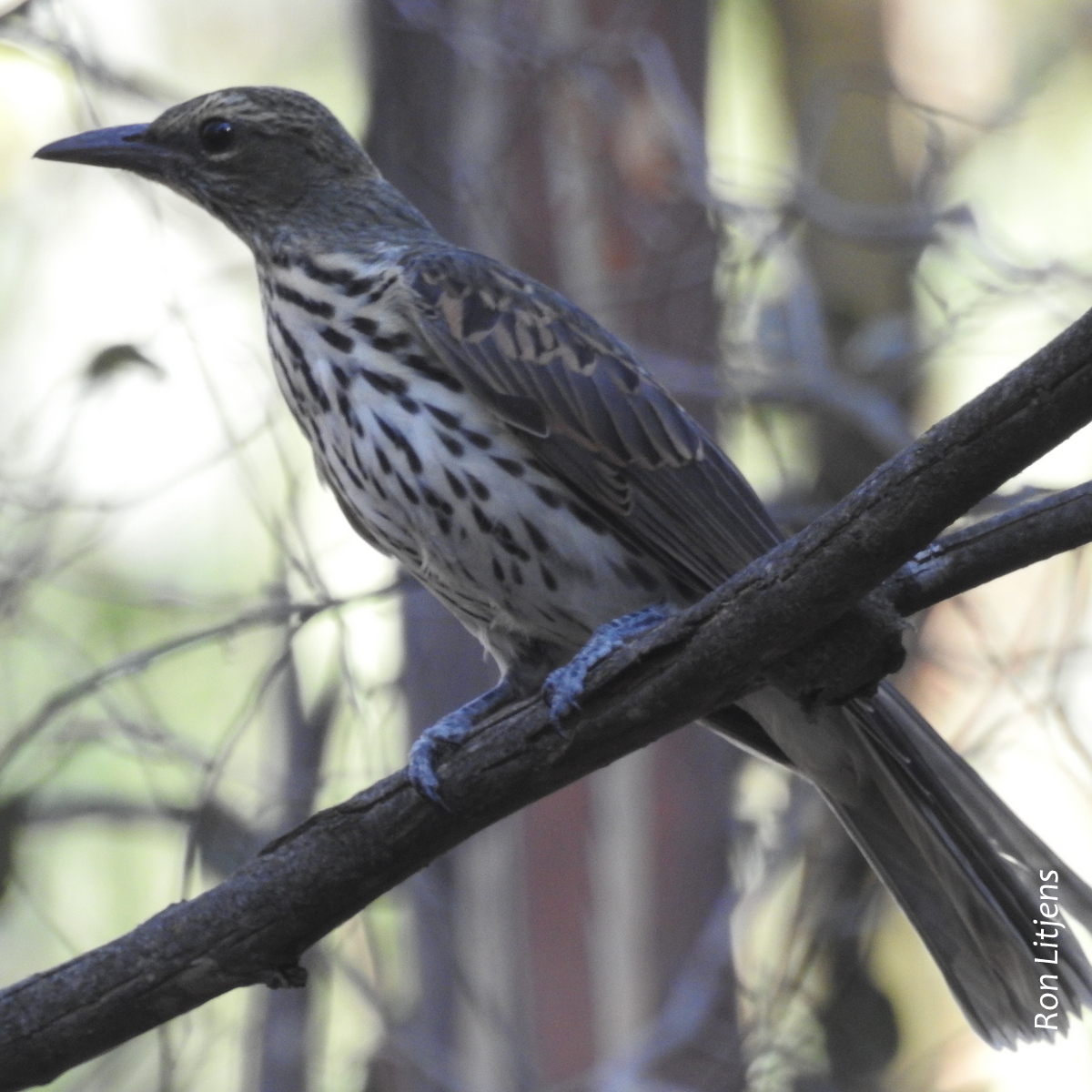 At first sight the art of twitching (bird watching) seems fairly easy – memorise from a reputable bird book all the birds in your area and then observe them in the wild. It is only when you hang around with a group of twitchers do you realise the complexities that lie within this past-time. Veterans to the game can not only identify the birds by sight, they can do it by bird call. There is an added layer of difficulty when immature birds get thrown into the mix. It then becomes apparent just how much knowledge some twitchers have.
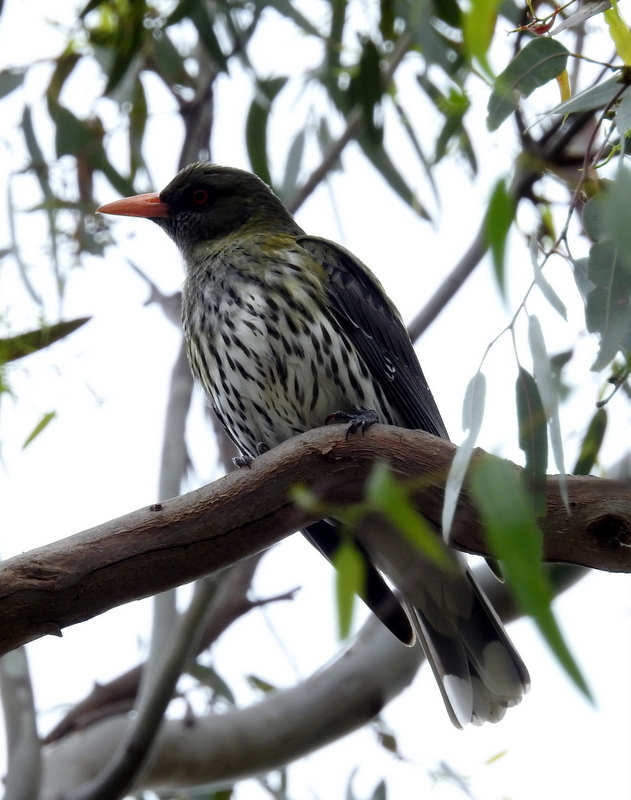 Olive-backed Orioles (Oriolus sagittatus) have been calling in the district and there are young ones about (see picture above left). Apart from their distinctive call the pattern on the breast is a give-away. Paint the beak orange and make the eye red and voila, you have an adult Oriole (pictured right). Easy right?
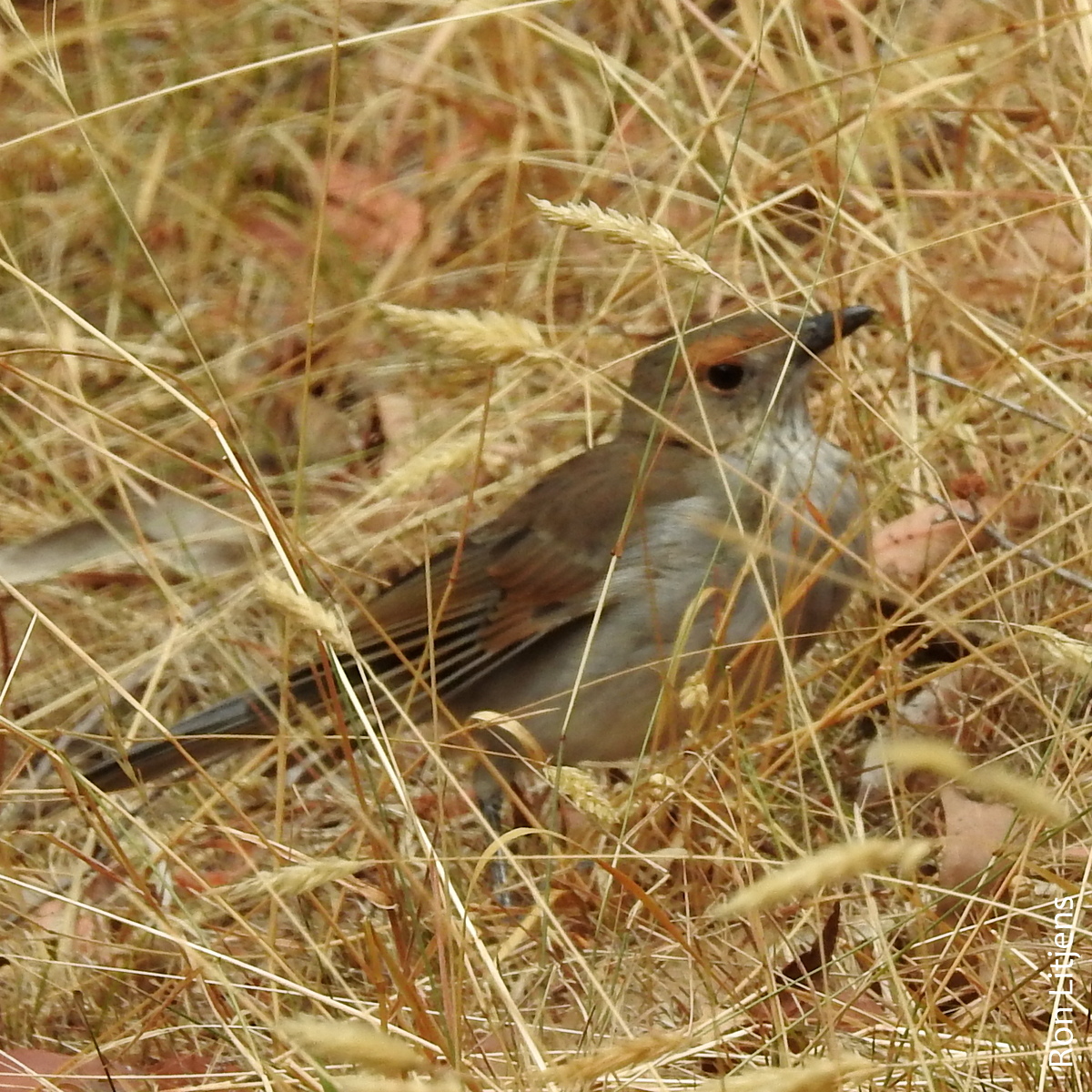 Similarly, the difference in appearance between an immature (left) and adult (below) Grey Shrike-Thrush (Colluricincla harmonica) is also about colouration, in this case the immature bird has a tan eyebrow and tan wing edges. Of course if you are in the know you will know that the adult pictured is a male – the lores (the area between the eye and the beak) is white not grey. OK, a bit trickier but still relatively simple.
 .
.
.
.
.
.
.
.
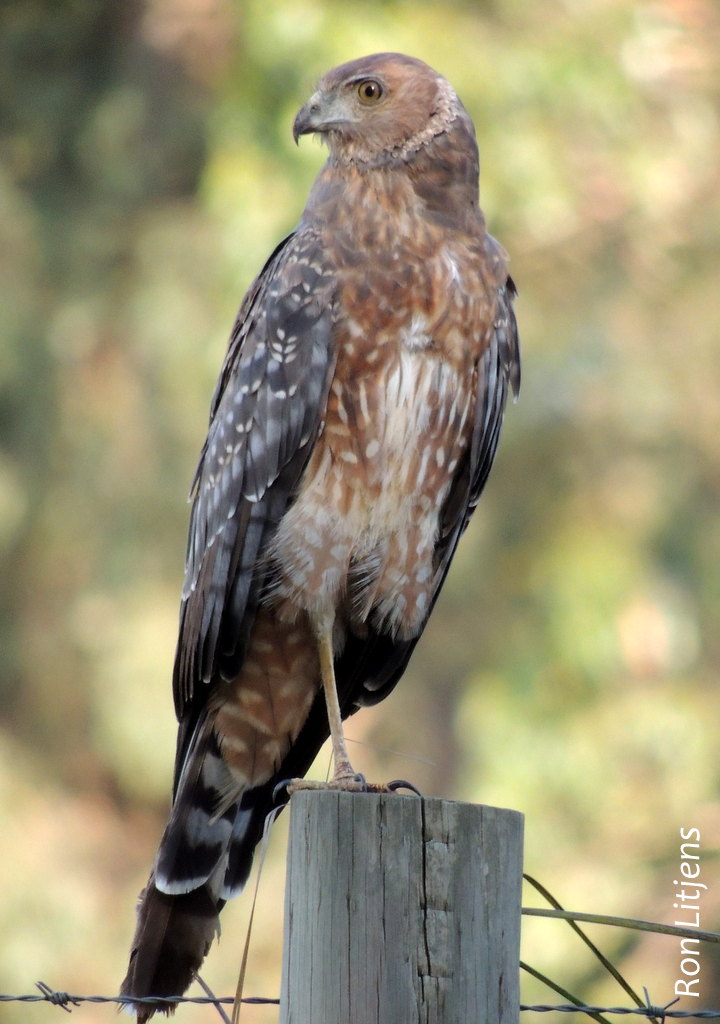
I am always impressed though by twitchers who can identify the differences between the many Australian raptors – kites, kestrels, falcons, goshawks, hobbies, etc. I asked a twitcher friend to identify the bird in a photo I had taken (left). He immediately said a Spotted Harrier (Circus assimilis) and then after about half a minute of looking at the photo said ‘Second year bird’.
What a geek! (Apologies to P.M., outstanding knowledge!)
A hive of activity, still
Despite the fact that many Australian native bees do not form a hive, and that the Blue-banded Bees have left the vicinity, the Blue-banded B&B recently described is still a hive of activity. The Blue-banded Bees have gone and so too have their parasitic predators, the Cuckoo Bees and the Gasteruptiid Wasps.
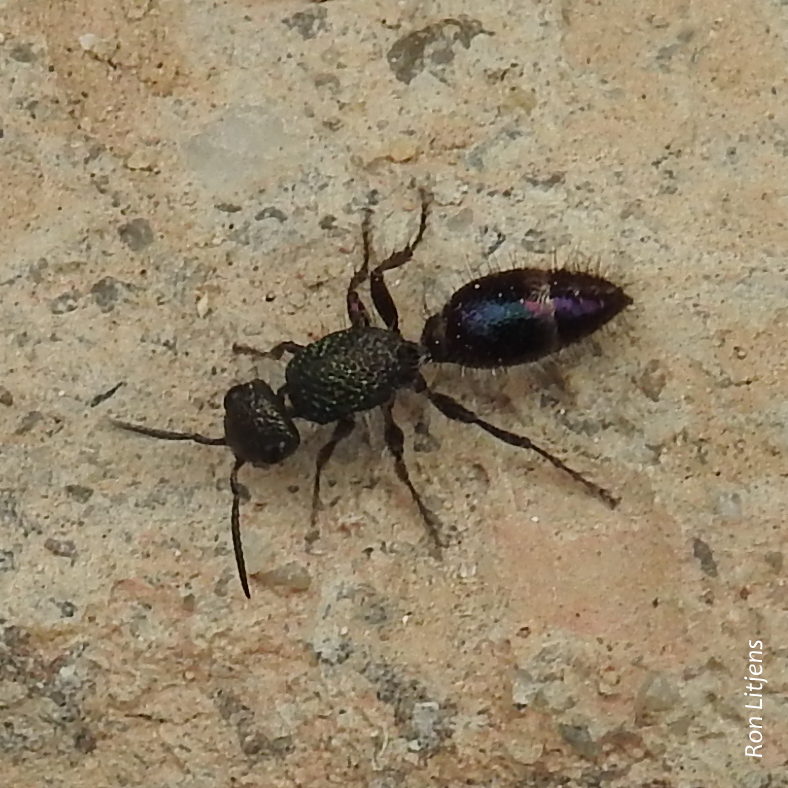 The B&B is still buzzing though. At the base of the lime-mortared brickwork is a bluestone block, originally the base of the loading bay entrance. Drilled into the block for reasons time has forgotten are a series of holes. In recent days orange and black wasps have been building nests of mud in those holes. Also investigating the holes have been Cuckoo Wasps (I think), pictured left. They are not wingless although the photograph makes them look so. The Cuckoo Wasps have been busy checking all the holes … except one!
Cuckoo Wasps are typically iridescent green or blue. As the name suggests they are a parasitic wasp laying their eggs in the nest of their host, in this case Mud-Dauber Wasps. When the Cuckoo Wasp eggs hatch the larvae eat the food that has been stored for the Mud-dauber young and then when the Mud-daubers larvae hatch they eat them as well.
 Back to the hole which was avoided by the Cuckoo Wasp … sitting inside was one of the orange and black wasps, no doubt protecting the nest. But for how long? At some point in time one imagines it will have to go out and feed and the Cuckoo Wasp will pounce.
Unfortunately there’s no room service at the Blue-banded B&B.
Preying on the mantis
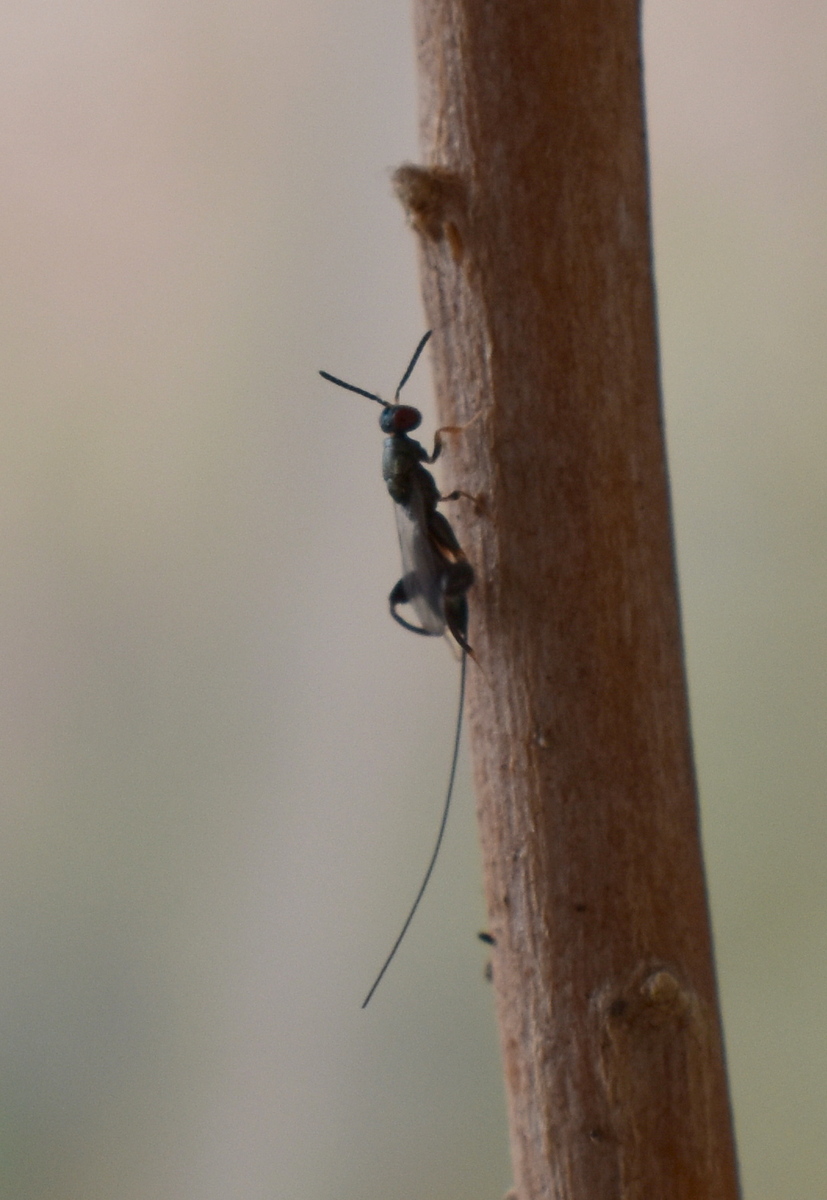 An ovipositor is a structure used by some animals to lays eggs. For insects it is situated at the end of the abdomen, see picture left. The organ can be highly modified. In sawflies the ovipositor has been modified as a saw-like tool to slice open leaves into which eggs are laid. In grasshoppers and crickets the ovipositor acts as a shovel to dig holes in the ground. The eggs are then laid in the resulting chamber. The ovipositor in many hymenopterans (ants, bees and wasps) has been modified for stinging or piercing, many having associated venom glands. Parasitic wasps in particular use the ovipositor to drill into a substrate so as to be able to deposit eggs directly on the host body.
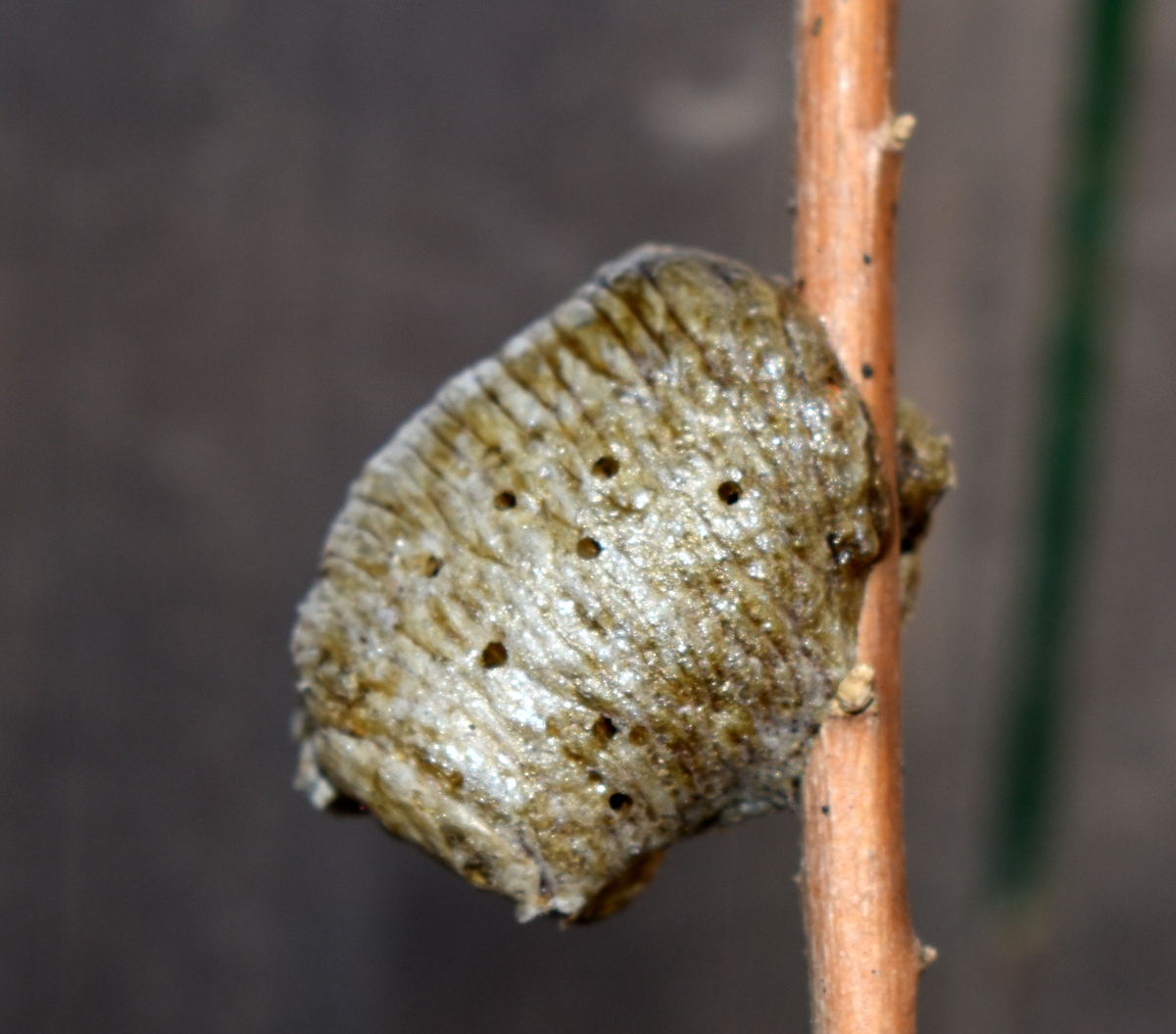 Marie on Junction Hill has been carefully watching a praying mantis egg-case (known as an ootheca, see picture right) that has been deposited on a plant outside the kitchen window, waiting for the moment in which the young mantises emerge. Recently however a Mantis Parasitic Wasp (Podagrion sp.) has been loitering about the ootheca, see photo below. The word Podagrion is derived from the Greek podagra meaning gout, referring to the wasp’s swollen hind legs (see pictured above).

Using the ovipositor as a drill the female wasp pushes it into the egg-case and deposits its eggs onto the eggs of the praying mantis. When the wasp eggs hatch they eat the mantis eggs. The holes in the side of the ootheca indicate some young wasps have already emerged.
Depending on the species an ootheca can contain up to several hundred eggs. Hopefully Marie still has a chance of photographing some of the baby mantises hatching.
Reflections on dung
 When we think of dung beetles (which admittedly is not that often), we tend to think of the two dozen or so species that were introduced by the CSIRO to aid the dispersal of cattle dung and thus reduce the problems of pasture fouling and fly breeding. But Australia has its own dung beetle fauna – apparently more than 500 species! Although some of these will tackle cattle dung, the denser, drier fibrous pellets of native marsupials are much more to their liking.
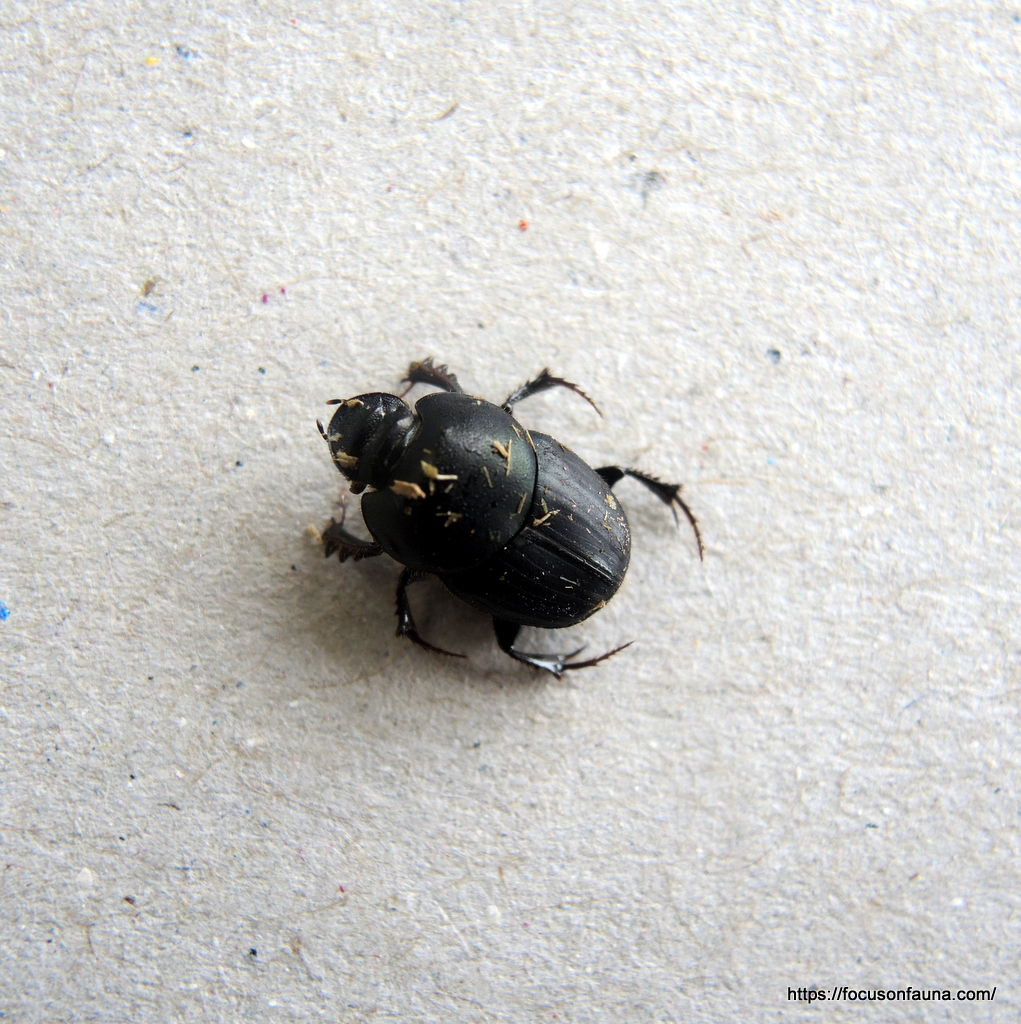
Walking past a patch of decomposing Common Wombat scats we noticed movement and, on inspection, active below the surface were several dung beetles. One of the beetles is shown in the photo above, and was identified by our dung beetle guru, Bertram Lobert, as most probably Onthophagus australis, a native species that can also be abundant in cattle dung at times. So we started to take a greater interest in the faeces of our local wombats, and discovered that the relatively rapid breakdown by dung beetles appears to be a rarity – most of the cube-shaped pellets seem to hang around for some time, hardening and fading before eventually crumbling.
As well as wombats, there are plenty of Eastern Grey Kangaroos on our property at present and, as far as we can tell, there are no dung beetles active in their numerous droppings – like the wombat scats, the pellets just dry over time and eventually crumble to dust, so that there is a range of shades from almost shiny black fresh scats to very pale older ones.
This got us thinking: have native dung beetle numbers declined? And if so, is it due to human agricultural activity – such as use of chemicals, soil compaction, mechanical disturbance, etc. Or have the beetles simply gone with the flow, so to speak, and switched to the more abundant and readily available cattle dung?
We have no answers and would welcome any comment. Results of internet searches are dominated by articles and information on introduced dung beetle species. However we did come across an article by Nicole Coggan titled Are Native Dung Beetle Species Following Mammals in the Critical Weight Range towards Extinction? which considers dung beetles in relation to small native mammals, but not kangaroos or wombats.
It would be a great pity if native dung beetles are declining, because one of the services they provide is to tunnel, sometimes quite deeply, into the soil to bury dung, thus not only enriching the soil, but also improving rain penetration. We’ll continue to keep a scatological eye on what we have available.
The four and a half hour con
There are some situations which I would love to photograph – a Powerful Owl grasping a possum (tick) or a White-bellied Sea-Eagle snatching a fish from the surface of a lake (not yet). I call these National Geographic shots. Another which fits this category is a cuckoo chick being fed by its adoptive hosts. So when I saw a juvenile Pallid Cuckoo (pictured below) sitting in a tree chirping as if calling for food and found it in the same vicinity the next day I thought, here’s my chance.
 Pallid Cuckoos (Cacomantis pallidus), like most Australian cuckoos, are brood parasites in that their eggs are laid in the nests of other species and when they hatch the chicks are raised by the new host. Very often there is a size mismatch between the cuckoo chick and the chicks of the host, that is if the cuckoo chick doesn’t kick the other chicks out of the nest. Typical host species are honeyeaters and orioles.
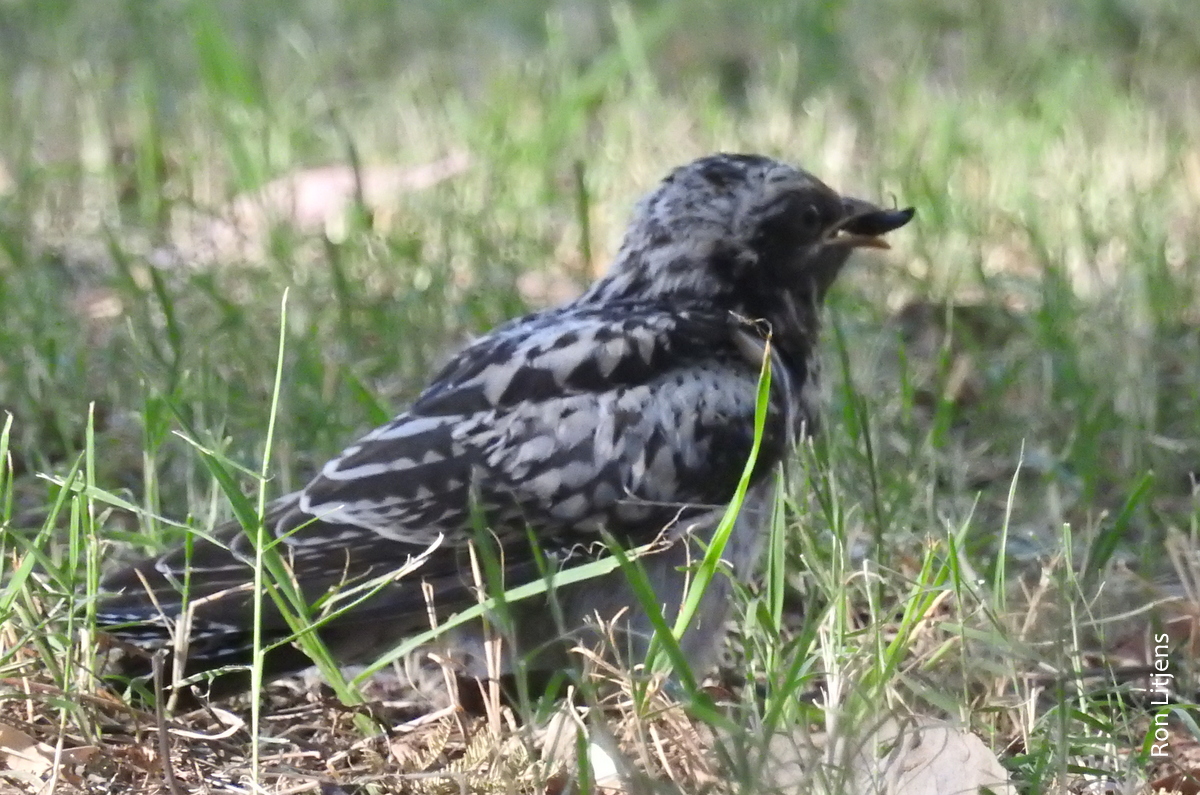 Over a period of three days I watched the juvenile cuckoo as it flew from tree to tree and I waited, camera at the ready, for the moment when the hosts would turn up to feed it. After about four and a half hours of accumulated viewing time the con was revealed – the juvenile cuckoo flew down to the ground and ate a beetle (see picture right). It wasn’t waiting to be fed at all.
The National Geographic moment was gone, firstly because the photograph was not of host/cuckoo feeding behaviour, and secondly because the shot wasn’t in focus anyway.
The Eyes Have It
When you’ve seen a spider walking across the ceiling have you ever wondered what family it belongs to? Do you find yourself at a loss when dinner time conversation turns to arachnid identification? If the answer is yes, read on.
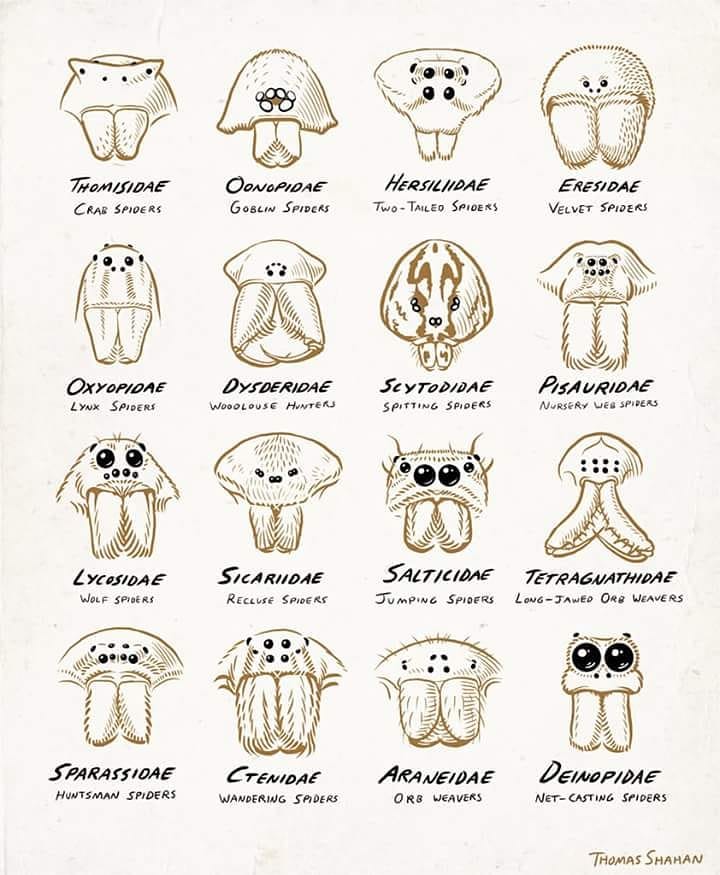 Spiders generally have four pairs of eyes – a main pair which have muscles to move the retina and are capable of forming images, and three pairs of secondary eyes which are fixed. The spatial arrangement of the eyes is characteristic of which type of spider it is. The chart to the left which I found on the web (no pun intended) shows the characteristic eye conformations associated with the various spider families.
One of the most common spiders out and about in the district, particularly at night-time is pictured below. A check of the id chart shows it to be… (see if you can work it out before reading the answer below)

 of the family Lycosidae, the Wolf Spiders. Three pairs of eyes can clearly be seen on the front of the cephalothorax (the fused head and thorax section of spiders). The fourth pair of eyes hinted at in the id chart can easily be seen in the picture right, facing backwards. Wolf Spiders are excellent hunters. They have excellent eyesight and have many sensory hairs (see picture above) to enhance the sense of touch. These spiders do not build webs but rely on chasing down prey or ambushing them from their burrows.
As discussed in a previous blog, Wolf Spiders are easy to locate at night with a torch by their eye-shine. I wonder if you are really, really good whether you can id a spider at night using the multiple eye-shine and the id chart?
P.S. Of what family is this spider? (pictured below). Click HERE for the answer.

Talking about Quolls
 Some years ago we were involved in an unsuccessful survey using hair traps to detect the possible presence of Spotted-tailed Quolls, Dasyurus maculatus, (pictured left) in Tallarook State Forest. After that experience we tended to conclude that the quoll was locally extinct and rumoured sightings were shelved in our mind into the same category as the Thylacine, black panther and even the mythical bunyip!
But recent survey work by the Australian Quoll Conservancy as part of the Victorian Quoll Project has thrown new light on the possible occurrence of quolls in our general area. The AQC project aims to establish a reliable and continuous survey program to determine Spotted-tailed Quoll numbers and distribution in Victoria. It also aims to foster greater awareness of the species through educational events with community partners.
Chris Cobern, coordinator with the Upper Goulburn Landcare Network, is one of a number of volunteers with AQC and reports that they have found scats in the Wallaby Creek area that have been positively identified as containing grooming hairs of a Spotted-tailed Quoll by ecologist (and scat analyser) Barbara Triggs, author of Tracks, Scats and Other Traces – A Field Guide to Australian Mammals. Remote camera deployment is also being used as part of the Victorian Quoll Project, and a yet to be confirmed photo of a quoll was recently recorded. In the Kinglake area Chris has obtained photos of the related Brush-tailed Phascogale (at right), but as yet no quolls.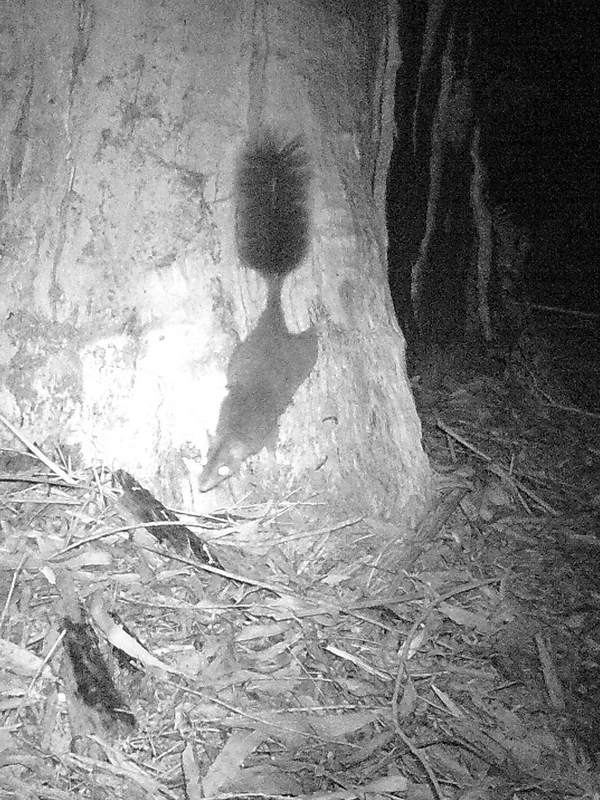
The project findings reinforce the need for work being undertaken by the King Parrot Catchment Fox Control Project, and both Parks Victoria and DEWLP will be ramping up feral cat and fox control in the Kinglake National Park and Mt. Disappointment State Forest areas with a view to protecting the endangered quoll from the threats of competition and predation.
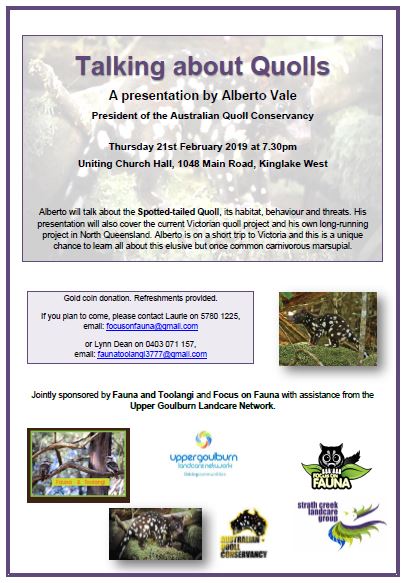 Alberto Vale, president of the AQC, is currently here on a trip from north Queensland and will be giving a presentation on the Spotted-tailed Quoll in Kinglake West this coming Thursday 21st February. The talk is jointly sponsored by Focus on Fauna and the Fauna and Toolangi group. All are welcome, but RSVP is essential – click on the thumbnail flyer at left.
And as to why it’s called spotted-tailed when in fact it’s spotted all over? All four of Australia’s quoll species have white spots on the body, but the Spotted-tailed is the only one with spots on its tail – simple really!
Black as pitch…
 …is one of the many similes to describe the total absence of colour. It is a state rarely encountered in nature unless of course you take yourself deep underground. But I reckon that I have seen something close. The Black (or Blue) Hairy Flower Wasp (Scolia soror), pictured left, is very black and very hairy, hence the name. The wings, depending on the angle at which you look at them appear to be a deep metallic blue. At the moment they are hunting around for two things – food for themselves and food for their future young.

 The adults are nectar feeders. Some of these pictures were taken at a Crepe Myrtle in the Pioneer Reserve in Strath Creek, where they were swarming the bush. After eating their fill, squadrons of them flew low across the ground, particularly over areas which were heavily mulched, including compost heaps and wood-chip piles. This is where Scarab Beetle larvae live. After mating, a female Flower Wasp searches for scarab larvae and when she find them, digs down, paralyses and then lays eggs on them. The hatched wasp larvae then consume the beetle grub.
It is no coincidence that this blog site was discussing Scarab Beetles about a month ago. At that time they were mating and laying eggs. The time for beetle eggs to hatch is between 7 to 35 days. And now six weeks on the Black Hairy Flower Wasps are mating and laying eggs (on the hatched Scarab larvae).
Everything is interconnected!
A Blue-banded Bee it is not
 With all the excitement at our place recently about Blue-banded Bees I am seeing them everywhere…or so I thought. The insect pictured left (click HERE to see a previous blog about it) is a Sand Wasp (Bembix sp.). As it hurtles past doing its wasp-like thing it superficially looks (and sounds) like a Blue-banded Bee. Both are building nests at the moment – the BB Bee in dried mud (and lime mortar!) and the Sand Wasp, as the name suggests, in sand.
Sand Wasps can be found hovering over bare sandy patches looking for an appropriate place to dig a tunnel in which to build a nest. Using its antennae it assesses a site to make sure the sand is easy enough to dig in but stable enough to support a tunnel without collapsing. Once a site is chosen it braces itself on the two back pairs of legs and rapidly digs a hole using its front pair of leg as scoops (see picture above).

 Once the tunnel is built the wasp flies off to catch and paralyse an insect, which it does in flight. For Sand Wasps the prey of choice are flies. The picture above shows a Sand Wasp carrying an immobilized March Fly back to the nest. The fly is placed in the nest, an egg is laid on it and the tunnel is sealed. The picture right shows a Sand Wasp approaching the tunnel entrance carrying its prey.
This process was fascinating to watch but ended abruptly when Mac the dog, wondering why I was laying on the lawn for so long, came over and stood on the tunnel entrance. I was obviously focused on the wrong fauna.
A Lesson in Light
 The topic of beetles has been getting a bit of a flogging on this website lately. At the moment they are out in force, feeding on nectar-bearing flowers. The Stag Beetle pictured left (Lamprima sp.) is one of these. It is stunning and its visual appearance is due to two different processes of light.
A close look at the carapace shows that it is dimpled. When the beetle is viewed from above in the sunlight it looks like it is covered in tiny little LEDs. This is due to reflection. The sunlight striking the beetle simply gets reflected back but at all different angles due to the curvature of the dimples.

The shimmering colours on the beetle’s shell (pictured above) are due to a process known as diffraction. Sunlight striking the shell gets broken up into spectral colours (nominally red, orange, yellow, green, blue, indigo and violet). Those old enough will remember the album cover of Pink Floyd’s Dark Side of the Moon showing light being diffracted into the different colours by a prism. This process is also responsible for phenomena such as rainbows, the blue bands on Blue-banded Bees and the colourful eye-spots on some butterflies and moths.
Instead of a prism diffracting the light on the beetle’s shell there are grooves. For these grooves to cause light diffraction they have to be spaced at intervals approximating the wavelengths of the colours. For example the wavelength of green light is nominally 550 nanometres (550 millionths of a millimetre) so the grooves must be similarly spaced, much smaller than the eye can detect.
So what makes this beetle so colourful is not only its cute dimples but its groovy shell.




 Focus On Fauna