Meet the parents
 The handsome creature pictured to the left is the larva of an antlion. The habits of antlion larvae were described in a blog five years ago (click HERE). They hunt by creating funnels in the sand. When an unsuspecting creature (usually an ant) slips down the slope of the funnel, the antlion larva waiting hidden at the bottom grabs the ant and drags it under the surface. It then immobilises the ant, injects it with enzymes and sucks out the juices. If you want to see one, locate the tell-tale funnel in a bare patch of sand and gently blow into it. The larva will be revealed at the bottom of the funnel. The parents though are much harder to find.
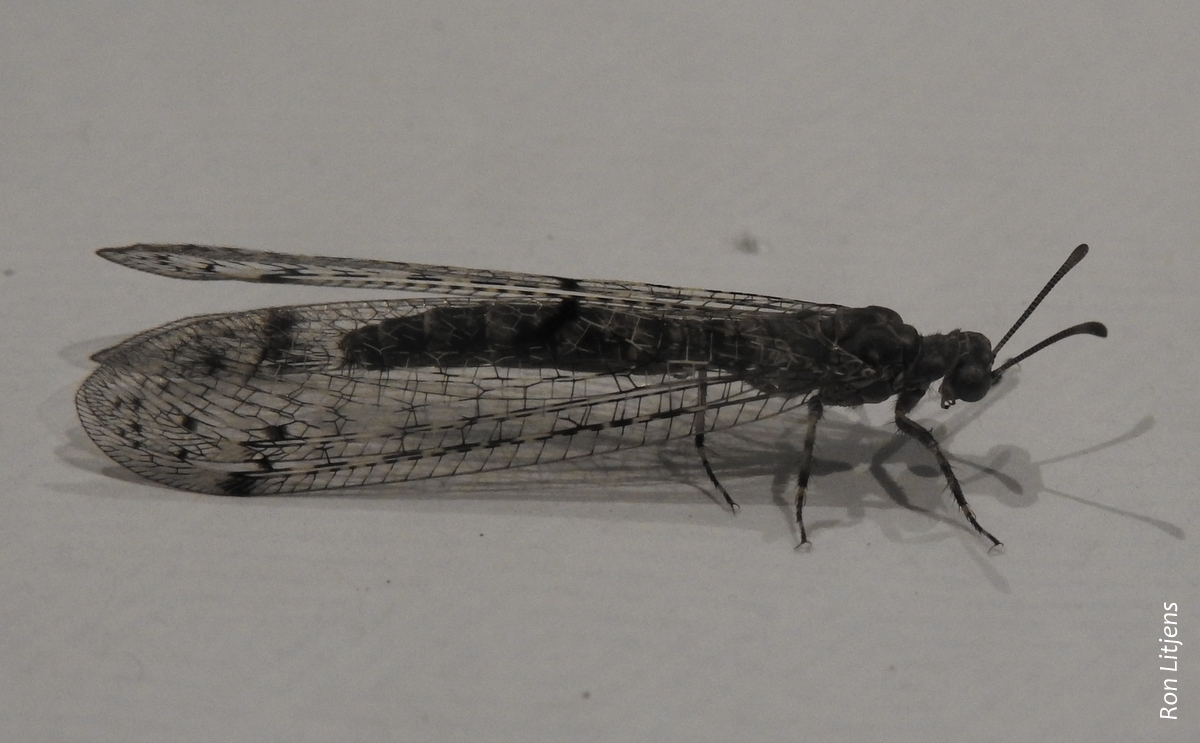
 During the warm summer nights we usually leave our unscreened windows open. Last week an adult antlion (pictured right and below) appeared in our bathroom. Adult antlions look sort of like a dragonfly, sort of like a damselfly…sort of. Like damselflies, antlions fold their wings along their body (see below). But that is where the similarity ends. Antlions have long clubbed antennae whereas damselfly antennae are very short (click on photo far bottom left). In flight the antlion action is ‘fluttery’ compared to the direct motion of a damselfly.

Damselfly
Adult antlions are nocturnal, which is why we rarely see them. The fact that their lifespan is measured in weeks rather than months doesn’t help either. Depending on the species adult antlions eat nectar and pollen or small invertebrates.
Even though you’ve now met the parents it’s hard to see the family resemblance in the larvae.
Is the coast clear?
 One of the dangers of watching and more-so writing about nature is that one can tend to anthropomorphise what we see i.e. assign human characteristics and behaviours to the actions of animals. Doing so however can sometimes make a good story.
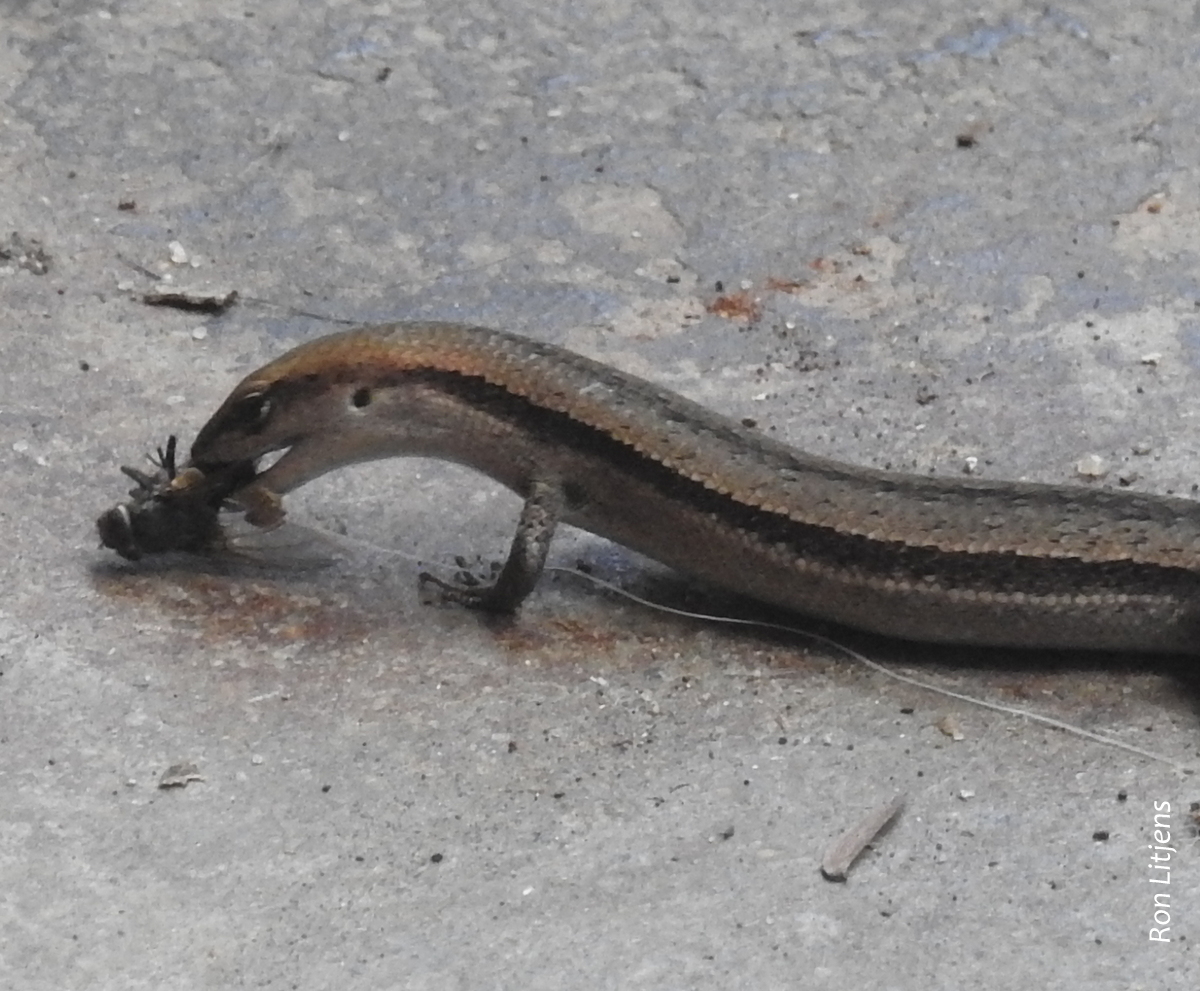
Our property is populated by Garden Skinks (Lamproholis sp.), pictured left. Watering the veggie patch results in a stampede of the little critters from underneath the straw mulch. We even have a few that slip in and out under the patio doors and live inside the house.
 Skinks are one of the five broad groups of lizards, the others being Geckos, Legless Lizards, Goannas and Dragons. Only geckos have a larger number of species. Skinks are typified by a shiny, snake-like appearance and include not only Garden Skinks but also larger lizards such as Blue-tongues. In Australia there are 11 species of Garden Skinks. They are found in eastern and south-eastern Australia.
Garden Skinks feed on small invertebrates such as insects and spiders. The ones in our house patrol the window ledges for flies and other insects trapped in the house behind the glass. They also make a meal of the plentiful Daddy Long-legs (Pholcus sp.) who set up their webs in the same location hunting the same food.
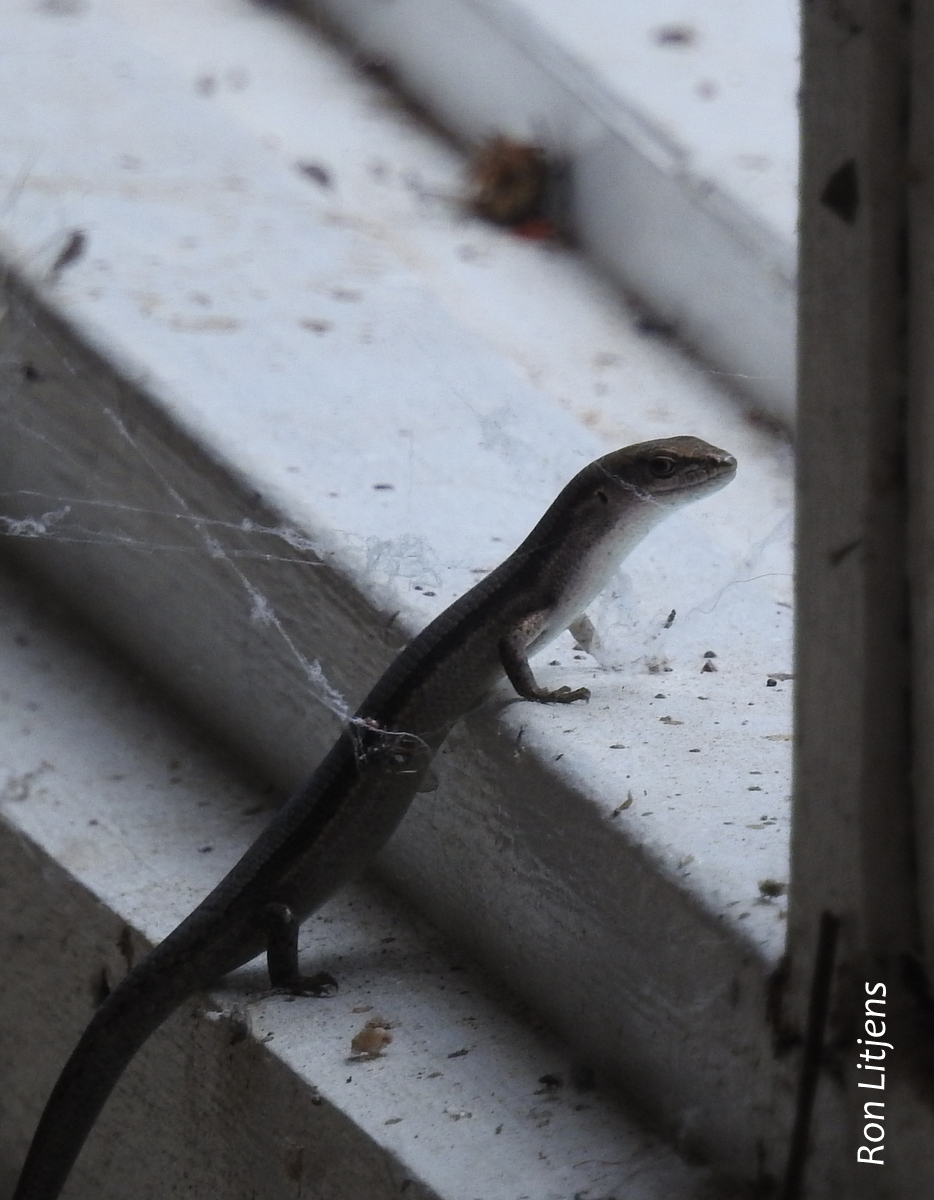
Is the coast clear?
Last week whilst being entertained by one of our resident skinks devouring a fly, we noticed it stopped eating and raced to the window looking out. Sliding past was an Eastern Brown Snake (Pseudonaja textilis), pictured above right, another one of our reptile neighbours.
Now I might be anthropomorphising but tell me it’s not checking that the coast is clear.
Jewel of a spider
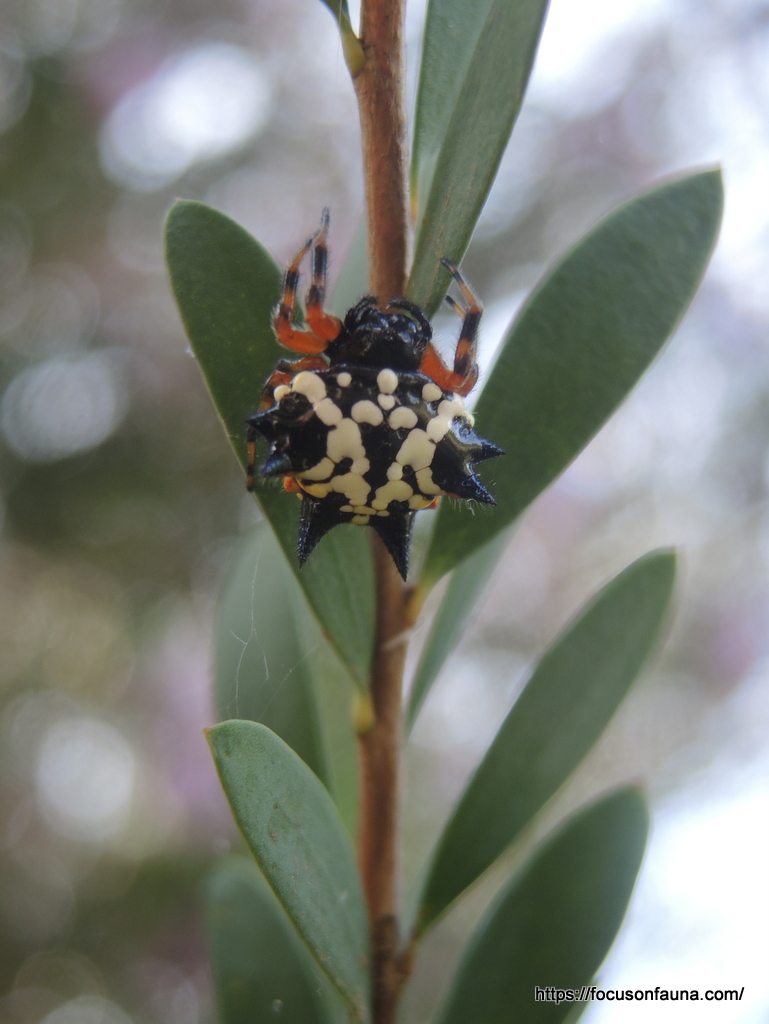
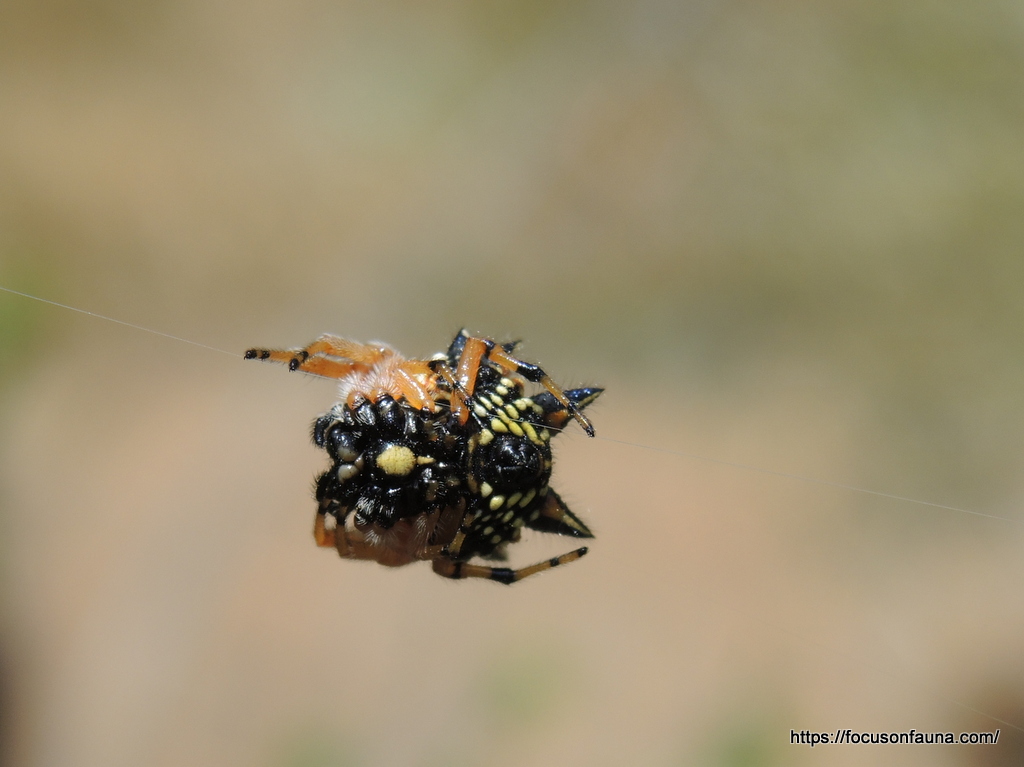 A common sight around our garden at present is the little spider pictured left. It’s a Jewel Spider, Austracantha minax, also commonly known as Spiny Spider or Christmas Spider (supposedly because it’s most numerous around Xmas time). It looks like a cake decorator has been busy with the icing bag on its back, and its underside is also colourfully patterned (see below, right).
The Jewel Spider belongs to the orb-weaver family Araneidae. It is the only member of the genus Austracantha and is endemic to Australia. All the ones we have found lately have been solitary, but it is common for them to hang out in groups, building extensive intertwining webs, presumably to improve the chances of prey capture, but proving a curse to bushwalkers.
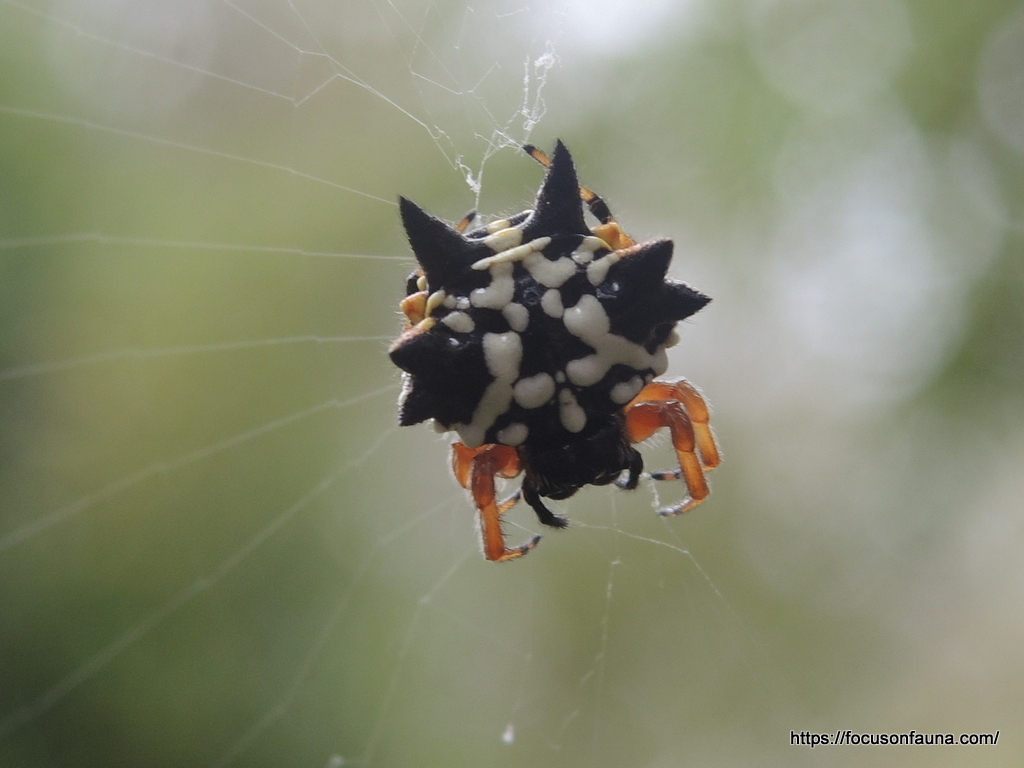
The female (pictured) is larger than the male and spends her time sitting at the centre of her spiral web. Unlike some other orb-weavers, the web is relatively permanent and not rebuilt every day.
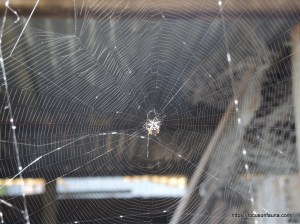
The Jewel Spider has an interesting ploy to improve the web’s durability – it adds white silk tufts at intervals along the main support and anchor threads (see web photos below) to increase their visibility to larger animals so they are less likely to go barrelling into the web.
The rest of the web is very fine and near invisible to the spider’s prey of small flying insects.
So keep an eye out for this little jewel, if only to avoid getting tangled in its web.
Hiding your colours
 On these warm summer nights I have taken to walking Mac the dog late at night with a head-torch (that’s me wearing the torch not Mac ). It has revealed a wonderful world of critters, usually by having them slap you in the face as they swarm around the light.
One of the more striking moths seen recently, pictured left, sent me scurrying to the reference books to try and id it. It is a Fallen Bark Looper Moth (Gastrophora henricaria). The ‘looper’ term refers to the particular walking style of the caterpillar (see previous post).
The caterpillars feed on 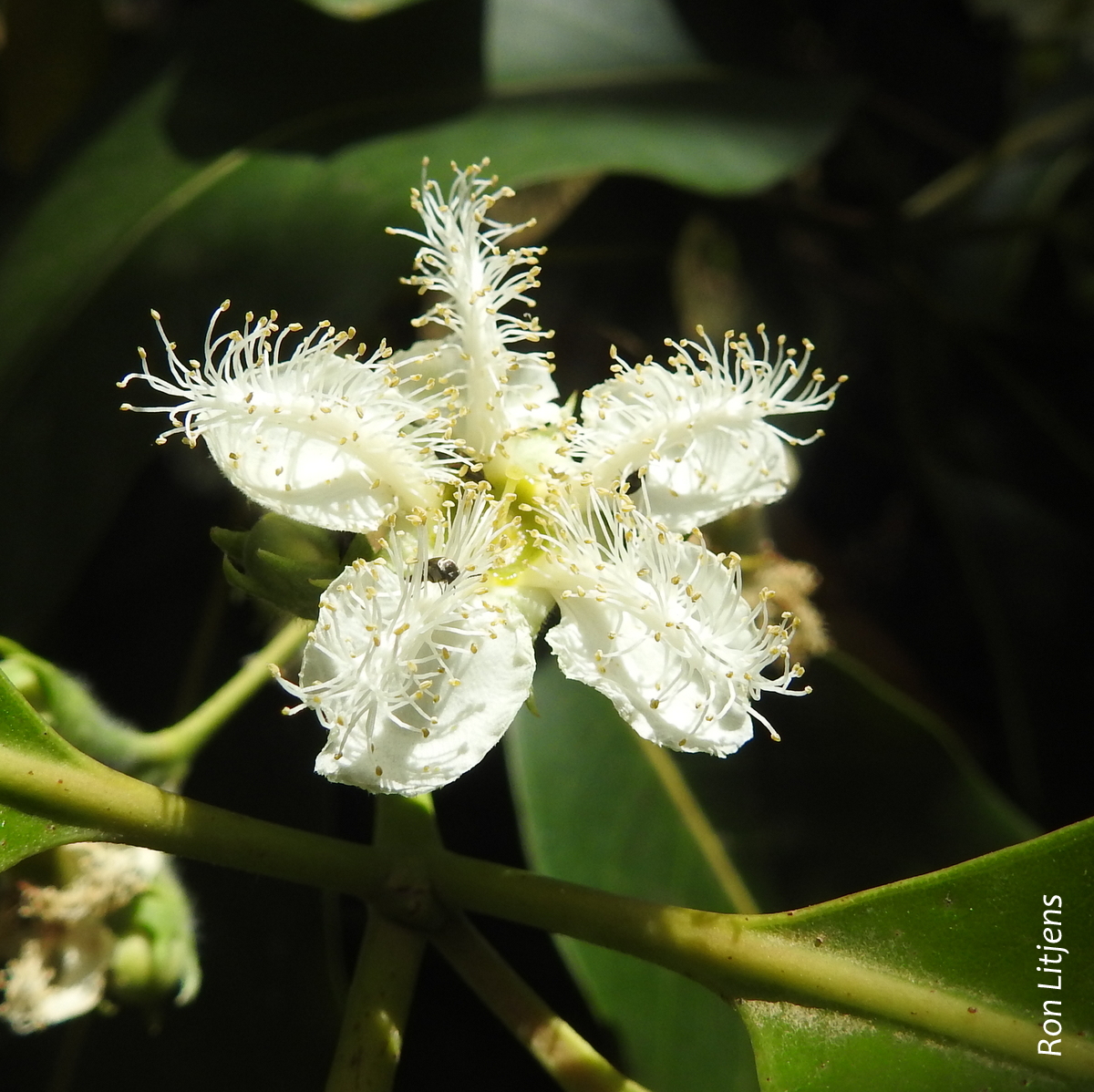 Eucalyptus and Brush Box (Lophostemon confertus) leaves. The Brush Box is a native of northern NSW / southern Queensland. Coincidentally a hitherto unknown bush on our property was, after 15 years, identified as a Brush Box earlier in the week (spooky!). It is currently flowering (pictured right) and is an absolute ‘wasp magnet’.
 Macwake looked up the moth in Moths of Victoria Part 4 by Peter Marriott, and sent me the picture below from the accompanying CD. The moth in question is a male and its underwings are stunning.
.
It’s a pity I didn’t know this at the time of taking the photo otherwise I would have poked it with a stick…only joking.
Life’s not easy at the Blue-banded B&B
 The last blog described an external wall of our house where dozens of female Blue-banded Bees (Amegilla sp.) had made their nests by burrowing into the friable lime mortar. At the end of each burrow is a cell in which an egg and a food supply of pollen (for when the egg hatches) are sealed. Watching the bees come and go has been fascinating (better than the TV) but in doing so we have noticed a number of other insects loitering outside.
Black Spider Wasps (Fabriogenia sp.), pictured above left, have been searching all the nooks and crannies in the mortar to locate spiders which they detect by tapping their orange antennae on the surface. Once located the wasp immobilises the spider and takes it away to the nest where it lays eggs on it (see previous blog).
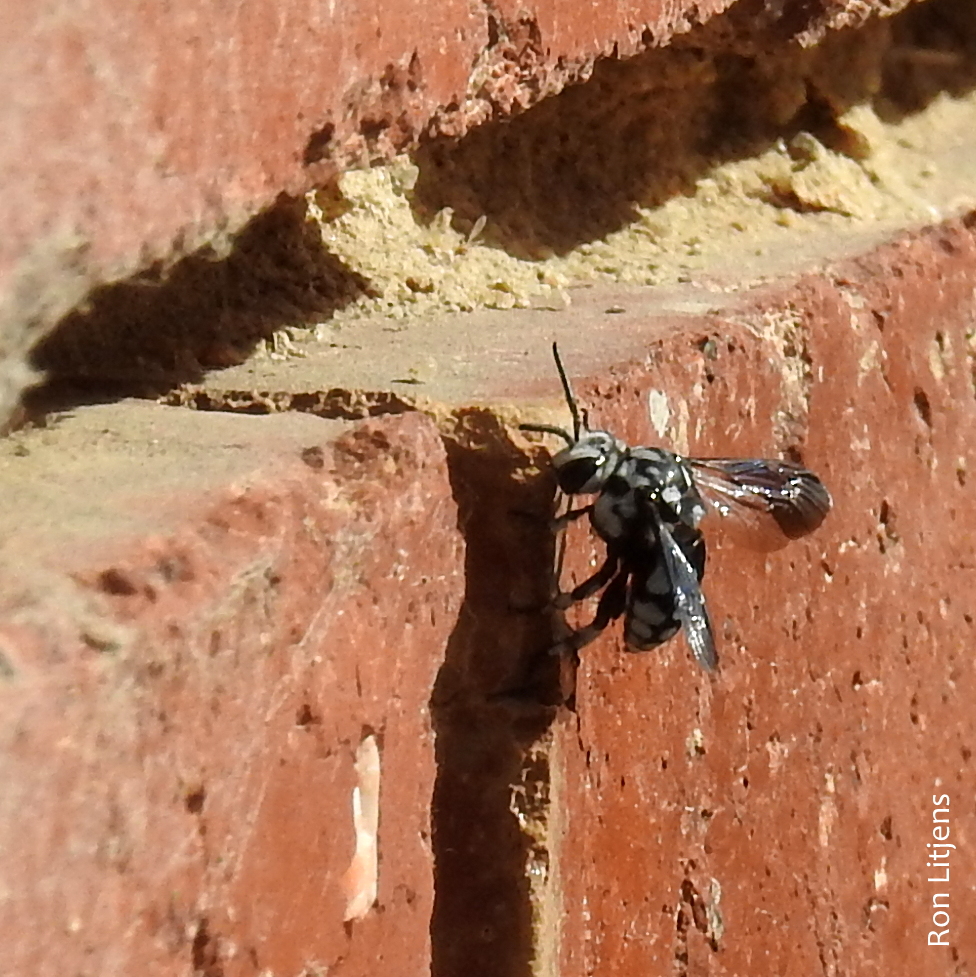 More troubling from a Blue-banded (BB) Bee point of view is the presence of Chequered Cuckoo Bees (Thyreus sp.), pictured right. Cuckoo bees do not build nests. Instead they wait until a Blue-banded Bee has just about finished loading the cell with pollen and then while the BB Bee is away they lay their own egg inside the cell. If the cuckoo bee larva hatches first it will eat all the food and the BB Bee larva will starve.
.
.

Cuckoo bee (right) following a Blue-banded Bee (left) home
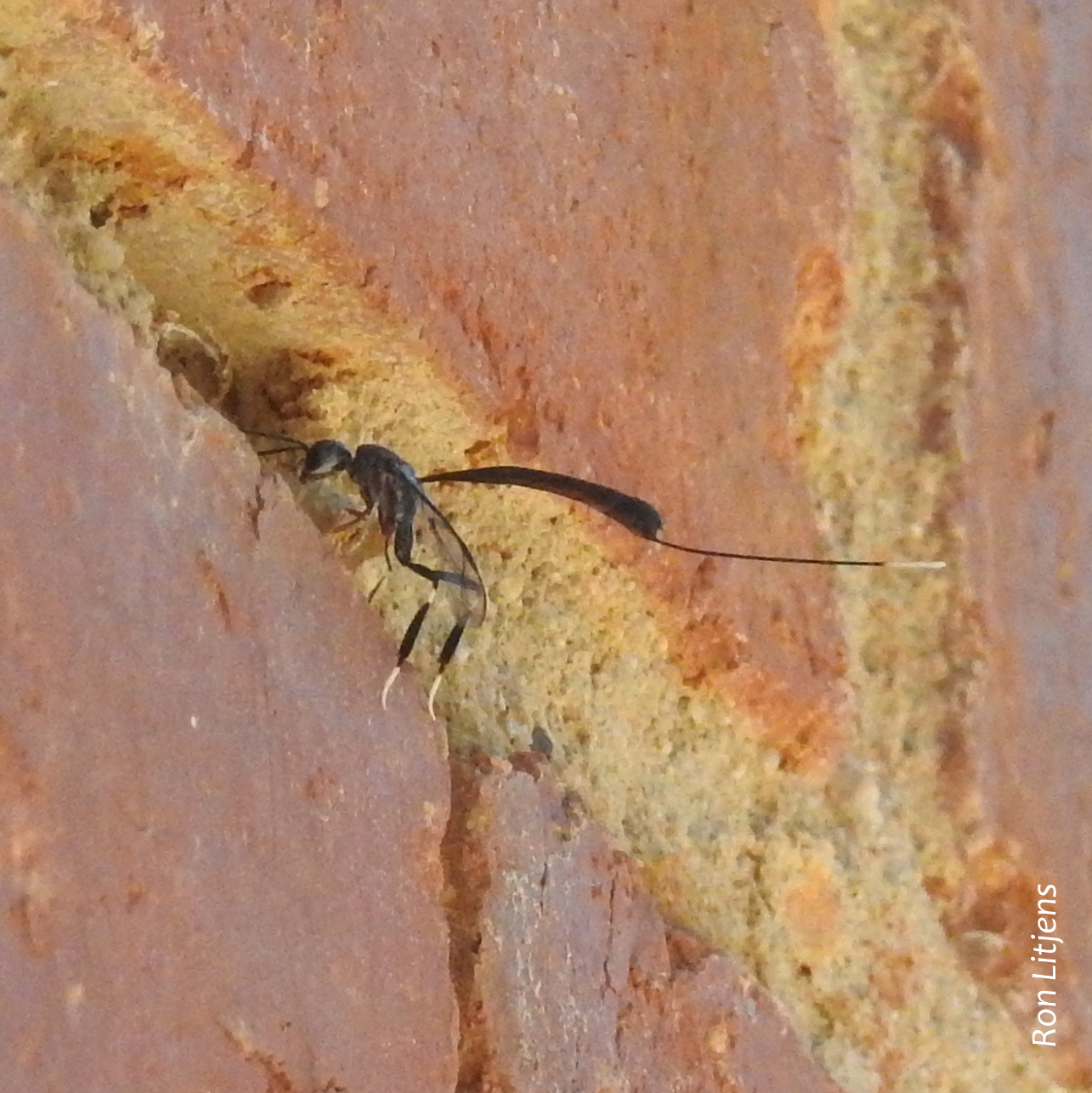 And if that wasn’t enough, Gasteruptiid Wasps (Gasteruption sp.) (pictured left) are also checking out the BB Bee nests when the bees are away. Adult wasps are nectar feeders and can be seen buzzing around flowers in summer. The female wasps of this type oviposit an egg into the BB Bee nest cell. When the wasp larva hatches it consumes the bee egg or larva and the stored pollen. This is called kleptoparasiticism.
They say that you can’t choose your family but you can choose who you mix with…unless they follow you home.
The blue-banded B&B is open for business
 We have recently moved into an old brick building (ca. 1905) that is falling down. The very long list of repairs includes repointing all the lime mortar between the bricks which has weathered out over time. I also want to install a bee hotel (or B&B) somewhere in the garden. I have had several half-hearted attempts at this elsewhere but now it’s time to get serious.
My guru on bees and other things pollinating is Karen Retra, based in Albury. One of her many jobs is to coordinate the Wild Pollinator Count, a citizen science project run twice a year. Karen’s website contains some really great downloadable resources including how to build bee (& other critter) hotels.
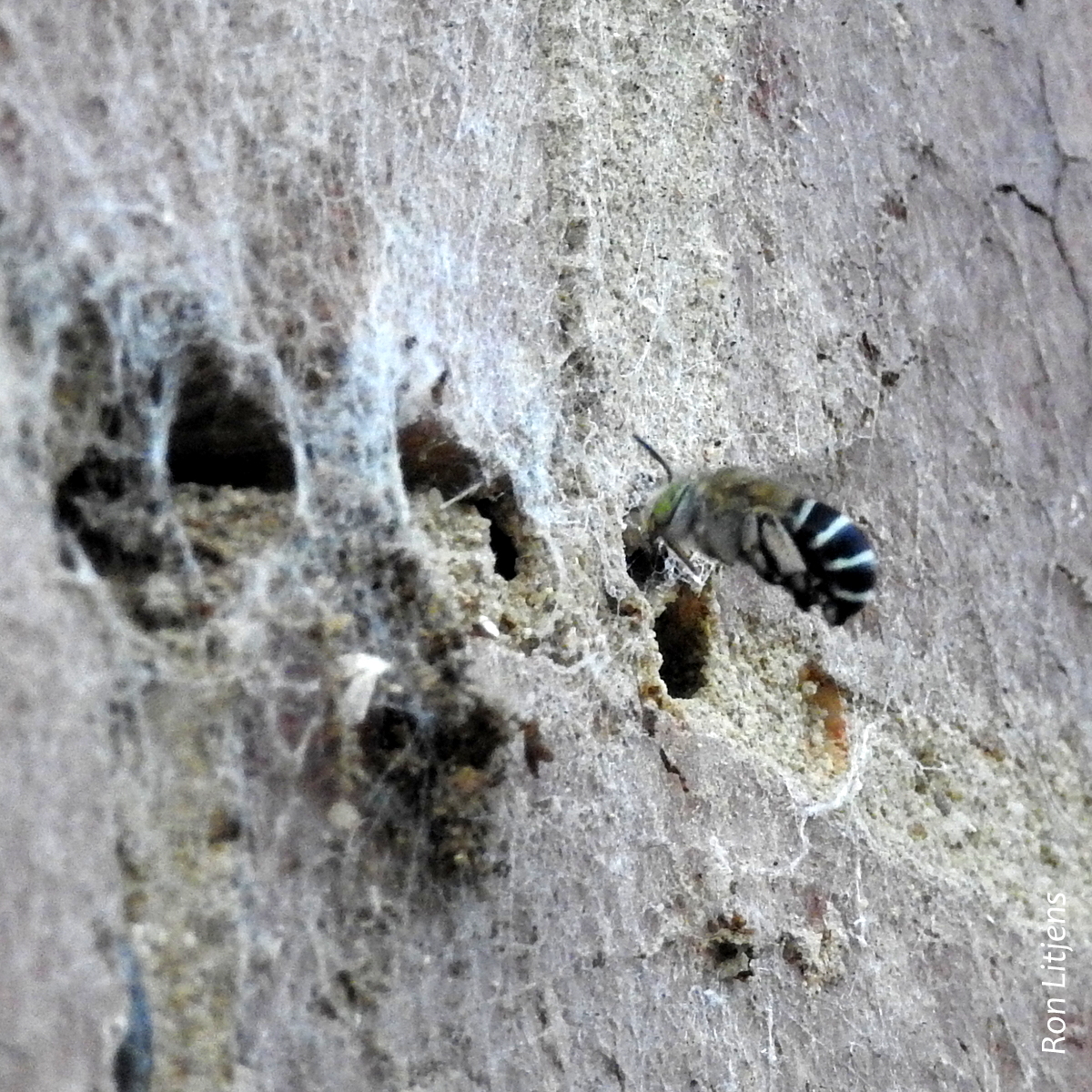 Walking next to the building last night after a very hot day I heard the buzzing sound I recognized to be that of Blue-banded Bees (Amegilla sp.) (who’s calling me a nerd?). Looking up I saw not one or two but dozens of these bees coming back to their nesting sites in the weathered mortar (photos above and right).
Blue-banded Bees, covered previously on this blog-site, are native to Australia. They build solitary nests burrowed into limestone, dried river banks and, surprise, surprise, mortar between bricks. At the end of the tunnel is a cell which contains a single egg.
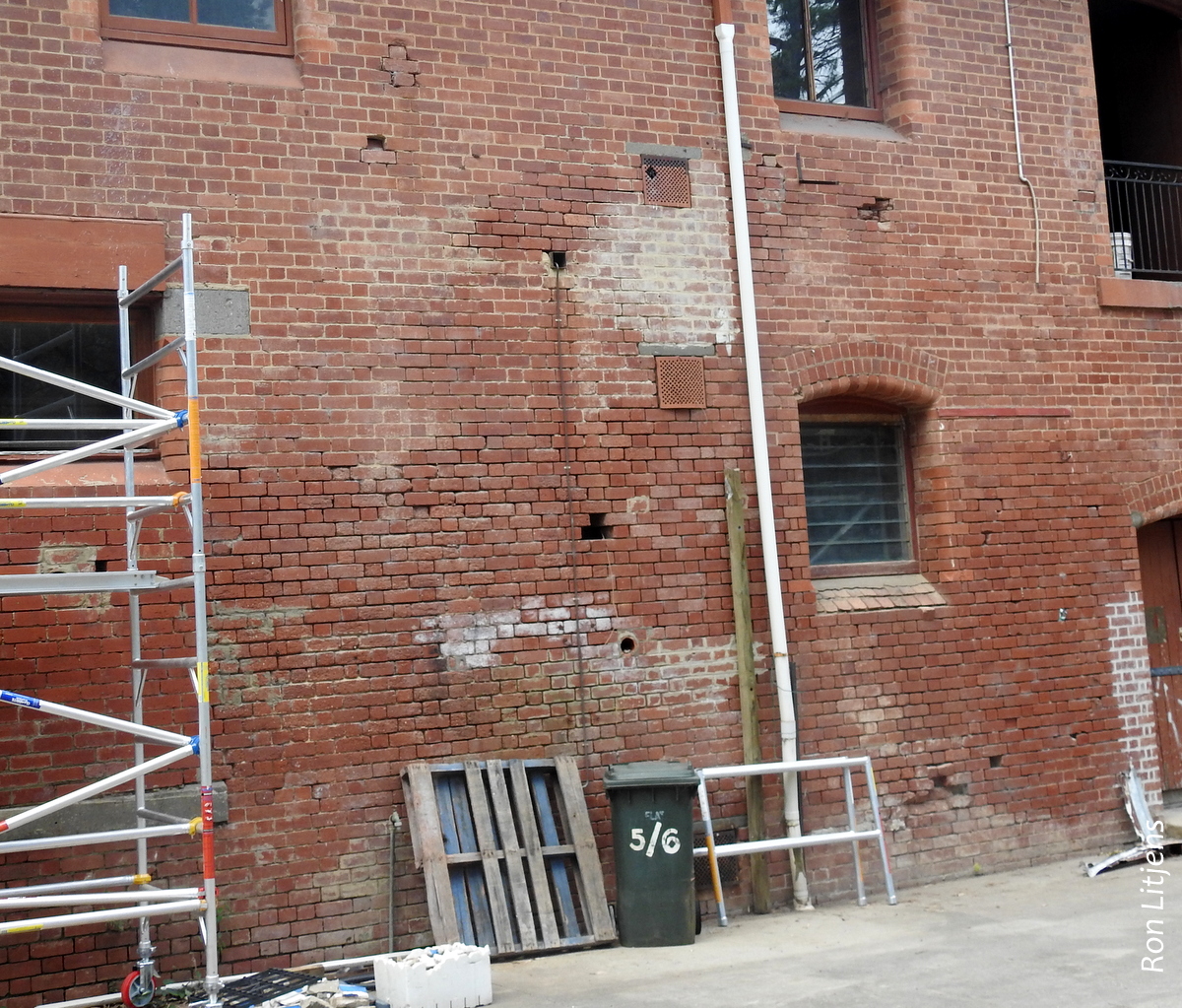
Welcome to the Blue-banded B&B
I’m now in a dilemma. I have just purchased scaffolding so that I can access the upper reaches of the brick wall to repoint all the cracks and holes in the mortar (see picture left). Currently the scaffolding has temporarily been transformed into a viewing platform of my newly discovered residents but I will eventually have to renovate the building … or maybe not?
I now find myself living in the largest bee hotel in the world. I wonder how much of the mortar damage the little buggers did themselves!
Precarious position
 As described in the previous post, A wine glass half empty, it’s always a delight to come across an active bird’s nest, but things don’t always go to plan. We were surprised to find a flimsy nest in a spindly Drooping Sheoak (see below) out in the open at the back of our place. Further surprise came when we discovered a couple of downy chicks in the nest. These turned out to belong to a pair of Dusky Woodswallows, part of a small flock that had taken up residence here recently.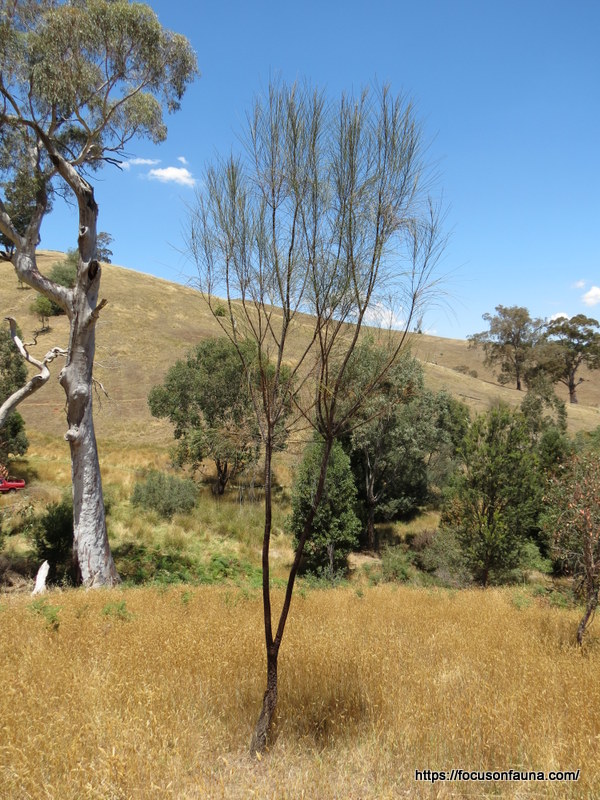
We were able to watch from a distance for a day or two as the parents regularly flew in to feed the chicks. But, perhaps inevitably given the precarious position of the nest and the number of predatory birds around – kookaburras, currawongs, butcherbirds and several raptors – the next visit to the site just a couple of days later revealed no sign of the nest, chicks or even adults – nothing!
It’s a tough world out there, and although our woodswallows got one stage further than Ronlit’s fantails, the result unfortunately was the same in the end.
See the slide show below for more pictures.
A Wine Glass half empty
 In fact this is a wine glass totally empty story. In the past few years I have been training myself to not just see birds but observe what they are doing and listen for them, because photographing them is one thing but being able to watch them nesting and rear chicks is another.
So it was with great delight before Xmas that I heard and then saw two Grey Fantails (Rhipidura albiscapa) involved in a lot of activity in the vines next to the house. The birds then started making repeated trips to the back door (pictured above left through an embarrassingly dirty window) where they appeared to be collecting the hairs of our Border Collie, Mac, from the door mat. The frequency of those visits suggested that the nest was not too far away and after careful observation of the to’s and fro’s of the birds the location of the nest site was soon apparent.

Over a period of five day the nest slowly took the shape of the classic wine glass (without the base), characteristic of Grey Fantails. Fantail nests are made of fine grass, bark strips, plant fibre (& Mac hairs) all held together with spider webs. Unfortunately, irrespective of what angle I tried to take a photograph (even from the roof) there were leaves in the way. But being aware of the danger of having the eggs predated by a currawong or some other bird I resisted the urge to do some pruning.

The literature says the sitting time is about two weeks. Through the three days of heavy downpours and the plus 40C days a bird sat on the nest (pictured above). Then after a week and a half, nothing. The nest was left untended and has been ever since. No explanation. Not even any evidence of eggs. All that is left is a deteriorating construction of bark and Mac hair, pictured left.
For a wine glass full story, a glimpse of what could have been, check out ‘A Grey Fan-tale’.
Dollarbirds, cicadas and mynas
We received this report from Peter of Seymour about Dollarbirds beside the Goulburn River:

“On 2nd January, as I was walking along the river bank, I came across a loud gang of magpies and with it the call of a bird I didn’t immediately recognise. As I approached, the magpies flew off and a Dollarbird flew out of the trees above. Moving closer, I saw a Dollarbird chick on the ground (see photo above), presumably the target of the magpie gang. The chick had the plumage colour of the adults but a pale bill and gape. As I reached for the chick, I was treated to a wide-gaped threat and strident calls, with adults also calling nearby. I put the chick up into a branch and there it stayed – and was still there next morning. The adults were also around and both the adults and chick were calling.

I returned a couple of days later with Alan, a keen local birdwatcher, and we found the chick back on the ground but still apparently healthy. We then spotted a second chick at the entrance to a horizontal hollow branch high in a River Red Gum (see photos). Alan described how he had seen Dollarbirds nesting in similar hollows along the river in previous years. In particular, he spoke about the adults feeding the chicks with cicadas that are noisily abundant along the river in summer.

To confirm his observations, a Dollarbird landed on a branch with an insect in its beak and typical cicada wings protruding either side. Dollarbirds travel from Indonesia and New Guinea to Australia to breed over summer. At least in this area, cicadas seem to be a valuable food source and may be sufficient reason for Dollarbirds to travel so far south to breed.

Cicada exoskeletons
However, there is a sinister note to this story. Many Common Mynas were also present along the river bank. In an article on the Greengrocer Cicada in the December edition of the Victorian National Parks Association magazine Park Watch, John Kotsiaris notes that:
The other main threat to the green grocer, in my view, is the Indian [Common] myna bird; a very cunning and aggressive invasive species which was introduced into Melbourne in 1862 to control insects in market gardens. When male green grocer cicadas are attacked by a bird you will know about it. [The cicada] will let out a long, loud buzzing “eeeeeeeeeeeeeee!”. I have found that almost always [it] will be in the beak of an Indian myna.
So, the question is: are Common Mynas a threat to a critical food source for the breeding Dollarbirds? Or are there enough cicadas to go round?”
PS. As far as we are aware, the Dollarbird would be a rare sighting in the Flowerdale-Strath Creek area, and we would be pleased to hear from anyone who has seen one.
And babies make 31
 I will never know the discomfort (or not) of carrying a child when the temperature outside tops 40C but I would imagine that I would be spending a lot of time inside under the air-conditioner whether it be at home, the library or shopping mall. Animals don’t have that option.
In the baking heat during a rest stop on a bike ride I spied this Australian Native Cockroach (Ellipsidion sp.) pictured left, spending time on the apparent search for something. Closer examination of the insect revealed it to be a female carrying an ootheca (egg case), the pale brown mass under the wings (pictured below).
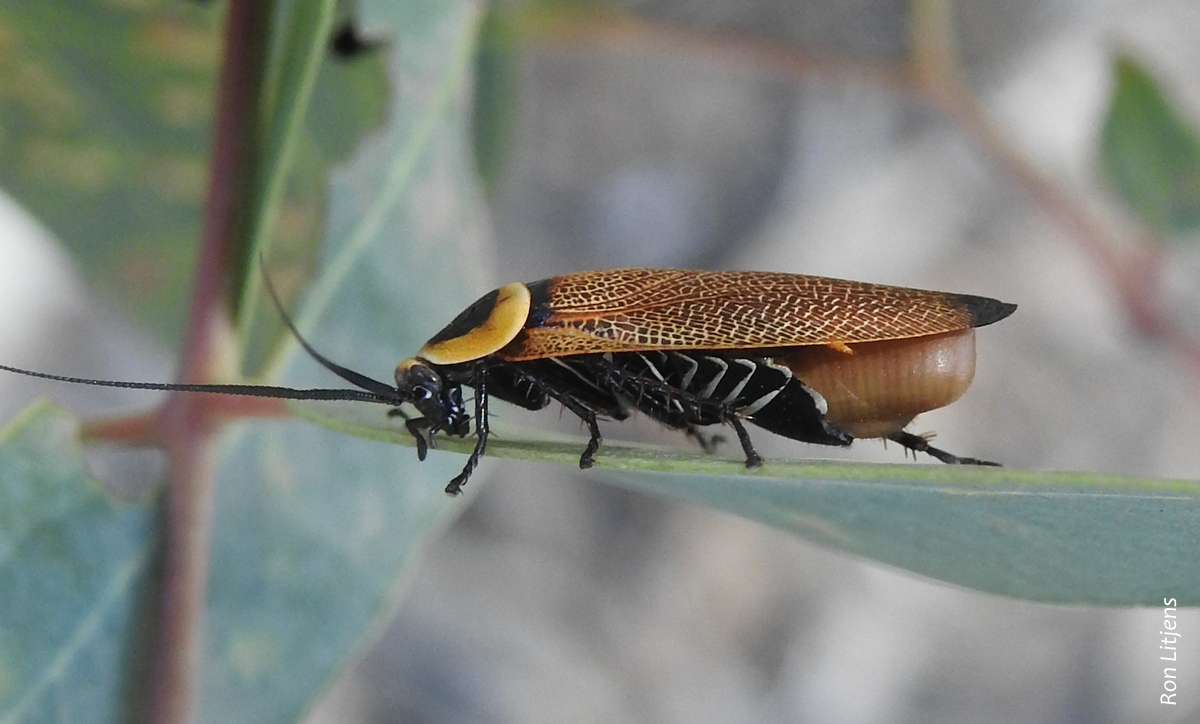
 The male and female cockroach mate end to end. The female then produces an ootheca that contains between 20 and 30 eggs, each egg being surrounded by air space. The oothecae when formed are soft but harden upon exposure to air. They are carried around until a suitable spot is found to deposit it, usually in a bark crevice. When hatched the instars look similar to the adult (pictured right) but without fully formed wings or genitalia. The life cycle proceeds through several instar stages until the final moult (ecdysis) when the adult emerges. The adult is initially white (pictured below left) but develops colouration over the space of several hours.
 But at the start of this cycle spare a thought for the Mum wandering through the bush on those hot days with 30 eggs on board.




 Focus On Fauna