Grey eminence
 BirdLife Australia is currently running the Great Aussie Bird Count which has had us out searching for local birds over a chosen 20-minute period the last couple of days. One of our regular visitors, but not yet recorded in the count, is the Grey Currawong. Perhaps because of its rather elegant grey plumage or its more solitary nature, this bird always seems a little more endearing and less threatening than its cousin the Pied Currawong, which we reported on in July.

The Grey Currawong’s slender bill provides it with an efficient tool for winkling out invertebrates from under the bark on tree trunks and branches, so rough-barked trees like the one pictured at right form one of its favourite hunting grounds.
From a distance it’s not always easy to distinguish between the Grey and Pied Currawongs because the shades of their plumage can vary, but in flight the Pied’s white feathers at the base of its tail can be seen – this white is lacking in the Grey. The best distinguishing feature of the Grey is its ringing “cling-cling” call.
Listen to the call, recorded yesterday at dawn, by clicking on the audio bar below.
Hanging the washing out to dry
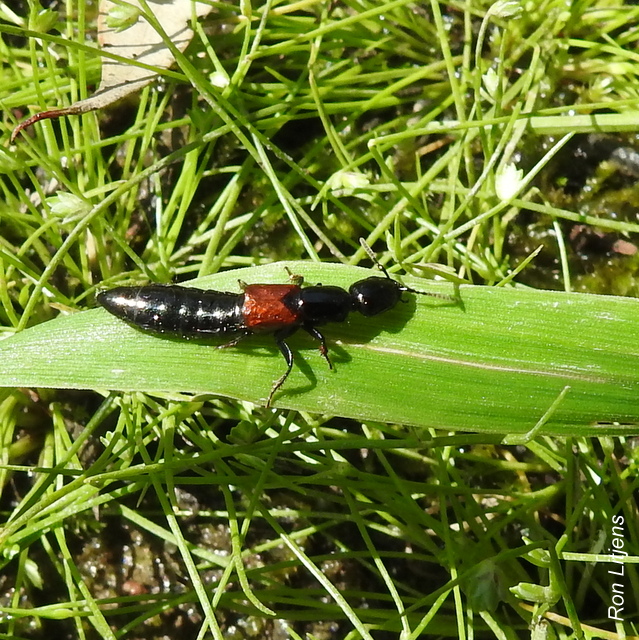 The recent heavy rains and subsequent flooding have been a boon to observers of insects. Insects too slow to avoid the rising waters are found helplessly floating on the surface searching for a piece of vegetation or a passing snail to cling to. Plucking them out of the water and carrying them to a leaf or blade of grass affords a good opportunity to observe them up close as they recover and dry out.
A case in point is this recently rescued rove beetle (pictured left). Rove beetles eat almost anything but are voracious predators of insects and other invertebrates. Like other beetles they have outer hard wing casings (elytra) that protect the more fragile flying wings underneath. In most beetles this outer casing covers the entire abdomen. However one of the characteristics of the rove beetle is the very short elytra (brown coloured in this species).
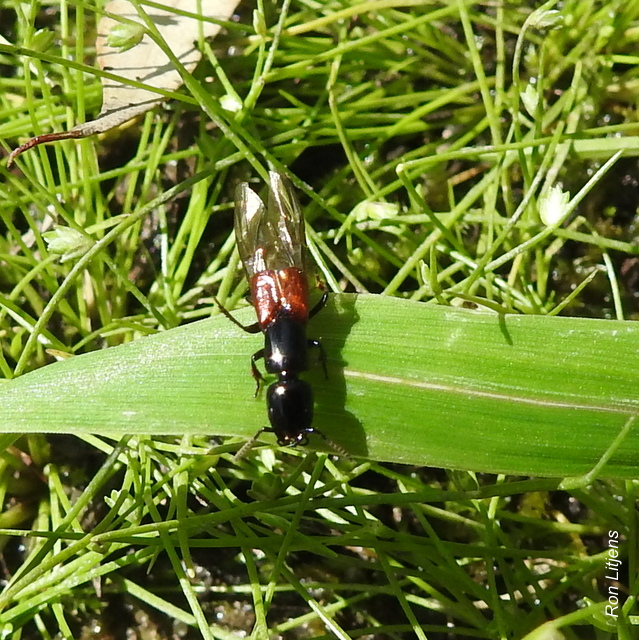 As this critter was drying off it unfolded its large flying wings to dry them in the sun (pictured right). After a few minutes it quickly folded them up and packed them under the tiny elytra.
We need some of that know-how to help us repack the portable marquee the Strath Creek Landcare Group has just purchased.
Spiders: learning to love them
 This is the title of our next Focus on Fauna presentation, and with that in mind we have included this unusual photo of a Water Spider (Dolomedes sp.) despite our policy of not immediately confronting possibly arachnophobic followers with a large spider photo.
The spider talk by Lynne Kelly will be held at Strath Creek Hall on 23rd October and all are welcome to attend. Click on the flyer at right for full details.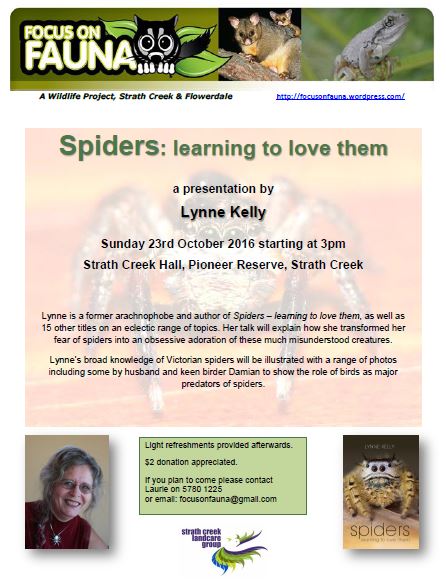
With the rainfall pattern we are experiencing, any container left outside at present is full of water in no time. And just as quickly, it seems, comes a captive population of aquatic wildlife: mosquito larvae, mites, springtails possibly – and even occasionally a spider like the one pictured here in a bucket.

Water Spiders, also known as Fishing Spiders, are in the family Pisauridae. They have hairs on the tips of their ‘feet’ (tarsi) that enable them to walk on water without breaking the surface tension. In effect they use the water surface as a web, detecting small prey by the ripples they create. But they can also dive and catch prey below the surface.
You’ve gotta love ’em!
Attention entrepreneurs!
The stunning photo of an Eastern Spinebill on the nest in the last post requires more than good photography. It also requires knowledge of what types of birds build what types of nests and then a keen eye to spot the comings and goings of our feathered friends to indicate where the nest is for this season.
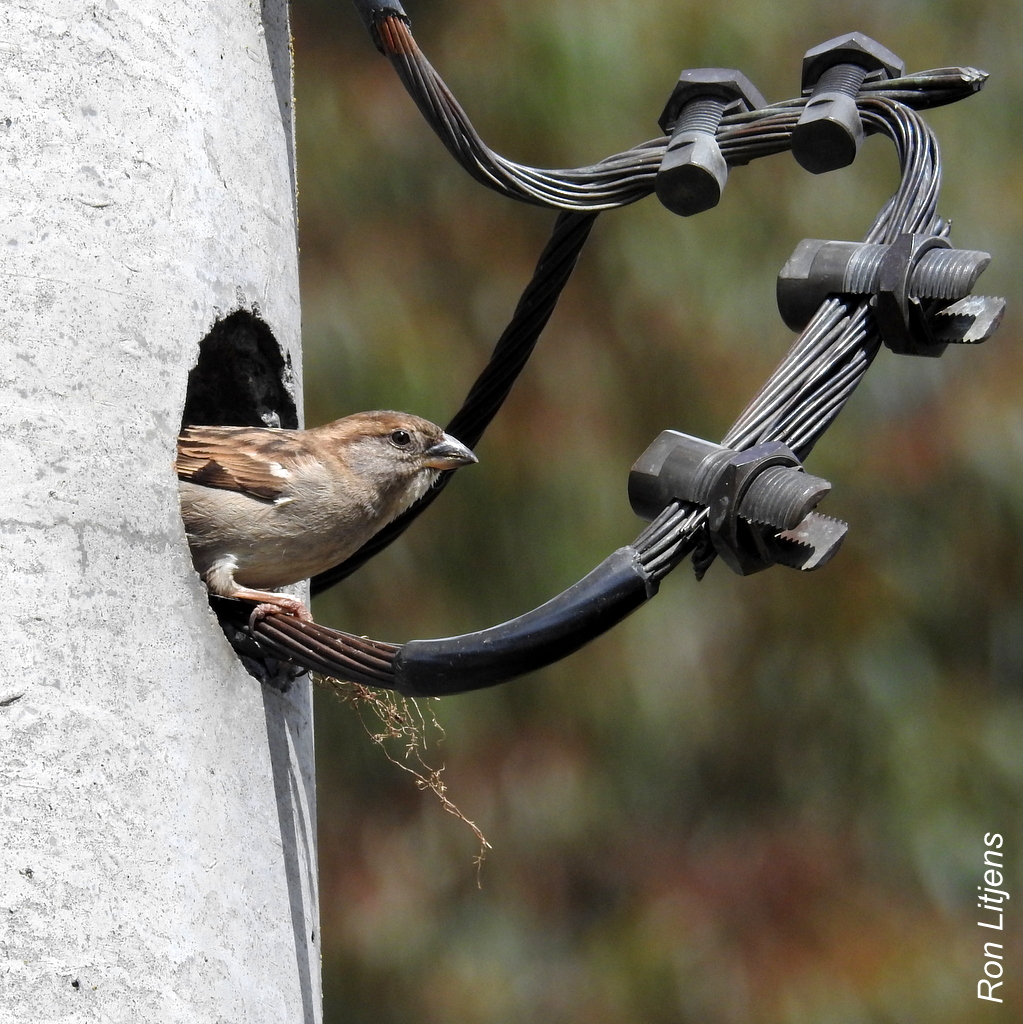 Or…you can do what I do and identify nest sites in artificial structures that the birds visit every year. In this way the ‘where is the nest?’ question is removed from the equation and it is just the ‘when?’ and the ‘who?’ questions needing answers.
Every spring I eagerly await the return of a pair of Striated Pardalotes that nest in a hole in a concrete power-pole. Every year they turn up and I follow their activities from delivery of leaves and twigs to the nest hole through to the appearance of the fledglings. This year however I was surprised and very disappointed that the hole was commandeered by a pair of House Sparrows (Passer domesticus) (above left).
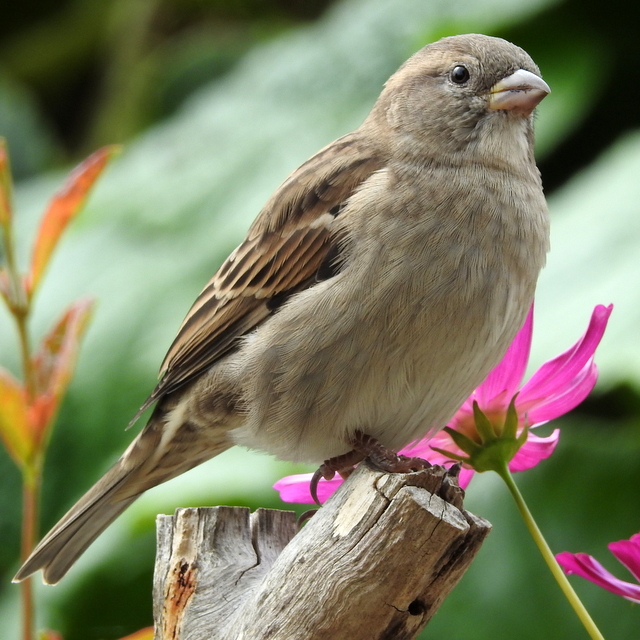 House Sparrows were introduced to Melbourne in the 1860s to combat insect pests but soon became pests themselves. As with other introduced bird species such as Indian Mynas and Blackbirds, these ‘ferals’ aggressively compete with our native birds for nest sites and food. Interestingly, House Sparrow numbers have declined in their native Europe to such an extent that they are now classed as a species of high conservation concern.
I can sense an export opportunity for a budding entrepreneur!
Trusting
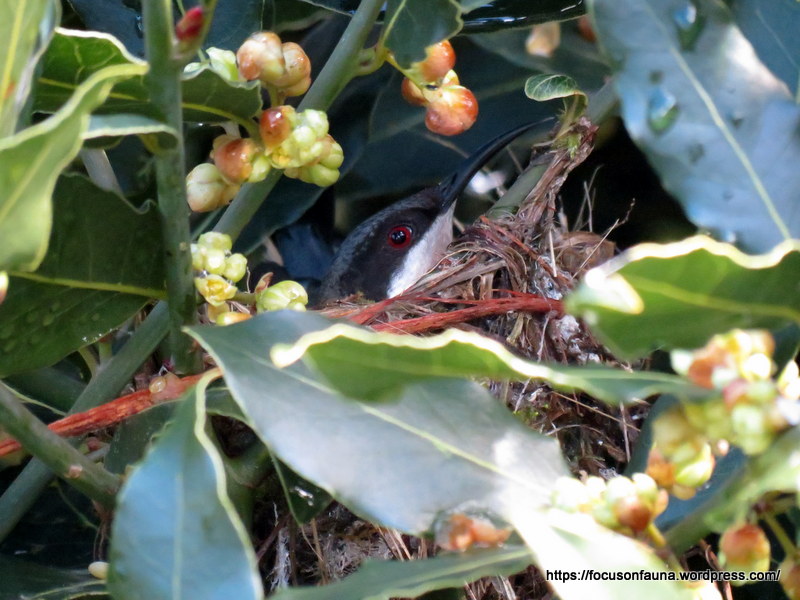
Eastern Spinebill on nest
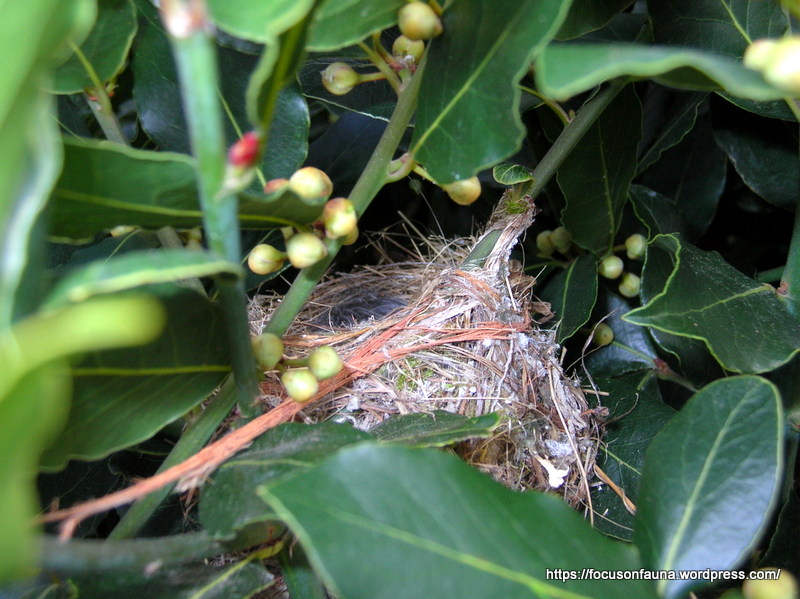
E. Spinebill nest
We have even wondered whether birds choose to nest in places close to regular human activity as a deliberate ploy to deter predators such as currawongs, that are wary of humans and never dare venture close to the house.
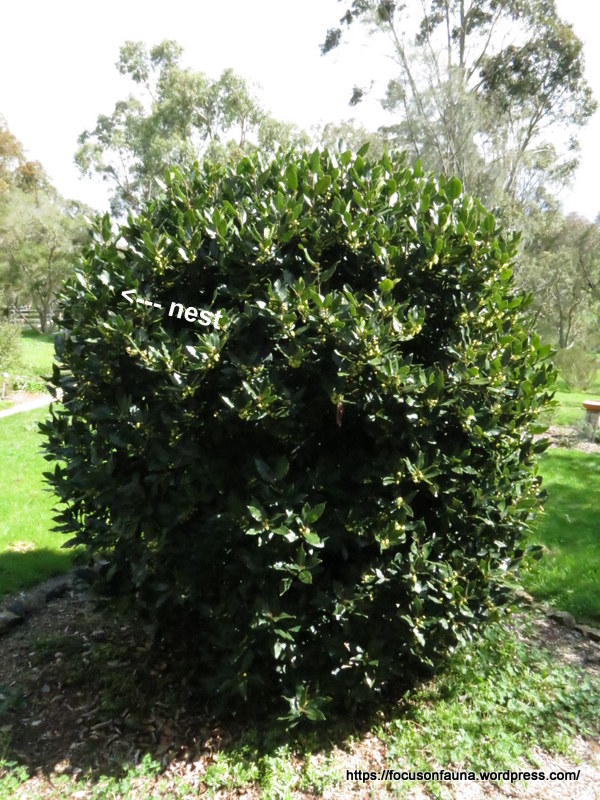
Sweet Bay
A pair of Yellow-faced Honeyeaters took this strategy (if that’s in fact what it is) to extremes last spring when they successfully nested in a native Weeping Baeckea (Baeckea linifolia) whose spindly branches overhang the garden path, and we would brush past within inches of the nest on a daily basis. That intricate and apparently flimsy nest is still there intact twelve months later (see photo below), having survived rain, hail and winds.
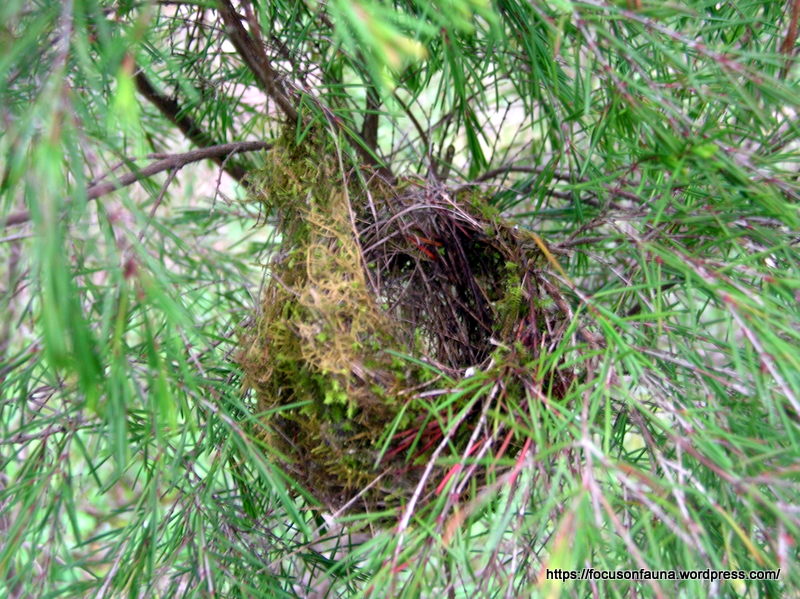
Old Yellow-faced Honeyeater nest
We look forward to having a close-up view of the spinebills’ brood.
Now I’m beginning to get it
The quest this season is to be able to identify the LBJ’s (little brown jobs), those birds of indeterminate species that to the untrained eye all look the same as they go about their daily business – in particular the Thornbills.
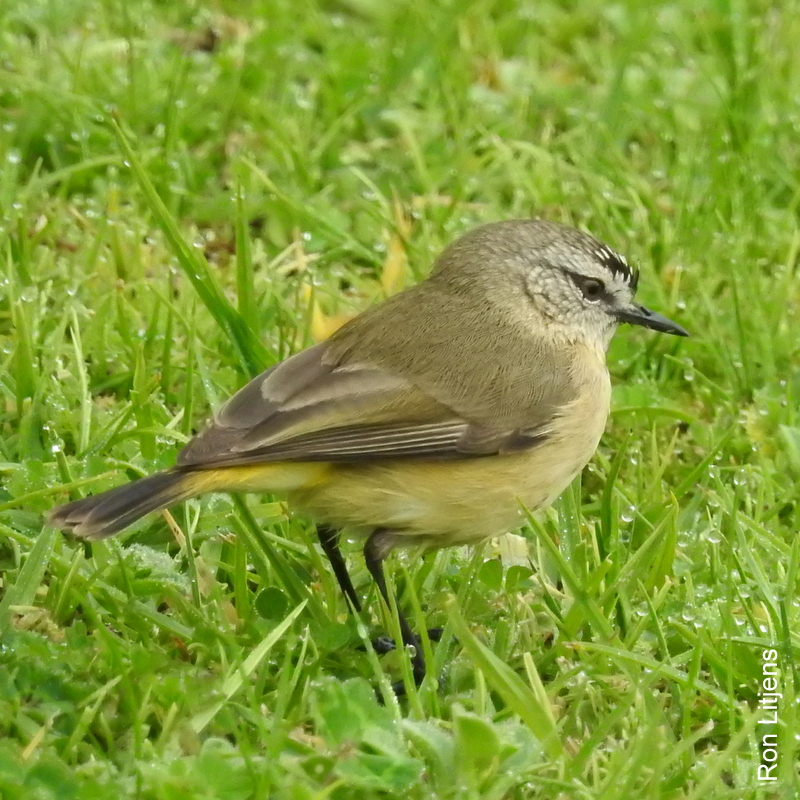 With names like the Buff-rumped Thornbill and the Yellow-rumped Thornbill one would assume the task would be easy. But in reality when these critters are sitting down or flitting high in the tree tops the rump can either not be seen or is too far away to determine the exact hue. So the plan is to get a reasonably good photo of each so that I can get a really good look at them.
This is the start – and telling them apart is really not that difficult if you know what you are looking for.
Pictured above left is the Yellow-rumped Thornbill (Acanthiza chrysorrhoa). Apart from its obviously yellow rump it has a black crown with white flecks. I should be able to see that at a distance.
 Pictured right is a Striated Thornbill (Acanthiza lineata). It has a tan crown with dense white streaks (I think the streaks are the give-away).
I think I have these two sorted. Only two or three more to go (in this district at least).
Whistling in the Wind
 Even though I could not see it, it wasn’t hard to identify the bird from its call (click on bird call below). The distinct whistling sound said Whistling Kite (Haliastur sphrenurus). But when its partner/friend/competitor alighted in a nearby tree (see picture left) the species was confirmed. These kites frequently call to each other when in flight and when perched, so are more often located by sound rather than by sight.
The scientific name is derived from the Greek words hals meaning sea and astur meaning hawk and sphen meaning wedge and oura meaning tail – a wedge tailed seahawk. It is a pity I did not get a shot of its tail whilst in flight to confirm the description.

Whistling Kites are distributed across most of Australia. As with most raptors the female is larger than the male. They live near water and usually feed on live prey which they take from the ground or from the surface of the water. Food includes mammals, fish, reptiles and amphibians.
And from the look of the beak the hapless prey would soon get the point.
Whistling Kite’s call:
Spider cluster
Perhaps in acknowledgement of the sensitivities of arachnophobes, spiders have not featured all that often on this blog, and here we have deliberately not featured a full-size photo.
But we received two photos of fine looking spiders from regular contributor Dave that are worth sharing. The spiders were found under a tyre on the property “Three Sisters” at Flowerdale. There was, in fact, a cluster (if that’s the correct collective name) of different species all apparently cohabiting happily – Red-back Spiders (Latrodectus hasseltii), Daddy Long-legs (Pholcus phalangioides) and a White-tailed Spider (Lampona cylindrata), as well as the Prowling Spider (Miturga sp.) and unidentified spider pictured below. We would welcome any identification suggestions for the latter. Prowling spiders (family Miturgidae) are so named because of their wandering hunting habits.
The other spider pictured was found hiding in a tray of revegetation tube-stock plants – poised to surprise an unsuspecting worker. This one looks to us like a Badge Huntsman Spider (Neosparassus diana), which was featured on a previous post.
Click on the photos below for a closer slideshow look at these striking specimens.
-

- Prowling Spider
-
- Unidentified spider
-
- Badge Huntsman Spider
A Hitchhiker’s Guide to the Gastropod
Everyone has welcomed the recent rains. The heavy downpours in the last week caused localised flooding but no-one seemed to mind. Any rain is good.
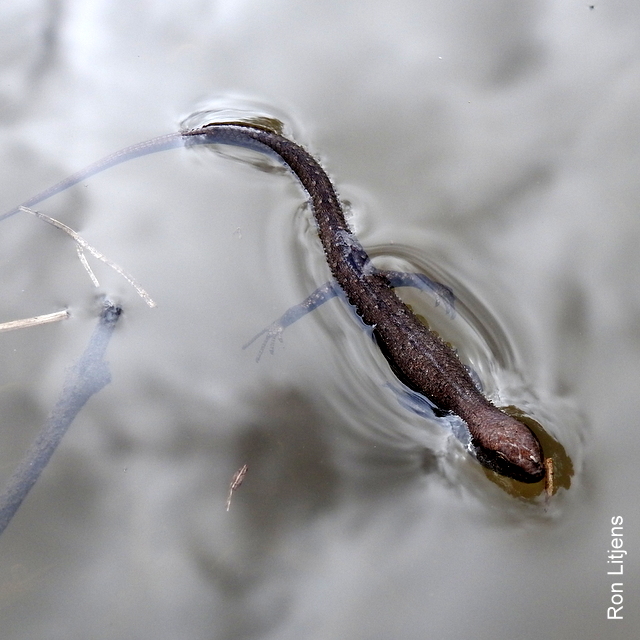 But spare a thought for all the critters which have lost their homes in the recent deluge. When rain falls lightly ground dwelling animals such as reptiles, insects and the like have time to decide whether or not to vacate their tunnels and burrows and head to drier ground. However when the rain falls heavily and the water level rises quickly these animals don’t have time to decide and are often caught unawares.

Rove Beetle (Thyreocephalus sp.)
After the recent heavy downpours in the district last week all manner of creatures were caught out. On the edges of dams and waterways fauna were seen swimming or floating on the surface of the water trying to find something to cling onto until the water receded. Usually it was a piece of vegetation such as a blade of grass or stick.
Sometimes they even hitch-hiked on other creatures to stop from drowning. If you look carefully at the picture below, a garden snail became a life raft to a centipede, several slaters and a wolf spider. Meanwhile the nearby grass stems were covered with other critters escaping the deluge.

It seems in times of survival, old enmities are put aside. Just wait until the water goes down though!
Fly in sprinter
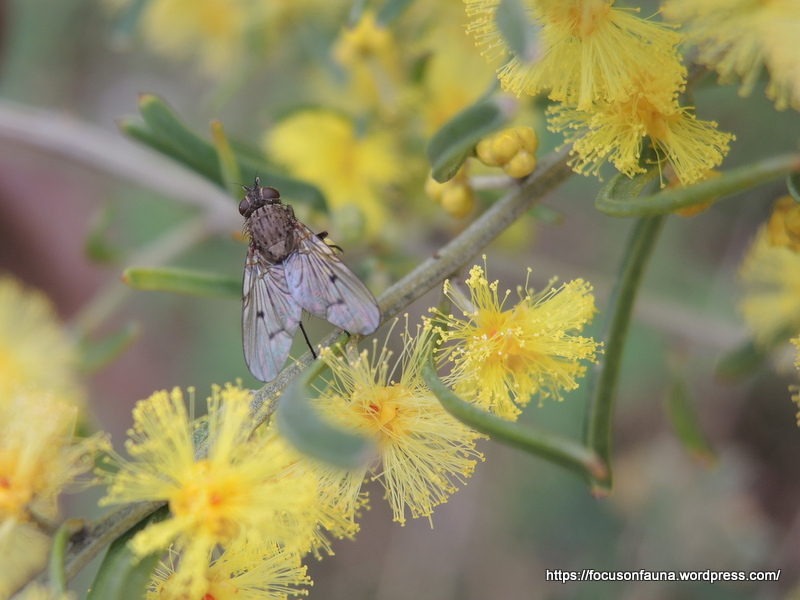
Female Muscid fly on Bent-leaf Wattle
No, the title doesn’t refer to the Olympics, but instead to that intermediate ‘season’ between winter and spring, ‘sprinter’ being a term we recently heard coined by Professor Tim Entwisle from the Royal Botanic Gardens Victoria on Radio National during a fascinating program titled In Season about the changing nature of our seasons. Few insect pollinators are active over the winter months, but sprinter is a time when occasional fine sunny days get native insects active and they start to be seen on the few native plants in flower locally at this time of year.
We spotted the fly pictured above on a Bent-leaf Wattle (Acacia flexifolia) in our garden and with a bit more searching we discovered a few other native wild pollinators as well as the introduced European Honey Bee which, given its origins in colder climes, can readily cope with lower temperatures.
With help from Manu at the Wild Pollinator Count and Tony D. on the Bowerbird website we think our fly is from the family Muscidae, possibly from the genus Helina. What we also learnt from Manu is that the gender of a fly can be determined from the placement of its eyes – the male’s eyes meet in the middle of its forehead looking from above, whereas the female’s eyes are set apart.






 Focus On Fauna