What’s the buzz?
The Wild Pollinator Count last month taught me that there are many things, not only bees, that pollinate our flowers. And if you are thinking bees, the range of native bees is large.


Recently I have noticed native Blue-banded Bees (Amegilla cingulate), pictured above, in our garden. About the size of a European Honey Bee it has blue bands on the abdomen – five if it’s a male, four if it’s a female. They are solitary bees that do not build a hive. Instead the female bee constructs a tunnel in the ground where it lays an egg and then looks after the hatched larva by feeding it nectar. The male sleeps outside, locking its jaws on a grass stem or stick then just hanging there (pictured below).
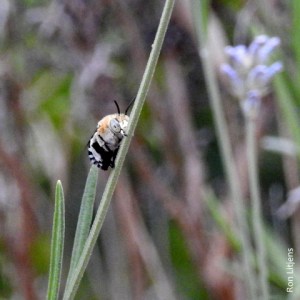
Blue-banded Bees are ‘buzz pollinators’ – dislodging hard-to-get pollen by rapidly vibrating the flowers with either their wings or head. They are particularly attracted to blue and purple flowers and in our garden are found around the lavender and pelargoniums.
Trying to get a photograph of these bees is difficult. They flit about very quickly. They also seem to be more aware of intruders than the honey bee and if you get too close they will stop their feeding, fly over towards you and look you up and down. Most disconcerting.
But if you sit there long enough …
Bronze beauty !
 Usually at this time of year it’s a Stubble Quail that causes the heart to beat faster when it is inadvertently flushed from long grass with a clatter of wings. But the quail are absent this season, and lately it’s the Common Bronzewing that produces the same effect when it suddenly flies off a few metres away in the back of our property near Strath Creek. Often all you see is a fairly dull-plumaged plump bird rapidly flying off low to the ground, and disappearing into shrubbery or low branches of a tree.
While driving along Upper King Parrot Creek Road the other day, we spotted a bronzewing sitting in the middle of the road – which is actually not an uncommon occurrence near Carver Creek. The bird eventually flew off and perched in a roadside tree, so as usual it was screech to a halt and out with the camera to try to get a shot. Fortunately the light was just right to capture the bronzed green iridescence of its wing that gives the bird its common name, but which doesn’t always show up in photos. Bronzewing indeed!
Peace and goodwill
We live on a bush block surrounded on three sides by open farmland. Unsurprisingly the majority of birds we have seen on the property are woodland birds. Some of the birds associated with the more open country have never been seen in our bush. So we have Crimson Rosellas but no Eastern Rosellas, Grey Fantails but no Willie Wagtails, which feels strange because Eastern Rosellas and Wagtails for example are abundant at the end of our driveway and all along the road leading to it.

Teenager ‘coming out’
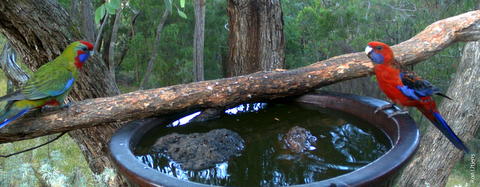
For five years now we have monitored on a daily basis using a motion-sensing camera the birds that visit the bird bath. So far we have recorded over three dozen species (and a dozen species of non-avian fauna). These days the visitors are the ‘same old suspects’. Until last week. In the past couple of months the most frequently photographed birds have been Crimson Rosellas (Platycercus elegans), usually in family groups in all states of maturity. We record them as adults (all red and blue plumage), juveniles (all green plumage), pictured above, and teenagers (a manky-looking in-between state, pictured right).

Last week while trawling through the previous days pics we came across a two teenage rosellas that didn’t quite look the same. Closer examination showed one to be the expected Crimson Rosella but the other to be an Eastern Rosella (Platycercus eximius), for the first time ever. Every day since these two have flown in together, drunk together, washed together and then flown away together, several times a day.
I’m not sure how this relationship has formed and what message I should take from it. Given the time of the year I am going to put it down to the fact it is the time of peace and goodwill among all man-(and rosella)-kind irrespective of race, colour or creed.
P.S. Geoff, our bird man from Yea suggests that the bluish tinge to the white cheeks of the Eastern Rosella could indicate that it is a hybrid, that is, has both a Crimson Rosella and an Eastern Rosella parent. Integration indeed!
Dodonaea decorations
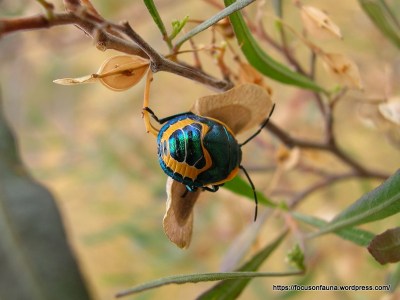 It’s collection time in our seed production area, which was set up to supply seed for the Goulburn Broken Indigenous Seed Bank at University of Melbourne’s Dookie Campus. One of the species is Narrow-leaf Hop-bush (Dodonaea viscosa subsp. angustissima) which attracts a wide variety of colourful bugs (order Hemiptera) and beetles (order Coleoptera).
Most of the bugs appear to be intricately patterned shield-back bugs belonging to the family Scutelleridae, commonly known as Jewel Bugs or Metallic Shield Bugs. It is not entirely clear what they are feeding on, but they do seem to be found mostly on bushes with an abundance of seed capsules. True bugs have piercing and sucking mouth parts, compared to beetles which have biting, chewing mouth parts.
Click on any of the photos below and view as a slide show.
Could these be the new natural alternative for festive season tree decorations?


Legless on a Sunday afternoon
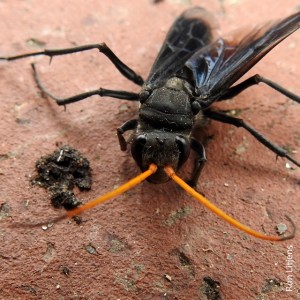 With the approach of the hot and sultry days of the festive season, being legless is a state to which some Australians aspire on a Sunday afternoon. But not if you are a spider, for this is the season of the Black Spider Wasps (Fabriogenia sp.) and they are hunting.
Currently you will see these medium-sized black wasps tapping surfaces with their bright orange antennae (pictured left) searching for spiders, the food source for young wasps. Once located, the spider is immobilised by the wasp’s sting. The legs of the spider are removed at the first joint to aid transport and entry into the nest entrance.
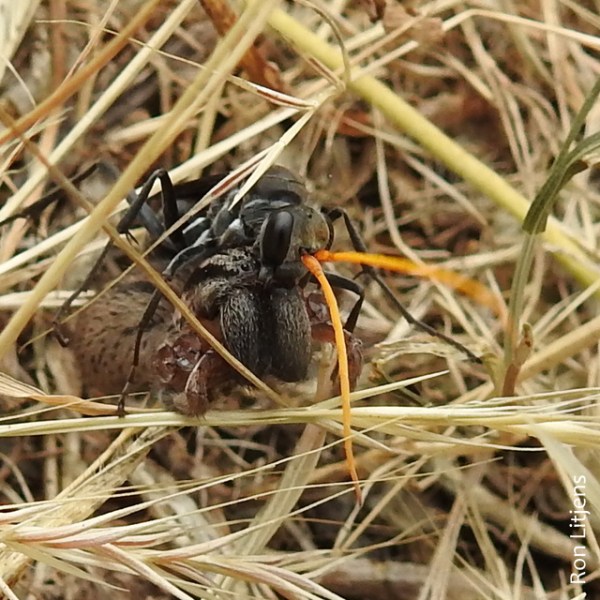
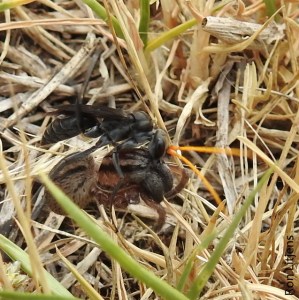 The wasp grasps the head of the spider (pictured above and right) with its mandibles and drags the paralysed body to the nest where eggs are laid on spider’s abdomen. The spider is sealed in the nest and remains alive until the eggs hatch and the wasp larvae start feeding.
This tale also featured earlier this year (click HERE to view) and macabre as it is, it is hard to look away.
Babes in the wood
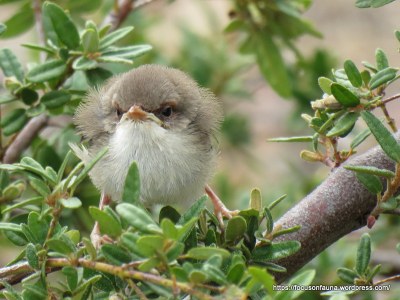 There are plenty of newly-fledged young birds around at present, and it’s a precarious existence for them out there, with all sorts of predators around – butcherbirds, currawongs, snakes, etc. Young birds still dependent on adults for feeding tread a fine line between ensuring they remain hidden, letting the parents know where they are and gradually learning to fly efficiently (while following its parent this fairy-wren chick crashed into a tank and had to be hastily rescued from a bucket!).
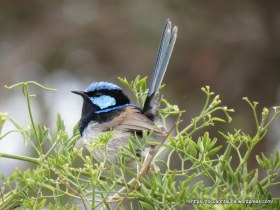
Superb Fairy-wrens have cooperative parenting, with care of the chicks taken on by the dominant male and several other members of the group, leaving the female to get on with nesting again, sometimes raising several broods in a season.
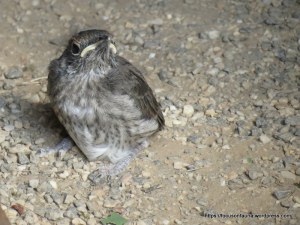
 Grey Shrike-thrush chicks just out of the nest emit a persistent faint but far-carrying “peep”, while hidden deep in a dense shrub, waiting to be fed by their parents. Click on the audio below to hear the call, which is interrupted by the harsh warning call of an adult when it became aware of our presence. The chick at left was straight out of the nest in our shed. A few days later it was safely settled deep in a callistemon – see photo below.
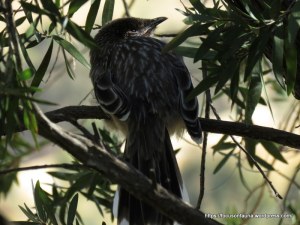
 Our pair of Red Wattle-bird youngsters aren’t bothered about staying hidden. They are a bit more advanced, and of course larger, than the Grey Shrike-thrushes. They are starting to feed themselves on nectar in a Yellow Gum (Eucalyptus leucoxylon), but are still begging for food and maintain a regular contact call with their parents (listen to audio below), and the yellow gape they had as nestlings is still visible.
Mystery solved
One of the frustrations when walking in the bush is when you see an interesting thing but don’t have enough data to work out what it is. And so it was walking back to the house at dusk I came across a Silver Wattle (Acacia dealbata) in which was attached two butterfly (or moth) pupae covered in ants. A subsequent keyword search in Google got me no closer to understanding what I had seen. The return trip next day to get some photos revealed several nearby trees festooned with ant covered pupae. And on one of the branches was a recently emerged butterfly, one that I had never seen before, EVER. Back to the books — it was problem solved.
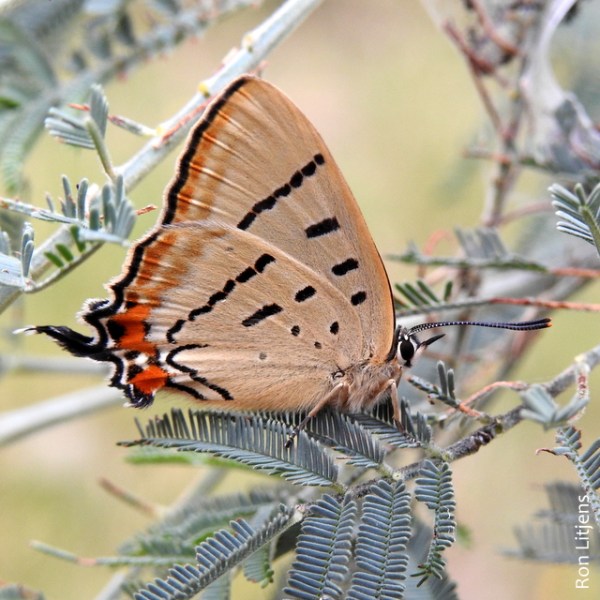 The butterfly was an Imperial Hairstreak (Jalmenus evagoras). A small sized butterfly (pictured above), it is found on the east coast of Australia from southern Queensland along the Great Dividing Range to Victoria. It is of the Lycaenidae family of butterflies, which is known to have relationships with ants. In summer after mating this female butterfly flies around looking for a suitable place to lay eggs. The eggs are only laid on certain acacias; Silver Wattle is one of them. The other prerequisite is that of the 3000 species of Australian ants, the eggs have to be laid near populations of either of two of these species, Iridomyrmex anceps or I. rufoniger.
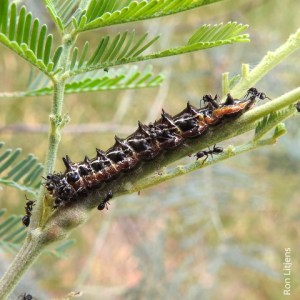 After hatching the ants tend the caterpillars (pictured right) and later the pupae, both of which excrete honeydew, a food source for the ants. In return the ants protect against predators such as wasps and spiders. It is this protection that allows the caterpillar to feed during the daytime and the pupae to hang in plain view. The caterpillars pupate in a group on a communal web (pictured below).
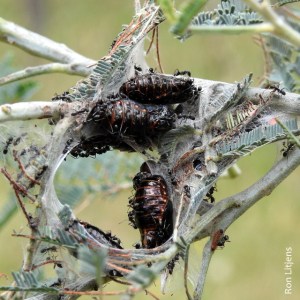
The Imperial Hairstreak is rarely seen. It flies at grass height and with its wings closed it is highly camouflaged. The open wings reveal bright, iridescent blue patches.
So if you are walking in the bush and you see flashes of blue, you have probably disturbed one of these beautiful butterflies … or if you are walking to your ‘plot’ it’s probably the police.
Antipasto anyone?
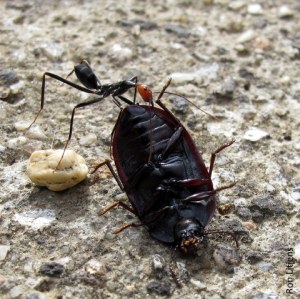
Red-headed Spider Ant (Leptomyrmex erythrocephalus) with beetle
In today’s world of fast food and drive-in take-aways it is easy to forget that for some creatures foraging for food is a hard slog. Take ants for example. They are social insects meaning like bees and termites they live in large groups. Each member of the group has a specific role and for some their role in life is to search for food and bring it back to the nest.
Ants may forage hundreds of metres from the nest. For species that are social foragers, that is search for and transport food as a coordinated group, the discoverer of a food source will plot the shortest route back to the nest using the sun to navigate. This ant will leave a scent trail on the ground for other ants to follow, which they detect through their antennae. Other ants following the trail also leave a chemical scent,
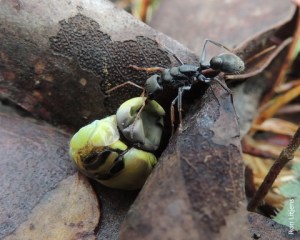
Jumper Ant (Myrmecia pilosula) with dragonfly’s head
thus reinforcing the trail. (I remember as a kid wiping my finger across ant scent trails and watching the insects search around and try to find the continuing trail – obviously in the era before iPads!). Ants may collectively drag the food back to the nest whole or chew it up into manageable pieces. Sometimes the prey is much larger than the ant itself (see photographs).
Bull Ants (pictured below), though social creatures, tend to be more solitary hunters and rely on their excellent (relatively speaking) eyesight to hunt rather than scent. Unlike most ants they will actually follow you with their eyes as you walk past.

Bull Ant (Myrmecia sp.) with lunch
These insects provide a useful service in cleaning up the debris of the natural world. (Those waiting for a punch-line are in for an anti-climax).
Weasel ?

 Another photo contribution from the Hubbard family – this time it’s a Weasel Skink (Saproscincus mustelinus). It has interesting colouring with pale and darker flecks, giving it a pixellated effect. Its main distinguishing features are a white spot behind its eye and an orangey stripe on its side between hip and tail.
The Weasel Skink grows up to 65mm (snout to vent) with a fairly long tail. It is quite secretive, usually keeping under cover of leaf litter or fallen timber. It raises its body temperature by contact with its surroundings rather than basking directly in the sun, as many other skinks do.
Although the skink’s distribution covers much of eastern Victoria, this one was actually found in David’s garden in Seville. We would be interested to know of any reports in the Strath Creek/Flowerdale area.
So, why ‘weasel’? The Museum Victoria’s Discovery Centre offers the following: “Apparently the ‘weasel’ came about because the colour, size and shape of the body is similar to that of a weasel. A weasel … has a long slender body, … a small triangular shaped head with pointed snout and short legs, like the lizard. The colour of both is similar – light brown on top and white underneath … Sometimes some imagination is used when naming animals!” Indeed!!
Wild pollinators
One coming event that caught our eye on the Euroa Arboretum’s Biodiversity Spring calendar is the Wild Pollinator Count 2015, a citizen scientist project running from 15th to 22nd November, i.e. right now!
All you need to do to participate is to choose a sunny, warm, still day and watch your favourite flowering plant for 10 minutes, recording any insects landing on the flower(s). You’ll probably be amazed at the number and variety of wild pollinators around at this time of year and you can do multiple surveys on different plants. You can then submit your observations on the website and also send photos if you wish.
Below are a few pollinators on flowers photographed at our place – some we have managed to identify, with others we’d welcome any suggestions. Click on any of the images and view as a slide show using the arrows.