At home in a hay shed #2
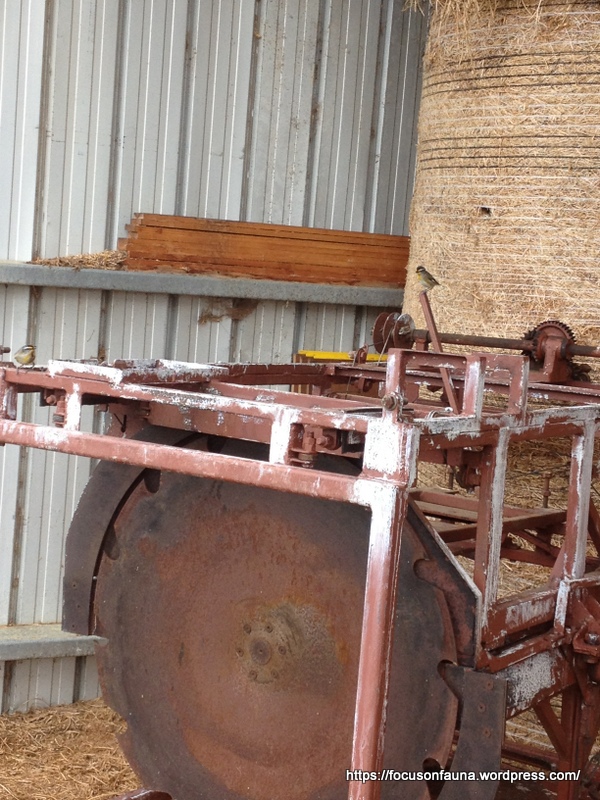 Last month we had a story of a Nankeen Kestrel that has taken up residence in our hay shed. Now we learn that there’s a bale of hay in the shed at the Three Sisters property near Flowerdale that won’t be available for stockfeed for a while. A pair of Striated Pardalotes has taken advantage of the holes made by spikes on the tractor used to lift large round bales, and has adopted one of the holes as a tunnel to their nest chamber inside the bale. The two birds can be seen in the picture at left.
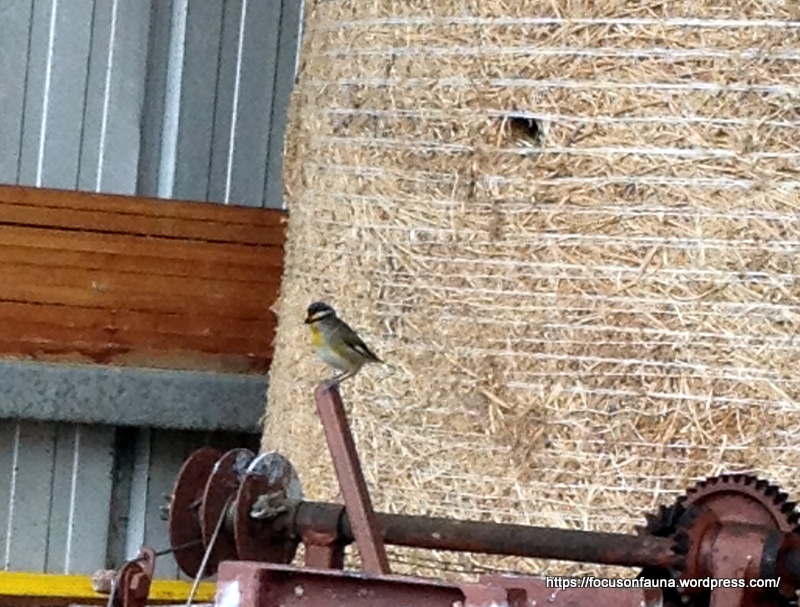
Striated Pardalotes usually build their nest in a tree hollow, or tunnel into a creek bank or roadside cutting, but are known to be opportunists and can nest in vent pipes, cracks in house walls or, in one case in our shed, a stack of polystyrene boxes.
Their “chip-chip” call can be heard around the district at present. Click on the audio bar below for a sample of their calls, which includes their soft contact trills, recorded locally.
Thanks to David Hubbard for the story and photos.
What birds tweet each other #2

Listening to the wild
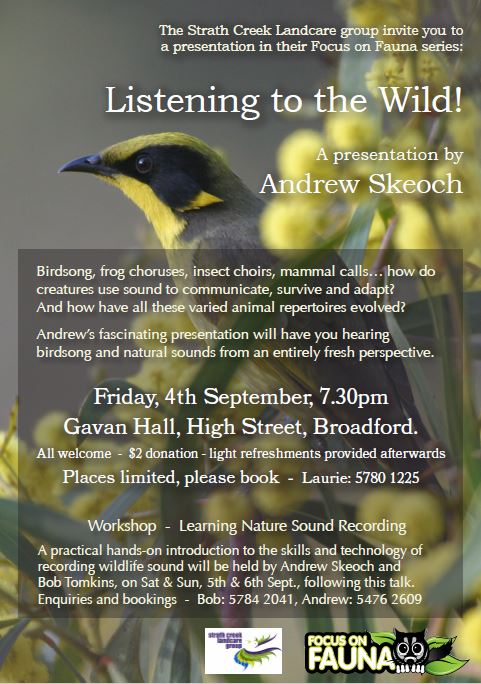 It’s all in the sound! The way creatures use sound to communicate, and the evolution of animal sounds, are fascinating subjects. More sophisticated recording equipment and computer analysis using sonograms have
led to great advances in the study of natural sounds.
So the Strath Creek Landcare Group is delighted to be hosting a presentation by Andrew Skeoch in Broadford
on Friday 4th September titled Listening to the Wild!
Andrew is a sound recordist, bioacoustic researcher and above all a passionate nature lover and communicator.
He will open your eyes, and ears, to the amazing world of the sounds of nature. All are welcome, but please do reserve your place with Laurie at focusonfauna@gmail.com
For full details click on the flyer at left.
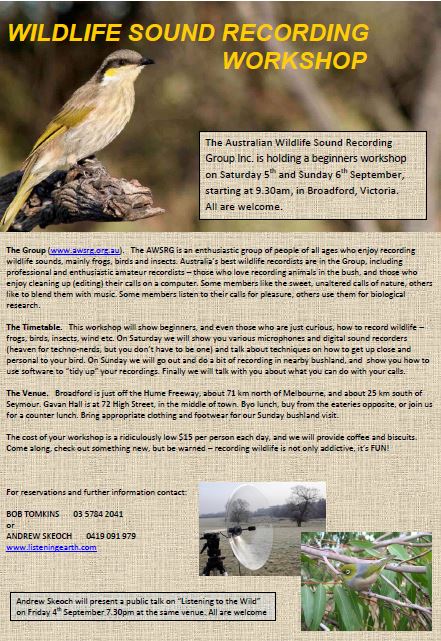
On the weekend following Andrew’s presentation, the Australian Wildlife Sound Recording Group is hosting an introductory workshop on Nature Sound Recording run by Andrew, together with Bob Tomkins, at the same venue in Broadford.
For further details download the flyer:
Wildlife Sound Recording workshop.
Spot the spider
ARACHNOPHOBES GO NO FURTHER!
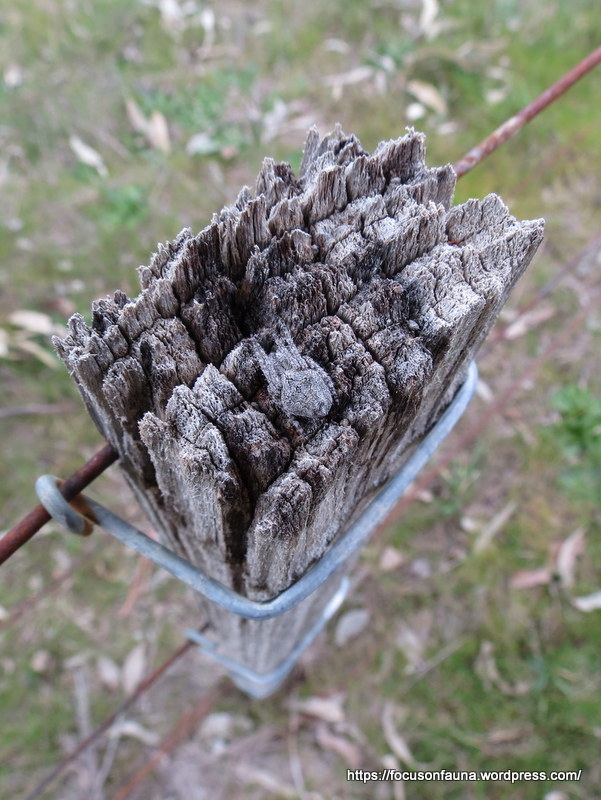 It’s a dangerous world out there in nature, so camouflage is a very useful strategy to adopt to avoid predation. Last week we noticed, purely by chance, the spider pictured at left which was hunched up on a wooden fence dropper, some days on the top of the post and others on the side, but always well-camouflaged and hard to spot.
It looks to us like a native Garden Orb-weaving Spider (Eriophora sp.), identified by its roughly triangular abdomen with two humps near the front, its leaf-like pattern on its back and, on close inspection but not obvious in the photos, red on the base of its legs.

Garden orb-weaving spiders build an intricate sticky new web each night, ready to catch insects which they sense by vibrations and quickly wrap in silk. They dismantle their web at dawn and rest nearby during the day with legs drawn in, easily blending in with the surrounds like the one pictured here.


For more information go to the Australian Museum website.
At dusk it comes
 It started in early winter. A pile of bird droppings on the ground outside our front door suggested that if we looked up we would see a nest, maybe of a Welcome Swallow, tucked under the eaves. But a search revealed no swallow’s nest, or nest of any kind, or even a hole in the fascia boards through which a bird might enter to create a nest. Day by day the pile of poo continued to grow.
During the day nothing inhabited the eaves above the door but after dusk we noticed a grey/brown bird (pictured left) clinging to the brickwork, asleep. Passing this photograph around the local birdos resulted in a range of guesses about what the bird was but I wasn’t about to disturb the  roosting bird to find out. Time for the motion-sensing camera! Using a jury-rigged system of stepladder, occy straps and pipe insulation, the camera was set up to reveal our visitor to be a White-throated Treecreeper (Cormobates leucophaea), pictured right.
Perching birds such as treecreepers can sleep clinging to branches and vertical surfaces. Their legs and feet are controlled by special tendons so that when a bird bends its legs the feet automatically close. It’s analogous to having your toes curl every time you sit down. In this way birds can sit and be securely locked on to a branch or surface to sleep. A look at the size of a  treecreeper’s feet (pictured left) shows that it can easily support itself to cling to our vertical wall.
On our property individual animals that we regularly come into contact with are given ‘human’ names. Focus on Fauna is scattered with accounts of the exploits of Wally the Southern Brown Tree Frog and Cato the Swamp Wallaby. In keeping with this tradition we are naming this bird as well. Given where it sleeps at night, and assuming it’s a female, we have dubbed it Evie.
At home in a hay shed
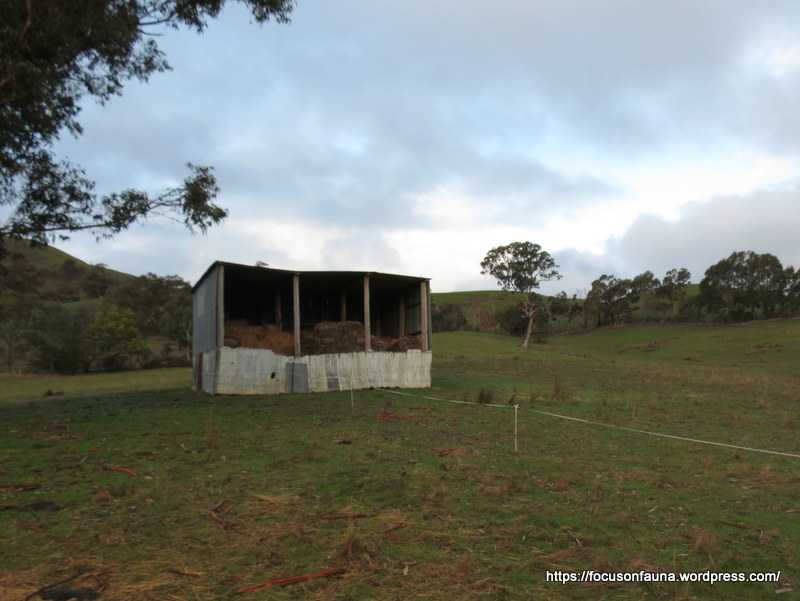
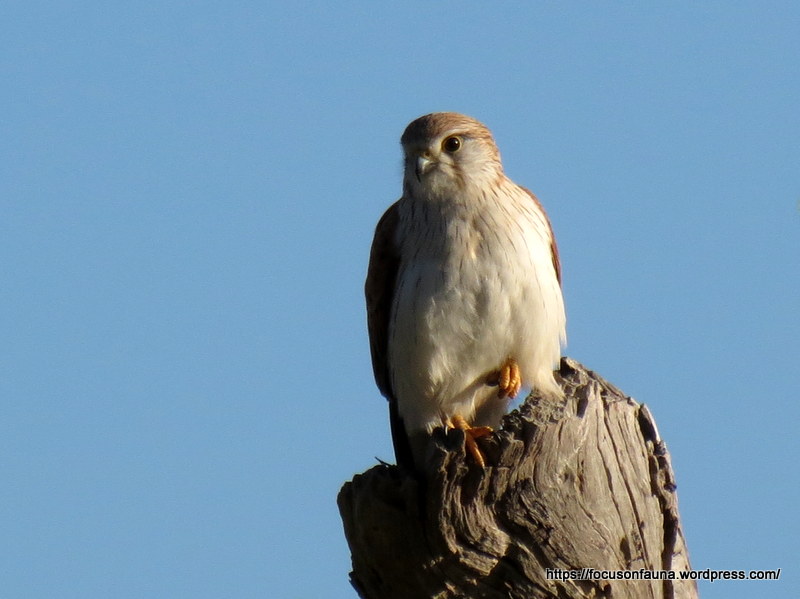 It may be only an ugly old corrugated iron hay shed to us, but a beautiful Nankeen Kestrel has adopted it as home. When we were collecting bales from the shed the other day, a kestrel suddenly landed on a protruding roof beam and stared at us for a few seconds from about 6 metres away, before flying off. The kestrel has since proved difficult to photograph – the picture below was taken a couple of years ago atop a dead tree some hundred metres from the hay shed.
Inside the shed we found streaks of whitewash excrement down a post in the corner, and on a corrugated iron sheet below there were dozens of regurgitated pellets, showing that the kestrel has been using the top of the post as a roost for some time. The pellets were of various colours, consistencies and composition, reflecting the bird’s varied diet of rodents, skinks, ground birds and many insects and other invertebrates.
-

- Corner post with ‘whitewash’ streaks
-
- The roosting spot
-
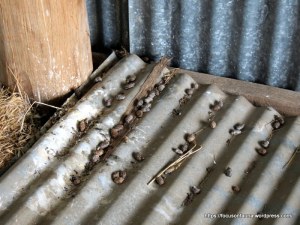
- Pellets below roost
-
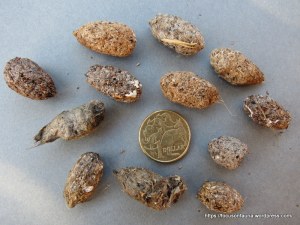
- A variety of pellets
The Nankeen Kestrel is a small falcon that lacks the speed of other falcons, relying instead on its superb hovering skills to locate and watch prey on the ground, before diving headfirst to catch it (unlike the Black-shouldered Kite, another skilful hoverer, that drops on its prey feet first).
The Nankeen Kestrel is nomadic and part-migratory, with some birds moving north for winter. We have recorded kestrels here in June/July in 8 of the last 15 years. Its shrill call recorded locally can be heard by clicking on the audio bar below.
Nature imitating life
Several beef farmers in our district are using dung beetles to increase the productivity of their pastures. Adult dung beetles do this by eating cow dung and releasing nutrients into the soil. The beetles also transport manure underground to breeding chambers where they lay their eggs in the dung and the larvae can feed on it when hatched.
Australia has several hundred native species of dung beetle. Unsurprisingly very few can deal with the high moisture content of cow manure, preferring instead the low-moisture kangaroo poo. The beetles used for agriculture purposes are species from Europe or Africa.
At a recent Strath Creek Landcare Group planting event a local dung beetle enthusiast was on hands and knees examining every cow pat in the paddock for the beetles. We did not see any beetles but saw lots of evidence of where they had been doing their job. Obviously there are viable colonies of dung beetles in our valley now.
One thing we did notice was this field cricket sitting on one of the cow pats. It was a serendipitous sighting as crickets are known to eat lots of things but manure is not one of them.
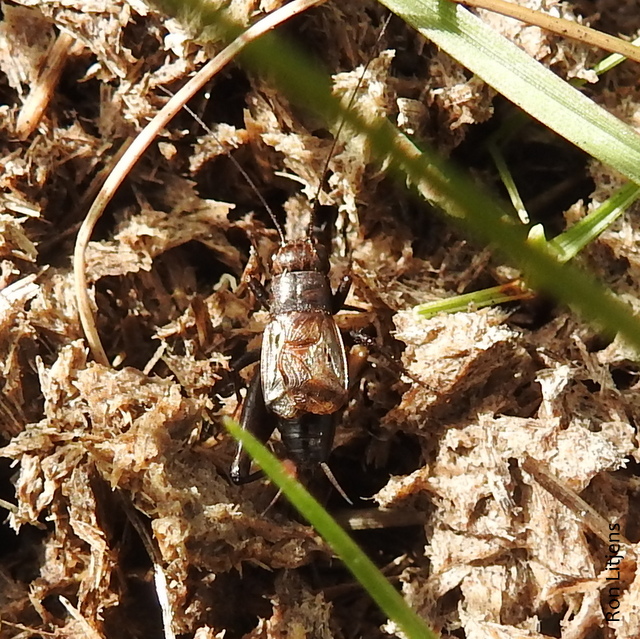
I title this photo Australian cricket in the shit. Somehow it smacks of nature imitating life.
Mea culpa!
One of the purposes of writing FoF blogs is to showcase the weird and wonderful world of fauna that exists in our valley. Taking the pictures is the easy bit. Identifying the critters is much harder (and for me, much more fun). I am not an entomologist, zoologist or any other -ologist. The veracity of the identifications should be considered taking into account those aforementioned qualifications, or lack thereof. Sometimes I later find I have identified a species incorrectly and rarely, even a genus. I do my best. Flicking through past blogs I discovered a bigger mistake than that. 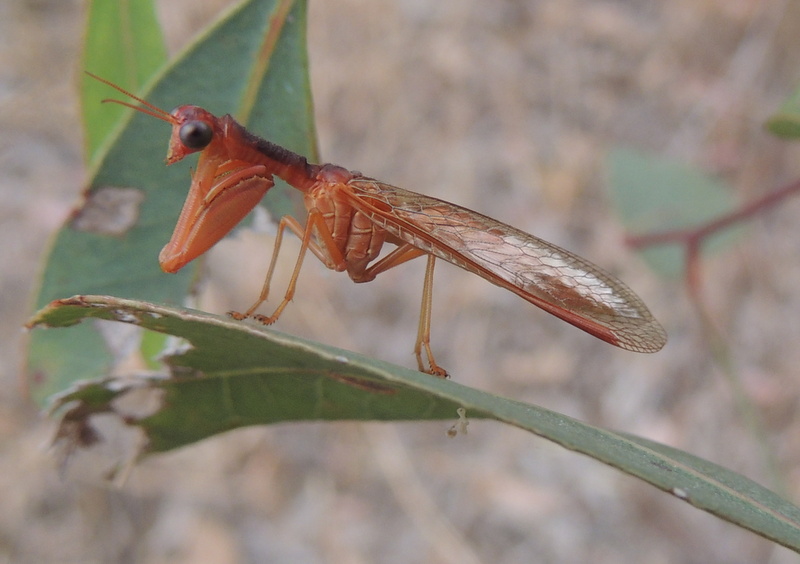 In a recent blog I identified the insect pictured left as a praying mantis, because of the barbed front legs and the way they were held. At least I got the insect bit right. It is in fact a Mantis Fly (Campion sp.). Curiously it is neither a mantis nor is it a fly. It is a type of lacewing, also known as a Mantid Lacewing. Obviously in the identification process I even got the insect family wrong. .
  The adult Mantis Fly is predatory, catching insects in the same way as a praying mantid does – with its barbed front legs. After mating the females lay thousands of eggs attached to tiny stalks. The larvae feast on spider eggs by getting into a spider egg sac and then sucking out the content of the eggs. They then pupate inside the egg sac. For those of you who saw the original blog and have been distressed about the initial identification, mea culpa. It won’t happen again.
Xmas in July
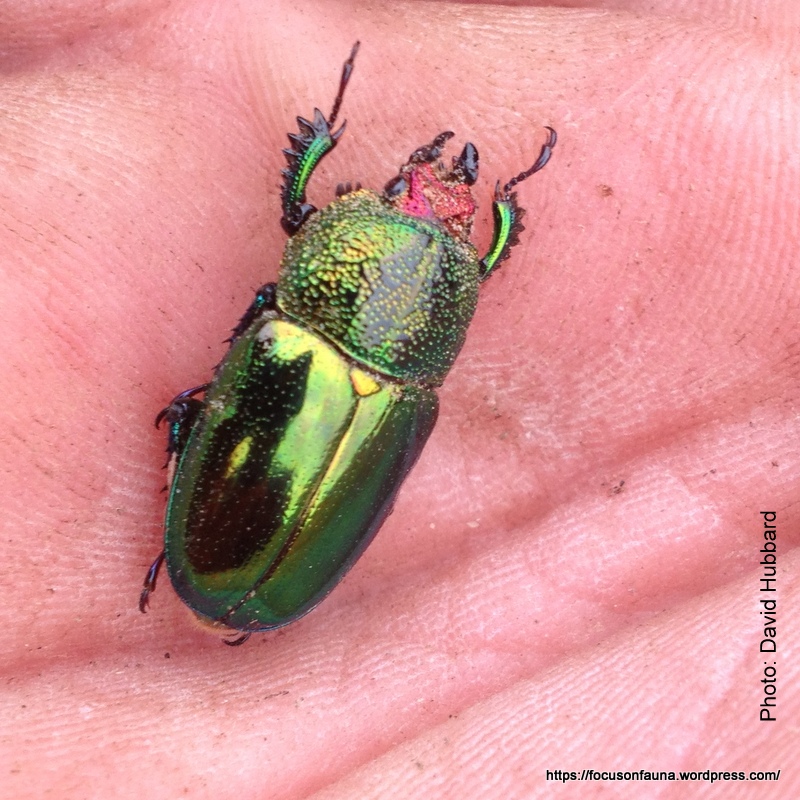 Be it spiders, flatworms or beetles, David H. from Flowerdale regularly comes up with some interesting photos for this blog. This gorgeous beetle is a good example. It’s a Christmas beetle, a common name associated with Australian native beetles in the genus Anoplognathus which has 35 species.
Named for its abundance around Christmas time, it seems to us unusual to find an adult beetle in July, at least in our neck of the woods – in northern parts of Australia they do become active earlier in the year than in Victoria. Here they normally live underground in larval form at this time of year, probably pupating near the surface by now, prior to emerging in Spring as adults. Perhaps recent rains after a dry spell triggered this one’s emergence – or is it a manifestation of climate change?
The larvae feed mainly on grass roots, whereas the adult beetles feed on eucalypt leaves and have been associated with severe localised defoliation of trees during population explosions in favourable years.
Tales from the woodpile #7
NOT FOR ARACHNOPHOBES
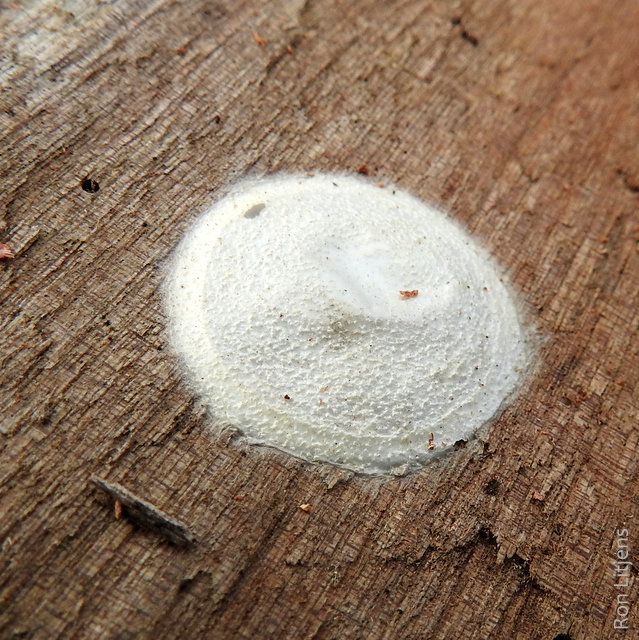 Cutting up wood last we week came across this white disc (see picture left) attached to the wood deep in one of the splits in the trunk. The owner of the disc soon revealed itself – a Social Huntsman (Delena cancerides) – which wasn’t acting too socially. After a few aggressive moves it settled down over its possession so I could easily observe it.
Spiders are different from insects in obvious ways. An insect has three body parts (head, thorax and abdomen), antennae, compound eyes and six legs. Spiders have only two body parts – a cephalothorax, from the Greek words cephalo meaning head and thorax meaning trunk or chest, and an abdomen. 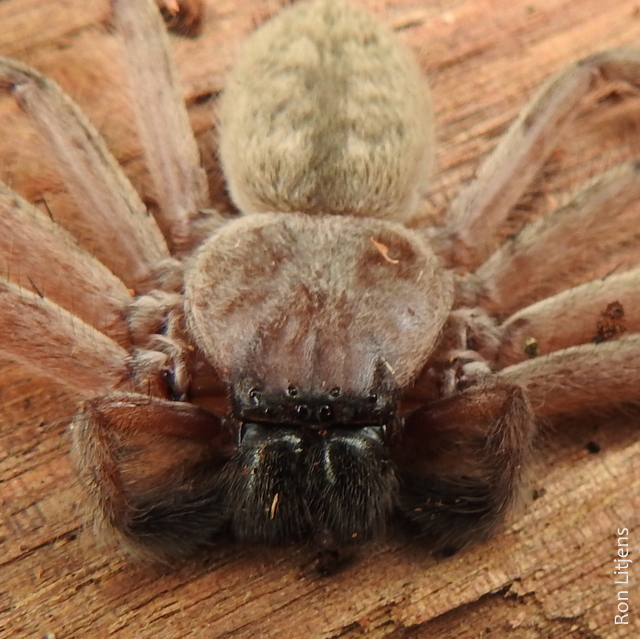 The cephalothorax has no antennae but has attached eight legs (see picture right). The knees of a huntsman instead of flexing vertically like most arthropods, flex forward. This allows the spider to be able to sidle into narrow spaces. The cephalothorax also houses eight simple eyes under which are two black chelicerae which contain the fangs. Huntsman poison is not regarded as fatal for humans.
Outside the chelicerae, looking like a pair of small legs are the palps (or pedipalps). Palps contain chemical detectors that function like smell or taste organs. In male Huntsmans the palp is also used for mating. In the final segment of the palp there is a structure that siphons up sperm packets from the male’s abdomen. The palps are then used to transfer the sperm packets to the female during mating. Once fertilised, the female produces a silk sac into which it lays up to 200 eggs, which is where this blog began (see picture above left).
This is not palp fiction. This is for real.




 Focus On Fauna