Fast disappearing
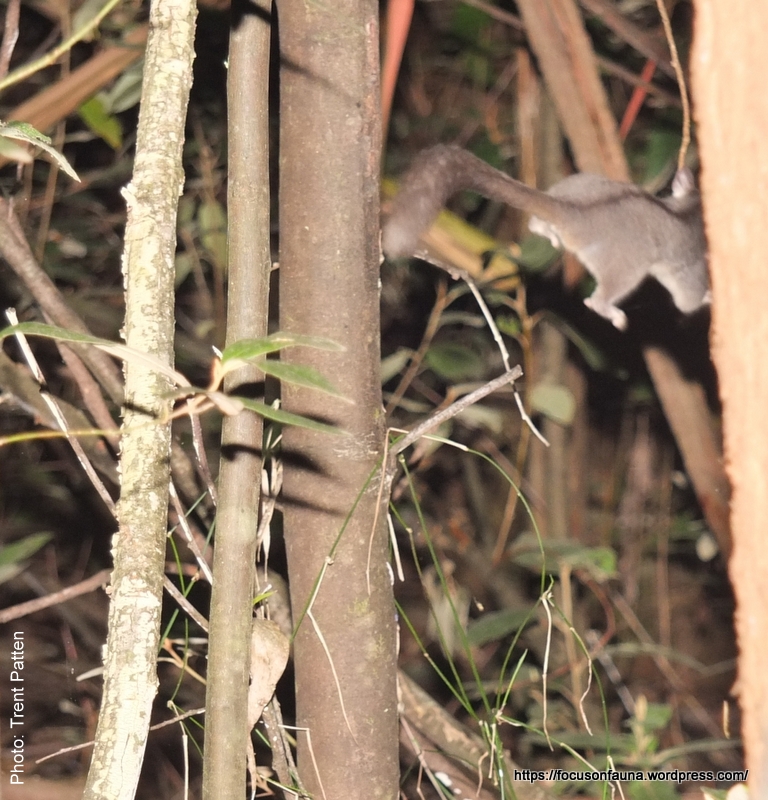 Not exactly a species local to the Flowerdale-Strath Creek area, but important to us nonetheless – this is the Leadbeater’s Possum, which has recently been listed as “Critically Endangered”, meaning it is facing a very high risk of extinction in the wild. Yes, we know we should start a blog post with an upbeat cheerful message, but there is unfortunately not a lot of positive news about this little creature, which incidentally happens to be one of Victoria’s faunal emblems (the other being the Helmeted Honeyeater which is also critically endangered!).
To highlight the plight of this little possum, we are holding a presentation titled “Flagship for the Forests” on Friday 26th June at Strath Creek Hall, starting at 7.30pm. The main speaker is Steve Meacher, President of Friends of Leadbeater’s Possum Inc. and Chair of Murrindindi Environment Advisory Committee. Steve will focus on the importance of Leadbeater’s Possum as a flagship species for the Mountain Ash forest ecosystem. He will be followed by local resident Trent Patten, a wildlife surveyor and relentless campaigner for protection of the possum, who will talk about the challenges involved and techniques used in recording evidence of colonies of Leadbeater’s.
All welcome – for full details click on the flyer at left.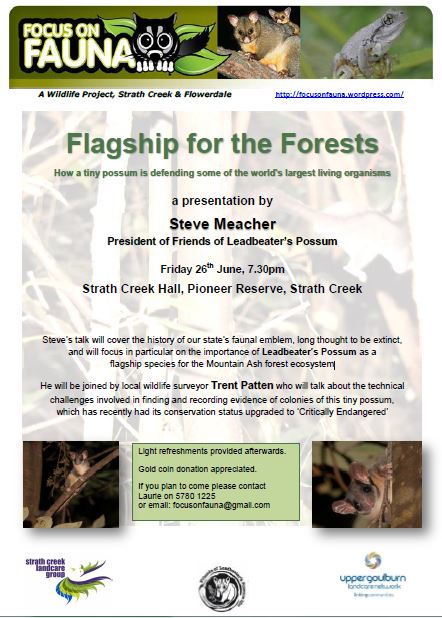

Don’t try this at home
Who is making all that racket?
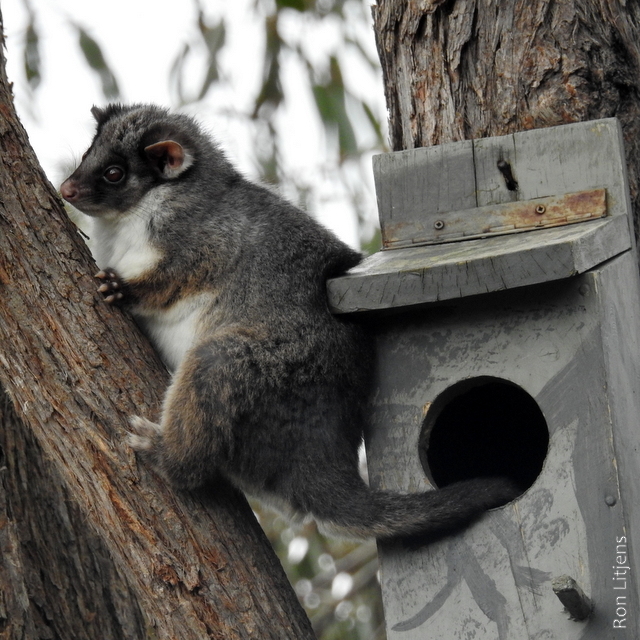
Great excitement. The nestbox that is so often the subject of this blog was inhabited by an Australian Owlet-nightjar last week. Great excitement because Yea’s local birdo had never seen one and we promised that if an ONJ (not Olivia Newton John) came to stay he would be the first to know. Unfortunately it was a one-night residency and ONJ quickly evacuated: the next day a tell-tale white-tipped tail of a ringtail possum was hanging out of the box entrance. The possum even made an unusual daytime appearance when it climbed out of the box to have a scratch and check out the neighbours (us). With the constant rotation of animals and birds inhabiting this nestbox we have begun to wonder how pristine clean it is inside. Given that this box hasn’t got a hinged lid I can neither check nor clean the box out between tenants.

I’m going back in for a snack
This particular tenant is cleaner than most. The Common Ringtail Possum (Pseudocheirus peregrinus) has adapted to the harsh Australian conditions. During the night when it is feeding on the leaves, flowers and fruit of eucalypt trees the possum produces hard faeces. However during the day when it is resting in its hollow it produces soft poo, which it eats. In this way the possum can conserve water and extract the maximum nutrients (for example nitrogen) from a typically nutrient-poor food source. Sounds like the ideal way to keep the house clean … but don’t try this at home.
White noise

Long-billed Corellas
-
- River Red Gums
-
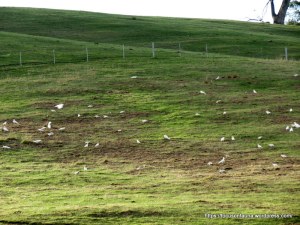
- A bit of natural weed control!
-

- Just some of the mixed flock
-

- Sulphur-crested Cockatoos
Towards dusk, these birds are often joined by small groups of corellas winging their way down the King Parrot Valley from the direction of Flowerdale. There is much argy-bargy with raucous calls as they settle in for the night, high in the red gum branches. Occasionally something seems to spook them and they take off as one with a deafening screech, wheel around for a while, before once again settling in the trees.
Listen to the audio below to hear this sudden cacophony.
For more on local corellas, click HERE.
Red Wattlebirds or Red-wattle Birds?
 Every year in January, a Silky Oak tree (Grevillea robusta) is the scene of the epic wattlebird wars where Red Wattlebirds (Anthochaera carunculata) take on each other and all-comers to protect their nectar supplies. These fearsome battles have been previously documented. Well, it has started again. The field of battle this time is a grove of Pincushion Hakeas up on the hill. For about a week now the raucous ‘yakyak’ calls have signalled the restarting of hostilities.
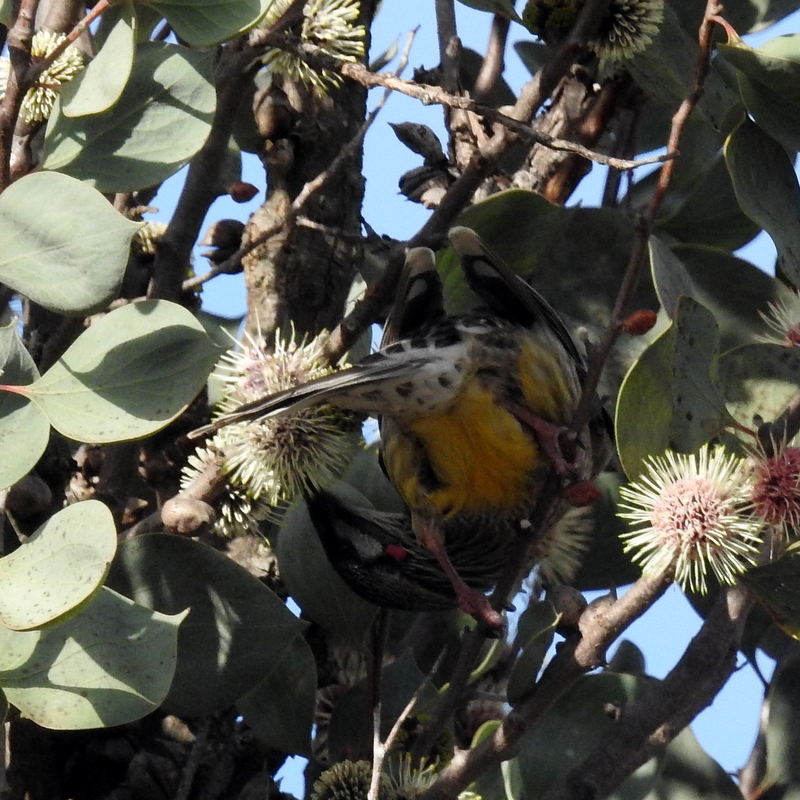
Upsy-daisy
Pincushion Hakeas (Hakea laurina) are endemic to south-western Australia and were planted by the previous owners. Because of where the flowers grow on the plant, the wattlebirds often have to perform amazing acrobatics to feed on them.
To date it appears the wattlebirds are just fighting one another – sort of like a civil war. But I know from past years it is just a matter of time before other species, particularly the New Holland Honeyeaters, get in on the act.
Red Wattlebirds are one of Australia’s largest honeyeaters. The common name is problematic in that it neither refers to their colour nor the trees in which they perch, but describes the red
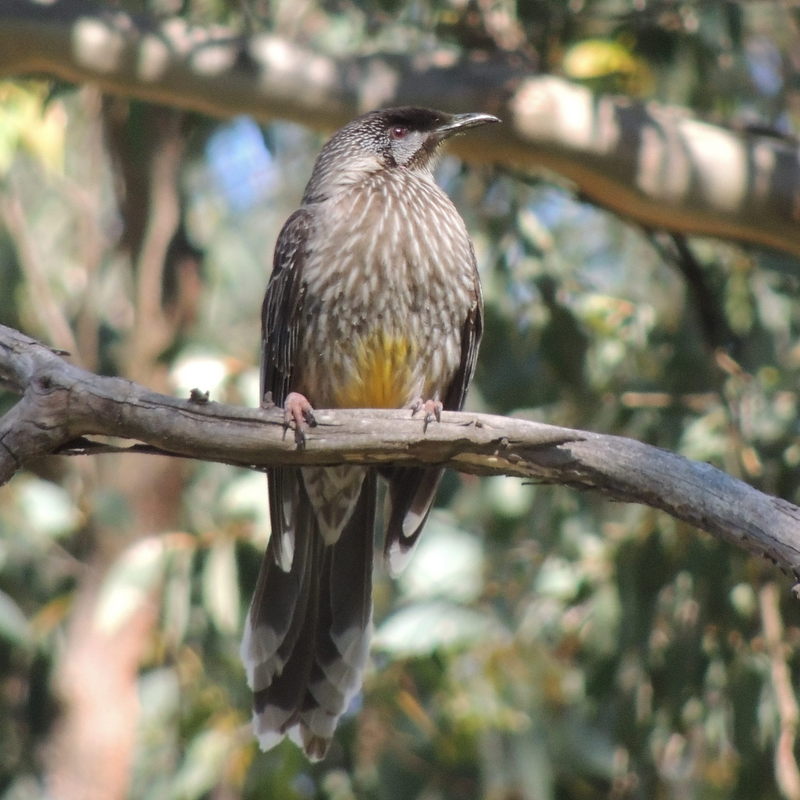
A rare sight – a wattlebird at rest
fleshy bits called ‘wattles’ that hang from their cheeks. (The scientific name, Anthochaera carunculata, is derived from the Greek, anthos meaning flower, khairo meaning to enjoy and carnis meaning meat, referring to the wattles themselves).
Thinking about it, a less confusing name for this bird might be Red-wattle Bird.
Not toad-in-the-hole …

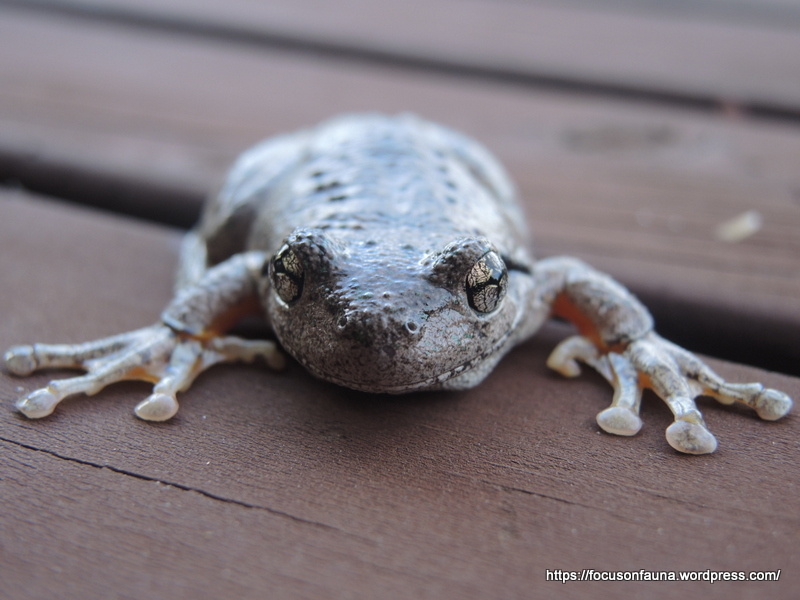
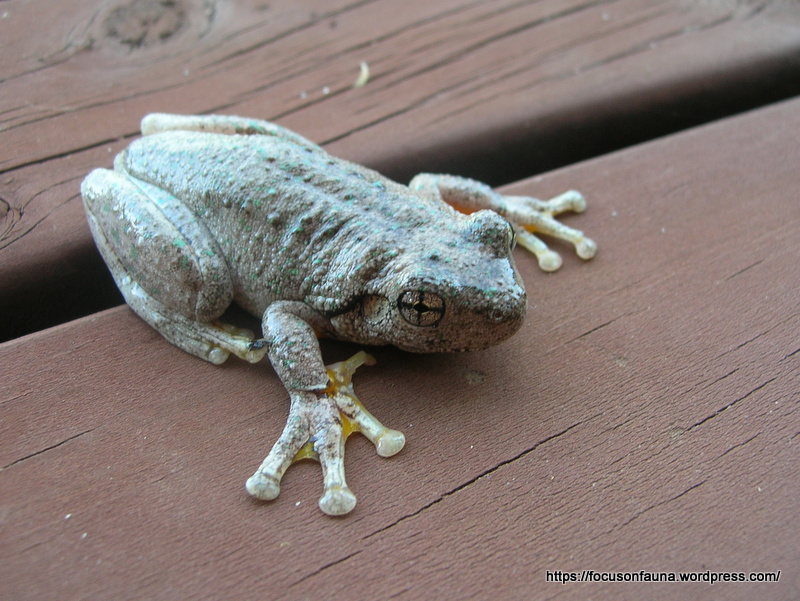 … but frog-in-the-barrel. We have a plastic barrel that collects water off a shed roof, but also at times tends to collect mosquito larvae. While scooping larvae out with a fine-mesh sieve the other day, an unexpected grey lump flopped into the sieve. It turned out to be a Peron’s Tree Frog (Litoria peronii), presumably also catching mosquito larvae.
Peron’s Tree Frog is readily identified by the cross-shaped eye pupil, and by the bright yellow and mottled black colouring in its groin and arm-pits, which was clearly visible when it hopped, but doesn’t show up in these photos. The male’s strange call is the origin of its other common name – the “Maniacal Cackle Frog”.
Listen to the call, which was recorded in Flowerdale, by clicking on the audio bar below. (The “eeeeek” of the Plains Froglet can be heard in the background.)
Tree Frogs (Family Hylidae) are characterised by having pads on their digits, and Peron’s Tree Frog has particularly large pads, as seen in the photographs, and is a very agile climber, known to climb into gutters and downpipes as well as trees, and barrels!
After the photo session this frog was returned to the barrel to continue its mosquito control – and save us some work !
Tales from the woodpile #6
Over the years our woodpile has proved to be a treasure-trove of invertebrates, which have been highlighted on this blog, and this year is no exception. Now I KNOW the first rule of blogging on this website is NO SPIDERS. But I am reminded of two proverbs: Beauty is in the eye of the beholder and It is better to ask for forgiveness than permission – (see the last sentence).
While collecting wood from the woodpile yesterday I came across this creature which I think is absolutely beautiful – apologies to all the arachnophobes. It is a species of Huntsman spider known as a Badge Spider (Neoparassus diana). It is nocturnal, hunts other spiders among other things, and builds a silken home in leaves or under bark.

The name is derived from a striking black, cream and brown ‘badge’ marking on the underside of the abdomen. I glimpsed the badge and tried to photograph it but the spider was not inclined to display it a second time and I was not inclined to push the point.
If you (can) look closely, you’ll see this animal is an optometrist’s dream, as it has several pairs of eyes. Some are used for detecting motion and others are thought to detect light intensity and so are used for maintaining balance (and I suppose knowing when it’s bed-time).
For those who don’t find this beautiful … forgive me.
Gliders at home
Sugar Gliders (Petaurus breviceps) readily take to nest-boxes and they have featured on this blog a number of times before. But we never tire of viewing remote camera images of these little creatures, and nest-box sites are a good place to record them.
Nest-boxes are a means of compensating for the loss of natural tree hollows due to land clearing, and give birds and small arboreal mammals like sugar gliders a better chance of survival and breeding.
However, in Tasmania, researchers are trying to develop nest-boxes for native birds that exclude Sugar Gliders, which are thought to have been introduced there early last century and have been implicated in the predation of endangered birds like Orange-bellied Parrots and particularly Swift Parrots. The sugar gliders, primarily sap, nectar and invertebrate feeders, have been found to eat eggs, nestlings and even adult female Swift Parrots, placing the species under severe threat of population collapse.
And if you think these cute and cuddly critters couldn’t possibly be so vicious, a friend who was bitten while working with them said it really, really hurt !
Down to earth
This magnificent young Wedge-tailed Eagle (Aquila audax) provided us with a rare close-up view as it perched next to a dam in a Strath Creek paddock.

We know it’s youngish from the straw-coloured plumage on its nape and across its upper wings. The plumage gradually darkens with age, developing into mostly black after about 5 years old.
Wedgies soaring above the King Parrot Valley are quite a common sight these days, and they can also be seen on the ground, either feeding on carrion or just resting on a hillside – but it’s not usually possible to approach as closely as this one allowed. Despite its species name ‘audax‘ meaning bold, they are generally fairly shy and wary.
It’s a Flame … by a nose

Male Flame Robin
During a recent bicycle ride down the Epic Trail on Mt Buller I shared my lunch stop with a flock of Flame Robins (Petroica phoenicea). The photo (left) certainly does not do justice to how striking the male plumage is, particularly against a dull and rainy day in the high country. As far as I knew, this was the first time I had ever observed a Flame Robin.
Recently I found myself in the middle of ‘the tribe’ – a mixed flock of small birds that forage together across our property. It contained treecreepers, thornbills, scrub-wrens, fairy-wrens and robins (usually Scarlet Robins and Eastern Yellow Robins). In fact the male Scarlet Robin was easy to spot flitting through the undergrowth. 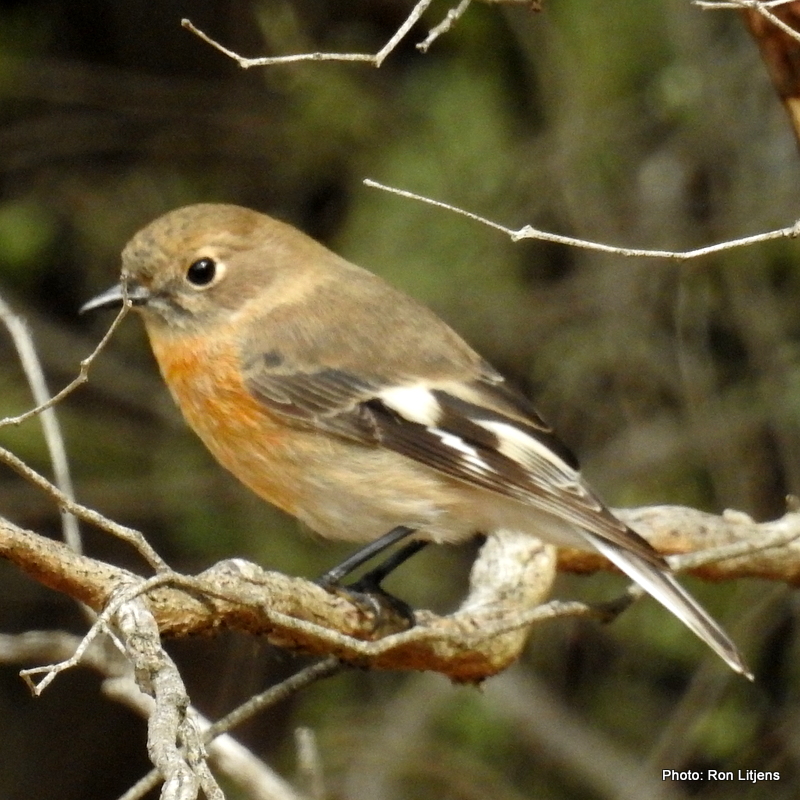
When I later examined my photos on the computer, what I assumed to be a female Scarlet Robin, was in fact a juvenile male Flame Robin, pictured right. Surprising, because I had never seen Flame Robins before on our hill (or so I thought) and also because the adult male bird was nowhere to be seen in the wandering flock.
To my untrained eye the difference between the Flame Robin (right) and female Scarlet Robin (Petroica boodang), pictured below, certainly at a distance and in the bush, is slight. But when you see them together the obvious give-away is the white nose spot on the Scarlet Robin. So I may have observed a Flame Robin before but not noticed. 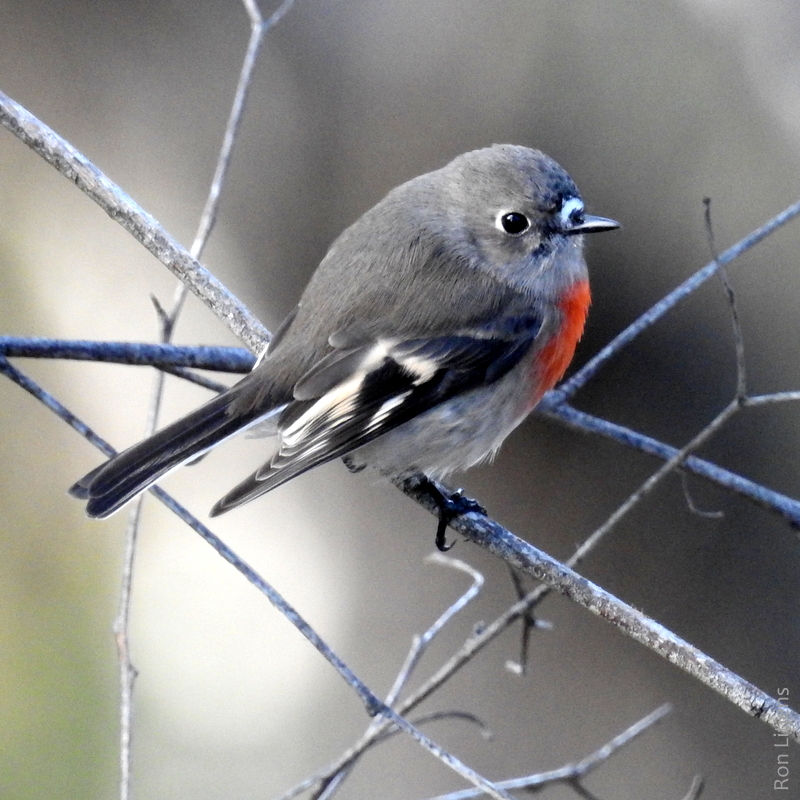
It’s another tick on my list of bird sightings up on the hill.
The one that got away
 Sometimes the smallest things in nature are the most fascinating to watch. The sight of this tiny Wall Spider (Oecobius navus), not much bigger than the Green-head Ant it was wrapping in its silk, had even our resident arachnophobe enthralled. The spider ran round and round the ant, gradually cocooning it. However, just when the ant seemed thoroughly encased, it somehow managed to escape, and the spider retreated to its nearby web in the brickwork.